The EMA is the EU regulatory body responsible for
the scientific evaluation and supervision of medicines
developed by pharmaceutical companies for use in
EU.
EMA
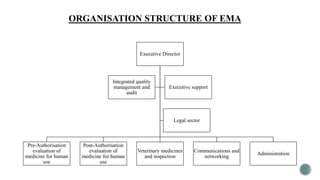
Executive Director
Pre-Authorisation
evaluation of
medicine for human
use
Post-Authorisation
evaluation of
medicine for human
use
Veterinary medicines
and inspection
Communications and
networking
Administration
Integrated quality
management and
audit
Executive support
Legal sector
ORGANISATION STRUCTURE OF EMA
 The European Medicines Agency (EMA) works with the European
Directorate for the Quality of Medicines and HealthCare (EDQM), a
directorate of the Council of Europe.
 The EDQM traces its origins and statutes to a European treaty promoting the
elaboration of a common pharmacopoeia in Europe
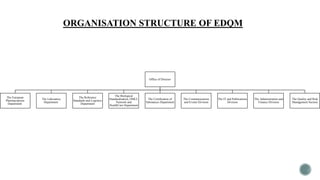
EDQM
(European Directorate for the Quality of Medicines and HealthCare )
Office of Director
The European
Pharmacopoeia
Department
The Laboratory
Department
The Reference
Standards and Logistics
Department
The Biological
Standardisation, OMCL
Network and
HealthCare Department
The Certification of
Substances Department
The Communications
and Events Division
The IT and Publications
Division
The Administration and
Finance Division
The Quality and Risk
Management Section
ORGANISATION STRUCTURE OF EDQM
 ASMF mean the Active Substance Master File.
 EDMF means the European Drug Master File.
 It contains all the data of Quality and Quality control of the Active
Substance(API).
 OBJECTIVE:
 The main objective of the Active Substance Master File(ASMF) procedure, is to
allow valuable confidential intellectual property of the manufacturer of the active
substance (ASM) to be protected.
 while at the same time allowing the Applicant or Marketing Authorisation (MA)
holder to take full responsibility for the medicinal product and the quality and
quality control of the active substance.
 ASMFs linked to human and veterinary medicinal products should be presented in
the format of the Common Technical Document (CTD).
ASMF
(Active Substance Master Files)
 CONTENTS OF THE ASMF
 • ASMF Should contain detailed scientific information as indicated under the
various headings to applicant for Marketing Authorization (MA) for Medicinal
Products in the member states of the European Union (EU).
 • ASMF linked to human medicinal products should be presented in the Format
of "CTD”.
 ASMF should be physically divided into two separate parts, namely:
1. 1. Applicant Part (AP)
2. 2. Restricted Part (RP)
 Applicant Part contains the non-confidential information to the applicant/MA holder.
 Restricted Part contains the Confidential information directly to the Regulatory
Authority.
 ASME should contains the Table of Contents (TOC) and Separate Summarize for both
AP & the RP.
 In cases, where the ASMF is provided in the CTD format both summarizes should be
presented as a "Quality Overall Summary (QOS)".
• ASMF can only be submitted in support of an Marketing Authorization Application
(MAA) &
• Marketing Authorization Variation (MAV).
• The ASMF Procedure can be used for the following active substances:
1. New Active Substance
2. Existing Active Substance (Not mentioned in the EU Pharmacopeia)
3. Pharmacopeial Active Substance.
USE OF THE ACTIVE SUBSTANCE MASTER FILE
(ASMF)
 The ASMF procedure can not be used for the Biological Active Substance.
 The ASMF holder may have an ASMF as well as a "Certificate of Suitability (CEP)"
issued by European Directive Quality Management (EDQM) for a single active
substance.
 The ASMF holder should give permission to the EMA/other Regulatory Authorities to
assess the data in the ASMF in relation to a specific MAA/MAV in the form of a Letter
of Access (LOA).
 The ASMF holder should submit to the Applicant/MA holder:
1. A copy of Latest version of Applicant Part (AP).
2. A copy of the Quality Overall Summary (QOS).
3. A copy of Letter of Access (LOA).
ASMF points
 Investigational Medical product Dossier
• The IMPD is the basis for approval of clinical trials by the competent authorities in the EU.
• The Clinical Trial Directive came in force, harmonizing the laws, regulations and administrative
provisions of the Member states relating to the implementation of CP in the conduct of clinical
trials on medicinal products for human use.
• The directive introduced a harmonized procedure for the authorization to perform a clinical
study in any one of the EU Member States.
• In addition, it defines the documentation to be submitted to the Ethics Committee as well as the
Investigational Medicinal Product Dossier (IMPD) to be submitted to the competent authority
for approval.
WHAT IS IMPD?
 The Investigational Medicinal Product Dossier (IMPD) is one of several pieces of
Investigational Medicinal Product (IMP) related data required whenever the
performance of a clinical trial is intended in one or more European Union Member
States.
 The IMPD includes summaries of information related to the quality, manufacture and
control of any IMP (including reference product and (placebo), and data from non-
clinical and clinical studies.
 The following should accompany the IMPD:
Receipt of confirmation of EudraCT number
Covering letter
Application form
Copy of IEC approval or comments
Copy of any scientific advice
A letter of authorization for use when applicant is not the
sponsor
Informed consent form
 Subject information ( if any)
Arrangement for recruitment of subjects
Protocol with any amendments
Summary of protocol in the national language
 Peer review of trial if available
Ethical assessment by principal investigator
IB
Report of any trial with same IMP
Example of label in the national language
 Overall content of IMPD
1.Quality data
Quality data including summaries of chemical pharmaceutical and biological data on the IMP.
Data should be based on the IMPs to be used for a clinical trial whose manufacture complies
with the principle of good manufacturing practice applicant should also supply the following.
 A copy of manufacturing authorization stating the scope of the authorization if the IMP is
manufactured in the EU and does not have marketing authorization in the EU. If the IMP is not
manufactured in the EU and does not have a marketing authorization in the EU.
 Certification of the qualified person that the manufacturing site works in compliance with GMP
at least equivalent to EU GMP.
 Certification of the GMP status of any active biological substance.
 Copy of the importers authorization
2. Non clinical pharmacology
Nonclinical pharmacology and toxicology data including summaries of nonclinical
pharmacology and toxicology data for any IMP to be use in the clinical trial or justify
why they have not.
3. Previous clinical data
Previous clinical trial and human experience data section providing summaries of all
available data from previous clinical trial and human experience with the proposed
IMPs.
4. Overall risk and assessment
Overall risk and benefits assessment section should provide a brief integrated
summary that critically analyses the nonclinical and clinical data in relation to the
potential risk and benefits of the proposed trial.
The test should identify any trial that terminated prematurely and discuss the
reasons.
Any evaluation of foreseeable risk and anticipate benefits for trials on minors or
incapacitated adults should be taken into account.
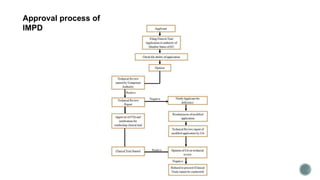
Approval process of
IMPD
https://www.ema.europa.eu/en
https://www.edqm.eu/en/
https://www.researchgate.net/figure/IMPD-review-process-To-ensure-the-
implementation-of-GCP-in-the-MS-of-EU-Clinical-Trial_fig2_340385147
Reference
THANK YOU