CATARACT
SWATILEKHA DAS, RN
B.Sc (H)Nursing, M.Sc
(MSN)
ASST. PROFESSOR
DEFINITION
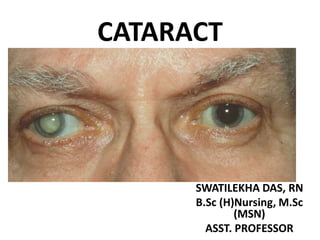
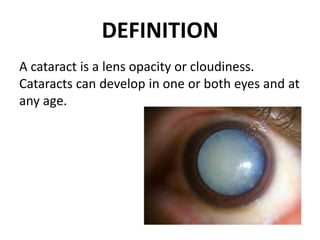
A cataract is a lens opacity or cloudiness.
Cataracts can develop in one or both eyes and at
any age.
RISK FACTORS
Cigarette smoking
Long-term use of corticosteroids, especially at
high doses
Sunlight and ionizing radiation
Diabetes
Obesity
Eye injuries can increase the risk of cataracts.
TYPES
The three most common types of senile (age-
related) cataracts are defined by their location in
the lens: nuclear, cortical, and posterior
subcapsular.
Visual impairment depends on the size, density,
and location in the lens. More than one type can
be present in one eye.
CLINICAL MANIFESTATIONS
• Painless, blurry vision.
• Perception that surroundings are dimmer (as if
glasses need cleaning).
• Light scattering; reduced contrast sensitivity,
sensitivity to glare, and reduced visual acuity.
Other effects include myopic shift (return of
ability to do close work [eg, reading fine print]
without eyeglasses), astigmatism, monocular
diplopia (double vision), color shift (the aging
lens becomes progressively more absorbent at
the blue end of the spectrum), brunescens
(color values shift to yellow-brown), and
reduced light transmission.
DIAGNOSTIC STUDIES
• Degree of visual acuity is directly
proportionate to density of the cataract.
• Snellen visual acuity test.
• Ophthalmoscopy.
• Slit-lamp biomicroscopic examination.
MEDICAL MANAGEMENT
No nonsurgical (medications, eyedrops,
eyeglasses) treatment cures cataracts or prevents
age-related cataracts
Studies have found no benefit from antioxidant
supplements, vitamins C and E, beta-carotene, and
selenium
Glasses or contact, bifocal, or magnifying lenses
may improve vision.
Mydriatics can be used short term, but glare is
increased.
SURGICAL MANAGEMENT
In general, if reduced vision from cataract does
not interfere with normal activities, surgery may
not be needed.
In deciding when cataract surgery is to be
performed, the patient’s functional and visual
status should be a primary consideration.
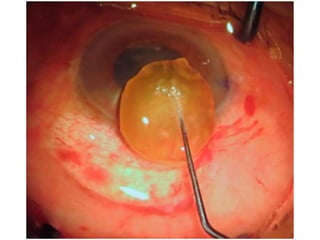
Surgical options include phacoemulsification
(method of extracapsular cataract surgery) and lens
replacement (aphakic eyeglasses, contact lenses,
and intraocular lens implants).
Cataracts are removed under local anesthesia on
an outpatient basis. When both eyes have
cataracts, one eye is treated first, with at least
several weeks, preferably months, separating the
two procedures.
NURSING MANAGEMENT
• Withhold any anticoagulants the patient is
receiving, if medically appropriate. In some cases,
anticoagulant therapy may continue.
• Administer dilating drops every 10 minutes for
four doses at least 1 hour before surgery. Antibiotic,
corticosteroid, and anti-inflammatory drops may be
administered prophylactically to prevent
postoperative infection and inflammation.
• Provide patient verbal and written instructions
about how to protect the eye, administer
medications, recognize signs of complications, and
obtain emergency care.
• Explains that there should be minimal discomfort
after surgery, and instruct the patient to take a mild
analgesic agent, such as acetaminophen, as needed.
• Antibiotic, anti-inflammatory, and corticosteroid
eye drops or ointments are prescribed
postoperatively
Cataract  - Easy PPT for Nursing Students

Cataract - Easy PPT for Nursing Students

  • 1.
    CATARACT SWATILEKHA DAS, RN B.Sc(H)Nursing, M.Sc (MSN) ASST. PROFESSOR
  • 2.
    DEFINITION A cataract isa lens opacity or cloudiness. Cataracts can develop in one or both eyes and at any age.
  • 3.
    RISK FACTORS Cigarette smoking Long-termuse of corticosteroids, especially at high doses Sunlight and ionizing radiation Diabetes Obesity Eye injuries can increase the risk of cataracts.
  • 4.
    TYPES The three mostcommon types of senile (age- related) cataracts are defined by their location in the lens: nuclear, cortical, and posterior subcapsular. Visual impairment depends on the size, density, and location in the lens. More than one type can be present in one eye.
  • 5.
    CLINICAL MANIFESTATIONS • Painless,blurry vision. • Perception that surroundings are dimmer (as if glasses need cleaning). • Light scattering; reduced contrast sensitivity, sensitivity to glare, and reduced visual acuity.
  • 6.
    Other effects includemyopic shift (return of ability to do close work [eg, reading fine print] without eyeglasses), astigmatism, monocular diplopia (double vision), color shift (the aging lens becomes progressively more absorbent at the blue end of the spectrum), brunescens (color values shift to yellow-brown), and reduced light transmission.
  • 7.
    DIAGNOSTIC STUDIES • Degreeof visual acuity is directly proportionate to density of the cataract. • Snellen visual acuity test. • Ophthalmoscopy. • Slit-lamp biomicroscopic examination.
  • 8.
    MEDICAL MANAGEMENT No nonsurgical(medications, eyedrops, eyeglasses) treatment cures cataracts or prevents age-related cataracts Studies have found no benefit from antioxidant supplements, vitamins C and E, beta-carotene, and selenium Glasses or contact, bifocal, or magnifying lenses may improve vision. Mydriatics can be used short term, but glare is increased.
  • 9.
    SURGICAL MANAGEMENT In general,if reduced vision from cataract does not interfere with normal activities, surgery may not be needed. In deciding when cataract surgery is to be performed, the patient’s functional and visual status should be a primary consideration.
  • 10.
    Surgical options includephacoemulsification (method of extracapsular cataract surgery) and lens replacement (aphakic eyeglasses, contact lenses, and intraocular lens implants). Cataracts are removed under local anesthesia on an outpatient basis. When both eyes have cataracts, one eye is treated first, with at least several weeks, preferably months, separating the two procedures.
  • 12.
    NURSING MANAGEMENT • Withholdany anticoagulants the patient is receiving, if medically appropriate. In some cases, anticoagulant therapy may continue. • Administer dilating drops every 10 minutes for four doses at least 1 hour before surgery. Antibiotic, corticosteroid, and anti-inflammatory drops may be administered prophylactically to prevent postoperative infection and inflammation.
  • 13.
    • Provide patientverbal and written instructions about how to protect the eye, administer medications, recognize signs of complications, and obtain emergency care. • Explains that there should be minimal discomfort after surgery, and instruct the patient to take a mild analgesic agent, such as acetaminophen, as needed. • Antibiotic, anti-inflammatory, and corticosteroid eye drops or ointments are prescribed postoperatively