Ms. Pratiksha Vasant Bhalerao
 Refractive disorders are abnormalities of refraction
that occur in the eye. Here, vision is impaired because
of shortened or elongated eyeball which prevents light
rays from focusing sharply on the retina. Blurred vision
from refractive error can be corrected with eye glasses
or contact lenses.
 Emmetropia is normal optical condition of eye. When
parallel rays of light from infinity come to focus on
retina with accommodation is at rest. No error of
refraction.
 Myopia also known as nearsightedness. Myopia is a
condition in which an image of a distant object
becomes focused in front of the retina. It is caused by
refractive errors in the cornea, refractive errors in the
lens or a combination of the two. In this condition,
distant objects appear out of focus and may cause
headaches and/or eye strain.
 Hyperopia also called farsightedness. Hyperopia is the
most common refractive error in which an image of a
distant object becomes focused behind the retina. In
this, the focal plane of light entering the eye is
posterior to the retina, resulting in sharper visual
acuity for objects at distance and decreased visual
acuity for closer objects. Patient usually compliant of
headache and/or eye strain.
 Strabismus: Inability of the eyes to focus in the same
direction. It is commonly called cross-eyed.
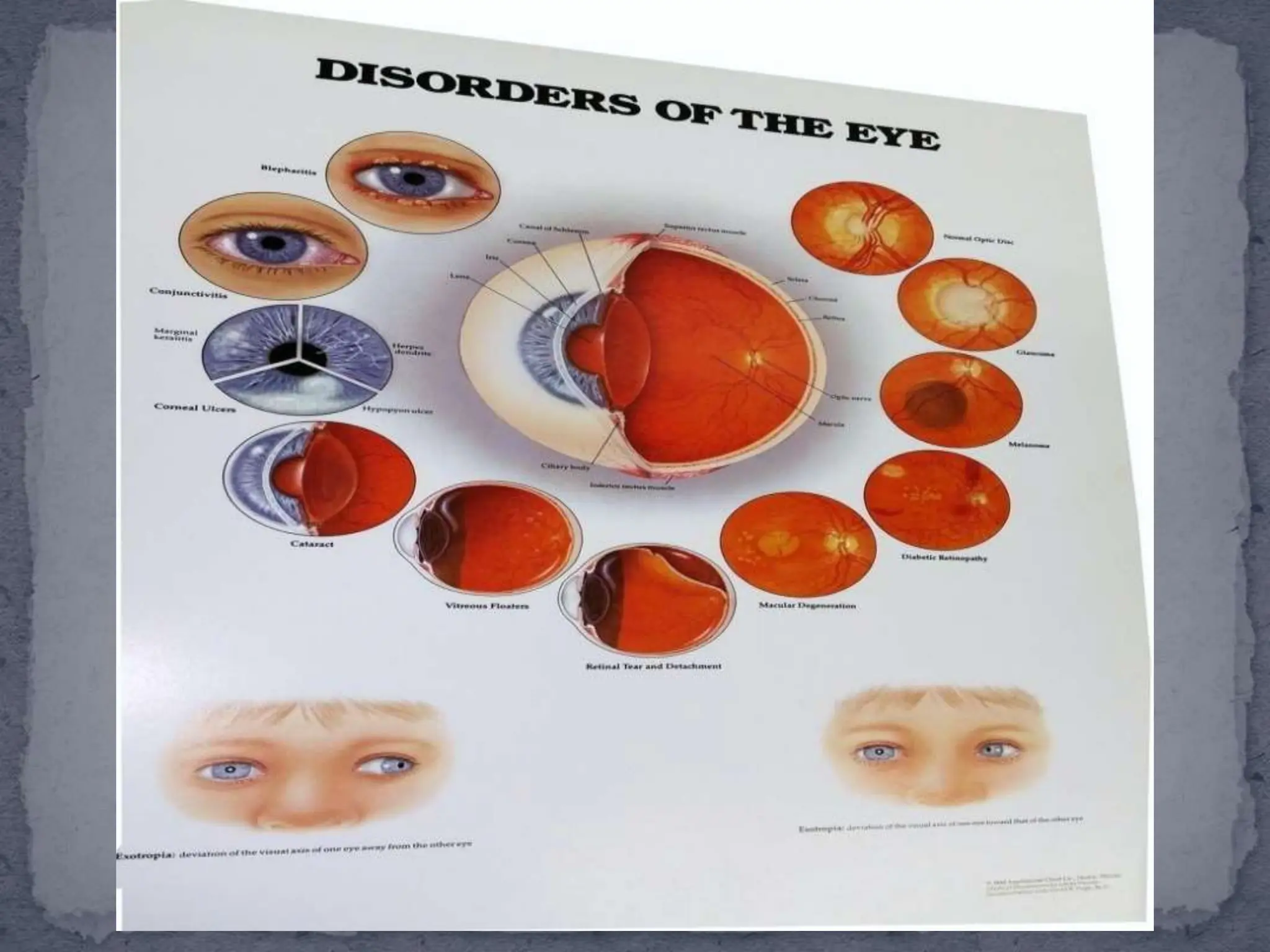
 Esotropia: Eye turns in the direction of the nose.
 b. Exotropia: Eye turns outward.
 Astigmatism is a condition in which an abnormal
curvature of the cornea can cause two focal points to
fall in two different locations, making objects up close
and at a distance appear blurry. Astigmatisms may
cause eye strain and may be combined with
nearsightedness or farsightedness. It is the refractive
error caused by optical aberrations of the cornea and/
or lens away from a perfectly spherical refractive
configuration.
 Eyeball length (When the eyeball grows too long or
too short).
 Problems with the shape of the cornea (The clear
outer layer of the eye).
 Aging of the lens.
 Family history: Genetic factors are responsible for
extreme form of refractive errors.
 Congenital, present at birth and usually unilateral.
 Simple or developmental, most common type does
not progress after adolescence.
 Nearsightedness, usually start in childhood.
Presbyopia is common in adults aged 40 and older.
 Reduced visual acuity for distance but near objects are
seen clearly no headache. In pathological myopia,
black spots floating in front of eye.
 Congenital: It is present at birth and associated with
other congenital anomalies of eyeball.
 Simple or developmental: It is the most common type
that results from variation in the development of
eyeball with growth of eyeball in size and
hypermetropia is gradually diminished.
 Symptoms: Eyestrain appears in gross degree of error.
1) Blurred vision
2) Double vision
3) Squinting
4) Headache
5) Eye strain
6) Glare or halos around bright lights.
7) Difficulty in doing close work, letter appears blurred
after some time during reading, headache, burning, and
dryness in eye.
8) Trouble focusing when reading or looking at a computer.
 Visual acuity testing is done to check vision loss.
 Refraction: Refractive errors are diagnosed through a
process known as refraction. The patient is asked to
view on eye chart while lenses of different strengths
are systematically placed in front of the eye. The
patient is asked if the lenses sharpen or worsen vision.
Conservative Management
 The use of a lens. Myopic vision is corrected to bring
the image forward onto the retina with a concave lens.
 Hyperopic vision is corrected with convex lenses to
move the focused image back to the retina.
Eye Glasses
 Eye glasses are often used to hold the lenses necessary
to correct errors of refraction.
 They are beneficial because of low cost, easy to use,
durability and availability.
 Prolong use of eye glasses leads to an alteration in
physical appearance, put weight of the frame on the
nose and reduce peripheral vision.
Contact Lenses
 Contact lenses are a second form of medical treatment
for refractive errors.
1. Hard lenses: Hard lenses have been used to treat
refractive errors for many years.
 Contraindications:
a. Insufficient tear film quality.
b. Lifestyle or occupation in an environment containing
dust, dryness or fumes.
c. Lack of motivation to maintain lens care and
sterilization protocols.
d. Inadequate manual dexterity to insert and remove
lenses.
e. Impaired corneal sensation.
 Complications:
a. Corneal edema
b. Corneal abrasions
c. Dryness of epithelium.
d. Irritation
e. Laceration (minute breaks)
2. Soft lenses: Soft contact lenses are large but are better
tolerated than hard contact lenses. Most soft lense
wearing problems are related to:
a. Deterioration of the lens.
b. Deposits in the lens.
c. Lens care routines.
d. Lack of complications with lens care practices.
 Disadvantages:
a. Easy damage to lenses (tears or holes).
b. An increased tendency of lenses to absorb chemicals
and medications.
c. A reduced ability to correct astigmatism.
 Types of soft contact lenses:
a. Daily wear lenses, worn during waking hours.
b. Extended-wear contact lenses, which can be worn
continuously for several days to several weeks.
 Radial Keratotomy:
Radial keratotomy is an outpatient surgical procedure
for the treatment of mild to moderate myopia.
 Complications:
Corneal scar (if incision is too deep). Failure to achieve
adequate correction (if incisions are made too
shallow).
 Epikeratophakia
In this procedure, donor corneal tissue is surgically
grafted into the patient's own cornea to alter its
refractive ability. The donor corneal tissue is frozen
and reshaped to the specific strength and size needed
by the patient.
 Laser-Assisted in Situ Keratomileusis (LASIK)
It uses a laser (a strong beam of light) to change the
shape of the cornea and helps to make vision clearer.
1. Assess the general condition of the eye of the patient.
2. Identify the cause of refractive error.
3. Maintain sterility of the eye droppers, tubes of
medication and other items. Then reduce the risk of
eye infection.
4. Advice the patient regarding the use of lens.
5. Use aseptic technique while doing dressing of surgical
site to prevent infection.
6. Advice the patient not to share eye makeup with
others.
7. Advice the patient not to rub the eyes.
8. Advice the patient not to use dirty clothes to clean the
eyes.
9. Demonstrate the proper administration of eye drops
or ointments.
10. Teach the patient to avoid itching in eyes.
11. Teach the patient regarding the use of eye glasses.
12. Teach the patient about the complication that may
occur due to the use of lenses.
1. Corneal edema
2. Corneal abrasions
3. Dryness of epithelium.
4. Irritation
5. Laceration (minute breaks)
 Take well balanced diet.
 Avoid putting eye strain.
 Make use of eye glasses as adviced by doctor.
 Teach patient about use and care of contact lens.
 Advice parents to bring child for refraction
screening at eye clinic.
 Hordeolum (Stye):
Hordeolum is a painful, acute infectious process of the
upper or lower eyelid. This infection is caused by
staphylococcal organism. It represents a localized
abscess formation of the follicle of an eyelash whereas
an internal hordeolum is an acute bacterial infection
of the meibomian glands of the eyelid.
 Types of Hordeolum
Based on the location, hordeolum is divided into two
types:
1. Internal hordeolum, occurred on meibomian glands.
At this internal hordeolum bump leads to the
conjunctiva (the inner lining of the eyelid).
2. External hordeolum, occurred at zeis glands and
moll glands. Lump visible from the outside on the
outside of the eyelid skin.
 A chalazion is a small bump in the eyelid caused by a
blockage of a tiny oil gland. Chronic inflammation of a
meibomian gland may lead to formation of a chalazion
(a granulomatous cyst or nodule to the eyelid).
 Etiology
Hordeolum is caused by Staphylococcus aureus with
Staphylococcus epidermidis.
 Clinical Manifestations
1. Localized abscess at the base of eyelash.
2. Edema of lid.
3. Pain
4. Discomfort, burning
5. Itching of eyelid margins
 Diagnostic Evaluation
History and physical evaluation.
 Management
1. No special treatment is required as stye will recover
by itself within one week.
2. Warm compresses and erythromycin ophthalmic
ointment applied twice a day are usually beneficial
for faster recovery.
3. Patients should be taught not to squeeze styes
because the infection may spread and cause cellulitis
of eyelids.
4. Warm compresses should be applied for 15 minutes at
least four times a day. Gentle massage of the nodule
has also been suggested to assist in the expression of
the obstructed material.
5. Incision and drainage are considered for very large
hordeolum.
 Nursing Management
1. Eye care is very important.
2. Do not squeeze or pop a stye.
3. Do not wear makeup or contact lenses until the area
has fully healed.
4. Avoid scratching or tapping hordeolum.
5. Let hordeolum broke by itself, and then wipe with a
sterile gauze when pus out or fluid from the
hordeolum.
6. Advice patient to close eyes while cleaning
hordeolum.
7. Remove contact lenses during the treatment period.
8. Warm compresses should be applied for 15 minutes at
least four times a day. Gentle massage of the nodule
has also been suggested to assist in the expression of
the obstructed material.
9. Assist doctor for incision and drainage (if required).
10. Assess anxiety level of patient and provide psycho-
logical support.
 Complications
Cellulitis of eye.
 Blepharitis:
Blepharitis is swelling or inflammation of glands and
lash follicles on the eyelid margins, usually where the
eyelash hair follicles are located by the location of the
problem, blepharitis can be anterior versus posterior.
 Etiology
1. In people with blepharitis, too much oil is produced
by the glands near the eyelid. The exact reason for
this problem is not known.
2. It is usually caused by Staphylococcus and
Streptococci.
 Risk Factors
Blepharitis is more likely to be seen with:
1. A skin condition called seborrheic dermatitis or
seborrhea, which often involves the scalp, eyebrows,
eyelids, behind the ears and creases of the nose.
2. Allergies and lice that affect the eyelashes (less
common).
3. Excess growth of the bacteria that are normally
found on the skin.
4. Rosacea: A skin condition that makes the face turn
red.
 Clinical Manifestations
1. Burning
2. Crusty
3. Itching
4. Reddened
5. Swollen
 Diagnostic Evaluation
An examination of the eyelids during an eye examination
is usually enough to diagnose blepharitis.
 Management
1. Apply warm compresses to eyes for 5 minutes, at
least two times per day.
2. Use a cotton swab, gently rub a solution of warm
water and no-tears baby shampoo along eyelid where
the lash meets the lid. Do this in the morning and
before go to bed.
 Nursing Management
1. Eye care is very important.
2. Do not wear eye makeup or contact lenses until the area has fully healed.
3. Avoid scratching or tapping on affected eye.
4. Advice patient to close eyes while cleaning eyelids and clean it from inner canthus to outer
canthus.
5. Remove contact lenses during the treatment period.
6. Warm compresses should be applied for 15 minutes at least four times a day. Gentle massage of the
nodule has also been suggested to assist in the expression of the obstructed material.
7. Assess anxiety level of the patient and provide psychological support.
 Complications
1. Conjunctivitis
2. Stye
3. Ectropion
 Entropion:
Entropion is a medical condition in which the eyelid
(usually the lower lid) folds inward. It gives discomfort
to the patient as the eyelashes constantly rub against
the cornea
 Entropion may be unilateral or bilateral.
 Lower eyelid entropion is much more common than
the upper eyelid entropion.
 Types of Entropion
1. Congenital: Congenital entropion is rare.
2. Spastic: Spastic entropion is usually temporary.
3. Involutional: Involutional entropion happens when
a person get old and the treatment requires surgery.
4. Cicatricial: Cicatricial is more complex with
multiple cases. It can be the result of scarring or
inflammation caused by eye infections or previous
eyelid surgeries.
Etiology
1. Genetic factors.
2. Trachoma infection may cause scarring of the inner
eyelid, which may cause entropion.
3. Blepharitis: Inflammation of the eyelids usually by
staphylococci organism.
a. Allergic blepharitis: It is associated with response to
drugs or cosmetics applied to the eye or eyelids.
b. Squamous blepharitis: It is associated with dandruff
of the scalp.
Risk Factors
 It occurs more frequently in women than men.
 Infection with organisms, e.g. Staphylococci, Viruses,
Streptococci, etc.
 Allergic reaction within the body.
 Exposure to external irritants, e.g. poison.
 Use of eye cosmetics.6. Sunburn
 Clinical Manifestations
1. Eye itching
2. Redness of eye.
3. Eyelid pain
4. Lacrimation of eye.
5. Photophobia
6. Crusting ulceration
7. Lid becomes glued together during sleep.
 Diagnostic Evaluation:
Patient history and physical examination.
 Management
1. Warm compresses followed by erythromycin or
bactericide eye ointment.
2. Eye drops of steroid may be prescribed.
3. Mild analgesics, such as paracetamol may be
prescribed to relieve pain.
 Complications
1. Corneal irritation
2. Corneal injury
 Patient Education and Health Maintenance
1. Using artificial tears or lubricating ointments may
prevent corneal complications.
2. Provide information regarding eye disorder and its
management.
3. Teach about eye care and instillation of eye drops.
4. Provide psychological support.
 Ectropion:
Ectropion is the turning out of the eyelid (usually the
lower eyelid), so that the inner surface is exposed.
 Types of Ectropion
1. Involutional (senile) ectropion: The most frequent
type of ectropion. It is caused by laxity, atrophy or
disinsertion of the supporting structures and loss of
elasticity and decreased orbital and malar fat.
2. Congenital ectropion: Congenital ectropion is
extremely rare and usually occurs due to vertical skin
foreshortening in blepharophimosis syndrome.
3. Paralytic ectropion: It is caused by paresis of the
orbicularis oculi muscle, generally as a result of facial
nerve paralysis.
4. Cicatricial and mechanical ectropion:
a. In cicatricial ectropion, the most frequent cause is
foreshortening of the anterior lamella due to
mechanical, chemical or thermal damage or post-
operative cicatricial retractions.
b. Periorbital edema and tumors are the most common
causes of mechanical ectropion.
 Etiology
1. Birth defect with Down's syndrome.
2. Facial palsy: Paralysis and weakness of facial nerve
and muscles.
3. Scar tissue from burns.
4. Benign or cancerous growths on eyelid.
 Risk Factors
1. Ectropion is common in old people. Aging causes
weakening of muscle tissue.
2. It affects lower lid commonly.
3. Previous eye surgery.
 Clinical Manifestations
1. Dry, painful eyes.
2. Excess tearing of the eye (epiphora).
3. Eyelid turns outward.
4. Long-term (chronic) conjunctivitis.
5. Keratitis.
6. Redness of the lid and white part of the eye.
 Diagnostic Evaluation
A physical examination of the eyes and eyelids confirm
the diagnosis. Special tests are usually not necessary.
 Complications
 Corneal dryness and irritation may lead to:
1. Corneal abrasions
2. Corneal ulcers
3. Eye infections
 Patient Education and Health Maintenance
1. Most cases are not preventable. Using artificial tears
or lubricating ointments may prevent corneal
complications.
2. Provide information regarding eye disorder and its
management.
3. Teach about eye care and instillation of eye drops.
4. Provide psychological support.
 Conjunctivitis
Conjunctivitis is an inflammation of the conjunctiva. It
occurs most commonly due to an allergic reaction/
infection.
 Types of Conjunctivitis
According to Etiology
1. Allergic conjunctivitis: It is the inflammation of
conjunctiva due to allergy.
2. Bacterial conjunctivitis: It is the inflammation of
conjunctiva due to chlamydia trachomatis.
3. Toxic conjunctivitis: Chemical conjunctivitis can be
result of medications, chlorine from swimming pool.
 It may result from:
a. Exposure to toxic fumes among industrial workers.
b. Exposure to irritants such as smoke, hair spray, acids
and alkalis.
 According to Severity
1. Acute conjunctivitis
2. Chronic conjunctivitis (trachoma)
 Etiology
1. The most common cause is hay fever.
2. Infectious conjunctivitis can result from bacteria,
viruses, fungi, and parasites and transmitted to eye
by direct contact.
3. Bacterial conjunctivitis is an infection most often
caused by Staphylococcal or Streptococcal bacteria or
gonococcus.
4. Contagious viruses associated with the common cold,
Adeno virus and Entero virus, herpes and Varicella-
zoster.
 Risk Factors
1. Pollen from trees, grass and ragweed.
2. Animal skin and secretions, such as saliva.
3. Perfumes, cosmetics.
4. Air pollution, smoke and dust mites.
5. Skin medicines.
6. Exposure to irritants like air pollution, chlorine in
swimming pools, and exposure to noxious chemicals,
gonorrheal genital infection.
 Clinical Manifestations
1. Bacterial origin has moderate redness with yellow/
green discharge.
2. Edema of the conjunctiva.
3. Lid edema
4. Itching with allergies.
5. Crusting discharge on lid.
6. Increased lacrimation
7. Viral conjunctivitis in combination with rhinitis may
cause allergic rhino conjunctivitis.
8. Irritation (Chemosis)
9. Foreign body sensation
10. Scratching
11. Burning sensation
12. Photophobia
13. Infection starts in one eye and then spread to other
eye.
 Diagnostic Evaluation
1. History and eye examination.
2. Conjunctiva scrapings to look for eosinophils.
3. Visual acuity measurements to determine whether
vision has been affected.
 Complications
1. Keratitis
2. Bacterial superinfection
3. Conjunctival scarring
4. Corneal ulceration
5. Chronic infection
 Keratoconjunctivitis Sicca:
Keratoconjunctivitis Sicca (KCS), also called keratitis
sicca, sicca syndrome, xerophthalmia or dry eye
syndrome, is an eye disease caused by decreased tear
production or increased tear film evaporation.
 Etiology
1. Lacrimal gland malfunction: Genetically and injury
infection.
2. It is associated with systemic disorders, such as
autoimmune diseases like primary Sjogren's
syndrome and rheumatoid arthritis.
3. Facial nerve palsy.
4. Medications: Antihistamine, oral contraceptives,
atropine decrease tear production and Sjogren's
syndrome.
 Risk Factors
1. KCS is commonly occur among person older than 50
years of age.
2. Middle-aged and older adults are the most
commonly affected group because of the high
prevalence of contact lens usage, systemic drug
effects, autoimmune diseases, and refractive
surgeries.
3. It is more common in women than in men.
 Clinical Manifestations
1. Dryness, burning and a sandy-gritty eye irritation
that gets worse as the day goes.
2. Itchy, scratchy, stingy or tired eyes.
3. Photophobia.
4. Feeling of something in the eye.
5. Other symptoms are pain, redness, a pulling
sensation and pressure behind the eye.
 Diagnostic Evaluation
1. Slit lamp examination
2. Carbon paper test
 Complications
1. Eye inflammation
2. Abrasion of the corneal surface
3. Corneal ulcers
4. Vision loss
 Conjunctiva Bleeding
Subconjunctival hemorrhage is a benign disorder, i.e, a
common cause of acute ocular redness. It may be
spontaneous, traumatic, or related to systemic illness.
 Etiology
1. Acute hemorrhagic conjunctivitis is caused by Entero
virus and Coxsackie virus.
2. Ocular surgery such as cataract surgery, filtration
surgery and refractive surgery.
3. Conjunctival tumors.
4. Medications, such as anticoagulant and antiplatelets.
5. Bleeding disorder.
6. Local trauma, systemic hypertension, acute
conjunctivitis, and diabetes mellitus.
 Risk Factors
1. Trauma to globe (foreign body or eye rubbing or blunt
or penetrating injuries of the globe).
2. Use of contact lens in younger patients.
3. Systemic vascular diseases such as hypertension,
diabetes, and arteriosclerosis are more common causes
for elderly.
4. Coughing, sneezing, straining, or other similar actions
most commonly cause eye injury/strain and increase
risk to develop subconjunctival hemorrhages.
5. Rubbing eye too hard.
6. Eye scratching
 Clinical Manifestations
1. Redness on the white part of the eye.
2. Eye is irritated or feels scratched.
3. Feeling of fullness in the eye.
 Diagnostic Evaluation
1. Eye examination and patient history.
2. Ultrasound to assess condition of the eye.
3. CT scan to look for injury around the eye.
4. Blood test to check for any underlying condition that
might cause eye complications.
 Keratitis:
Keratitis is the inflammation or infection of cornea. It
may be superfacial or deep.
 Superfacial keratitis.
 Deep keratitis.
 Etiology :
 Bacteria
 Viruses
 Fungal
 Physical and chemical trauma
 Risk factor:
 Improper use contact lenses
 Corticosteroid
 Eye injury
 Clinical manifestation:
 Pain
 Tearing
 Blurring of vision
 Sensitivity
 Corneal ulcer:
Corneal ulcer may be defined as, “the discontinuation in
the normal epithelial layer of cornea associated with
necrosis of surrounding tissue of cornea
 Etiology:
 Bacterial
 Viruses
 Fungal
 Protozoa
 Contact lenses
 Xerosis
 Blunt eye trauma
 Risk factors:
 Medical condition
 Corneal ulcer
 Contact lens wearers
 Steroid eye drop
 Violent coughing
 Clinical manifestation:
 Pain
 Ulcer
 Blurred vision
 Discomfort
 Irritation
 Diagnostic evaluation:
 Slit lamp examination
 Tissue sample
 Corneal transplantation:
A corneal transplant is the surgery to replace the cornea
with tissue from a donor.
 Indication:
 Keratoconus
 Corneal dystrophy
 Corneal scarring
 Contraindication:
 Systemic disorders
 Eye infections
 Intrinsic eye disease
 Complications:
 Bleeding
 Eye infection
 Glaucoma
 Swelling
 Cataract:
Cataract is a clouding in the crystalline lens of the eye
varying in degree from slight to complete opacity and
obstructing the passage of light.
 Types
 Congenital cataract
 Acquired cataract
 Etiology :
 Environmental
 Drug and toxins
 Genetics
 Intraocular disorders
 parasitic
 Risk factors:
 Aging
 Associated ocular condition
 Toxic factors
 Nutritional factors
 Physical factors
 Systemic disease and syndromes
 Clinical manifestations:
 Painless, blurry vision
 Light scattering
 Other effects:
Myopic
Astigmatism
Monocular diplopia
 Diagnostic evaluation
 History and eye examination
 Surgical management
 Nursing management
 Complication:
 Retrobulbar hemorrhage
 Rupture of post capsule
 Acute bacterial endopthalmitis
 Malposition of IOL- astigmatism, sensitivity to glare.
 Corneal edema
 Glaucoma:
Glaucoma is a group of ocular conditions related to
increase IOP, caused by congestion of aqueous humor
in eye.
 Types of glaucoma:
 According to the cause of disease
1. Primary glaucoma
2. Secondary glaucoma
 According to the onset an duration of disease
1. Acute glaucoma
2. Chronic glaucoma
 According to the width of angle between the cornea
and iris
Open and closed glaucoma
 Other form of glaucoma
 Etiology
1. Due to increase volume of blood in blood vessels or
due to decrease venous outflow.
2. Decrease in volume of the lens and vitreous humor.
3. Due to external pressure on eye.
 Risk factors:
1. Family history of glaucoma
2. Older age
3. Diabetes mellitus
4. Cardiovascullar disorders
5. Migrain syndrome
6. Nearsightedness
7. Eye trauma
8. Topical corticosteroid
9. Black race
10. High intra ocular pressure
 Clinical manifestation:
Open angle glaucoma
1. No initial manifestations
2. Frequent lens changes in
glasses
3. Rainbow halos around
light
4. Impaired dark adaptation
5. Gradual reaction to visual
field
6. Mild to moderate I/O 24-
32 mmHg pressure
7. Loss of peripheral vision
and progress to loss of
central vision.
Angle closure glaucoma
1. Abrupt onset of eye pain
2. Headache
3. Decrease visual acuity
4. Nausea and vomiting
5. Red conjunctiva
6. Cloudy cornea
7. Fixed pupil
8. Rapid and significant I/O
50-70 mmHg pressure
Complications
blindness
 Retinal detachment is a disorder of the eye in which
the retinal pigment layer separate from sensory layer.
Types of retinal detachment:
1. Rhegmatogenous retinal detachment
2. Exudative, serous or secondary retinal detachment
3. Tractional retinal detachment
4. Both rhegmatogenous and tractional retinal
detachment
 Etiology:
1. Retinal break
2. Trauma
3. Predisposing factors
4. Cataract extraction surgery
5. Degeneration of retina
6. Systemic disorders
 Risk factors
1. Age
2. Cataract extraction
3. Severe myopia
4. trauma
 Diagnostic evaluation:
 Physical examination
 Electroretinogram
 Tonometer
 Ophthalmoscopy
 Slit-lamp examination
 Optical coherence tomography
 Surgical management
Scleral buckling surgery
Vitrectomy
Pneumatic retinopexy
 Total blindness is the inability to see light from dark,
or the total inability to see.
 Etiology
 Glaucoma, cataract, diabetes mellitus and trachoma
 Exposure of a pregnant women to certain diseases can
cause congenital eye problems.
 Injuries to the eyes.
 Disease in the brain
 Malnutrition
 age
 Risk factors:
 Ocular infection
 Retinal detachment
 Uncorrected refractive error
 Clinical manifestations:
 Lack of eye-to-eye contact
 Abnormal eye movement
 Failure to locate distance objects
 Squinting, frequent blinking
 Frequent rubbing of eye
 Gray opacities in eyes
 Disorientation
 Anxiety
 Anger
 Visual distortions
 Incoordination of work
 History of fall, accidents
 Diagnostic evaluation:
 Patient history and snellen test
 Visual acuity test
 Slit lamp examination
 Color blindness:
Color blindness is the inability or decreased ability to see
color, or perceive color differences, under normal
lighting conditions. It affects a significant percentage
of the population.
 Classification :
 Acquired
 Inherited
 Risk factors:
 Family history
 Eye disorders
 Health issues
 Clinical manifestation:
 Difficulty distinguishing between colors
 Inability to see shades or tones of the same color.
 Diagnostic evaluation
Eye examination
 Night blindness:
Also called nyctalopia. It is the inability to see well at
night or in poor light.
 Etiology:
 Risk factors:
 Non-pregnant women
 Low consumption of vitamin A rich animal food.
 Clinical manifestation:
 Eye pain
 Headache
 Nausea
 Vomitting
 Blurry or cloudy vision
 Difficulty seeing into the distance
eye disorders .pptx

eye disorders .pptx

  • 2.
  • 3.
     Refractive disordersare abnormalities of refraction that occur in the eye. Here, vision is impaired because of shortened or elongated eyeball which prevents light rays from focusing sharply on the retina. Blurred vision from refractive error can be corrected with eye glasses or contact lenses.
  • 5.
     Emmetropia isnormal optical condition of eye. When parallel rays of light from infinity come to focus on retina with accommodation is at rest. No error of refraction.
  • 6.
     Myopia alsoknown as nearsightedness. Myopia is a condition in which an image of a distant object becomes focused in front of the retina. It is caused by refractive errors in the cornea, refractive errors in the lens or a combination of the two. In this condition, distant objects appear out of focus and may cause headaches and/or eye strain.
  • 8.
     Hyperopia alsocalled farsightedness. Hyperopia is the most common refractive error in which an image of a distant object becomes focused behind the retina. In this, the focal plane of light entering the eye is posterior to the retina, resulting in sharper visual acuity for objects at distance and decreased visual acuity for closer objects. Patient usually compliant of headache and/or eye strain.
  • 10.
     Strabismus: Inabilityof the eyes to focus in the same direction. It is commonly called cross-eyed.
  • 12.
     Esotropia: Eyeturns in the direction of the nose.  b. Exotropia: Eye turns outward.
  • 13.
     Astigmatism isa condition in which an abnormal curvature of the cornea can cause two focal points to fall in two different locations, making objects up close and at a distance appear blurry. Astigmatisms may cause eye strain and may be combined with nearsightedness or farsightedness. It is the refractive error caused by optical aberrations of the cornea and/ or lens away from a perfectly spherical refractive configuration.
  • 15.
     Eyeball length(When the eyeball grows too long or too short).  Problems with the shape of the cornea (The clear outer layer of the eye).  Aging of the lens.
  • 16.
     Family history:Genetic factors are responsible for extreme form of refractive errors.  Congenital, present at birth and usually unilateral.  Simple or developmental, most common type does not progress after adolescence.  Nearsightedness, usually start in childhood. Presbyopia is common in adults aged 40 and older.
  • 18.
     Reduced visualacuity for distance but near objects are seen clearly no headache. In pathological myopia, black spots floating in front of eye.
  • 19.
     Congenital: Itis present at birth and associated with other congenital anomalies of eyeball.  Simple or developmental: It is the most common type that results from variation in the development of eyeball with growth of eyeball in size and hypermetropia is gradually diminished.
  • 20.
     Symptoms: Eyestrainappears in gross degree of error. 1) Blurred vision 2) Double vision 3) Squinting 4) Headache 5) Eye strain 6) Glare or halos around bright lights. 7) Difficulty in doing close work, letter appears blurred after some time during reading, headache, burning, and dryness in eye. 8) Trouble focusing when reading or looking at a computer.
  • 21.
     Visual acuitytesting is done to check vision loss.  Refraction: Refractive errors are diagnosed through a process known as refraction. The patient is asked to view on eye chart while lenses of different strengths are systematically placed in front of the eye. The patient is asked if the lenses sharpen or worsen vision.
  • 22.
    Conservative Management  Theuse of a lens. Myopic vision is corrected to bring the image forward onto the retina with a concave lens.  Hyperopic vision is corrected with convex lenses to move the focused image back to the retina.
  • 23.
    Eye Glasses  Eyeglasses are often used to hold the lenses necessary to correct errors of refraction.  They are beneficial because of low cost, easy to use, durability and availability.  Prolong use of eye glasses leads to an alteration in physical appearance, put weight of the frame on the nose and reduce peripheral vision.
  • 24.
    Contact Lenses  Contactlenses are a second form of medical treatment for refractive errors. 1. Hard lenses: Hard lenses have been used to treat refractive errors for many years.
  • 26.
     Contraindications: a. Insufficienttear film quality. b. Lifestyle or occupation in an environment containing dust, dryness or fumes. c. Lack of motivation to maintain lens care and sterilization protocols. d. Inadequate manual dexterity to insert and remove lenses. e. Impaired corneal sensation.
  • 27.
     Complications: a. Cornealedema b. Corneal abrasions c. Dryness of epithelium. d. Irritation e. Laceration (minute breaks)
  • 29.
    2. Soft lenses:Soft contact lenses are large but are better tolerated than hard contact lenses. Most soft lense wearing problems are related to: a. Deterioration of the lens. b. Deposits in the lens. c. Lens care routines. d. Lack of complications with lens care practices.
  • 30.
     Disadvantages: a. Easydamage to lenses (tears or holes). b. An increased tendency of lenses to absorb chemicals and medications. c. A reduced ability to correct astigmatism.
  • 31.
     Types ofsoft contact lenses: a. Daily wear lenses, worn during waking hours. b. Extended-wear contact lenses, which can be worn continuously for several days to several weeks.
  • 32.
     Radial Keratotomy: Radialkeratotomy is an outpatient surgical procedure for the treatment of mild to moderate myopia.
  • 34.
     Complications: Corneal scar(if incision is too deep). Failure to achieve adequate correction (if incisions are made too shallow).
  • 35.
     Epikeratophakia In thisprocedure, donor corneal tissue is surgically grafted into the patient's own cornea to alter its refractive ability. The donor corneal tissue is frozen and reshaped to the specific strength and size needed by the patient.
  • 37.
     Laser-Assisted inSitu Keratomileusis (LASIK) It uses a laser (a strong beam of light) to change the shape of the cornea and helps to make vision clearer.
  • 39.
    1. Assess thegeneral condition of the eye of the patient. 2. Identify the cause of refractive error. 3. Maintain sterility of the eye droppers, tubes of medication and other items. Then reduce the risk of eye infection. 4. Advice the patient regarding the use of lens. 5. Use aseptic technique while doing dressing of surgical site to prevent infection. 6. Advice the patient not to share eye makeup with others.
  • 40.
    7. Advice thepatient not to rub the eyes. 8. Advice the patient not to use dirty clothes to clean the eyes. 9. Demonstrate the proper administration of eye drops or ointments. 10. Teach the patient to avoid itching in eyes. 11. Teach the patient regarding the use of eye glasses. 12. Teach the patient about the complication that may occur due to the use of lenses.
  • 41.
    1. Corneal edema 2.Corneal abrasions 3. Dryness of epithelium. 4. Irritation 5. Laceration (minute breaks)
  • 43.
     Take wellbalanced diet.  Avoid putting eye strain.  Make use of eye glasses as adviced by doctor.  Teach patient about use and care of contact lens.  Advice parents to bring child for refraction screening at eye clinic.
  • 44.
     Hordeolum (Stye): Hordeolumis a painful, acute infectious process of the upper or lower eyelid. This infection is caused by staphylococcal organism. It represents a localized abscess formation of the follicle of an eyelash whereas an internal hordeolum is an acute bacterial infection of the meibomian glands of the eyelid.
  • 46.
     Types ofHordeolum Based on the location, hordeolum is divided into two types: 1. Internal hordeolum, occurred on meibomian glands. At this internal hordeolum bump leads to the conjunctiva (the inner lining of the eyelid). 2. External hordeolum, occurred at zeis glands and moll glands. Lump visible from the outside on the outside of the eyelid skin.
  • 49.
     A chalazionis a small bump in the eyelid caused by a blockage of a tiny oil gland. Chronic inflammation of a meibomian gland may lead to formation of a chalazion (a granulomatous cyst or nodule to the eyelid).
  • 51.
     Etiology Hordeolum iscaused by Staphylococcus aureus with Staphylococcus epidermidis.
  • 54.
     Clinical Manifestations 1.Localized abscess at the base of eyelash. 2. Edema of lid. 3. Pain 4. Discomfort, burning 5. Itching of eyelid margins
  • 55.
     Diagnostic Evaluation Historyand physical evaluation.
  • 56.
     Management 1. Nospecial treatment is required as stye will recover by itself within one week. 2. Warm compresses and erythromycin ophthalmic ointment applied twice a day are usually beneficial for faster recovery. 3. Patients should be taught not to squeeze styes because the infection may spread and cause cellulitis of eyelids.
  • 57.
    4. Warm compressesshould be applied for 15 minutes at least four times a day. Gentle massage of the nodule has also been suggested to assist in the expression of the obstructed material. 5. Incision and drainage are considered for very large hordeolum.
  • 58.
     Nursing Management 1.Eye care is very important. 2. Do not squeeze or pop a stye. 3. Do not wear makeup or contact lenses until the area has fully healed. 4. Avoid scratching or tapping hordeolum. 5. Let hordeolum broke by itself, and then wipe with a sterile gauze when pus out or fluid from the hordeolum.
  • 59.
    6. Advice patientto close eyes while cleaning hordeolum. 7. Remove contact lenses during the treatment period. 8. Warm compresses should be applied for 15 minutes at least four times a day. Gentle massage of the nodule has also been suggested to assist in the expression of the obstructed material. 9. Assist doctor for incision and drainage (if required). 10. Assess anxiety level of patient and provide psycho- logical support.
  • 60.
  • 62.
     Blepharitis: Blepharitis isswelling or inflammation of glands and lash follicles on the eyelid margins, usually where the eyelash hair follicles are located by the location of the problem, blepharitis can be anterior versus posterior.
  • 63.
     Etiology 1. Inpeople with blepharitis, too much oil is produced by the glands near the eyelid. The exact reason for this problem is not known. 2. It is usually caused by Staphylococcus and Streptococci.
  • 64.
     Risk Factors Blepharitisis more likely to be seen with: 1. A skin condition called seborrheic dermatitis or seborrhea, which often involves the scalp, eyebrows, eyelids, behind the ears and creases of the nose. 2. Allergies and lice that affect the eyelashes (less common). 3. Excess growth of the bacteria that are normally found on the skin. 4. Rosacea: A skin condition that makes the face turn red.
  • 65.
     Clinical Manifestations 1.Burning 2. Crusty 3. Itching 4. Reddened 5. Swollen
  • 66.
     Diagnostic Evaluation Anexamination of the eyelids during an eye examination is usually enough to diagnose blepharitis.
  • 67.
     Management 1. Applywarm compresses to eyes for 5 minutes, at least two times per day. 2. Use a cotton swab, gently rub a solution of warm water and no-tears baby shampoo along eyelid where the lash meets the lid. Do this in the morning and before go to bed.
  • 68.
     Nursing Management 1.Eye care is very important. 2. Do not wear eye makeup or contact lenses until the area has fully healed. 3. Avoid scratching or tapping on affected eye. 4. Advice patient to close eyes while cleaning eyelids and clean it from inner canthus to outer canthus. 5. Remove contact lenses during the treatment period. 6. Warm compresses should be applied for 15 minutes at least four times a day. Gentle massage of the nodule has also been suggested to assist in the expression of the obstructed material. 7. Assess anxiety level of the patient and provide psychological support.
  • 69.
  • 71.
     Entropion: Entropion isa medical condition in which the eyelid (usually the lower lid) folds inward. It gives discomfort to the patient as the eyelashes constantly rub against the cornea
  • 72.
     Entropion maybe unilateral or bilateral.  Lower eyelid entropion is much more common than the upper eyelid entropion.
  • 73.
     Types ofEntropion 1. Congenital: Congenital entropion is rare. 2. Spastic: Spastic entropion is usually temporary. 3. Involutional: Involutional entropion happens when a person get old and the treatment requires surgery. 4. Cicatricial: Cicatricial is more complex with multiple cases. It can be the result of scarring or inflammation caused by eye infections or previous eyelid surgeries.
  • 74.
    Etiology 1. Genetic factors. 2.Trachoma infection may cause scarring of the inner eyelid, which may cause entropion. 3. Blepharitis: Inflammation of the eyelids usually by staphylococci organism. a. Allergic blepharitis: It is associated with response to drugs or cosmetics applied to the eye or eyelids. b. Squamous blepharitis: It is associated with dandruff of the scalp.
  • 75.
    Risk Factors  Itoccurs more frequently in women than men.  Infection with organisms, e.g. Staphylococci, Viruses, Streptococci, etc.  Allergic reaction within the body.  Exposure to external irritants, e.g. poison.  Use of eye cosmetics.6. Sunburn
  • 77.
     Clinical Manifestations 1.Eye itching 2. Redness of eye. 3. Eyelid pain 4. Lacrimation of eye. 5. Photophobia 6. Crusting ulceration 7. Lid becomes glued together during sleep.
  • 78.
     Diagnostic Evaluation: Patienthistory and physical examination.
  • 79.
     Management 1. Warmcompresses followed by erythromycin or bactericide eye ointment. 2. Eye drops of steroid may be prescribed. 3. Mild analgesics, such as paracetamol may be prescribed to relieve pain.
  • 81.
     Complications 1. Cornealirritation 2. Corneal injury
  • 82.
     Patient Educationand Health Maintenance 1. Using artificial tears or lubricating ointments may prevent corneal complications. 2. Provide information regarding eye disorder and its management. 3. Teach about eye care and instillation of eye drops. 4. Provide psychological support.
  • 83.
     Ectropion: Ectropion isthe turning out of the eyelid (usually the lower eyelid), so that the inner surface is exposed.
  • 84.
     Types ofEctropion 1. Involutional (senile) ectropion: The most frequent type of ectropion. It is caused by laxity, atrophy or disinsertion of the supporting structures and loss of elasticity and decreased orbital and malar fat. 2. Congenital ectropion: Congenital ectropion is extremely rare and usually occurs due to vertical skin foreshortening in blepharophimosis syndrome.
  • 85.
    3. Paralytic ectropion:It is caused by paresis of the orbicularis oculi muscle, generally as a result of facial nerve paralysis. 4. Cicatricial and mechanical ectropion: a. In cicatricial ectropion, the most frequent cause is foreshortening of the anterior lamella due to mechanical, chemical or thermal damage or post- operative cicatricial retractions. b. Periorbital edema and tumors are the most common causes of mechanical ectropion.
  • 86.
     Etiology 1. Birthdefect with Down's syndrome. 2. Facial palsy: Paralysis and weakness of facial nerve and muscles. 3. Scar tissue from burns. 4. Benign or cancerous growths on eyelid.
  • 87.
     Risk Factors 1.Ectropion is common in old people. Aging causes weakening of muscle tissue. 2. It affects lower lid commonly. 3. Previous eye surgery.
  • 89.
     Clinical Manifestations 1.Dry, painful eyes. 2. Excess tearing of the eye (epiphora). 3. Eyelid turns outward. 4. Long-term (chronic) conjunctivitis. 5. Keratitis. 6. Redness of the lid and white part of the eye.
  • 90.
     Diagnostic Evaluation Aphysical examination of the eyes and eyelids confirm the diagnosis. Special tests are usually not necessary.
  • 92.
     Complications  Cornealdryness and irritation may lead to: 1. Corneal abrasions 2. Corneal ulcers 3. Eye infections
  • 93.
     Patient Educationand Health Maintenance 1. Most cases are not preventable. Using artificial tears or lubricating ointments may prevent corneal complications. 2. Provide information regarding eye disorder and its management. 3. Teach about eye care and instillation of eye drops. 4. Provide psychological support.
  • 94.
     Conjunctivitis Conjunctivitis isan inflammation of the conjunctiva. It occurs most commonly due to an allergic reaction/ infection.
  • 97.
     Types ofConjunctivitis According to Etiology 1. Allergic conjunctivitis: It is the inflammation of conjunctiva due to allergy. 2. Bacterial conjunctivitis: It is the inflammation of conjunctiva due to chlamydia trachomatis. 3. Toxic conjunctivitis: Chemical conjunctivitis can be result of medications, chlorine from swimming pool.
  • 98.
     It mayresult from: a. Exposure to toxic fumes among industrial workers. b. Exposure to irritants such as smoke, hair spray, acids and alkalis.
  • 99.
     According toSeverity 1. Acute conjunctivitis 2. Chronic conjunctivitis (trachoma)
  • 100.
     Etiology 1. Themost common cause is hay fever. 2. Infectious conjunctivitis can result from bacteria, viruses, fungi, and parasites and transmitted to eye by direct contact.
  • 101.
    3. Bacterial conjunctivitisis an infection most often caused by Staphylococcal or Streptococcal bacteria or gonococcus. 4. Contagious viruses associated with the common cold, Adeno virus and Entero virus, herpes and Varicella- zoster.
  • 102.
     Risk Factors 1.Pollen from trees, grass and ragweed. 2. Animal skin and secretions, such as saliva. 3. Perfumes, cosmetics. 4. Air pollution, smoke and dust mites. 5. Skin medicines. 6. Exposure to irritants like air pollution, chlorine in swimming pools, and exposure to noxious chemicals, gonorrheal genital infection.
  • 104.
     Clinical Manifestations 1.Bacterial origin has moderate redness with yellow/ green discharge. 2. Edema of the conjunctiva. 3. Lid edema 4. Itching with allergies. 5. Crusting discharge on lid. 6. Increased lacrimation
  • 105.
    7. Viral conjunctivitisin combination with rhinitis may cause allergic rhino conjunctivitis. 8. Irritation (Chemosis) 9. Foreign body sensation 10. Scratching 11. Burning sensation 12. Photophobia 13. Infection starts in one eye and then spread to other eye.
  • 106.
     Diagnostic Evaluation 1.History and eye examination. 2. Conjunctiva scrapings to look for eosinophils. 3. Visual acuity measurements to determine whether vision has been affected.
  • 108.
     Complications 1. Keratitis 2.Bacterial superinfection 3. Conjunctival scarring 4. Corneal ulceration 5. Chronic infection
  • 109.
     Keratoconjunctivitis Sicca: KeratoconjunctivitisSicca (KCS), also called keratitis sicca, sicca syndrome, xerophthalmia or dry eye syndrome, is an eye disease caused by decreased tear production or increased tear film evaporation.
  • 111.
     Etiology 1. Lacrimalgland malfunction: Genetically and injury infection. 2. It is associated with systemic disorders, such as autoimmune diseases like primary Sjogren's syndrome and rheumatoid arthritis.
  • 112.
    3. Facial nervepalsy. 4. Medications: Antihistamine, oral contraceptives, atropine decrease tear production and Sjogren's syndrome.
  • 113.
     Risk Factors 1.KCS is commonly occur among person older than 50 years of age. 2. Middle-aged and older adults are the most commonly affected group because of the high prevalence of contact lens usage, systemic drug effects, autoimmune diseases, and refractive surgeries. 3. It is more common in women than in men.
  • 115.
     Clinical Manifestations 1.Dryness, burning and a sandy-gritty eye irritation that gets worse as the day goes. 2. Itchy, scratchy, stingy or tired eyes. 3. Photophobia. 4. Feeling of something in the eye. 5. Other symptoms are pain, redness, a pulling sensation and pressure behind the eye.
  • 116.
     Diagnostic Evaluation 1.Slit lamp examination 2. Carbon paper test
  • 119.
     Complications 1. Eyeinflammation 2. Abrasion of the corneal surface 3. Corneal ulcers 4. Vision loss
  • 120.
     Conjunctiva Bleeding Subconjunctivalhemorrhage is a benign disorder, i.e, a common cause of acute ocular redness. It may be spontaneous, traumatic, or related to systemic illness.
  • 122.
     Etiology 1. Acutehemorrhagic conjunctivitis is caused by Entero virus and Coxsackie virus. 2. Ocular surgery such as cataract surgery, filtration surgery and refractive surgery. 3. Conjunctival tumors.
  • 123.
    4. Medications, suchas anticoagulant and antiplatelets. 5. Bleeding disorder. 6. Local trauma, systemic hypertension, acute conjunctivitis, and diabetes mellitus.
  • 124.
     Risk Factors 1.Trauma to globe (foreign body or eye rubbing or blunt or penetrating injuries of the globe). 2. Use of contact lens in younger patients. 3. Systemic vascular diseases such as hypertension, diabetes, and arteriosclerosis are more common causes for elderly.
  • 126.
    4. Coughing, sneezing,straining, or other similar actions most commonly cause eye injury/strain and increase risk to develop subconjunctival hemorrhages. 5. Rubbing eye too hard. 6. Eye scratching
  • 127.
     Clinical Manifestations 1.Redness on the white part of the eye. 2. Eye is irritated or feels scratched. 3. Feeling of fullness in the eye.
  • 128.
     Diagnostic Evaluation 1.Eye examination and patient history. 2. Ultrasound to assess condition of the eye. 3. CT scan to look for injury around the eye. 4. Blood test to check for any underlying condition that might cause eye complications.
  • 130.
     Keratitis: Keratitis isthe inflammation or infection of cornea. It may be superfacial or deep.  Superfacial keratitis.  Deep keratitis.
  • 131.
     Etiology : Bacteria  Viruses  Fungal  Physical and chemical trauma
  • 132.
     Risk factor: Improper use contact lenses  Corticosteroid  Eye injury
  • 134.
     Clinical manifestation: Pain  Tearing  Blurring of vision  Sensitivity
  • 136.
     Corneal ulcer: Cornealulcer may be defined as, “the discontinuation in the normal epithelial layer of cornea associated with necrosis of surrounding tissue of cornea
  • 137.
     Etiology:  Bacterial Viruses  Fungal  Protozoa  Contact lenses  Xerosis  Blunt eye trauma
  • 138.
     Risk factors: Medical condition  Corneal ulcer  Contact lens wearers  Steroid eye drop  Violent coughing
  • 140.
     Clinical manifestation: Pain  Ulcer  Blurred vision  Discomfort  Irritation
  • 141.
     Diagnostic evaluation: Slit lamp examination  Tissue sample
  • 143.
     Corneal transplantation: Acorneal transplant is the surgery to replace the cornea with tissue from a donor.
  • 144.
     Indication:  Keratoconus Corneal dystrophy  Corneal scarring
  • 145.
     Contraindication:  Systemicdisorders  Eye infections  Intrinsic eye disease
  • 146.
     Complications:  Bleeding Eye infection  Glaucoma  Swelling
  • 147.
     Cataract: Cataract isa clouding in the crystalline lens of the eye varying in degree from slight to complete opacity and obstructing the passage of light.
  • 148.
     Types  Congenitalcataract  Acquired cataract
  • 149.
     Etiology : Environmental  Drug and toxins  Genetics  Intraocular disorders  parasitic
  • 150.
     Risk factors: Aging  Associated ocular condition  Toxic factors  Nutritional factors  Physical factors  Systemic disease and syndromes
  • 152.
     Clinical manifestations: Painless, blurry vision  Light scattering  Other effects: Myopic Astigmatism Monocular diplopia
  • 153.
     Diagnostic evaluation History and eye examination
  • 154.
     Surgical management Nursing management
  • 156.
     Complication:  Retrobulbarhemorrhage  Rupture of post capsule  Acute bacterial endopthalmitis  Malposition of IOL- astigmatism, sensitivity to glare.  Corneal edema
  • 157.
     Glaucoma: Glaucoma isa group of ocular conditions related to increase IOP, caused by congestion of aqueous humor in eye.
  • 159.
     Types ofglaucoma:  According to the cause of disease 1. Primary glaucoma 2. Secondary glaucoma  According to the onset an duration of disease 1. Acute glaucoma 2. Chronic glaucoma  According to the width of angle between the cornea and iris Open and closed glaucoma  Other form of glaucoma
  • 160.
     Etiology 1. Dueto increase volume of blood in blood vessels or due to decrease venous outflow. 2. Decrease in volume of the lens and vitreous humor. 3. Due to external pressure on eye.
  • 161.
     Risk factors: 1.Family history of glaucoma 2. Older age 3. Diabetes mellitus 4. Cardiovascullar disorders 5. Migrain syndrome 6. Nearsightedness 7. Eye trauma 8. Topical corticosteroid 9. Black race 10. High intra ocular pressure
  • 163.
     Clinical manifestation: Openangle glaucoma 1. No initial manifestations 2. Frequent lens changes in glasses 3. Rainbow halos around light 4. Impaired dark adaptation 5. Gradual reaction to visual field 6. Mild to moderate I/O 24- 32 mmHg pressure 7. Loss of peripheral vision and progress to loss of central vision. Angle closure glaucoma 1. Abrupt onset of eye pain 2. Headache 3. Decrease visual acuity 4. Nausea and vomiting 5. Red conjunctiva 6. Cloudy cornea 7. Fixed pupil 8. Rapid and significant I/O 50-70 mmHg pressure
  • 165.
  • 166.
     Retinal detachmentis a disorder of the eye in which the retinal pigment layer separate from sensory layer.
  • 168.
    Types of retinaldetachment: 1. Rhegmatogenous retinal detachment 2. Exudative, serous or secondary retinal detachment 3. Tractional retinal detachment 4. Both rhegmatogenous and tractional retinal detachment
  • 169.
     Etiology: 1. Retinalbreak 2. Trauma 3. Predisposing factors 4. Cataract extraction surgery 5. Degeneration of retina 6. Systemic disorders
  • 170.
     Risk factors 1.Age 2. Cataract extraction 3. Severe myopia 4. trauma
  • 173.
     Diagnostic evaluation: Physical examination  Electroretinogram  Tonometer  Ophthalmoscopy  Slit-lamp examination  Optical coherence tomography
  • 175.
     Surgical management Scleralbuckling surgery Vitrectomy Pneumatic retinopexy
  • 178.
     Total blindnessis the inability to see light from dark, or the total inability to see.
  • 179.
     Etiology  Glaucoma,cataract, diabetes mellitus and trachoma  Exposure of a pregnant women to certain diseases can cause congenital eye problems.  Injuries to the eyes.  Disease in the brain  Malnutrition  age
  • 181.
     Risk factors: Ocular infection  Retinal detachment  Uncorrected refractive error
  • 183.
     Clinical manifestations: Lack of eye-to-eye contact  Abnormal eye movement  Failure to locate distance objects  Squinting, frequent blinking  Frequent rubbing of eye  Gray opacities in eyes  Disorientation  Anxiety  Anger  Visual distortions  Incoordination of work  History of fall, accidents
  • 184.
     Diagnostic evaluation: Patient history and snellen test  Visual acuity test  Slit lamp examination
  • 186.
     Color blindness: Colorblindness is the inability or decreased ability to see color, or perceive color differences, under normal lighting conditions. It affects a significant percentage of the population.
  • 187.
     Classification : Acquired  Inherited
  • 189.
     Risk factors: Family history  Eye disorders  Health issues
  • 190.
     Clinical manifestation: Difficulty distinguishing between colors  Inability to see shades or tones of the same color.
  • 191.
  • 193.
     Night blindness: Alsocalled nyctalopia. It is the inability to see well at night or in poor light.
  • 194.
  • 195.
     Risk factors: Non-pregnant women  Low consumption of vitamin A rich animal food.
  • 196.
     Clinical manifestation: Eye pain  Headache  Nausea  Vomitting  Blurry or cloudy vision  Difficulty seeing into the distance