MEDICAL SURGICAL NURSING- II
UNIT – II
NURSING MANAGEMENT OF PATIENTS WITH
DISORDERS OF EYE
TOPIC : NATIONAL PROGRAMME FOR CONTROL
OF BLINDNESS, EYE CAMPS, EYE BANKING AND
EYE PROSTHESIS
PRESENTED BY
Mrs. SOUMYA SUBRAMANI, M.Sc.(N)
LECTURER, MSN DEPARTMENT
CON- SRIPMS, COIMBATORE.
NATIONAL PROGRAMME
FOR CONTROL OF
BLINDNESS
2
10
INTRODUCTION
• India was the first country in the world to launch
National Level Blindness Control Programme.
• NPCB was launched in 1976 as a 100% centrally
sponsored programme.
• In 1994-95 programme decentralized with
formation of District Blindness Control Society in
each district.
• Goal- to reduce the prevalence of blindness from
1.4 to 0.3% by 2020.
4
Objectives of NPCB
1)To continue 3 ongoing signature activities i.e.,
performance of 66 lacs cataracts operations per
year; school eye screening & distribution of 9
lacs free spectacles per year for refractive
errors; and collection of 50 thousand donated
eyes per year for keratoplasty.
2)To reduce the backlog of avoidable blindness
through identification and treatment at primary,
secondary and tertiary levels.
5
Contd…….
3)To develop comprehensive universal eye care
services and quality service delivery.
4)Strengthening and upgradation of Regional
Institutes of Ophthalmology to Centre of
Excellance in various sub-specialities.
5)Strengthening of existing infrastructure facilities
and to develop additional human resources for
providing eye care in all districts.
6
Contd……..
6)To enhance community awareness on eye care.
7)To increase and expand research for prevention of
blindness and visual impairment.
8)To secure participation of voluntary
organizations/private practitioners in delivering
eye care.
STRATEGY OF PROGRAMME:
• Strengthening service delivery
• Developing human resource for eye care
• Promoting out-reach activities & public
awareness
• Developing institutional capacity
• To establish eye care facilities for every 5 lac
persons.
REVISED STRATEGIES:
• More comprehensive by strengthening services for other
causes of blindness
• To shift from eye camp approach to fixed facility surgical
approach and from conventional surgery to IOL
implantation.
• To expand World bank project like building eye care
infrastructure all over country
• To strengthen the participation of Voluntary organization in
programme and to earmark geographical areas to NGOs.
• To enhance coverage of eye care services in tribal and
other under served areas
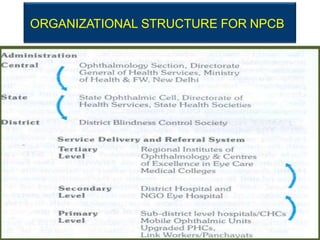
ORGANIZATIONAL STRUCTURE FOR NPCB
10
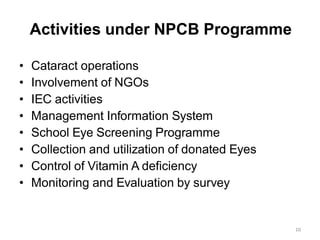
Activities under NPCB Programme
• Cataract operations
• Involvement of NGOs
• IEC activities
• Management Information System
• School Eye Screening Programme
• Collection and utilization of donated Eyes
• Control of Vitamin A deficiency
• Monitoring and Evaluation by survey
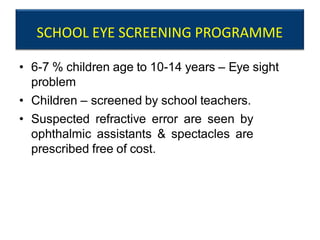
SCHOOL EYE SCREENING PROGRAMME
• 6-7 % children age to 10-14 years – Eye sight
problem
• Children – screened by school teachers.
• Suspected refractive error are seen by
ophthalmic assistants & spectacles are
prescribed free of cost.
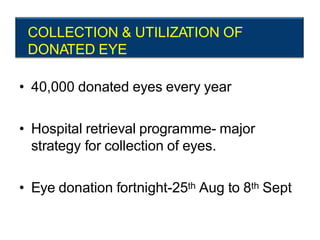
COLLECTION & UTILIZATION OF
DONATED EYE
• 40,000 donated eyes every year
• Hospital retrieval programme- major
strategy for collection of eyes.
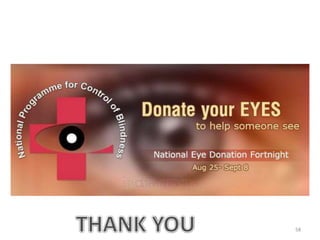
• Eye donation fortnight-25th Aug to 8th Sept
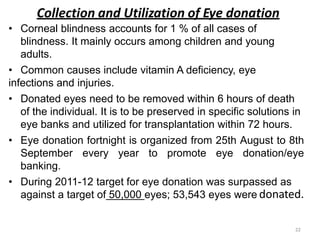
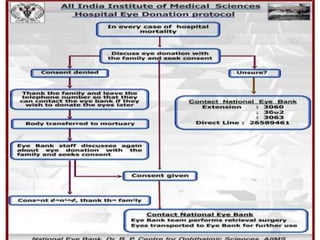
Collection and Utilization of Eye donation
• Corneal blindness accounts for 1 % of all cases of
blindness. It mainly occurs among children and young
adults.
• Common causes include vitamin A deficiency, eye
infections and injuries.
• Donated eyes need to be removed within 6 hours of death
of the individual. It is to be preserved in specific solutions in
eye banks and utilized for transplantation within 72 hours.
• Eye donation fortnight is organized from 25th August to 8th
September every year to promote eye donation/eye
banking.
• During 2011-12 target for eye donation was surpassed as
against a target of 50,000 eyes; 53,543 eyes were donated.
22
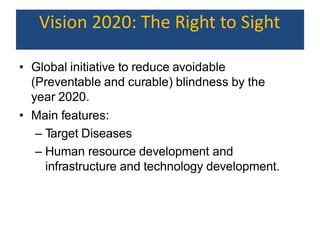
Vision 2020: The Right to Sight
• Global initiative to reduce avoidable
(Preventable and curable) blindness by the
year 2020.
• Main features:
– Target Diseases
– Human resource development and
infrastructure and technology development.
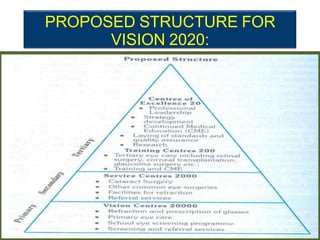
PROPOSED STRUCTURE FOR
VISION 2020:
THE RIGHT TO SIGHT
16
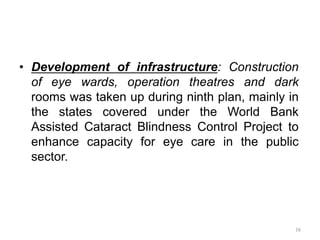
• Development of infrastructure: Construction
of eye wards, operation theatres and dark
rooms was taken up during ninth plan, mainly in
the states covered under the World Bank
Assisted Cataract Blindness Control Project to
enhance capacity for eye care in the public
sector.
New initiatives of the program in 12th
Five Year Plan
17
• Distribution of free spectacles for near work to
old persons suffering from Presbyopia.
• Telemedicine in ophthalmology department
• Provision of multipurpose District Mobile
Ophthalmic Units in all districts all over the
country.
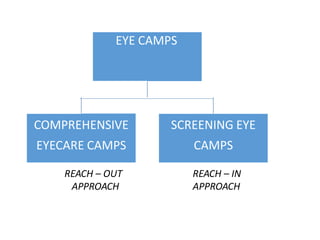
REACH – OUT
APPROACH
REACH – IN
APPROACH
EYE CAMPS
COMPREHENSIVE
EYECARE CAMPS
SCREENING EYE
CAMPS
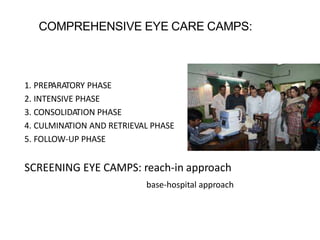
COMPREHENSIVE EYE CARE CAMPS:
1. PREPARATORY PHASE
2. INTENSIVE PHASE
3. CONSOLIDATION PHASE
4. CULMINATION AND RETRIEVAL PHASE
5. FOLLOW-UP PHASE
SCREENING EYE CAMPS: reach-in approach
base-hospital approach
EYE BANKING
Why do we need an Eye Bank ?
EYE BANK:
It is a non-profit community
organization which deals with collection, storage
and distribution of cornea for the purpose of
corneal grafting, research and supply of other eye
tissues for other purposes.
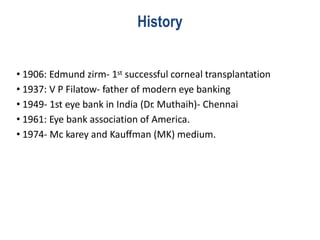
• 1906: Edmund zirm- 1st successful corneal transplantation
• 1937: V P Filatow- father of modern eye banking
• 1949- 1st eye bank in India (Dr. Muthaih)- Chennai
• 1961: Eye bank association of America.
• 1974- Mc karey and Kauffman (MK) medium.
History
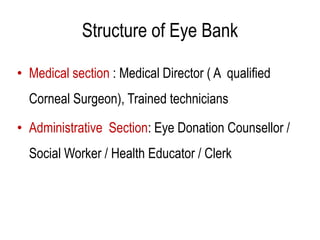
Structure of Eye Bank
• Medical section : Medical Director ( A qualified
Corneal Surgeon), Trained technicians
• Administrative Section: Eye Donation Counsellor /
Social Worker / Health Educator / Clerk
Functions of the Administrative Section
The administrative section is responsible for
- Public awareness programmes
- Liaison with government, local voluntary and
other health care agencies
- Fund raising
Functions of the Medical Section
Medical section deals with the entire technical
operation of the eye bank:
-Tissue harvesting, evaluation, preservation and
distribution.
(maintaining medical quality of highest standard).
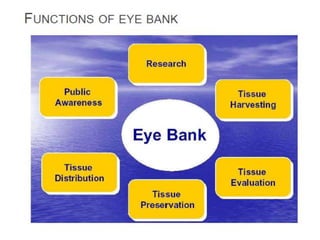
Functions of the Eye Bank
Networking of eye banks under the umbrella of a national
organisation ( e.g. Eye Bank Association of India) allows
-Public education programmes
- Institution of newer eye banking procedures
- Training programmes and
development of uniform medical standards
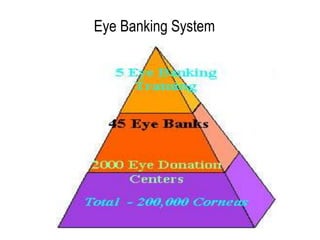
Eye Banking System
Eye Banking System
Eye Donation Center (EDC)
(1) public and professional awareness about eye donation
(2) co-ordinate with donor families and hospitals to motivate eye
donation
(3) to harvest corneal tissue and collect blood for serology
(4) to ensure safe transportation of tissue to the parent eye bank.
Eye Bank (EB)
• Provide a round-the-clock public response system over the telephone
and conduct public awareness programs on eye donation.
• Co-ordinate with donor families and hospitals to motivate eye
donation/Hospital Cornea Retrieval Programs – (HCRP)
• To harvest corneal tissue
• To process, preserve and evaluate the collected tissue
• To distribute tissue in an equitable manner for Keratoplasty
• To ensure safe transportation of tissue
Eye Bank Training Centre (EBTC)
• All of the eye bank functions plus training for all levels of personnel in
eye banking and research.
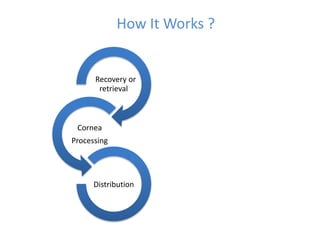
Recovery or
retrieval
Cornea
Processing
Distribution
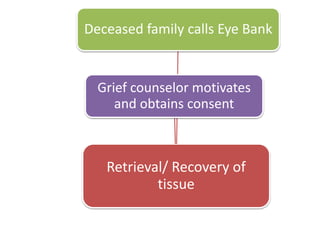
How It Works ?
Retrieval/ Recovery of
tissue
Deceased family calls Eye Bank
Grief counselor motivates
and obtains consent
EYE BANK PERSONNEL:
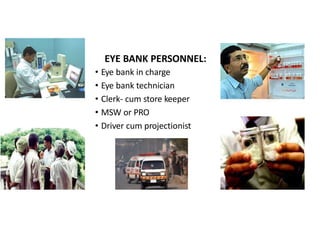
• Eye bank in charge
• Eye bank technician
• Clerk- cum store keeper
• MSW or PRO
• Driver cum projectionist
FACTS ABOUT EYE DONATION
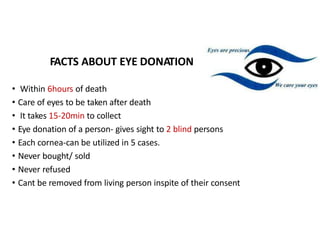
• Within 6hours of death
• Care of eyes to be taken after death
• It takes 15-20min to collect
• Eye donation of a person- gives sight to 2 blind persons
• Each cornea-can be utilized in 5 cases.
• Never bought/ sold
• Never refused
• Cant be removed from living person inspite of their consent
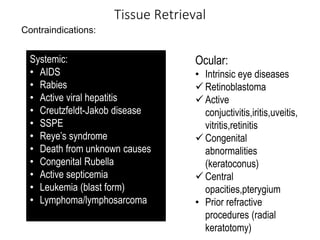
Tissue Retrieval
Contraindications:
Systemic:
• AIDS
• Rabies
• Active viral hepatitis
• Creutzfeldt-Jakob disease
• SSPE
• Reye’s syndrome
• Death from unknown causes
• Congenital Rubella
• Active septicemia
• Leukemia (blast form)
• Lymphoma/lymphosarcoma
Ocular:
• Intrinsic eye diseases
 Retinoblastoma
 Active
conjuctivitis,iritis,uveitis,
vitritis,retinitis
 Congenital
abnormalities
(keratoconus)
 Central
opacities,pterygium
• Prior refractive
procedures (radial
keratotomy)
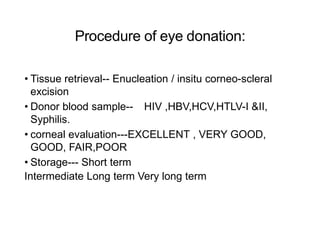
Procedure of eye donation:
• Tissue retrieval-- Enucleation / insitu corneo-scleral
excision
• Donor blood sample-- HIV ,HBV,HCV,HTLV-I &II,
Syphilis.
• corneal evaluation---EXCELLENT , VERY GOOD,
GOOD, FAIR,POOR
• Storage--- Short term
Intermediate Long term Very long term
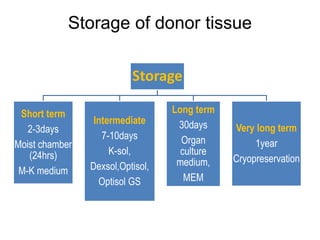
Storage of donor tissue
Storage
Short term
2-3days
Moist chamber
(24hrs)
M-K medium
Intermediate
7-10days
K-sol,
Dexsol,Optisol,
Optisol GS
Long term
30days
Organ
culture
medium,
MEM
Very long term
1year
Cryopreservation
Preservation of cornea
• Long term Organ Culture storage system
 MEM media(minimum essential media)
 Developed by Harry Eagle.
 34 degree C
 Incubated at room temperature in nutrient medium
 Storage period : 30 days
 Advantage: Enables HLA matching
• Very long time preservation:
 Cryopreservation
 1year
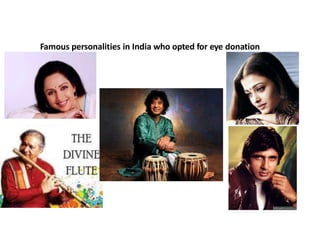
Famous personalities in India who opted for eye donation
MARCH IS NATIONAL EYE DONOR MONTH
EYE DONAION FORTNIGHT- 25th AUGUST TO 8th
SEPTEMBER
WORLD SIGHT DAY- 13th OCTOBER(2nd thursday)
LEGAL ASPECTS IN INDIA
• Under the Transplantation of Human Organs Act, 1994
(THOA)
1. The qualification of doctors permitted to perform
enucleation (surgical eye removal) has been reduced
from MS (Ophth.) to MBBS.
2. Eye donation in India is always decided by the
donor’s surviving relatives and not by the actual
donor.
3. Enucleating doctors always have to legally obtain a
written consent from the relatives of the deceased
before they actually remove the eyes.
EYE Prosthesis
Introduction
• This ocular prosthesis is nothing but a
artificial eye which is used to increase the
aesthetic appearance of an individual who
lost their eye due to some accidents
Note:
• It clearly mentions that, this artificial eye
does not regain the vision
What is ocular prosthesis?
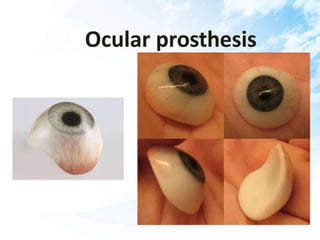
• An ocular prosthesis or artificial eye is a type of
craniofacial prosthesis that replaces an absent natural
eye following an enucleation, evisceration, or orbital
exenteration.
• The prosthesis fits over an orbital implant and under
the eyelids.
Ocular prosthesis
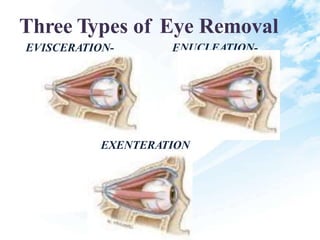
Three Types of Eye Removal
EVISCERATION- ENUCLEATION-
EXENTERATION
Eye implants
Basically , There are two types of implants:
1. Non- integrated implant
2. Integrated implant
Raw Materials for manufacturing
prosthesis
• Plastic
• Wax
• plaster of Paris
• Alginate
• Paints and other decorating materials
Possible Conditions Leading to
anArtificial Eye
• ENUCLEATION
• BLIND, PAINFUL EYE
• OCULAR MELANOMA
• TRAUMA
• RUPTURED GLOBE
• PENETRATING EYE INJURY
• PEFORATING EYE INJURY
• CATARACT
• INFECTION
• VITREOUS HEMORRHAGE
• ENDOPHTHALMITIS
Advantages:
• Inherent biocompactibility and proclivity to
become fibrovascularity integrated with
resiudual muscle and tissue.
• It also minimize the fear of the bacterial infection
Disadvantages
• Extended operative time required to
locate and attach the extraocular muscle
to the motility sphere.
• Cost effective.
Conclusion
• The art of replacing missing eye with a
prosthesis has been carried out many years
and these can be stock or custom made. The
use of an ocular prosthesis of appropriate
size, contour can prove aesthetical value.
• It promotes physical and psychological
healing for the patient and improve social
acceptance.
58

13. npcb,eye camps,eye banking, eye prosthesis

  • 1.
    MEDICAL SURGICAL NURSING-II UNIT – II NURSING MANAGEMENT OF PATIENTS WITH DISORDERS OF EYE TOPIC : NATIONAL PROGRAMME FOR CONTROL OF BLINDNESS, EYE CAMPS, EYE BANKING AND EYE PROSTHESIS PRESENTED BY Mrs. SOUMYA SUBRAMANI, M.Sc.(N) LECTURER, MSN DEPARTMENT CON- SRIPMS, COIMBATORE.
  • 2.
  • 3.
    10 INTRODUCTION • India wasthe first country in the world to launch National Level Blindness Control Programme. • NPCB was launched in 1976 as a 100% centrally sponsored programme. • In 1994-95 programme decentralized with formation of District Blindness Control Society in each district. • Goal- to reduce the prevalence of blindness from 1.4 to 0.3% by 2020.
  • 4.
    4 Objectives of NPCB 1)Tocontinue 3 ongoing signature activities i.e., performance of 66 lacs cataracts operations per year; school eye screening & distribution of 9 lacs free spectacles per year for refractive errors; and collection of 50 thousand donated eyes per year for keratoplasty. 2)To reduce the backlog of avoidable blindness through identification and treatment at primary, secondary and tertiary levels.
  • 5.
    5 Contd……. 3)To develop comprehensiveuniversal eye care services and quality service delivery. 4)Strengthening and upgradation of Regional Institutes of Ophthalmology to Centre of Excellance in various sub-specialities. 5)Strengthening of existing infrastructure facilities and to develop additional human resources for providing eye care in all districts.
  • 6.
    6 Contd…….. 6)To enhance communityawareness on eye care. 7)To increase and expand research for prevention of blindness and visual impairment. 8)To secure participation of voluntary organizations/private practitioners in delivering eye care.
  • 7.
    STRATEGY OF PROGRAMME: •Strengthening service delivery • Developing human resource for eye care • Promoting out-reach activities & public awareness • Developing institutional capacity • To establish eye care facilities for every 5 lac persons.
  • 8.
    REVISED STRATEGIES: • Morecomprehensive by strengthening services for other causes of blindness • To shift from eye camp approach to fixed facility surgical approach and from conventional surgery to IOL implantation. • To expand World bank project like building eye care infrastructure all over country • To strengthen the participation of Voluntary organization in programme and to earmark geographical areas to NGOs. • To enhance coverage of eye care services in tribal and other under served areas
  • 9.
  • 10.
    10 Activities under NPCBProgramme • Cataract operations • Involvement of NGOs • IEC activities • Management Information System • School Eye Screening Programme • Collection and utilization of donated Eyes • Control of Vitamin A deficiency • Monitoring and Evaluation by survey
  • 11.
    SCHOOL EYE SCREENINGPROGRAMME • 6-7 % children age to 10-14 years – Eye sight problem • Children – screened by school teachers. • Suspected refractive error are seen by ophthalmic assistants & spectacles are prescribed free of cost.
  • 12.
    COLLECTION & UTILIZATIONOF DONATED EYE • 40,000 donated eyes every year • Hospital retrieval programme- major strategy for collection of eyes. • Eye donation fortnight-25th Aug to 8th Sept
  • 13.
    Collection and Utilizationof Eye donation • Corneal blindness accounts for 1 % of all cases of blindness. It mainly occurs among children and young adults. • Common causes include vitamin A deficiency, eye infections and injuries. • Donated eyes need to be removed within 6 hours of death of the individual. It is to be preserved in specific solutions in eye banks and utilized for transplantation within 72 hours. • Eye donation fortnight is organized from 25th August to 8th September every year to promote eye donation/eye banking. • During 2011-12 target for eye donation was surpassed as against a target of 50,000 eyes; 53,543 eyes were donated. 22
  • 14.
    Vision 2020: TheRight to Sight • Global initiative to reduce avoidable (Preventable and curable) blindness by the year 2020. • Main features: – Target Diseases – Human resource development and infrastructure and technology development.
  • 15.
    PROPOSED STRUCTURE FOR VISION2020: THE RIGHT TO SIGHT
  • 16.
    16 • Development ofinfrastructure: Construction of eye wards, operation theatres and dark rooms was taken up during ninth plan, mainly in the states covered under the World Bank Assisted Cataract Blindness Control Project to enhance capacity for eye care in the public sector.
  • 17.
    New initiatives ofthe program in 12th Five Year Plan 17 • Distribution of free spectacles for near work to old persons suffering from Presbyopia. • Telemedicine in ophthalmology department • Provision of multipurpose District Mobile Ophthalmic Units in all districts all over the country.
  • 18.
    REACH – OUT APPROACH REACH– IN APPROACH EYE CAMPS COMPREHENSIVE EYECARE CAMPS SCREENING EYE CAMPS
  • 19.
    COMPREHENSIVE EYE CARECAMPS: 1. PREPARATORY PHASE 2. INTENSIVE PHASE 3. CONSOLIDATION PHASE 4. CULMINATION AND RETRIEVAL PHASE 5. FOLLOW-UP PHASE SCREENING EYE CAMPS: reach-in approach base-hospital approach
  • 20.
  • 21.
    Why do weneed an Eye Bank ?
  • 23.
    EYE BANK: It isa non-profit community organization which deals with collection, storage and distribution of cornea for the purpose of corneal grafting, research and supply of other eye tissues for other purposes.
  • 24.
    • 1906: Edmundzirm- 1st successful corneal transplantation • 1937: V P Filatow- father of modern eye banking • 1949- 1st eye bank in India (Dr. Muthaih)- Chennai • 1961: Eye bank association of America. • 1974- Mc karey and Kauffman (MK) medium. History
  • 25.
    Structure of EyeBank • Medical section : Medical Director ( A qualified Corneal Surgeon), Trained technicians • Administrative Section: Eye Donation Counsellor / Social Worker / Health Educator / Clerk
  • 26.
    Functions of theAdministrative Section The administrative section is responsible for - Public awareness programmes - Liaison with government, local voluntary and other health care agencies - Fund raising
  • 27.
    Functions of theMedical Section Medical section deals with the entire technical operation of the eye bank: -Tissue harvesting, evaluation, preservation and distribution. (maintaining medical quality of highest standard).
  • 28.
    Functions of theEye Bank Networking of eye banks under the umbrella of a national organisation ( e.g. Eye Bank Association of India) allows -Public education programmes - Institution of newer eye banking procedures - Training programmes and development of uniform medical standards
  • 30.
  • 31.
    Eye Banking System EyeDonation Center (EDC) (1) public and professional awareness about eye donation (2) co-ordinate with donor families and hospitals to motivate eye donation (3) to harvest corneal tissue and collect blood for serology (4) to ensure safe transportation of tissue to the parent eye bank.
  • 32.
    Eye Bank (EB) •Provide a round-the-clock public response system over the telephone and conduct public awareness programs on eye donation. • Co-ordinate with donor families and hospitals to motivate eye donation/Hospital Cornea Retrieval Programs – (HCRP) • To harvest corneal tissue • To process, preserve and evaluate the collected tissue • To distribute tissue in an equitable manner for Keratoplasty • To ensure safe transportation of tissue Eye Bank Training Centre (EBTC) • All of the eye bank functions plus training for all levels of personnel in eye banking and research.
  • 33.
  • 35.
    Retrieval/ Recovery of tissue Deceasedfamily calls Eye Bank Grief counselor motivates and obtains consent
  • 36.
    EYE BANK PERSONNEL: •Eye bank in charge • Eye bank technician • Clerk- cum store keeper • MSW or PRO • Driver cum projectionist
  • 37.
    FACTS ABOUT EYEDONATION • Within 6hours of death • Care of eyes to be taken after death • It takes 15-20min to collect • Eye donation of a person- gives sight to 2 blind persons • Each cornea-can be utilized in 5 cases. • Never bought/ sold • Never refused • Cant be removed from living person inspite of their consent
  • 38.
    Tissue Retrieval Contraindications: Systemic: • AIDS •Rabies • Active viral hepatitis • Creutzfeldt-Jakob disease • SSPE • Reye’s syndrome • Death from unknown causes • Congenital Rubella • Active septicemia • Leukemia (blast form) • Lymphoma/lymphosarcoma Ocular: • Intrinsic eye diseases  Retinoblastoma  Active conjuctivitis,iritis,uveitis, vitritis,retinitis  Congenital abnormalities (keratoconus)  Central opacities,pterygium • Prior refractive procedures (radial keratotomy)
  • 39.
    Procedure of eyedonation: • Tissue retrieval-- Enucleation / insitu corneo-scleral excision • Donor blood sample-- HIV ,HBV,HCV,HTLV-I &II, Syphilis. • corneal evaluation---EXCELLENT , VERY GOOD, GOOD, FAIR,POOR • Storage--- Short term Intermediate Long term Very long term
  • 40.
    Storage of donortissue Storage Short term 2-3days Moist chamber (24hrs) M-K medium Intermediate 7-10days K-sol, Dexsol,Optisol, Optisol GS Long term 30days Organ culture medium, MEM Very long term 1year Cryopreservation
  • 41.
    Preservation of cornea •Long term Organ Culture storage system  MEM media(minimum essential media)  Developed by Harry Eagle.  34 degree C  Incubated at room temperature in nutrient medium  Storage period : 30 days  Advantage: Enables HLA matching • Very long time preservation:  Cryopreservation  1year
  • 42.
    Famous personalities inIndia who opted for eye donation
  • 43.
    MARCH IS NATIONALEYE DONOR MONTH EYE DONAION FORTNIGHT- 25th AUGUST TO 8th SEPTEMBER WORLD SIGHT DAY- 13th OCTOBER(2nd thursday)
  • 44.
    LEGAL ASPECTS ININDIA • Under the Transplantation of Human Organs Act, 1994 (THOA) 1. The qualification of doctors permitted to perform enucleation (surgical eye removal) has been reduced from MS (Ophth.) to MBBS. 2. Eye donation in India is always decided by the donor’s surviving relatives and not by the actual donor. 3. Enucleating doctors always have to legally obtain a written consent from the relatives of the deceased before they actually remove the eyes.
  • 47.
  • 48.
    Introduction • This ocularprosthesis is nothing but a artificial eye which is used to increase the aesthetic appearance of an individual who lost their eye due to some accidents Note: • It clearly mentions that, this artificial eye does not regain the vision
  • 49.
    What is ocularprosthesis? • An ocular prosthesis or artificial eye is a type of craniofacial prosthesis that replaces an absent natural eye following an enucleation, evisceration, or orbital exenteration. • The prosthesis fits over an orbital implant and under the eyelids.
  • 50.
  • 51.
    Three Types ofEye Removal EVISCERATION- ENUCLEATION- EXENTERATION
  • 52.
    Eye implants Basically ,There are two types of implants: 1. Non- integrated implant 2. Integrated implant
  • 53.
    Raw Materials formanufacturing prosthesis • Plastic • Wax • plaster of Paris • Alginate • Paints and other decorating materials
  • 54.
    Possible Conditions Leadingto anArtificial Eye • ENUCLEATION • BLIND, PAINFUL EYE • OCULAR MELANOMA • TRAUMA • RUPTURED GLOBE • PENETRATING EYE INJURY • PEFORATING EYE INJURY • CATARACT • INFECTION • VITREOUS HEMORRHAGE • ENDOPHTHALMITIS
  • 55.
    Advantages: • Inherent biocompactibilityand proclivity to become fibrovascularity integrated with resiudual muscle and tissue. • It also minimize the fear of the bacterial infection
  • 56.
    Disadvantages • Extended operativetime required to locate and attach the extraocular muscle to the motility sphere. • Cost effective.
  • 57.
    Conclusion • The artof replacing missing eye with a prosthesis has been carried out many years and these can be stock or custom made. The use of an ocular prosthesis of appropriate size, contour can prove aesthetical value. • It promotes physical and psychological healing for the patient and improve social acceptance.
  • 58.