C NJUNCTIVITIS
Prepared by:
Inas
Samna
Nathasha
Nazeeha
Ilhama
OBJECTIVES
• At the end of the presentation the audience will have an idea about;
• What is conjunctivitis
• Types of conjunctivitis
• Microbial conjunctivitis
• Allergic conjunctivitis
• Toxic conjunctivitis
• Sign and symptoms
• Medical management
• Nursing management
• Prevention
• Conjunctivitis in babies and children
• Effects and disorders in elderly people
• Home remedies to treat conjunctivitis
CONTENT• What is conjunctivitis
• Types of conjunctivitis
• Microbial conjunctivitis
• Allergic conjunctivitis
• Toxic conjunctivitis
• Sign and symptoms
• Medical management
• Nursing management
• Prevention
• Conjunctivitis in babies and children
• Effects and disorders in elderly people
• Home remedies to treat conjunctivitis
CONJUNCTIVITIS
• The conjunctiva is a thin
membrane that covers the inner
surface of the eyelid and the white
part of the eyeball(sclera).
• Inflammation of the conjunctiva is
called conjunctivitis, which makes
the white of the eye appear red.
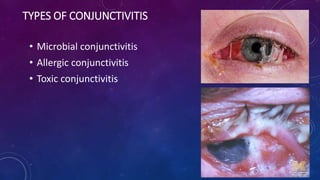
TYPES OF CONJUNCTIVITIS
• Microbial conjunctivitis
• Allergic conjunctivitis
• Toxic conjunctivitis
MICROBIAL CONJUNCTIVITIS
• Bacterial conjunctivitis is one of the most commonly encountered eye
problems in medicine.
• Most cases are acute, self-limited, and not a major cause of morbidity.
• However, because of its high prevalence, it has a large societal impact in
terms of missed days of school or work.
• Antibiotics can hasten the resolution of symptoms and microbial
eradication and are therefore typically used to allow patients to return to
their daily activities faster and to decrease the spread of disease.
ALLERGIC CONJUNCTIVITIS
• Allergic conjunctivitis is an eye inflammation caused by an allergic reaction
to substances like pollen or mold spores.
• The inside of your eyelids and the covering of your eyeball have a
membrane called the conjunctiva.
• The conjunctiva is susceptible to irritation from allergens, especially during
hay fever season.
TOXIC CONJUNCTIVITIS
• Toxic conjunctivitis typically occurs with protracted use of topical ocular
medications .
• The reaction may take days to years to develop. There also appears to be a
dose-response effect with regard to the preservative concentration and total
amount of preservative-containing medications used
• It implies direct damage to ocular tissues from an offending agent, usually a
preservative or medication.
Allergic conjunctivitis
SIGN AND SYMPTOMS
• Tenderness of the eye, or pain (which can be severe in the cases of irritant
conjunctivitis)
• Itchiness
• Body aches
• Photophobia
• Discomfort in the eye
• Redness of the eye or inner eyelids
• Discharge and teariness
• Discharge may cause eyelids to crust and stick together while sleeping
• Swelling of the eyelids
• Infection usually begins with one eye, but can quickly spread to other eye in
cases of viral or bacterial conjunctivitis
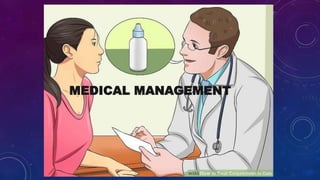
MEDICAL MANAGEMENT
MEDICAL MANAGEMENT
• The management of conjunctivitis depends on the type. Most types of mild
and viral conjunctivitis are self-limiting, benign conditions that may not
require treatment and laboratory procedures.
• For more severe cases, topical antibiotics, eye drops or ointment are
prescribed.
• Patients with allergic conjunctivitis especially recurrent or seasonal
conjunctivitis are usually given corticosteroids in ophthalmic preparations.
• Use of vasoconstrictors such as topical epinephrine solution, cold
compresses, ice packs, and cool ventilation usually provide comfort by
decreasing swelling.
• For conjunctivitis caused by chemical irritants, the eye must be irrigated
immediately and profusely with saline or sterile water.
NURSING MANAGEMENT
• Eye will look red and will have watery discharge and lids will be swollen
for about a week.
• Will experience eye pain, a sandy sensation in the eye, and sensitivity
to light
• Symptoms will resolve after about 1 week
• May use light cold compresses over the eye for about 10 minutes four
to five times a day to soothe the pain
• May use artificial tears for the sandy sensation in the eye and mild pain
medications such as acetaminophen
• Need to stay at home. Children must not play outside. May return to
work or school after 7 days when the redness and discharge have
cleared.
• Do not share towels, linens, make up or toys
• Wash hands thoroughly with soap and water frequently, including
and before and after applying artificial tears or cold compresses.
• Use a new tissue every time you wipe the discharge from the eye.
May dampen the tissue with clean water to clean the outside of the
eye
• May wash face and take a shower as normally do
• Discard all make up articles. Must not apply make up until the disease
is over
• May weak dark glasses if bright lights bother
• If the discharge from the eyes turns yellowish and puslike or
experience changes in the vision, need to return to the health care
providers for an examination.
Nursing Management (cont…..)
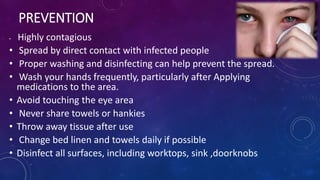
PREVENTION
• Highly contagious
• Spread by direct contact with infected people
• Proper washing and disinfecting can help prevent the spread.
• Wash your hands frequently, particularly after Applying
medications to the area.
• Avoid touching the eye area
• Never share towels or hankies
• Throw away tissue after use
• Change bed linen and towels daily if possible
• Disinfect all surfaces, including worktops, sink ,doorknobs
Conjunctivitis in Babies & Children
• Newborns are very susceptible to pink eye, especially if the
mother has an STD. It is very easy for bacteria or virus to pass
through the birth canal into the baby's eyes, thus causing pink
eye. Also, some babies are born with a very small tear duct, this
tear duct can become blocked and lead to conjunctivitis.
• Pregnant women should get screened for bacteria laden
STD’s to ensure the health of their unborn baby.
• School aged children seem to be affected by conjunctivitis a lot; this is due to
the constant interaction with other children and the lack of proper hygiene
knowledge. Alternatively, pink eye is obtained from allergies.
• Children who have frequent allergic reactions to substances such as, ragweed,
pollen, grass and animal dander are at risk. In addition, outside irritants or
chemicals like chlorine, smoke, smog, fumes, and soaps can all cause pink eye in
children.
EFFECTS AND DISORDERS IN THE ELDERLY PEOPLE
• They are at more risk of getting conjunctivitis. Because they
have lower immune response.
• They make more time to get better cause of low immunity and
it may worsen.
HOME REMEDIES CONJUNCTIVITIS
• Add a few drops of honey to your eye wash as honey has
antibacterial properties. Honey will also soothe the eye and
promote faster healing.
• Grate a potato and place on the affected eye for 15 minutes.
Potato is a natural astringent and will help reduce eye
inflammation.
• Replace the water of your eyewash or compress with warm milk
THANK YOU!!!
Safety and Health
our Concern
REFERENCE
• https://www.uptodate.com/contents/toxic-conjunctivitis
• https://www.rnpedia.com/nursing-notes/medical-surgical-nursing-notes/conjunctivitis-nursing-
management/
• http://nursingfile.com/nursing-care-plan/nursing-interventions/nursing-interventions-for-
conjunctivitis.html
• https://www.webmd.com/eye-health/tc/pinkeye-home-treatment#1
• https://www.nativeremedies.com/ailment/pink-eye-symptoms.html

Conjunctivitis

  • 1.
  • 2.
    OBJECTIVES • At theend of the presentation the audience will have an idea about; • What is conjunctivitis • Types of conjunctivitis • Microbial conjunctivitis • Allergic conjunctivitis • Toxic conjunctivitis • Sign and symptoms • Medical management • Nursing management • Prevention • Conjunctivitis in babies and children • Effects and disorders in elderly people • Home remedies to treat conjunctivitis
  • 3.
    CONTENT• What isconjunctivitis • Types of conjunctivitis • Microbial conjunctivitis • Allergic conjunctivitis • Toxic conjunctivitis • Sign and symptoms • Medical management • Nursing management • Prevention • Conjunctivitis in babies and children • Effects and disorders in elderly people • Home remedies to treat conjunctivitis
  • 4.
    CONJUNCTIVITIS • The conjunctivais a thin membrane that covers the inner surface of the eyelid and the white part of the eyeball(sclera). • Inflammation of the conjunctiva is called conjunctivitis, which makes the white of the eye appear red.
  • 5.
    TYPES OF CONJUNCTIVITIS •Microbial conjunctivitis • Allergic conjunctivitis • Toxic conjunctivitis
  • 6.
    MICROBIAL CONJUNCTIVITIS • Bacterialconjunctivitis is one of the most commonly encountered eye problems in medicine. • Most cases are acute, self-limited, and not a major cause of morbidity. • However, because of its high prevalence, it has a large societal impact in terms of missed days of school or work. • Antibiotics can hasten the resolution of symptoms and microbial eradication and are therefore typically used to allow patients to return to their daily activities faster and to decrease the spread of disease.
  • 7.
    ALLERGIC CONJUNCTIVITIS • Allergicconjunctivitis is an eye inflammation caused by an allergic reaction to substances like pollen or mold spores. • The inside of your eyelids and the covering of your eyeball have a membrane called the conjunctiva. • The conjunctiva is susceptible to irritation from allergens, especially during hay fever season.
  • 8.
    TOXIC CONJUNCTIVITIS • Toxicconjunctivitis typically occurs with protracted use of topical ocular medications . • The reaction may take days to years to develop. There also appears to be a dose-response effect with regard to the preservative concentration and total amount of preservative-containing medications used • It implies direct damage to ocular tissues from an offending agent, usually a preservative or medication.
  • 9.
  • 10.
    SIGN AND SYMPTOMS •Tenderness of the eye, or pain (which can be severe in the cases of irritant conjunctivitis) • Itchiness • Body aches • Photophobia • Discomfort in the eye • Redness of the eye or inner eyelids • Discharge and teariness • Discharge may cause eyelids to crust and stick together while sleeping • Swelling of the eyelids • Infection usually begins with one eye, but can quickly spread to other eye in cases of viral or bacterial conjunctivitis
  • 11.
  • 12.
    MEDICAL MANAGEMENT • Themanagement of conjunctivitis depends on the type. Most types of mild and viral conjunctivitis are self-limiting, benign conditions that may not require treatment and laboratory procedures. • For more severe cases, topical antibiotics, eye drops or ointment are prescribed. • Patients with allergic conjunctivitis especially recurrent or seasonal conjunctivitis are usually given corticosteroids in ophthalmic preparations. • Use of vasoconstrictors such as topical epinephrine solution, cold compresses, ice packs, and cool ventilation usually provide comfort by decreasing swelling. • For conjunctivitis caused by chemical irritants, the eye must be irrigated immediately and profusely with saline or sterile water.
  • 13.
    NURSING MANAGEMENT • Eyewill look red and will have watery discharge and lids will be swollen for about a week. • Will experience eye pain, a sandy sensation in the eye, and sensitivity to light • Symptoms will resolve after about 1 week • May use light cold compresses over the eye for about 10 minutes four to five times a day to soothe the pain • May use artificial tears for the sandy sensation in the eye and mild pain medications such as acetaminophen • Need to stay at home. Children must not play outside. May return to work or school after 7 days when the redness and discharge have cleared.
  • 14.
    • Do notshare towels, linens, make up or toys • Wash hands thoroughly with soap and water frequently, including and before and after applying artificial tears or cold compresses. • Use a new tissue every time you wipe the discharge from the eye. May dampen the tissue with clean water to clean the outside of the eye • May wash face and take a shower as normally do • Discard all make up articles. Must not apply make up until the disease is over • May weak dark glasses if bright lights bother • If the discharge from the eyes turns yellowish and puslike or experience changes in the vision, need to return to the health care providers for an examination. Nursing Management (cont…..)
  • 15.
    PREVENTION • Highly contagious •Spread by direct contact with infected people • Proper washing and disinfecting can help prevent the spread. • Wash your hands frequently, particularly after Applying medications to the area. • Avoid touching the eye area • Never share towels or hankies • Throw away tissue after use • Change bed linen and towels daily if possible • Disinfect all surfaces, including worktops, sink ,doorknobs
  • 16.
    Conjunctivitis in Babies& Children • Newborns are very susceptible to pink eye, especially if the mother has an STD. It is very easy for bacteria or virus to pass through the birth canal into the baby's eyes, thus causing pink eye. Also, some babies are born with a very small tear duct, this tear duct can become blocked and lead to conjunctivitis. • Pregnant women should get screened for bacteria laden STD’s to ensure the health of their unborn baby. • School aged children seem to be affected by conjunctivitis a lot; this is due to the constant interaction with other children and the lack of proper hygiene knowledge. Alternatively, pink eye is obtained from allergies. • Children who have frequent allergic reactions to substances such as, ragweed, pollen, grass and animal dander are at risk. In addition, outside irritants or chemicals like chlorine, smoke, smog, fumes, and soaps can all cause pink eye in children.
  • 17.
    EFFECTS AND DISORDERSIN THE ELDERLY PEOPLE • They are at more risk of getting conjunctivitis. Because they have lower immune response. • They make more time to get better cause of low immunity and it may worsen.
  • 18.
    HOME REMEDIES CONJUNCTIVITIS •Add a few drops of honey to your eye wash as honey has antibacterial properties. Honey will also soothe the eye and promote faster healing. • Grate a potato and place on the affected eye for 15 minutes. Potato is a natural astringent and will help reduce eye inflammation. • Replace the water of your eyewash or compress with warm milk
  • 19.
    THANK YOU!!! Safety andHealth our Concern
  • 20.
    REFERENCE • https://www.uptodate.com/contents/toxic-conjunctivitis • https://www.rnpedia.com/nursing-notes/medical-surgical-nursing-notes/conjunctivitis-nursing- management/ •http://nursingfile.com/nursing-care-plan/nursing-interventions/nursing-interventions-for- conjunctivitis.html • https://www.webmd.com/eye-health/tc/pinkeye-home-treatment#1 • https://www.nativeremedies.com/ailment/pink-eye-symptoms.html