SEMINAR ON – REFRACTIVE ERROR
PRESENTED BY-HIMASHRI KUMAR
ROLL NO-18
CLASS – BSC NURSING 4TH
SEMISTER
SUBJECT –ADULT HEALTH NURSING 2
INTRODUCTION-
DEFINITION-
• A refractive error is a very common eye disorder. It occurs
when the eye cannot clearly focused the image from the
outside world. The result of refractive error is blurred vision
which is sometimes so severe that it causes visual
impairment.
• Refractive error also known as refraction error is a problem
with focusing light accurately on the ratina due to the
shape of eye
PREVALENCE-
• The overall prevalence of refractive error per 100
children was 8.0 and in schools it was 10.8 . The
population – based prevalence of myopia ,
hyperopia and astigmatism was 5.3 %, 4.0% and5.4%
respectively.
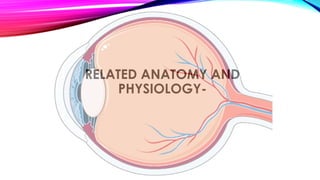
RELATED ANATOMY AND
PHYSIOLOGY-
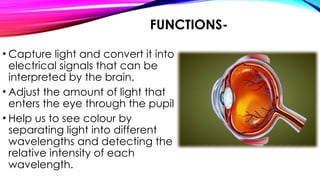
FUNCTIONS-
• Capture light and convert it into
electrical signals that can be
interpreted by the brain.
• Adjust the amount of light that
enters the eye through the pupil
• Help us to see colour by
separating light into different
wavelengths and detecting the
relative intensity of each
wavelength.
TYPES OF REFRACTIVE ERRORS-
1. Myopia
2. Hyperopia
3. Astigmatism
4. presbyopia
TYPES OF REFRACTIVE ERRORS-
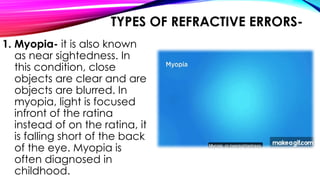
1. Myopia- it is also known
as near sightedness. In
this condition, close
objects are clear and are
objects are blurred. In
myopia, light is focused
infront of the ratina
instead of on the ratina, it
is falling short of the back
of the eye. Myopia is
often diagnosed in
childhood.
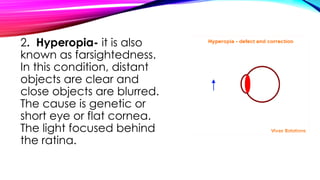
2. Hyperopia- it is also
known as farsightedness.
In this condition, distant
objects are clear and
close objects are blurred.
The cause is genetic or
short eye or flat cornea.
The light focused behind
the ratina.
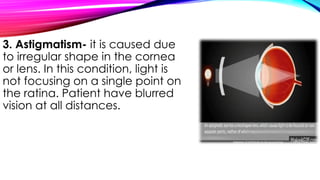
3. Astigmatism- it is caused due
to irregular shape in the cornea
or lens. In this condition, light is
not focusing on a single point on
the ratina. Patient have blurred
vision at all distances.
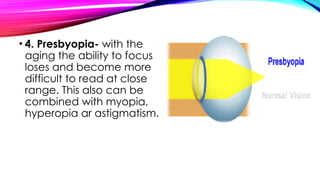
• 4. Presbyopia- with the
aging the ability to focus
loses and become more
difficult to read at close
range. This also can be
combined with myopia,
hyperopia ar astigmatism.
ETIOLOGY-
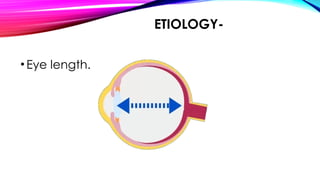
•Eye length.
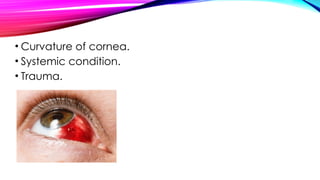
• Curvature of cornea.
• Systemic condition.
• Trauma.
CLINICAL MANIFESTATION-
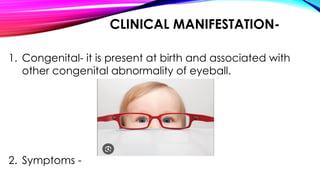
1. Congenital- it is present at birth and associated with
other congenital abnormality of eyeball.
2. Symptoms -
DIAGNOSTIC EVALUATION-
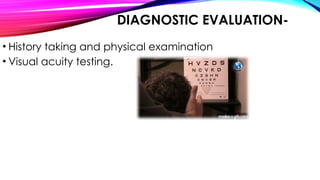
• History taking and physical examination
• Visual acuity testing.
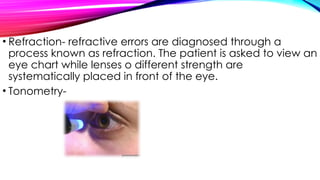
• Refraction- refractive errors are diagnosed through a
process known as refraction. The patient is asked to view an
eye chart while lenses o different strength are
systematically placed in front of the eye.
• Tonometry-
• Retinoscopy-
MEDICAL MANAGEMENT-
• Pharmacological management-
1. Cycloplegic drugs are used to refraction.(to
paralyze the ciliary muscle in order to determine
the true refractive error of eye)
2. Cholinergien- pilocarpine, carbachol- it increases
aqueous fluid outflow by contracting the ciliary
muscles.
3. Beta-blockers – betaxolol, timolol, decreases
aqueous humor production
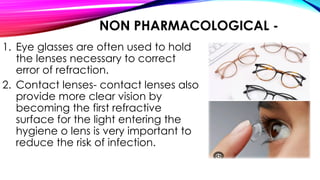
NON PHARMACOLOGICAL -
1. Eye glasses are often used to hold
the lenses necessary to correct
error of refraction.
2. Contact lenses- contact lenses also
provide more clear vision by
becoming the first refractive
surface for the light entering the
hygiene o lens is very important to
reduce the risk of infection.
SURGICAL MANAGEMENT-
•Radial keratotomy- radial keratotomy is a surgical
procedure that was used in the past to correct
nearsightedness(myopia). It involve making radial
incisions(cuts) into the cornea, which is the clear
front part of the eye. These incisions are arranged in
a spoke- like pattern, which flattens the cornea and
reduces its focusing power, thereby correcting the
refractive error.
• Epikeratophakia- it is a surgical procedure that was
developed to correct refractive errors, particularly
myopia( nearsightedness) and hyperopia
• procedure-
A thin layer of corneal tissue from a donor eye is
saved to the desired curvature using a
microkeratome or excimer laser.
This donor tissue is then placed on the patient’s
cornea and secured in place with sutures or tissue
adhesive.
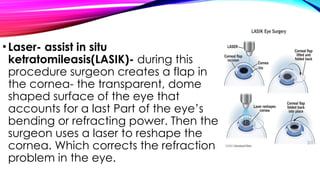
•Laser- assist in situ
ketratomileasis(LASIK)- during this
procedure surgeon creates a flap in
the cornea- the transparent, dome
shaped surface of the eye that
accounts for a last Part of the eye’s
bending or refracting power. Then the
surgeon uses a laser to reshape the
cornea. Which corrects the refraction
problem in the eye.
NURSING MANAGEMENT-
• Nursing assessment-
1. Assess the general condition of the eye of the
patient.
2. Identify the causes of refractive error.
3. Advice the patient regarding the use of lens.
4. Advice the patient not to rub the eyes.
5. Teach the patient to avoid itching in eyes.
NURSING DIAGNOSIS-
1. Disturbed sleeping pattern related to headache.
2. Activity intolerance related to vision difficulty.
3. Deficit knowledge related to disorder’s sign and
symptoms
4. Anxiety related to surgical management.
COMPLICATION-
•Corneal edemacan happen after an injury or an
infection.
•Corneal abrasion
•Dryness of epithelium
•Irritation
HEALTH EDUCATION-
1. Take well balance diet.
2. Avoid putting eye strain.
3. Make use of eye glasses as
advised by doctor.
4. Teach patient about use and
care of contact lens.
5. Advice parents to bring child for
refraction screening at eye
clinic.
6. Follow- up the regular
medication.
PROGNOSIS-
•The prognosis for refractive error, like
nearsightedness, farsightedness and
astigmatism is generally good. The can often
be corrected with glasses, contact lenses or
refractive surgery. However, the exact
prognosis depends on factors such as the
severity of the error, the individual is an any
underlying eye condition. Regular eye exams
are crusial for monitoring and managing
refractives errors effectively.
CONCLUSION-
refractive error.pptx reference nursing e

refractive error.pptx reference nursing e

  • 1.
    SEMINAR ON –REFRACTIVE ERROR PRESENTED BY-HIMASHRI KUMAR ROLL NO-18 CLASS – BSC NURSING 4TH SEMISTER SUBJECT –ADULT HEALTH NURSING 2
  • 2.
  • 3.
    DEFINITION- • A refractiveerror is a very common eye disorder. It occurs when the eye cannot clearly focused the image from the outside world. The result of refractive error is blurred vision which is sometimes so severe that it causes visual impairment. • Refractive error also known as refraction error is a problem with focusing light accurately on the ratina due to the shape of eye
  • 4.
    PREVALENCE- • The overallprevalence of refractive error per 100 children was 8.0 and in schools it was 10.8 . The population – based prevalence of myopia , hyperopia and astigmatism was 5.3 %, 4.0% and5.4% respectively.
  • 5.
  • 6.
    FUNCTIONS- • Capture lightand convert it into electrical signals that can be interpreted by the brain. • Adjust the amount of light that enters the eye through the pupil • Help us to see colour by separating light into different wavelengths and detecting the relative intensity of each wavelength.
  • 7.
    TYPES OF REFRACTIVEERRORS- 1. Myopia 2. Hyperopia 3. Astigmatism 4. presbyopia
  • 8.
    TYPES OF REFRACTIVEERRORS- 1. Myopia- it is also known as near sightedness. In this condition, close objects are clear and are objects are blurred. In myopia, light is focused infront of the ratina instead of on the ratina, it is falling short of the back of the eye. Myopia is often diagnosed in childhood.
  • 9.
    2. Hyperopia- itis also known as farsightedness. In this condition, distant objects are clear and close objects are blurred. The cause is genetic or short eye or flat cornea. The light focused behind the ratina.
  • 10.
    3. Astigmatism- itis caused due to irregular shape in the cornea or lens. In this condition, light is not focusing on a single point on the ratina. Patient have blurred vision at all distances.
  • 11.
    • 4. Presbyopia-with the aging the ability to focus loses and become more difficult to read at close range. This also can be combined with myopia, hyperopia ar astigmatism.
  • 12.
  • 13.
    • Curvature ofcornea. • Systemic condition. • Trauma.
  • 16.
    CLINICAL MANIFESTATION- 1. Congenital-it is present at birth and associated with other congenital abnormality of eyeball. 2. Symptoms -
  • 17.
    DIAGNOSTIC EVALUATION- • Historytaking and physical examination • Visual acuity testing.
  • 18.
    • Refraction- refractiveerrors are diagnosed through a process known as refraction. The patient is asked to view an eye chart while lenses o different strength are systematically placed in front of the eye. • Tonometry-
  • 19.
  • 20.
    MEDICAL MANAGEMENT- • Pharmacologicalmanagement- 1. Cycloplegic drugs are used to refraction.(to paralyze the ciliary muscle in order to determine the true refractive error of eye) 2. Cholinergien- pilocarpine, carbachol- it increases aqueous fluid outflow by contracting the ciliary muscles. 3. Beta-blockers – betaxolol, timolol, decreases aqueous humor production
  • 21.
    NON PHARMACOLOGICAL - 1.Eye glasses are often used to hold the lenses necessary to correct error of refraction. 2. Contact lenses- contact lenses also provide more clear vision by becoming the first refractive surface for the light entering the hygiene o lens is very important to reduce the risk of infection.
  • 22.
  • 23.
    •Radial keratotomy- radialkeratotomy is a surgical procedure that was used in the past to correct nearsightedness(myopia). It involve making radial incisions(cuts) into the cornea, which is the clear front part of the eye. These incisions are arranged in a spoke- like pattern, which flattens the cornea and reduces its focusing power, thereby correcting the refractive error.
  • 24.
    • Epikeratophakia- itis a surgical procedure that was developed to correct refractive errors, particularly myopia( nearsightedness) and hyperopia • procedure- A thin layer of corneal tissue from a donor eye is saved to the desired curvature using a microkeratome or excimer laser. This donor tissue is then placed on the patient’s cornea and secured in place with sutures or tissue adhesive.
  • 25.
    •Laser- assist insitu ketratomileasis(LASIK)- during this procedure surgeon creates a flap in the cornea- the transparent, dome shaped surface of the eye that accounts for a last Part of the eye’s bending or refracting power. Then the surgeon uses a laser to reshape the cornea. Which corrects the refraction problem in the eye.
  • 26.
    NURSING MANAGEMENT- • Nursingassessment- 1. Assess the general condition of the eye of the patient. 2. Identify the causes of refractive error. 3. Advice the patient regarding the use of lens. 4. Advice the patient not to rub the eyes. 5. Teach the patient to avoid itching in eyes.
  • 27.
    NURSING DIAGNOSIS- 1. Disturbedsleeping pattern related to headache. 2. Activity intolerance related to vision difficulty. 3. Deficit knowledge related to disorder’s sign and symptoms 4. Anxiety related to surgical management.
  • 28.
    COMPLICATION- •Corneal edemacan happenafter an injury or an infection. •Corneal abrasion •Dryness of epithelium •Irritation
  • 29.
    HEALTH EDUCATION- 1. Takewell balance diet. 2. Avoid putting eye strain. 3. Make use of eye glasses as advised by doctor. 4. Teach patient about use and care of contact lens. 5. Advice parents to bring child for refraction screening at eye clinic. 6. Follow- up the regular medication.
  • 30.
    PROGNOSIS- •The prognosis forrefractive error, like nearsightedness, farsightedness and astigmatism is generally good. The can often be corrected with glasses, contact lenses or refractive surgery. However, the exact prognosis depends on factors such as the severity of the error, the individual is an any underlying eye condition. Regular eye exams are crusial for monitoring and managing refractives errors effectively.
  • 31.