Lenses A lens is made of transparent material such as glass or plastic with a refractive index larger than that of air.
Two Types of Lenses A convex lens is thicker at the center than at the edges. Also called converging. A concave lens is thinner at then center than at the edges. Also called diverging.
 
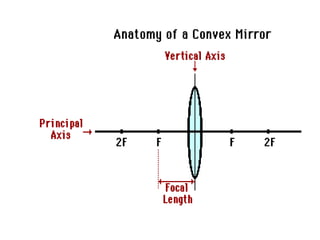
Features of Lenses Principal Plane:   the line that passes vertically through the middle of the lens. Principal Axis : the straight line perpendicular to the Principal Plane of the lens at its center. Focal Point : the location where the parallel rays of light from the source meet, or converge. Focal Length : the distance from the Focal Point to the Principal Plane along the Principal Axis. Center of Curvature : twice the distance of the focal point to the mirror surface.
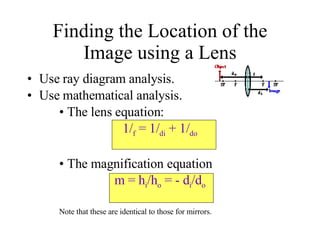
Use ray diagram analysis. Use mathematical analysis. The lens equation: 1/ f  = 1/ di  + 1/ do The magnification equation m = h i /h o  = - d i /d o Note that these are identical to those for mirrors. Finding the Location of the Image using a Lens
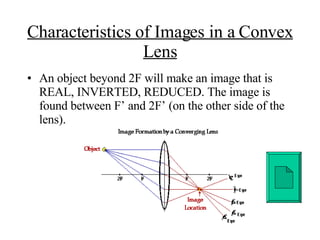
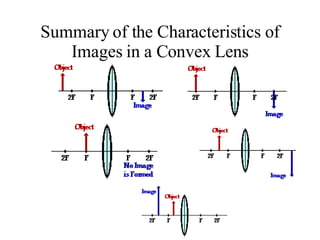
Characteristics of Images in a Convex Lens An object beyond 2F will make an image that is REAL, INVERTED, REDUCED. The image is found between F’ and 2F’ (on the other side of the lens).
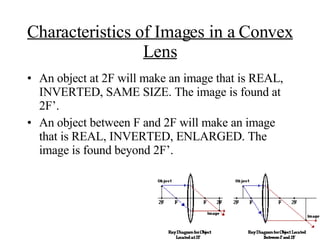
Characteristics of Images in a Convex Lens An object at 2F will make an image that is REAL, INVERTED, SAME SIZE. The image is found at 2F’.  An object between F and 2F will make an image that is REAL, INVERTED, ENLARGED. The image is found beyond 2F’.
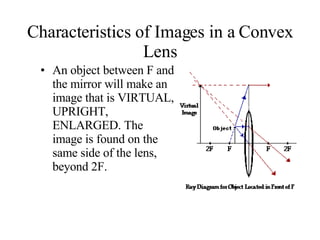
Characteristics of Images in a Convex Lens An object between F and the mirror will make an image that is VIRTUAL, UPRIGHT, ENLARGED. The image is found on the same side of the lens, beyond 2F.
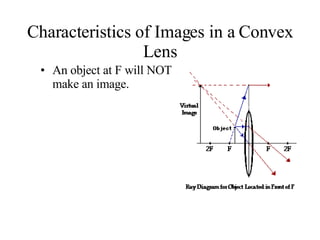
Characteristics of Images in a Convex Lens An object at F will NOT make an image.
Summary of the Characteristics of Images in a Convex Lens
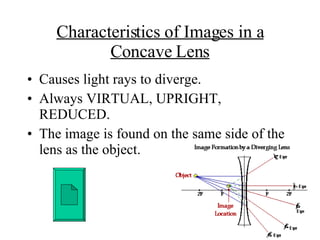
Characteristics of Images in a Concave Lens Causes light rays to diverge. Always VIRTUAL, UPRIGHT, REDUCED. The image is found on the same side of the lens as the object.
Optical Instruments Tools that use lenses  Examples: Cameras Telescopes Compound microscopes Projectors
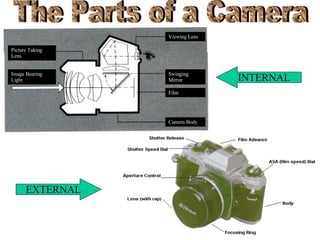
The Parts of a Camera EXTERNAL INTERNAL Camera Body Film Swinging Mirror Viewing Lens Image Bearing Light Picture Taking Lens
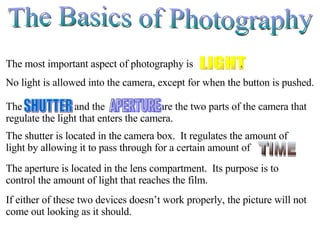
The Basics of Photography No light is allowed into the camera, except for when the button is pushed. The aperture is located in the lens compartment.  Its purpose is to control the amount of light that reaches the film. If either of these two devices doesn’t work properly, the picture will not come out looking as it should. LIGHT The most important aspect of photography is  . The  and the  are the two parts of the camera that regulate the light that enters the camera. SHUTTER APERTURE The shutter is located in the camera box.  It regulates the amount of light by allowing it to pass through for a certain amount of  . TIME
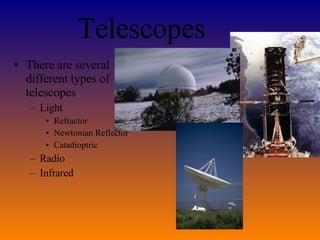
Telescopes There are several different types of telescopes Light Refractor Newtonian Reflector Catadioptric Radio Infrared
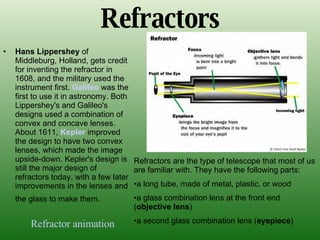
Refractors Hans Lippershey  of Middleburg, Holland, gets credit for inventing the refractor in 1608, and the military used the instrument first.  Galileo  was the first to use it in astronomy. Both Lippershey's and Galileo's designs used a combination of convex and concave lenses. About 1611,  Kepler  improved the design to have two convex lenses, which made the image upside-down. Kepler's design is still the major design of refractors today, with a few later improvements in the lenses and the glass to make them.   Refractor animation Refractors are the type of telescope that most of us are familiar with. They have the following parts:  a long tube, made of metal, plastic, or wood  a glass combination lens at the front end ( objective lens )  a second glass combination lens ( eyepiece )
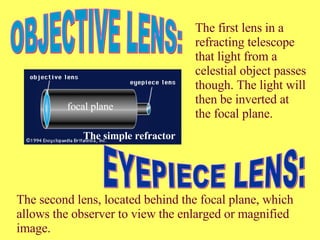
OBJECTIVE LENS: EYEPIECE LENS: The first lens in a refracting telescope that light from a celestial object passes though. The light will then be inverted at the focal plane. The second lens, located behind the focal plane, which allows the observer to view the enlarged or magnified image. focal plane The simple refractor
A refracting telescope's light  gathering power is proportional to the size of the objective lens and to the ratio of the  focal lengths of the objective lens and  the eyepiece.
The Compound Microscope Works very similar to the refracting telescope in that it enlarges small objects. Uses 2 converging lenses of short focal length.
The Projector A series of converging lenses are uses to show enlarged images of slides or movies. One set of lenses is used to send intensely bright light through the slide or negatives and a second lens, the projection lens, can be slid back and forth to focus the image.
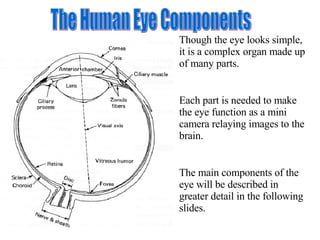
The Human Eye Components Though the eye looks simple, it is a complex organ made up of many parts. Each part is needed to make the eye function as a mini camera relaying images to the brain. The main components of the eye will be described in greater detail in the following slides.
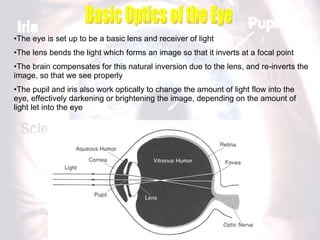
Basic Optics of the Eye The eye is set up to be a basic lens and receiver of light The lens bends the light which forms an image so that it inverts at a focal point The brain compensates for this natural inversion due to the lens, and re-inverts the image, so that we see properly The pupil and iris also work optically to change the amount of light flow into the eye, effectively darkening or brightening the image, depending on the amount of light let into the eye
Defects in Vision Farsighted  Can see far, but not near Nearsighted Can see close, but not far. (myopia) Astimatic An astigmatism is caused by a defective curve in either the lens or the cornea Instead of the lens and cornea bending the light into a point, the extra curve bend the light into a line which blurs vision
Defects in Lenses Spherical aberration Edges bend differently than center. Chromatic aberration Colors bend different amounts and need to be resolved to get a focused image.

Lenses And Mirrors

  • 1.
    Lenses A lensis made of transparent material such as glass or plastic with a refractive index larger than that of air.
  • 2.
    Two Types ofLenses A convex lens is thicker at the center than at the edges. Also called converging. A concave lens is thinner at then center than at the edges. Also called diverging.
  • 3.
  • 4.
    Features of LensesPrincipal Plane: the line that passes vertically through the middle of the lens. Principal Axis : the straight line perpendicular to the Principal Plane of the lens at its center. Focal Point : the location where the parallel rays of light from the source meet, or converge. Focal Length : the distance from the Focal Point to the Principal Plane along the Principal Axis. Center of Curvature : twice the distance of the focal point to the mirror surface.
  • 5.
    Use ray diagramanalysis. Use mathematical analysis. The lens equation: 1/ f = 1/ di + 1/ do The magnification equation m = h i /h o = - d i /d o Note that these are identical to those for mirrors. Finding the Location of the Image using a Lens
  • 6.
    Characteristics of Imagesin a Convex Lens An object beyond 2F will make an image that is REAL, INVERTED, REDUCED. The image is found between F’ and 2F’ (on the other side of the lens).
  • 7.
    Characteristics of Imagesin a Convex Lens An object at 2F will make an image that is REAL, INVERTED, SAME SIZE. The image is found at 2F’. An object between F and 2F will make an image that is REAL, INVERTED, ENLARGED. The image is found beyond 2F’.
  • 8.
    Characteristics of Imagesin a Convex Lens An object between F and the mirror will make an image that is VIRTUAL, UPRIGHT, ENLARGED. The image is found on the same side of the lens, beyond 2F.
  • 9.
    Characteristics of Imagesin a Convex Lens An object at F will NOT make an image.
  • 10.
    Summary of theCharacteristics of Images in a Convex Lens
  • 11.
    Characteristics of Imagesin a Concave Lens Causes light rays to diverge. Always VIRTUAL, UPRIGHT, REDUCED. The image is found on the same side of the lens as the object.
  • 12.
    Optical Instruments Toolsthat use lenses Examples: Cameras Telescopes Compound microscopes Projectors
  • 13.
    The Parts ofa Camera EXTERNAL INTERNAL Camera Body Film Swinging Mirror Viewing Lens Image Bearing Light Picture Taking Lens
  • 14.
    The Basics ofPhotography No light is allowed into the camera, except for when the button is pushed. The aperture is located in the lens compartment. Its purpose is to control the amount of light that reaches the film. If either of these two devices doesn’t work properly, the picture will not come out looking as it should. LIGHT The most important aspect of photography is . The and the are the two parts of the camera that regulate the light that enters the camera. SHUTTER APERTURE The shutter is located in the camera box. It regulates the amount of light by allowing it to pass through for a certain amount of . TIME
  • 15.
    Telescopes There areseveral different types of telescopes Light Refractor Newtonian Reflector Catadioptric Radio Infrared
  • 16.
    Refractors Hans Lippershey of Middleburg, Holland, gets credit for inventing the refractor in 1608, and the military used the instrument first. Galileo was the first to use it in astronomy. Both Lippershey's and Galileo's designs used a combination of convex and concave lenses. About 1611, Kepler improved the design to have two convex lenses, which made the image upside-down. Kepler's design is still the major design of refractors today, with a few later improvements in the lenses and the glass to make them. Refractor animation Refractors are the type of telescope that most of us are familiar with. They have the following parts: a long tube, made of metal, plastic, or wood a glass combination lens at the front end ( objective lens ) a second glass combination lens ( eyepiece )
  • 17.
    OBJECTIVE LENS: EYEPIECELENS: The first lens in a refracting telescope that light from a celestial object passes though. The light will then be inverted at the focal plane. The second lens, located behind the focal plane, which allows the observer to view the enlarged or magnified image. focal plane The simple refractor
  • 18.
    A refracting telescope'slight gathering power is proportional to the size of the objective lens and to the ratio of the focal lengths of the objective lens and the eyepiece.
  • 19.
    The Compound MicroscopeWorks very similar to the refracting telescope in that it enlarges small objects. Uses 2 converging lenses of short focal length.
  • 20.
    The Projector Aseries of converging lenses are uses to show enlarged images of slides or movies. One set of lenses is used to send intensely bright light through the slide or negatives and a second lens, the projection lens, can be slid back and forth to focus the image.
  • 21.
    The Human EyeComponents Though the eye looks simple, it is a complex organ made up of many parts. Each part is needed to make the eye function as a mini camera relaying images to the brain. The main components of the eye will be described in greater detail in the following slides.
  • 22.
    Basic Optics ofthe Eye The eye is set up to be a basic lens and receiver of light The lens bends the light which forms an image so that it inverts at a focal point The brain compensates for this natural inversion due to the lens, and re-inverts the image, so that we see properly The pupil and iris also work optically to change the amount of light flow into the eye, effectively darkening or brightening the image, depending on the amount of light let into the eye
  • 23.
    Defects in VisionFarsighted Can see far, but not near Nearsighted Can see close, but not far. (myopia) Astimatic An astigmatism is caused by a defective curve in either the lens or the cornea Instead of the lens and cornea bending the light into a point, the extra curve bend the light into a line which blurs vision
  • 24.
    Defects in LensesSpherical aberration Edges bend differently than center. Chromatic aberration Colors bend different amounts and need to be resolved to get a focused image.