11
Chapter 4 & 3Chapter 4 & 3
Lenses &Lenses &
ReflectionReflection
Types of LensesTypes of Lenses
 Converging:Converging:
 Causes light rays to come togetherCauses light rays to come together
 Examples: Magnifying glass, camera, eyeExamples: Magnifying glass, camera, eye
glassesglasses
 Diverging:Diverging:
 Causes light rays to spread apartCauses light rays to spread apart
 Examples: Microscope, telescope, eyeExamples: Microscope, telescope, eye
glassesglasses
Principal RaysPrincipal Rays
 Just like curved mirrors, lenses are used toJust like curved mirrors, lenses are used to
produce imagesproduce images
 The images are found by using three principalThe images are found by using three principal
rays:rays:
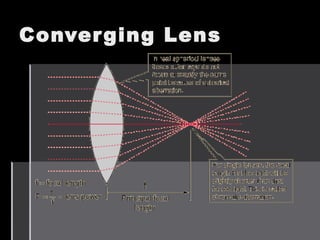
 Principal Ray 1:Principal Ray 1: A light ray parallel to the principalA light ray parallel to the principal
axis is refracted through the principal focal point.axis is refracted through the principal focal point.
 Principal Ray 2:Principal Ray 2: Passes through the optical center.Passes through the optical center.
No apparent refraction occurs but the ray is bent.No apparent refraction occurs but the ray is bent.
The ray seems to pass straight through to the otherThe ray seems to pass straight through to the other
side.side.
 Principal Ray 3:Principal Ray 3: Passes through the secondaryPasses through the secondary
focal point and will be refracted. Will exit the lensfocal point and will be refracted. Will exit the lens
parallel to the principal axis.parallel to the principal axis.
Converging LensConverging Lens
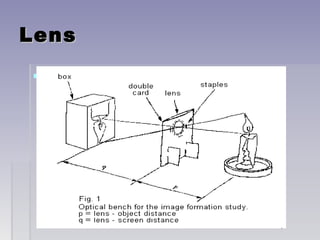
LensLens

Diverging LensesDiverging Lenses
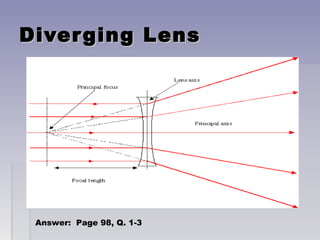
 Principal ray 1Principal ray 1 (parallel to the principal axis,(parallel to the principal axis,
PA) will be refracted away from thePA) will be refracted away from the PAPA. But the. But the
prolongation of the ray will pass through theprolongation of the ray will pass through the
principal focus.principal focus.
 Principal ray 2Principal ray 2 (straight through the optical(straight through the optical
center) has no apparent sign of refraction.center) has no apparent sign of refraction.
 Principal ray 3Principal ray 3 (via the secondary focal point)(via the secondary focal point)
is refracted parallel to the principal axis.is refracted parallel to the principal axis.
Diverging LensDiverging Lens

Answer: Page 98, Q. 1-3
Optical PowerOptical Power
 The strength of a lens (optical power) is relatedThe strength of a lens (optical power) is related
to its focal length. A short focal length meansto its focal length. A short focal length means
the light rays are being refracted a lot. Thethe light rays are being refracted a lot. The
optical power of the lens is strong.optical power of the lens is strong.
 A long focal length means the light rays are notA long focal length means the light rays are not
being refracted very much. The optical powerbeing refracted very much. The optical power
of the lens is weak.of the lens is weak.
 The power of a lens is equal to the inverse ofThe power of a lens is equal to the inverse of
the focal point. P = 1/fthe focal point. P = 1/f
 Power unit: dioptres (d)Power unit: dioptres (d)
 Focal length: meters (m), negative if divergingFocal length: meters (m), negative if diverging
Lens CombinationsLens Combinations
 By combining lenses, different optical powers can beBy combining lenses, different optical powers can be
obtained. This is quite useful for making telescopes,obtained. This is quite useful for making telescopes,
microscopes or any other optical instrument that usesmicroscopes or any other optical instrument that uses
more than one lens.more than one lens.
 TheThe optical powersoptical powers can be added using the equation:can be added using the equation:
 PPTT = P= P11 + P+ P22 + P+ Pnn……
 PPTT: Total optical power in dioptres: Total optical power in dioptres
 PP11, P, P22, P, Pnn,: Power of each lens in dioptres.,: Power of each lens in dioptres.
 N.B.N.B. The focal lengthsThe focal lengths CAN NOTCAN NOT be added together tobe added together to
solve optical power. You must use the equationsolve optical power. You must use the equation P=1/fP=1/f
to obtain theto obtain the PP value.value.
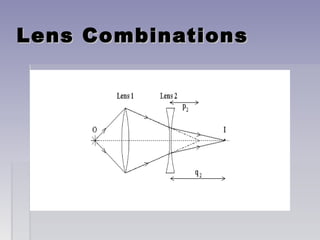
Lens CombinationsLens Combinations
 What is the power, focal lengths?What is the power, focal lengths?
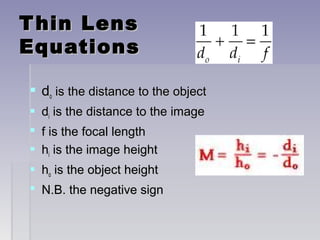
Thin LensThin Lens
EquationsEquations
 ddoo is the distance to the objectis the distance to the object
 ddii is the distance to the imageis the distance to the image
 f is the focal lengthf is the focal length
 hhii is the image heightis the image height
 hhoo is the object heightis the object height
 N.B. the negative signN.B. the negative sign
Conventions for theConventions for the
EquationEquation
 Distances are measured from the vertex.Distances are measured from the vertex.
 Focal lengths are positive for converging lenses andFocal lengths are positive for converging lenses and
negative for diverging lensesnegative for diverging lenses
 Radii of curvature are positive for converging lenses andRadii of curvature are positive for converging lenses and
negative for diverging lenses.negative for diverging lenses.
 Image and object distances are positive for real imagesImage and object distances are positive for real images
and objects.and objects.
 Image and object distances are negative for virtualImage and object distances are negative for virtual
images and objects.images and objects.
 Image and object heights are positive when upright andImage and object heights are positive when upright and
negative when inverted.negative when inverted.
 Answer: Page 122, Q. 5,6,7,9Answer: Page 122, Q. 5,6,7,9
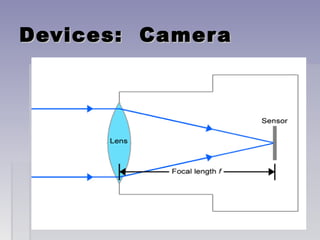
Devices: CameraDevices: Camera
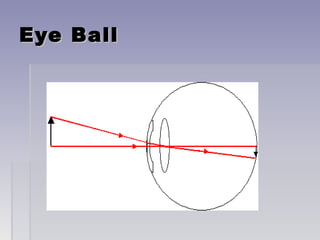
Eye BallEye Ball
RefractionRefraction
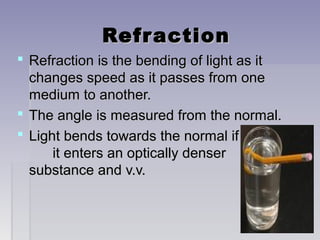
 Refraction is the bending of light as itRefraction is the bending of light as it
changes speed as it passes from onechanges speed as it passes from one
medium to another.medium to another.
 The angle is measured from the normal.The angle is measured from the normal.
 Light bends towards the normal ifLight bends towards the normal if
it enters an optically denserit enters an optically denser
substance and v.v.substance and v.v.
Table of ObservationsTable of Observations
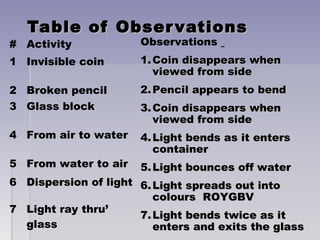
# Activity
1 Invisible coin
2 Broken pencil
3 Glass block
4 From air to water
5 From water to air
6 Dispersion of light
7 Light ray thru’
glass
Observations
1.1. Coin disappears whenCoin disappears when
viewed from sideviewed from side
2.2. Pencil appears to bendPencil appears to bend
3.3. Coin disappears whenCoin disappears when
viewed from sideviewed from side
4.4. Light bends as it entersLight bends as it enters
containercontainer
5.5. Light bounces off waterLight bounces off water
6.6. Light spreads out intoLight spreads out into
colours ROYGBVcolours ROYGBV
7.7. Light bends twice as itLight bends twice as it
enters and exits the glassenters and exits the glass
Refractive Index - nRefractive Index - n
 The refractive index, n, is a measure of howThe refractive index, n, is a measure of how
much light bends as it enters the substance.much light bends as it enters the substance.
 n = c/v, where c = 3x10n = c/v, where c = 3x1088
m/sm/s
 v = velocity of light in new mediumv = velocity of light in new medium
 Air has a refractive index of 1.Air has a refractive index of 1.
 Diamond bends light the most (n= 2.42).Diamond bends light the most (n= 2.42).
 Table of n values – page 79.Table of n values – page 79.
1717
Snell’s LawSnell’s Law
 In air, n = sin ΘIn air, n = sin Θii / sin Θ/ sin Θrr
 Snell’s Law: nSnell’s Law: n11sinΘsinΘ11 = n= n22sinΘsinΘ22
 The left side refers to the medium in which theThe left side refers to the medium in which the
light is incident.light is incident.
 The right side refers to the medium to where theThe right side refers to the medium to where the
light exits.light exits.
 ActivityActivity
 P. 81, Q. 1-3P. 81, Q. 1-3
 P. 83, Q. 1-2P. 83, Q. 1-2
 P. 86, Q. 3-5, 7P. 86, Q. 3-5, 7
1818
Total InternalTotal Internal
ReflectionReflection
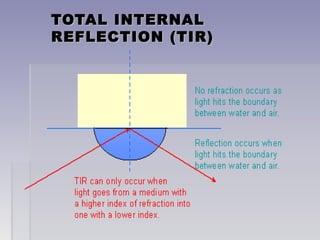
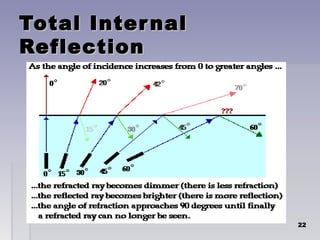
 This occurs when a ray of light passesThis occurs when a ray of light passes
from an optically dense material (big n) tofrom an optically dense material (big n) to
an optically LESS dense material (low n).an optically LESS dense material (low n).
 If the angle of incidence is greater than aIf the angle of incidence is greater than a
certain angle – the critical angle - thecertain angle – the critical angle - the
light will NOT refract out, but will reflectlight will NOT refract out, but will reflect
internally.internally.
1919
TOTAL INTERNALTOTAL INTERNAL
REFLECTION (TIR)REFLECTION (TIR)
Critical AngleCritical Angle
 In TIR situations, there comes a point at which theIn TIR situations, there comes a point at which the
angle of refraction increases until it leaves theangle of refraction increases until it leaves the
medium.medium.
 In this case the angle of refraction can be consideredIn this case the angle of refraction can be considered
to be equal to 90to be equal to 90oo
..
 The angle of incidence at which an angle of refractionThe angle of incidence at which an angle of refraction
of 90° first occurs is the Critical Angle.of 90° first occurs is the Critical Angle.
 Thus for Critical Angle questions, the angle ofThus for Critical Angle questions, the angle of
refraction is assumed to be 90°.refraction is assumed to be 90°.
2121
Total InternalTotal Internal
ReflectionReflection

2222
Snell’s Law & TIRSnell’s Law & TIR
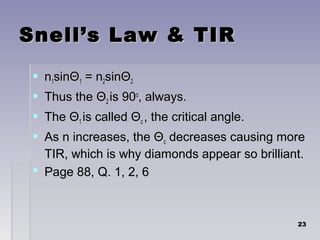
 nn11sinΘsinΘ11 = n= n22sinΘsinΘ22
 Thus the ΘThus the Θ22 is 90is 90oo
, always., always.
 The ΘThe Θ11 is called Θis called Θcc , the critical angle., the critical angle.
 As n increases, the ΘAs n increases, the Θcc decreases causing moredecreases causing more
TIR, which is why diamonds appear so brilliant.TIR, which is why diamonds appear so brilliant.
 Page 88, Q. 1, 2, 6Page 88, Q. 1, 2, 6
2323
Fibre OpticsFibre Optics
 This is especially useful in fibre optics.This is especially useful in fibre optics.
 Light enters a optic fibre and reflects onLight enters a optic fibre and reflects on
the inside of the cable instead ofthe inside of the cable instead of
escaping.escaping.
 So signals can be transmitted at theSo signals can be transmitted at the
speed of light, much faster than thespeed of light, much faster than the
speed of electricity.speed of electricity.
2424

Physics 504 Chapter 3-4

  • 1.
    11 Chapter 4 &3Chapter 4 & 3 Lenses &Lenses & ReflectionReflection
  • 2.
    Types of LensesTypesof Lenses  Converging:Converging:  Causes light rays to come togetherCauses light rays to come together  Examples: Magnifying glass, camera, eyeExamples: Magnifying glass, camera, eye glassesglasses  Diverging:Diverging:  Causes light rays to spread apartCauses light rays to spread apart  Examples: Microscope, telescope, eyeExamples: Microscope, telescope, eye glassesglasses
  • 3.
    Principal RaysPrincipal Rays Just like curved mirrors, lenses are used toJust like curved mirrors, lenses are used to produce imagesproduce images  The images are found by using three principalThe images are found by using three principal rays:rays:  Principal Ray 1:Principal Ray 1: A light ray parallel to the principalA light ray parallel to the principal axis is refracted through the principal focal point.axis is refracted through the principal focal point.  Principal Ray 2:Principal Ray 2: Passes through the optical center.Passes through the optical center. No apparent refraction occurs but the ray is bent.No apparent refraction occurs but the ray is bent. The ray seems to pass straight through to the otherThe ray seems to pass straight through to the other side.side.  Principal Ray 3:Principal Ray 3: Passes through the secondaryPasses through the secondary focal point and will be refracted. Will exit the lensfocal point and will be refracted. Will exit the lens parallel to the principal axis.parallel to the principal axis.
  • 4.
  • 5.
  • 6.
    Diverging LensesDiverging Lenses Principal ray 1Principal ray 1 (parallel to the principal axis,(parallel to the principal axis, PA) will be refracted away from thePA) will be refracted away from the PAPA. But the. But the prolongation of the ray will pass through theprolongation of the ray will pass through the principal focus.principal focus.  Principal ray 2Principal ray 2 (straight through the optical(straight through the optical center) has no apparent sign of refraction.center) has no apparent sign of refraction.  Principal ray 3Principal ray 3 (via the secondary focal point)(via the secondary focal point) is refracted parallel to the principal axis.is refracted parallel to the principal axis.
  • 7.
  • 8.
    Optical PowerOptical Power The strength of a lens (optical power) is relatedThe strength of a lens (optical power) is related to its focal length. A short focal length meansto its focal length. A short focal length means the light rays are being refracted a lot. Thethe light rays are being refracted a lot. The optical power of the lens is strong.optical power of the lens is strong.  A long focal length means the light rays are notA long focal length means the light rays are not being refracted very much. The optical powerbeing refracted very much. The optical power of the lens is weak.of the lens is weak.  The power of a lens is equal to the inverse ofThe power of a lens is equal to the inverse of the focal point. P = 1/fthe focal point. P = 1/f  Power unit: dioptres (d)Power unit: dioptres (d)  Focal length: meters (m), negative if divergingFocal length: meters (m), negative if diverging
  • 9.
    Lens CombinationsLens Combinations By combining lenses, different optical powers can beBy combining lenses, different optical powers can be obtained. This is quite useful for making telescopes,obtained. This is quite useful for making telescopes, microscopes or any other optical instrument that usesmicroscopes or any other optical instrument that uses more than one lens.more than one lens.  TheThe optical powersoptical powers can be added using the equation:can be added using the equation:  PPTT = P= P11 + P+ P22 + P+ Pnn……  PPTT: Total optical power in dioptres: Total optical power in dioptres  PP11, P, P22, P, Pnn,: Power of each lens in dioptres.,: Power of each lens in dioptres.  N.B.N.B. The focal lengthsThe focal lengths CAN NOTCAN NOT be added together tobe added together to solve optical power. You must use the equationsolve optical power. You must use the equation P=1/fP=1/f to obtain theto obtain the PP value.value.
  • 10.
    Lens CombinationsLens Combinations What is the power, focal lengths?What is the power, focal lengths?
  • 11.
    Thin LensThin Lens EquationsEquations ddoo is the distance to the objectis the distance to the object  ddii is the distance to the imageis the distance to the image  f is the focal lengthf is the focal length  hhii is the image heightis the image height  hhoo is the object heightis the object height  N.B. the negative signN.B. the negative sign
  • 12.
    Conventions for theConventionsfor the EquationEquation  Distances are measured from the vertex.Distances are measured from the vertex.  Focal lengths are positive for converging lenses andFocal lengths are positive for converging lenses and negative for diverging lensesnegative for diverging lenses  Radii of curvature are positive for converging lenses andRadii of curvature are positive for converging lenses and negative for diverging lenses.negative for diverging lenses.  Image and object distances are positive for real imagesImage and object distances are positive for real images and objects.and objects.  Image and object distances are negative for virtualImage and object distances are negative for virtual images and objects.images and objects.  Image and object heights are positive when upright andImage and object heights are positive when upright and negative when inverted.negative when inverted.  Answer: Page 122, Q. 5,6,7,9Answer: Page 122, Q. 5,6,7,9
  • 13.
  • 14.
  • 15.
    RefractionRefraction  Refraction isthe bending of light as itRefraction is the bending of light as it changes speed as it passes from onechanges speed as it passes from one medium to another.medium to another.  The angle is measured from the normal.The angle is measured from the normal.  Light bends towards the normal ifLight bends towards the normal if it enters an optically denserit enters an optically denser substance and v.v.substance and v.v.
  • 16.
    Table of ObservationsTableof Observations # Activity 1 Invisible coin 2 Broken pencil 3 Glass block 4 From air to water 5 From water to air 6 Dispersion of light 7 Light ray thru’ glass Observations 1.1. Coin disappears whenCoin disappears when viewed from sideviewed from side 2.2. Pencil appears to bendPencil appears to bend 3.3. Coin disappears whenCoin disappears when viewed from sideviewed from side 4.4. Light bends as it entersLight bends as it enters containercontainer 5.5. Light bounces off waterLight bounces off water 6.6. Light spreads out intoLight spreads out into colours ROYGBVcolours ROYGBV 7.7. Light bends twice as itLight bends twice as it enters and exits the glassenters and exits the glass
  • 17.
    Refractive Index -nRefractive Index - n  The refractive index, n, is a measure of howThe refractive index, n, is a measure of how much light bends as it enters the substance.much light bends as it enters the substance.  n = c/v, where c = 3x10n = c/v, where c = 3x1088 m/sm/s  v = velocity of light in new mediumv = velocity of light in new medium  Air has a refractive index of 1.Air has a refractive index of 1.  Diamond bends light the most (n= 2.42).Diamond bends light the most (n= 2.42).  Table of n values – page 79.Table of n values – page 79. 1717
  • 18.
    Snell’s LawSnell’s Law In air, n = sin ΘIn air, n = sin Θii / sin Θ/ sin Θrr  Snell’s Law: nSnell’s Law: n11sinΘsinΘ11 = n= n22sinΘsinΘ22  The left side refers to the medium in which theThe left side refers to the medium in which the light is incident.light is incident.  The right side refers to the medium to where theThe right side refers to the medium to where the light exits.light exits.  ActivityActivity  P. 81, Q. 1-3P. 81, Q. 1-3  P. 83, Q. 1-2P. 83, Q. 1-2  P. 86, Q. 3-5, 7P. 86, Q. 3-5, 7 1818
  • 19.
    Total InternalTotal Internal ReflectionReflection This occurs when a ray of light passesThis occurs when a ray of light passes from an optically dense material (big n) tofrom an optically dense material (big n) to an optically LESS dense material (low n).an optically LESS dense material (low n).  If the angle of incidence is greater than aIf the angle of incidence is greater than a certain angle – the critical angle - thecertain angle – the critical angle - the light will NOT refract out, but will reflectlight will NOT refract out, but will reflect internally.internally. 1919
  • 20.
  • 21.
    Critical AngleCritical Angle In TIR situations, there comes a point at which theIn TIR situations, there comes a point at which the angle of refraction increases until it leaves theangle of refraction increases until it leaves the medium.medium.  In this case the angle of refraction can be consideredIn this case the angle of refraction can be considered to be equal to 90to be equal to 90oo ..  The angle of incidence at which an angle of refractionThe angle of incidence at which an angle of refraction of 90° first occurs is the Critical Angle.of 90° first occurs is the Critical Angle.  Thus for Critical Angle questions, the angle ofThus for Critical Angle questions, the angle of refraction is assumed to be 90°.refraction is assumed to be 90°. 2121
  • 22.
  • 23.
    Snell’s Law &TIRSnell’s Law & TIR  nn11sinΘsinΘ11 = n= n22sinΘsinΘ22  Thus the ΘThus the Θ22 is 90is 90oo , always., always.  The ΘThe Θ11 is called Θis called Θcc , the critical angle., the critical angle.  As n increases, the ΘAs n increases, the Θcc decreases causing moredecreases causing more TIR, which is why diamonds appear so brilliant.TIR, which is why diamonds appear so brilliant.  Page 88, Q. 1, 2, 6Page 88, Q. 1, 2, 6 2323
  • 24.
    Fibre OpticsFibre Optics This is especially useful in fibre optics.This is especially useful in fibre optics.  Light enters a optic fibre and reflects onLight enters a optic fibre and reflects on the inside of the cable instead ofthe inside of the cable instead of escaping.escaping.  So signals can be transmitted at theSo signals can be transmitted at the speed of light, much faster than thespeed of light, much faster than the speed of electricity.speed of electricity. 2424