REFLECTIVE TEACHING :
PRINCIPLES AND
PRACTICES
What does the idea of being a reflective language teacher bring to mind?
How can language teachers continue to grow?
What are some steps teachers can take to enhance awareness of their strengths and weaknesses?
What are some strategies teachers could begin to develop now to avoid burnout in the future?
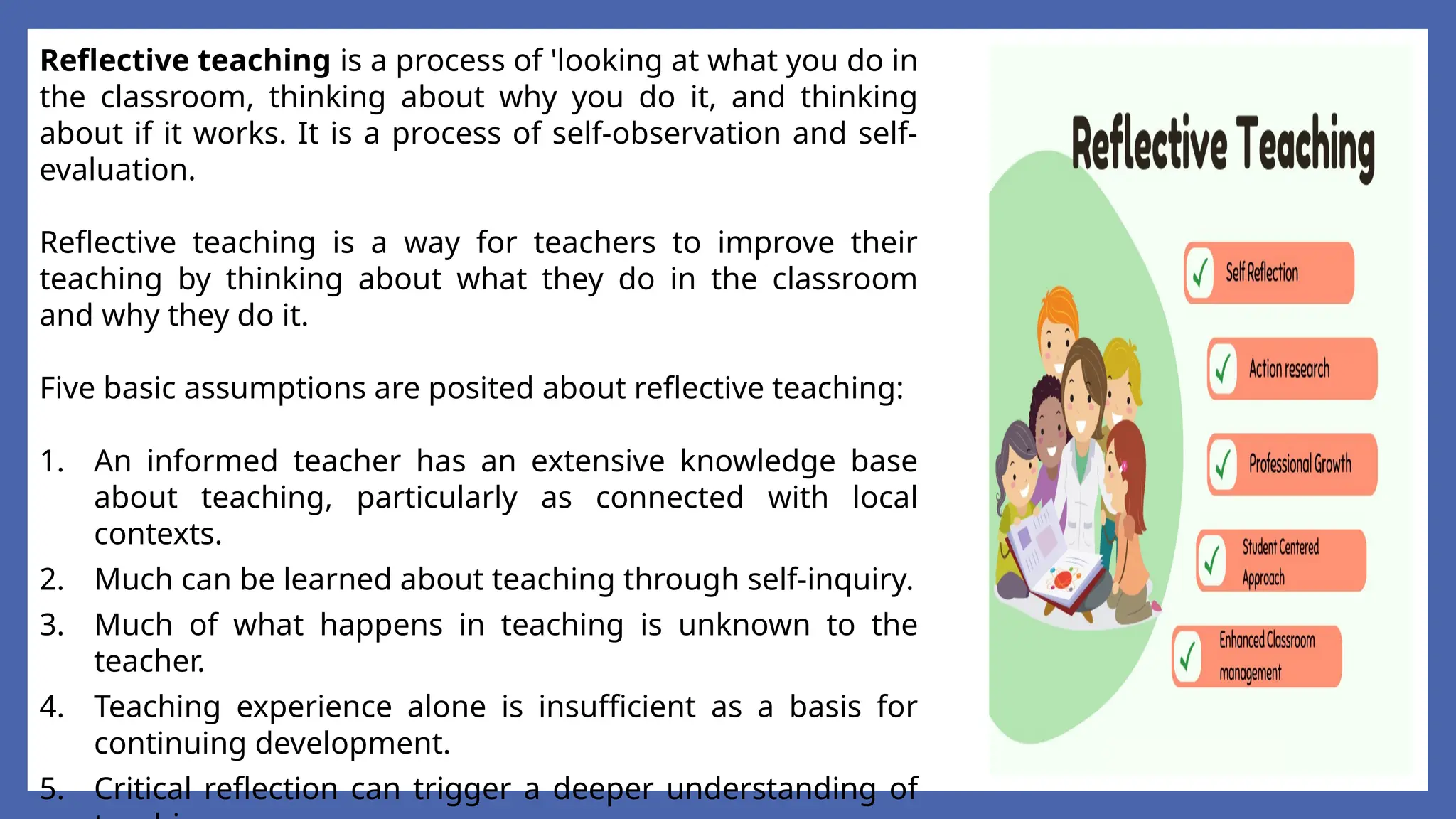
Reflective teaching is a process of 'looking at what you do in
the classroom, thinking about why you do it, and thinking
about if it works. It is a process of self-observation and self-
evaluation.
Reflective teaching is a way for teachers to improve their
teaching by thinking about what they do in the classroom
and why they do it.
Five basic assumptions are posited about reflective teaching:
1. An informed teacher has an extensive knowledge base
about teaching, particularly as connected with local
contexts.
2. Much can be learned about teaching through self-inquiry.
3. Much of what happens in teaching is unknown to the
teacher.
4. Teaching experience alone is insufficient as a basis for
continuing development.
5. Critical reflection can trigger a deeper understanding of
Purposes of reflective teaching:
1. To expand our understandings of the teaching-learning process
2. To expand our repertoire of strategic options as language
teachers
3. To take ownership of our own theories of language teaching as
informed by teaching practice
4. To enhance the quality of learning opportunities we are able to
provide in language classrooms.
Those of us interested in reflective teaching need to work to
improve these abilities : gather and examine information on what is
taking place within a language course, identify anything puzzling
about the teaching-learning process, build awareness and deepen
understanding of teaching-learning behaviors, collaborate with
others interested in processes of reflective teaching, refine
questions tide to teaching that are worth further exploration, locate
resources to help clarify questions being posed, make informed
changes in teaching-learning behaviors.
The roots and origins of reflective teaching :
The concept of reflective teaching has its origins in the work of philosopher and educator John Dewey in
the early 20th century. Dewey emphasized the importance of reflection in the learning process, arguing
that true learning occurs when individuals engage in active reflection on their experiences.
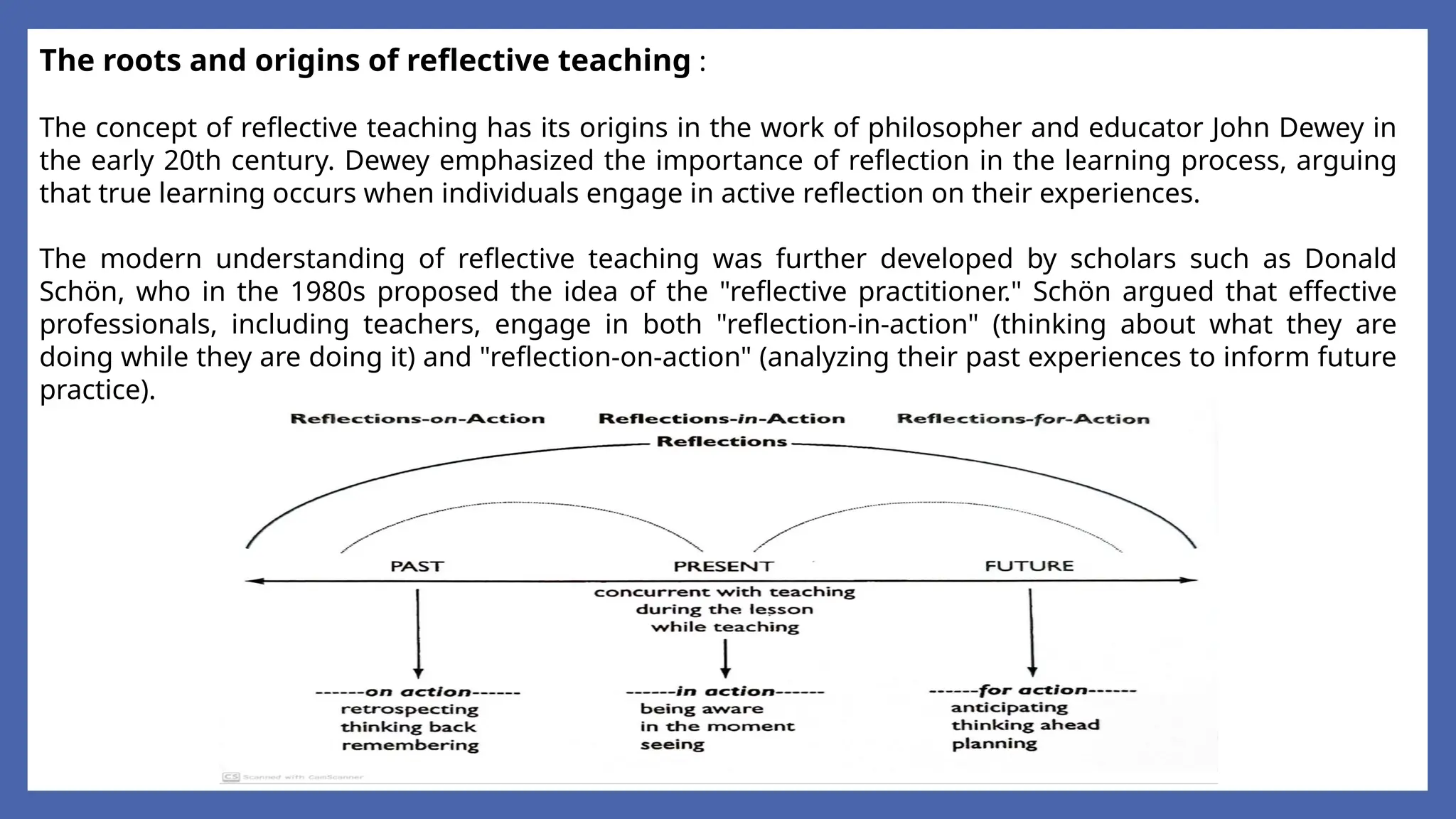
The modern understanding of reflective teaching was further developed by scholars such as Donald
Schön, who in the 1980s proposed the idea of the "reflective practitioner." Schön argued that effective
professionals, including teachers, engage in both "reflection-in-action" (thinking about what they are
doing while they are doing it) and "reflection-on-action" (analyzing their past experiences to inform future
practice).
The roots and origins of reflective teaching :
Since then, the idea of reflective teaching has become a core component of teacher education and
professional development programs around the world. Reflective teaching is based on the belief that
teachers can improve their practice by regularly examining their own beliefs, assumptions, and actions,
and using those insights to make informed decisions about their teaching.
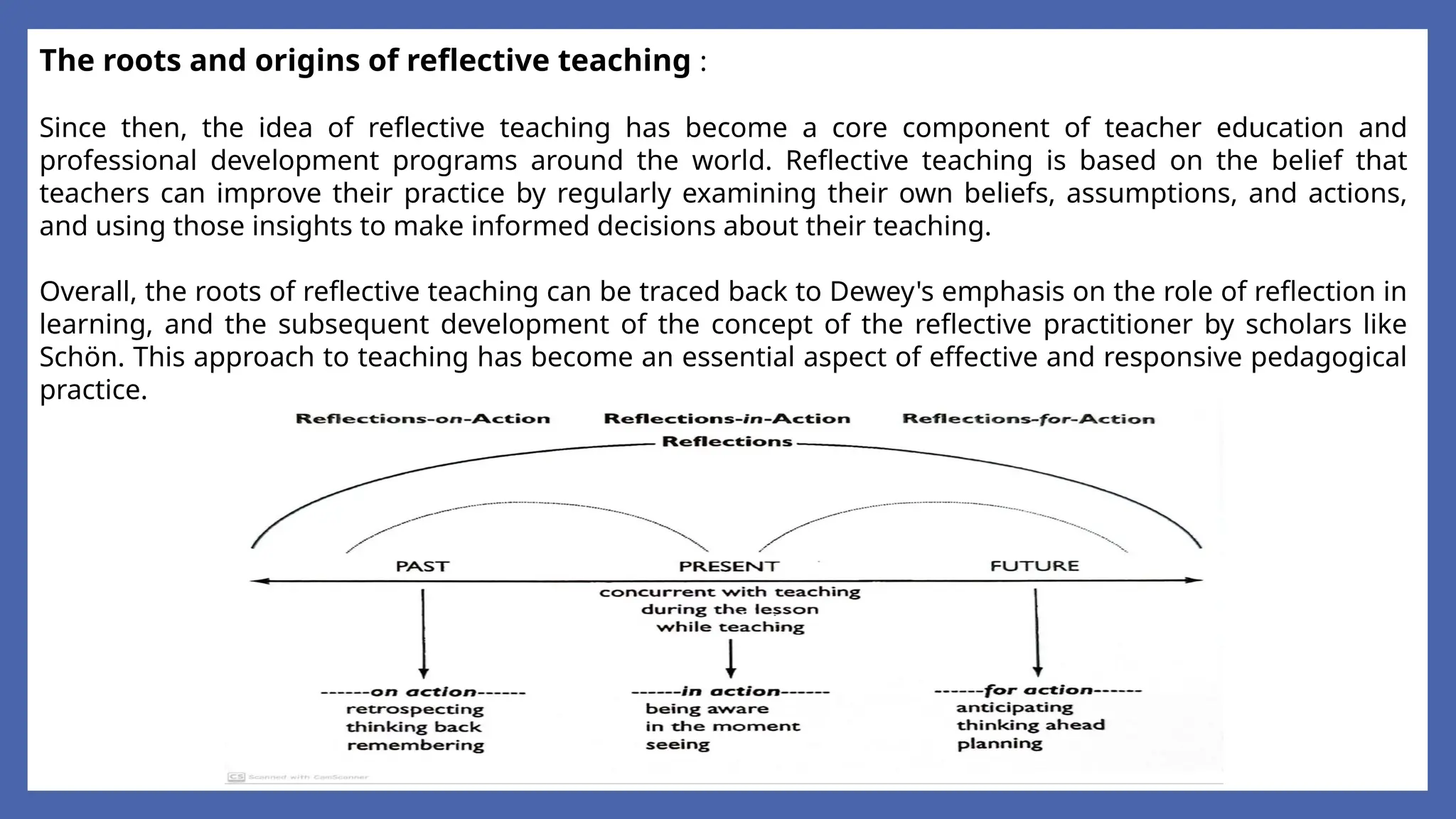
Overall, the roots of reflective teaching can be traced back to Dewey's emphasis on the role of reflection in
learning, and the subsequent development of the concept of the reflective practitioner by scholars like
Schön. This approach to teaching has become an essential aspect of effective and responsive pedagogical
practice.
Alternative traditions of reflective teaching : in addition to
the conceptual roots and tripartite dimensions of reflective teaching
already discussed, there is another definitional matter that merits
attention specialists continue to debate the scope and parameters
of reflective teaching. In one tradition, the focus is on the
professional efforts of individual teachers working in particular
settings. Illustrated in the work of many contemporary English
language of self-observation, self-assessment, building
awareness, and continuing professional development.
Self-observation: Self-observation is a key part of reflective
teaching, where the teacher carefully examines their own
instructional practices, decisions, and behaviors in the classroom. As
a reflective teacher, you observe yourself teaching and analyze your
actions, thought processes, and interactions with students. This self-
observation allows you to identify areas for improvement,
experiment with new teaching strategies, and continuously develop
your skills. By closely examining your own teaching, you can gain
valuable insights that inform your future lessons and professional
growth. Self-observation is an essential component of the reflective
teaching cycle, helping teachers become more conscious,
intentional, and effective in their practice.
Self-assessment: Self-assessment is a crucial component of
reflective teaching. It involves the teacher critically evaluating their
own performance, effectiveness, and progress. Through self-
assessment, teachers analyze their instructional methods, student
learning outcomes, and their own professional growth. This process
allows teachers to identify their strengths, weaknesses, and areas
for improvement. By engaging in self-assessment, teachers can set
meaningful goals, experiment with new approaches, and
continuously enhance their teaching practice. Self-assessment
empowers teachers to take ownership of their professional
development and make informed decisions to improve their
effectiveness in the classroom.
Building awareness: Building awareness is a key aspect of reflective
teaching. It involves developing a deeper understanding of oneself as a
teacher, one's teaching context, and the impact of one's actions on student
learning. Through building awareness, teachers become more conscious of
their beliefs, assumptions, and biases that shape their instructional
decisions. They also gain insights into the unique needs, perspectives, and
experiences of their students. By building this self-awareness and contextual
awareness, teachers can make more informed and intentional choices in
their practice. Ultimately, building awareness enables teachers to become
more reflective, adaptable, and responsive in their teaching, leading to
improved student outcomes and continuous professional growth.
continuing professional development : Continuing
professional development (CPD) is an essential component of
reflective teaching. It involves the ongoing process of learning,
growth, and improvement as a teacher. Through CPD, reflective
teachers engage in activities such as attending workshops, taking
courses, collaborating with colleagues, and exploring new teaching
methods. This allows them to stay up-to-date with the latest
educational research, pedagogical strategies, and technological
innovations. Reflective teachers use CPD to identify their
professional development needs, set goals, and implement changes
to enhance their teaching practice. By embracing CPD, teachers
demonstrate a commitment to lifelong learning and ensure that
their knowledge, skills, and approaches remain relevant and
effective in serving the evolving needs of their students. CPD is a
crucial aspect of the reflective teaching cycle, fostering continuous
improvement and professional growth.
Classroom applications :
1. Lesson planning and reflection: Reflective teachers carefully
plan their lessons, considering the learning objectives,
instructional strategies, and assessment methods. After the
lesson, they reflect on what worked well, what challenges arose,
and how they can improve for the next lesson.
2. Classroom observations: Reflective teachers may invite
colleagues or administrators to observe their classes and
provide feedback. They then reflect on the observations to
identify areas for improvement in their teaching.
3. Student feedback: Reflective teachers regularly collect feedback
from students, either through informal discussions or
structured surveys. They use this feedback to understand the
students' perspectives and make adjustments to their teaching.
Classroom applications :
4. Reflective journaling: Reflective teachers maintain a teaching
journal or log, where they record their thoughts, insights, and
lessons learned from their classroom experiences. This helps
them identify patterns, trends, and areas for growth.
5. Action research: Reflective teachers engage in small-scale action
research projects, where they identify a problem or challenge in
their classroom, implement a new strategy, and then reflect on
the outcomes to inform their future practice.
6. Professional learning communities: Reflective teachers
collaborate with colleagues in professional learning
communities, where they share experiences, discuss best
practices, and engage in collective reflection to enhance their
teaching.
By applying these reflective techniques in the classroom, teachers
can continuously improve their practice, adapt to the needs of their
students, and foster a culture of ongoing professional development.
Two perspectives of reflective teaching :
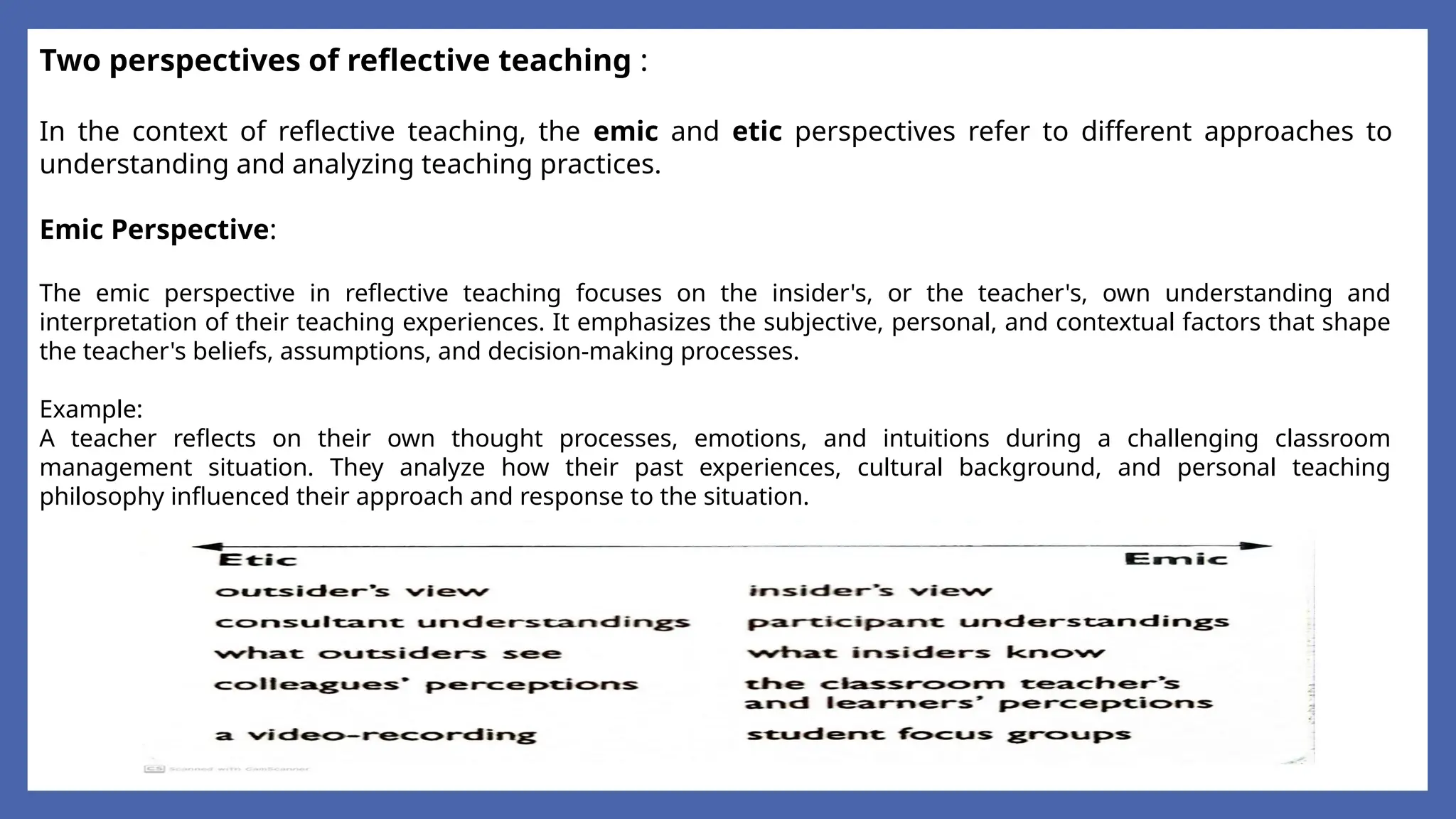
In the context of reflective teaching, the emic and etic perspectives refer to different approaches to
understanding and analyzing teaching practices.
Emic Perspective:
The emic perspective in reflective teaching focuses on the insider's, or the teacher's, own understanding and
interpretation of their teaching experiences. It emphasizes the subjective, personal, and contextual factors that shape
the teacher's beliefs, assumptions, and decision-making processes.
Example:
A teacher reflects on their own thought processes, emotions, and intuitions during a challenging classroom
management situation. They analyze how their past experiences, cultural background, and personal teaching
philosophy influenced their approach and response to the situation.
Etic Perspective:
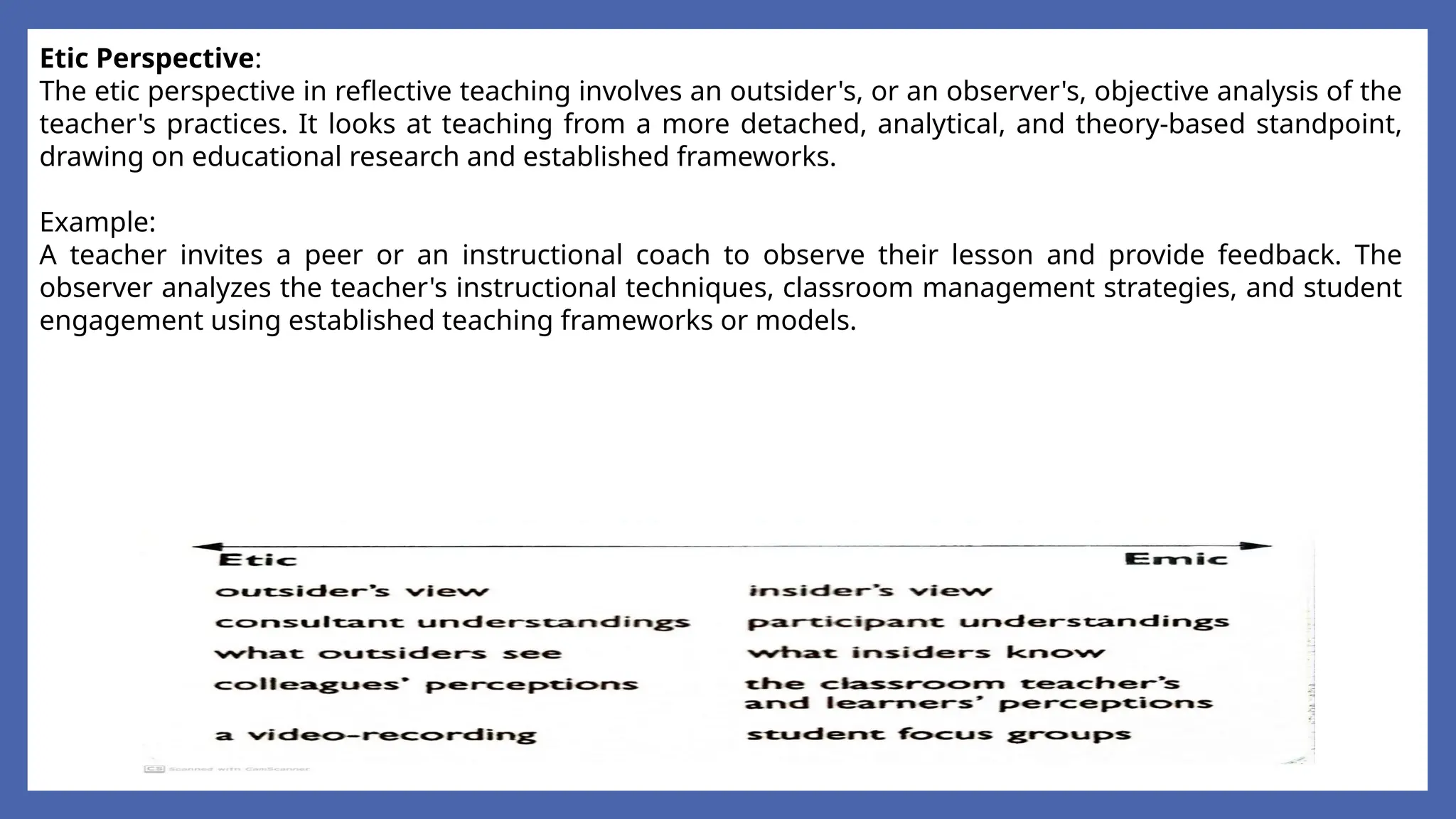
The etic perspective in reflective teaching involves an outsider's, or an observer's, objective analysis of the
teacher's practices. It looks at teaching from a more detached, analytical, and theory-based standpoint,
drawing on educational research and established frameworks.
Example:
A teacher invites a peer or an instructional coach to observe their lesson and provide feedback. The
observer analyzes the teacher's instructional techniques, classroom management strategies, and student
engagement using established teaching frameworks or models.
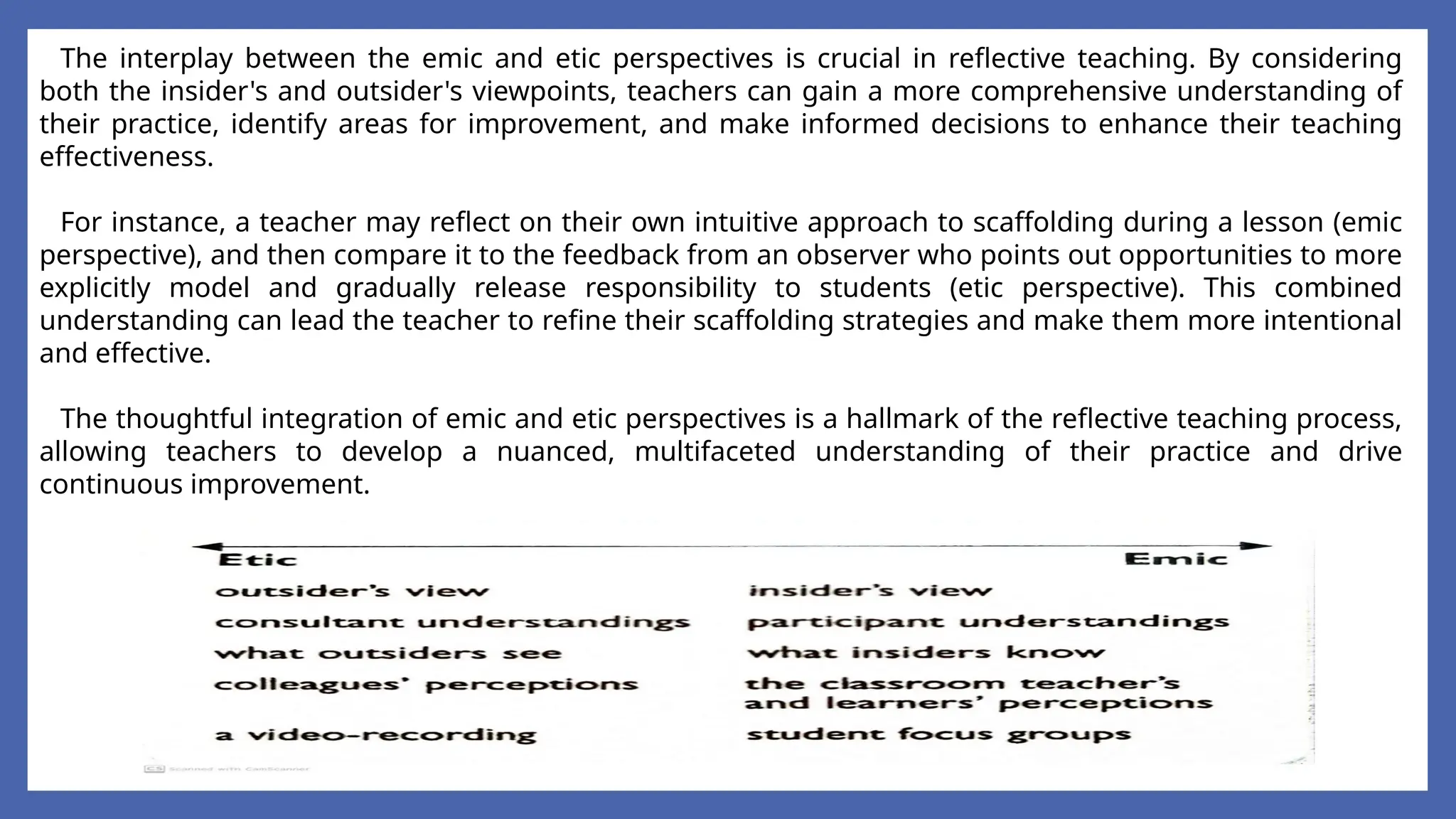
The interplay between the emic and etic perspectives is crucial in reflective teaching. By considering
both the insider's and outsider's viewpoints, teachers can gain a more comprehensive understanding of
their practice, identify areas for improvement, and make informed decisions to enhance their teaching
effectiveness.
For instance, a teacher may reflect on their own intuitive approach to scaffolding during a lesson (emic
perspective), and then compare it to the feedback from an observer who points out opportunities to more
explicitly model and gradually release responsibility to students (etic perspective). This combined
understanding can lead the teacher to refine their scaffolding strategies and make them more intentional
and effective.
The thoughtful integration of emic and etic perspectives is a hallmark of the reflective teaching process,
allowing teachers to develop a nuanced, multifaceted understanding of their practice and drive
continuous improvement.
Future trends :
As we look towards the future, reflective teaching is likely to
play an increasingly important role in the evolving landscape
of education. Here are some ways reflective teaching may
evolve and align with future trends :
1. Embracing technology: Reflective teaching will continue to
integrate emerging technologies, such as video recording,
digital portfolios, and virtual collaboration platforms, to
enhance the self-observation, self-assessment, and professional
development processes.
2. Data-informed decision making: Reflective teachers will
leverage data-driven insights, from student performance
analytics to classroom observation data, to inform their
reflections and guide their instructional decisions.
3. Personalized professional development: Reflective teaching will
become more personalized, with teachers tailoring their
continuing professional development (CPD) activities to their
unique needs, goals, and contexts.
Future trends :
4. Collaborative reflection: Reflective teaching will increasingly involve
collaborative reflection, with teachers engaging in peer-to-peer
observations, co-teaching, and interdisciplinary discussions to learn
from one another and develop a collective understanding of best
practices.
5. Adaptive expertise: Reflective teaching will support the development
of adaptive expertise, where teachers become adept at continuously
adjusting their practices to meet the evolving needs of diverse
learners and respond to changing educational landscapes.
6. Sustainability and well-being: Reflective teaching practices will
integrate a stronger focus on teacher well-being and sustainable
practices, helping educators manage stress, promote work-life
balance, and maintain a healthy, resilient mindset.
7. Equity and inclusion: Reflective teaching will increasingly emphasize
the importance of equity, diversity, and inclusion, with teachers
critically examining their biases, teaching approaches, and
classroom environments to ensure they are providing equitable
learning opportunities for all students.
Conclusion :
Reflective teaching empowers educators to continuously
improve their practice and positively impact student learning.
Through self-observation, self-assessment, and building self-
awareness, teachers gain valuable insights, identify areas for
growth, and adapt their teaching to evolving classroom
needs. At the heart of reflective teaching is a commitment to
lifelong learning and professional development, cultivating
the adaptive expertise necessary to thrive in education.

As reflective teaching continues to evolve, it will play an
increasingly vital role in fostering equity, well-being, and
student success. Embracing the power of reflection enables
teachers to take ownership of their practice, become agents
of change, and inspire their students to reach new heights.
Reflective teaching is not just a set of techniques, but a
mindset that drives ongoing improvement and positive
impact in the classroom.
EFFECTIVE
PROFESSIONAL
DEVELOPMENT FOR
LANGUAGE TEACHERS
What are some characteristics of effective professional development for
English as a second/foreign language teachers?
What are some ways English teaching professionals can continue to learn
both on their own and as part of a professional learning community?
How has technology expanded professional learning opportunities?
Here are some key characteristics of effective professional development for English as a
Second/Foreign Language (ESL/EFL) teachers:
1. Relevance and contextualization: Professional development should be tailored to the
specific needs, challenges, and contexts of ESL/EFL teachers. It should address the unique
pedagogical and linguistic considerations of teaching English language learners.
2. Ongoing and sustained support: Professional development should not be a one-time
event, but an ongoing process that provides continuous learning opportunities. ESL/EFL
teachers need sustained support and opportunities to apply, reflect, and refine their
practices.
3. Collaborative and peer-to-peer learning: Professional development should foster
collaboration and the sharing of best practices among ESL/EFL teachers. Opportunities for
peer observation, mentoring, and peer-to-peer feedback can be highly valuable.
4. Grounded in research and evidence-based practices: Professional development should be
informed by the latest research and evidence-based instructional approaches in second
language acquisition and teaching. ESL/EFL teachers should be exposed to the theoretical
foundations and empirical support for effective teaching strategies.
Here are some key characteristics of effective professional development for English as a
Second/Foreign Language (ESL/EFL) teachers:
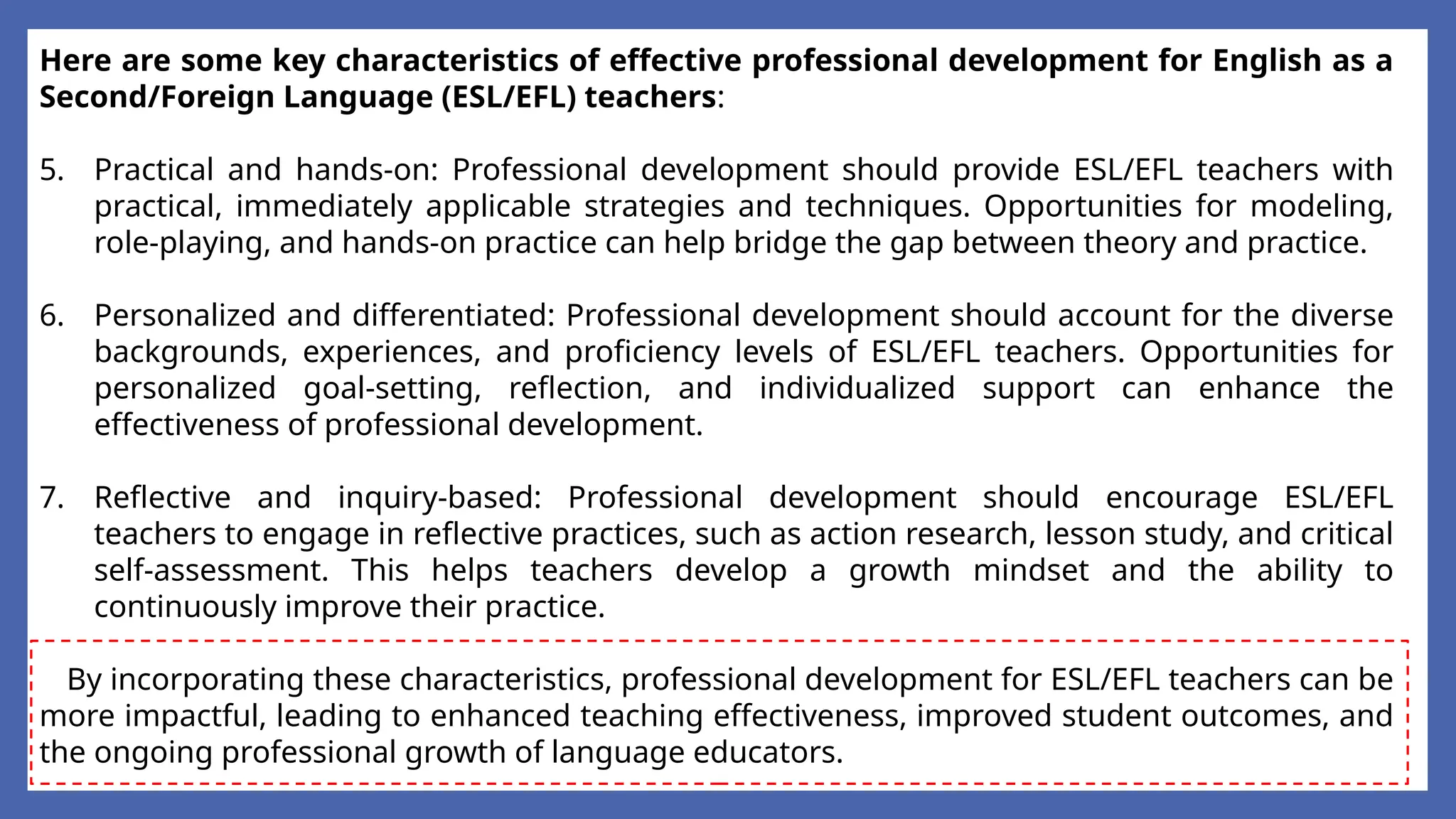
5. Practical and hands-on: Professional development should provide ESL/EFL teachers with
practical, immediately applicable strategies and techniques. Opportunities for modeling,
role-playing, and hands-on practice can help bridge the gap between theory and practice.
6. Personalized and differentiated: Professional development should account for the diverse
backgrounds, experiences, and proficiency levels of ESL/EFL teachers. Opportunities for
personalized goal-setting, reflection, and individualized support can enhance the
effectiveness of professional development.
7. Reflective and inquiry-based: Professional development should encourage ESL/EFL
teachers to engage in reflective practices, such as action research, lesson study, and critical
self-assessment. This helps teachers develop a growth mindset and the ability to
continuously improve their practice.
By incorporating these characteristics, professional development for ESL/EFL teachers can be
more impactful, leading to enhanced teaching effectiveness, improved student outcomes, and
the ongoing professional growth of language educators.
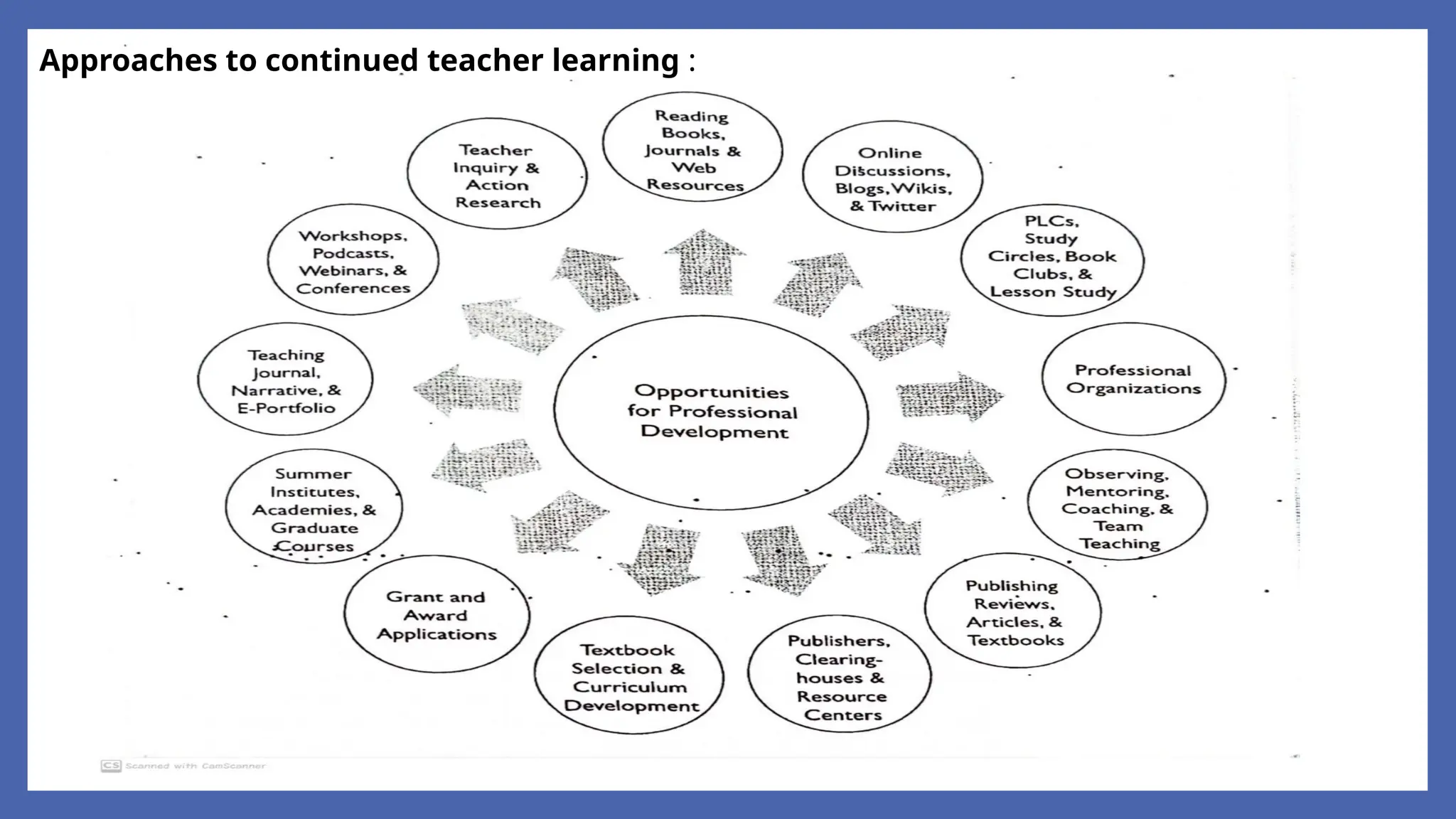
Approaches to continued teacher learning :
most famous professional associations and organizations
for teacher learning:
1. American Educational Research Association (AERA): A leading
international professional organization dedicated to advancing
educational research and its practical applications.
2. Association for Supervision and Curriculum Development (ASCD): A
global community of educators dedicated to excellence in learning,
teaching, and leading.
3. National Council of Teachers of English (NCTE): A professional
organization that promotes the development of literacy and the
use of English language arts at all educational levels.
4. National Science Teachers Association (NSTA): The largest
professional organization in the world promoting excellence and
innovation in science teaching and learning.
5. International Literacy Association (ILA): A global organization of
literacy educators and experts, focused on promoting high-quality
literacy instruction and research.
most famous professional associations and organizations
for teacher learning:
6. International Society for Technology in Education (ISTE): A leading
nonprofit organization focused on innovating education through
the use of technology.
7. National Association for the Education of Young Children (NAEYC):
The world's largest organization working on behalf of young
children, with a focus on professional development for early
childhood educators.
8. American Federation of Teachers (AFT): A union that represents
teachers, paraprofessionals, and other school personnel, providing
professional development opportunities.
9. National Education Association (NEA): The largest professional
employee organization in the United States, supporting the
professional growth of teachers.
10. Association of Teacher Educators (ATE): A national organization
dedicated to the improvement of teacher education for both
school-based and college/university-based teacher educators.
Professionals journals:
ELT Journal, English for Specific Purposes, English Teaching Forum
Language Learning, Language Teaching, Language Testing
Modern English Teacher, TESL Canada Journal, TESL-EJ.
TESOL Journal, TESOL Quarterly, Journal of Teacher Education
(published by AACTE)
Teaching and Teacher Education (published by Elsevier), Professional
Development in Education (published by Routledge)
Review of Educational Research (published by AERA), Journal of
Educational Change (published by Springer)
Teachers College Record (published by Teachers College Columbia
University), Action in Teacher Education (published by Routledge)
Online discussion groups can have a significant impact on teacher
learning and professional development. Here are some of the key ways in
which online discussion groups can affect teacher learning:
Accessibility and Convenience: Online discussion groups allow teachers to
engage in professional learning opportunities from the comfort of their own
homes or schools, overcoming geographical and scheduling barriers.This
increased accessibility makes it easier for teachers to participate in ongoing,
just-in-time learning.
Reflective Practice: Online discussion forums provide opportunities for
teachers to engage in reflective practices, such as sharing their experiences,
asking questions, and receiving feedback from their peers.This reflective
process can help teachers deepen their understanding of their own teaching
practices and identify areas for improvement.
Access to Experts and Resources: Online discussion groups may include the
participation of subject-matter experts, educational researchers, or
experienced practitioners who can share their knowledge and insights.Teachers
can also access a wealth of resources, such as research articles, lesson plans,
and instructional materials, shared within the discussion group.
Online discussion groups can have a significant impact on teacher
learning and professional development. Here are some of the key ways in
which online discussion groups can affect teacher learning:
Collaborative Knowledge-Sharing: Online discussion groups facilitate the
exchange of ideas, strategies, and best practices among teachers from diverse
backgrounds and experiences. This collaborative knowledge-sharing enables
teachers to learn from each other, gain new perspectives, and expand their
professional networks.
Personalized and Differentiated Learning: Online discussion groups can be
tailored to specific subject areas, grade levels, or areas of interest, allowing
teachers to engage in learning that is directly relevant to their needs and
contexts. Teachers can also participate in multiple discussion groups to address
their diverse professional development goals.
Conclusion:
Teacher learning is crucial for ensuring student success and the quality
of education. Effective teacher learning involves a multifaceted
approach, including reflective teaching, professional development,
collaboration, and the use of online resources.
Through self-observation, self-assessment, and building self-
awareness, teachers can gain valuable insights to guide their
professional growth. Collaboration with peers, participation in
professional associations, and exposure to research-based practices
further empower teachers to expand their perspectives and stay at the
forefront of educational innovation.
Ultimately, a commitment to lifelong learning and continuous self-
improvement is essential for teachers to thrive in the dynamic field of
education. By embracing various methods of teacher learning,
educators can foster their own growth, enhance student outcomes, and
contribute to the ongoing evolution of the teaching profession.
Created by : Mahdi
Golmohammadi

reflective teaching: principles and practices.pptx

  • 1.
    REFLECTIVE TEACHING : PRINCIPLESAND PRACTICES What does the idea of being a reflective language teacher bring to mind? How can language teachers continue to grow? What are some steps teachers can take to enhance awareness of their strengths and weaknesses? What are some strategies teachers could begin to develop now to avoid burnout in the future?
  • 2.
    Reflective teaching isa process of 'looking at what you do in the classroom, thinking about why you do it, and thinking about if it works. It is a process of self-observation and self- evaluation. Reflective teaching is a way for teachers to improve their teaching by thinking about what they do in the classroom and why they do it. Five basic assumptions are posited about reflective teaching: 1. An informed teacher has an extensive knowledge base about teaching, particularly as connected with local contexts. 2. Much can be learned about teaching through self-inquiry. 3. Much of what happens in teaching is unknown to the teacher. 4. Teaching experience alone is insufficient as a basis for continuing development. 5. Critical reflection can trigger a deeper understanding of
  • 3.
    Purposes of reflectiveteaching: 1. To expand our understandings of the teaching-learning process 2. To expand our repertoire of strategic options as language teachers 3. To take ownership of our own theories of language teaching as informed by teaching practice 4. To enhance the quality of learning opportunities we are able to provide in language classrooms. Those of us interested in reflective teaching need to work to improve these abilities : gather and examine information on what is taking place within a language course, identify anything puzzling about the teaching-learning process, build awareness and deepen understanding of teaching-learning behaviors, collaborate with others interested in processes of reflective teaching, refine questions tide to teaching that are worth further exploration, locate resources to help clarify questions being posed, make informed changes in teaching-learning behaviors.
  • 4.
    The roots andorigins of reflective teaching : The concept of reflective teaching has its origins in the work of philosopher and educator John Dewey in the early 20th century. Dewey emphasized the importance of reflection in the learning process, arguing that true learning occurs when individuals engage in active reflection on their experiences. The modern understanding of reflective teaching was further developed by scholars such as Donald Schön, who in the 1980s proposed the idea of the "reflective practitioner." Schön argued that effective professionals, including teachers, engage in both "reflection-in-action" (thinking about what they are doing while they are doing it) and "reflection-on-action" (analyzing their past experiences to inform future practice).
  • 5.
    The roots andorigins of reflective teaching : Since then, the idea of reflective teaching has become a core component of teacher education and professional development programs around the world. Reflective teaching is based on the belief that teachers can improve their practice by regularly examining their own beliefs, assumptions, and actions, and using those insights to make informed decisions about their teaching. Overall, the roots of reflective teaching can be traced back to Dewey's emphasis on the role of reflection in learning, and the subsequent development of the concept of the reflective practitioner by scholars like Schön. This approach to teaching has become an essential aspect of effective and responsive pedagogical practice.
  • 6.
    Alternative traditions ofreflective teaching : in addition to the conceptual roots and tripartite dimensions of reflective teaching already discussed, there is another definitional matter that merits attention specialists continue to debate the scope and parameters of reflective teaching. In one tradition, the focus is on the professional efforts of individual teachers working in particular settings. Illustrated in the work of many contemporary English language of self-observation, self-assessment, building awareness, and continuing professional development. Self-observation: Self-observation is a key part of reflective teaching, where the teacher carefully examines their own instructional practices, decisions, and behaviors in the classroom. As a reflective teacher, you observe yourself teaching and analyze your actions, thought processes, and interactions with students. This self- observation allows you to identify areas for improvement, experiment with new teaching strategies, and continuously develop your skills. By closely examining your own teaching, you can gain valuable insights that inform your future lessons and professional growth. Self-observation is an essential component of the reflective teaching cycle, helping teachers become more conscious, intentional, and effective in their practice.
  • 7.
    Self-assessment: Self-assessment isa crucial component of reflective teaching. It involves the teacher critically evaluating their own performance, effectiveness, and progress. Through self- assessment, teachers analyze their instructional methods, student learning outcomes, and their own professional growth. This process allows teachers to identify their strengths, weaknesses, and areas for improvement. By engaging in self-assessment, teachers can set meaningful goals, experiment with new approaches, and continuously enhance their teaching practice. Self-assessment empowers teachers to take ownership of their professional development and make informed decisions to improve their effectiveness in the classroom. Building awareness: Building awareness is a key aspect of reflective teaching. It involves developing a deeper understanding of oneself as a teacher, one's teaching context, and the impact of one's actions on student learning. Through building awareness, teachers become more conscious of their beliefs, assumptions, and biases that shape their instructional decisions. They also gain insights into the unique needs, perspectives, and experiences of their students. By building this self-awareness and contextual awareness, teachers can make more informed and intentional choices in their practice. Ultimately, building awareness enables teachers to become more reflective, adaptable, and responsive in their teaching, leading to improved student outcomes and continuous professional growth.
  • 8.
    continuing professional development: Continuing professional development (CPD) is an essential component of reflective teaching. It involves the ongoing process of learning, growth, and improvement as a teacher. Through CPD, reflective teachers engage in activities such as attending workshops, taking courses, collaborating with colleagues, and exploring new teaching methods. This allows them to stay up-to-date with the latest educational research, pedagogical strategies, and technological innovations. Reflective teachers use CPD to identify their professional development needs, set goals, and implement changes to enhance their teaching practice. By embracing CPD, teachers demonstrate a commitment to lifelong learning and ensure that their knowledge, skills, and approaches remain relevant and effective in serving the evolving needs of their students. CPD is a crucial aspect of the reflective teaching cycle, fostering continuous improvement and professional growth.
  • 9.
    Classroom applications : 1.Lesson planning and reflection: Reflective teachers carefully plan their lessons, considering the learning objectives, instructional strategies, and assessment methods. After the lesson, they reflect on what worked well, what challenges arose, and how they can improve for the next lesson. 2. Classroom observations: Reflective teachers may invite colleagues or administrators to observe their classes and provide feedback. They then reflect on the observations to identify areas for improvement in their teaching. 3. Student feedback: Reflective teachers regularly collect feedback from students, either through informal discussions or structured surveys. They use this feedback to understand the students' perspectives and make adjustments to their teaching.
  • 10.
    Classroom applications : 4.Reflective journaling: Reflective teachers maintain a teaching journal or log, where they record their thoughts, insights, and lessons learned from their classroom experiences. This helps them identify patterns, trends, and areas for growth. 5. Action research: Reflective teachers engage in small-scale action research projects, where they identify a problem or challenge in their classroom, implement a new strategy, and then reflect on the outcomes to inform their future practice. 6. Professional learning communities: Reflective teachers collaborate with colleagues in professional learning communities, where they share experiences, discuss best practices, and engage in collective reflection to enhance their teaching. By applying these reflective techniques in the classroom, teachers can continuously improve their practice, adapt to the needs of their students, and foster a culture of ongoing professional development.
  • 11.
    Two perspectives ofreflective teaching : In the context of reflective teaching, the emic and etic perspectives refer to different approaches to understanding and analyzing teaching practices. Emic Perspective: The emic perspective in reflective teaching focuses on the insider's, or the teacher's, own understanding and interpretation of their teaching experiences. It emphasizes the subjective, personal, and contextual factors that shape the teacher's beliefs, assumptions, and decision-making processes. Example: A teacher reflects on their own thought processes, emotions, and intuitions during a challenging classroom management situation. They analyze how their past experiences, cultural background, and personal teaching philosophy influenced their approach and response to the situation.
  • 12.
    Etic Perspective: The eticperspective in reflective teaching involves an outsider's, or an observer's, objective analysis of the teacher's practices. It looks at teaching from a more detached, analytical, and theory-based standpoint, drawing on educational research and established frameworks. Example: A teacher invites a peer or an instructional coach to observe their lesson and provide feedback. The observer analyzes the teacher's instructional techniques, classroom management strategies, and student engagement using established teaching frameworks or models.
  • 13.
    The interplay betweenthe emic and etic perspectives is crucial in reflective teaching. By considering both the insider's and outsider's viewpoints, teachers can gain a more comprehensive understanding of their practice, identify areas for improvement, and make informed decisions to enhance their teaching effectiveness. For instance, a teacher may reflect on their own intuitive approach to scaffolding during a lesson (emic perspective), and then compare it to the feedback from an observer who points out opportunities to more explicitly model and gradually release responsibility to students (etic perspective). This combined understanding can lead the teacher to refine their scaffolding strategies and make them more intentional and effective. The thoughtful integration of emic and etic perspectives is a hallmark of the reflective teaching process, allowing teachers to develop a nuanced, multifaceted understanding of their practice and drive continuous improvement.
  • 14.
    Future trends : Aswe look towards the future, reflective teaching is likely to play an increasingly important role in the evolving landscape of education. Here are some ways reflective teaching may evolve and align with future trends : 1. Embracing technology: Reflective teaching will continue to integrate emerging technologies, such as video recording, digital portfolios, and virtual collaboration platforms, to enhance the self-observation, self-assessment, and professional development processes. 2. Data-informed decision making: Reflective teachers will leverage data-driven insights, from student performance analytics to classroom observation data, to inform their reflections and guide their instructional decisions. 3. Personalized professional development: Reflective teaching will become more personalized, with teachers tailoring their continuing professional development (CPD) activities to their unique needs, goals, and contexts.
  • 15.
    Future trends : 4.Collaborative reflection: Reflective teaching will increasingly involve collaborative reflection, with teachers engaging in peer-to-peer observations, co-teaching, and interdisciplinary discussions to learn from one another and develop a collective understanding of best practices. 5. Adaptive expertise: Reflective teaching will support the development of adaptive expertise, where teachers become adept at continuously adjusting their practices to meet the evolving needs of diverse learners and respond to changing educational landscapes. 6. Sustainability and well-being: Reflective teaching practices will integrate a stronger focus on teacher well-being and sustainable practices, helping educators manage stress, promote work-life balance, and maintain a healthy, resilient mindset. 7. Equity and inclusion: Reflective teaching will increasingly emphasize the importance of equity, diversity, and inclusion, with teachers critically examining their biases, teaching approaches, and classroom environments to ensure they are providing equitable learning opportunities for all students.
  • 16.
    Conclusion : Reflective teachingempowers educators to continuously improve their practice and positively impact student learning. Through self-observation, self-assessment, and building self- awareness, teachers gain valuable insights, identify areas for growth, and adapt their teaching to evolving classroom needs. At the heart of reflective teaching is a commitment to lifelong learning and professional development, cultivating the adaptive expertise necessary to thrive in education. As reflective teaching continues to evolve, it will play an increasingly vital role in fostering equity, well-being, and student success. Embracing the power of reflection enables teachers to take ownership of their practice, become agents of change, and inspire their students to reach new heights. Reflective teaching is not just a set of techniques, but a mindset that drives ongoing improvement and positive impact in the classroom.
  • 18.
    EFFECTIVE PROFESSIONAL DEVELOPMENT FOR LANGUAGE TEACHERS Whatare some characteristics of effective professional development for English as a second/foreign language teachers? What are some ways English teaching professionals can continue to learn both on their own and as part of a professional learning community? How has technology expanded professional learning opportunities?
  • 19.
    Here are somekey characteristics of effective professional development for English as a Second/Foreign Language (ESL/EFL) teachers: 1. Relevance and contextualization: Professional development should be tailored to the specific needs, challenges, and contexts of ESL/EFL teachers. It should address the unique pedagogical and linguistic considerations of teaching English language learners. 2. Ongoing and sustained support: Professional development should not be a one-time event, but an ongoing process that provides continuous learning opportunities. ESL/EFL teachers need sustained support and opportunities to apply, reflect, and refine their practices. 3. Collaborative and peer-to-peer learning: Professional development should foster collaboration and the sharing of best practices among ESL/EFL teachers. Opportunities for peer observation, mentoring, and peer-to-peer feedback can be highly valuable. 4. Grounded in research and evidence-based practices: Professional development should be informed by the latest research and evidence-based instructional approaches in second language acquisition and teaching. ESL/EFL teachers should be exposed to the theoretical foundations and empirical support for effective teaching strategies.
  • 20.
    Here are somekey characteristics of effective professional development for English as a Second/Foreign Language (ESL/EFL) teachers: 5. Practical and hands-on: Professional development should provide ESL/EFL teachers with practical, immediately applicable strategies and techniques. Opportunities for modeling, role-playing, and hands-on practice can help bridge the gap between theory and practice. 6. Personalized and differentiated: Professional development should account for the diverse backgrounds, experiences, and proficiency levels of ESL/EFL teachers. Opportunities for personalized goal-setting, reflection, and individualized support can enhance the effectiveness of professional development. 7. Reflective and inquiry-based: Professional development should encourage ESL/EFL teachers to engage in reflective practices, such as action research, lesson study, and critical self-assessment. This helps teachers develop a growth mindset and the ability to continuously improve their practice. By incorporating these characteristics, professional development for ESL/EFL teachers can be more impactful, leading to enhanced teaching effectiveness, improved student outcomes, and the ongoing professional growth of language educators.
  • 21.
    Approaches to continuedteacher learning :
  • 22.
    most famous professionalassociations and organizations for teacher learning: 1. American Educational Research Association (AERA): A leading international professional organization dedicated to advancing educational research and its practical applications. 2. Association for Supervision and Curriculum Development (ASCD): A global community of educators dedicated to excellence in learning, teaching, and leading. 3. National Council of Teachers of English (NCTE): A professional organization that promotes the development of literacy and the use of English language arts at all educational levels. 4. National Science Teachers Association (NSTA): The largest professional organization in the world promoting excellence and innovation in science teaching and learning. 5. International Literacy Association (ILA): A global organization of literacy educators and experts, focused on promoting high-quality literacy instruction and research.
  • 23.
    most famous professionalassociations and organizations for teacher learning: 6. International Society for Technology in Education (ISTE): A leading nonprofit organization focused on innovating education through the use of technology. 7. National Association for the Education of Young Children (NAEYC): The world's largest organization working on behalf of young children, with a focus on professional development for early childhood educators. 8. American Federation of Teachers (AFT): A union that represents teachers, paraprofessionals, and other school personnel, providing professional development opportunities. 9. National Education Association (NEA): The largest professional employee organization in the United States, supporting the professional growth of teachers. 10. Association of Teacher Educators (ATE): A national organization dedicated to the improvement of teacher education for both school-based and college/university-based teacher educators.
  • 24.
    Professionals journals: ELT Journal,English for Specific Purposes, English Teaching Forum Language Learning, Language Teaching, Language Testing Modern English Teacher, TESL Canada Journal, TESL-EJ. TESOL Journal, TESOL Quarterly, Journal of Teacher Education (published by AACTE) Teaching and Teacher Education (published by Elsevier), Professional Development in Education (published by Routledge) Review of Educational Research (published by AERA), Journal of Educational Change (published by Springer) Teachers College Record (published by Teachers College Columbia University), Action in Teacher Education (published by Routledge)
  • 25.
    Online discussion groupscan have a significant impact on teacher learning and professional development. Here are some of the key ways in which online discussion groups can affect teacher learning: Accessibility and Convenience: Online discussion groups allow teachers to engage in professional learning opportunities from the comfort of their own homes or schools, overcoming geographical and scheduling barriers.This increased accessibility makes it easier for teachers to participate in ongoing, just-in-time learning. Reflective Practice: Online discussion forums provide opportunities for teachers to engage in reflective practices, such as sharing their experiences, asking questions, and receiving feedback from their peers.This reflective process can help teachers deepen their understanding of their own teaching practices and identify areas for improvement. Access to Experts and Resources: Online discussion groups may include the participation of subject-matter experts, educational researchers, or experienced practitioners who can share their knowledge and insights.Teachers can also access a wealth of resources, such as research articles, lesson plans, and instructional materials, shared within the discussion group.
  • 26.
    Online discussion groupscan have a significant impact on teacher learning and professional development. Here are some of the key ways in which online discussion groups can affect teacher learning: Collaborative Knowledge-Sharing: Online discussion groups facilitate the exchange of ideas, strategies, and best practices among teachers from diverse backgrounds and experiences. This collaborative knowledge-sharing enables teachers to learn from each other, gain new perspectives, and expand their professional networks. Personalized and Differentiated Learning: Online discussion groups can be tailored to specific subject areas, grade levels, or areas of interest, allowing teachers to engage in learning that is directly relevant to their needs and contexts. Teachers can also participate in multiple discussion groups to address their diverse professional development goals.
  • 27.
    Conclusion: Teacher learning iscrucial for ensuring student success and the quality of education. Effective teacher learning involves a multifaceted approach, including reflective teaching, professional development, collaboration, and the use of online resources. Through self-observation, self-assessment, and building self- awareness, teachers can gain valuable insights to guide their professional growth. Collaboration with peers, participation in professional associations, and exposure to research-based practices further empower teachers to expand their perspectives and stay at the forefront of educational innovation. Ultimately, a commitment to lifelong learning and continuous self- improvement is essential for teachers to thrive in the dynamic field of education. By embracing various methods of teacher learning, educators can foster their own growth, enhance student outcomes, and contribute to the ongoing evolution of the teaching profession.
  • 28.
    Created by :Mahdi Golmohammadi

Editor's Notes

  • #1 Are your classroom colors different than what you see in this template? That’s OK! Click on Design -> Variants (the down arrow) -> Pick the color scheme that works for you! Feel free to change any “You will…” and “I will…” statements to ensure they align with your classroom procedures and rules!