Quick Sort
Afaq Mansoor Khan
BSSE 2017-21
IMSciences Peshawar
What is Quick Sort?
• Quick sort is a divide and conquer algorithm
which relies on a partition operation:
– to partition an array an element called a pivot is
selected
• All elements smaller than the pivot are moved
before it and all greater elements are moved
after it
• The lesser and greater sublists are then
recursively sorted
2
Quick sort
• Efficient implementations (with in-place
partitioning), somewhat complex, but are
among the fastest sorting algorithms in
practice
• One of the most popular sorting algorithms
and is available in many standard
programming libraries.
Idea of Quick-Sort
1) Divide : If the sequence S has 2 or more elements,
select an element x from S to be your pivot. Any
arbitrary element, like the last, will do. Remove all the
elements of S and divide them into 3 sequences:
L, holds S’s elements less than x
E, holds S’s elements equal to x
G, holds S’s elements greater than x
2) Recurse: Recursively sort L and G
3) Conquer: Finally, to put elements back into S in order,
first inserts the elements of L, then those of E, and
those of G.
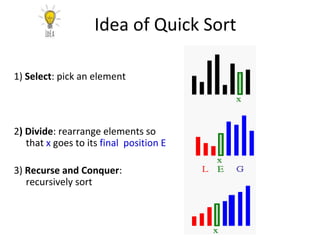
Idea of Quick Sort
1) Select: pick an element
2) Divide: rearrange elements so
that x goes to its final position E
3) Recurse and Conquer:
recursively sort
Two key steps
• How to pick a pivot?
• How to partition?
Pick a pivot
• Use the first element as pivot
– if the input is random, ok
– if the input is presorted (or in reverse order)
• all the elements go into S2 (or S1)
• Results in O(n2) behavior (Analyze this case later)
• Choose the pivot randomly
– generally safe
A better partition
• Want to partition an array A[left .. right]
• First, get the pivot element out of the way by swapping it with the last
element. (Swap pivot and A[right])
pivot i j
5 6 4 6 3 12 19 5 6 4 63 1219
swap
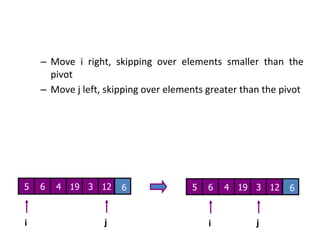
– Move i right, skipping over elements smaller than the
pivot
– Move j left, skipping over elements greater than the pivot
i j
5 6 4 63 1219
i j
5 6 4 63 1219
• When i and j have stopped and i is to the left of j
– Swap A[i] and A[j]
• The large element is pushed to the right and the small element is pushed to
the left
– Repeat the process until i and j cross
swap
i j
5 6 4 63 1219
i j
5 3 4 66 1219
• When i and j have crossed
– Swap A[i] and pivot
• Result:
– A[x] <= pivot, for x < i
– A[x] >= pivot, for x > i
i j
5 3 4 66 1219
ij
5 3 4 66 1219
ij
5 3 4 6 6 12 19
Quicksort example
1
3
8
1
9
2
4
3
3
1
6
5
5
7
2
6
7
5
0
1
3
8
1
9
2
4
3
3
1
6
5
5
7
2
6
7
5
0
1
3 4
3
3
1
5
72
6
0
8
1
9
2
7
5
6
5
1
3
4
3
3
1
5
7
2
6
0
8
1
9
2
7
5
1
3
4
3
3
1
5
7
2
6
0
6
5
8
1
9
2
7
5
Select pivot
partition
Recursive call Recursive call
Merge
Quicksort Algorithm
• To sort a[left...right]:
1. if left < right:
1.1. Partition a[left...right] such that:
all a[left...p-1] are less than a[p], and
all a[p+1...right] are >= a[p]
1.2. Quicksort a[left...p-1]
1.3. Quicksort a[p+1...right]
2. Terminate
Quick Sort Source Code C++
void QuickSort(int list[], int left, int right) {
int pivot, leftArrow, rightArrow;
leftArrow = left;
rightArrow = right;
pivot = list[(left + right) / 2];
do {
while (list[rightArrow] > pivot)
rightArrow--;
while (list[leftArrow] < pivot)
leftArrow++;
if (leftArrow <= rightArrow) {
Swap_Data(list[leftArrow], list[rightArrow]);
leftArrow++;
rightArrow--;
}
}
while (rightArrow >= leftArrow);
if (left < rightArrow)
QuickSort(list, left, rightArrow);
if (leftArrow < right)
QuickSort(list, leftArrow, right);
}
Quick Sort Pseudo Code
• QuickSort(A,start,end)
• { if(start<end)
• { pIndex 🡨 partition(A,start,end)
QuickSort(A,start,Pindex-1)
QuickSort(A,Pindex+1,end)
}
}
• Partition(A,start,end)
• { pivot 🡨 A[end]
Pindex 🡨 start
For i 🡨 start to end-1
{
If(A[i] <= pivot)
{ Swap(a[i],P[pindex])
Pindex 🡨 Pindex+1
}
}
Swap(A[pindex] , A[end])
Return Pindex }
Complexity of Quick Sort
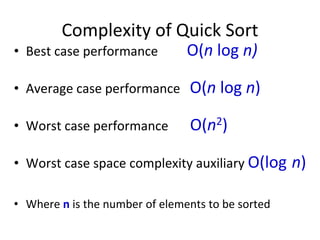
• Best case performance O(n log n)
• Average case performance O(n log n)
• Worst case performance O(n2)
• Worst case space complexity auxiliary O(log n)
• Where n is the number of elements to be sorted
Questions?
THANK YOU!
☺
References
• Data Structures and Algorithm Analysis by M. A.
Weiss, 2nd edition
• https://cs.nyu.edu/courses/spring99/V22.0102-
002/quick.html
• www.dcs.gla.ac.uk/~pat/52233/slides/QuickSort1x1.
pdf

Quick sort

  • 1.
    Quick Sort Afaq MansoorKhan BSSE 2017-21 IMSciences Peshawar
  • 2.
    What is QuickSort? • Quick sort is a divide and conquer algorithm which relies on a partition operation: – to partition an array an element called a pivot is selected • All elements smaller than the pivot are moved before it and all greater elements are moved after it • The lesser and greater sublists are then recursively sorted 2
  • 3.
    Quick sort • Efficientimplementations (with in-place partitioning), somewhat complex, but are among the fastest sorting algorithms in practice • One of the most popular sorting algorithms and is available in many standard programming libraries.
  • 4.
    Idea of Quick-Sort 1)Divide : If the sequence S has 2 or more elements, select an element x from S to be your pivot. Any arbitrary element, like the last, will do. Remove all the elements of S and divide them into 3 sequences: L, holds S’s elements less than x E, holds S’s elements equal to x G, holds S’s elements greater than x 2) Recurse: Recursively sort L and G 3) Conquer: Finally, to put elements back into S in order, first inserts the elements of L, then those of E, and those of G.
  • 5.
    Idea of QuickSort 1) Select: pick an element 2) Divide: rearrange elements so that x goes to its final position E 3) Recurse and Conquer: recursively sort
  • 6.
    Two key steps •How to pick a pivot? • How to partition?
  • 7.
    Pick a pivot •Use the first element as pivot – if the input is random, ok – if the input is presorted (or in reverse order) • all the elements go into S2 (or S1) • Results in O(n2) behavior (Analyze this case later) • Choose the pivot randomly – generally safe
  • 8.
    A better partition •Want to partition an array A[left .. right] • First, get the pivot element out of the way by swapping it with the last element. (Swap pivot and A[right]) pivot i j 5 6 4 6 3 12 19 5 6 4 63 1219 swap
  • 9.
    – Move iright, skipping over elements smaller than the pivot – Move j left, skipping over elements greater than the pivot i j 5 6 4 63 1219 i j 5 6 4 63 1219
  • 10.
    • When iand j have stopped and i is to the left of j – Swap A[i] and A[j] • The large element is pushed to the right and the small element is pushed to the left – Repeat the process until i and j cross swap i j 5 6 4 63 1219 i j 5 3 4 66 1219
  • 11.
    • When iand j have crossed – Swap A[i] and pivot • Result: – A[x] <= pivot, for x < i – A[x] >= pivot, for x > i i j 5 3 4 66 1219 ij 5 3 4 66 1219 ij 5 3 4 6 6 12 19
  • 12.
  • 13.
    Quicksort Algorithm • Tosort a[left...right]: 1. if left < right: 1.1. Partition a[left...right] such that: all a[left...p-1] are less than a[p], and all a[p+1...right] are >= a[p] 1.2. Quicksort a[left...p-1] 1.3. Quicksort a[p+1...right] 2. Terminate
  • 14.
    Quick Sort SourceCode C++ void QuickSort(int list[], int left, int right) { int pivot, leftArrow, rightArrow; leftArrow = left; rightArrow = right; pivot = list[(left + right) / 2]; do { while (list[rightArrow] > pivot) rightArrow--; while (list[leftArrow] < pivot) leftArrow++; if (leftArrow <= rightArrow) { Swap_Data(list[leftArrow], list[rightArrow]); leftArrow++; rightArrow--; } } while (rightArrow >= leftArrow); if (left < rightArrow) QuickSort(list, left, rightArrow); if (leftArrow < right) QuickSort(list, leftArrow, right); }
  • 15.
    Quick Sort PseudoCode • QuickSort(A,start,end) • { if(start<end) • { pIndex 🡨 partition(A,start,end) QuickSort(A,start,Pindex-1) QuickSort(A,Pindex+1,end) } } • Partition(A,start,end) • { pivot 🡨 A[end] Pindex 🡨 start For i 🡨 start to end-1 { If(A[i] <= pivot) { Swap(a[i],P[pindex]) Pindex 🡨 Pindex+1 } } Swap(A[pindex] , A[end]) Return Pindex }
  • 16.
    Complexity of QuickSort • Best case performance O(n log n) • Average case performance O(n log n) • Worst case performance O(n2) • Worst case space complexity auxiliary O(log n) • Where n is the number of elements to be sorted
  • 17.
  • 18.
  • 19.
    References • Data Structuresand Algorithm Analysis by M. A. Weiss, 2nd edition • https://cs.nyu.edu/courses/spring99/V22.0102- 002/quick.html • www.dcs.gla.ac.uk/~pat/52233/slides/QuickSort1x1. pdf