Linear Sorting
Sorting in O(N) time
Dr. AMIT KUMAR @JUET
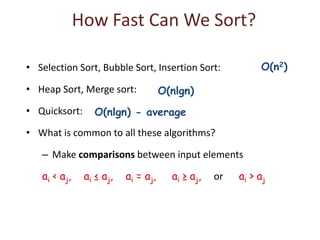
How Fast Can We Sort?
• Selection Sort, Bubble Sort, Insertion Sort:
• Heap Sort, Merge sort:
• Quicksort:
• What is common to all these algorithms?
– Make comparisons between input elements
ai < aj, ai ≤ aj, ai = aj, ai ≥ aj, or ai > aj
O(n2)
O(nlgn)
O(nlgn) - average
Can we do better than O( n log n )?
– No.
– It can be proven that any comparison-based sorting
algorithm will need to carry out at least O( n log n )
operations
How Fast Can We Sort?
Dr. AMIT KUMAR @JUET
Can we do better?
• Linear sorting algorithms
– Bucket sort
– Radix Sort
– Counting Sort
• Make certain assumptions about the data
• Linear sorts are NOT “comparison sorts”
Restrictions on the problem
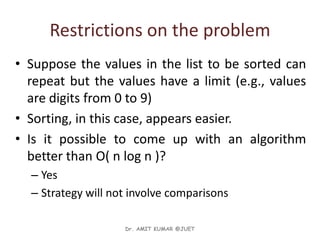
• Suppose the values in the list to be sorted can
repeat but the values have a limit (e.g., values
are digits from 0 to 9)
• Sorting, in this case, appears easier.
• Is it possible to come up with an algorithm
better than O( n log n )?
– Yes
– Strategy will not involve comparisons
Dr. AMIT KUMAR @JUET
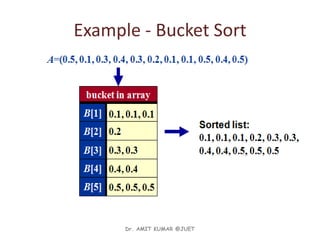
Bucket Sort
• Assumption:
– the input is generated by a random process that distributes elements
uniformly over [0, 1]
• Idea:
– Divide [(0, 1) into k equal-sized buckets (k=Θ(n))]
– Distribute the n input values into the buckets
– Sort each bucket (e.g., using quicksort)
– Go through the buckets in order, listing elements in each one
• Input: A[1 . . n], where 0 ≤ A[i] < 1 for all i
• Output: elements A[i] sorted
Dr. AMIT KUMAR @JUET
Example - Bucket Sort
Dr. AMIT KUMAR @JUET
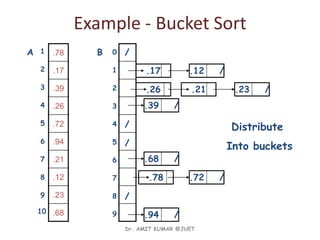
Example - Bucket Sort
.78
.17
.39
.26
.72
.94
.21
.12
.23
.68
0
1
2
3
4
5
6
7
8
9
1
2
3
4
5
6
7
8
9
10
.21
.12 /
.72 /
.23 /
.78
.94 /
.68 /
.39 /
.26
.17
/
/
/
/
A B
Distribute
Into buckets
Dr. AMIT KUMAR @JUET
Example - Bucket Sort
0
1
2
3
4
5
6
7
8
9
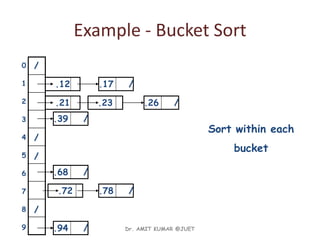
.23
.17 /
.78 /
.26 /
.72
.94 /
.68 /
.39 /
.21
.12
/
/
/
/
Sort within each
bucket
Dr. AMIT KUMAR @JUET
Example - Bucket Sort
0
1
2
3
4
5
6
7
8
9
.23
.17 /
.78 /
.26 /
.72
.94 /
.68 /
.39 /
.21
.12
/
/
/
/
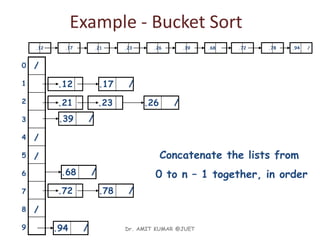
.17.12 .23 .26.21 .39 .68 .78.72 .94 /
Concatenate the lists from
0 to n – 1 together, in order
Dr. AMIT KUMAR @JUET
Bucket sort algorithm
Algorithm BucketSort( S )
( values in S are between 0 and m-1 )
for j  0 to m-1 do // initialize m buckets
b[j]  0
for i  0 to n-1 do // place elements in their
b[S[i]]  b[S[i]] + 1 // appropriate buckets
i  0
for j  0 to m-1 do // place elements in buckets
for r  1 to b[j] do // back in S
S[i]  j
i  i + 1
Dr. AMIT KUMAR @JUET
Time complexity
• Bucket initialization: O( m )
• From array to buckets: O( n )
• From buckets to array: O( n )
– Even though this stage is a nested loop, notice that all we
do is dequeue from each bucket until they are all empty –>
n dequeue operations in all
• Since m will likely be small compared to n, Bucket
sort is O( n )
– Strictly speaking, time complexity is O ( n + m )
Dr. AMIT KUMAR @JUET
Analysis of Bucket Sort
Alg.: BUCKET-SORT(A, n)
for i ← 1 to n
do insert A[i] into list B[nA[i]]
for i ← 0 to k - 1
do sort list B[i] with quicksort sort
concatenate lists B[0], B[1], . . . , B[n -1]
together in order
return the concatenated lists
O(n)
k O(n/k log(n/k))
=O(nlog(n/k)
O(k)
O(n) (if k=Θ(n))
Dr. AMIT KUMAR @JUET
Sorting integers
• Can we perform bucket sort on any array of (non-
negative) integers?
– Yes, but note that the number of buckets will depend on
the maximum integer value
• If you are sorting 1000 integers and the maximum
value is 999999, you will need 1 million buckets!
– Time complexity is not really O( n ) because m is much >
than n. Actual time complexity is O( m )
• Can we do better?
Dr. AMIT KUMAR @JUET
Radix Sort
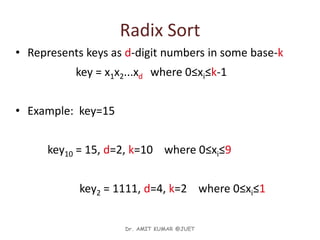
• Represents keys as d-digit numbers in some base-k
key = x1x2...xd where 0≤xi≤k-1
• Example: key=15
key10 = 15, d=2, k=10 where 0≤xi≤9
key2 = 1111, d=4, k=2 where 0≤xi≤1
Dr. AMIT KUMAR @JUET
Radix Sort
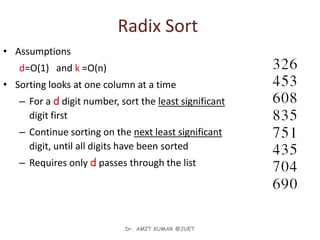
• Assumptions
d=O(1) and k =O(n)
• Sorting looks at one column at a time
– For a d digit number, sort the least significant
digit first
– Continue sorting on the next least significant
digit, until all digits have been sorted
– Requires only d passes through the list
Dr. AMIT KUMAR @JUET
Radix Sort
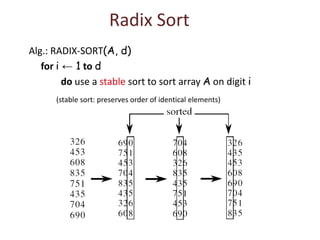
Alg.: RADIX-SORT(A, d)
for i ← 1 to d
do use a stable sort to sort array A on digit i
(stable sort: preserves order of identical elements)
Analysis of Radix Sort
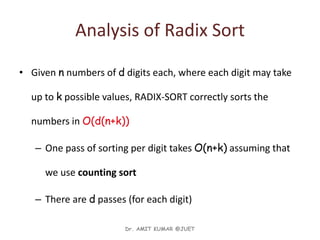
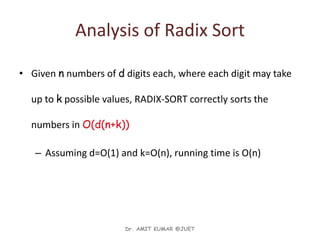
• Given n numbers of d digits each, where each digit may take
up to k possible values, RADIX-SORT correctly sorts the
numbers in O(d(n+k))
– One pass of sorting per digit takes O(n+k) assuming that
we use counting sort
– There are d passes (for each digit)
Dr. AMIT KUMAR @JUET
Analysis of Radix Sort
• Given n numbers of d digits each, where each digit may take
up to k possible values, RADIX-SORT correctly sorts the
numbers in O(d(n+k))
– Assuming d=O(1) and k=O(n), running time is O(n)
Dr. AMIT KUMAR @JUET
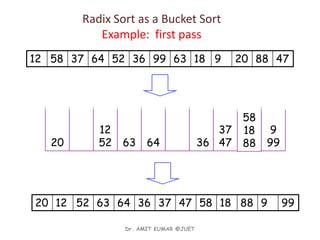
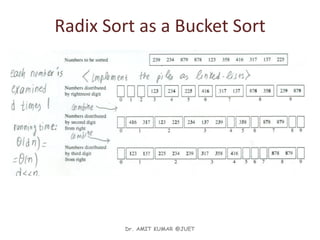
Radix Sort as a Bucket Sort
Example: first pass
12 58 37 64 52 36 99 63 18 9 20 88 47
20
12
52 63 64 36
37
47
58
18
88
9
99
20 12 52 63 64 36 37 47 58 18 88 9 99
Dr. AMIT KUMAR @JUET
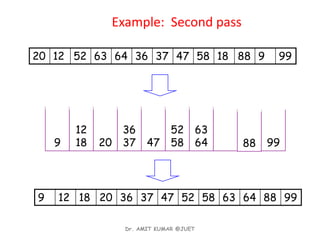
Example: Second pass
9 12 18 20 36 37 47 52 58 63 64 88 99
9
12
18 20
36
37 47
52
58
63
64 88 99
20 12 52 63 64 36 37 47 58 18 88 9 99
Dr. AMIT KUMAR @JUET
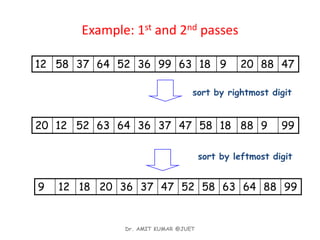
Example: 1st and 2nd passes
12 58 37 64 52 36 99 63 18 9 20 88 47
20 12 52 63 64 36 37 47 58 18 88 9 99
9 12 18 20 36 37 47 52 58 63 64 88 99
sort by rightmost digit
sort by leftmost digit
Dr. AMIT KUMAR @JUET
Radix Sort as a Bucket Sort
Dr. AMIT KUMAR @JUET
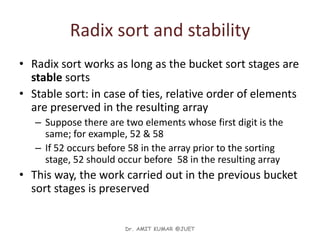
Radix sort and stability
• Radix sort works as long as the bucket sort stages are
stable sorts
• Stable sort: in case of ties, relative order of elements
are preserved in the resulting array
– Suppose there are two elements whose first digit is the
same; for example, 52 & 58
– If 52 occurs before 58 in the array prior to the sorting
stage, 52 should occur before 58 in the resulting array
• This way, the work carried out in the previous bucket
sort stages is preserved
Dr. AMIT KUMAR @JUET
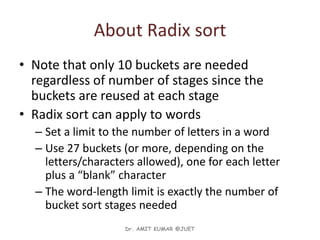
About Radix sort
• Note that only 10 buckets are needed
regardless of number of stages since the
buckets are reused at each stage
• Radix sort can apply to words
– Set a limit to the number of letters in a word
– Use 27 buckets (or more, depending on the
letters/characters allowed), one for each letter
plus a “blank” character
– The word-length limit is exactly the number of
bucket sort stages needed
Dr. AMIT KUMAR @JUET
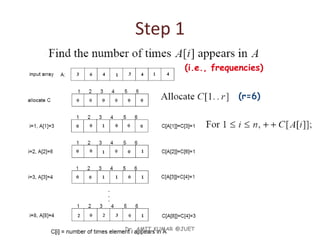
Counting Sort
• Assumptions:
– n integers which are in the range [0 ... r]
– r is in the order of n, that is, r=O(n)
• Idea:
– For each element x, find the number of elements x
– Place x into its correct position in the output array
output array
Dr. AMIT KUMAR @JUET
Step 1
(i.e., frequencies)
(r=6)
Dr. AMIT KUMAR @JUET
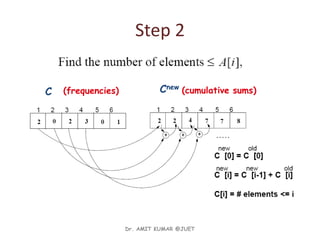
Step 2
Cnew
C (frequencies) (cumulative sums)
Dr. AMIT KUMAR @JUET
Algorithm
• Start from the last element of A
• Place A[i] at its correct place in the output array
• Decrease C[A[i]] by one
30320352
1 2 3 4 5 6 7 8
A
77422
1 2 3 4 5
Cnew 8
0
Dr. AMIT KUMAR @JUET
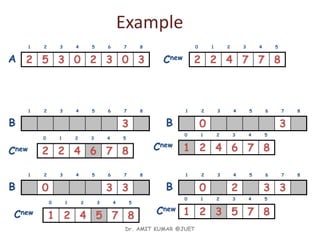
Example
30320352
1 2 3 4 5 6 7 8
A 77422
1 2 3 4 5
Cnew 8
0
3
1 2 3 4 5 6 7 8
B
76422
1 2 3 4 5
Cnew 8
0
30
1 2 3 4 5 6 7 8
B
76421
1 2 3 4 5
Cnew
8
0
330
1 2 3 4 5 6 7 8
B
75421
1 2 3 4 5
Cnew
8
0
3320
1 2 3 4 5 6 7 8
B
75321
1 2 3 4 5
Cnew
8
0
Dr. AMIT KUMAR @JUET
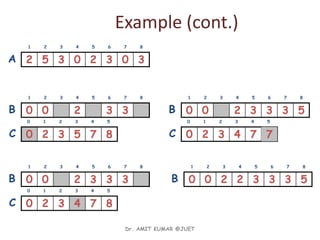
Example (cont.)
30320352
1 2 3 4 5 6 7 8
A
33200
1 2 3 4 5 6 7 8
B
75320
1 2 3 4 5
C 8
0
5333200
1 2 3 4 5 6 7 8
B
74320
1 2 3 4 5
C 7
0
333200
1 2 3 4 5 6 7 8
B
74320
1 2 3 4 5
C 8
0
53332200
1 2 3 4 5 6 7 8
B
Dr. AMIT KUMAR @JUET
COUNTING-SORT ALGO
Alg.: COUNTING-SORT(A, B, n, k)
1. for i ← 0 to r
2. do C[ i ] ← 0
3. for j ← 1 to n
4. do C[A[ j ]] ← C[A[ j ]] + 1
5. C[i] contains the number of elements equal to i
6. for i ← 1 to r
7. do C[ i ] ← C[ i ] + C[i -1]
8. C[i] contains the number of elements ≤ i
9. for j ← n downto 1
10. do B[C[A[ j ]]] ← A[ j ]
11. C[A[ j ]] ← C[A[ j ]] - 1
1 n
0 k
A
C
1 n
B
j
Analysis of Counting Sort
Alg.: COUNTING-SORT(A, B, n, k)
1. for i ← 0 to r
2. do C[ i ] ← 0
3. for j ← 1 to n
4. do C[A[ j ]] ← C[A[ j ]] + 1
5. C[i] contains the number of elements equal to i
6. for i ← 1 to r
7. do C[ i ] ← C[ i ] + C[i -1]
8. C[i] contains the number of elements ≤ i
9. for j ← n downto 1
10. do B[C[A[ j ]]] ← A[ j ]
11. C[A[ j ]] ← C[A[ j ]] - 1
O(r)
O(n)
O(r)
O(n)
Overall time: O(n + r)
Analysis of Counting Sort
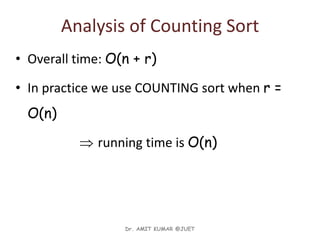
• Overall time: O(n + r)
• In practice we use COUNTING sort when r =
O(n)
 running time is O(n)
Dr. AMIT KUMAR @JUET

Linear sort

  • 1.
    Linear Sorting Sorting inO(N) time Dr. AMIT KUMAR @JUET
  • 2.
    How Fast CanWe Sort? • Selection Sort, Bubble Sort, Insertion Sort: • Heap Sort, Merge sort: • Quicksort: • What is common to all these algorithms? – Make comparisons between input elements ai < aj, ai ≤ aj, ai = aj, ai ≥ aj, or ai > aj O(n2) O(nlgn) O(nlgn) - average
  • 3.
    Can we dobetter than O( n log n )? – No. – It can be proven that any comparison-based sorting algorithm will need to carry out at least O( n log n ) operations How Fast Can We Sort? Dr. AMIT KUMAR @JUET
  • 4.
    Can we dobetter? • Linear sorting algorithms – Bucket sort – Radix Sort – Counting Sort • Make certain assumptions about the data • Linear sorts are NOT “comparison sorts”
  • 5.
    Restrictions on theproblem • Suppose the values in the list to be sorted can repeat but the values have a limit (e.g., values are digits from 0 to 9) • Sorting, in this case, appears easier. • Is it possible to come up with an algorithm better than O( n log n )? – Yes – Strategy will not involve comparisons Dr. AMIT KUMAR @JUET
  • 6.
    Bucket Sort • Assumption: –the input is generated by a random process that distributes elements uniformly over [0, 1] • Idea: – Divide [(0, 1) into k equal-sized buckets (k=Θ(n))] – Distribute the n input values into the buckets – Sort each bucket (e.g., using quicksort) – Go through the buckets in order, listing elements in each one • Input: A[1 . . n], where 0 ≤ A[i] < 1 for all i • Output: elements A[i] sorted Dr. AMIT KUMAR @JUET
  • 7.
    Example - BucketSort Dr. AMIT KUMAR @JUET
  • 8.
    Example - BucketSort .78 .17 .39 .26 .72 .94 .21 .12 .23 .68 0 1 2 3 4 5 6 7 8 9 1 2 3 4 5 6 7 8 9 10 .21 .12 / .72 / .23 / .78 .94 / .68 / .39 / .26 .17 / / / / A B Distribute Into buckets Dr. AMIT KUMAR @JUET
  • 9.
    Example - BucketSort 0 1 2 3 4 5 6 7 8 9 .23 .17 / .78 / .26 / .72 .94 / .68 / .39 / .21 .12 / / / / Sort within each bucket Dr. AMIT KUMAR @JUET
  • 10.
    Example - BucketSort 0 1 2 3 4 5 6 7 8 9 .23 .17 / .78 / .26 / .72 .94 / .68 / .39 / .21 .12 / / / / .17.12 .23 .26.21 .39 .68 .78.72 .94 / Concatenate the lists from 0 to n – 1 together, in order Dr. AMIT KUMAR @JUET
  • 11.
    Bucket sort algorithm AlgorithmBucketSort( S ) ( values in S are between 0 and m-1 ) for j  0 to m-1 do // initialize m buckets b[j]  0 for i  0 to n-1 do // place elements in their b[S[i]]  b[S[i]] + 1 // appropriate buckets i  0 for j  0 to m-1 do // place elements in buckets for r  1 to b[j] do // back in S S[i]  j i  i + 1 Dr. AMIT KUMAR @JUET
  • 12.
    Time complexity • Bucketinitialization: O( m ) • From array to buckets: O( n ) • From buckets to array: O( n ) – Even though this stage is a nested loop, notice that all we do is dequeue from each bucket until they are all empty –> n dequeue operations in all • Since m will likely be small compared to n, Bucket sort is O( n ) – Strictly speaking, time complexity is O ( n + m ) Dr. AMIT KUMAR @JUET
  • 13.
    Analysis of BucketSort Alg.: BUCKET-SORT(A, n) for i ← 1 to n do insert A[i] into list B[nA[i]] for i ← 0 to k - 1 do sort list B[i] with quicksort sort concatenate lists B[0], B[1], . . . , B[n -1] together in order return the concatenated lists O(n) k O(n/k log(n/k)) =O(nlog(n/k) O(k) O(n) (if k=Θ(n)) Dr. AMIT KUMAR @JUET
  • 14.
    Sorting integers • Canwe perform bucket sort on any array of (non- negative) integers? – Yes, but note that the number of buckets will depend on the maximum integer value • If you are sorting 1000 integers and the maximum value is 999999, you will need 1 million buckets! – Time complexity is not really O( n ) because m is much > than n. Actual time complexity is O( m ) • Can we do better? Dr. AMIT KUMAR @JUET
  • 15.
    Radix Sort • Representskeys as d-digit numbers in some base-k key = x1x2...xd where 0≤xi≤k-1 • Example: key=15 key10 = 15, d=2, k=10 where 0≤xi≤9 key2 = 1111, d=4, k=2 where 0≤xi≤1 Dr. AMIT KUMAR @JUET
  • 16.
    Radix Sort • Assumptions d=O(1)and k =O(n) • Sorting looks at one column at a time – For a d digit number, sort the least significant digit first – Continue sorting on the next least significant digit, until all digits have been sorted – Requires only d passes through the list Dr. AMIT KUMAR @JUET
  • 17.
    Radix Sort Alg.: RADIX-SORT(A,d) for i ← 1 to d do use a stable sort to sort array A on digit i (stable sort: preserves order of identical elements)
  • 18.
    Analysis of RadixSort • Given n numbers of d digits each, where each digit may take up to k possible values, RADIX-SORT correctly sorts the numbers in O(d(n+k)) – One pass of sorting per digit takes O(n+k) assuming that we use counting sort – There are d passes (for each digit) Dr. AMIT KUMAR @JUET
  • 19.
    Analysis of RadixSort • Given n numbers of d digits each, where each digit may take up to k possible values, RADIX-SORT correctly sorts the numbers in O(d(n+k)) – Assuming d=O(1) and k=O(n), running time is O(n) Dr. AMIT KUMAR @JUET
  • 20.
    Radix Sort asa Bucket Sort Example: first pass 12 58 37 64 52 36 99 63 18 9 20 88 47 20 12 52 63 64 36 37 47 58 18 88 9 99 20 12 52 63 64 36 37 47 58 18 88 9 99 Dr. AMIT KUMAR @JUET
  • 21.
    Example: Second pass 912 18 20 36 37 47 52 58 63 64 88 99 9 12 18 20 36 37 47 52 58 63 64 88 99 20 12 52 63 64 36 37 47 58 18 88 9 99 Dr. AMIT KUMAR @JUET
  • 22.
    Example: 1st and2nd passes 12 58 37 64 52 36 99 63 18 9 20 88 47 20 12 52 63 64 36 37 47 58 18 88 9 99 9 12 18 20 36 37 47 52 58 63 64 88 99 sort by rightmost digit sort by leftmost digit Dr. AMIT KUMAR @JUET
  • 23.
    Radix Sort asa Bucket Sort Dr. AMIT KUMAR @JUET
  • 24.
    Radix sort andstability • Radix sort works as long as the bucket sort stages are stable sorts • Stable sort: in case of ties, relative order of elements are preserved in the resulting array – Suppose there are two elements whose first digit is the same; for example, 52 & 58 – If 52 occurs before 58 in the array prior to the sorting stage, 52 should occur before 58 in the resulting array • This way, the work carried out in the previous bucket sort stages is preserved Dr. AMIT KUMAR @JUET
  • 25.
    About Radix sort •Note that only 10 buckets are needed regardless of number of stages since the buckets are reused at each stage • Radix sort can apply to words – Set a limit to the number of letters in a word – Use 27 buckets (or more, depending on the letters/characters allowed), one for each letter plus a “blank” character – The word-length limit is exactly the number of bucket sort stages needed Dr. AMIT KUMAR @JUET
  • 26.
    Counting Sort • Assumptions: –n integers which are in the range [0 ... r] – r is in the order of n, that is, r=O(n) • Idea: – For each element x, find the number of elements x – Place x into its correct position in the output array output array Dr. AMIT KUMAR @JUET
  • 27.
  • 28.
    Step 2 Cnew C (frequencies)(cumulative sums) Dr. AMIT KUMAR @JUET
  • 29.
    Algorithm • Start fromthe last element of A • Place A[i] at its correct place in the output array • Decrease C[A[i]] by one 30320352 1 2 3 4 5 6 7 8 A 77422 1 2 3 4 5 Cnew 8 0 Dr. AMIT KUMAR @JUET
  • 30.
    Example 30320352 1 2 34 5 6 7 8 A 77422 1 2 3 4 5 Cnew 8 0 3 1 2 3 4 5 6 7 8 B 76422 1 2 3 4 5 Cnew 8 0 30 1 2 3 4 5 6 7 8 B 76421 1 2 3 4 5 Cnew 8 0 330 1 2 3 4 5 6 7 8 B 75421 1 2 3 4 5 Cnew 8 0 3320 1 2 3 4 5 6 7 8 B 75321 1 2 3 4 5 Cnew 8 0 Dr. AMIT KUMAR @JUET
  • 31.
    Example (cont.) 30320352 1 23 4 5 6 7 8 A 33200 1 2 3 4 5 6 7 8 B 75320 1 2 3 4 5 C 8 0 5333200 1 2 3 4 5 6 7 8 B 74320 1 2 3 4 5 C 7 0 333200 1 2 3 4 5 6 7 8 B 74320 1 2 3 4 5 C 8 0 53332200 1 2 3 4 5 6 7 8 B Dr. AMIT KUMAR @JUET
  • 32.
    COUNTING-SORT ALGO Alg.: COUNTING-SORT(A,B, n, k) 1. for i ← 0 to r 2. do C[ i ] ← 0 3. for j ← 1 to n 4. do C[A[ j ]] ← C[A[ j ]] + 1 5. C[i] contains the number of elements equal to i 6. for i ← 1 to r 7. do C[ i ] ← C[ i ] + C[i -1] 8. C[i] contains the number of elements ≤ i 9. for j ← n downto 1 10. do B[C[A[ j ]]] ← A[ j ] 11. C[A[ j ]] ← C[A[ j ]] - 1 1 n 0 k A C 1 n B j
  • 33.
    Analysis of CountingSort Alg.: COUNTING-SORT(A, B, n, k) 1. for i ← 0 to r 2. do C[ i ] ← 0 3. for j ← 1 to n 4. do C[A[ j ]] ← C[A[ j ]] + 1 5. C[i] contains the number of elements equal to i 6. for i ← 1 to r 7. do C[ i ] ← C[ i ] + C[i -1] 8. C[i] contains the number of elements ≤ i 9. for j ← n downto 1 10. do B[C[A[ j ]]] ← A[ j ] 11. C[A[ j ]] ← C[A[ j ]] - 1 O(r) O(n) O(r) O(n) Overall time: O(n + r)
  • 34.
    Analysis of CountingSort • Overall time: O(n + r) • In practice we use COUNTING sort when r = O(n)  running time is O(n) Dr. AMIT KUMAR @JUET
  • 35.