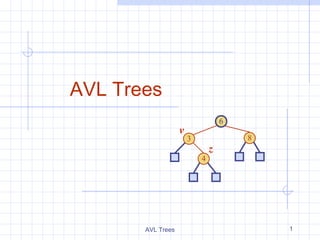
AVL Trees
                                   6
                   v
                       3               8
                               z
                           4


       AVL Trees                           1
AVL Tree Definition
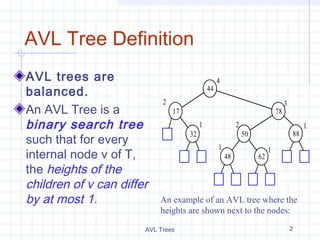
AVL trees are                                      4
balanced.                                     44
                            2
An AVL Tree is a
                                                                                   3
                                17                                            78
binary search tree                        1                 2                                   1
such that for every
                                     32                         50                         88
                                                   1
internal node v of T,                                  48            62
                                                                          1

the heights of the
children of v can differ
by at most 1.              An example of an AVL tree where the
                           heights are shown next to the nodes:

                       AVL Trees                                                       2
 
AVL Trees:
       AVL trees were invented in 1962 by two Russian
      scientist G.M Adelson Velsky & E.M Landis.
  
Definition:
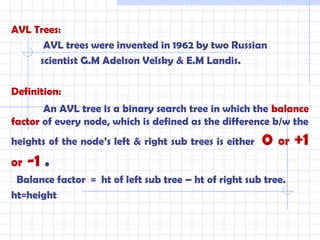
       An AVL tree is a binary search tree in which the balance
factor of every node, which is defined as the difference b/w the
heights of the node’s left & right sub trees is either   0 or +1
or   -1 .
 Balance factor = ht of left sub tree – ht of right sub tree.
ht=height
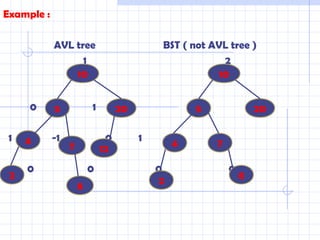
Example :

            AVL tree                       BST ( not AVL tree )
                  1                                    2
                10                                    10


     0      5            1        20               05                020

 1   4      -1                0        1                -1
                 7                             4         7
                             12
     0                   0                 0                 0
 2                                                               8
                                           2
                     8


      If an insertion of a new node makes an AVL tree
unbalanced , we transform the tree by a rotation
 

         Rotation :
          A Rotation in an AVL tree is a local transformation of
its sub tree rooted at a node whose balance has become either
+2 or -2 ,if there are several such nodes, we rotate the tree
rooted at the unbalanced node that is the closest to the newly
inserted leaf.
 
Types of rotations :

       Totally there are four types of rotations

1.            Single right rotation or R-rotation

2.            Single left rotation or L-rotation

3.            Double right-left rotation or RL-rotation

4.            Double left-right rotation or LR-rotation
 
Points to remember to select different rotation technique :

1.Straight line with positive unbalanced.
              apply Right rotation for unbalanced node.
              +2
                5                            04

    +1    4                        0             0
                                            2        5

  0
      2
 

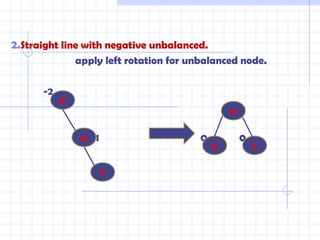
2.Straight line with negative unbalanced.
               apply left rotation for unbalanced node.

      -2
           5
                                                 06

                6 -1                     0            0
                                             5            7

                       70
 

3.Curved line with positive unbalanced.
             apply left-right rotation.

       Right rotation for unbalanced node and left rotation
for the nearest node.

                  +2
             5                                   0
                                                 4
        4   -1
                                           0 2        5   0
              2        0
 

4.Curved line with negative unbalanced.
                  apply right-left rotation.

       Left rotation for unbalanced node and right rotation
for the nearest node.

                  -2
              5                                      0
                                                      7
              +1       8
                                               0 5        8 0
      0   7
n(2)   3

                                                                      n(1)

Height of an AVL Tree
                                                                 4


 Fact: The height of an AVL tree storing n keys is O(log
 n).
 Proof: Let us bound n(h): the minimum number of internal
 nodes of an AVL tree of height h.
 We easily see that n(1) = 1 and n(2) = 2
 For n > 2, an AVL tree of height h contains the root node,
 one AVL subtree of height n-1 and another of height n-2.
 That is, n(h) = 1 + n(h-1) + n(h-2)
 Knowing n(h-1) > n(h-2), we get n(h) > 2n(h-2). So
 n(h) > 2n(h-2), n(h) > 4n(h-4), n(h) > 8n(n-6), … (by induction),
 n(h) > 2in(h-2i)
 Solving the base case we get: n(h) > 2 h/2-1
 Taking logarithms: h < 2log n(h) +2
 Thus the height of an AVL Trees is O(log n)
                         AVL tree                                    11
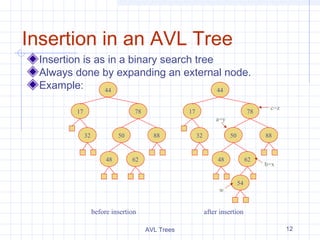
Insertion in an AVL Tree
 Insertion is as in a binary search tree
 Always done by expanding an external node.
 Example:       44                       44

                                                                                      c=z
        17                       78               17                            78
                                                                a=y

             32             50          88             32             50             88


                       48        62                              48             62
                                                                                     b=x


                                                                           54
                                                                 w


                  before insertion                          after insertion

                                      AVL Trees                                             12
Trinode Restructuring
           let (a,b,c) be an inorder listing of x, y, z
           perform the rotations needed to make b the topmost node of the
           three
                                   (other two cases
                                                                             a=z                  case 2: double rotation
            a=z                    are symmetrical)
                                                                                                  (a right rotation about c,
                                                                                       c=y        then a left rotation about a)
                  b=y
                                                                       T0
      T0
                        c=x                                                      b=x
                                                                                             T3
            T1                                       b=y                                                           b=x
                                                                            T1         T2
                   T2         T3
                                          a=z                   c=x                                     a=z                   c=y


case 1: single rotation
(a left rotation about a)            T0         T1         T2         T3                           T0         T1         T2         T3

                                                           AVL Trees                                                      13
Insertion Example, continued
                             5
                        44
      2
                                                                  z       64
          17                                                          78         7
                                      3
                                          2y                                         1
                    1
               32                1        50                4                   88
                             1
                                                        2        x
                                 48
                                               1
                                                   3        62
                                                                 5
                                                   54                           T3
unbalanced...                                                     T2
                                 T0
                                                                                4
                                          T1                               44                              4
                                                   2                                                   3        x
                                                       17
                                                                                            2 y            62
                                                                                                                     z6
                                                                      1                   2                               2
                                                                 32
                                                                                1
                                                                                     1     50     3             5
                                                                                                                     78        7
                                                                                                       1                            1
                    ...balanced                                                      48           54                           88

                                                                                                                    T2

                                                                                     T0           T1                           T3
                                                   AVL Trees                                                              14
Restructuring
(as Single Rotations)
 Single Rotations:


            a=z                              single rotation               b=y
                       b=y                                      a=z                   c=x
                                  c=x

       T0                                                                                   T3
                  T1                    T3                 T0         T1         T2
                             T2


                             c=z        single rotation               b=y
                  b=y                                      a=x                   c=z
       a=x

                                   T3                 T3
  T0                    T2                                       T2         T1         T0
             T1
                                             AVL Trees                                           15
Restructuring
(as Double Rotations)
 double rotations:


            a=z                               double rotation               b=x
                                  c=y                            a=z                   c=y
                       b=x

       T0                                                                         T2
                             T2          T3                 T0         T1                     T3
                  T1


                              c=z         double rotation              b=x
        a=y                                                 a=y                    c=z
                   b=x

                                    T0                            T2
  T3         T2                                        T3                    T1          T0
                        T1
                                               AVL Trees                                           16
Removal in an AVL Tree
  Removal begins as in a binary search tree, which
  means the node removed will become an empty
  external node. Its parent, w, may cause an imbalance.
  Example:      44                     44


         17                           62               17                  62


              32            50               78                  50             78


                       48        54               88        48        54             88


                   before deletion of 32                    after deletion

                                           AVL Trees                                      17
Rebalancing after a Removal
  Let z be the first unbalanced node encountered while travelling
  up the tree from w. Also, let y be the child of z with the larger
  height, and let x be the child of y with the larger height.
  We perform restructure(x) to restore balance at z.
  As this restructuring may upset the balance of another node
  higher in the tree, we must continue checking for balance until
  the root of T is reached


                                                                      62
      a=z     44

                                                               44              78
  w     17                   62         b=y

                                                          17         50             88
                   50             78          c=x


                                                                48        54
             48         54             88


                                              AVL Trees                                  18
Running Times for
AVL Trees
 a single restructure is O(1)
    using a linked-structure binary tree
 find is O(log n)
    height of tree is O(log n), no restructures needed
 insert is O(log n)
    initial find is O(log n)
    Restructuring up the tree, maintaining heights is O(log n)
 remove is O(log n)
    initial find is O(log n)
    Restructuring up the tree, maintaining heights is O(log n)


                             AVL Trees                            19

Avl trees

  • 1.
    AVL Trees 6 v 3 8 z 4 AVL Trees 1
  • 2.
    AVL Tree Definition AVLtrees are 4 balanced. 44 2 An AVL Tree is a 3 17 78 binary search tree 1 2 1 such that for every 32 50 88 1 internal node v of T, 48 62 1 the heights of the children of v can differ by at most 1. An example of an AVL tree where the heights are shown next to the nodes: AVL Trees 2
  • 3.
      AVL Trees: AVL trees were invented in 1962 by two Russian scientist G.M Adelson Velsky & E.M Landis.    Definition: An AVL tree is a binary search tree in which the balance factor of every node, which is defined as the difference b/w the heights of the node’s left & right sub trees is either 0 or +1 or -1 . Balance factor = ht of left sub tree – ht of right sub tree. ht=height
  • 4.
    Example : AVL tree BST ( not AVL tree ) 1 2 10 10 0 5 1 20 05 020 1 4 -1 0 1 -1 7 4 7 12 0 0 0 0 2 8 2 8
  • 5.
      If an insertion of a new node makes an AVL tree unbalanced , we transform the tree by a rotation   Rotation : A Rotation in an AVL tree is a local transformation of its sub tree rooted at a node whose balance has become either +2 or -2 ,if there are several such nodes, we rotate the tree rooted at the unbalanced node that is the closest to the newly inserted leaf.
  • 6.
      Types of rotations: Totally there are four types of rotations 1. Single right rotation or R-rotation 2. Single left rotation or L-rotation 3. Double right-left rotation or RL-rotation 4. Double left-right rotation or LR-rotation
  • 7.
      Points to rememberto select different rotation technique : 1.Straight line with positive unbalanced. apply Right rotation for unbalanced node. +2 5 04 +1 4 0 0 2 5 0 2
  • 8.
      2.Straight line withnegative unbalanced. apply left rotation for unbalanced node. -2 5 06 6 -1 0 0 5 7 70
  • 9.
      3.Curved line withpositive unbalanced. apply left-right rotation. Right rotation for unbalanced node and left rotation for the nearest node. +2 5 0 4 4 -1 0 2 5 0 2 0
  • 10.
      4.Curved line withnegative unbalanced. apply right-left rotation. Left rotation for unbalanced node and right rotation for the nearest node. -2 5 0 7 +1 8 0 5 8 0 0 7
  • 11.
    n(2) 3 n(1) Height of an AVL Tree 4 Fact: The height of an AVL tree storing n keys is O(log n). Proof: Let us bound n(h): the minimum number of internal nodes of an AVL tree of height h. We easily see that n(1) = 1 and n(2) = 2 For n > 2, an AVL tree of height h contains the root node, one AVL subtree of height n-1 and another of height n-2. That is, n(h) = 1 + n(h-1) + n(h-2) Knowing n(h-1) > n(h-2), we get n(h) > 2n(h-2). So n(h) > 2n(h-2), n(h) > 4n(h-4), n(h) > 8n(n-6), … (by induction), n(h) > 2in(h-2i) Solving the base case we get: n(h) > 2 h/2-1 Taking logarithms: h < 2log n(h) +2 Thus the height of an AVL Trees is O(log n) AVL tree 11
  • 12.
    Insertion in anAVL Tree Insertion is as in a binary search tree Always done by expanding an external node. Example: 44 44 c=z 17 78 17 78 a=y 32 50 88 32 50 88 48 62 48 62 b=x 54 w before insertion after insertion AVL Trees 12
  • 13.
    Trinode Restructuring let (a,b,c) be an inorder listing of x, y, z perform the rotations needed to make b the topmost node of the three (other two cases a=z case 2: double rotation a=z are symmetrical) (a right rotation about c, c=y then a left rotation about a) b=y T0 T0 c=x b=x T3 T1 b=y b=x T1 T2 T2 T3 a=z c=x a=z c=y case 1: single rotation (a left rotation about a) T0 T1 T2 T3 T0 T1 T2 T3 AVL Trees 13
  • 14.
    Insertion Example, continued 5 44 2 z 64 17 78 7 3 2y 1 1 32 1 50 4 88 1 2 x 48 1 3 62 5 54 T3 unbalanced... T2 T0 4 T1 44 4 2 3 x 17 2 y 62 z6 1 2 2 32 1 1 50 3 5 78 7 1 1 ...balanced 48 54 88 T2 T0 T1 T3 AVL Trees 14
  • 15.
    Restructuring (as Single Rotations) Single Rotations: a=z single rotation b=y b=y a=z c=x c=x T0 T3 T1 T3 T0 T1 T2 T2 c=z single rotation b=y b=y a=x c=z a=x T3 T3 T0 T2 T2 T1 T0 T1 AVL Trees 15
  • 16.
    Restructuring (as Double Rotations) double rotations: a=z double rotation b=x c=y a=z c=y b=x T0 T2 T2 T3 T0 T1 T3 T1 c=z double rotation b=x a=y a=y c=z b=x T0 T2 T3 T2 T3 T1 T0 T1 AVL Trees 16
  • 17.
    Removal in anAVL Tree Removal begins as in a binary search tree, which means the node removed will become an empty external node. Its parent, w, may cause an imbalance. Example: 44 44 17 62 17 62 32 50 78 50 78 48 54 88 48 54 88 before deletion of 32 after deletion AVL Trees 17
  • 18.
    Rebalancing after aRemoval Let z be the first unbalanced node encountered while travelling up the tree from w. Also, let y be the child of z with the larger height, and let x be the child of y with the larger height. We perform restructure(x) to restore balance at z. As this restructuring may upset the balance of another node higher in the tree, we must continue checking for balance until the root of T is reached 62 a=z 44 44 78 w 17 62 b=y 17 50 88 50 78 c=x 48 54 48 54 88 AVL Trees 18
  • 19.
    Running Times for AVLTrees a single restructure is O(1)  using a linked-structure binary tree find is O(log n)  height of tree is O(log n), no restructures needed insert is O(log n)  initial find is O(log n)  Restructuring up the tree, maintaining heights is O(log n) remove is O(log n)  initial find is O(log n)  Restructuring up the tree, maintaining heights is O(log n) AVL Trees 19

Editor's Notes

  • #2 Red-Black Trees 11/06/12 23:50