Recurrences
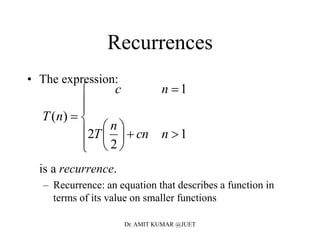
• The expression:
is a recurrence.
– Recurrence: an equation that describes a function in
terms of its value on smaller functions














1
2
2
1
)(
ncn
n
T
nc
nT
Dr. AMIT KUMAR @JUET
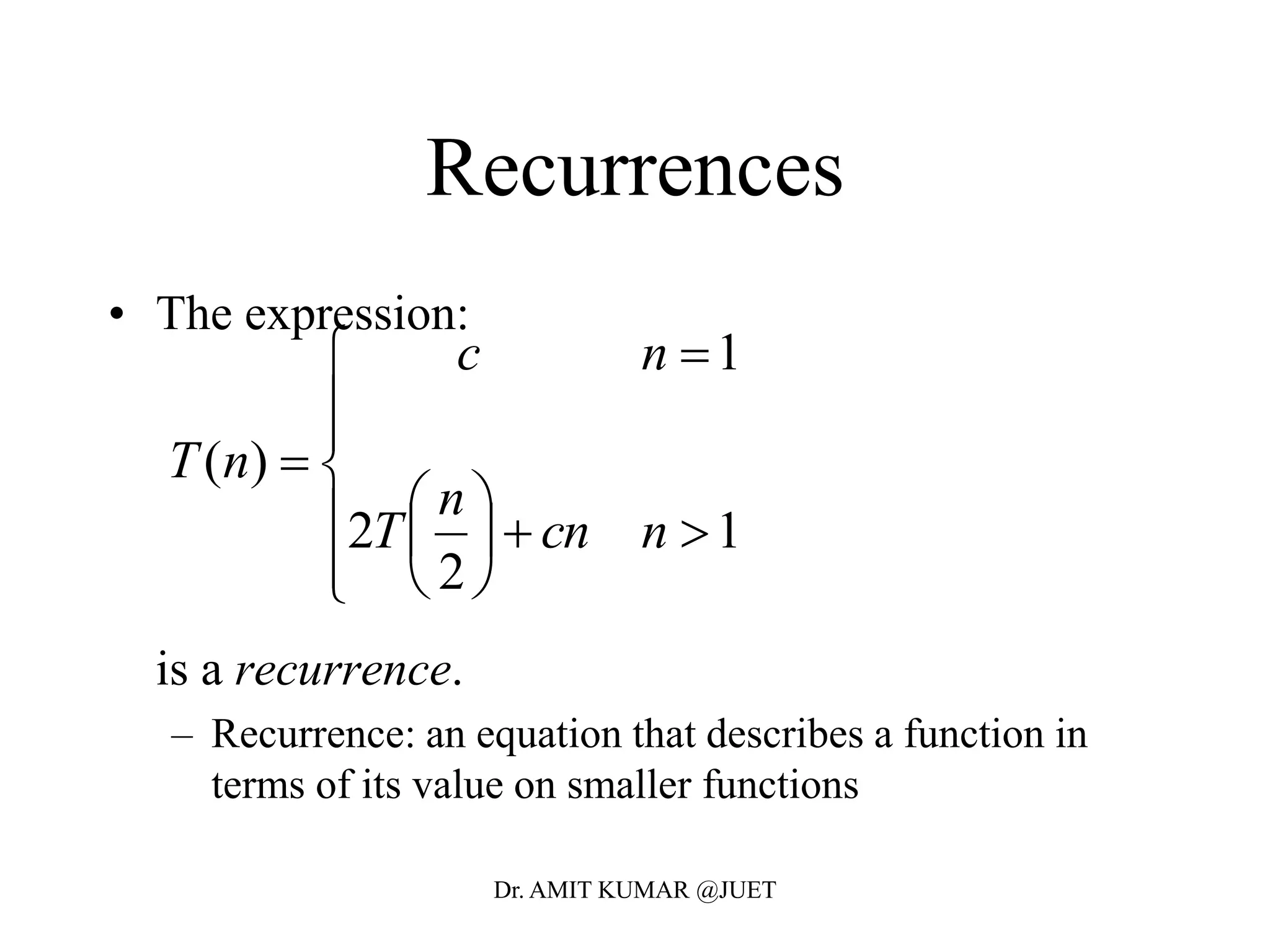
Master Method/Theorem
• Theorem 4.1 (page 73)
– for T(n) = aT(n/b)+f(n), n/b may be n/b or n/b.
– where a  1, b>1 are positive integers, f(n) be a non-
negative function.
1. If f(n)=O(nlogb
a-) for some >0, then T(n)= (nlogb
a
).
2. If f(n)= (nlogb
a
), then T(n)= (nlogb
a
lg n).
3. If f(n)=(nlogb
a+) for some >0, and if af(n/b) cf(n)
for some c<1 and all sufficiently large n, then T(n)=
(f(n)).
Dr. AMIT KUMAR @JUET
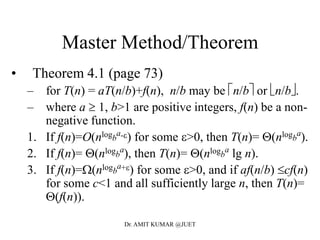
Implications of Master Theorem
• Comparison between f(n) and nlogb
a
(<,=,>)
• Must be asymptotically smaller (or larger) by a
polynomial, i.e., n
for some >0.
• In case 3, the “regularity” must be satisfied, i.e.,
af(n/b) cf(n) for some c<1 .
• There are gaps
– between 1 and 2: f(n) is smaller than nlogb
a
, but not
polynomially smaller.
– between 2 and 3: f(n) is larger than nlogb
a
, but not
polynomially larger.
– in case 3, if the “regularity” fails to hold.
Dr. AMIT KUMAR @JUET
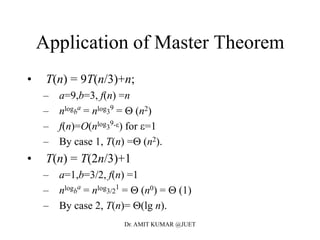
Application of Master Theorem
• T(n) = 9T(n/3)+n;
– a=9,b=3, f(n) =n
– nlogb
a
= nlog3
9
=  (n2)
– f(n)=O(nlog3
9-) for =1
– By case 1, T(n) = (n2).
• T(n) = T(2n/3)+1
– a=1,b=3/2, f(n) =1
– nlogb
a
= nlog3/2
1
=  (n0) =  (1)
– By case 2, T(n)= (lg n).
Dr. AMIT KUMAR @JUET
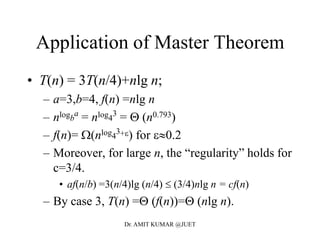
Application of Master Theorem
• T(n) = 3T(n/4)+nlg n;
– a=3,b=4, f(n) =nlg n
– nlogb
a
= nlog4
3
=  (n0.793)
– f(n)= (nlog4
3+) for 0.2
– Moreover, for large n, the “regularity” holds for
c=3/4.
• af(n/b) =3(n/4)lg (n/4)  (3/4)nlg n = cf(n)
– By case 3, T(n) = (f(n))= (nlg n).
Dr. AMIT KUMAR @JUET
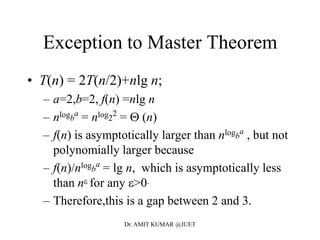
Exception to Master Theorem
• T(n) = 2T(n/2)+nlg n;
– a=2,b=2, f(n) =nlg n
– nlogb
a
= nlog2
2
=  (n)
– f(n) is asymptotically larger than nlogb
a
, but not
polynomially larger because
– f(n)/nlogb
a
= lg n, which is asymptotically less
than n for any >0.
– Therefore,this is a gap between 2 and 3.
Dr. AMIT KUMAR @JUET
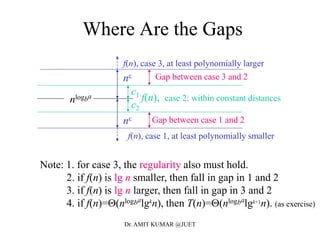
Where Are the Gaps
nlogba f(n), case 2: within constant distances
c1
c2
n
f(n), case 1, at least polynomially smaller
Gap between case 1 and 2
n Gap between case 3 and 2
f(n), case 3, at least polynomially larger
Note: 1. for case 3, the regularity also must hold.
2. if f(n) is lg n smaller, then fall in gap in 1 and 2
3. if f(n) is lg n larger, then fall in gap in 3 and 2
4. if f(n)=(nlogba
lgk
n), then T(n)=(nlogba
lgk+1
n). (as exercise)
Dr. AMIT KUMAR @JUET

Recurrence and master theorem

  • 1.
    Recurrences • The expression: isa recurrence. – Recurrence: an equation that describes a function in terms of its value on smaller functions               1 2 2 1 )( ncn n T nc nT Dr. AMIT KUMAR @JUET
  • 2.
    Master Method/Theorem • Theorem4.1 (page 73) – for T(n) = aT(n/b)+f(n), n/b may be n/b or n/b. – where a  1, b>1 are positive integers, f(n) be a non- negative function. 1. If f(n)=O(nlogb a-) for some >0, then T(n)= (nlogb a ). 2. If f(n)= (nlogb a ), then T(n)= (nlogb a lg n). 3. If f(n)=(nlogb a+) for some >0, and if af(n/b) cf(n) for some c<1 and all sufficiently large n, then T(n)= (f(n)). Dr. AMIT KUMAR @JUET
  • 3.
    Implications of MasterTheorem • Comparison between f(n) and nlogb a (<,=,>) • Must be asymptotically smaller (or larger) by a polynomial, i.e., n for some >0. • In case 3, the “regularity” must be satisfied, i.e., af(n/b) cf(n) for some c<1 . • There are gaps – between 1 and 2: f(n) is smaller than nlogb a , but not polynomially smaller. – between 2 and 3: f(n) is larger than nlogb a , but not polynomially larger. – in case 3, if the “regularity” fails to hold. Dr. AMIT KUMAR @JUET
  • 4.
    Application of MasterTheorem • T(n) = 9T(n/3)+n; – a=9,b=3, f(n) =n – nlogb a = nlog3 9 =  (n2) – f(n)=O(nlog3 9-) for =1 – By case 1, T(n) = (n2). • T(n) = T(2n/3)+1 – a=1,b=3/2, f(n) =1 – nlogb a = nlog3/2 1 =  (n0) =  (1) – By case 2, T(n)= (lg n). Dr. AMIT KUMAR @JUET
  • 5.
    Application of MasterTheorem • T(n) = 3T(n/4)+nlg n; – a=3,b=4, f(n) =nlg n – nlogb a = nlog4 3 =  (n0.793) – f(n)= (nlog4 3+) for 0.2 – Moreover, for large n, the “regularity” holds for c=3/4. • af(n/b) =3(n/4)lg (n/4)  (3/4)nlg n = cf(n) – By case 3, T(n) = (f(n))= (nlg n). Dr. AMIT KUMAR @JUET
  • 6.
    Exception to MasterTheorem • T(n) = 2T(n/2)+nlg n; – a=2,b=2, f(n) =nlg n – nlogb a = nlog2 2 =  (n) – f(n) is asymptotically larger than nlogb a , but not polynomially larger because – f(n)/nlogb a = lg n, which is asymptotically less than n for any >0. – Therefore,this is a gap between 2 and 3. Dr. AMIT KUMAR @JUET
  • 7.
    Where Are theGaps nlogba f(n), case 2: within constant distances c1 c2 n f(n), case 1, at least polynomially smaller Gap between case 1 and 2 n Gap between case 3 and 2 f(n), case 3, at least polynomially larger Note: 1. for case 3, the regularity also must hold. 2. if f(n) is lg n smaller, then fall in gap in 1 and 2 3. if f(n) is lg n larger, then fall in gap in 3 and 2 4. if f(n)=(nlogba lgk n), then T(n)=(nlogba lgk+1 n). (as exercise) Dr. AMIT KUMAR @JUET