
Dr. AMIT KUMAR @JUET
Graph Algorithms – 2
graphs-2 - 2 Lin / DeviDr. AMIT KUMAR @JUET
Identification of Edges
 Edge type for edge (u, v) can be identified when it is first explored
by DFS.
 Identification is based on the color of v.
» White – tree edge.
» Gray – back edge.
» Black – forward or cross edge.
graphs-2 - 3 Lin / DeviDr. AMIT KUMAR @JUET
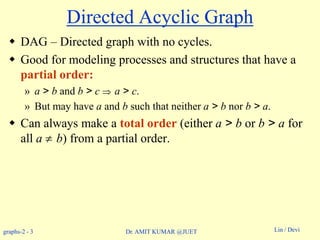
Directed Acyclic Graph
 DAG – Directed graph with no cycles.
 Good for modeling processes and structures that have a
partial order:
» a > b and b > c  a > c.
» But may have a and b such that neither a > b nor b > a.
 Can always make a total order (either a > b or b > a for
all a  b) from a partial order.
graphs-2 - 4 Lin / DeviDr. AMIT KUMAR @JUET
Example
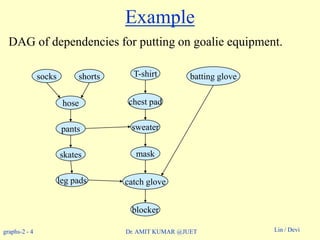
DAG of dependencies for putting on goalie equipment.
socks shorts
hose
pants
skates
leg pads
T-shirt
chest pad
sweater
mask
catch glove
blocker
batting glove
graphs-2 - 5 Lin / DeviDr. AMIT KUMAR @JUET
Characterizing a DAG
Proof:
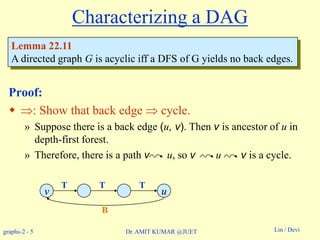
 : Show that back edge  cycle.
» Suppose there is a back edge (u, v). Then v is ancestor of u in
depth-first forest.
» Therefore, there is a path v u, so v u v is a cycle.
Lemma 22.11
A directed graph G is acyclic iff a DFS of G yields no back edges.
v u
T T T
B
graphs-2 - 6 Lin / DeviDr. AMIT KUMAR @JUET
Characterizing a DAG
Proof (Contd.):
  : Show that a cycle implies a back edge.
» c : cycle in G, v : first vertex discovered in c, (u, v) : preceding
edge in c.
» At time d[v], vertices of c form a white path v u. Why?
» By white-path theorem, u is a descendent of v in depth-first
forest.
» Therefore, (u, v) is a back edge.
Lemma 22.11
A directed graph G is acyclic iff a DFS of G yields no back edges.
v u
T T T
B
graphs-2 - 7 Lin / DeviDr. AMIT KUMAR @JUET
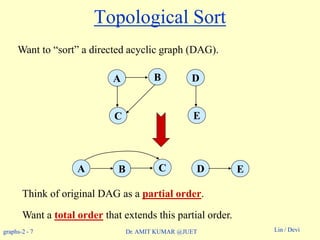
Topological Sort
Want to “sort” a directed acyclic graph (DAG).
B
E
D
C
A
C EDA B
Think of original DAG as a partial order.
Want a total order that extends this partial order.
graphs-2 - 8 Lin / DeviDr. AMIT KUMAR @JUET
Topological Sort
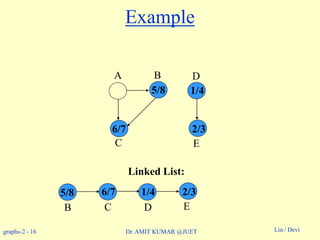
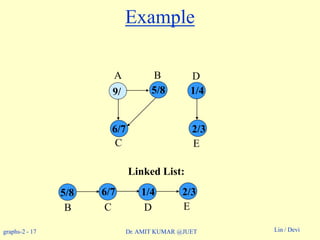
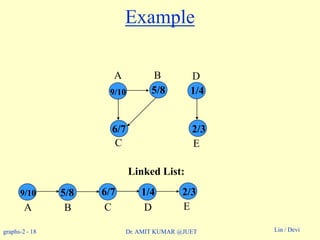
 Performed on a DAG.
 Linear ordering of the vertices of G such that if (u, v) 
E, then u appears somewhere before v.
Topological-Sort (G)
1. call DFS(G) to compute finishing times f [v] for all v  V
2. as each vertex is finished, insert it onto the front of a linked list
3. return the linked list of vertices
Time: (V + E).
Example: On board.
graphs-2 - 9 Lin / DeviDr. AMIT KUMAR @JUET
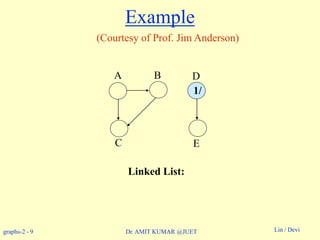
Example
Linked List:
A B D
C E
1/
(Courtesy of Prof. Jim Anderson)
graphs-2 - 10 Lin / DeviDr. AMIT KUMAR @JUET
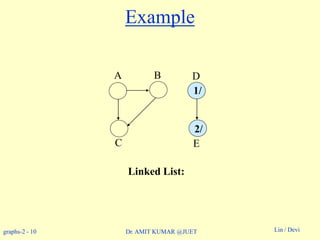
Example
Linked List:
A B D
C E
1/
2/
graphs-2 - 11 Lin / DeviDr. AMIT KUMAR @JUET
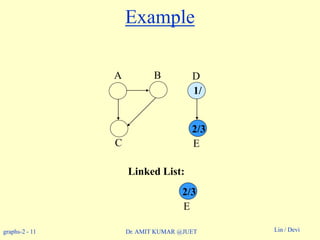
Example
Linked List:
A B D
C E
1/
2/3
E
2/3
graphs-2 - 12 Lin / DeviDr. AMIT KUMAR @JUET
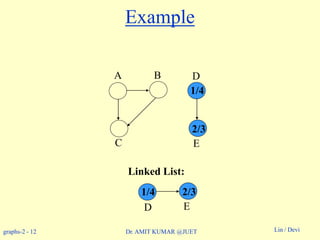
Example
Linked List:
A B D
C E
1/4
2/3
E
2/31/4
D
graphs-2 - 13 Lin / DeviDr. AMIT KUMAR @JUET
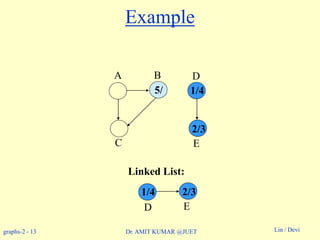
Example
Linked List:
A B D
C E
1/4
2/3
E
2/31/4
D
5/
graphs-2 - 14 Lin / DeviDr. AMIT KUMAR @JUET
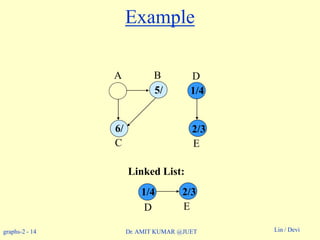
Example
Linked List:
A B D
C E
1/4
2/3
E
2/31/4
D
5/
6/
graphs-2 - 15 Lin / DeviDr. AMIT KUMAR @JUET
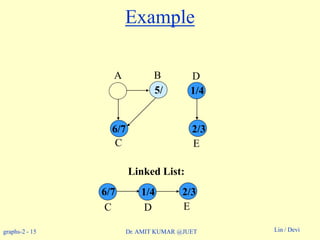
Example
Linked List:
A B D
C E
1/4
2/3
E
2/31/4
D
5/
6/7
6/7
C
graphs-2 - 16 Lin / DeviDr. AMIT KUMAR @JUET
Example
Linked List:
A B D
C E
1/4
2/3
E
2/31/4
D
5/8
6/7
6/7
C
5/8
B
graphs-2 - 17 Lin / DeviDr. AMIT KUMAR @JUET
Example
Linked List:
A B D
C E
1/4
2/3
E
2/31/4
D
5/8
6/7
6/7
C
5/8
B
9/
graphs-2 - 18 Lin / DeviDr. AMIT KUMAR @JUET
Example
Linked List:
A B D
C E
1/4
2/3
E
2/31/4
D
5/8
6/7
6/7
C
5/8
B
9/10
9/10
A
graphs-2 - 19 Lin / DeviDr. AMIT KUMAR @JUET
Correctness Proof
 Just need to show if (u, v)  E, then f [v] < f [u].
 When we explore (u, v), what are the colors of u and v?
» u is gray.
» Is v gray, too?
• No, because then v would be ancestor of u.
•  (u, v) is a back edge.
•  contradiction of Lemma 22.11 (dag has no back edges).
» Is v white?
• Then becomes descendant of u.
• By parenthesis theorem, d[u] < d[v] < f [v] < f [u].
» Is v black?
• Then v is already finished.
• Since we’re exploring (u, v), we have not yet finished u.
• Therefore, f [v] < f [u].
graphs-2 - 20 Lin / DeviDr. AMIT KUMAR @JUET
Strongly Connected Components
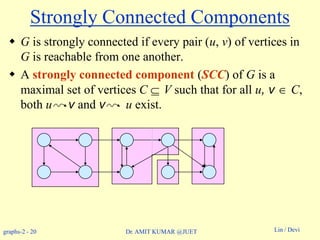
 G is strongly connected if every pair (u, v) of vertices in
G is reachable from one another.
 A strongly connected component (SCC) of G is a
maximal set of vertices C  V such that for all u, v  C,
both u v and v u exist.
graphs-2 - 21 Lin / DeviDr. AMIT KUMAR @JUET
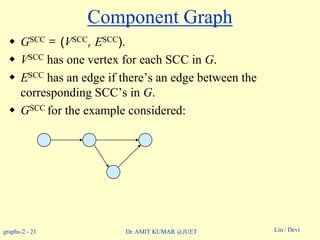
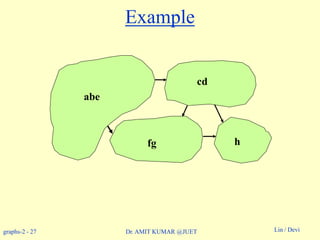
Component Graph
 GSCC = (VSCC, ESCC).
 VSCC has one vertex for each SCC in G.
 ESCC has an edge if there’s an edge between the
corresponding SCC’s in G.
 GSCC for the example considered:
graphs-2 - 22 Lin / DeviDr. AMIT KUMAR @JUET
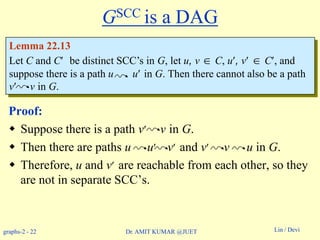
GSCC is a DAG
Proof:
 Suppose there is a path v v in G.
 Then there are paths u u v and v v u in G.
 Therefore, u and v are reachable from each other, so they
are not in separate SCC’s.
Lemma 22.13
Let C and C be distinct SCC’s in G, let u, v  C, u, v  C, and
suppose there is a path u u in G. Then there cannot also be a path
v v in G.
graphs-2 - 23 Lin / DeviDr. AMIT KUMAR @JUET
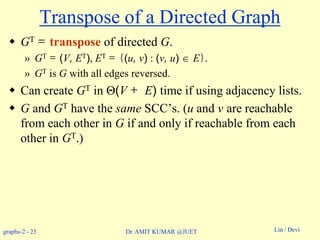
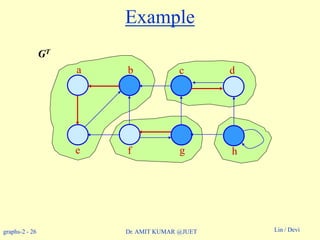
Transpose of a Directed Graph
 GT = transpose of directed G.
» GT = (V, ET), ET = {(u, v) : (v, u)  E}.
» GT is G with all edges reversed.
 Can create GT in Θ(V + E) time if using adjacency lists.
 G and GT have the same SCC’s. (u and v are reachable
from each other in G if and only if reachable from each
other in GT.)
graphs-2 - 24 Lin / DeviDr. AMIT KUMAR @JUET
Algorithm to determine SCCs
SCC(G)
1. call DFS(G) to compute finishing times f [u] for all u
2. compute GT
3. call DFS(GT), but in the main loop, consider vertices in order of
decreasing f [u] (as computed in first DFS)
4. output the vertices in each tree of the depth-first forest formed in
second DFS as a separate SCC
Time: (V + E).
Example: On board.
graphs-2 - 25 Lin / DeviDr. AMIT KUMAR @JUET
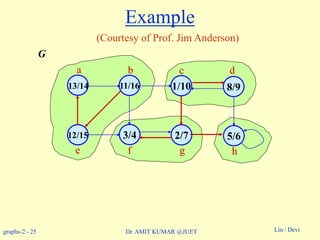
Example
13/14
12/15 3/4 2/7
11/16 1/10
a b c
e f g
5/6
8/9
h
d
(Courtesy of Prof. Jim Anderson)
G
graphs-2 - 26 Lin / DeviDr. AMIT KUMAR @JUET
Example
a b c
e f g h
d
GT
graphs-2 - 27 Lin / DeviDr. AMIT KUMAR @JUET
Example
cd
hfg
abe
graphs-2 - 28 Lin / DeviDr. AMIT KUMAR @JUET
How does it work?
 Idea:
» By considering vertices in second DFS in decreasing order of
finishing times from first DFS, we are visiting vertices of the
component graph in topologically sorted order.
» Because we are running DFS on GT, we will not be visiting any
v from a u, where v and u are in different components.
 Notation:
» d[u] and f [u] always refer to first DFS.
» Extend notation for d and f to sets of vertices U  V:
» d(U) = minuU{d[u]} (earliest discovery time)
» f (U) = maxuU{ f [u]} (latest finishing time)
graphs-2 - 29 Lin / DeviDr. AMIT KUMAR @JUET
SCCs and DFS finishing times
Proof:
 Case 1: d(C) < d(C)
» Let x be the first vertex discovered in C.
» At time d[x], all vertices in C and C are
white. Thus, there exist paths of white
vertices from x to all vertices in C and C.
» By the white-path theorem, all vertices in
C and C are descendants of x in depth-
first tree.
» By the parenthesis theorem, f [x] = f (C)
> f(C).
Lemma 22.14
Let C and C be distinct SCC’s in G = (V, E). Suppose there is an
edge (u, v)  E such that u  C and v C. Then f (C) > f (C).
C C
u v
x
graphs-2 - 30 Lin / DeviDr. AMIT KUMAR @JUET
SCCs and DFS finishing times
Proof:
 Case 2: d(C) > d(C)
» Let y be the first vertex discovered in C.
» At time d[y], all vertices in C are white and
there is a white path from y to each vertex in
C  all vertices in C become descendants
of y. Again, f [y] = f (C).
» At time d[y], all vertices in C are also white.
» By earlier lemma, since there is an edge (u,
v), we cannot have a path from C to C.
» So no vertex in C is reachable from y.
» Therefore, at time f [y], all vertices in C are
still white.
» Therefore, for all w  C, f [w] > f [y], which
implies that f (C) > f (C).
Lemma 22.14
Let C and C be distinct SCC’s in G = (V, E). Suppose there is an
edge (u, v)  E such that u  C and v C. Then f (C) > f (C).
C C
u v
yx
graphs-2 - 31 Lin / DeviDr. AMIT KUMAR @JUET
SCCs and DFS finishing times
Proof:
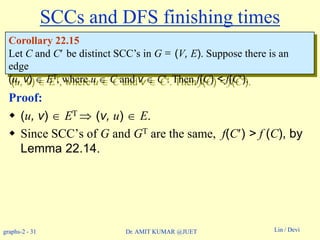
 (u, v)  ET  (v, u)  E.
 Since SCC’s of G and GT are the same, f(C) > f (C), by
Lemma 22.14.
Corollary 22.15
Let C and C be distinct SCC’s in G = (V, E). Suppose there is an
edge
(u, v)  ET, where u  C and v  C. Then f(C) < f(C).
graphs-2 - 32 Lin / DeviDr. AMIT KUMAR @JUET
Correctness of SCC
 When we do the second DFS, on GT, start with SCC C
such that f(C) is maximum.
» The second DFS starts from some x  C, and it visits all
vertices in C.
» Corollary 22.15 says that since f(C) > f (C) for all C  C, there
are no edges from C to C in GT.
» Therefore, DFS will visit only vertices in C.
» Which means that the depth-first tree rooted at x contains
exactly the vertices of C.
graphs-2 - 33 Lin / DeviDr. AMIT KUMAR @JUET
Correctness of SCC
 The next root chosen in the second DFS is in SCC C
such that f (C) is maximum over all SCC’s other than C.
» DFS visits all vertices in C, but the only edges out of C go to
C, which we’ve already visited.
» Therefore, the only tree edges will be to vertices in C.
 We can continue the process.
 Each time we choose a root for the second DFS, it can
reach only
» vertices in its SCC—get tree edges to these,
» vertices in SCC’s already visited in second DFS—get no tree
edges to these.

Topological sorting

  • 1.
    Dr. AMIT KUMAR@JUET Graph Algorithms – 2
  • 2.
    graphs-2 - 2Lin / DeviDr. AMIT KUMAR @JUET Identification of Edges  Edge type for edge (u, v) can be identified when it is first explored by DFS.  Identification is based on the color of v. » White – tree edge. » Gray – back edge. » Black – forward or cross edge.
  • 3.
    graphs-2 - 3Lin / DeviDr. AMIT KUMAR @JUET Directed Acyclic Graph  DAG – Directed graph with no cycles.  Good for modeling processes and structures that have a partial order: » a > b and b > c  a > c. » But may have a and b such that neither a > b nor b > a.  Can always make a total order (either a > b or b > a for all a  b) from a partial order.
  • 4.
    graphs-2 - 4Lin / DeviDr. AMIT KUMAR @JUET Example DAG of dependencies for putting on goalie equipment. socks shorts hose pants skates leg pads T-shirt chest pad sweater mask catch glove blocker batting glove
  • 5.
    graphs-2 - 5Lin / DeviDr. AMIT KUMAR @JUET Characterizing a DAG Proof:  : Show that back edge  cycle. » Suppose there is a back edge (u, v). Then v is ancestor of u in depth-first forest. » Therefore, there is a path v u, so v u v is a cycle. Lemma 22.11 A directed graph G is acyclic iff a DFS of G yields no back edges. v u T T T B
  • 6.
    graphs-2 - 6Lin / DeviDr. AMIT KUMAR @JUET Characterizing a DAG Proof (Contd.):   : Show that a cycle implies a back edge. » c : cycle in G, v : first vertex discovered in c, (u, v) : preceding edge in c. » At time d[v], vertices of c form a white path v u. Why? » By white-path theorem, u is a descendent of v in depth-first forest. » Therefore, (u, v) is a back edge. Lemma 22.11 A directed graph G is acyclic iff a DFS of G yields no back edges. v u T T T B
  • 7.
    graphs-2 - 7Lin / DeviDr. AMIT KUMAR @JUET Topological Sort Want to “sort” a directed acyclic graph (DAG). B E D C A C EDA B Think of original DAG as a partial order. Want a total order that extends this partial order.
  • 8.
    graphs-2 - 8Lin / DeviDr. AMIT KUMAR @JUET Topological Sort  Performed on a DAG.  Linear ordering of the vertices of G such that if (u, v)  E, then u appears somewhere before v. Topological-Sort (G) 1. call DFS(G) to compute finishing times f [v] for all v  V 2. as each vertex is finished, insert it onto the front of a linked list 3. return the linked list of vertices Time: (V + E). Example: On board.
  • 9.
    graphs-2 - 9Lin / DeviDr. AMIT KUMAR @JUET Example Linked List: A B D C E 1/ (Courtesy of Prof. Jim Anderson)
  • 10.
    graphs-2 - 10Lin / DeviDr. AMIT KUMAR @JUET Example Linked List: A B D C E 1/ 2/
  • 11.
    graphs-2 - 11Lin / DeviDr. AMIT KUMAR @JUET Example Linked List: A B D C E 1/ 2/3 E 2/3
  • 12.
    graphs-2 - 12Lin / DeviDr. AMIT KUMAR @JUET Example Linked List: A B D C E 1/4 2/3 E 2/31/4 D
  • 13.
    graphs-2 - 13Lin / DeviDr. AMIT KUMAR @JUET Example Linked List: A B D C E 1/4 2/3 E 2/31/4 D 5/
  • 14.
    graphs-2 - 14Lin / DeviDr. AMIT KUMAR @JUET Example Linked List: A B D C E 1/4 2/3 E 2/31/4 D 5/ 6/
  • 15.
    graphs-2 - 15Lin / DeviDr. AMIT KUMAR @JUET Example Linked List: A B D C E 1/4 2/3 E 2/31/4 D 5/ 6/7 6/7 C
  • 16.
    graphs-2 - 16Lin / DeviDr. AMIT KUMAR @JUET Example Linked List: A B D C E 1/4 2/3 E 2/31/4 D 5/8 6/7 6/7 C 5/8 B
  • 17.
    graphs-2 - 17Lin / DeviDr. AMIT KUMAR @JUET Example Linked List: A B D C E 1/4 2/3 E 2/31/4 D 5/8 6/7 6/7 C 5/8 B 9/
  • 18.
    graphs-2 - 18Lin / DeviDr. AMIT KUMAR @JUET Example Linked List: A B D C E 1/4 2/3 E 2/31/4 D 5/8 6/7 6/7 C 5/8 B 9/10 9/10 A
  • 19.
    graphs-2 - 19Lin / DeviDr. AMIT KUMAR @JUET Correctness Proof  Just need to show if (u, v)  E, then f [v] < f [u].  When we explore (u, v), what are the colors of u and v? » u is gray. » Is v gray, too? • No, because then v would be ancestor of u. •  (u, v) is a back edge. •  contradiction of Lemma 22.11 (dag has no back edges). » Is v white? • Then becomes descendant of u. • By parenthesis theorem, d[u] < d[v] < f [v] < f [u]. » Is v black? • Then v is already finished. • Since we’re exploring (u, v), we have not yet finished u. • Therefore, f [v] < f [u].
  • 20.
    graphs-2 - 20Lin / DeviDr. AMIT KUMAR @JUET Strongly Connected Components  G is strongly connected if every pair (u, v) of vertices in G is reachable from one another.  A strongly connected component (SCC) of G is a maximal set of vertices C  V such that for all u, v  C, both u v and v u exist.
  • 21.
    graphs-2 - 21Lin / DeviDr. AMIT KUMAR @JUET Component Graph  GSCC = (VSCC, ESCC).  VSCC has one vertex for each SCC in G.  ESCC has an edge if there’s an edge between the corresponding SCC’s in G.  GSCC for the example considered:
  • 22.
    graphs-2 - 22Lin / DeviDr. AMIT KUMAR @JUET GSCC is a DAG Proof:  Suppose there is a path v v in G.  Then there are paths u u v and v v u in G.  Therefore, u and v are reachable from each other, so they are not in separate SCC’s. Lemma 22.13 Let C and C be distinct SCC’s in G, let u, v  C, u, v  C, and suppose there is a path u u in G. Then there cannot also be a path v v in G.
  • 23.
    graphs-2 - 23Lin / DeviDr. AMIT KUMAR @JUET Transpose of a Directed Graph  GT = transpose of directed G. » GT = (V, ET), ET = {(u, v) : (v, u)  E}. » GT is G with all edges reversed.  Can create GT in Θ(V + E) time if using adjacency lists.  G and GT have the same SCC’s. (u and v are reachable from each other in G if and only if reachable from each other in GT.)
  • 24.
    graphs-2 - 24Lin / DeviDr. AMIT KUMAR @JUET Algorithm to determine SCCs SCC(G) 1. call DFS(G) to compute finishing times f [u] for all u 2. compute GT 3. call DFS(GT), but in the main loop, consider vertices in order of decreasing f [u] (as computed in first DFS) 4. output the vertices in each tree of the depth-first forest formed in second DFS as a separate SCC Time: (V + E). Example: On board.
  • 25.
    graphs-2 - 25Lin / DeviDr. AMIT KUMAR @JUET Example 13/14 12/15 3/4 2/7 11/16 1/10 a b c e f g 5/6 8/9 h d (Courtesy of Prof. Jim Anderson) G
  • 26.
    graphs-2 - 26Lin / DeviDr. AMIT KUMAR @JUET Example a b c e f g h d GT
  • 27.
    graphs-2 - 27Lin / DeviDr. AMIT KUMAR @JUET Example cd hfg abe
  • 28.
    graphs-2 - 28Lin / DeviDr. AMIT KUMAR @JUET How does it work?  Idea: » By considering vertices in second DFS in decreasing order of finishing times from first DFS, we are visiting vertices of the component graph in topologically sorted order. » Because we are running DFS on GT, we will not be visiting any v from a u, where v and u are in different components.  Notation: » d[u] and f [u] always refer to first DFS. » Extend notation for d and f to sets of vertices U  V: » d(U) = minuU{d[u]} (earliest discovery time) » f (U) = maxuU{ f [u]} (latest finishing time)
  • 29.
    graphs-2 - 29Lin / DeviDr. AMIT KUMAR @JUET SCCs and DFS finishing times Proof:  Case 1: d(C) < d(C) » Let x be the first vertex discovered in C. » At time d[x], all vertices in C and C are white. Thus, there exist paths of white vertices from x to all vertices in C and C. » By the white-path theorem, all vertices in C and C are descendants of x in depth- first tree. » By the parenthesis theorem, f [x] = f (C) > f(C). Lemma 22.14 Let C and C be distinct SCC’s in G = (V, E). Suppose there is an edge (u, v)  E such that u  C and v C. Then f (C) > f (C). C C u v x
  • 30.
    graphs-2 - 30Lin / DeviDr. AMIT KUMAR @JUET SCCs and DFS finishing times Proof:  Case 2: d(C) > d(C) » Let y be the first vertex discovered in C. » At time d[y], all vertices in C are white and there is a white path from y to each vertex in C  all vertices in C become descendants of y. Again, f [y] = f (C). » At time d[y], all vertices in C are also white. » By earlier lemma, since there is an edge (u, v), we cannot have a path from C to C. » So no vertex in C is reachable from y. » Therefore, at time f [y], all vertices in C are still white. » Therefore, for all w  C, f [w] > f [y], which implies that f (C) > f (C). Lemma 22.14 Let C and C be distinct SCC’s in G = (V, E). Suppose there is an edge (u, v)  E such that u  C and v C. Then f (C) > f (C). C C u v yx
  • 31.
    graphs-2 - 31Lin / DeviDr. AMIT KUMAR @JUET SCCs and DFS finishing times Proof:  (u, v)  ET  (v, u)  E.  Since SCC’s of G and GT are the same, f(C) > f (C), by Lemma 22.14. Corollary 22.15 Let C and C be distinct SCC’s in G = (V, E). Suppose there is an edge (u, v)  ET, where u  C and v  C. Then f(C) < f(C).
  • 32.
    graphs-2 - 32Lin / DeviDr. AMIT KUMAR @JUET Correctness of SCC  When we do the second DFS, on GT, start with SCC C such that f(C) is maximum. » The second DFS starts from some x  C, and it visits all vertices in C. » Corollary 22.15 says that since f(C) > f (C) for all C  C, there are no edges from C to C in GT. » Therefore, DFS will visit only vertices in C. » Which means that the depth-first tree rooted at x contains exactly the vertices of C.
  • 33.
    graphs-2 - 33Lin / DeviDr. AMIT KUMAR @JUET Correctness of SCC  The next root chosen in the second DFS is in SCC C such that f (C) is maximum over all SCC’s other than C. » DFS visits all vertices in C, but the only edges out of C go to C, which we’ve already visited. » Therefore, the only tree edges will be to vertices in C.  We can continue the process.  Each time we choose a root for the second DFS, it can reach only » vertices in its SCC—get tree edges to these, » vertices in SCC’s already visited in second DFS—get no tree edges to these.