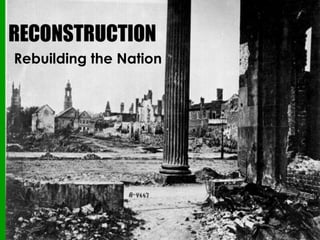
Rebuilding the Nation
Key Questions:
• How do should the South be brought back to the
Union?
• How will the South be rebuilt after its destruction
during the war?
• How will all the newly freed slaves be integrated
into American society?
• Which branch of government should control the
process of Reconstruction?
Presidential Plans for
Reconstruction:
Lincoln vs. Johnson
Abraham Lincoln’s Plan
• Once a Southern State
– Had 10% of voters took oath of
allegiance to the Union
– Ratified the 13th amendment
• It could rejoin the Union and
send representatives to
Congress
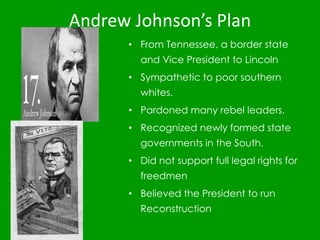
Andrew Johnson’s Plan
• From Tennessee, a border state
and Vice President to Lincoln
• Sympathetic to poor southern
whites.
• Pardoned many rebel leaders.
• Recognized newly formed state
governments in the South.
• Did not support full legal rights for
freedmen
• Believed the President to run
Reconstruction
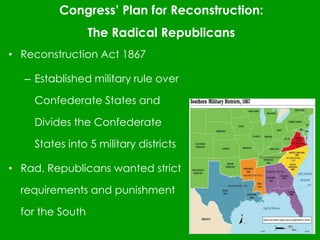
Congress’ Plan for Reconstruction:
The Radical Republicans
• Reconstruction Act 1867
– Established military rule over
Confederate States and
Divides the Confederate
States into 5 military districts
• Rad. Republicans wanted strict
requirements and punishment
for the South
Bringing Freedmen into
American society.
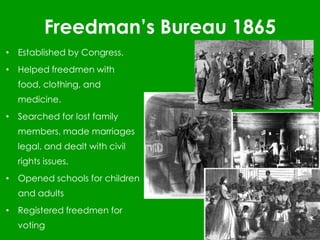
Freedman’s Bureau 1865
• Established by Congress.
• Helped freedmen with
food, clothing, and
medicine.
• Searched for lost family
members, made marriages
legal, and dealt with civil
rights issues.
• Opened schools for children
and adults
• Registered freedmen for
voting
Civil War Amendments: Free Citizens Vote
• 13th Amendment:
• 14th Amendment:
• 15th Amendment:
The Aftermath of Reconstruction:
Did it work?
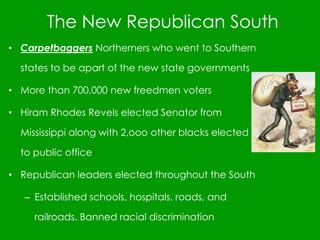
The New Republican South
• Carpetbaggers Northerners who went to Southern
states to be apart of the new state governments
• More than 700,000 new freedmen voters
• Hiram Rhodes Revels elected Senator from
Mississippi along with 2,ooo other blacks elected
to public office
• Republican leaders elected throughout the South
– Established schools, hospitals, roads, and
railroads. Banned racial discrimination
Sharecropping: ECONOMIC SLAVERY
• Done to keep plantation farming alive
without slavery
• Plantation owner would provide the land,
tools, and materials to a freedman to work.
• The freedman would give a share of his
crop to the plantation owner as payment
• It developed into a new form of oppression
of the freedman Many sharecroppers were
also poor white farmers.
The Ku Klux Klan
• Ku Klux Klan- formed
by ex-Confederate
soldiers.
• Secret, terrorist
designed to create
fear on African
Americans
• Bombing, lynching,
murder, arson, rape,
etc…
The Black Codes
• Laws passed by Southern States. Based on
older slave laws.
• To preserve traditional southern society
despite the abolition of slavery.
• Examples:
– Illegal for freedmen to hold public office.
– Illegal to travel freely, to serve on a juries.
– Freedmen without jobs can be fined or
jailed.
– Voting Tax and Literacy test before able to
vote.
Impeachment of Andrew Johnson
• Congress already wanted
him gone for some time
• Congress passed the
Tenure of Office Act which
barred Johnson from firing
is Cabinet
• Johnson fired his Sect. of
War and Congress
impeached him
• He survived the dismissal
vote by one!
The “New South”
• A modern, industrial South has been born!
• Moved away from plantation culture since
slave labor no longer existed.
• Northerners came to the South to help
rebuild, put in new rail lines and develop
new industries including cotton and steel
mills.
• Urban Industrialization begins

Reconstruction

  • 1.
  • 2.
    Key Questions: • Howdo should the South be brought back to the Union? • How will the South be rebuilt after its destruction during the war? • How will all the newly freed slaves be integrated into American society? • Which branch of government should control the process of Reconstruction?
  • 3.
  • 4.
    Abraham Lincoln’s Plan •Once a Southern State – Had 10% of voters took oath of allegiance to the Union – Ratified the 13th amendment • It could rejoin the Union and send representatives to Congress
  • 5.
    Andrew Johnson’s Plan •From Tennessee, a border state and Vice President to Lincoln • Sympathetic to poor southern whites. • Pardoned many rebel leaders. • Recognized newly formed state governments in the South. • Did not support full legal rights for freedmen • Believed the President to run Reconstruction
  • 6.
    Congress’ Plan forReconstruction: The Radical Republicans • Reconstruction Act 1867 – Established military rule over Confederate States and Divides the Confederate States into 5 military districts • Rad. Republicans wanted strict requirements and punishment for the South
  • 7.
  • 8.
    Freedman’s Bureau 1865 •Established by Congress. • Helped freedmen with food, clothing, and medicine. • Searched for lost family members, made marriages legal, and dealt with civil rights issues. • Opened schools for children and adults • Registered freedmen for voting
  • 9.
    Civil War Amendments:Free Citizens Vote • 13th Amendment: • 14th Amendment: • 15th Amendment:
  • 10.
    The Aftermath ofReconstruction: Did it work?
  • 11.
    The New RepublicanSouth • Carpetbaggers Northerners who went to Southern states to be apart of the new state governments • More than 700,000 new freedmen voters • Hiram Rhodes Revels elected Senator from Mississippi along with 2,ooo other blacks elected to public office • Republican leaders elected throughout the South – Established schools, hospitals, roads, and railroads. Banned racial discrimination
  • 12.
    Sharecropping: ECONOMIC SLAVERY •Done to keep plantation farming alive without slavery • Plantation owner would provide the land, tools, and materials to a freedman to work. • The freedman would give a share of his crop to the plantation owner as payment • It developed into a new form of oppression of the freedman Many sharecroppers were also poor white farmers.
  • 14.
    The Ku KluxKlan • Ku Klux Klan- formed by ex-Confederate soldiers. • Secret, terrorist designed to create fear on African Americans • Bombing, lynching, murder, arson, rape, etc…
  • 15.
    The Black Codes •Laws passed by Southern States. Based on older slave laws. • To preserve traditional southern society despite the abolition of slavery. • Examples: – Illegal for freedmen to hold public office. – Illegal to travel freely, to serve on a juries. – Freedmen without jobs can be fined or jailed. – Voting Tax and Literacy test before able to vote.
  • 16.
    Impeachment of AndrewJohnson • Congress already wanted him gone for some time • Congress passed the Tenure of Office Act which barred Johnson from firing is Cabinet • Johnson fired his Sect. of War and Congress impeached him • He survived the dismissal vote by one!
  • 17.
    The “New South” •A modern, industrial South has been born! • Moved away from plantation culture since slave labor no longer existed. • Northerners came to the South to help rebuild, put in new rail lines and develop new industries including cotton and steel mills. • Urban Industrialization begins