A SURVEY OF
AMERICAN HISTORY
Unit 2: Westward Expansion and Civil War

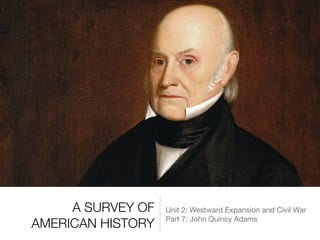
Part 7: John Quincy Adams
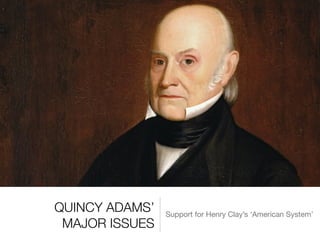
QUINCY ADAMS’

MAJOR ISSUES
Support for Henry Clay’s ‘American System’
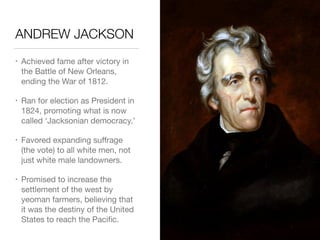
ANDREW JACKSON
• Achieved fame after victory in
the Battle of New Orleans,
ending the War of 1812.

• Ran for election as President in
1824, promoting what is now
called ‘Jacksonian democracy.’

• Favored expanding suffrage
(the vote) to all white men, not
just white male landowners.

• Promised to increase the
settlement of the west by
yeoman farmers, believing that
it was the destiny of the United
States to reach the Pacific.
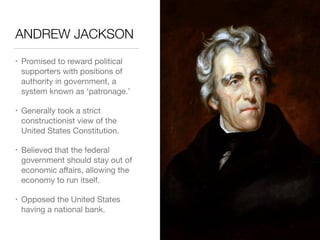
ANDREW JACKSON
• Promised to reward political
supporters with positions of
authority in government, a
system known as ‘patronage.’

• Generally took a strict
constructionist view of the
United States Constitution.

• Believed that the federal
government should stay out of
economic affairs, allowing the
economy to run itself.

• Opposed the United States
having a national bank.
THE ‘CORRUPT
BARGAIN’ OF 1824
• The election of 1824 was a four-
way race between John Adams,
Andrew Jackson, William H.
Crawford and Congressman
Henry Clay. All of them were
Democratic-Republicans.

• Adams won the election, despite
Jackson’s popularity, because
Clay came in last but instructed
his supporters to vote for Adams
in the Electoral College.

• In return, Adams appointed Clay
as Secretary of State. Jackson’s
supporters called this a ‘corrupt
bargain’ designed to keep
Jackson out of the White House.
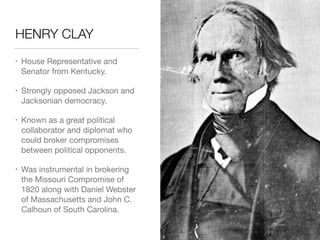
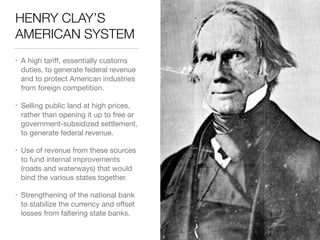
HENRY CLAY
• House Representative and
Senator from Kentucky.

• Strongly opposed Jackson and
Jacksonian democracy.

• Known as a great political
collaborator and diplomat who
could broker compromises
between political opponents.

• Was instrumental in brokering
the Missouri Compromise of
1820 along with Daniel Webster
of Massachusetts and John C.
Calhoun of South Carolina.
HENRY CLAY’S
AMERICAN SYSTEM
• A high tariff, essentially customs
duties, to generate federal revenue
and to protect American industries
from foreign competition.

• Selling public land at high prices,
rather than opening it up to free or
government-subsidized settlement,
to generate federal revenue.

• Use of revenue from these sources
to fund internal improvements
(roads and waterways) that would
bind the various states together.

• Strengthening of the national bank
to stabilize the currency and offset
losses from faltering state banks.
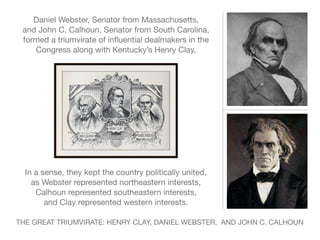
THE GREAT TRIUMVIRATE: HENRY CLAY, DANIEL WEBSTER, AND JOHN C. CALHOUN
In a sense, they kept the country politically united,

as Webster represented northeastern interests,
Calhoun represented southeastern interests,

and Clay represented western interests.
Daniel Webster, Senator from Massachusetts,

and John C. Calhoun, Senator from South Carolina,
formed a triumvirate of influential dealmakers in the
Congress along with Kentucky’s Henry Clay.
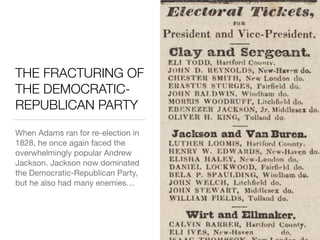
THE FRACTURING OF
THE DEMOCRATIC-
REPUBLICAN PARTY
When Adams ran for re-election in
1828, he once again faced the
overwhelmingly popular Andrew
Jackson. Jackson now dominated
the Democratic-Republican Party,
but he also had many enemies…
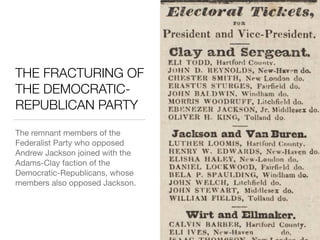
THE FRACTURING OF
THE DEMOCRATIC-
REPUBLICAN PARTY
The remnant members of the
Federalist Party who opposed
Andrew Jackson joined with the
Adams-Clay faction of the
Democratic-Republicans, whose
members also opposed Jackson.
THE FRACTURING OF
THE DEMOCRATIC-
REPUBLICAN PARTY
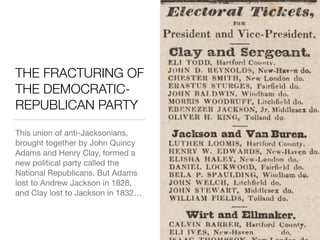
This union of anti-Jacksonians,
brought together by John Quincy
Adams and Henry Clay, formed a
new political party called the
National Republicans. But Adams
lost to Andrew Jackson in 1828,
and Clay lost to Jackson in 1832…
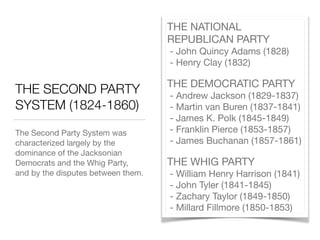
THE SECOND PARTY
SYSTEM (1824-1860)
The Second Party System was
characterized largely by the
dominance of the Jacksonian
Democrats and the Whig Party,
and by the disputes between them.
THE NATIONAL
REPUBLICAN PARTY

- John Quincy Adams (1828)

- Henry Clay (1832)

THE DEMOCRATIC PARTY

- Andrew Jackson (1829-1837)

- Martin van Buren (1837-1841)

- James K. Polk (1845-1849)

- Franklin Pierce (1853-1857)

- James Buchanan (1857-1861)

THE WHIG PARTY

- William Henry Harrison (1841)

- John Tyler (1841-1845)

- Zachary Taylor (1849-1850)

- Millard Fillmore (1850-1853)
A SURVEY OF
AMERICAN HISTORY
Unit 2: Westward Expansion and Civil War

Part 7: John Quincy Adams

27 John Quincy Adams

  • 1.
    A SURVEY OF AMERICANHISTORY Unit 2: Westward Expansion and Civil War Part 7: John Quincy Adams
  • 2.
    QUINCY ADAMS’
 MAJOR ISSUES Supportfor Henry Clay’s ‘American System’
  • 3.
    ANDREW JACKSON • Achievedfame after victory in the Battle of New Orleans, ending the War of 1812. • Ran for election as President in 1824, promoting what is now called ‘Jacksonian democracy.’ • Favored expanding suffrage (the vote) to all white men, not just white male landowners. • Promised to increase the settlement of the west by yeoman farmers, believing that it was the destiny of the United States to reach the Pacific.
  • 4.
    ANDREW JACKSON • Promisedto reward political supporters with positions of authority in government, a system known as ‘patronage.’ • Generally took a strict constructionist view of the United States Constitution. • Believed that the federal government should stay out of economic affairs, allowing the economy to run itself. • Opposed the United States having a national bank.
  • 5.
    THE ‘CORRUPT BARGAIN’ OF1824 • The election of 1824 was a four- way race between John Adams, Andrew Jackson, William H. Crawford and Congressman Henry Clay. All of them were Democratic-Republicans. • Adams won the election, despite Jackson’s popularity, because Clay came in last but instructed his supporters to vote for Adams in the Electoral College. • In return, Adams appointed Clay as Secretary of State. Jackson’s supporters called this a ‘corrupt bargain’ designed to keep Jackson out of the White House.
  • 6.
    HENRY CLAY • HouseRepresentative and Senator from Kentucky. • Strongly opposed Jackson and Jacksonian democracy. • Known as a great political collaborator and diplomat who could broker compromises between political opponents. • Was instrumental in brokering the Missouri Compromise of 1820 along with Daniel Webster of Massachusetts and John C. Calhoun of South Carolina.
  • 7.
    HENRY CLAY’S AMERICAN SYSTEM •A high tariff, essentially customs duties, to generate federal revenue and to protect American industries from foreign competition. • Selling public land at high prices, rather than opening it up to free or government-subsidized settlement, to generate federal revenue. • Use of revenue from these sources to fund internal improvements (roads and waterways) that would bind the various states together. • Strengthening of the national bank to stabilize the currency and offset losses from faltering state banks.
  • 8.
    THE GREAT TRIUMVIRATE:HENRY CLAY, DANIEL WEBSTER, AND JOHN C. CALHOUN In a sense, they kept the country politically united,
 as Webster represented northeastern interests, Calhoun represented southeastern interests,
 and Clay represented western interests. Daniel Webster, Senator from Massachusetts,
 and John C. Calhoun, Senator from South Carolina, formed a triumvirate of influential dealmakers in the Congress along with Kentucky’s Henry Clay.
  • 9.
    THE FRACTURING OF THEDEMOCRATIC- REPUBLICAN PARTY When Adams ran for re-election in 1828, he once again faced the overwhelmingly popular Andrew Jackson. Jackson now dominated the Democratic-Republican Party, but he also had many enemies…
  • 10.
    THE FRACTURING OF THEDEMOCRATIC- REPUBLICAN PARTY The remnant members of the Federalist Party who opposed Andrew Jackson joined with the Adams-Clay faction of the Democratic-Republicans, whose members also opposed Jackson.
  • 11.
    THE FRACTURING OF THEDEMOCRATIC- REPUBLICAN PARTY This union of anti-Jacksonians, brought together by John Quincy Adams and Henry Clay, formed a new political party called the National Republicans. But Adams lost to Andrew Jackson in 1828, and Clay lost to Jackson in 1832…
  • 12.
    THE SECOND PARTY SYSTEM(1824-1860) The Second Party System was characterized largely by the dominance of the Jacksonian Democrats and the Whig Party, and by the disputes between them. THE NATIONAL REPUBLICAN PARTY
 - John Quincy Adams (1828)
 - Henry Clay (1832) THE DEMOCRATIC PARTY
 - Andrew Jackson (1829-1837)
 - Martin van Buren (1837-1841)
 - James K. Polk (1845-1849)
 - Franklin Pierce (1853-1857)
 - James Buchanan (1857-1861) THE WHIG PARTY
 - William Henry Harrison (1841)
 - John Tyler (1841-1845)
 - Zachary Taylor (1849-1850)
 - Millard Fillmore (1850-1853)
  • 13.
    A SURVEY OF AMERICANHISTORY Unit 2: Westward Expansion and Civil War Part 7: John Quincy Adams