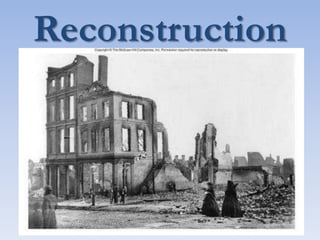

Reconstruction
Key Questions
1. How do we
bring the South
back into the
Union?
2. How do we
rebuild the
South after its
destruction
during the war?
3. How do we
integrate and
protect newly-
emancipated
black freedmen?
4. What branch
of government
should control
the process of
Reconstruction?
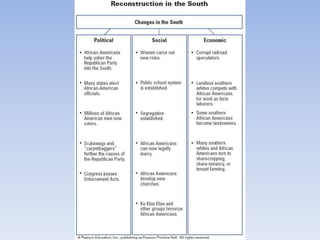
Differing Views of Reconstruction
1865-1877
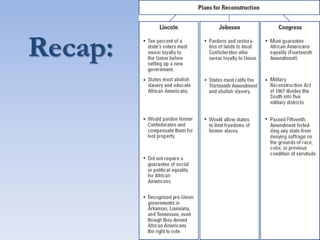
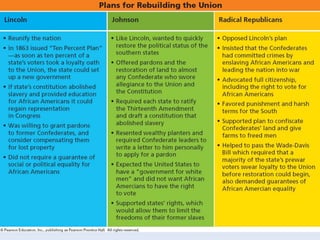
1. Wartime/10%: (Lincoln) – Lenient
2. Presidential: (Johnson) – Semi-lenient; punish
Confederate elite only
3. Congressional/Radical Reconstruction:
(Thaddeus Stevens and Rad. Rep.) – harsh;
treat South as conquered territory; empower blacks
and poor whites
With malice toward none, with charity for
all, with firmness in the right as God
gives us to see the right, let us strive on to
finish the work we are in, to bind up the
nation's wounds, to care for him who
shall have borne the battle and for his
widow and his orphan, to do all which
may achieve and cherish a just and
lasting peace . . .
- Abraham Lincoln, Second Inaugural Address, March 4, 1865
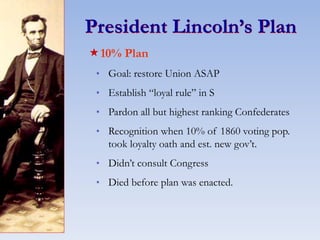
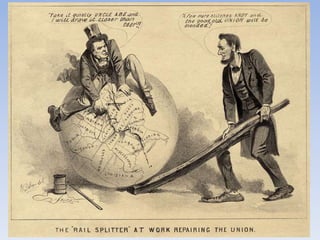
President Lincoln’s Plan
10% Plan
* Goal: restore Union ASAP
* Establish “loyal rule” in S
* Pardon all but highest ranking Confederates
* Recognition when 10% of 1860 voting pop.
took loyalty oath and est. new gov’t.
* Didn’t consult Congress
* Died before plan was enacted.
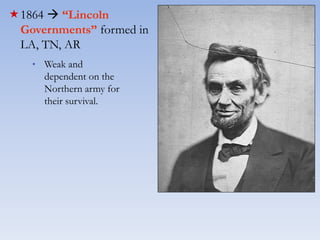
1864  “Lincoln
Governments” formed in
LA, TN, AR
* Weak and
dependent on the
Northern army for
their survival.
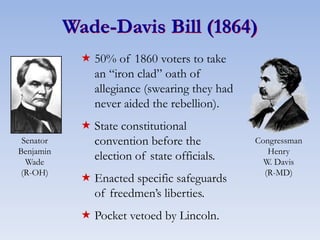
Wade-Davis Bill (1864)
 50% of 1860 voters to take
an “iron clad” oath of
allegiance (swearing they had
never aided the rebellion).
 State constitutional
convention before the
election of state officials.
 Enacted specific safeguards
of freedmen’s liberties.
 Pocket vetoed by Lincoln.
Senator
Benjamin
Wade
(R-OH)
Congressman
Henry
W. Davis
(R-MD)
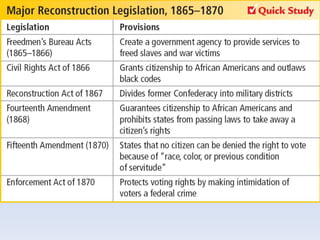
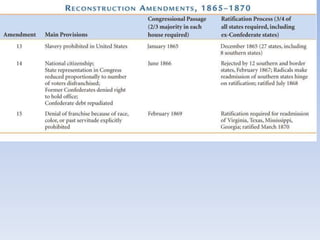
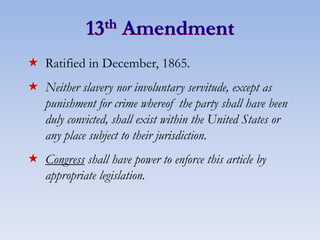
13th Amendment
 Ratified in December, 1865.
 Neither slavery nor involuntary servitude, except as
punishment for crime whereof the party shall have been
duly convicted, shall exist within the United States or
any place subject to their jurisdiction.
 Congress shall have power to enforce this article by
appropriate legislation.
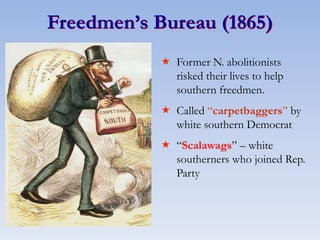
Freedmen’s Bureau (1865)
 Former N. abolitionists
risked their lives to help
southern freedmen.
 Called “carpetbaggers” by
white southern Democrat
 “Scalawags” – white
southerners who joined Rep.
Party
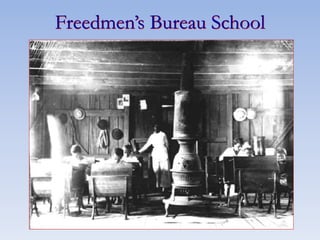
Freedmen’s Bureau School
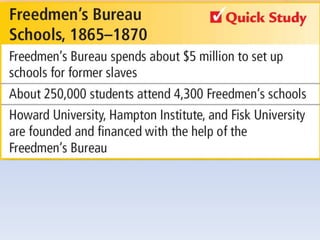
Establishment of Historically
Black Colleges in the South
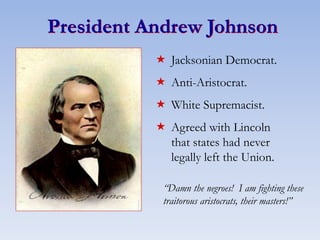
President Andrew Johnson
 Jacksonian Democrat.
 Anti-Aristocrat.
 White Supremacist.
 Agreed with Lincoln
that states had never
legally left the Union.
“Damn the negroes! I am fighting these
traitorous aristocrats, their masters!”
President Johnson’s Plan (10%+)
 Simple loyalty oath for all except Confederate officers and those
worth more than $20,000 (they could apply directly to Johnson)
 New constitutions must repudiate slavery, secession and state debts.
 Named provisional governors in Confederate states and called them
to oversee elections for constitutional conventions.
EFFECTS?
1. Disenfranchised certain leading Confederates.
2. Pardoned planter aristocrats brought them back
to political power to control state organizations.
3. Republicans were outraged that planter elite
were back in power in the South!
Growing Northern Alarm!
 Many Southern state constitutions fell
short of minimum requirements.
 Johnson granted 13,500 special
pardons.
 Revival of southern defiance.
BLACK CODES
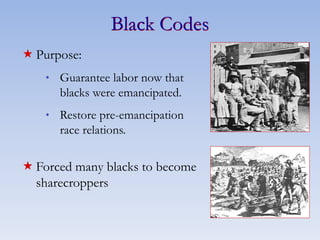
Black Codes
 Purpose:
* Guarantee labor now that
blacks were emancipated.
* Restore pre-emancipation
race relations.
 Forced many blacks to become
sharecroppers
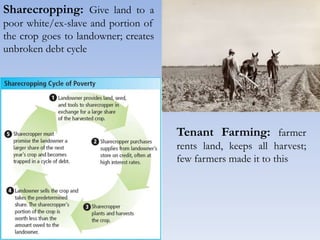
Sharecropping: Give land to a
poor white/ex-slave and portion of
the crop goes to landowner; creates
unbroken debt cycle
Tenant Farming: farmer
rents land, keeps all harvest;
few farmers made it to this
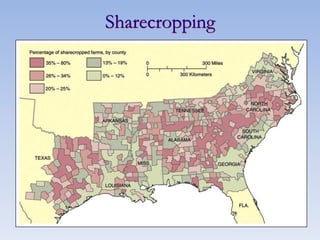
Sharecropping
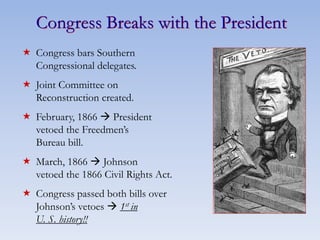
Congress Breaks with the President
 Congress bars Southern
Congressional delegates.
 Joint Committee on
Reconstruction created.
 February, 1866  President
vetoed the Freedmen’s
Bureau bill.
 March, 1866  Johnson
vetoed the 1866 Civil Rights Act.
 Congress passed both bills over
Johnson’s vetoes  1st in
U. S. history!!
14th Amendment
 Ratified in July, 1868.
* Provide a constitutional guarantee of the rights and
security of freed people.
* Insure against neo-Confederate political power.
 Southern states would be punished for denying
the right to vote to black citizens!
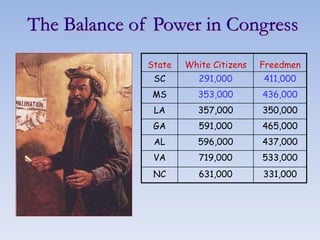
The Balance of Power in Congress
State White Citizens Freedmen
SC 291,000 411,000
MS 353,000 436,000
LA 357,000 350,000
GA 591,000 465,000
AL 596,000 437,000
VA 719,000 533,000
NC 631,000 331,000
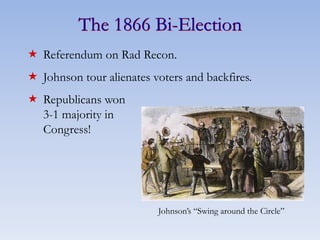
The 1866 Bi-Election
Johnson’s “Swing around the Circle”
 Referendum on Rad Recon.
 Johnson tour alienates voters and backfires.
 Republicans won
3-1 majority in
Congress!
Radical Plan for Readmission
 Civil authorities in South subject to military
supervision.
 Required new state constitutions, including
black suffrage and ratification of the 13th and 14th
Amendments.
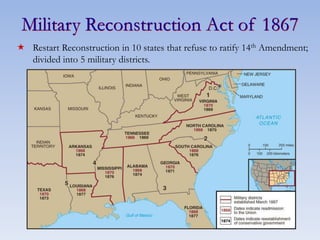
Military Reconstruction Act of 1867
 Restart Reconstruction in 10 states that refuse to ratify 14th Amendment;
divided into 5 military districts.
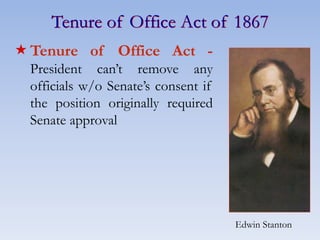
Tenure of Office Act of 1867
Tenure of Office Act -
President can’t remove any
officials w/o Senate’s consent if
the position originally required
Senate approval
Edwin Stanton
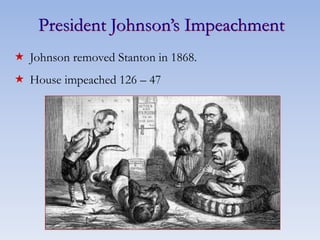
President Johnson’s Impeachment
 Johnson removed Stanton in 1868.
 House impeached 126 – 47
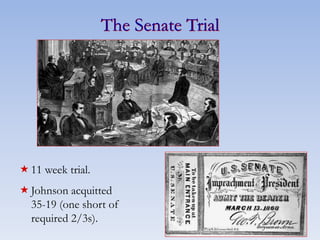
The Senate Trial
11 week trial.
Johnson acquitted
35-19 (one short of
required 2/3s).
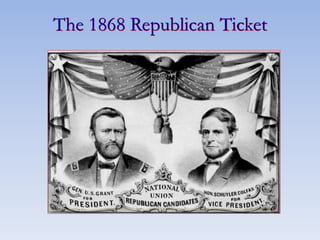
The 1868 Republican Ticket
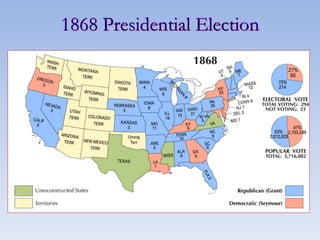
1868 Presidential Election
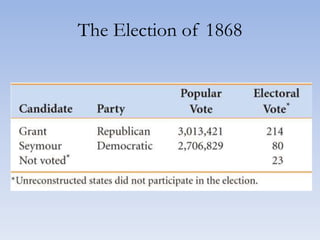
The Election of 1868
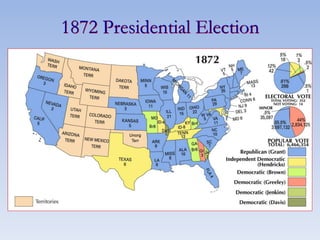
1872 Presidential Election
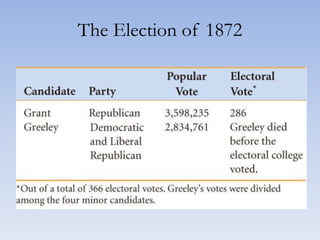
The Election of 1872
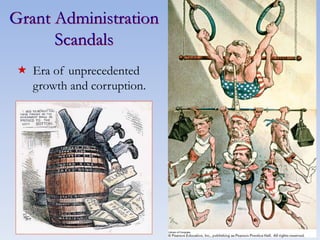
Grant Administration
Scandals
 Era of unprecedented
growth and corruption.
William “Boss” Tweed, NYC -
Tammany Hall’s political machine)
[Thomas Nast  crusading cartoonist/reporter]
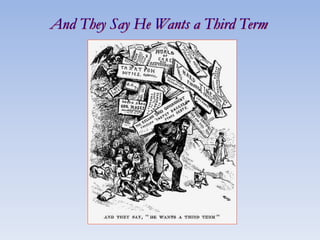
And They Say He Wants a Third Term
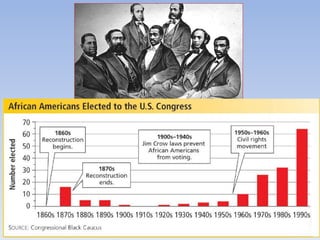
Blacks in Southern Politics
 Core voters were black veterans.
 Blacks politically unprepared.
 Blacks could register and vote in states since 1867.
 The 15th
Amendment
guaranteed
federal voting.
15th Amendment
 Ratified in 1870.
 The right of citizens of the United States to vote shall not be
denied or abridged by the United States or by any state on
account of race, color, or previous condition of servitude.
 The Congress shall have power to enforce this article by
appropriate legislation.
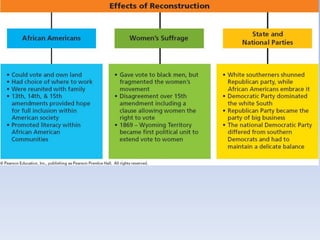
 Women’s rights groups were furious that they were
not granted the vote!
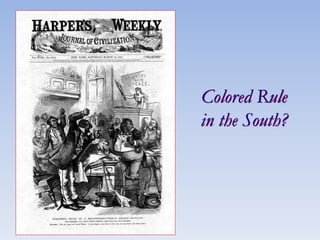
Colored Rule
in the South?
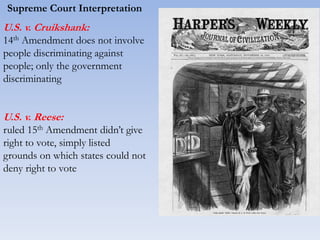
Supreme Court Interpretation
U.S. v. Cruikshank:
14th Amendment does not involve
people discriminating against
people; only the government
discriminating
U.S. v. Reese:
ruled 15th Amendment didn’t give
right to vote, simply listed
grounds on which states could not
deny right to vote
Ku Klux Klan:
the “Invisible Empire of the South”
The Failure of Federal Enforcement
 Enforcement Acts of 1870 & 1871 [also
known as the KKK Act].
 “The Lost Cause.”
 Redeemers (prewar
Democrats and
Union Whigs).
The Civil Rights Act of 1875
 Crime for any individual to deny full & equal use
of public conveyances and public places.
 Prohibited discrimination in jury selection.
 Shortcoming  no strong enforcement
 No new civil rights act was attempted for 90 years!
Northern Support Wanes
 Changes within the
Republican Party:
 ‘Scalawags’ not committed
to protecting African-
Americans
 The party splits over
corruption
 Panic of 1873 [6-year
depression].
 Concern over westward
expansion and Indian wars
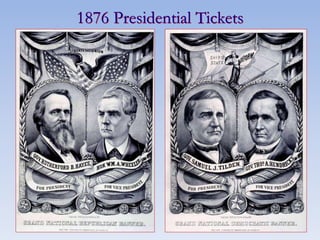
1876 Presidential Tickets
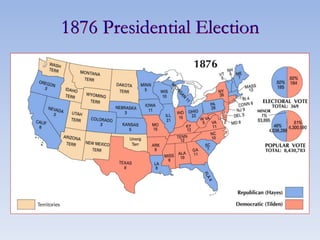
1876 Presidential Election
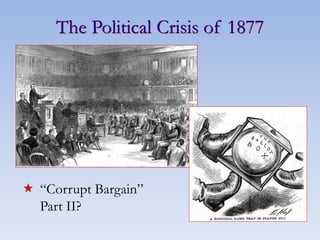
The Political Crisis of 1877
 “Corrupt Bargain”
Part II?
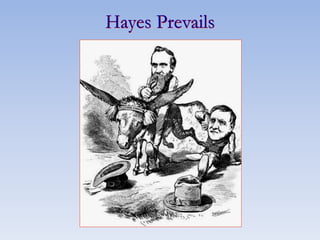
Hayes Prevails
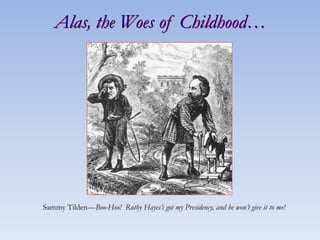
Alas, the Woes of Childhood…
Sammy Tilden—Boo-Hoo! Ruthy Hayes’s got my Presidency, and he won’t give it to me!
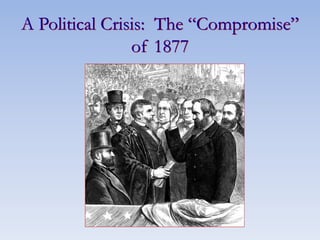
A Political Crisis: The “Compromise”
of 1877
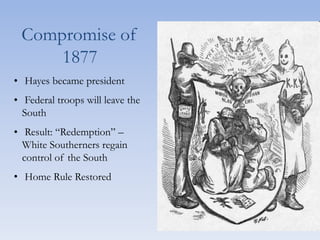
Compromise of
1877
• Hayes became president
• Federal troops will leave the
South
• Result: “Redemption” –
White Southerners regain
control of the South
• Home Rule Restored
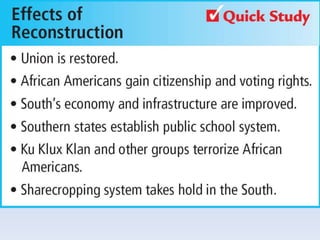
Reconstruction:
Success or Failure?
Recap:
Reconstruction
Reconstruction
Reconstruction
Reconstruction

Reconstruction

  • 1.
  • 2.
    Key Questions 1. Howdo we bring the South back into the Union? 2. How do we rebuild the South after its destruction during the war? 3. How do we integrate and protect newly- emancipated black freedmen? 4. What branch of government should control the process of Reconstruction?
  • 3.
    Differing Views ofReconstruction 1865-1877 1. Wartime/10%: (Lincoln) – Lenient 2. Presidential: (Johnson) – Semi-lenient; punish Confederate elite only 3. Congressional/Radical Reconstruction: (Thaddeus Stevens and Rad. Rep.) – harsh; treat South as conquered territory; empower blacks and poor whites
  • 5.
    With malice towardnone, with charity for all, with firmness in the right as God gives us to see the right, let us strive on to finish the work we are in, to bind up the nation's wounds, to care for him who shall have borne the battle and for his widow and his orphan, to do all which may achieve and cherish a just and lasting peace . . . - Abraham Lincoln, Second Inaugural Address, March 4, 1865
  • 6.
    President Lincoln’s Plan 10%Plan * Goal: restore Union ASAP * Establish “loyal rule” in S * Pardon all but highest ranking Confederates * Recognition when 10% of 1860 voting pop. took loyalty oath and est. new gov’t. * Didn’t consult Congress * Died before plan was enacted.
  • 8.
    1864  “Lincoln Governments”formed in LA, TN, AR * Weak and dependent on the Northern army for their survival.
  • 9.
    Wade-Davis Bill (1864) 50% of 1860 voters to take an “iron clad” oath of allegiance (swearing they had never aided the rebellion).  State constitutional convention before the election of state officials.  Enacted specific safeguards of freedmen’s liberties.  Pocket vetoed by Lincoln. Senator Benjamin Wade (R-OH) Congressman Henry W. Davis (R-MD)
  • 10.
    13th Amendment  Ratifiedin December, 1865.  Neither slavery nor involuntary servitude, except as punishment for crime whereof the party shall have been duly convicted, shall exist within the United States or any place subject to their jurisdiction.  Congress shall have power to enforce this article by appropriate legislation.
  • 11.
    Freedmen’s Bureau (1865) Former N. abolitionists risked their lives to help southern freedmen.  Called “carpetbaggers” by white southern Democrat  “Scalawags” – white southerners who joined Rep. Party
  • 12.
  • 14.
  • 16.
    President Andrew Johnson Jacksonian Democrat.  Anti-Aristocrat.  White Supremacist.  Agreed with Lincoln that states had never legally left the Union. “Damn the negroes! I am fighting these traitorous aristocrats, their masters!”
  • 17.
    President Johnson’s Plan(10%+)  Simple loyalty oath for all except Confederate officers and those worth more than $20,000 (they could apply directly to Johnson)  New constitutions must repudiate slavery, secession and state debts.  Named provisional governors in Confederate states and called them to oversee elections for constitutional conventions. EFFECTS? 1. Disenfranchised certain leading Confederates. 2. Pardoned planter aristocrats brought them back to political power to control state organizations. 3. Republicans were outraged that planter elite were back in power in the South!
  • 18.
    Growing Northern Alarm! Many Southern state constitutions fell short of minimum requirements.  Johnson granted 13,500 special pardons.  Revival of southern defiance. BLACK CODES
  • 19.
    Black Codes  Purpose: *Guarantee labor now that blacks were emancipated. * Restore pre-emancipation race relations.  Forced many blacks to become sharecroppers
  • 20.
    Sharecropping: Give landto a poor white/ex-slave and portion of the crop goes to landowner; creates unbroken debt cycle Tenant Farming: farmer rents land, keeps all harvest; few farmers made it to this
  • 21.
  • 22.
    Congress Breaks withthe President  Congress bars Southern Congressional delegates.  Joint Committee on Reconstruction created.  February, 1866  President vetoed the Freedmen’s Bureau bill.  March, 1866  Johnson vetoed the 1866 Civil Rights Act.  Congress passed both bills over Johnson’s vetoes  1st in U. S. history!!
  • 24.
    14th Amendment  Ratifiedin July, 1868. * Provide a constitutional guarantee of the rights and security of freed people. * Insure against neo-Confederate political power.  Southern states would be punished for denying the right to vote to black citizens!
  • 25.
    The Balance ofPower in Congress State White Citizens Freedmen SC 291,000 411,000 MS 353,000 436,000 LA 357,000 350,000 GA 591,000 465,000 AL 596,000 437,000 VA 719,000 533,000 NC 631,000 331,000
  • 26.
    The 1866 Bi-Election Johnson’s“Swing around the Circle”  Referendum on Rad Recon.  Johnson tour alienates voters and backfires.  Republicans won 3-1 majority in Congress!
  • 27.
    Radical Plan forReadmission  Civil authorities in South subject to military supervision.  Required new state constitutions, including black suffrage and ratification of the 13th and 14th Amendments.
  • 28.
    Military Reconstruction Actof 1867  Restart Reconstruction in 10 states that refuse to ratify 14th Amendment; divided into 5 military districts.
  • 29.
    Tenure of OfficeAct of 1867 Tenure of Office Act - President can’t remove any officials w/o Senate’s consent if the position originally required Senate approval Edwin Stanton
  • 30.
    President Johnson’s Impeachment Johnson removed Stanton in 1868.  House impeached 126 – 47
  • 31.
    The Senate Trial 11week trial. Johnson acquitted 35-19 (one short of required 2/3s).
  • 33.
  • 34.
  • 35.
  • 36.
  • 37.
  • 38.
    Grant Administration Scandals  Eraof unprecedented growth and corruption.
  • 39.
    William “Boss” Tweed,NYC - Tammany Hall’s political machine) [Thomas Nast  crusading cartoonist/reporter]
  • 40.
    And They SayHe Wants a Third Term
  • 42.
    Blacks in SouthernPolitics  Core voters were black veterans.  Blacks politically unprepared.  Blacks could register and vote in states since 1867.  The 15th Amendment guaranteed federal voting.
  • 43.
    15th Amendment  Ratifiedin 1870.  The right of citizens of the United States to vote shall not be denied or abridged by the United States or by any state on account of race, color, or previous condition of servitude.  The Congress shall have power to enforce this article by appropriate legislation.  Women’s rights groups were furious that they were not granted the vote!
  • 45.
  • 46.
    Supreme Court Interpretation U.S.v. Cruikshank: 14th Amendment does not involve people discriminating against people; only the government discriminating U.S. v. Reese: ruled 15th Amendment didn’t give right to vote, simply listed grounds on which states could not deny right to vote
  • 47.
    Ku Klux Klan: the“Invisible Empire of the South”
  • 48.
    The Failure ofFederal Enforcement  Enforcement Acts of 1870 & 1871 [also known as the KKK Act].  “The Lost Cause.”  Redeemers (prewar Democrats and Union Whigs).
  • 49.
    The Civil RightsAct of 1875  Crime for any individual to deny full & equal use of public conveyances and public places.  Prohibited discrimination in jury selection.  Shortcoming  no strong enforcement  No new civil rights act was attempted for 90 years!
  • 51.
    Northern Support Wanes Changes within the Republican Party:  ‘Scalawags’ not committed to protecting African- Americans  The party splits over corruption  Panic of 1873 [6-year depression].  Concern over westward expansion and Indian wars
  • 52.
  • 53.
  • 54.
    The Political Crisisof 1877  “Corrupt Bargain” Part II?
  • 55.
  • 56.
    Alas, the Woesof Childhood… Sammy Tilden—Boo-Hoo! Ruthy Hayes’s got my Presidency, and he won’t give it to me!
  • 57.
    A Political Crisis:The “Compromise” of 1877
  • 58.
    Compromise of 1877 • Hayesbecame president • Federal troops will leave the South • Result: “Redemption” – White Southerners regain control of the South • Home Rule Restored
  • 61.
  • 62.