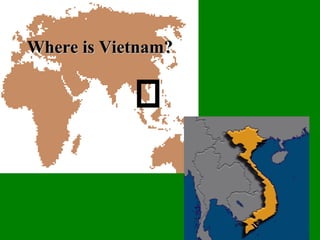
Where is Vietnam?Where is Vietnam?
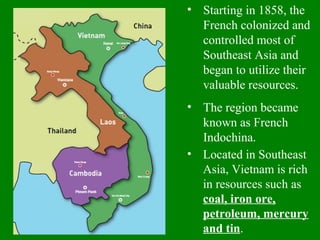
• Starting in 1858, the
French colonized and
controlled most of
Southeast Asia and
began to utilize their
valuable resources.
• The region became
known as French
Indochina.
• Located in Southeast
Asia, Vietnam is rich
in resources such as
coal, iron ore,
petroleum, mercury
and tin.
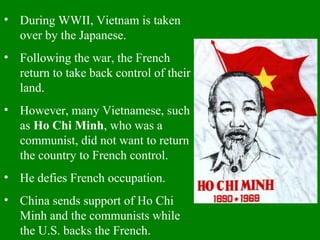
• During WWII, Vietnam is taken
over by the Japanese.
• Following the war, the French
return to take back control of their
land.
• However, many Vietnamese, such
as Ho Chi Minh, who was a
communist, did not want to return
the country to French control.
• He defies French occupation.
• China sends support of Ho Chi
Minh and the communists while
the U.S. backs the French.
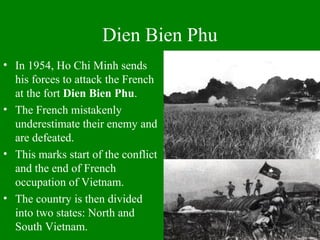
Dien Bien Phu
• In 1954, Ho Chi Minh sends
his forces to attack the French
at the fort Dien Bien Phu.
• The French mistakenly
underestimate their enemy and
are defeated.
• This marks start of the conflict
and the end of French
occupation of Vietnam.
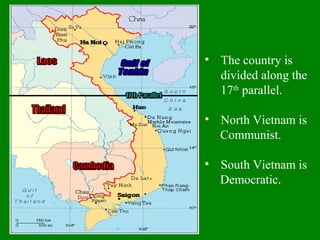
• The country is then divided
into two states: North and
South Vietnam.
• The country is
divided along the
17th
parallel.
• North Vietnam is
Communist.
• South Vietnam is
Democratic.
Why get involved?
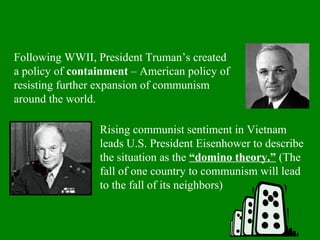
Rising communist sentiment in Vietnam
leads U.S. President Eisenhower to describe
the situation as the “domino theory.” (The
fall of one country to communism will lead
to the fall of its neighbors)
Following WWII, President Truman’s created
a policy of containment – American policy of
resisting further expansion of communism
around the world.
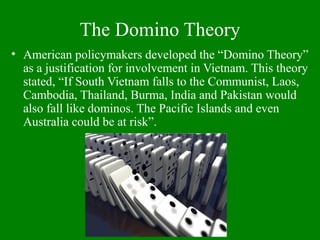
The Domino Theory
• American policymakers developed the “Domino Theory”
as a justification for involvement in Vietnam. This theory
stated, “If South Vietnam falls to the Communist, Laos,
Cambodia, Thailand, Burma, India and Pakistan would
also fall like dominos. The Pacific Islands and even
Australia could be at risk”.
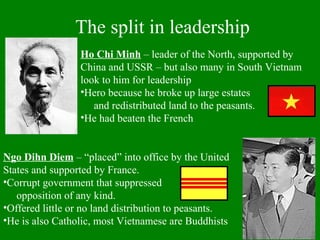
The split in leadership
Ngo Dihn Diem – “placed” into office by the United
States and supported by France.
•Corrupt government that suppressed
opposition of any kind.
•Offered little or no land distribution to peasants.
•He is also Catholic, most Vietnamese are Buddhists
Ho Chi Minh – leader of the North, supported by
China and USSR – but also many in South Vietnam
look to him for leadership
•Hero because he broke up large estates
and redistributed land to the peasants.
•He had beaten the French
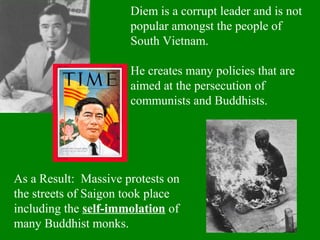
Diem is a corrupt leader and is not
popular amongst the people of
South Vietnam.
He creates many policies that are
aimed at the persecution of
communists and Buddhists.
As a Result: Massive protests on
the streets of Saigon took place
including the self-immolation of
many Buddhist monks.
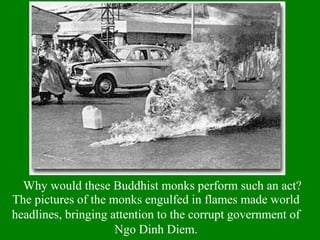
Why would these Buddhist monks perform such an act?
The pictures of the monks engulfed in flames made world
headlines, bringing attention to the corrupt government of
Ngo Dinh Diem.
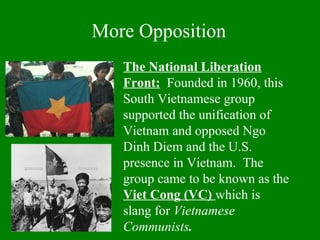
The National Liberation
Front: Founded in 1960, this
South Vietnamese group
supported the unification of
Vietnam and opposed Ngo
Dinh Diem and the U.S.
presence in Vietnam. The
group came to be known as the
Viet Cong (VC) which is
slang for Vietnamese
Communists.
More Opposition
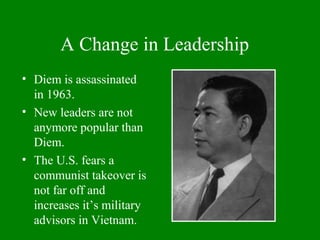
A Change in Leadership
• Diem is assassinated
in 1963.
• New leaders are not
anymore popular than
Diem.
• The U.S. fears a
communist takeover is
not far off and
increases it’s military
advisors in Vietnam.
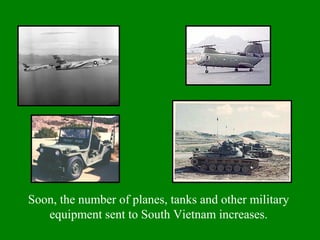
Soon, the number of planes, tanks and other military
equipment sent to South Vietnam increases.
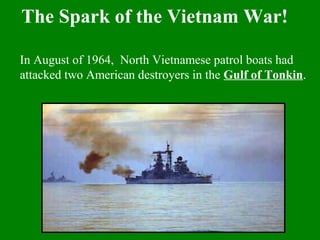
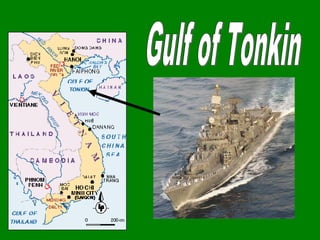
In August of 1964, North Vietnamese patrol boats had
attacked two American destroyers in the Gulf of Tonkin.
The Spark of the Vietnam War!
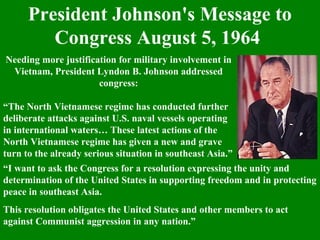
President Johnson's Message to
Congress August 5, 1964
Needing more justification for military involvement in
Vietnam, President Lyndon B. Johnson addressed
congress:
“The North Vietnamese regime has conducted further
deliberate attacks against U.S. naval vessels operating
in international waters… These latest actions of the
North Vietnamese regime has given a new and grave
turn to the already serious situation in southeast Asia.”
“I want to ask the Congress for a resolution expressing the unity and
determination of the United States in supporting freedom and in protecting
peace in southeast Asia.
This resolution obligates the United States and other members to act
against Communist aggression in any nation.”
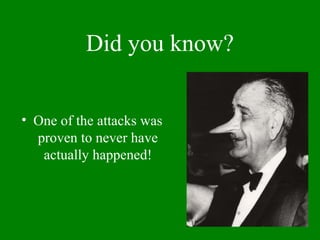
Did you know?
• One of the attacks was
proven to never have
actually happened!
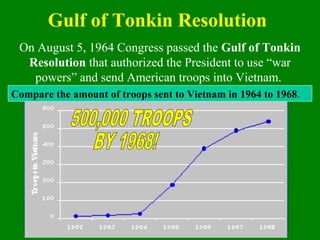
On August 5, 1964 Congress passed the Gulf of Tonkin
Resolution that authorized the President to use “war
powers” and send American troops into Vietnam.
Gulf of Tonkin Resolution
Compare the amount of troops sent to Vietnam in 1964 to 1968.
Did you know?
• The United States never ACTUALLY declared
war on North Vietnam!
Interesting…
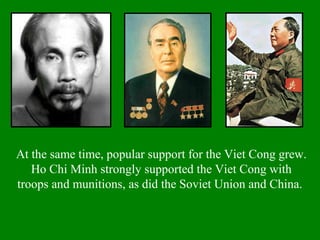
At the same time, popular support for the Viet Cong grew.
Ho Chi Minh strongly supported the Viet Cong with
troops and munitions, as did the Soviet Union and China.
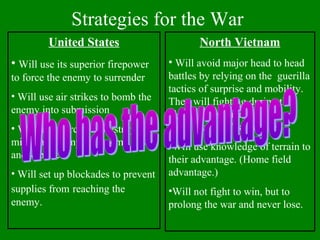
Strategies for the War
United States
• Will use its superior firepower
to force the enemy to surrender
• Will use air strikes to bomb the
enemy into submission
• Will use search and destroy
missions to pinpoint enemy bases
and supplies.
• Will set up blockades to prevent
supplies from reaching the
enemy.
North Vietnam
• Will avoid major head to head
battles by relying on the guerilla
tactics of surprise and mobility.
They will fighting during the
night and use underground
tunnels to confuse enemy.
•Will use knowledge of terrain to
their advantage. (Home field
advantage.)
•Will not fight to win, but to
prolong the war and never lose.
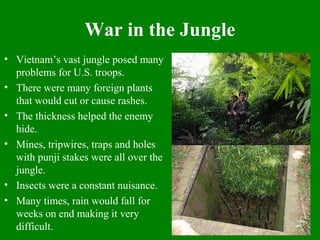
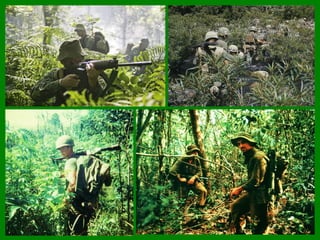
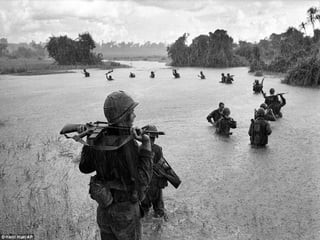
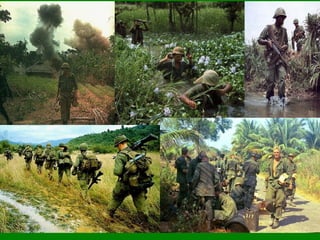
War in the Jungle
• Vietnam’s vast jungle posed many
problems for U.S. troops.
• There were many foreign plants
that would cut or cause rashes.
• The thickness helped the enemy
hide.
• Mines, tripwires, traps and holes
with punji stakes were all over the
jungle.
• Insects were a constant nuisance.
• Many times, rain would fall for
weeks on end making it very
difficult.
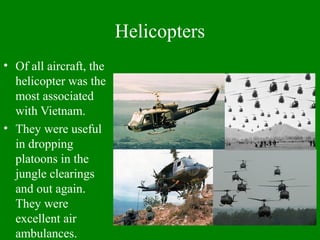
Helicopters
• Of all aircraft, the
helicopter was the
most associated
with Vietnam.
• They were useful
in dropping
platoons in the
jungle clearings
and out again.
They were
excellent air
ambulances.
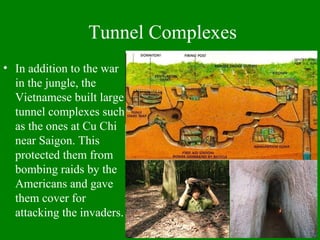
Tunnel Complexes
• In addition to the war
in the jungle, the
Vietnamese built large
tunnel complexes such
as the ones at Cu Chi
near Saigon. This
protected them from
bombing raids by the
Americans and gave
them cover for
attacking the invaders.
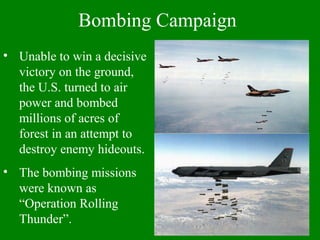
• Unable to win a decisive
victory on the ground,
the U.S. turned to air
power and bombed
millions of acres of
forest in an attempt to
destroy enemy hideouts.
• The bombing missions
were known as
“Operation Rolling
Thunder”.
Bombing Campaign
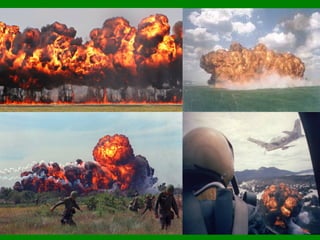
Napalm Bombs
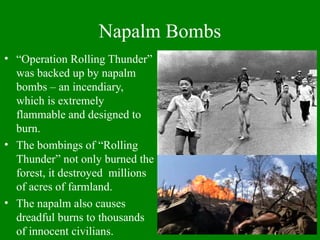
• “Operation Rolling Thunder”
was backed up by napalm
bombs – an incendiary,
which is extremely
flammable and designed to
burn.
• The bombings of “Rolling
Thunder” not only burned the
forest, it destroyed millions
of acres of farmland.
• The napalm also causes
dreadful burns to thousands
of innocent civilians.
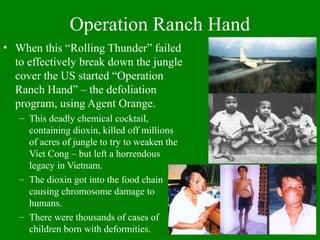
Operation Ranch Hand
• When this “Rolling Thunder” failed
to effectively break down the jungle
cover the US started “Operation
Ranch Hand” – the defoliation
program, using Agent Orange.
– This deadly chemical cocktail,
containing dioxin, killed off millions
of acres of jungle to try to weaken the
Viet Cong – but left a horrendous
legacy in Vietnam.
– The dioxin got into the food chain
causing chromosome damage to
humans.
– There were thousands of cases of
children born with deformities.
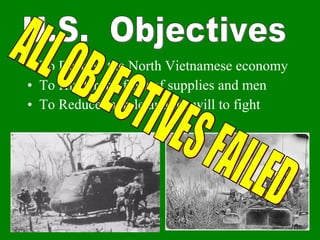
• To Destroy the North Vietnamese economy
• To Hinder the flow of supplies and men
• To Reduce morale and the will to fight
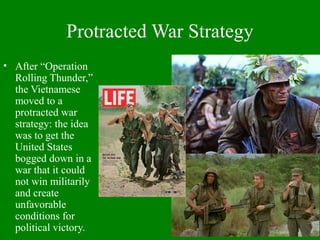
Protracted War Strategy
• After “Operation
Rolling Thunder,”
the Vietnamese
moved to a
protracted war
strategy: the idea
was to get the
United States
bogged down in a
war that it could
not win militarily
and create
unfavorable
conditions for
political victory.
Major Turning Points
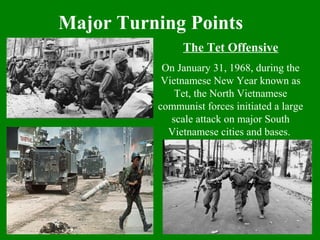
The Tet Offensive
On January 31, 1968, during the
Vietnamese New Year known as
Tet, the North Vietnamese
communist forces initiated a large
scale attack on major South
Vietnamese cities and bases.
Results of the Tet Offensive
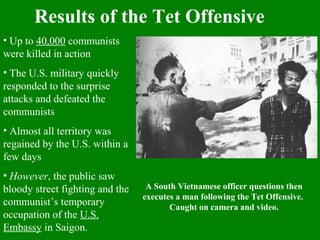
• Up to 40,000 communists
were killed in action
• The U.S. military quickly
responded to the surprise
attacks and defeated the
communists
• Almost all territory was
regained by the U.S. within a
few days
• However, the public saw
bloody street fighting and the
communist’s temporary
occupation of the U.S.
Embassy in Saigon.
A South Vietnamese officer questions then
executes a man following the Tet Offensive.
Caught on camera and video.
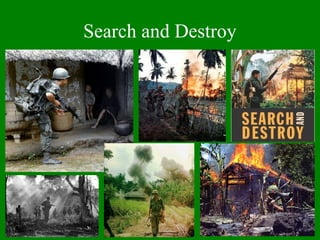
Search & Destroy Tactics
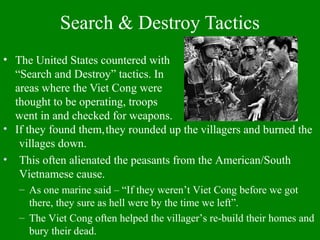
• The United States countered with
“Search and Destroy” tactics. In
areas where the Viet Cong were
thought to be operating, troops
went in and checked for weapons.
If they found them,• they rounded up the villagers and burned the
villages down.
• This often alienated the peasants from the American/South
Vietnamese cause.
– As one marine said – “If they weren’t Viet Cong before we got
there, they sure as hell were by the time we left”.
– The Viet Cong often helped the villager’s re-build their homes and
bury their dead.
Search and Destroy
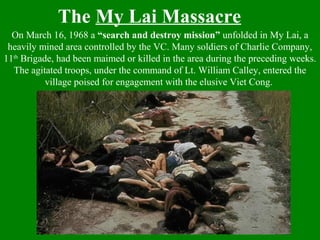
The My Lai Massacre
On March 16, 1968 a “search and destroy mission” unfolded in My Lai, a
heavily mined area controlled by the VC. Many soldiers of Charlie Company,
11th
Brigade, had been maimed or killed in the area during the preceding weeks.
The agitated troops, under the command of Lt. William Calley, entered the
village poised for engagement with the elusive Viet Cong.
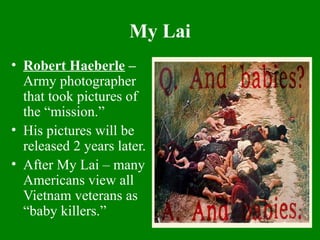
My Lai
• Robert Haeberle –
Army photographer
that took pictures of
the “mission.”
• His pictures will be
released 2 years later.
• After My Lai – many
Americans view all
Vietnam veterans as
“baby killers.”
The Tet Offensive and
the My Lai Massacre
were turning points in
the Vietnam War.
Discuss.
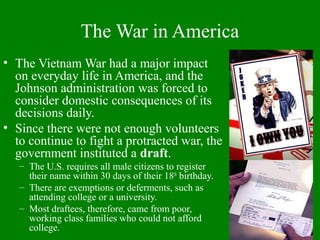
The War in America
• The Vietnam War had a major impact
on everyday life in America, and the
Johnson administration was forced to
consider domestic consequences of its
decisions daily.
• Since there were not enough volunteers
to continue to fight a protracted war, the
government instituted a draft.
– The U.S. requires all male citizens to register
their name within 30 days of their 18th
birthday.
– There are exemptions or deferments, such as
attending college or a university.
– Most draftees, therefore, came from poor,
working class families who could not afford
college.
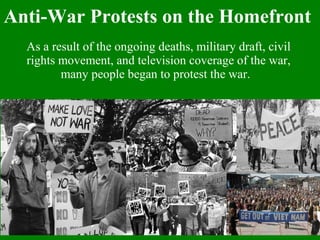
Anti-War Protests on the Homefront
As a result of the ongoing deaths, military draft, civil
rights movement, and television coverage of the war,
many people began to protest the war.
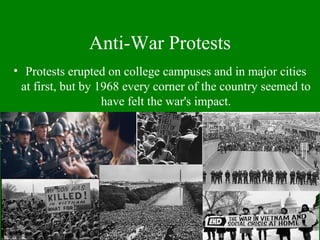
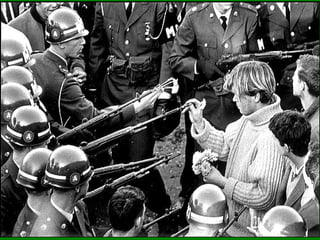
Anti-War Protests
• Protests erupted on college campuses and in major cities
at first, but by 1968 every corner of the country seemed to
have felt the war's impact.
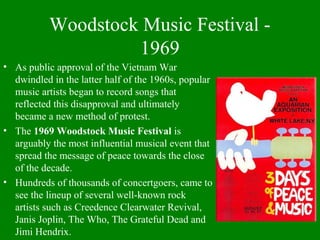
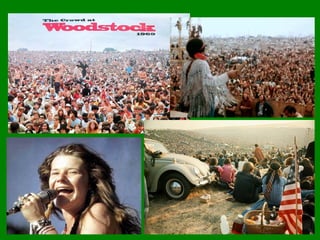
Woodstock Music Festival -
1969
• As public approval of the Vietnam War
dwindled in the latter half of the 1960s, popular
music artists began to record songs that
reflected this disapproval and ultimately
became a new method of protest.
• The 1969 Woodstock Music Festival is
arguably the most influential musical event that
spread the message of peace towards the close
of the decade.
• Hundreds of thousands of concertgoers, came to
see the lineup of several well-known rock
artists such as Creedence Clearwater Revival,
Janis Joplin, The Who, The Grateful Dead and
Jimi Hendrix.
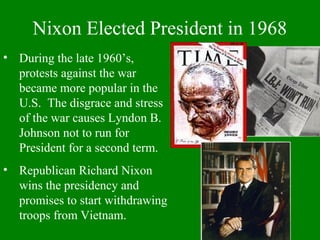
Nixon Elected President in 1968
• During the late 1960’s,
protests against the war
became more popular in the
U.S. The disgrace and stress
of the war causes Lyndon B.
Johnson not to run for
President for a second term.
• Republican Richard Nixon
wins the presidency and
promises to start withdrawing
troops from Vietnam.
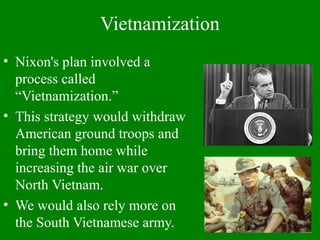
Vietnamization
• Nixon's plan involved a
process called
“Vietnamization.”
• This strategy would withdraw
American ground troops and
bring them home while
increasing the air war over
North Vietnam.
• We would also rely more on
the South Vietnamese army.
Paris Peace Accords
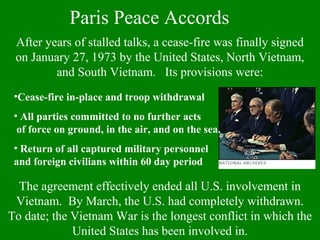
After years of stalled talks, a cease-fire was finally signed
on January 27, 1973 by the United States, North Vietnam,
and South Vietnam. Its provisions were:
•Cease-fire in-place and troop withdrawal
• All parties committed to no further acts
of force on ground, in the air, and on the sea.
• Return of all captured military personnel
and foreign civilians within 60 day period
The agreement effectively ended all U.S. involvement in
Vietnam. By March, the U.S. had completely withdrawn.
To date; the Vietnam War is the longest conflict in which the
United States has been involved in.
The War Not Over
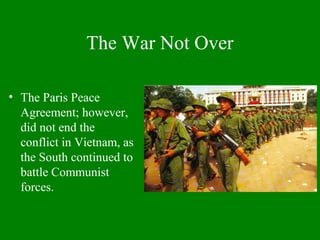
• The Paris Peace
Agreement; however,
did not end the
conflict in Vietnam, as
the South continued to
battle Communist
forces.
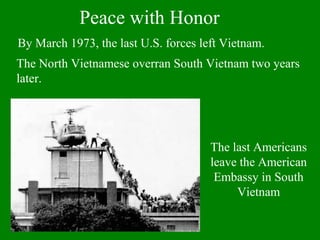
By March 1973, the last U.S. forces left Vietnam.
The North Vietnamese overran South Vietnam two years
later.
Peace with Honor
The last Americans
leave the American
Embassy in South
Vietnam
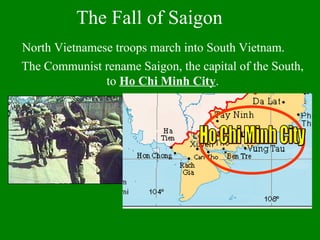
The Communist rename Saigon, the capital of the South,
to Ho Chi Minh City.
North Vietnamese troops march into South Vietnam.
The Fall of Saigon
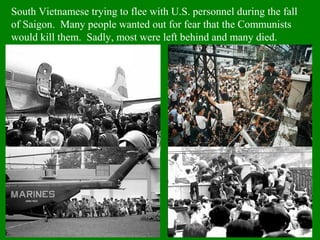
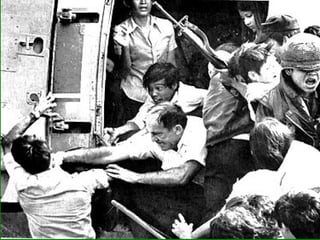
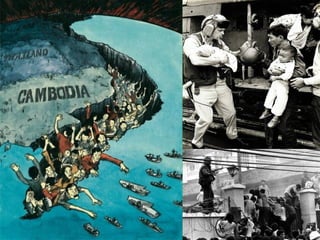
South Vietnamese trying to flee with U.S. personnel during the fall
of Saigon. Many people wanted out for fear that the Communists
would kill them. Sadly, most were left behind and many died.
Results of the Vietnam War
• There is an estimated 3+ million total deaths as a result of the war.
•There were 58,000 Americans, 400,000 South Vietnamese, and over
900,000 Viet Cong and North Vietnamese killed in Action.
• 304,000 Americans wounded
• Over 10,000 American MIA/POW’s
•14,000 are permanently disabled.
•800,000 Vietnam veterans diagnosed as having “significant” to
“severe” problems of readjustment (PTSD).
• U.S. officially recognized Vietnam in 1989
• Vietnam still remains a united nation under a communist
government
•The conflict is the longest in U.S. history.
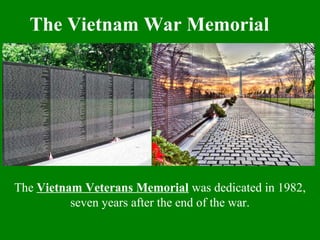
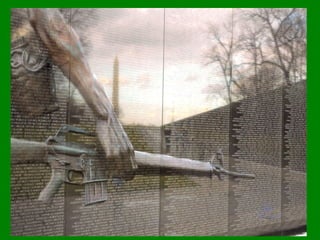
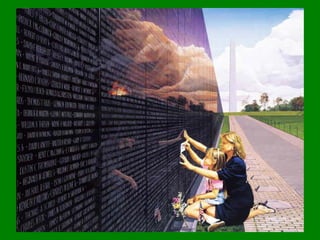
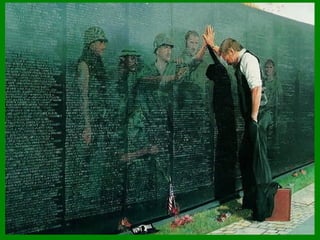
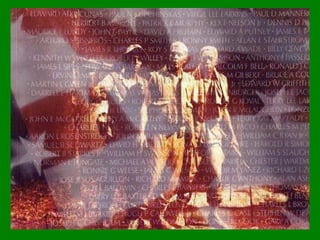
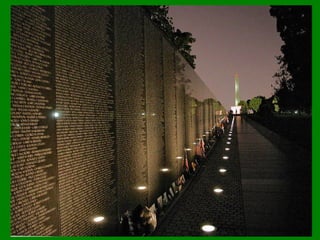
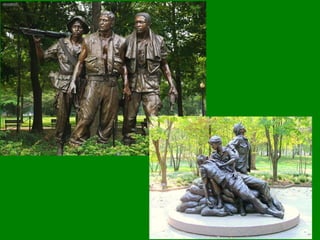
The Vietnam War Memorial
The Vietnam Veterans Memorial was dedicated in 1982,
seven years after the end of the war.
Vietnam War
Vietnam War
Vietnam War
Vietnam War
Vietnam War
Vietnam War
Vietnam War

Vietnam War

  • 2.
  • 3.
    • Starting in1858, the French colonized and controlled most of Southeast Asia and began to utilize their valuable resources. • The region became known as French Indochina. • Located in Southeast Asia, Vietnam is rich in resources such as coal, iron ore, petroleum, mercury and tin.
  • 4.
    • During WWII,Vietnam is taken over by the Japanese. • Following the war, the French return to take back control of their land. • However, many Vietnamese, such as Ho Chi Minh, who was a communist, did not want to return the country to French control. • He defies French occupation. • China sends support of Ho Chi Minh and the communists while the U.S. backs the French.
  • 5.
    Dien Bien Phu •In 1954, Ho Chi Minh sends his forces to attack the French at the fort Dien Bien Phu. • The French mistakenly underestimate their enemy and are defeated. • This marks start of the conflict and the end of French occupation of Vietnam. • The country is then divided into two states: North and South Vietnam.
  • 6.
    • The countryis divided along the 17th parallel. • North Vietnam is Communist. • South Vietnam is Democratic.
  • 7.
  • 8.
    Rising communist sentimentin Vietnam leads U.S. President Eisenhower to describe the situation as the “domino theory.” (The fall of one country to communism will lead to the fall of its neighbors) Following WWII, President Truman’s created a policy of containment – American policy of resisting further expansion of communism around the world.
  • 9.
    The Domino Theory •American policymakers developed the “Domino Theory” as a justification for involvement in Vietnam. This theory stated, “If South Vietnam falls to the Communist, Laos, Cambodia, Thailand, Burma, India and Pakistan would also fall like dominos. The Pacific Islands and even Australia could be at risk”.
  • 10.
    The split inleadership Ngo Dihn Diem – “placed” into office by the United States and supported by France. •Corrupt government that suppressed opposition of any kind. •Offered little or no land distribution to peasants. •He is also Catholic, most Vietnamese are Buddhists Ho Chi Minh – leader of the North, supported by China and USSR – but also many in South Vietnam look to him for leadership •Hero because he broke up large estates and redistributed land to the peasants. •He had beaten the French
  • 11.
    Diem is acorrupt leader and is not popular amongst the people of South Vietnam. He creates many policies that are aimed at the persecution of communists and Buddhists. As a Result: Massive protests on the streets of Saigon took place including the self-immolation of many Buddhist monks.
  • 12.
    Why would theseBuddhist monks perform such an act? The pictures of the monks engulfed in flames made world headlines, bringing attention to the corrupt government of Ngo Dinh Diem.
  • 13.
    The National Liberation Front:Founded in 1960, this South Vietnamese group supported the unification of Vietnam and opposed Ngo Dinh Diem and the U.S. presence in Vietnam. The group came to be known as the Viet Cong (VC) which is slang for Vietnamese Communists. More Opposition
  • 14.
    A Change inLeadership • Diem is assassinated in 1963. • New leaders are not anymore popular than Diem. • The U.S. fears a communist takeover is not far off and increases it’s military advisors in Vietnam.
  • 15.
    Soon, the numberof planes, tanks and other military equipment sent to South Vietnam increases.
  • 16.
    In August of1964, North Vietnamese patrol boats had attacked two American destroyers in the Gulf of Tonkin. The Spark of the Vietnam War!
  • 18.
    President Johnson's Messageto Congress August 5, 1964 Needing more justification for military involvement in Vietnam, President Lyndon B. Johnson addressed congress: “The North Vietnamese regime has conducted further deliberate attacks against U.S. naval vessels operating in international waters… These latest actions of the North Vietnamese regime has given a new and grave turn to the already serious situation in southeast Asia.” “I want to ask the Congress for a resolution expressing the unity and determination of the United States in supporting freedom and in protecting peace in southeast Asia. This resolution obligates the United States and other members to act against Communist aggression in any nation.”
  • 19.
    Did you know? •One of the attacks was proven to never have actually happened!
  • 20.
    On August 5,1964 Congress passed the Gulf of Tonkin Resolution that authorized the President to use “war powers” and send American troops into Vietnam. Gulf of Tonkin Resolution Compare the amount of troops sent to Vietnam in 1964 to 1968.
  • 21.
    Did you know? •The United States never ACTUALLY declared war on North Vietnam! Interesting…
  • 22.
    At the sametime, popular support for the Viet Cong grew. Ho Chi Minh strongly supported the Viet Cong with troops and munitions, as did the Soviet Union and China.
  • 23.
    Strategies for theWar United States • Will use its superior firepower to force the enemy to surrender • Will use air strikes to bomb the enemy into submission • Will use search and destroy missions to pinpoint enemy bases and supplies. • Will set up blockades to prevent supplies from reaching the enemy. North Vietnam • Will avoid major head to head battles by relying on the guerilla tactics of surprise and mobility. They will fighting during the night and use underground tunnels to confuse enemy. •Will use knowledge of terrain to their advantage. (Home field advantage.) •Will not fight to win, but to prolong the war and never lose.
  • 24.
    War in theJungle • Vietnam’s vast jungle posed many problems for U.S. troops. • There were many foreign plants that would cut or cause rashes. • The thickness helped the enemy hide. • Mines, tripwires, traps and holes with punji stakes were all over the jungle. • Insects were a constant nuisance. • Many times, rain would fall for weeks on end making it very difficult.
  • 26.
    Helicopters • Of allaircraft, the helicopter was the most associated with Vietnam. • They were useful in dropping platoons in the jungle clearings and out again. They were excellent air ambulances.
  • 29.
    Tunnel Complexes • Inaddition to the war in the jungle, the Vietnamese built large tunnel complexes such as the ones at Cu Chi near Saigon. This protected them from bombing raids by the Americans and gave them cover for attacking the invaders.
  • 30.
    • Unable towin a decisive victory on the ground, the U.S. turned to air power and bombed millions of acres of forest in an attempt to destroy enemy hideouts. • The bombing missions were known as “Operation Rolling Thunder”. Bombing Campaign
  • 32.
    Napalm Bombs • “OperationRolling Thunder” was backed up by napalm bombs – an incendiary, which is extremely flammable and designed to burn. • The bombings of “Rolling Thunder” not only burned the forest, it destroyed millions of acres of farmland. • The napalm also causes dreadful burns to thousands of innocent civilians.
  • 33.
    Operation Ranch Hand •When this “Rolling Thunder” failed to effectively break down the jungle cover the US started “Operation Ranch Hand” – the defoliation program, using Agent Orange. – This deadly chemical cocktail, containing dioxin, killed off millions of acres of jungle to try to weaken the Viet Cong – but left a horrendous legacy in Vietnam. – The dioxin got into the food chain causing chromosome damage to humans. – There were thousands of cases of children born with deformities.
  • 34.
    • To Destroythe North Vietnamese economy • To Hinder the flow of supplies and men • To Reduce morale and the will to fight
  • 35.
    Protracted War Strategy •After “Operation Rolling Thunder,” the Vietnamese moved to a protracted war strategy: the idea was to get the United States bogged down in a war that it could not win militarily and create unfavorable conditions for political victory.
  • 36.
    Major Turning Points TheTet Offensive On January 31, 1968, during the Vietnamese New Year known as Tet, the North Vietnamese communist forces initiated a large scale attack on major South Vietnamese cities and bases.
  • 37.
    Results of theTet Offensive • Up to 40,000 communists were killed in action • The U.S. military quickly responded to the surprise attacks and defeated the communists • Almost all territory was regained by the U.S. within a few days • However, the public saw bloody street fighting and the communist’s temporary occupation of the U.S. Embassy in Saigon. A South Vietnamese officer questions then executes a man following the Tet Offensive. Caught on camera and video.
  • 38.
    Search & DestroyTactics • The United States countered with “Search and Destroy” tactics. In areas where the Viet Cong were thought to be operating, troops went in and checked for weapons. If they found them,• they rounded up the villagers and burned the villages down. • This often alienated the peasants from the American/South Vietnamese cause. – As one marine said – “If they weren’t Viet Cong before we got there, they sure as hell were by the time we left”. – The Viet Cong often helped the villager’s re-build their homes and bury their dead.
  • 39.
  • 40.
    The My LaiMassacre On March 16, 1968 a “search and destroy mission” unfolded in My Lai, a heavily mined area controlled by the VC. Many soldiers of Charlie Company, 11th Brigade, had been maimed or killed in the area during the preceding weeks. The agitated troops, under the command of Lt. William Calley, entered the village poised for engagement with the elusive Viet Cong.
  • 41.
    My Lai • RobertHaeberle – Army photographer that took pictures of the “mission.” • His pictures will be released 2 years later. • After My Lai – many Americans view all Vietnam veterans as “baby killers.”
  • 42.
    The Tet Offensiveand the My Lai Massacre were turning points in the Vietnam War. Discuss.
  • 43.
    The War inAmerica • The Vietnam War had a major impact on everyday life in America, and the Johnson administration was forced to consider domestic consequences of its decisions daily. • Since there were not enough volunteers to continue to fight a protracted war, the government instituted a draft. – The U.S. requires all male citizens to register their name within 30 days of their 18th birthday. – There are exemptions or deferments, such as attending college or a university. – Most draftees, therefore, came from poor, working class families who could not afford college.
  • 44.
    Anti-War Protests onthe Homefront As a result of the ongoing deaths, military draft, civil rights movement, and television coverage of the war, many people began to protest the war.
  • 45.
    Anti-War Protests • Protestserupted on college campuses and in major cities at first, but by 1968 every corner of the country seemed to have felt the war's impact.
  • 47.
    Woodstock Music Festival- 1969 • As public approval of the Vietnam War dwindled in the latter half of the 1960s, popular music artists began to record songs that reflected this disapproval and ultimately became a new method of protest. • The 1969 Woodstock Music Festival is arguably the most influential musical event that spread the message of peace towards the close of the decade. • Hundreds of thousands of concertgoers, came to see the lineup of several well-known rock artists such as Creedence Clearwater Revival, Janis Joplin, The Who, The Grateful Dead and Jimi Hendrix.
  • 49.
    Nixon Elected Presidentin 1968 • During the late 1960’s, protests against the war became more popular in the U.S. The disgrace and stress of the war causes Lyndon B. Johnson not to run for President for a second term. • Republican Richard Nixon wins the presidency and promises to start withdrawing troops from Vietnam.
  • 50.
    Vietnamization • Nixon's planinvolved a process called “Vietnamization.” • This strategy would withdraw American ground troops and bring them home while increasing the air war over North Vietnam. • We would also rely more on the South Vietnamese army.
  • 51.
    Paris Peace Accords Afteryears of stalled talks, a cease-fire was finally signed on January 27, 1973 by the United States, North Vietnam, and South Vietnam. Its provisions were: •Cease-fire in-place and troop withdrawal • All parties committed to no further acts of force on ground, in the air, and on the sea. • Return of all captured military personnel and foreign civilians within 60 day period The agreement effectively ended all U.S. involvement in Vietnam. By March, the U.S. had completely withdrawn. To date; the Vietnam War is the longest conflict in which the United States has been involved in.
  • 52.
    The War NotOver • The Paris Peace Agreement; however, did not end the conflict in Vietnam, as the South continued to battle Communist forces.
  • 53.
    By March 1973,the last U.S. forces left Vietnam. The North Vietnamese overran South Vietnam two years later. Peace with Honor The last Americans leave the American Embassy in South Vietnam
  • 54.
    The Communist renameSaigon, the capital of the South, to Ho Chi Minh City. North Vietnamese troops march into South Vietnam. The Fall of Saigon
  • 55.
    South Vietnamese tryingto flee with U.S. personnel during the fall of Saigon. Many people wanted out for fear that the Communists would kill them. Sadly, most were left behind and many died.
  • 58.
    Results of theVietnam War • There is an estimated 3+ million total deaths as a result of the war. •There were 58,000 Americans, 400,000 South Vietnamese, and over 900,000 Viet Cong and North Vietnamese killed in Action. • 304,000 Americans wounded • Over 10,000 American MIA/POW’s •14,000 are permanently disabled. •800,000 Vietnam veterans diagnosed as having “significant” to “severe” problems of readjustment (PTSD). • U.S. officially recognized Vietnam in 1989 • Vietnam still remains a united nation under a communist government •The conflict is the longest in U.S. history.
  • 60.
    The Vietnam WarMemorial The Vietnam Veterans Memorial was dedicated in 1982, seven years after the end of the war.