Standard 10
Reconstruction
Presidential Reconstruction
• refers to the plans laid out by President Abraham Lincoln and
carried out by President Andrew Johnson.
• This plan echoed the words of Lincoln’s second Inaugural
Address, which urged no revenge on former Confederate
supporters.
• The purpose of Presidential Reconstruction was to readmit
the southern states to the Union as quickly as possible.
• Republicans in Congress, however, were outraged by the fact
that the new southern state governments were passing laws
that deprived the newly freed slaves of their rights.
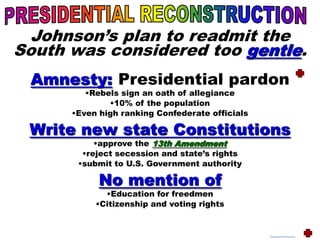
Johnson’s plan to readmit the
South was considered too gentle.
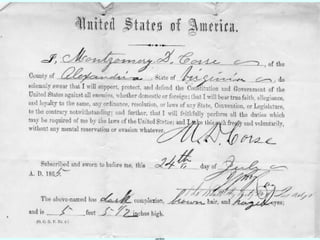
Amnesty: Presidential pardon
•Rebels sign an oath of allegiance
•10% of the population
•Even high ranking Confederate officials
Write new state Constitutions
•approve the 13th Amendment
•reject secession and state’s rights
•submit to U.S. Government authority
No mention of
•Education for freedmen
•Citizenship and voting rights
PresidentialReconstruction
pardon
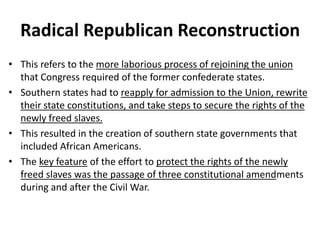
Radical Republican Reconstruction
• This refers to the more laborious process of rejoining the union
that Congress required of the former confederate states.
• Southern states had to reapply for admission to the Union, rewrite
their state constitutions, and take steps to secure the rights of the
newly freed slaves.
• This resulted in the creation of southern state governments that
included African Americans.
• The key feature of the effort to protect the rights of the newly
freed slaves was the passage of three constitutional amendments
during and after the Civil War.
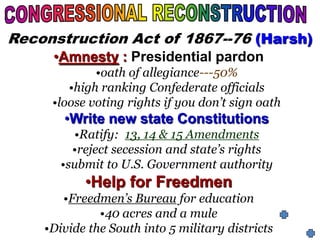
Plans compared
•Amnesty : Presidential pardon
•oath of allegiance---50%
•high ranking Confederate officials
•loose voting rights if you don’t sign oath
•Write new state Constitutions
•Ratify: 13, 14 & 15 Amendments
•reject secession and state’s rights
•submit to U.S. Government authority
•Help for Freedmen
•Freedmen’s Bureau for education
•40 acres and a mule
•Divide the South into 5 military districts
Reconstruction Act of 1867--76 (Harsh)
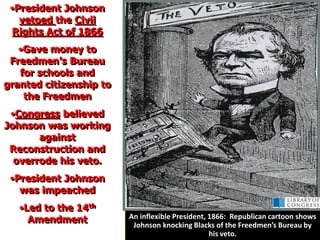
•President Johnson
vetoed the Civil
Rights Act of 1866
•Gave money to
Freedmen’s Bureau
for schools and
granted citizenship to
the Freedmen
•Congress believed
Johnson was working
against
Reconstruction and
overrode his veto.
•President Johnson
was impeached
•Led to the 14th
Amendment An inflexible President, 1866: Republican cartoon shows
Johnson knocking Blacks of the Freedmen’s Bureau by
his veto.
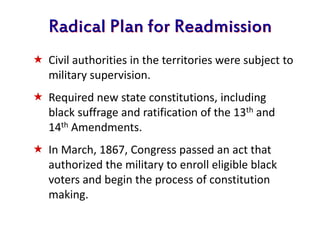
Radical Plan for Readmission
 Civil authorities in the territories were subject to
military supervision.
 Required new state constitutions, including
black suffrage and ratification of the 13th and
14th Amendments.
 In March, 1867, Congress passed an act that
authorized the military to enroll eligible black
voters and begin the process of constitution
making.
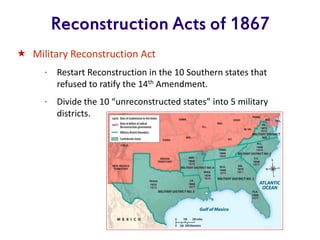
Reconstruction Acts of 1867
 Military Reconstruction Act
* Restart Reconstruction in the 10 Southern states that
refused to ratify the 14th Amendment.
* Divide the 10 “unreconstructed states” into 5 military
districts.
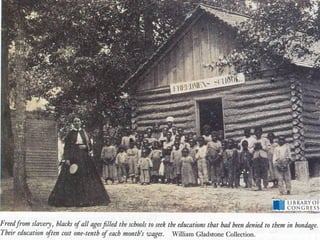
1865, Congress created the Freedman’s
Bureau to help former slaves get a new
start in life. This was the first major relief
agency in United States history.
Bureau’s Accomplishments
Built thousands of schools to educate Blacks.
Former slaves rushed to get an education for
themselves and their children.
Education was difficult and dangerous to gain.
Southerners hated the idea that Freedmen
would go to school.
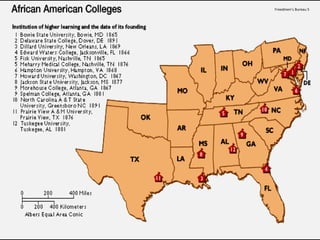
Freedmen’s Bureau 5
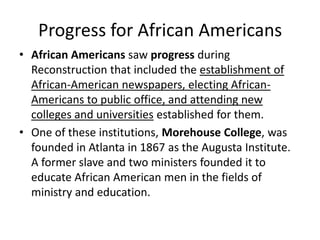
Progress for African Americans
• African Americans saw progress during
Reconstruction that included the establishment of
African-American newspapers, electing African-
Americans to public office, and attending new
colleges and universities established for them.
• One of these institutions, Morehouse College, was
founded in Atlanta in 1867 as the Augusta Institute.
A former slave and two ministers founded it to
educate African American men in the fields of
ministry and education.
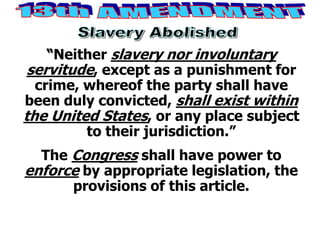
“Neither slavery nor involuntary
servitude, except as a punishment for
crime, whereof the party shall have
been duly convicted, shall exist within
the United States, or any place subject
to their jurisdiction.”
The Congress shall have power to
enforce by appropriate legislation, the
provisions of this article.
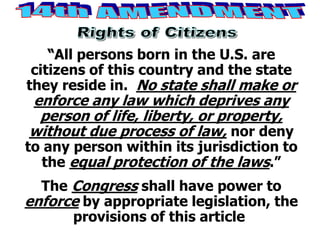
“All persons born in the U.S. are
citizens of this country and the state
they reside in. No state shall make or
enforce any law which deprives any
person of life, liberty, or property,
without due process of law, nor deny
to any person within its jurisdiction to
the equal protection of the laws.”
The Congress shall have power to
enforce by appropriate legislation, the
provisions of this article.
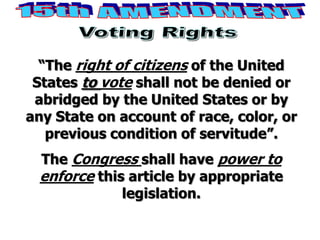
“The right of citizens of the United
States to vote shall not be denied or
abridged by the United States or by
any State on account of race, color, or
previous condition of servitude”.
The Congress shall have power to
enforce this article by appropriate
legislation.
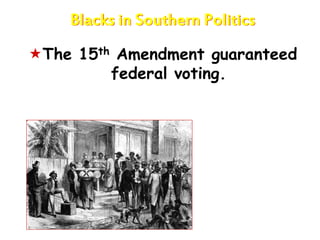
Blacks in Southern Politics
The 15th Amendment guaranteed
federal voting.
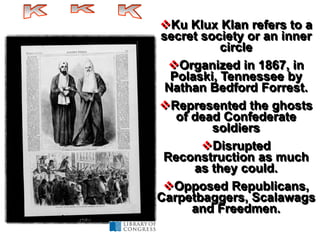
Ku Klux Klan refers to a
secret society or an inner
circle
Organized in 1867, in
Polaski, Tennessee by
Nathan Bedford Forrest.
Represented the ghosts
of dead Confederate
soldiers
Disrupted
Reconstruction as much
as they could.
Opposed Republicans,
Carpetbaggers, Scalawags
and Freedmen.
During Radical Reconstruction, the Republican Party
was a mixture of people who had little in common
except a desire to prosper in the postwar South. This
bloc of voters included freedmen and two other
groups: carpetbaggers and scalawags.
Northern Republicans who moved to the postwar South
became known as carpetbaggers.
Southerners gave them this insulting nickname, which
referred to a type of cheap suitcase made from carpet
scraps.
Carpetbaggers were often depicted as greedy men seeking
to grab power or make a fast buck.
White southern Republicans were seen as
traitors and called scalawags.
Refers to one who is a “scoundrel”, reprobate or
unprincipled person.
Some scalawags were former Whigs who had
opposed secession.
Some were small farmers who resented the
planter class. Many scalawags, but not all, were
poor.
social reality
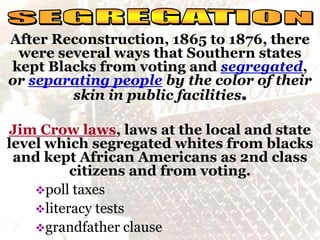
After Reconstruction, 1865 to 1876, there
were several ways that Southern states
kept Blacks from voting and segregated,
or separating people by the color of their
skin in public facilities.
Jim Crow laws, laws at the local and state
level which segregated whites from blacks
and kept African Americans as 2nd class
citizens and from voting.
poll taxes
literacy tests
grandfather clause
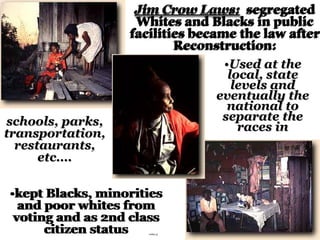
Jim Crow Laws: segregated
Whites and Blacks in public
facilities became the law after
Reconstruction:
•Used at the
local, state
levels and
eventually the
national to
separate the
races in
•kept Blacks, minorities
and poor whites from
voting and as 2nd class
citizen status
schools, parks,
transportation,
restaurants,
etc….
JClaws1
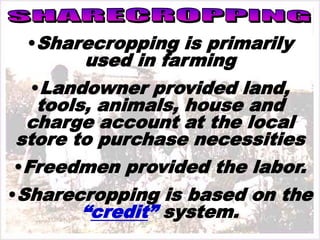
•Sharecropping is primarily
used in farming
•Landowner provided land,
tools, animals, house and
charge account at the local
store to purchase necessities
•Freedmen provided the labor.
•Sharecropping is based on the
“credit” system.
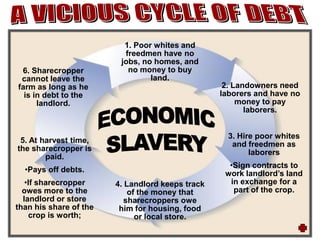
1. Poor whites and
freedmen have no
jobs, no homes, and
no money to buy
land.
2. Landowners need
laborers and have no
money to pay
laborers.
4. Landlord keeps track
of the money that
sharecroppers owe
him for housing, food
or local store.
5. At harvest time,
the sharecropper is
paid.
•Pays off debts.
•If sharecropper
owes more to the
landlord or store
than his share of the
crop is worth;
6. Sharecropper
cannot leave the
farm as long as he
is in debt to the
landlord.
3. Hire poor whites
and freedmen as
laborers
•Sign contracts to
work landlord’s land
in exchange for a
part of the crop.
•Similar to Slave
Codes.
•Restricted the
freedom of movement.
•Limited their rights as
free people.
 As southern states were restored to the Union under President Johnson’s plan, they began
to enact black codes, laws that restricted freedmen’s rights.
 The black codes established virtual slavery with provisions such as these:
 Curfews: Generally, black people could not gather after sunset.
 Vagrancy laws: Freedmen convicted of vagrancy– that is, not working– could
be fined, whipped, or sold for a year’s labor.
 Labor contracts: Freedmen had to sign agreements in January for a year of
work. Those who quit in the middle of a contract often lost all the wages they had
earned.
 Land restrictions: Freed people could rent land or homes only in rural areas.
This restriction forced them to live on plantations.
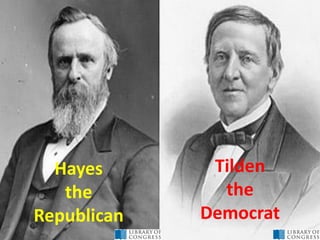
Hayes
the
Republican
Tilden
the
Democrat
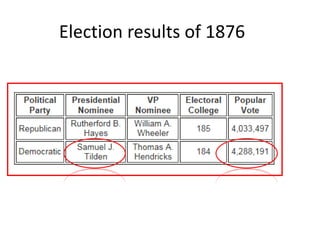
Election results of 1876
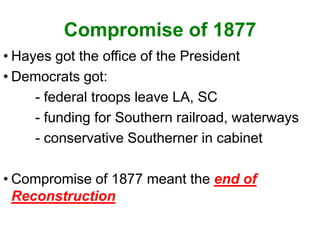
Compromise of 1877
• Hayes got the office of the President
• Democrats got:
- federal troops leave LA, SC
- funding for Southern railroad, waterways
- conservative Southerner in cabinet
• Compromise of 1877 meant the end of
Reconstruction
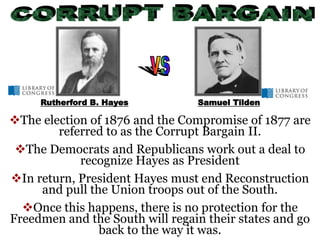
The election of 1876 and the Compromise of 1877 are
referred to as the Corrupt Bargain II.
The Democrats and Republicans work out a deal to
recognize Hayes as President
In return, President Hayes must end Reconstruction
and pull the Union troops out of the South.
Once this happens, there is no protection for the
Freedmen and the South will regain their states and go
back to the way it was.
Rutherford B. Hayes Samuel Tilden
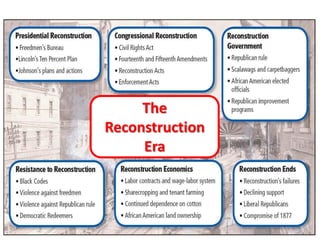
The
Reconstruction
Era

Standard 10

  • 1.
  • 2.
    Presidential Reconstruction • refersto the plans laid out by President Abraham Lincoln and carried out by President Andrew Johnson. • This plan echoed the words of Lincoln’s second Inaugural Address, which urged no revenge on former Confederate supporters. • The purpose of Presidential Reconstruction was to readmit the southern states to the Union as quickly as possible. • Republicans in Congress, however, were outraged by the fact that the new southern state governments were passing laws that deprived the newly freed slaves of their rights.
  • 3.
    Johnson’s plan toreadmit the South was considered too gentle. Amnesty: Presidential pardon •Rebels sign an oath of allegiance •10% of the population •Even high ranking Confederate officials Write new state Constitutions •approve the 13th Amendment •reject secession and state’s rights •submit to U.S. Government authority No mention of •Education for freedmen •Citizenship and voting rights PresidentialReconstruction
  • 4.
  • 5.
    Radical Republican Reconstruction •This refers to the more laborious process of rejoining the union that Congress required of the former confederate states. • Southern states had to reapply for admission to the Union, rewrite their state constitutions, and take steps to secure the rights of the newly freed slaves. • This resulted in the creation of southern state governments that included African Americans. • The key feature of the effort to protect the rights of the newly freed slaves was the passage of three constitutional amendments during and after the Civil War.
  • 6.
    Plans compared •Amnesty :Presidential pardon •oath of allegiance---50% •high ranking Confederate officials •loose voting rights if you don’t sign oath •Write new state Constitutions •Ratify: 13, 14 & 15 Amendments •reject secession and state’s rights •submit to U.S. Government authority •Help for Freedmen •Freedmen’s Bureau for education •40 acres and a mule •Divide the South into 5 military districts Reconstruction Act of 1867--76 (Harsh)
  • 7.
    •President Johnson vetoed theCivil Rights Act of 1866 •Gave money to Freedmen’s Bureau for schools and granted citizenship to the Freedmen •Congress believed Johnson was working against Reconstruction and overrode his veto. •President Johnson was impeached •Led to the 14th Amendment An inflexible President, 1866: Republican cartoon shows Johnson knocking Blacks of the Freedmen’s Bureau by his veto.
  • 8.
    Radical Plan forReadmission  Civil authorities in the territories were subject to military supervision.  Required new state constitutions, including black suffrage and ratification of the 13th and 14th Amendments.  In March, 1867, Congress passed an act that authorized the military to enroll eligible black voters and begin the process of constitution making.
  • 9.
    Reconstruction Acts of1867  Military Reconstruction Act * Restart Reconstruction in the 10 Southern states that refused to ratify the 14th Amendment. * Divide the 10 “unreconstructed states” into 5 military districts.
  • 10.
    1865, Congress createdthe Freedman’s Bureau to help former slaves get a new start in life. This was the first major relief agency in United States history. Bureau’s Accomplishments Built thousands of schools to educate Blacks. Former slaves rushed to get an education for themselves and their children. Education was difficult and dangerous to gain. Southerners hated the idea that Freedmen would go to school.
  • 12.
  • 13.
    Progress for AfricanAmericans • African Americans saw progress during Reconstruction that included the establishment of African-American newspapers, electing African- Americans to public office, and attending new colleges and universities established for them. • One of these institutions, Morehouse College, was founded in Atlanta in 1867 as the Augusta Institute. A former slave and two ministers founded it to educate African American men in the fields of ministry and education.
  • 14.
    “Neither slavery norinvoluntary servitude, except as a punishment for crime, whereof the party shall have been duly convicted, shall exist within the United States, or any place subject to their jurisdiction.” The Congress shall have power to enforce by appropriate legislation, the provisions of this article.
  • 15.
    “All persons bornin the U.S. are citizens of this country and the state they reside in. No state shall make or enforce any law which deprives any person of life, liberty, or property, without due process of law, nor deny to any person within its jurisdiction to the equal protection of the laws.” The Congress shall have power to enforce by appropriate legislation, the provisions of this article.
  • 16.
    “The right ofcitizens of the United States to vote shall not be denied or abridged by the United States or by any State on account of race, color, or previous condition of servitude”. The Congress shall have power to enforce this article by appropriate legislation.
  • 17.
    Blacks in SouthernPolitics The 15th Amendment guaranteed federal voting.
  • 18.
    Ku Klux Klanrefers to a secret society or an inner circle Organized in 1867, in Polaski, Tennessee by Nathan Bedford Forrest. Represented the ghosts of dead Confederate soldiers Disrupted Reconstruction as much as they could. Opposed Republicans, Carpetbaggers, Scalawags and Freedmen.
  • 19.
    During Radical Reconstruction,the Republican Party was a mixture of people who had little in common except a desire to prosper in the postwar South. This bloc of voters included freedmen and two other groups: carpetbaggers and scalawags. Northern Republicans who moved to the postwar South became known as carpetbaggers. Southerners gave them this insulting nickname, which referred to a type of cheap suitcase made from carpet scraps. Carpetbaggers were often depicted as greedy men seeking to grab power or make a fast buck.
  • 20.
    White southern Republicanswere seen as traitors and called scalawags. Refers to one who is a “scoundrel”, reprobate or unprincipled person. Some scalawags were former Whigs who had opposed secession. Some were small farmers who resented the planter class. Many scalawags, but not all, were poor.
  • 21.
    social reality After Reconstruction,1865 to 1876, there were several ways that Southern states kept Blacks from voting and segregated, or separating people by the color of their skin in public facilities. Jim Crow laws, laws at the local and state level which segregated whites from blacks and kept African Americans as 2nd class citizens and from voting. poll taxes literacy tests grandfather clause
  • 22.
    Jim Crow Laws:segregated Whites and Blacks in public facilities became the law after Reconstruction: •Used at the local, state levels and eventually the national to separate the races in •kept Blacks, minorities and poor whites from voting and as 2nd class citizen status schools, parks, transportation, restaurants, etc…. JClaws1
  • 23.
    •Sharecropping is primarily usedin farming •Landowner provided land, tools, animals, house and charge account at the local store to purchase necessities •Freedmen provided the labor. •Sharecropping is based on the “credit” system.
  • 24.
    1. Poor whitesand freedmen have no jobs, no homes, and no money to buy land. 2. Landowners need laborers and have no money to pay laborers. 4. Landlord keeps track of the money that sharecroppers owe him for housing, food or local store. 5. At harvest time, the sharecropper is paid. •Pays off debts. •If sharecropper owes more to the landlord or store than his share of the crop is worth; 6. Sharecropper cannot leave the farm as long as he is in debt to the landlord. 3. Hire poor whites and freedmen as laborers •Sign contracts to work landlord’s land in exchange for a part of the crop.
  • 25.
    •Similar to Slave Codes. •Restrictedthe freedom of movement. •Limited their rights as free people.
  • 26.
     As southernstates were restored to the Union under President Johnson’s plan, they began to enact black codes, laws that restricted freedmen’s rights.  The black codes established virtual slavery with provisions such as these:  Curfews: Generally, black people could not gather after sunset.  Vagrancy laws: Freedmen convicted of vagrancy– that is, not working– could be fined, whipped, or sold for a year’s labor.  Labor contracts: Freedmen had to sign agreements in January for a year of work. Those who quit in the middle of a contract often lost all the wages they had earned.  Land restrictions: Freed people could rent land or homes only in rural areas. This restriction forced them to live on plantations.
  • 27.
  • 28.
  • 29.
    Compromise of 1877 •Hayes got the office of the President • Democrats got: - federal troops leave LA, SC - funding for Southern railroad, waterways - conservative Southerner in cabinet • Compromise of 1877 meant the end of Reconstruction
  • 30.
    The election of1876 and the Compromise of 1877 are referred to as the Corrupt Bargain II. The Democrats and Republicans work out a deal to recognize Hayes as President In return, President Hayes must end Reconstruction and pull the Union troops out of the South. Once this happens, there is no protection for the Freedmen and the South will regain their states and go back to the way it was. Rutherford B. Hayes Samuel Tilden
  • 31.