OUTCOME: WESTWARD EXPANSION
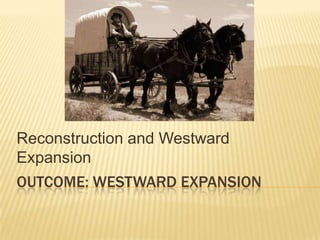
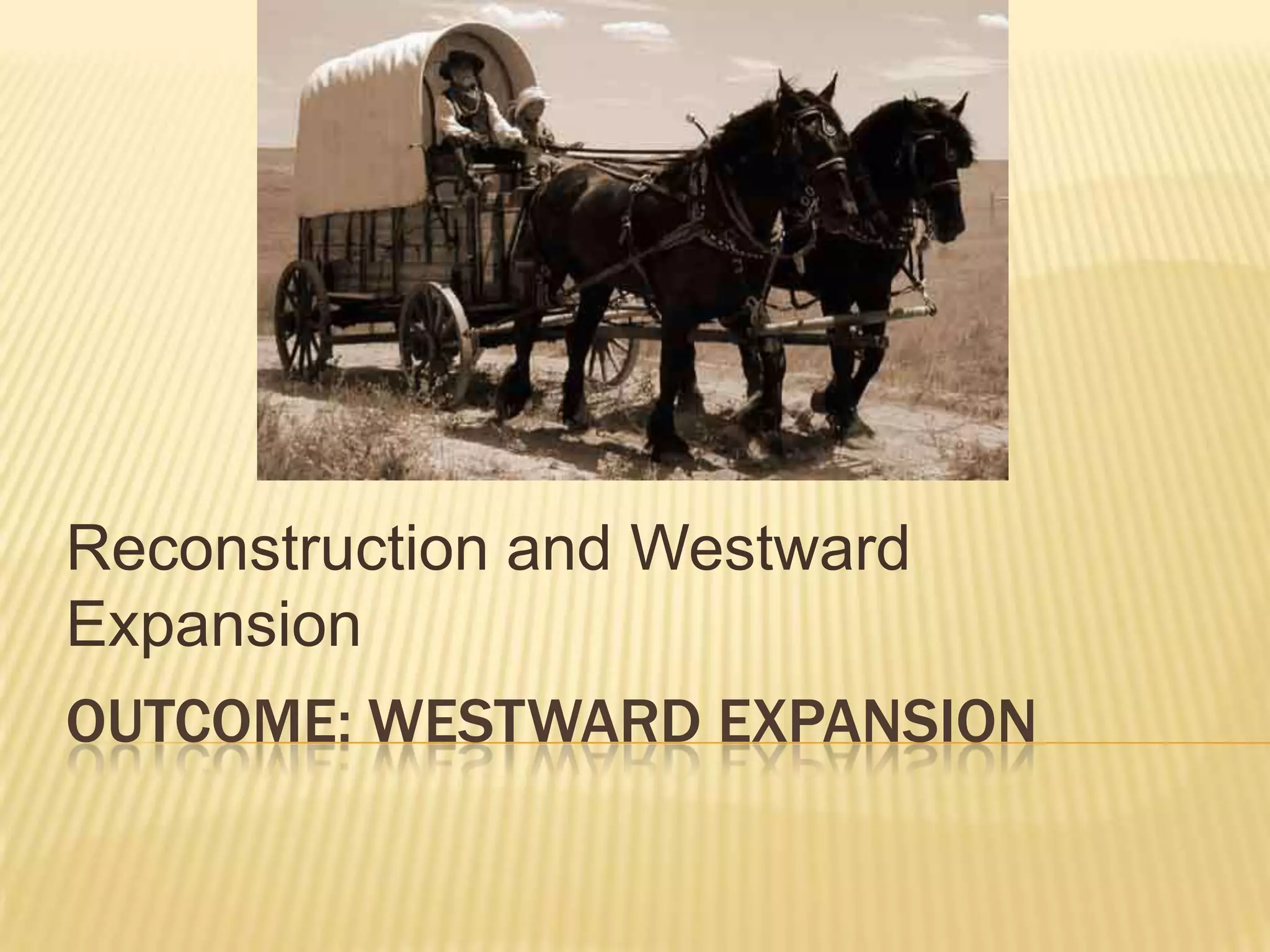
Reconstruction and Westward
Expansion
WESTWARD EXPANSION
1. Setting the Stage (Background on the
West)
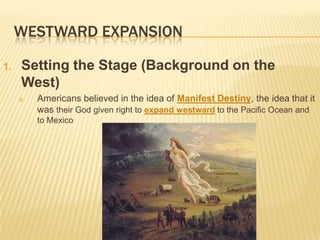
a. Americans believed in the idea of Manifest Destiny, the idea that it
was their God given right to expand westward to the Pacific Ocean and
to Mexico
THOMAS JEFFERSON & NAPOLEON
WESTWARD EXPANSION
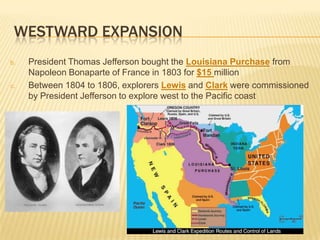
b. President Thomas Jefferson bought the Louisiana Purchase from
Napoleon Bonaparte of France in 1803 for $15 million
c. Between 1804 to 1806, explorers Lewis and Clark were commissioned
by President Jefferson to explore west to the Pacific coast
WESTWARD EXPANSION
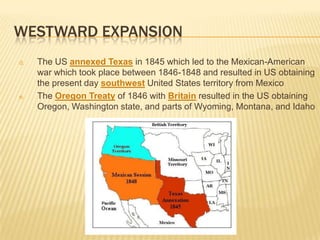
d. The US annexed Texas in 1845 which led to the Mexican-American
war which took place between 1846-1848 and resulted in US obtaining
the present day southwest United States territory from Mexico
e. The Oregon Treaty of 1846 with Britain resulted in the US obtaining
Oregon, Washington state, and parts of Wyoming, Montana, and Idaho
WESTWARD EXPANSION
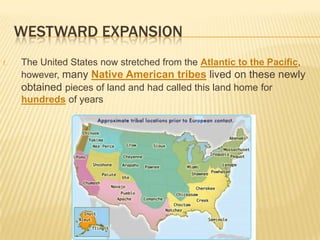
f. The United States now stretched from the Atlantic to the Pacific,
however, many Native American tribes lived on these newly
obtained pieces of land and had called this land home for
hundreds of years
WESTWARD EXPANSION
2. Motivations to settle the West
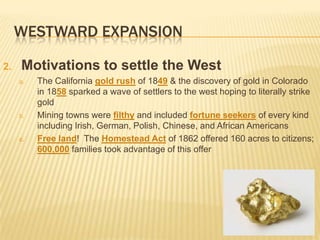
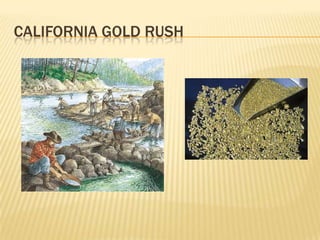
a. The California gold rush of 1849 & the discovery of gold in Colorado
in 1858 sparked a wave of settlers to the west hoping to literally strike
gold
b. Mining towns were filthy and included fortune seekers of every kind
including Irish, German, Polish, Chinese, and African Americans
c. Free land! The Homestead Act of 1862 offered 160 acres to citizens;
600,000 families took advantage of this offer
CALIFORNIA GOLD RUSH
49ERS
WESTWARD EXPANSION
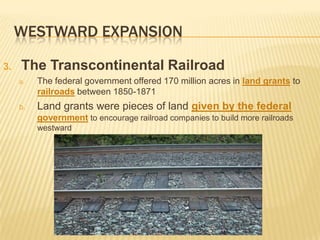
3. The Transcontinental Railroad
a. The federal government offered 170 million acres in land grants to
railroads between 1850-1871
b. Land grants were pieces of land given by the federal
government to encourage railroad companies to build more railroads
westward
WESTWARD EXPANSION
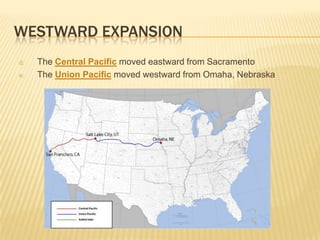
d. The Central Pacific moved eastward from Sacramento
e. The Union Pacific moved westward from Omaha, Nebraska
WESTWARD EXPANSION
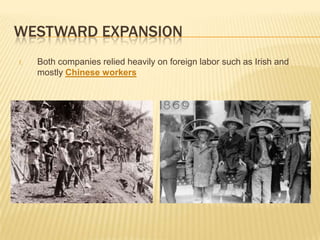
f. Both companies relied heavily on foreign labor such as Irish and
mostly Chinese workers
WESTWARD EXPANSION
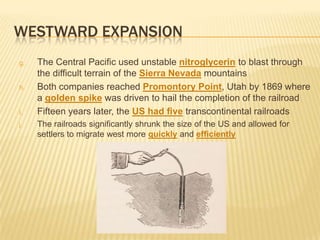
g. The Central Pacific used unstable nitroglycerin to blast through
the difficult terrain of the Sierra Nevada mountains
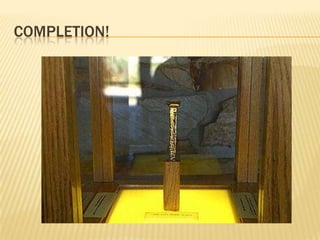
h. Both companies reached Promontory Point, Utah by 1869 where
a golden spike was driven to hail the completion of the railroad
i. Fifteen years later, the US had five transcontinental railroads
j. The railroads significantly shrunk the size of the US and allowed for
settlers to migrate west more quickly and efficiently
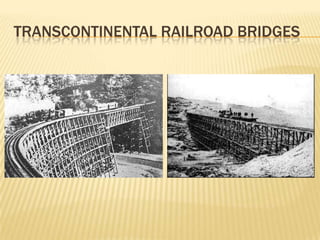
TRANSCONTINENTAL RAILROAD BRIDGES
COMPLETION!
WESTWARD EXPANSION
4. Life in the West
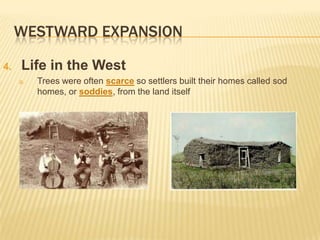
a. Trees were often scarce so settlers built their homes called sod
homes, or soddies, from the land itself
WESTWARD EXPANSION
4. Life in the West
b. Women often worked in the fields with men plowing, planting, and
harvesting the crops
c. Minnesota and Wisconsin were important for lumber production
WESTWARD EXPANSION
4. Life in the West
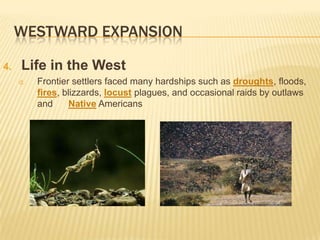
d. Frontier settlers faced many hardships such as droughts, floods,
fires, blizzards, locust plagues, and occasional raids by outlaws
and Native Americans
WESTWARD EXPANSION
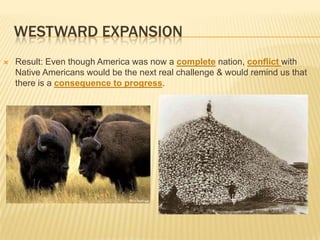
 Result: Even though America was now a complete nation, conflict with
Native Americans would be the next real challenge & would remind us that
there is a consequence to progress.

Westward Expansion

  • 1.
  • 2.
    WESTWARD EXPANSION 1. Settingthe Stage (Background on the West) a. Americans believed in the idea of Manifest Destiny, the idea that it was their God given right to expand westward to the Pacific Ocean and to Mexico
  • 3.
  • 4.
    WESTWARD EXPANSION b. PresidentThomas Jefferson bought the Louisiana Purchase from Napoleon Bonaparte of France in 1803 for $15 million c. Between 1804 to 1806, explorers Lewis and Clark were commissioned by President Jefferson to explore west to the Pacific coast
  • 5.
    WESTWARD EXPANSION d. TheUS annexed Texas in 1845 which led to the Mexican-American war which took place between 1846-1848 and resulted in US obtaining the present day southwest United States territory from Mexico e. The Oregon Treaty of 1846 with Britain resulted in the US obtaining Oregon, Washington state, and parts of Wyoming, Montana, and Idaho
  • 6.
    WESTWARD EXPANSION f. TheUnited States now stretched from the Atlantic to the Pacific, however, many Native American tribes lived on these newly obtained pieces of land and had called this land home for hundreds of years
  • 7.
    WESTWARD EXPANSION 2. Motivationsto settle the West a. The California gold rush of 1849 & the discovery of gold in Colorado in 1858 sparked a wave of settlers to the west hoping to literally strike gold b. Mining towns were filthy and included fortune seekers of every kind including Irish, German, Polish, Chinese, and African Americans c. Free land! The Homestead Act of 1862 offered 160 acres to citizens; 600,000 families took advantage of this offer
  • 8.
  • 10.
  • 11.
    WESTWARD EXPANSION 3. TheTranscontinental Railroad a. The federal government offered 170 million acres in land grants to railroads between 1850-1871 b. Land grants were pieces of land given by the federal government to encourage railroad companies to build more railroads westward
  • 12.
    WESTWARD EXPANSION d. TheCentral Pacific moved eastward from Sacramento e. The Union Pacific moved westward from Omaha, Nebraska
  • 13.
    WESTWARD EXPANSION f. Bothcompanies relied heavily on foreign labor such as Irish and mostly Chinese workers
  • 14.
    WESTWARD EXPANSION g. TheCentral Pacific used unstable nitroglycerin to blast through the difficult terrain of the Sierra Nevada mountains h. Both companies reached Promontory Point, Utah by 1869 where a golden spike was driven to hail the completion of the railroad i. Fifteen years later, the US had five transcontinental railroads j. The railroads significantly shrunk the size of the US and allowed for settlers to migrate west more quickly and efficiently
  • 15.
  • 16.
  • 17.
    WESTWARD EXPANSION 4. Lifein the West a. Trees were often scarce so settlers built their homes called sod homes, or soddies, from the land itself
  • 18.
    WESTWARD EXPANSION 4. Lifein the West b. Women often worked in the fields with men plowing, planting, and harvesting the crops c. Minnesota and Wisconsin were important for lumber production
  • 19.
    WESTWARD EXPANSION 4. Lifein the West d. Frontier settlers faced many hardships such as droughts, floods, fires, blizzards, locust plagues, and occasional raids by outlaws and Native Americans
  • 20.
    WESTWARD EXPANSION  Result:Even though America was now a complete nation, conflict with Native Americans would be the next real challenge & would remind us that there is a consequence to progress.