The Fall of Atlanta
&
General Sherman’s March
May 1864February 1865
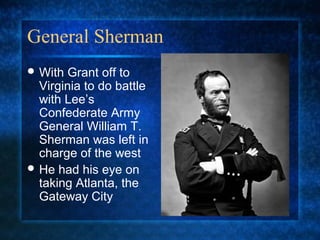
General Sherman
 With

Grant off to
Virginia to do battle
with Lee’s
Confederate Army
General William T.
Sherman was left in
charge of the west
 He had his eye on
taking Atlanta, the
Gateway City
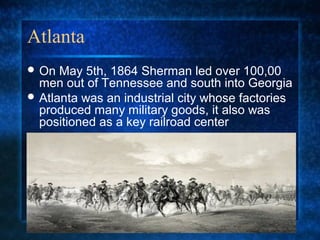
Atlanta
 On

May 5th, 1864 Sherman led over 100,00
men out of Tennessee and south into Georgia
 Atlanta was an industrial city whose factories
produced many military goods, it also was
positioned as a key railroad center
Atlanta




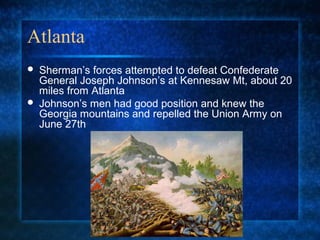
Sherman’s forces attempted to defeat Confederate
General Joseph Johnson’s at Kennesaw Mt, about 20
miles from Atlanta
Johnson’s men had good position and knew the
Georgia mountains and repelled the Union Army on
June 27th
Atlanta




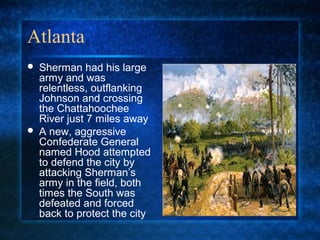
Sherman had his large
army and was
relentless, outflanking
Johnson and crossing
the Chattahoochee
River just 7 miles away
A new, aggressive
Confederate General
named Hood attempted
to defend the city by
attacking Sherman’s
army in the field, both
times the South was
defeated and forced
back to protect the city
Atlanta





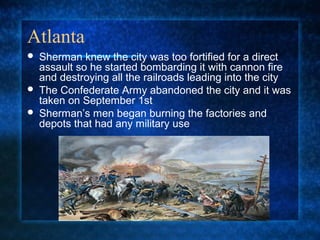
Sherman knew the city was too fortified for a direct
assault so he started bombarding it with cannon fire
and destroying all the railroads leading into the city
The Confederate Army abandoned the city and it was
taken on September 1st
Sherman’s men began burning the factories and
depots that had any military use
A boost for Lincoln
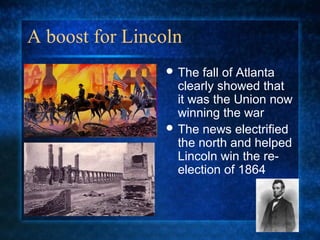
 The

fall of Atlanta
clearly showed that
it was the Union now
winning the war
 The news electrified
the north and helped
Lincoln win the reelection of 1864
Sherman





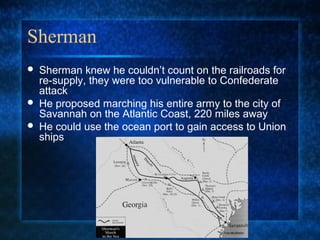
Sherman knew he couldn’t count on the railroads for
re-supply, they were too vulnerable to Confederate
attack
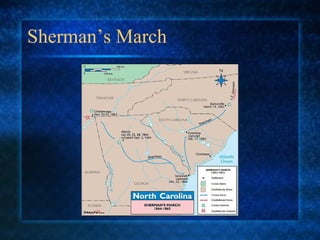
He proposed marching his entire army to the city of
Savannah on the Atlantic Coast, 220 miles away
He could use the ocean port to gain access to Union
ships
Sherman’s March




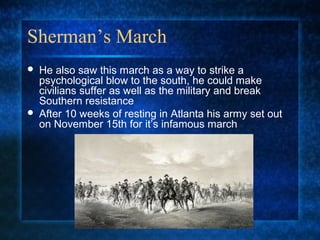
He also saw this march as a way to strike a
psychological blow to the south, he could make
civilians suffer as well as the military and break
Southern resistance
After 10 weeks of resting in Atlanta his army set out
on November 15th for it’s infamous march
Sherman’s March






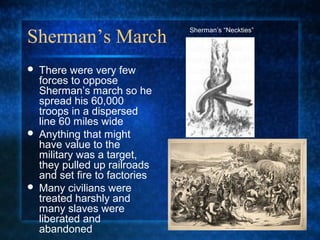
There were very few
forces to oppose
Sherman’s march so he
spread his 60,000
troops in a dispersed
line 60 miles wide
Anything that might
have value to the
military was a target,
they pulled up railroads
and set fire to factories
Many civilians were
treated harshly and
many slaves were
liberated and
abandoned

Sherman’s “Neckties”
Sherman’s March
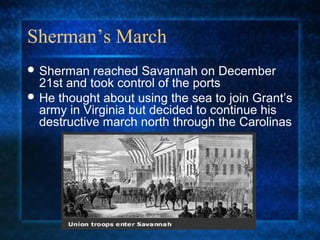
 Sherman

reached Savannah on December
21st and took control of the ports
 He thought about using the sea to join Grant’s
army in Virginia but decided to continue his
destructive march north through the Carolinas
Sherman’s March




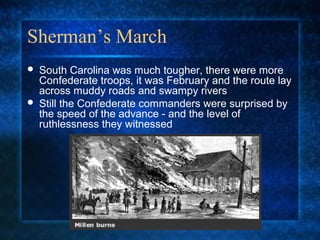
South Carolina was much tougher, there were more
Confederate troops, it was February and the route lay
across muddy roads and swampy rivers
Still the Confederate commanders were surprised by
the speed of the advance - and the level of
ruthlessness they witnessed
Sherman’s March





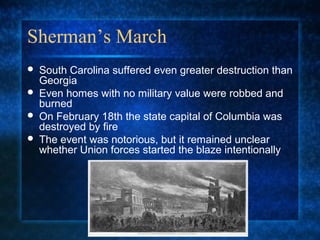
South Carolina suffered even greater destruction than
Georgia
Even homes with no military value were robbed and
burned
On February 18th the state capital of Columbia was
destroyed by fire
The event was notorious, but it remained unclear
whether Union forces started the blaze intentionally
Sherman’s March






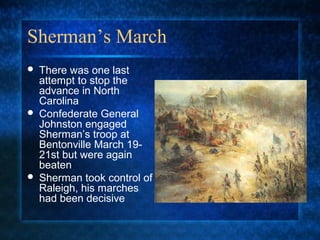
There was one last
attempt to stop the
advance in North
Carolina
Confederate General
Johnston engaged
Sherman’s troop at
Bentonville March 1921st but were again
beaten
Sherman took control of
Raleigh, his marches
had been decisive
Sherman’s March



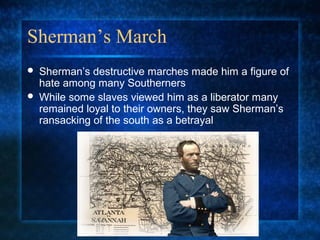
Sherman’s destructive marches made him a figure of
hate among many Southerners
While some slaves viewed him as a liberator many
remained loyal to their owners, they saw Sherman’s
ransacking of the south as a betrayal
Sherman’s words:
We are not only fighting
armies, but a hostile people,
and must make old and young,
rich and poor, feel the hard
hand of war, as well as their
organized armies. I know that
this recent movement of mine
through Georgia has had a
wonderful effect…”“
Sherman’s March

13. sherman's march

  • 1.
    The Fall ofAtlanta & General Sherman’s March May 1864February 1865
  • 2.
    General Sherman  With Grantoff to Virginia to do battle with Lee’s Confederate Army General William T. Sherman was left in charge of the west  He had his eye on taking Atlanta, the Gateway City
  • 3.
    Atlanta  On May 5th,1864 Sherman led over 100,00 men out of Tennessee and south into Georgia  Atlanta was an industrial city whose factories produced many military goods, it also was positioned as a key railroad center
  • 4.
    Atlanta   Sherman’s forces attemptedto defeat Confederate General Joseph Johnson’s at Kennesaw Mt, about 20 miles from Atlanta Johnson’s men had good position and knew the Georgia mountains and repelled the Union Army on June 27th
  • 5.
    Atlanta   Sherman had hislarge army and was relentless, outflanking Johnson and crossing the Chattahoochee River just 7 miles away A new, aggressive Confederate General named Hood attempted to defend the city by attacking Sherman’s army in the field, both times the South was defeated and forced back to protect the city
  • 6.
    Atlanta    Sherman knew thecity was too fortified for a direct assault so he started bombarding it with cannon fire and destroying all the railroads leading into the city The Confederate Army abandoned the city and it was taken on September 1st Sherman’s men began burning the factories and depots that had any military use
  • 7.
    A boost forLincoln  The fall of Atlanta clearly showed that it was the Union now winning the war  The news electrified the north and helped Lincoln win the reelection of 1864
  • 8.
    Sherman    Sherman knew hecouldn’t count on the railroads for re-supply, they were too vulnerable to Confederate attack He proposed marching his entire army to the city of Savannah on the Atlantic Coast, 220 miles away He could use the ocean port to gain access to Union ships
  • 9.
    Sherman’s March   He alsosaw this march as a way to strike a psychological blow to the south, he could make civilians suffer as well as the military and break Southern resistance After 10 weeks of resting in Atlanta his army set out on November 15th for it’s infamous march
  • 10.
    Sherman’s March    There werevery few forces to oppose Sherman’s march so he spread his 60,000 troops in a dispersed line 60 miles wide Anything that might have value to the military was a target, they pulled up railroads and set fire to factories Many civilians were treated harshly and many slaves were liberated and abandoned Sherman’s “Neckties”
  • 11.
    Sherman’s March  Sherman reachedSavannah on December 21st and took control of the ports  He thought about using the sea to join Grant’s army in Virginia but decided to continue his destructive march north through the Carolinas
  • 12.
    Sherman’s March   South Carolinawas much tougher, there were more Confederate troops, it was February and the route lay across muddy roads and swampy rivers Still the Confederate commanders were surprised by the speed of the advance - and the level of ruthlessness they witnessed
  • 13.
    Sherman’s March     South Carolinasuffered even greater destruction than Georgia Even homes with no military value were robbed and burned On February 18th the state capital of Columbia was destroyed by fire The event was notorious, but it remained unclear whether Union forces started the blaze intentionally
  • 14.
    Sherman’s March    There wasone last attempt to stop the advance in North Carolina Confederate General Johnston engaged Sherman’s troop at Bentonville March 1921st but were again beaten Sherman took control of Raleigh, his marches had been decisive
  • 15.
    Sherman’s March   Sherman’s destructivemarches made him a figure of hate among many Southerners While some slaves viewed him as a liberator many remained loyal to their owners, they saw Sherman’s ransacking of the south as a betrayal
  • 16.
    Sherman’s words: We arenot only fighting armies, but a hostile people, and must make old and young, rich and poor, feel the hard hand of war, as well as their organized armies. I know that this recent movement of mine through Georgia has had a wonderful effect…”“
  • 17.