by
Dr K. K.Gupta
Introduction
• First DNA ligase was purified and characterized in 1967 by the Gellert,
Lehman, Richardson, and Hurwitz laboratories.
• Although cutting DNA precisely by RE is useful for DNA analysis but its full
potential is only rely when the fragments produced by RE are joined
together to form recombinant DNA..
• This joining is achieved by DNA ligase.
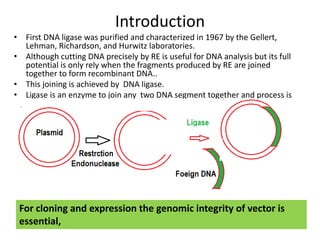
• Ligase is an enzyme to join any two DNA segment together and process is
called ligation despite of their different origin
For cloning and expression the genomic integrity of vector is
essential,
Continued…..
• DNA ligases play an essential role in maintaining
genomic integrity by joining breaks in the
phosphodiester backbone of DNA that occur during
• replication and recombination, and
• Repair of damaged DNA.
• In Biotechnology used to Integrate the DNA fragments
in to the vector
•
Source of ligase .
• Though ligase is of universal occurrence in
living organism and viruses but for use in RDT
it is isolated from two sources
• E.coli. 75 Kda.
• T4 bacteriophage 68 KDa - first ATP-
dependent ligase enzyme to be discovered
and is widely used in molecular biology,
• The enzyme isolated from bacteria E.coli is a
polypeptide chain with mol.wt of
Types of ligase
• E.coli DNA ligase -Monomeric , MW=74 kDa
• T4 Ligase
• Ampligase
• Genetically engineered ligase
• The RNA ligase for RNA fragments ligation .catalyzes
the formation of 3′ → 5′ phophodiester bondsetween
3′-OH and 5′-P groups of RNA molecules.
• Repairing of Anticodon loop
•
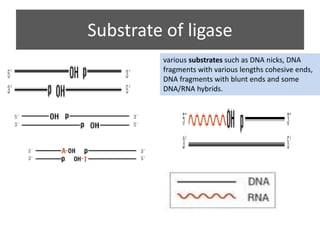
Substrate of ligase
various substrates such as DNA nicks, DNA
fragments with various lengths cohesive ends,
DNA fragments with blunt ends and some
DNA/RNA hybrids.
Ligase in Biotech
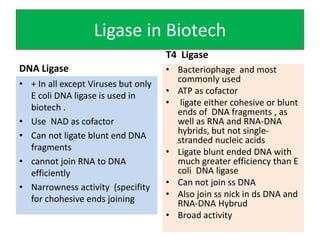
DNA Ligase
• + In all except Viruses but only
E coli DNA ligase is used in
biotech .
• Use NAD as cofactor
• Can not ligate blunt end DNA
fragments
• cannot join RNA to DNA
efficiently
• Narrowness activity (specifity
for chohesive ends joining
T4 Ligase
• Bacteriophage and most
commonly used
• ATP as cofactor
• ligate either cohesive or blunt
ends of DNA fragments , as
well as RNA and RNA-DNA
hybrids, but not single-
stranded nucleic acids
• Ligate blunt ended DNA with
much greater efficiency than E
coli DNA ligase
• Can not join ss DNA
• Also join ss nick in ds DNA and
RNA-DNA Hybrud
• Broad activity
Genetically engineered T4 Ligase
• Some engineering has been done to improve
the in vitro activity of T4 DNA ligase; one
successful approach, for example, tested T4
DNA ligase fused to several alternative DNA
binding proteins and found that the constructs
with either p50 or NF-KB as fusion partners
were over 160% more active in blunt-end
ligations for cloning purposes than wild type
T4 DNA ligase
Ligation efficiency
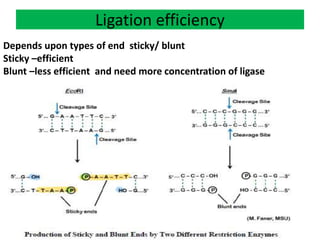
Depends upon types of end sticky/ blunt
Sticky –efficient
Blunt –less efficient and need more concentration of ligase
Activity and Mechanism of ligase action
• If two different DNA are treated with same restriction enzyme to give fragments
with complementary cohesive ends /sticky ends and mixed then two DNA will join
by forming phosphester bond between terminal nucleotides (5’phophoryl at the
end of one strand i.e donor )and 3’OH at other end i.e acceptor but it has nick
after
ATP is required which proceed in three steps
• 1.adenylation –addition of AMP in the active centre of ENz. And PP is released
2.,transfer of the AMP to the 5”P so called donor and formation of pyrophosphate
bond
• 3. Formation of phosphodiester bonds )
• T4 ligase catalyzes end to end joining.
• This could occur inter/intra molecular but inter molecular joining is correct.
• Ligation requires ATP and is carried at 4 deg celcius to lower the kinetic energy.
• This reduce the separation of paired sticky end which is later stabilized by ligation.
However, long reaction times are needed to compensate the low activity of DNA
ligase in cold.
Mechanisms
Weiss unit -
The amount of ligase that catalyzes the
exchange of 1 nmole of 32P from
inorganic pyrophosphate to ATP in 20
minutes at 37°C.
This is the one most commonly used.
enhancer for DNA ligase
• The activity of E. coli DNA ligase can be enhanced
by DNA POL at the right concentrations.
Enhancement only works when the
concentrations of the DNA polymerase 1 are
much lower than the DNA fragments to be
ligated. When the concentrations of Pol I DNA
polymerases are higher, it has an adverse effect
on E. coli DNA ligase
• The T4 enzyme conc is kept high and PEG is
added to reaction mixture for stimulation.
Blunt end ligation
• `
• Blund end fragment has no overhang which can
hold the two fragment temporarily together.
• So ligase and DNA concentration are kept high .
• It is therefore used to ligate the two DNA
fragments obtained by two different restriction
enzyme with non compatible sticky ends DNA.
The non complementary DNA are removed prior
to ligation using enzyme SI nuclease which digest
SS DNA
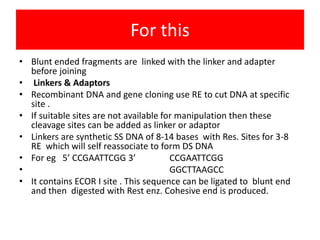
For this
• Blunt ended fragments are linked with the linker and adapter
before joining
• Linkers & Adaptors
• Recombinant DNA and gene cloning use RE to cut DNA at specific
site .
• If suitable sites are not available for manipulation then these
cleavage sites can be added as linker or adaptor
• Linkers are synthetic SS DNA of 8-14 bases with Res. Sites for 3-8
RE which will self reassociate to form DS DNA
• For eg 5’ CCGAATTCGG 3’ CCGAATTCGG
• GGCTTAAGCC
• It contains ECOR I site . This sequence can be ligated to blunt end
and then digested with Rest enz. Cohesive end is produced.
Application
• DNA ligase is important enzymatic tools without which RDT can not be achieved.
• The important function are:-
• Involves in ligation or joining of two DNA segments.
• Like –
• Two okazaki fragments in replication The fragments are formed of lagging strand and after removal of
primer the DNA segments are joined together two give continuous strand of DNA against 5’-3’ template
strand.
• It is used in Ligation of DNA in Vector for cloning & expression.
• Used in Ligation of linker and adaptor at the blunt ends of DNA fragments
• Used in Sealing of nick in DNA fragments
• 2. It I also used in ELISA to form Enzyme substare conjugate . P-nitrophenyl phosphate is a substrate
for AP but cannot form conjugate to give coloured product . The Ap remove P and forms a conjugate
• Note .
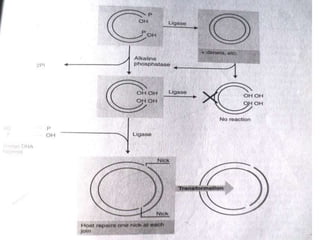
• Self ligation is prevented by use of Alkaline phosphatase. De phophorylated Vector DNA cannot be
recircularised in the cloning procedure and can be remain linear for ligating with the other DNA.
• Ligase requires 3’OH and 5’PO4 for ligation
DNA
LIGASE
…….

DNA ligase enzymes

  • 1.
  • 2.
    Introduction • First DNAligase was purified and characterized in 1967 by the Gellert, Lehman, Richardson, and Hurwitz laboratories. • Although cutting DNA precisely by RE is useful for DNA analysis but its full potential is only rely when the fragments produced by RE are joined together to form recombinant DNA.. • This joining is achieved by DNA ligase. • Ligase is an enzyme to join any two DNA segment together and process is called ligation despite of their different origin For cloning and expression the genomic integrity of vector is essential,
  • 3.
    Continued….. • DNA ligasesplay an essential role in maintaining genomic integrity by joining breaks in the phosphodiester backbone of DNA that occur during • replication and recombination, and • Repair of damaged DNA. • In Biotechnology used to Integrate the DNA fragments in to the vector •
  • 5.
    Source of ligase. • Though ligase is of universal occurrence in living organism and viruses but for use in RDT it is isolated from two sources • E.coli. 75 Kda. • T4 bacteriophage 68 KDa - first ATP- dependent ligase enzyme to be discovered and is widely used in molecular biology, • The enzyme isolated from bacteria E.coli is a polypeptide chain with mol.wt of
  • 6.
    Types of ligase •E.coli DNA ligase -Monomeric , MW=74 kDa • T4 Ligase • Ampligase • Genetically engineered ligase • The RNA ligase for RNA fragments ligation .catalyzes the formation of 3′ → 5′ phophodiester bondsetween 3′-OH and 5′-P groups of RNA molecules. • Repairing of Anticodon loop •
  • 7.
    Substrate of ligase varioussubstrates such as DNA nicks, DNA fragments with various lengths cohesive ends, DNA fragments with blunt ends and some DNA/RNA hybrids.
  • 8.
    Ligase in Biotech DNALigase • + In all except Viruses but only E coli DNA ligase is used in biotech . • Use NAD as cofactor • Can not ligate blunt end DNA fragments • cannot join RNA to DNA efficiently • Narrowness activity (specifity for chohesive ends joining T4 Ligase • Bacteriophage and most commonly used • ATP as cofactor • ligate either cohesive or blunt ends of DNA fragments , as well as RNA and RNA-DNA hybrids, but not single- stranded nucleic acids • Ligate blunt ended DNA with much greater efficiency than E coli DNA ligase • Can not join ss DNA • Also join ss nick in ds DNA and RNA-DNA Hybrud • Broad activity
  • 9.
    Genetically engineered T4Ligase • Some engineering has been done to improve the in vitro activity of T4 DNA ligase; one successful approach, for example, tested T4 DNA ligase fused to several alternative DNA binding proteins and found that the constructs with either p50 or NF-KB as fusion partners were over 160% more active in blunt-end ligations for cloning purposes than wild type T4 DNA ligase
  • 10.
    Ligation efficiency Depends upontypes of end sticky/ blunt Sticky –efficient Blunt –less efficient and need more concentration of ligase
  • 11.
    Activity and Mechanismof ligase action • If two different DNA are treated with same restriction enzyme to give fragments with complementary cohesive ends /sticky ends and mixed then two DNA will join by forming phosphester bond between terminal nucleotides (5’phophoryl at the end of one strand i.e donor )and 3’OH at other end i.e acceptor but it has nick after ATP is required which proceed in three steps • 1.adenylation –addition of AMP in the active centre of ENz. And PP is released 2.,transfer of the AMP to the 5”P so called donor and formation of pyrophosphate bond • 3. Formation of phosphodiester bonds ) • T4 ligase catalyzes end to end joining. • This could occur inter/intra molecular but inter molecular joining is correct. • Ligation requires ATP and is carried at 4 deg celcius to lower the kinetic energy. • This reduce the separation of paired sticky end which is later stabilized by ligation. However, long reaction times are needed to compensate the low activity of DNA ligase in cold.
  • 12.
  • 13.
    Weiss unit - Theamount of ligase that catalyzes the exchange of 1 nmole of 32P from inorganic pyrophosphate to ATP in 20 minutes at 37°C. This is the one most commonly used.
  • 14.
    enhancer for DNAligase • The activity of E. coli DNA ligase can be enhanced by DNA POL at the right concentrations. Enhancement only works when the concentrations of the DNA polymerase 1 are much lower than the DNA fragments to be ligated. When the concentrations of Pol I DNA polymerases are higher, it has an adverse effect on E. coli DNA ligase • The T4 enzyme conc is kept high and PEG is added to reaction mixture for stimulation.
  • 15.
    Blunt end ligation •` • Blund end fragment has no overhang which can hold the two fragment temporarily together. • So ligase and DNA concentration are kept high . • It is therefore used to ligate the two DNA fragments obtained by two different restriction enzyme with non compatible sticky ends DNA. The non complementary DNA are removed prior to ligation using enzyme SI nuclease which digest SS DNA
  • 16.
    For this • Bluntended fragments are linked with the linker and adapter before joining • Linkers & Adaptors • Recombinant DNA and gene cloning use RE to cut DNA at specific site . • If suitable sites are not available for manipulation then these cleavage sites can be added as linker or adaptor • Linkers are synthetic SS DNA of 8-14 bases with Res. Sites for 3-8 RE which will self reassociate to form DS DNA • For eg 5’ CCGAATTCGG 3’ CCGAATTCGG • GGCTTAAGCC • It contains ECOR I site . This sequence can be ligated to blunt end and then digested with Rest enz. Cohesive end is produced.
  • 18.
    Application • DNA ligaseis important enzymatic tools without which RDT can not be achieved. • The important function are:- • Involves in ligation or joining of two DNA segments. • Like – • Two okazaki fragments in replication The fragments are formed of lagging strand and after removal of primer the DNA segments are joined together two give continuous strand of DNA against 5’-3’ template strand. • It is used in Ligation of DNA in Vector for cloning & expression. • Used in Ligation of linker and adaptor at the blunt ends of DNA fragments • Used in Sealing of nick in DNA fragments • 2. It I also used in ELISA to form Enzyme substare conjugate . P-nitrophenyl phosphate is a substrate for AP but cannot form conjugate to give coloured product . The Ap remove P and forms a conjugate • Note . • Self ligation is prevented by use of Alkaline phosphatase. De phophorylated Vector DNA cannot be recircularised in the cloning procedure and can be remain linear for ligating with the other DNA. • Ligase requires 3’OH and 5’PO4 for ligation
  • 19.