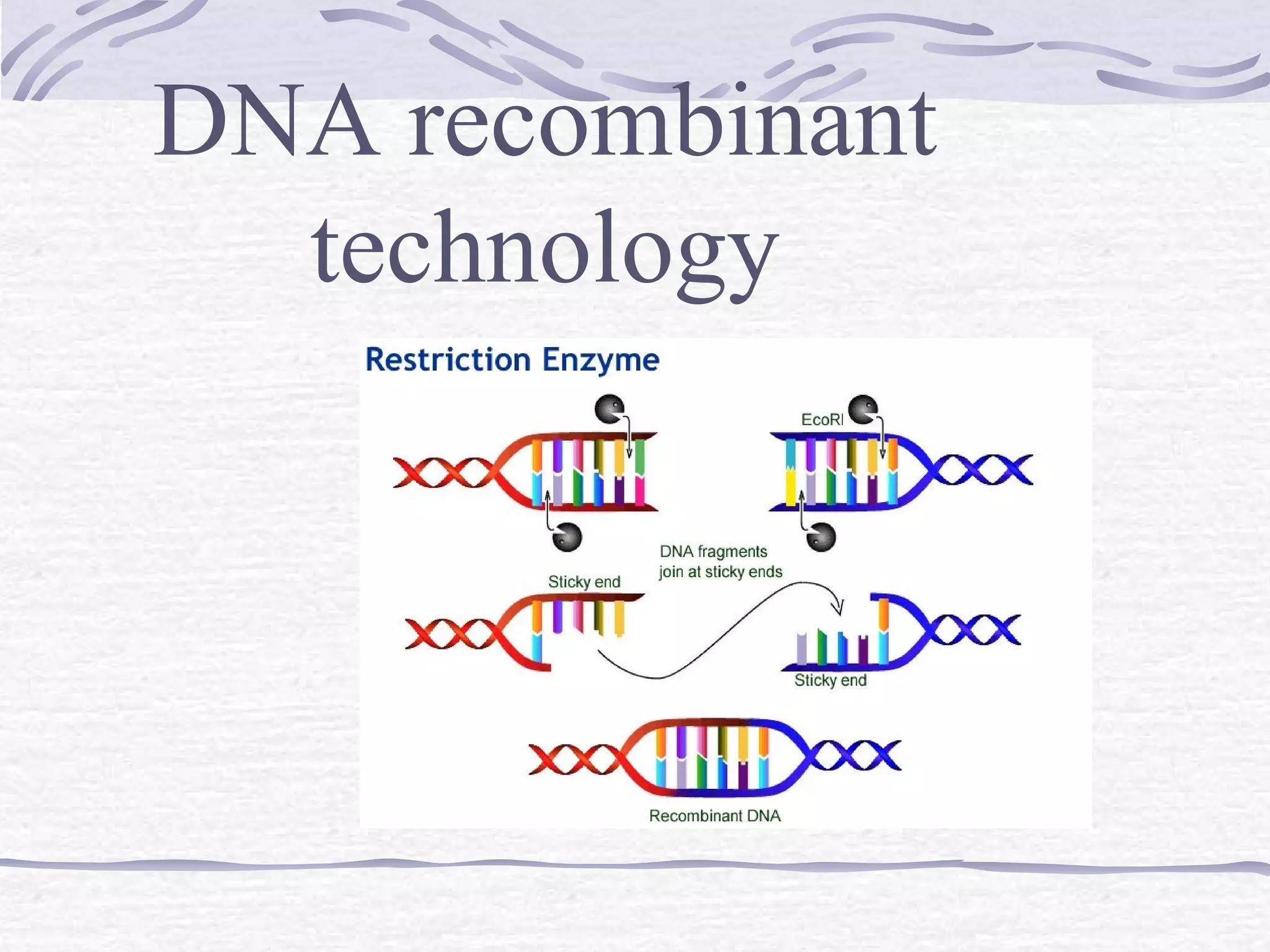
DNA recombinant
technology
A series of procedures used to
recombine DNA segments.. Under
certain conditions, a recombinant DNA
molecule can enter a cell and replicate.
Definition of recombinant DNA
technology( 基因重組 )
History of recombinant DNA
technology
Recombinant DNA technology is one
of the recent advances in
biotechnology, which was developed
by two scientists named Boyer and
Cohen in 1973.
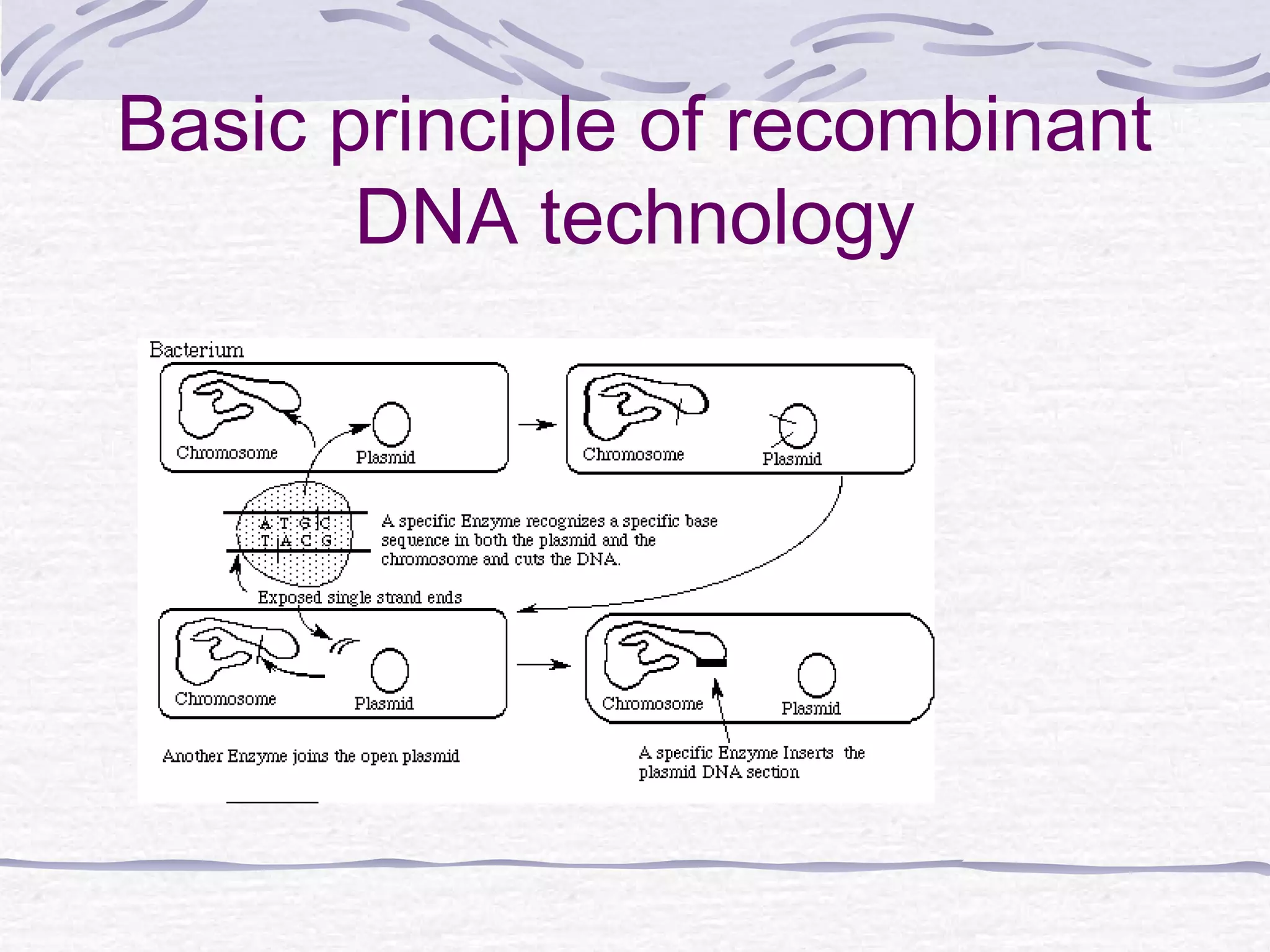
Basic principle of recombinant
DNA technology
The DNA is inserted into another
DNA molecule called ‘vector’( 載體 )
. The recombinant vector is then
introduced into a host cell where it
replicates itself, the gene is then
produced
Basic principle of recombinant
DNA technology
Applications of
Recombinant DNA
Technology
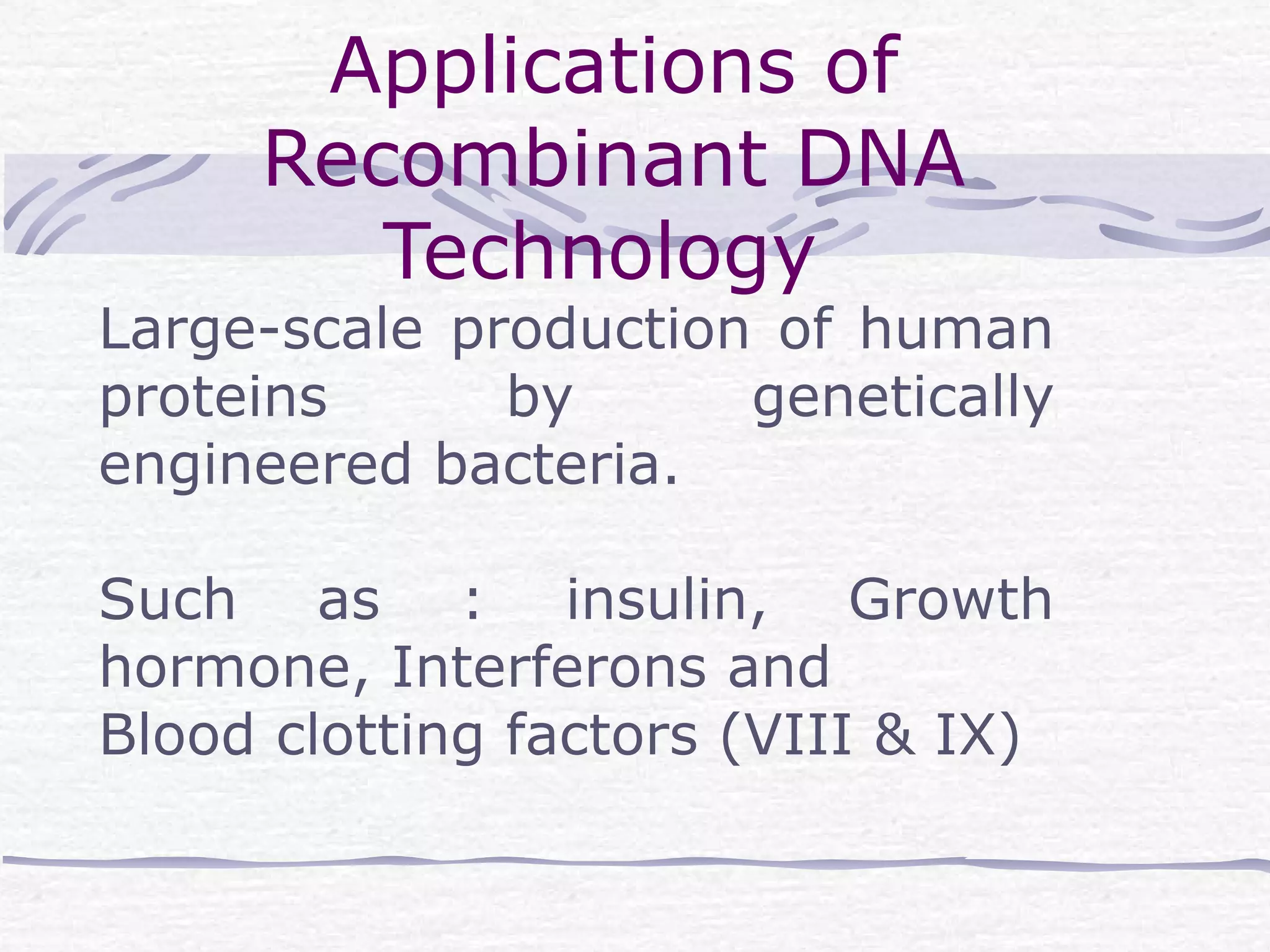
Large-scale production of human
proteins by genetically
engineered bacteria.
Such as : insulin, Growth
hormone, Interferons and
Blood clotting factors (VIII & IX)
Production of Human
Insulin( 胰島素 )
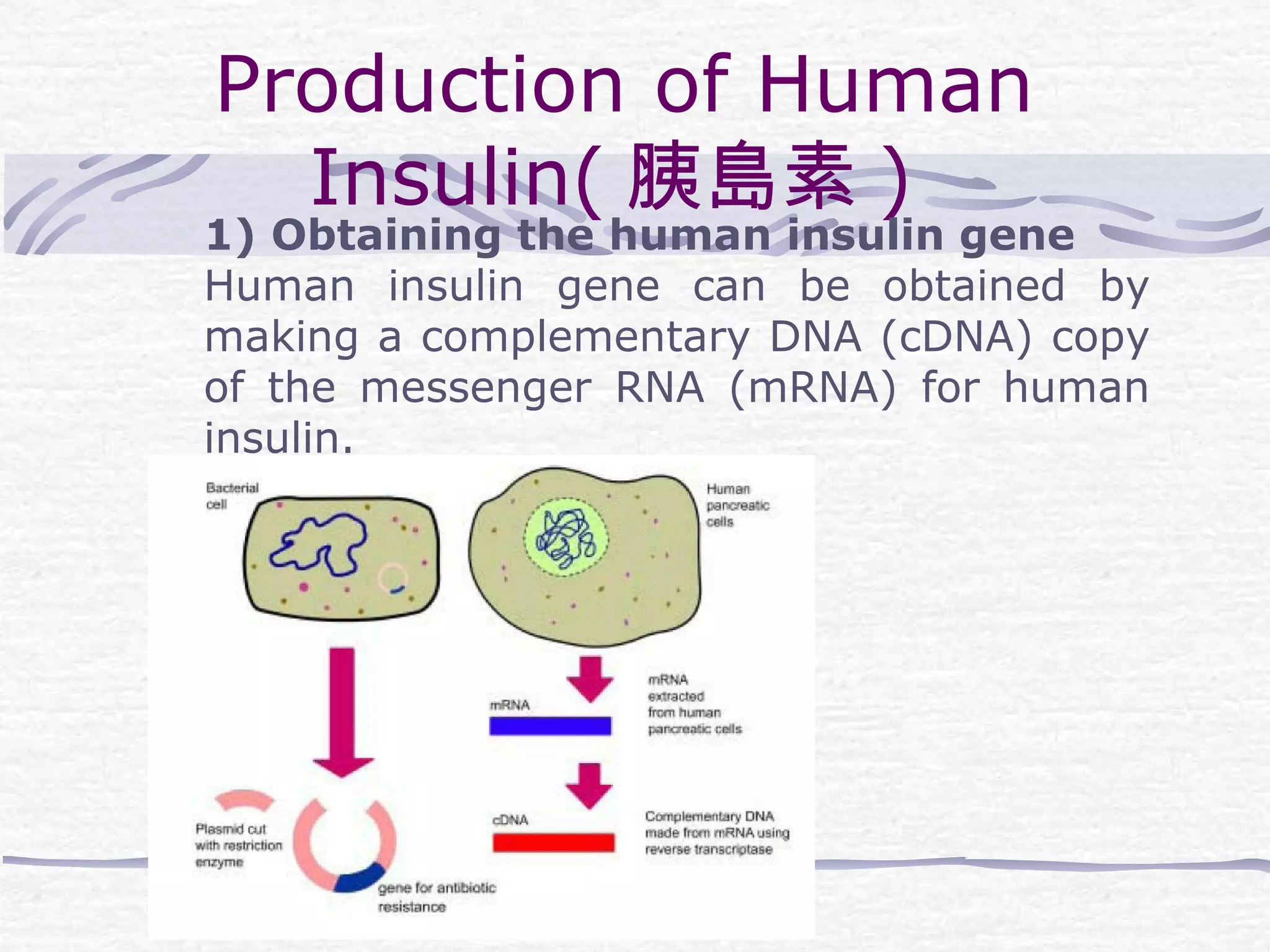
1) Obtaining the human insulin gene
Human insulin gene can be obtained by
making a complementary DNA (cDNA) copy
of the messenger RNA (mRNA) for human
insulin.
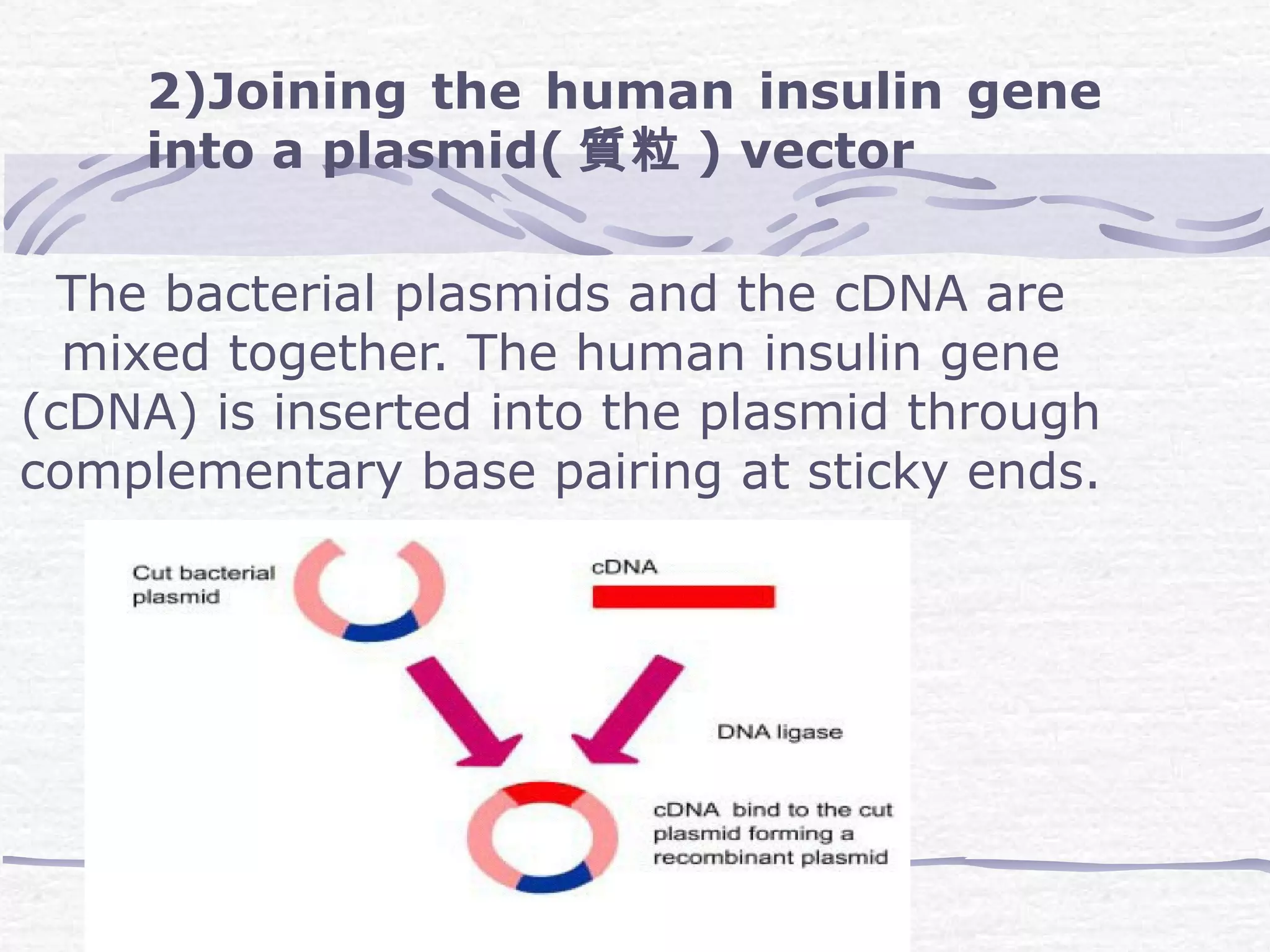
2)Joining the human insulin gene
into a plasmid( 質粒 ) vector
The bacterial plasmids and the cDNA are
mixed together. The human insulin gene
(cDNA) is inserted into the plasmid through
complementary base pairing at sticky ends.
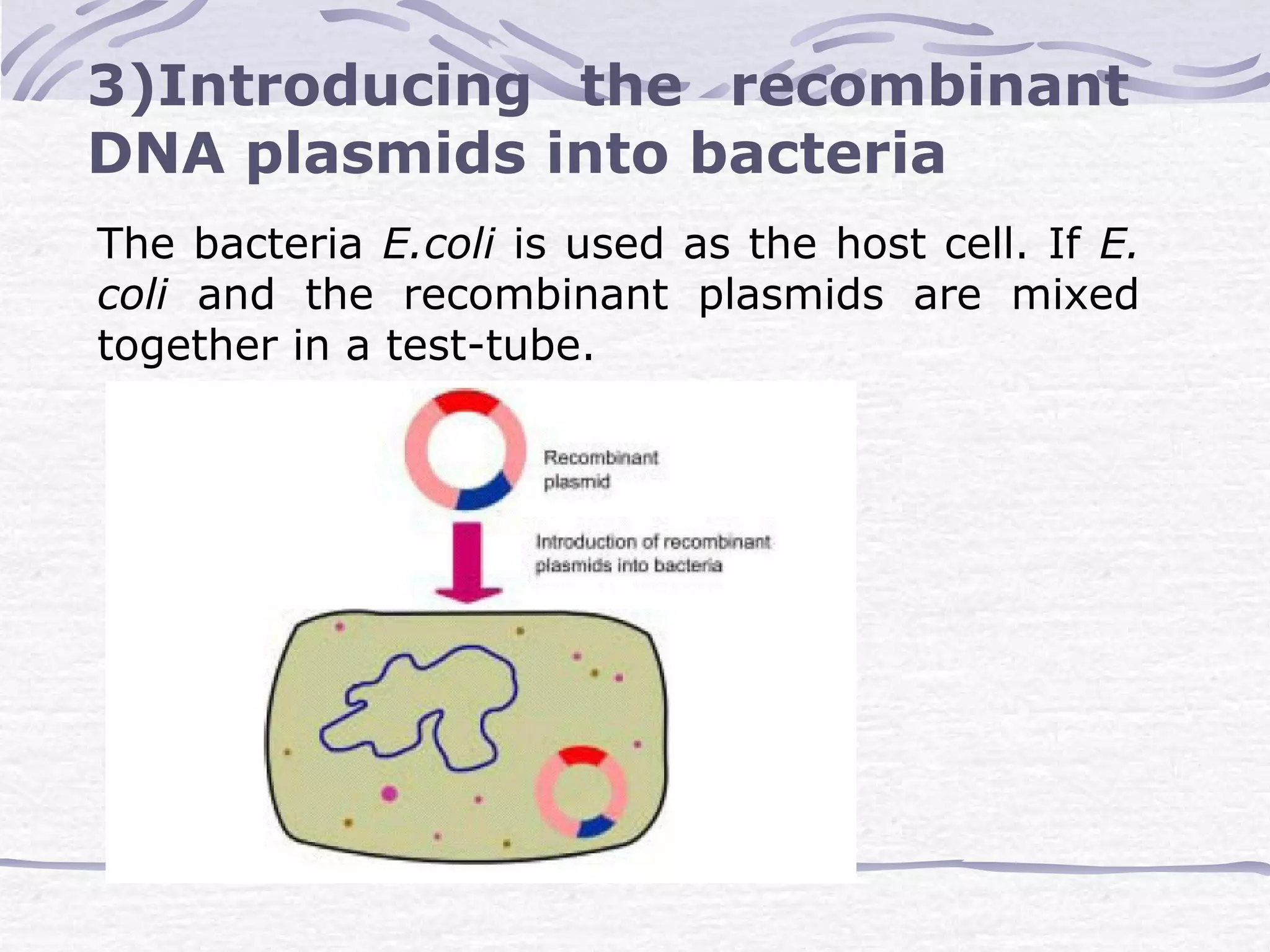
3)Introducing the recombinant
DNA plasmids into bacteria
The bacteria E.coli is used as the host cell. If E.
coli and the recombinant plasmids are mixed
together in a test-tube.
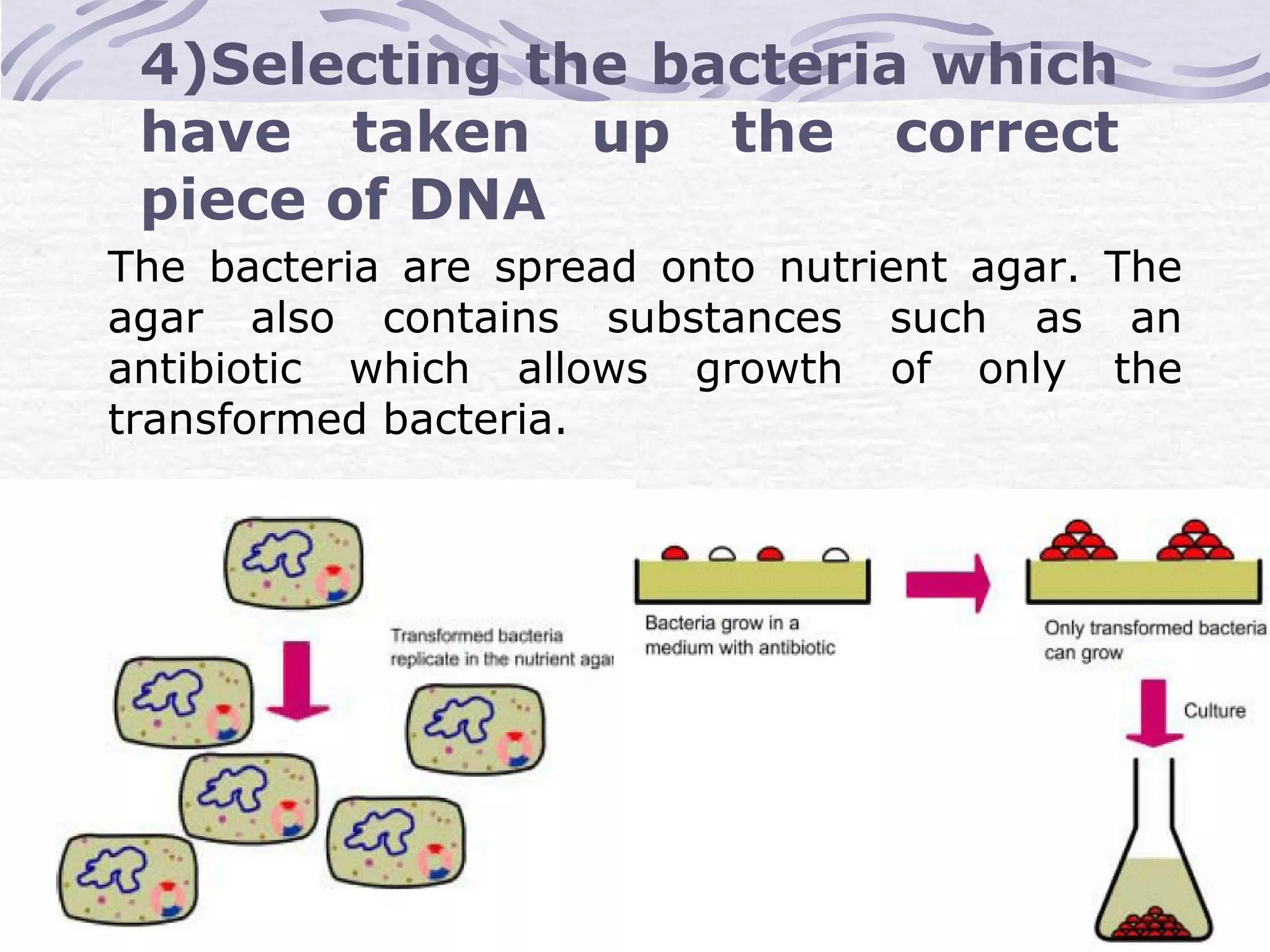
4)Selecting the bacteria which
have taken up the correct
piece of DNA
The bacteria are spread onto nutrient agar. The
agar also contains substances such as an
antibiotic which allows growth of only the
transformed bacteria.
Still in the experimental stages, it may be possible to
transfer the gene for normal adult hemoglobin into
marrow stem cells of an individual with sickle-cell
anemia( 鐮刀形貧血 ). The goal is to promote the
growth of enough cells to produce enough normal
hemoglobin to alleviate the symptoms of sickle-cell
anemia. One hundred percent (100%) is NOT required
to attain the alleviation of symptoms.
Gene therapy for genetic diseases
Safety Issues in relation to
Recombinant DNA Technology
As bacteria is commonly used in recombinant DNA work,
there has always been a concern among scientists and a
worry among people that there is a possibility that a clone
of highly pathogenic recombinant bacteria were made by
accident, then escaped from the laboratory and caused an
epidemic for which no drugs were available.
Recombinant DNA Advisory Committee (RAC) was
established in 1974 in the United States, which
responds to public concerns regarding the safety of
manipulation of genetic material through the use of
recombinant DNA techniques.
2 types of control : physical
containment and biological
containment ( 封鎖 )
Effective biological safety programs were
operated in a variety of laboratories, which
include a set of standard practices generally
used in microbiological laboratories, and
special procedures, equipment and laboratory
installations that provide physical barriers of
varying degrees.
In considering biological containment, the
vector (plasmid, organelle, or virus) for the
recombinant DNA and the host (bacterial,
plant, or animal cell) in which the vector is
propagated in the laboratory will be considered
together.
(i) survival of the vector in its host outside the
laboratory, and (ii) transmission of the vector
from the propagation host to other non-
laboratory hosts.
Biological containment
Dangerous of DNA
recombinant technology
It is always possible that an
antibiotic-resistant plasmid could be
accidentally incorporated into a
dangerous pathogen with serious
medical consequences.
http://www.ied.edu.hk/biotech/eng/classrm/ex

Recombinant DNA Technology

  • 1.
  • 2.
    A series ofprocedures used to recombine DNA segments.. Under certain conditions, a recombinant DNA molecule can enter a cell and replicate. Definition of recombinant DNA technology( 基因重組 )
  • 3.
    History of recombinantDNA technology Recombinant DNA technology is one of the recent advances in biotechnology, which was developed by two scientists named Boyer and Cohen in 1973.
  • 4.
    Basic principle ofrecombinant DNA technology The DNA is inserted into another DNA molecule called ‘vector’( 載體 ) . The recombinant vector is then introduced into a host cell where it replicates itself, the gene is then produced
  • 5.
    Basic principle ofrecombinant DNA technology
  • 6.
    Applications of Recombinant DNA Technology Large-scaleproduction of human proteins by genetically engineered bacteria. Such as : insulin, Growth hormone, Interferons and Blood clotting factors (VIII & IX)
  • 7.
    Production of Human Insulin(胰島素 ) 1) Obtaining the human insulin gene Human insulin gene can be obtained by making a complementary DNA (cDNA) copy of the messenger RNA (mRNA) for human insulin.
  • 8.
    2)Joining the humaninsulin gene into a plasmid( 質粒 ) vector The bacterial plasmids and the cDNA are mixed together. The human insulin gene (cDNA) is inserted into the plasmid through complementary base pairing at sticky ends.
  • 9.
    3)Introducing the recombinant DNAplasmids into bacteria The bacteria E.coli is used as the host cell. If E. coli and the recombinant plasmids are mixed together in a test-tube.
  • 10.
    4)Selecting the bacteriawhich have taken up the correct piece of DNA The bacteria are spread onto nutrient agar. The agar also contains substances such as an antibiotic which allows growth of only the transformed bacteria.
  • 11.
    Still in theexperimental stages, it may be possible to transfer the gene for normal adult hemoglobin into marrow stem cells of an individual with sickle-cell anemia( 鐮刀形貧血 ). The goal is to promote the growth of enough cells to produce enough normal hemoglobin to alleviate the symptoms of sickle-cell anemia. One hundred percent (100%) is NOT required to attain the alleviation of symptoms. Gene therapy for genetic diseases
  • 12.
    Safety Issues inrelation to Recombinant DNA Technology As bacteria is commonly used in recombinant DNA work, there has always been a concern among scientists and a worry among people that there is a possibility that a clone of highly pathogenic recombinant bacteria were made by accident, then escaped from the laboratory and caused an epidemic for which no drugs were available. Recombinant DNA Advisory Committee (RAC) was established in 1974 in the United States, which responds to public concerns regarding the safety of manipulation of genetic material through the use of recombinant DNA techniques.
  • 13.
    2 types ofcontrol : physical containment and biological containment ( 封鎖 ) Effective biological safety programs were operated in a variety of laboratories, which include a set of standard practices generally used in microbiological laboratories, and special procedures, equipment and laboratory installations that provide physical barriers of varying degrees.
  • 14.
    In considering biologicalcontainment, the vector (plasmid, organelle, or virus) for the recombinant DNA and the host (bacterial, plant, or animal cell) in which the vector is propagated in the laboratory will be considered together. (i) survival of the vector in its host outside the laboratory, and (ii) transmission of the vector from the propagation host to other non- laboratory hosts. Biological containment
  • 15.
    Dangerous of DNA recombinanttechnology It is always possible that an antibiotic-resistant plasmid could be accidentally incorporated into a dangerous pathogen with serious medical consequences.
  • 16.