Applications of bioinformatics in evolutionary studies, Molecular clock
hypothesis, Molecular Phylogeny, Molecular evolution and kimuras theory
CONTENTS
• Applications of Bioinformatics in Evolutionary Studies
• Molecular Phylogeny
• Molecular Evolution
• Molecular Clock
• Molecular Clock Hypothesis
• Kimuras Theory
• Phylogenetic Tree
Bioinformatics plays a crucial role in evolutionary studies by
providing tools and techniques to analyze large-scale biological
data, including DNA sequences, genomes, and proteins.
• Phylogenetics: Bioinformatics tools are used to reconstruct
evolutionary relationships among species by analyzing genetic
sequences. Phylogenetic trees help visualize the evolutionary
history and diversification patterns of organisms.
• Comparative genomics: Bioinformatics allows researchers to
compare genomes of different species to identify similarities,
differences, and evolutionary changes. This comparative
analysis provides insights into genome evolution, gene function,
APPLICATIONSOFBIOINFORMATICSIN
EVOLUTIONARYSTUDIES
• Molecular evolution: Bioinformatics tools analyze DNA and protein
sequences to study evolutionary processes, such as mutation rates,
natural selection, gene duplication, and gene loss. These analyses help
understand how molecular sequences evolve over time.
• Population genetics: Bioinformatics methods are employed to study
genetic variation within and between populations. Population genetic
analyses help infer demographic history, migration patterns, and
evolutionary forces shaping genetic diversity.
• Functional genomics: Bioinformatics facilitates the annotation and analysis
of genes and regulatory elements to understand their functions and
evolutionary conservation. Comparative functional genomics identifies
conserved functional elements and evolutionary changes associated with
gene regulation and expression.
• Molecular modeling and simulation: Bioinformatics techniques are used to
model protein structures, predict their functions, and simulate molecular
interactions. These approaches help elucidate the molecular basis of
evolutionary adaptations and protein evolution.
MOLECULARPHYLOGENY
• Molecular phylogeny is a branch of phylogeny.
• It examines genetic, hereditary molecular variations, primarily in DNA sequences,
to learn more about the evolutionary relationships of organisms.
• These investigations allow for the identification of the mechanisms that have led
to species diversity.
• It also involves the comparative analysis of the nucleotide sequences of genes
and the amino acid sequences and structural features of proteins.
• From these analysis evolutionary histories and relationships, and in some cases
also the functions, can be inferred.
• The increasing available completely sequenced
organisms and the importance of evolutionary
processes that affect the species history, have
stressed the interest in studying the molecular
evolution events at the sequence level.
MOLECULAREVOLUTION
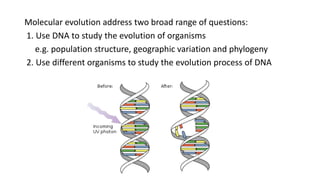
Molecular evolution address two broad range of questions:
1. Use DNA to study the evolution of organisms
e.g. population structure, geographic variation and phylogeny
2. Use different organisms to study the evolution process of DNA
MOLECULARCLOCK
• The molecular clock is a method that uses bio
molecular data (generally mutation rates) to
estimate the amount of time needed for a certain
amount of evolutionary change to occur.
• Since its proposal in the 1960s, the molecular
clock has become an essential tool in many areas
of evolutionary biology, including systematics,
molecular ecology, and conservation genetics.
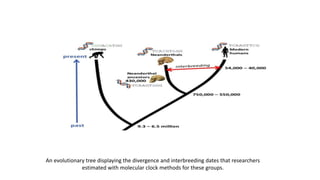
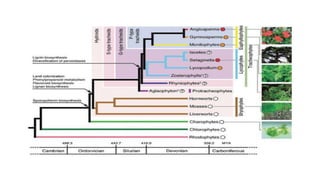
An evolutionary tree displaying the divergence and interbreeding dates that researchers
estimated with molecular clock methods for these groups.
MOLECULARCLOCKHYPOTHESIS
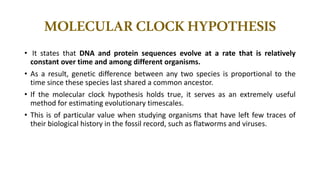
• It states that DNA and protein sequences evolve at a rate that is relatively
constant over time and among different organisms.
• As a result, genetic difference between any two species is proportional to the
time since these species last shared a common ancestor.
• If the molecular clock hypothesis holds true, it serves as an extremely useful
method for estimating evolutionary timescales.
• This is of particular value when studying organisms that have left few traces of
their biological history in the fossil record, such as flatworms and viruses.
MolecularClockHypothesisProposal:
• The molecular clock hypothesis was originally proposed by researchers Emile
Zuckerkandl and Linus Pauling on the basis of empirical observations.
• They noticed that the accumulation of amino acid substitutions in hemoglobin
was constant, like the ticks of a clock.
• This led them to believe that there might be a molecular evolutionary clock that
could describe changes in amino acids over time since the divergence of species.
Emile Zuckerkandl Linus Carl Pauling
Kimura’sNeutralTheoryofMolecularEvolution
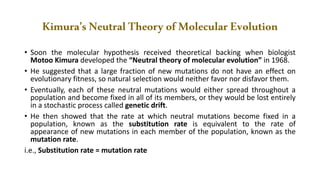
• Soon the molecular hypothesis received theoretical backing when biologist
Motoo Kimura developed the “Neutral theory of molecular evolution” in 1968.
• He suggested that a large fraction of new mutations do not have an effect on
evolutionary fitness, so natural selection would neither favor nor disfavor them.
• Eventually, each of these neutral mutations would either spread throughout a
population and become fixed in all of its members, or they would be lost entirely
in a stochastic process called genetic drift.
• He then showed that the rate at which neutral mutations become fixed in a
population, known as the substitution rate is equivalent to the rate of
appearance of new mutations in each member of the population, known as the
mutation rate.
i.e., Substitution rate = mutation rate
RejectionofKimura’sStrictMolecularClock
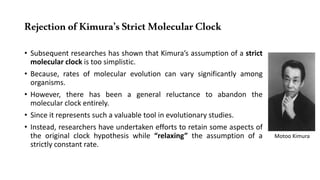
• Subsequent researches has shown that Kimura’s assumption of a strict
molecular clock is too simplistic.
• Because, rates of molecular evolution can vary significantly among
organisms.
• However, there has been a general reluctance to abandon the
molecular clock entirely.
• Since it represents such a valuable tool in evolutionary studies.
• Instead, researchers have undertaken efforts to retain some aspects of
the original clock hypothesis while “relaxing” the assumption of a
strictly constant rate.
Motoo Kimura
ProposalofRelaxedMolecularClock
• Then developed the so-called “relaxed” molecular clocks, which allow the
molecular rate to vary among lineages, though in a limited manner.
• There are currently two major types of relaxed-clock models :
(i) The first type assumes that the rate varies over time and among organisms, but
that this variation occurs around an average value.
(ii) The second type allows the evolutionary rate to “evolve” over time, based on
the assumption that the rate of molecular evolution is tied to other biological
characteristics that also undergo evolution.
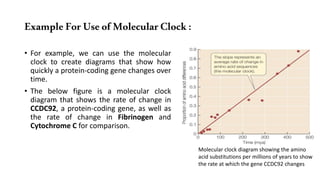
ExampleForUseofMolecularClock:
• For example, we can use the molecular
clock to create diagrams that show how
quickly a protein-coding gene changes over
time.
• The below figure is a molecular clock
diagram that shows the rate of change in
CCDC92, a protein-coding gene, as well as
the rate of change in Fibrinogen and
Cytochrome C for comparison.
Molecular clock diagram showing the amino
acid substitutions per millions of years to show
the rate at which the gene CCDC92 changes
LimitationsofMolecularClock
• It’s important to note that while the molecular clock is a useful tool, it does have
limitations.
• The mutation rate of DNA and proteins may not always be constant, and the
accuracy of the molecular clock depends on the quality of the data used.
PHYLOGENETIC TREE
• A phylogenetic tree is a diagram that represents
evolutionary relationships among organisms.
• They are hypotheses, not definitive facts.
• The pattern of branching in a phylogenetic tree
reflects how species or other groups evolved from a
series of common ancestors.
• They are useful for organizing knowledge of
biological diversity, structuring classifications, and
providing insight into events that occurred during
evolution.
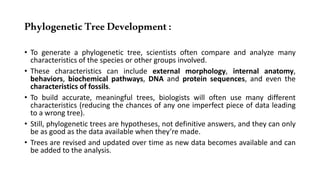
PhylogeneticTreeDevelopment:
• To generate a phylogenetic tree, scientists often compare and analyze many
characteristics of the species or other groups involved.
• These characteristics can include external morphology, internal anatomy,
behaviors, biochemical pathways, DNA and protein sequences, and even the
characteristics of fossils.
• To build accurate, meaningful trees, biologists will often use many different
characteristics (reducing the chances of any one imperfect piece of data leading
to a wrong tree).
• Still, phylogenetic trees are hypotheses, not definitive answers, and they can only
be as good as the data available when they’re made.
• Trees are revised and updated over time as new data becomes available and can
be added to the analysis.
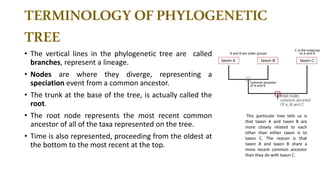
TERMINOLOGYOFPHYLOGENETIC
TREE
• The vertical lines in the phylogenetic tree are called
branches, represent a lineage.
• Nodes are where they diverge, representing a
speciation event from a common ancestor.
• The trunk at the base of the tree, is actually called the
root.
• The root node represents the most recent common
ancestor of all of the taxa represented on the tree.
• Time is also represented, proceeding from the oldest at
the bottom to the most recent at the top.
This particular tree tells us is
that taxon A and taxon B are
more closely related to each
other than either taxon is to
taxon C. The reason is that
taxon A and taxon B share a
more recent common ancestor
than they do with taxon C.
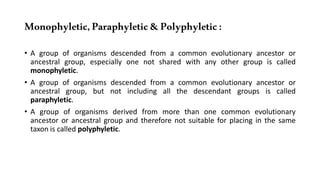
Monophyletic,Paraphyletic&Polyphyletic:
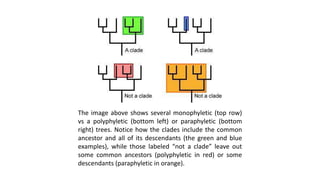
• A group of organisms descended from a common evolutionary ancestor or
ancestral group, especially one not shared with any other group is called
monophyletic.
• A group of organisms descended from a common evolutionary ancestor or
ancestral group, but not including all the descendant groups is called
paraphyletic.
• A group of organisms derived from more than one common evolutionary
ancestor or ancestral group and therefore not suitable for placing in the same
taxon is called polyphyletic.
The image above shows several monophyletic (top row)
vs a polyphyletic (bottom left) or paraphyletic (bottom
right) trees. Notice how the clades include the common
ancestor and all of its descendants (the green and blue
examples), while those labeled “not a clade” leave out
some common ancestors (polyphyletic in red) or some
descendants (paraphyletic in orange).
TypesofPhylogeneticTree :
• There are several different types of phylogenetic trees.
• They can be classified as:
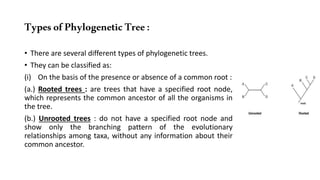
(i) On the basis of the presence or absence of a common root :
(a.) Rooted trees : are trees that have a specified root node,
which represents the common ancestor of all the organisms in
the tree.
(b.) Unrooted trees : do not have a specified root node and
show only the branching pattern of the evolutionary
relationships among taxa, without any information about their
common ancestor.
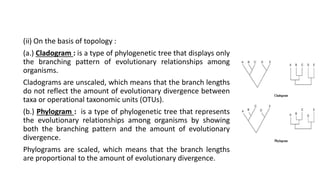
(ii) On the basis of topology :
(a.) Cladogram : is a type of phylogenetic tree that displays only
the branching pattern of evolutionary relationships among
organisms.
Cladograms are unscaled, which means that the branch lengths
do not reflect the amount of evolutionary divergence between
taxa or operational taxonomic units (OTUs).
(b.) Phylogram : is a type of phylogenetic tree that represents
the evolutionary relationships among organisms by showing
both the branching pattern and the amount of evolutionary
divergence.
Phylograms are scaled, which means that the branch lengths
are proportional to the amount of evolutionary divergence.
Applicationsofthephylogenetictree:
• Phylogenetic trees can be used to study the evolutionary relationships between
different species and to understand the evolutionary processes over time.
• Phylogenetic trees can be used to study the diversity and distribution of species
and to develop conservation strategies to protect endangered species and
ecosystems.
• Phylogenetic trees can be used to identify the origins of pathogens and to track
the spread of diseases.
• Phylogenetic trees can also be used in forensics to identify the origins of
biological samples found at crime scenes and to link suspects to crimes.
• Phylogenetic trees are useful for organizing and classifying organisms and species
according to their DNA sequences and morphological similarities and differences.
REFERENCE
• Baum, D. (2008) Reading a Phylogenetic Tree: The Meaning of Monophyletic
Groups. Nature Education 1(1):190.
• Ho, S. (2008) The molecular clock and estimating species divergence. Nature
Education 1(1):168.
• https://bioprinciples.biosci.gatech.edu/module-1-evolution/phylogenetic-trees/
• https://microbenotes.com/phylogenetic-tree/
• https://www.khanacademy.org/science/ap-biology/natural-
selection/phylogeny/a/phylogenetic-trees.
THANK YOU

Molecular phylogeny, molecular clock hypothesis, molecular evolution, kimuras theory.

  • 1.
    Applications of bioinformaticsin evolutionary studies, Molecular clock hypothesis, Molecular Phylogeny, Molecular evolution and kimuras theory
  • 2.
    CONTENTS • Applications ofBioinformatics in Evolutionary Studies • Molecular Phylogeny • Molecular Evolution • Molecular Clock • Molecular Clock Hypothesis • Kimuras Theory • Phylogenetic Tree
  • 3.
    Bioinformatics plays acrucial role in evolutionary studies by providing tools and techniques to analyze large-scale biological data, including DNA sequences, genomes, and proteins. • Phylogenetics: Bioinformatics tools are used to reconstruct evolutionary relationships among species by analyzing genetic sequences. Phylogenetic trees help visualize the evolutionary history and diversification patterns of organisms. • Comparative genomics: Bioinformatics allows researchers to compare genomes of different species to identify similarities, differences, and evolutionary changes. This comparative analysis provides insights into genome evolution, gene function, APPLICATIONSOFBIOINFORMATICSIN EVOLUTIONARYSTUDIES
  • 4.
    • Molecular evolution:Bioinformatics tools analyze DNA and protein sequences to study evolutionary processes, such as mutation rates, natural selection, gene duplication, and gene loss. These analyses help understand how molecular sequences evolve over time. • Population genetics: Bioinformatics methods are employed to study genetic variation within and between populations. Population genetic analyses help infer demographic history, migration patterns, and evolutionary forces shaping genetic diversity. • Functional genomics: Bioinformatics facilitates the annotation and analysis of genes and regulatory elements to understand their functions and evolutionary conservation. Comparative functional genomics identifies conserved functional elements and evolutionary changes associated with gene regulation and expression. • Molecular modeling and simulation: Bioinformatics techniques are used to model protein structures, predict their functions, and simulate molecular interactions. These approaches help elucidate the molecular basis of evolutionary adaptations and protein evolution.
  • 5.
    MOLECULARPHYLOGENY • Molecular phylogenyis a branch of phylogeny. • It examines genetic, hereditary molecular variations, primarily in DNA sequences, to learn more about the evolutionary relationships of organisms. • These investigations allow for the identification of the mechanisms that have led to species diversity. • It also involves the comparative analysis of the nucleotide sequences of genes and the amino acid sequences and structural features of proteins. • From these analysis evolutionary histories and relationships, and in some cases also the functions, can be inferred.
  • 6.
    • The increasingavailable completely sequenced organisms and the importance of evolutionary processes that affect the species history, have stressed the interest in studying the molecular evolution events at the sequence level. MOLECULAREVOLUTION
  • 7.
    Molecular evolution addresstwo broad range of questions: 1. Use DNA to study the evolution of organisms e.g. population structure, geographic variation and phylogeny 2. Use different organisms to study the evolution process of DNA
  • 12.
    MOLECULARCLOCK • The molecularclock is a method that uses bio molecular data (generally mutation rates) to estimate the amount of time needed for a certain amount of evolutionary change to occur. • Since its proposal in the 1960s, the molecular clock has become an essential tool in many areas of evolutionary biology, including systematics, molecular ecology, and conservation genetics.
  • 13.
    An evolutionary treedisplaying the divergence and interbreeding dates that researchers estimated with molecular clock methods for these groups.
  • 14.
    MOLECULARCLOCKHYPOTHESIS • It statesthat DNA and protein sequences evolve at a rate that is relatively constant over time and among different organisms. • As a result, genetic difference between any two species is proportional to the time since these species last shared a common ancestor. • If the molecular clock hypothesis holds true, it serves as an extremely useful method for estimating evolutionary timescales. • This is of particular value when studying organisms that have left few traces of their biological history in the fossil record, such as flatworms and viruses.
  • 15.
    MolecularClockHypothesisProposal: • The molecularclock hypothesis was originally proposed by researchers Emile Zuckerkandl and Linus Pauling on the basis of empirical observations. • They noticed that the accumulation of amino acid substitutions in hemoglobin was constant, like the ticks of a clock. • This led them to believe that there might be a molecular evolutionary clock that could describe changes in amino acids over time since the divergence of species. Emile Zuckerkandl Linus Carl Pauling
  • 16.
    Kimura’sNeutralTheoryofMolecularEvolution • Soon themolecular hypothesis received theoretical backing when biologist Motoo Kimura developed the “Neutral theory of molecular evolution” in 1968. • He suggested that a large fraction of new mutations do not have an effect on evolutionary fitness, so natural selection would neither favor nor disfavor them. • Eventually, each of these neutral mutations would either spread throughout a population and become fixed in all of its members, or they would be lost entirely in a stochastic process called genetic drift. • He then showed that the rate at which neutral mutations become fixed in a population, known as the substitution rate is equivalent to the rate of appearance of new mutations in each member of the population, known as the mutation rate. i.e., Substitution rate = mutation rate
  • 17.
    RejectionofKimura’sStrictMolecularClock • Subsequent researcheshas shown that Kimura’s assumption of a strict molecular clock is too simplistic. • Because, rates of molecular evolution can vary significantly among organisms. • However, there has been a general reluctance to abandon the molecular clock entirely. • Since it represents such a valuable tool in evolutionary studies. • Instead, researchers have undertaken efforts to retain some aspects of the original clock hypothesis while “relaxing” the assumption of a strictly constant rate. Motoo Kimura
  • 18.
    ProposalofRelaxedMolecularClock • Then developedthe so-called “relaxed” molecular clocks, which allow the molecular rate to vary among lineages, though in a limited manner. • There are currently two major types of relaxed-clock models : (i) The first type assumes that the rate varies over time and among organisms, but that this variation occurs around an average value. (ii) The second type allows the evolutionary rate to “evolve” over time, based on the assumption that the rate of molecular evolution is tied to other biological characteristics that also undergo evolution.
  • 19.
    ExampleForUseofMolecularClock: • For example,we can use the molecular clock to create diagrams that show how quickly a protein-coding gene changes over time. • The below figure is a molecular clock diagram that shows the rate of change in CCDC92, a protein-coding gene, as well as the rate of change in Fibrinogen and Cytochrome C for comparison. Molecular clock diagram showing the amino acid substitutions per millions of years to show the rate at which the gene CCDC92 changes
  • 20.
    LimitationsofMolecularClock • It’s importantto note that while the molecular clock is a useful tool, it does have limitations. • The mutation rate of DNA and proteins may not always be constant, and the accuracy of the molecular clock depends on the quality of the data used.
  • 21.
    PHYLOGENETIC TREE • Aphylogenetic tree is a diagram that represents evolutionary relationships among organisms. • They are hypotheses, not definitive facts. • The pattern of branching in a phylogenetic tree reflects how species or other groups evolved from a series of common ancestors. • They are useful for organizing knowledge of biological diversity, structuring classifications, and providing insight into events that occurred during evolution.
  • 23.
    PhylogeneticTreeDevelopment: • To generatea phylogenetic tree, scientists often compare and analyze many characteristics of the species or other groups involved. • These characteristics can include external morphology, internal anatomy, behaviors, biochemical pathways, DNA and protein sequences, and even the characteristics of fossils. • To build accurate, meaningful trees, biologists will often use many different characteristics (reducing the chances of any one imperfect piece of data leading to a wrong tree). • Still, phylogenetic trees are hypotheses, not definitive answers, and they can only be as good as the data available when they’re made. • Trees are revised and updated over time as new data becomes available and can be added to the analysis.
  • 24.
    TERMINOLOGYOFPHYLOGENETIC TREE • The verticallines in the phylogenetic tree are called branches, represent a lineage. • Nodes are where they diverge, representing a speciation event from a common ancestor. • The trunk at the base of the tree, is actually called the root. • The root node represents the most recent common ancestor of all of the taxa represented on the tree. • Time is also represented, proceeding from the oldest at the bottom to the most recent at the top. This particular tree tells us is that taxon A and taxon B are more closely related to each other than either taxon is to taxon C. The reason is that taxon A and taxon B share a more recent common ancestor than they do with taxon C.
  • 25.
    Monophyletic,Paraphyletic&Polyphyletic: • A groupof organisms descended from a common evolutionary ancestor or ancestral group, especially one not shared with any other group is called monophyletic. • A group of organisms descended from a common evolutionary ancestor or ancestral group, but not including all the descendant groups is called paraphyletic. • A group of organisms derived from more than one common evolutionary ancestor or ancestral group and therefore not suitable for placing in the same taxon is called polyphyletic.
  • 26.
    The image aboveshows several monophyletic (top row) vs a polyphyletic (bottom left) or paraphyletic (bottom right) trees. Notice how the clades include the common ancestor and all of its descendants (the green and blue examples), while those labeled “not a clade” leave out some common ancestors (polyphyletic in red) or some descendants (paraphyletic in orange).
  • 27.
    TypesofPhylogeneticTree : • Thereare several different types of phylogenetic trees. • They can be classified as: (i) On the basis of the presence or absence of a common root : (a.) Rooted trees : are trees that have a specified root node, which represents the common ancestor of all the organisms in the tree. (b.) Unrooted trees : do not have a specified root node and show only the branching pattern of the evolutionary relationships among taxa, without any information about their common ancestor.
  • 28.
    (ii) On thebasis of topology : (a.) Cladogram : is a type of phylogenetic tree that displays only the branching pattern of evolutionary relationships among organisms. Cladograms are unscaled, which means that the branch lengths do not reflect the amount of evolutionary divergence between taxa or operational taxonomic units (OTUs). (b.) Phylogram : is a type of phylogenetic tree that represents the evolutionary relationships among organisms by showing both the branching pattern and the amount of evolutionary divergence. Phylograms are scaled, which means that the branch lengths are proportional to the amount of evolutionary divergence.
  • 29.
    Applicationsofthephylogenetictree: • Phylogenetic treescan be used to study the evolutionary relationships between different species and to understand the evolutionary processes over time. • Phylogenetic trees can be used to study the diversity and distribution of species and to develop conservation strategies to protect endangered species and ecosystems. • Phylogenetic trees can be used to identify the origins of pathogens and to track the spread of diseases. • Phylogenetic trees can also be used in forensics to identify the origins of biological samples found at crime scenes and to link suspects to crimes. • Phylogenetic trees are useful for organizing and classifying organisms and species according to their DNA sequences and morphological similarities and differences.
  • 30.
    REFERENCE • Baum, D.(2008) Reading a Phylogenetic Tree: The Meaning of Monophyletic Groups. Nature Education 1(1):190. • Ho, S. (2008) The molecular clock and estimating species divergence. Nature Education 1(1):168. • https://bioprinciples.biosci.gatech.edu/module-1-evolution/phylogenetic-trees/ • https://microbenotes.com/phylogenetic-tree/ • https://www.khanacademy.org/science/ap-biology/natural- selection/phylogeny/a/phylogenetic-trees.
  • 31.