RECOMBINANT DNA TECHNOLOGY
LEC 1
SYED MUHAMMAD HASSAN ASKRI
A series of procedures used to recombine
DNA segments. Under certain conditions,
a recombinant DNA molecule can enter a
cell and replicate.
Recombinant DNA technology is one of the
recent advances in biotechnology, which was
developed by two scientists named Boyer and
Cohen in 1973.
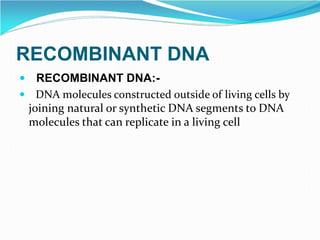
RECOMBINANT DNA
 RECOMBINANT DNA:-
 DNA molecules constructed outside of living cells by
joining natural or synthetic DNA segments to DNA
molecules that can replicate in a living cell
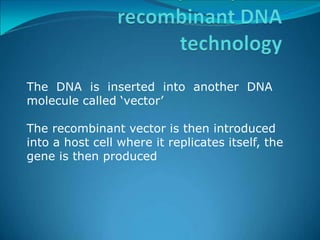
The DNA is inserted into another DNA
molecule called ‘vector’
The recombinant vector is then introduced
into a host cell where it replicates itself, the
gene is then produced
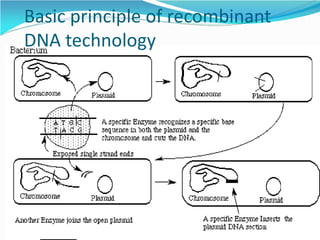
Basic principle of recombinant
DNA technology
How is Recombinant DNA
made?
There are three different methods by
which Recombinant DNA is made.
They are Transformation, Phage
Introduction, and
Transformation.
Non-Bacterial
Transformation
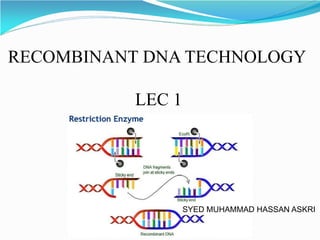
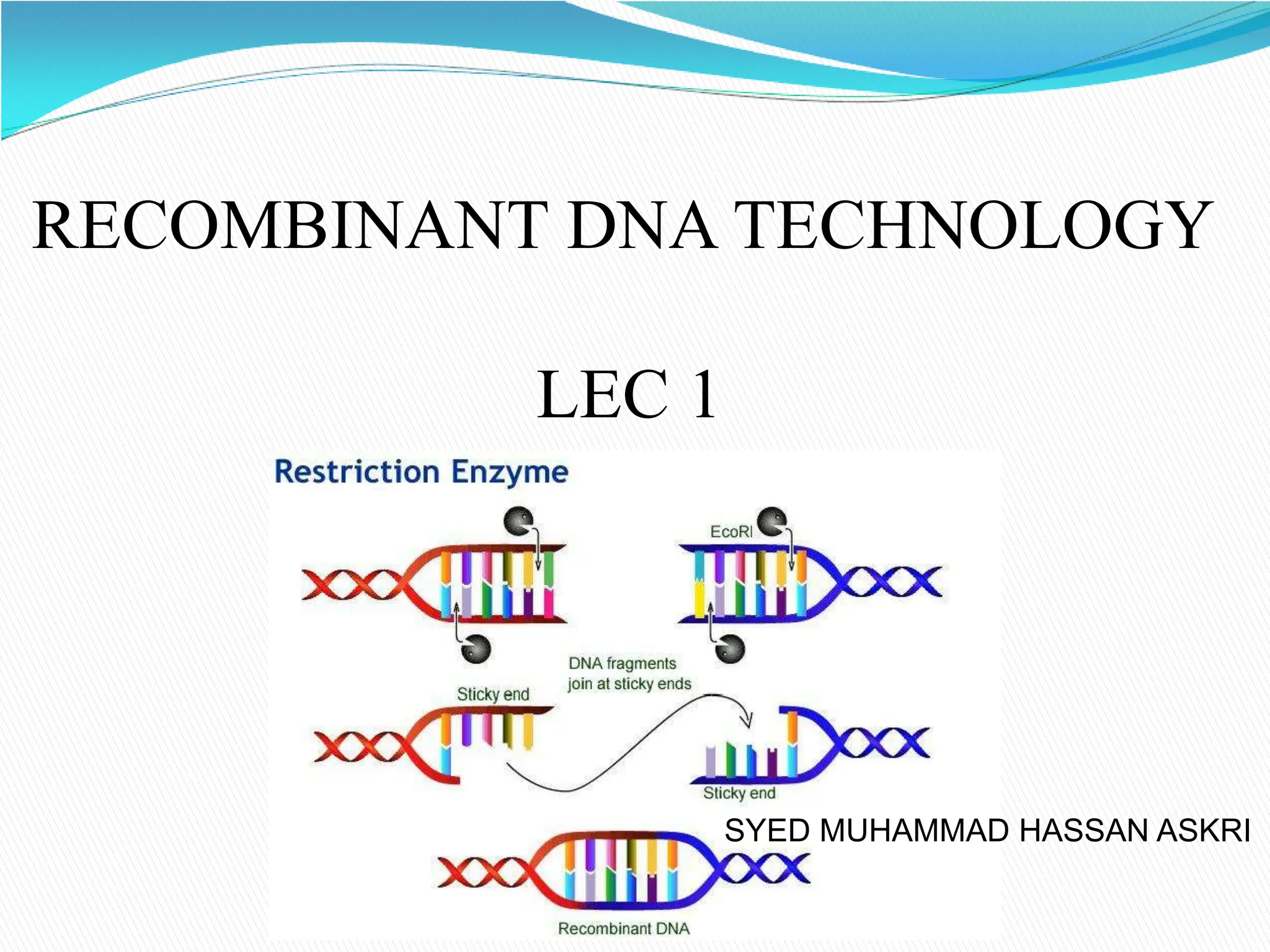
The first step in transformation is to select a piece of
DNA to be inserted into a vector. The second step is to
cut that piece of DNA with a restriction enzyme and then
ligate the DNA insert into the vector with DNA Ligase.
The insert contains a selectable marker which allows for
identification of recombinant molecules. The vector is
inserted into a host cell, in a process called
transformation. One example of a possible host cell is E.
coli. The host cells must be specially prepared to take up
the foreign DNA.
Non-Bacterial transformation
Microinjection, the DNA is injected
directly into the nucleus of the cell being
transformed. The host cells are bombarded
with high velocity micro-projectiles, such
as particles of gold or tungsten that have
been coated with DNA.
Phage Introduction
Phage introduction is the process of transfection,
which is equivalent to transformation,
except a phage is used instead of bacteria. In vitro
packaging of a vector is used. This uses lambda or
MI3 phages to produce phage plaques which
contain recombinants. The recombinants that are
created can be identified by differences in the
recombinants and non-recombinants using various
selection methods.
How does rDNA work?
Recombinant DNA works when the host cell expresses
protein from the recombinant genes. A significant
amount of recombinant protein will not be produced
by the host unless expression factors are added.
Protein expression depends upon the gene being
surrounded by a collection of signals which provide
instructions for the transcription and translation of the
gene by the cell. These signals include the promoter,
the ribosome binding site, and the terminator.
Expression vectors, in which the foreign DNA is
inserted, contain these signals. Signals are species
specific. In the case of E. coli, these signals must be E.
coli signals as E. coli is unlikely to understand the
signals of human promoters and terminators.
Problems are encountered if the gene contains introns
or contains signals which act as terminators to a
bacterial host. This results in premature termination,
and the recombinant protein may not be processed
correctly, be folded correctly, or may even be
degraded.
Production of recombinant proteins in
eukaryotic systems generally takes place in
yeast and filamentous fungi. The uses of
animal cells is difficult due to the fact that
many need a solid support surface, unlike
bacteria, and have complex growth needs.
However, some proteins are too complex
to be produced in bacterium, so eukaryotic
cells must be used.
Large-scale production of human proteins
by genetically engineered bacteria.
Such as : insulin, Growth hormone,
Interferons and
Blood clotting factors (VIII & IX)
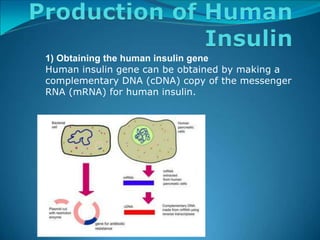
1) Obtaining the human insulin gene
Human insulin gene can be obtained by making a
complementary DNA (cDNA) copy of the messenger
RNA (mRNA) for human insulin.
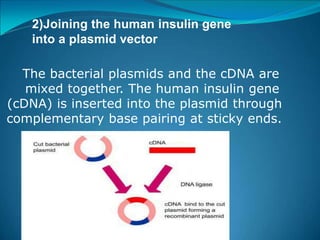
2)Joining the human insulin gene
into a plasmid vector
The bacterial plasmids and the cDNA are
mixed together. The human insulin gene
(cDNA) is inserted into the plasmid through
complementary base pairing at sticky ends.
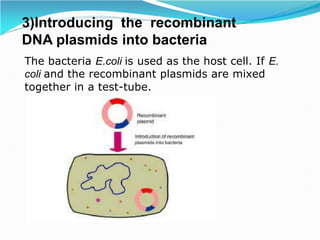
3)Introducing the recombinant
DNA plasmids into bacteria
The bacteria E.coli is used as the host cell. If E.
coli and the recombinant plasmids are mixed
together in a test-tube.
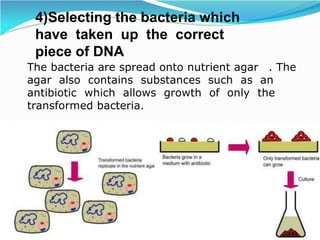
4)Selecting the bacteria which
have taken up the correct
piece of DNA
The bacteria are spread onto nutrient agar . The
agar also contains substances such as an
antibiotic which allows growth of only the
transformed bacteria.
Vaccine development
The surface antigen of
falciparum, one of the 4 species of malaria,
has been transferred to E. coli to produce
amounts large enough to develop a vaccine
against this form of malaria. It works well
enough for people who will visit a
malarious region for a relatively short
period of time.
Plasmodium
Hemophilia A and B
The genes encoding factors 8 and 9 are on the X
chromosome.
Like other X-linked disorders, hemophilia A and B are found
almost exclusively in males because they inherit just a
single X chromosome, and if the gene for factor 8 (or 9) on
it is defective, they will suffer from the disease.
There are many different mutant versions of the genes for
factors 8 and 9. Although some produce only a minor effect
on the function of their protein, others fail to produce any
functioning clotting factor.
Transferring the gene for normal adult
hemoglobin into marrow stem cells of an
individual with sickle-cell anemia. The goal
is to promote the growth of enough cells to
produce enough normal hemoglobin to
alleviate the symptoms of sickle-cell anemia.
Gene therapy for genetic diseases
Safety Issues in relation to Recombinant
DNA Technology
As bacteria is commonly used in recombinant DNA work,
there has always been a concern among scientists and a
worry among people that there is a possibility that a clone
of highly pathogenic recombinant bacteria were made by
accident, then escaped from the laboratory and caused an
epidemic for which no drugs were available.
Recombinant DNA Advisory Committee (RAC) was
established in 1974 in the United States, which
responds to public concerns regarding the safety of
manipulation of genetic material through the use of
recombinant DNA techniques.
2 types of control : physical
containment
containment
and biological
Effective biological safety programs were
operated in a variety of laboratories, which
include a set of standard practices generally
used in microbiological laboratories, and
special procedures, equipment and laboratory
installations that provide physical barriers of
varying degrees.
In considering biological containment, the
vector (plasmid, organelle, or virus) for the
recombinant DNA and the host (bacterial,
plant, or animal cell) in which the vector is
propagated in the laboratory will be considered
together
.
(i) survival of the vector in its host outside the
laboratory, and (ii) transmission of the vector
from the propagation host to other non-
laboratory hosts.
Biological containment
It is always possible that an antibiotic-resistant
plasmid could be accidentally incorporated into
a dangerous pathogen with serious medical
consequences.
 Within living cells, the exchange of DNA sequences and
genetic information can occur through a regulated series
enzymatic reactions involving pairing of DNA molecules
and phosphodiester bond breakage and rejoining. This
type of sequence rearrangement is known as genetic
recombination. genetic recombination responsible for
rearranging sequences between different pieces of DNA,
shaping the genome by altering the sequences that are
present, pairing chromosome before cell division and
promoting DNA repair.
DNA Recombination
 Roles
 Types
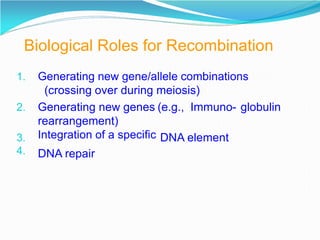
Biological Roles for Recombination
1. Generating new gene/allele combinations
(crossing over during meiosis)
2. Generating new genes (e.g., Immuno- globulin
rearrangement)
Integration of a specific
3.
4.
DNA element
DNA repair
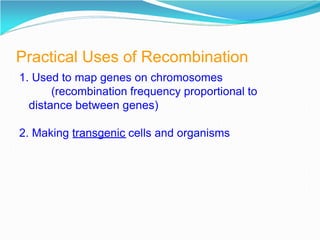
Practical Uses of Recombination
1. Used to map genes on chromosomes
(recombination frequency proportional to
distance between genes)
2. Making transgenic cells and organisms
THAN

LECTURE 4 Recombinant DNA Technology lec# 1.pptx

  • 1.
    RECOMBINANT DNA TECHNOLOGY LEC1 SYED MUHAMMAD HASSAN ASKRI
  • 2.
    A series ofprocedures used to recombine DNA segments. Under certain conditions, a recombinant DNA molecule can enter a cell and replicate.
  • 3.
    Recombinant DNA technologyis one of the recent advances in biotechnology, which was developed by two scientists named Boyer and Cohen in 1973.
  • 4.
    RECOMBINANT DNA  RECOMBINANTDNA:-  DNA molecules constructed outside of living cells by joining natural or synthetic DNA segments to DNA molecules that can replicate in a living cell
  • 5.
    The DNA isinserted into another DNA molecule called ‘vector’ The recombinant vector is then introduced into a host cell where it replicates itself, the gene is then produced
  • 6.
    Basic principle ofrecombinant DNA technology
  • 7.
    How is RecombinantDNA made? There are three different methods by which Recombinant DNA is made. They are Transformation, Phage Introduction, and Transformation. Non-Bacterial
  • 8.
    Transformation The first stepin transformation is to select a piece of DNA to be inserted into a vector. The second step is to cut that piece of DNA with a restriction enzyme and then ligate the DNA insert into the vector with DNA Ligase. The insert contains a selectable marker which allows for identification of recombinant molecules. The vector is inserted into a host cell, in a process called transformation. One example of a possible host cell is E. coli. The host cells must be specially prepared to take up the foreign DNA.
  • 9.
    Non-Bacterial transformation Microinjection, theDNA is injected directly into the nucleus of the cell being transformed. The host cells are bombarded with high velocity micro-projectiles, such as particles of gold or tungsten that have been coated with DNA.
  • 10.
    Phage Introduction Phage introductionis the process of transfection, which is equivalent to transformation, except a phage is used instead of bacteria. In vitro packaging of a vector is used. This uses lambda or MI3 phages to produce phage plaques which contain recombinants. The recombinants that are created can be identified by differences in the recombinants and non-recombinants using various selection methods.
  • 11.
    How does rDNAwork? Recombinant DNA works when the host cell expresses protein from the recombinant genes. A significant amount of recombinant protein will not be produced by the host unless expression factors are added. Protein expression depends upon the gene being surrounded by a collection of signals which provide instructions for the transcription and translation of the gene by the cell. These signals include the promoter, the ribosome binding site, and the terminator.
  • 12.
    Expression vectors, inwhich the foreign DNA is inserted, contain these signals. Signals are species specific. In the case of E. coli, these signals must be E. coli signals as E. coli is unlikely to understand the signals of human promoters and terminators. Problems are encountered if the gene contains introns or contains signals which act as terminators to a bacterial host. This results in premature termination, and the recombinant protein may not be processed correctly, be folded correctly, or may even be degraded.
  • 13.
    Production of recombinantproteins in eukaryotic systems generally takes place in yeast and filamentous fungi. The uses of animal cells is difficult due to the fact that many need a solid support surface, unlike bacteria, and have complex growth needs. However, some proteins are too complex to be produced in bacterium, so eukaryotic cells must be used.
  • 14.
    Large-scale production ofhuman proteins by genetically engineered bacteria. Such as : insulin, Growth hormone, Interferons and Blood clotting factors (VIII & IX)
  • 15.
    1) Obtaining thehuman insulin gene Human insulin gene can be obtained by making a complementary DNA (cDNA) copy of the messenger RNA (mRNA) for human insulin.
  • 16.
    2)Joining the humaninsulin gene into a plasmid vector The bacterial plasmids and the cDNA are mixed together. The human insulin gene (cDNA) is inserted into the plasmid through complementary base pairing at sticky ends.
  • 17.
    3)Introducing the recombinant DNAplasmids into bacteria The bacteria E.coli is used as the host cell. If E. coli and the recombinant plasmids are mixed together in a test-tube.
  • 18.
    4)Selecting the bacteriawhich have taken up the correct piece of DNA The bacteria are spread onto nutrient agar . The agar also contains substances such as an antibiotic which allows growth of only the transformed bacteria.
  • 19.
    Vaccine development The surfaceantigen of falciparum, one of the 4 species of malaria, has been transferred to E. coli to produce amounts large enough to develop a vaccine against this form of malaria. It works well enough for people who will visit a malarious region for a relatively short period of time. Plasmodium
  • 20.
    Hemophilia A andB The genes encoding factors 8 and 9 are on the X chromosome. Like other X-linked disorders, hemophilia A and B are found almost exclusively in males because they inherit just a single X chromosome, and if the gene for factor 8 (or 9) on it is defective, they will suffer from the disease. There are many different mutant versions of the genes for factors 8 and 9. Although some produce only a minor effect on the function of their protein, others fail to produce any functioning clotting factor.
  • 21.
    Transferring the genefor normal adult hemoglobin into marrow stem cells of an individual with sickle-cell anemia. The goal is to promote the growth of enough cells to produce enough normal hemoglobin to alleviate the symptoms of sickle-cell anemia. Gene therapy for genetic diseases
  • 22.
    Safety Issues inrelation to Recombinant DNA Technology As bacteria is commonly used in recombinant DNA work, there has always been a concern among scientists and a worry among people that there is a possibility that a clone of highly pathogenic recombinant bacteria were made by accident, then escaped from the laboratory and caused an epidemic for which no drugs were available. Recombinant DNA Advisory Committee (RAC) was established in 1974 in the United States, which responds to public concerns regarding the safety of manipulation of genetic material through the use of recombinant DNA techniques.
  • 23.
    2 types ofcontrol : physical containment containment and biological Effective biological safety programs were operated in a variety of laboratories, which include a set of standard practices generally used in microbiological laboratories, and special procedures, equipment and laboratory installations that provide physical barriers of varying degrees.
  • 24.
    In considering biologicalcontainment, the vector (plasmid, organelle, or virus) for the recombinant DNA and the host (bacterial, plant, or animal cell) in which the vector is propagated in the laboratory will be considered together . (i) survival of the vector in its host outside the laboratory, and (ii) transmission of the vector from the propagation host to other non- laboratory hosts. Biological containment
  • 25.
    It is alwayspossible that an antibiotic-resistant plasmid could be accidentally incorporated into a dangerous pathogen with serious medical consequences.
  • 26.
     Within livingcells, the exchange of DNA sequences and genetic information can occur through a regulated series enzymatic reactions involving pairing of DNA molecules and phosphodiester bond breakage and rejoining. This type of sequence rearrangement is known as genetic recombination. genetic recombination responsible for rearranging sequences between different pieces of DNA, shaping the genome by altering the sequences that are present, pairing chromosome before cell division and promoting DNA repair.
  • 27.
  • 28.
    Biological Roles forRecombination 1. Generating new gene/allele combinations (crossing over during meiosis) 2. Generating new genes (e.g., Immuno- globulin rearrangement) Integration of a specific 3. 4. DNA element DNA repair
  • 29.
    Practical Uses ofRecombination 1. Used to map genes on chromosomes (recombination frequency proportional to distance between genes) 2. Making transgenic cells and organisms
  • 30.