RECOMBINANT DNA
TECHNOLOGY –PART 1
Central dogma of molecular biology
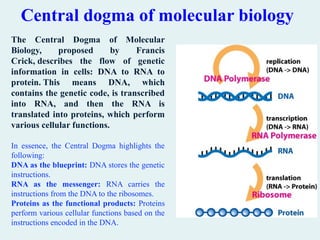
The Central Dogma of Molecular
Biology, proposed by Francis
Crick, describes the flow of genetic
information in cells: DNA to RNA to
protein. This means DNA, which
contains the genetic code, is transcribed
into RNA, and then the RNA is
translated into proteins, which perform
various cellular functions.
In essence, the Central Dogma highlights the
following:
DNA as the blueprint: DNA stores the genetic
instructions.
RNA as the messenger: RNA carries the
instructions from the DNA to the ribosomes.
Proteins as the functional products: Proteins
perform various cellular functions based on the
instructions encoded in the DNA.
History of Genetic Engineering/
Recombinant DNA Technology
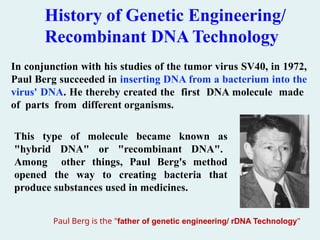
In conjunction with his studies of the tumor virus SV40, in 1972,
Paul Berg succeeded in inserting DNA from a bacterium into the
virus' DNA. He thereby created the first DNA molecule made
of parts from different organisms.
Paul Berg is the "father of genetic engineering/ rDNA Technology"
This type of molecule became known as
"hybrid DNA" or "recombinant DNA".
Among other things, Paul Berg's method
opened the way to creating bacteria that
produce substances used in medicines.
History of Recombinant
DNA Technology
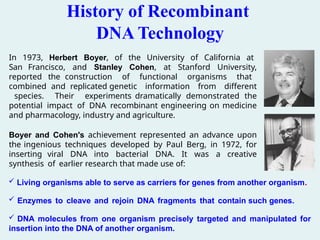
In 1973, Herbert Boyer, of the University of California at
San Francisco, and Stanley Cohen, at Stanford University,
reported the construction of functional organisms that
combined and replicated genetic information from different
species. Their experiments dramatically demonstrated the
potential impact of DNA recombinant engineering on medicine
and pharmacology, industry and agriculture.
Boyer and Cohen's achievement represented an advance upon
the ingenious techniques developed by Paul Berg, in 1972, for
inserting viral DNA into bacterial DNA. It was a creative
synthesis of earlier research that made use of:
 Living organisms able to serve as carriers for genes from another organism.
 Enzymes to cleave and rejoin DNA fragments that contain such genes.
 DNA molecules from one organism precisely targeted and manipulated for
insertion into the DNA of another organism.
Recombinant DNA and
Gene Cloning
 Recombinant DNA (rDNA) is a form of artificial
DNA that is created by combining two or more
sequences that would not normally occur together
through the process of gene splicing.
 Recombinant DNA technology is a technology
which allows DNA to be produced via artificial
means. The procedure has been used to change
DNA in living organisms and may have even more
practical uses in the future.
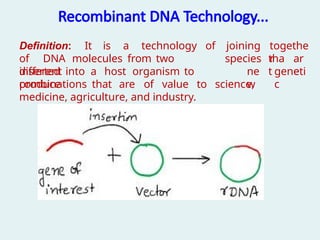
Recombinant DNA Technology...
togethe
r
Definition: It is a technology of
of DNA molecules from two
different
joining
species tha
t
ar
e
inserted into a host organism to
produce
ne
w
geneti
c
combinations that are of value to science,
medicine, agriculture, and industry.
Recombinant DNA:
Cloning and Creation of Chimeric Genes
What is Recombinant DNA Technology?
 Recombinant DNA technology is a
technology which allows DNA to
be produced via artificial means.
 The procedure has been used to change
DNA in living organisms and may have
even more practical uses in the future.
 It is an area of medical science that is just
beginning to be researched in a
concerted effort.
 Recombinant DNA technology works by
taking DNA from two different sources and
combining that DNA into a single molecule.
That alone, however, will not do much.
 Recombinant DNA technology only
becomes useful when that artificially-
created DNA is reproduced. This is known
as DNA cloning.
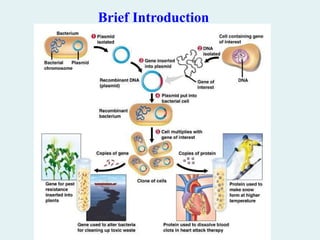
Brief Introduction
Recombinant DNA Technology
1. The basic concepts for recombinant
DNA technology
2. The basic procedures of recombinant
DNA technology
3. Application of recombinant DNA
technology
The basic concepts for
recombinant DNA technology
 In the early 1970s, technologies for the
laboratory manipulation of nucleic acids
emerged. In turn, these technologies led
to the construction of DNA molecules
composed of nucleotide sequences taken
from different sources. The products of
these innovations, recombinant DNA
molecules, opened exciting new avenues
of investigation in molecular biology and
genetics, and a new field was born—
recombinant DNA technology.
Concept of Recombinant DNA
 Recombinant DNA is a molecule that combines
DNA from two sources . Also known as gene
cloning.
 Creates a new combination of genetic material
– Human gene for insulin was placed in bacteria
– The bacteria are recombinant organisms and
produce insulin in large quantities for diabetics
– Genetically engineered drug in 1986
 Genetically modified organisms are possible
because of the universal nature of the genetic
code!
 Genetic engineering is the application
of this technology to the
manipulation of genes. These
advances were made possible by
methods for amplification of any
particular DNA segment( how? ),
regardless of source, within bacterial
host cells. Or, in the language of
recombinant DNA technology, the
cloning of virtually any DNA sequence
became feasible.
 Recombinant technology begins with the
isolation of a gene of interest (target gene).
The target gene is then inserted into the
plasmid or phage (vector) to form replicon.
 The replicon is then introduced into host cells
to cloned and either express the protein or not.
 The cloned replicon is referred to as
recombinant DNA. The procedure is called
recombinant DNA technology. Cloning is
necessary to produce numerous copies of the
DNA since the initial supply is inadequate to
insert into host cells.
 Some other terms are also in common use to
describe genetic engineering.
 Gene manipulation
 Recombinant DNA technology
 Gene cloning (Molecular cloning)
 Genetic modification
 Cloning——In classical biology, a clone is a
population of identical organisms derived
from a single parental organism.
 For example, the members of a colony of
bacterial cells that arise from a single cell on a
petri plate are clones. Molecular biology
has borrowed the term to mean a collection
of molecules or cells all identical to an
original molecule or cell.
How recombinant technology works
 These steps include isolating of the target
gene and the vector, specific cutting of
DNA at defined sites, joining or splicing of
DNA fragments, transforming of
replicon to host cell, cloning, selecting of
the positive cells containing
recombinant DNA, and either express or
not in the end.
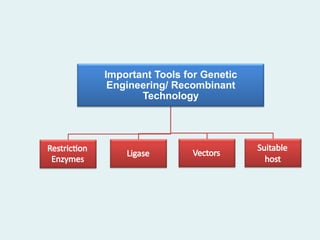
Important Tools for Genetic
Engineering/ Recombinant
Technology
Restriction
Enzymes
Ligase Vectors
Suitable
host
Six steps of Recombinant DNA
1. Isolating (vector and target gene)
2. Cutting (Cleavage)
3. Joining (Ligation)
4. Transforming
5. Cloning
6. Selecting (Screening)
The basic procedures of
recombinant DNA technology
 DNA molecules that are constructed with DNA
from different sources are called recombinant
DNA molecules.
 Recombinant DNA molecules are created
in nature more often than in the laboratory;
– for example, every time a bacteria phage or
eukaryotic virus infects its host cell and
integrates its DNA into the host genome, a
recombinant is created.
– Occasionally, these viruses pick up a fragment
of host DNA when they excise from their
host’s genome; these naturally occurring
recombinant DNA molecules have been
used to study some genes.
Six basic steps are common to most
recombinant DNA experiments
1. Isolation and purification of DNA.
Both vector and target DNA
molecules can be prepared by a
variety of routine methods, which are
not discussed here. In some cases, the
target DNA is synthesized in vitro.
2. Cleavage of DNA at particular sequences. As
we will see, cleaving DNA to generate
fragments of defined length, or with specific
endpoints, is crucial to recombinant DNA
technology. The DNA fragment of interest is
called insert DNA. In the laboratory, DNA is
usually cleaved by treating it with
commercially produced nucleases and
restriction endonucleases.
3. Ligation of DNA fragments.
A recombinant DNA molecule is usually
formed by cleaving the DNA of interest to
yield insert DNA and then ligating the
insert DNA to vector DNA (recombinant
DNA or chimeric DNA). DNA fragments are
typically joined using DNA ligase (also
commercially produced).
– T4 DNA Ligase
4. Introduction of recombinant DNA into
compatible host cells. In order to be
propagated, the recombinant DNA
molecule (insert DNA joined to vector
DNA) must be introduced into a
compatible host cell where it can replicate.
The direct uptake of foreign DNA by a host
cell is called genetic transformation (or
transformation). Recombinant DNA can
also be packaged into virus particles and
transferred to host cells by transfection.
5. Replication and expression of
recombinant DNA in host cells.
Cloning vectors allow insert DNA to be
replicated and, in some cases, expressed
in a host cell. The ability to clone and
express DNA efficiently depends on the
choice of appropriate vectors and hosts.
6. Identification of host cells that contain
recombinant DNA of interest. Vectors
usually contain easily scored genetic
markers, or genes, that allow the
selection of host cells that have taken up
foreign DNA. The identification of a
particular DNA fragment usually
involves an additional step—screening a
large number of recombinant DNA
clones. This is almost always the most
difficult step.
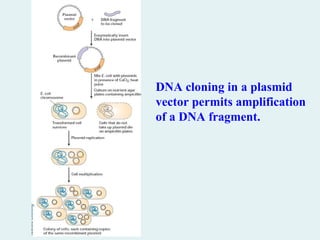
DNA cloning in a plasmid
vector permits amplification
of a DNA fragment.
First step:
Isolating DNA
1. Vector
2. Target gene
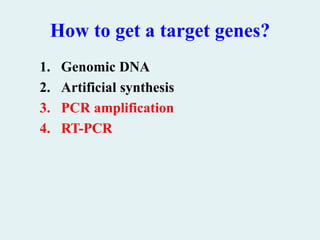
How to get a target genes?
1. Genomic DNA
2. Artificial synthesis
3. PCR amplification
4. RT-PCR
Polymerase chain reaction (PCR)
 A technique called the polymerase chain
reaction (PCR) has revolutionized
recombinant DNA technology. It can
amplify DNA from as little material as
a single cell and from very old tissue
such as that isolated from Egyptian
mummies, a frozen mammoth, and
insects trapped in ancient amber.
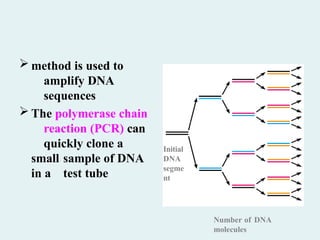
 method is used to
amplify DNA
sequences
 The polymerase chain
reaction (PCR) can
quickly clone a
small sample of DNA
in a test tube
Number of DNA
molecules
Initial
DNA
segme
nt
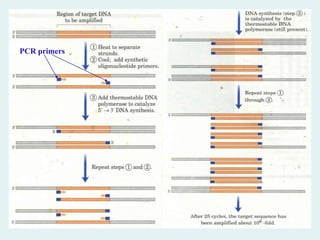
PCR primers
RT-PCR
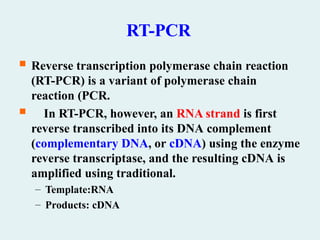
 Reverse transcription polymerase chain reaction
(RT-PCR) is a variant of polymerase chain
reaction (PCR.
 In RT-PCR, however, an RNA strand is first
reverse transcribed into its DNA complement
(complementary DNA, or cDNA) using the enzyme
reverse transcriptase, and the resulting cDNA is
amplified using traditional.
– Template:RNA
– Products: cDNA
Vectors- Cloning Vehicles
Cloning vectors can be plasmids,
bacteriophage, viruses, or even small
artificial chromosomes. Most vectors
contain sequences that allow them to be
replicated autonomously within a
compatible host cell, whereas a minority
carry sequences that facilitate integration
into the host genome.
 All cloning vectors have in common at least
one unique cloning site, a sequence that
can be cut by a restriction endonuclease to
allow site-specific insertion of foreign
DNA. The most useful vectors have
several restriction sites grouped together
in a multiple cloning site (MCS) called a
polylinker.
Types of vector
1. Plasmid Vectors
2. Bacteriophage Vectors
3. Virus vectors
4. Shuttle Vectors--can replicate in either
prokaryotic or eukaryotic cells.
5. Yeast Artificial Chromosomes as
Vectors
Plasmid Vectors
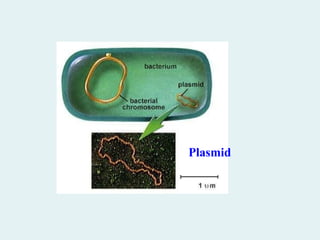
 Plasmids are circular, double-stranded
DNA (dsDNA) molecules that are separate
from a cell’s chromosomal DNA.
 These extra chromosomal DNAs, which
occur naturally in bacteria and in lower
eukaryotic cells (e.g., yeast), exist in a
parasitic or symbiotic relationship with
their host cell.
Plasmid
 Plasmids can replicate autonomously within
a host, and they frequently carry genes
conferring resistance to antibiotics such as
tetracycline, ampicillin, or kanamycin.
The expression of these marker genes can
be used to distinguish between host cells
that carry the vectors and those that do not
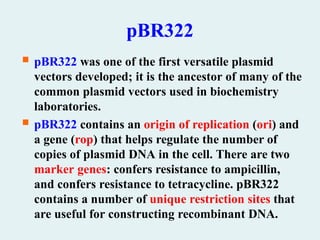
pBR322
 pBR322 was one of the first versatile plasmid
vectors developed; it is the ancestor of many of the
common plasmid vectors used in biochemistry
laboratories.
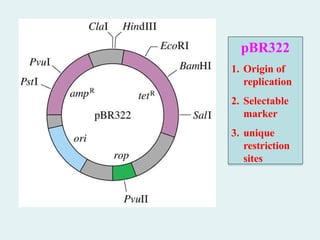
 pBR322 contains an origin of replication (ori) and
a gene (rop) that helps regulate the number of
copies of plasmid DNA in the cell. There are two
marker genes: confers resistance to ampicillin,
and confers resistance to tetracycline. pBR322
contains a number of unique restriction sites that
are useful for constructing recombinant DNA.
pBR322
1. Origin of
replication
2. Selectable
marker
3. unique
restriction
sites
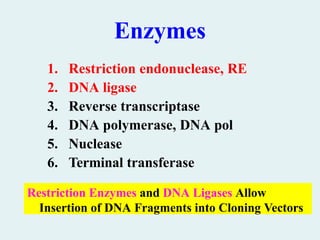
Enzymes
Restriction Enzymes and DNA Ligases Allow
Insertion of DNA Fragments into Cloning Vectors
1. Restriction endonuclease, RE
2. DNA ligase
3. Reverse transcriptase
4. DNA polymerase, DNA pol
5. Nuclease
6. Terminal transferase
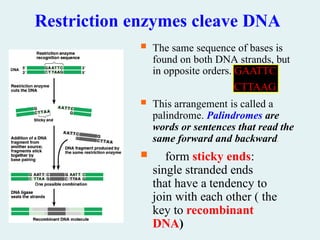
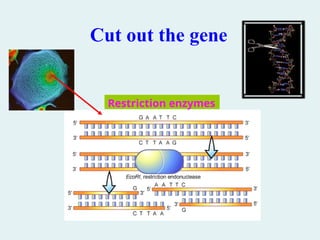
Restriction enzymes cleave DNA
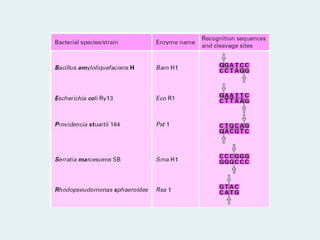
 The same sequence of bases is
found on both DNA strands, but
in opposite orders. GAATTC
CTTAAG
 This arrangement is called a
palindrome. Palindromes are
words or sentences that read the
same forward and backward.
 form sticky ends:
single stranded ends
that have a tendency to
join with each other ( the
key to recombinant
DNA)
Restriction Enzymes Cut DNA Chains at
Specific Locations
 Restriction enzymes are endonucleases
produced by bacteria that typically
recognize specific 4 to 8bp sequences,
called restriction sites, and then cleave both
DNA strands at this site.
 Restriction sites commonly are short
palindromic sequences; that is, the
restriction-site sequence is the same on
each DNA strand when read in the 5′ → 3′
direction.
Cut out the gene
Restriction enzymes
Restriction enzymes
 Restriction enzymes are named after the
bacterium from which they are isolated
– For example, Eco RI is from Escherichia
coli, and Bam HI is from Bacillus
amyloliquefaciens . The first three letters in the
restriction enzyme name consist of the first
letter of the genus (E) and the first two letters of
the species (co). These may be followed by a
strain designation (R) and a roman numeral (I)
to indicate the order of discovery (eg, EcoRI,
EcoRII).
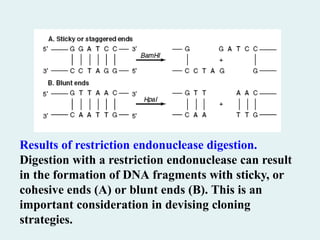
Blunt ends or sticky ends
 Each enzyme recognizes and cleaves a
specific double-stranded DNA sequence that
is 4–7 bp long. These DNA cuts result in
blunt ends (eg, Hpa I) or overlapping
(sticky) ends (eg, BamH I) , depending on the
mechanism used by the enzyme.
 Sticky ends are particularly useful in
constructing hybrid or chimeric
DNA molecules .
Results of restriction endonuclease digestion.
Digestion with a restriction endonuclease can result
in the formation of DNA fragments with sticky, or
cohesive ends (A) or blunt ends (B). This is an
important consideration in devising cloning
strategies.
Inserting DNA Fragments into Vectors
 DNA fragments with either sticky ends or blunt
ends can be inserted into vector DNA with the
aid of DNA ligases.
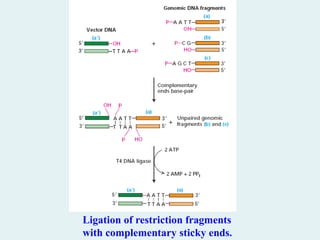
 For purposes of DNA cloning, purified DNA
ligase is used to covalently join the ends of a
restriction fragment and vector DNA that have
complementary ends . The vector DNA and
restriction fragment are covalently ligated
together through the standard 3 → 5
phosphodiester bonds of DNA.
 DNA ligase “pastes” the DNA fragments
together
Ligation of restriction fragments
with complementary sticky ends.
Identification of Host Cells
Containing Recombinant DNA
 Once a cloning vector and insert DNA have
been joined in vitro, the recombinant DNA
molecule can be introduced into a host cell,
most often a bacterial cell such as E. coli.
 In general, transformation is not a very
efficient way of getting DNA into a cell
because only a very small percentage of cells
take up recombinant DNA. Consequently,
those cells that have been successfully
transformed must be distinguished from the
vast majority of untransformed cells.
 Identification of host cells containing
recombinant DNA requires genetic selection or
screening or both.
 In a selection, cells are grown under conditions in
which only transformed cells can survive; all the
other cells die.
 In contrast, in a screen, transformed cells have to
be individually tested for the presence of the
desired recombinant DNA.
 Normally, a number of colonies of cells are
first selected and then screened for colonies
carrying the desired insert.
Selection Strategies Use Marker Genes
(Primary screening)
 Many selection strategies involve selectable
marker genes— genes whose presence
can easily be detected or demonstrated.
ampR
 Selection or screening can also be achieved
using insertional inactivation.
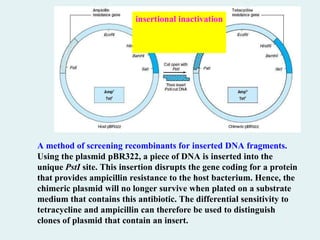
A method of screening recombinants for inserted DNA fragments.
Using the plasmid pBR322, a piece of DNA is inserted into the
unique PstI site. This insertion disrupts the gene coding for a protein
that provides ampicillin resistance to the host bacterium. Hence, the
chimeric plasmid will no longer survive when plated on a substrate
medium that contains this antibiotic. The differential sensitivity to
tetracycline and ampicillin can therefore be used to distinguish
clones of plasmid that contain an insert.
insertional inactivation
Screening (Strategies)
1. Gel Electrophoresis Allows Separation of
Vector DNA from Cloned Fragments
2. Cloned DNA Molecules Are Sequenced
Rapidly by the Dideoxy Chain-Termination
Method
3. The Polymerase Chain Reaction Amplifies a
Specific DNA Sequence from a Complex
Mixture
4. Blotting Techniques Permit Detection of
Specific DNA Fragments and mRNAs with
DNA Probes
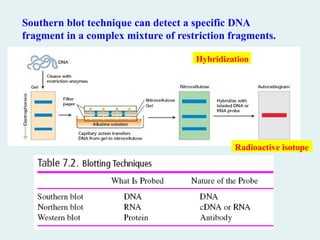
Southern blot technique can detect a specific DNA
fragment in a complex mixture of restriction fragments.
Radioactive isotope
Hybridization
Types of blotting techniques
 Southern blotting
 Southern blotting techniques is the first nucleic acid
blotting procedure developed in 1975 by
Southern.
 Southern blotting is the techniques for the specific
identification of DNA molecules.
 Northern blotting
 Northern blotting is the techniques for the specific
identification of RNA molecules.
 Western blotting
 Western blotting involves the identification of
proteins.
 Antigen + antibody
Expression of Proteins Using
Recombinant DNA Technology
 Cloned or amplified DNA can be purified and
sequenced, used to produce RNA and protein, or
introduced into organisms with the goal of
changing their phenotype.
 One of the reasons recombinant DNA technology
has had such a large impact on biochemistry is
that it has overcome many of the difficulties
inherent in purifying low-abundance proteins and
determining their amino acid sequences.
 Recombinant DNA technology allows the
protein to be purified without further
characterization. Purification begins
with overproduction of the protein in a
cell containing an expression vector.
– Prokaryotic Expression Vectors
– Eukaryotic Expression Vectors
Prokaryotic Expression Vectors
 Expression vectors for bacterial hosts are
generally plasmids that have been
engineered to contain appropriate
regulatory sequences for transcription and
translation such as strong promoters,
ribosome-binding sites, and transcription
terminators.
 Eukaryotic proteins can be made in bacteria by
inserting a cDNA fragment into an expression
vector . Large amounts of a desired protein can be
purified from the transformed cells.
 In some cases, the proteins can be used to treat
patients with genetic disorders.
 For example, human growth hormone, insulin, and
several blood coagulation factors have been
produced using recombinant DNA technology
and expression vectors.
Expression of Proteins in Eukaryotes
 Prokaryotic cells may be unable to produce
functional proteins from eukaryotic
genes even when all the signals
necessary for gene expression are present
because many eukaryotic proteins must
be post- translationally modified.
 Several expression vectors that function in
eukaryotes have been developed.
 These vectors contain eukaryotic origins of
replication, marker genes for selection in
eukaryotes, transcription and translation
control regions, and additional features
required for efficient translation of
eukaryotic mRNA, such as polyadenylation
signals and capping sites.
Applications of Recombinant
DNA Technology
1. Analysis of Gene Structure and
Expression
2. Pharmaceutical Products
– Drugs
– Vaccines
3. Genetically modified
organisms
(GMO)
– Transgenic plants
– Transgenic animal
4. Application in
medicine

RECOMBINANT DNA TECHNOLOGY LECTURE PART1

  • 1.
  • 2.
    Central dogma ofmolecular biology The Central Dogma of Molecular Biology, proposed by Francis Crick, describes the flow of genetic information in cells: DNA to RNA to protein. This means DNA, which contains the genetic code, is transcribed into RNA, and then the RNA is translated into proteins, which perform various cellular functions. In essence, the Central Dogma highlights the following: DNA as the blueprint: DNA stores the genetic instructions. RNA as the messenger: RNA carries the instructions from the DNA to the ribosomes. Proteins as the functional products: Proteins perform various cellular functions based on the instructions encoded in the DNA.
  • 3.
    History of GeneticEngineering/ Recombinant DNA Technology In conjunction with his studies of the tumor virus SV40, in 1972, Paul Berg succeeded in inserting DNA from a bacterium into the virus' DNA. He thereby created the first DNA molecule made of parts from different organisms. Paul Berg is the "father of genetic engineering/ rDNA Technology" This type of molecule became known as "hybrid DNA" or "recombinant DNA". Among other things, Paul Berg's method opened the way to creating bacteria that produce substances used in medicines.
  • 4.
    History of Recombinant DNATechnology In 1973, Herbert Boyer, of the University of California at San Francisco, and Stanley Cohen, at Stanford University, reported the construction of functional organisms that combined and replicated genetic information from different species. Their experiments dramatically demonstrated the potential impact of DNA recombinant engineering on medicine and pharmacology, industry and agriculture. Boyer and Cohen's achievement represented an advance upon the ingenious techniques developed by Paul Berg, in 1972, for inserting viral DNA into bacterial DNA. It was a creative synthesis of earlier research that made use of:  Living organisms able to serve as carriers for genes from another organism.  Enzymes to cleave and rejoin DNA fragments that contain such genes.  DNA molecules from one organism precisely targeted and manipulated for insertion into the DNA of another organism.
  • 5.
    Recombinant DNA and GeneCloning  Recombinant DNA (rDNA) is a form of artificial DNA that is created by combining two or more sequences that would not normally occur together through the process of gene splicing.  Recombinant DNA technology is a technology which allows DNA to be produced via artificial means. The procedure has been used to change DNA in living organisms and may have even more practical uses in the future.
  • 6.
    Recombinant DNA Technology... togethe r Definition:It is a technology of of DNA molecules from two different joining species tha t ar e inserted into a host organism to produce ne w geneti c combinations that are of value to science, medicine, agriculture, and industry.
  • 7.
    Recombinant DNA: Cloning andCreation of Chimeric Genes
  • 8.
    What is RecombinantDNA Technology?  Recombinant DNA technology is a technology which allows DNA to be produced via artificial means.  The procedure has been used to change DNA in living organisms and may have even more practical uses in the future.  It is an area of medical science that is just beginning to be researched in a concerted effort.
  • 9.
     Recombinant DNAtechnology works by taking DNA from two different sources and combining that DNA into a single molecule. That alone, however, will not do much.  Recombinant DNA technology only becomes useful when that artificially- created DNA is reproduced. This is known as DNA cloning.
  • 10.
  • 11.
    Recombinant DNA Technology 1.The basic concepts for recombinant DNA technology 2. The basic procedures of recombinant DNA technology 3. Application of recombinant DNA technology
  • 12.
    The basic conceptsfor recombinant DNA technology
  • 13.
     In theearly 1970s, technologies for the laboratory manipulation of nucleic acids emerged. In turn, these technologies led to the construction of DNA molecules composed of nucleotide sequences taken from different sources. The products of these innovations, recombinant DNA molecules, opened exciting new avenues of investigation in molecular biology and genetics, and a new field was born— recombinant DNA technology.
  • 14.
    Concept of RecombinantDNA  Recombinant DNA is a molecule that combines DNA from two sources . Also known as gene cloning.  Creates a new combination of genetic material – Human gene for insulin was placed in bacteria – The bacteria are recombinant organisms and produce insulin in large quantities for diabetics – Genetically engineered drug in 1986  Genetically modified organisms are possible because of the universal nature of the genetic code!
  • 15.
     Genetic engineeringis the application of this technology to the manipulation of genes. These advances were made possible by methods for amplification of any particular DNA segment( how? ), regardless of source, within bacterial host cells. Or, in the language of recombinant DNA technology, the cloning of virtually any DNA sequence became feasible.
  • 16.
     Recombinant technologybegins with the isolation of a gene of interest (target gene). The target gene is then inserted into the plasmid or phage (vector) to form replicon.  The replicon is then introduced into host cells to cloned and either express the protein or not.  The cloned replicon is referred to as recombinant DNA. The procedure is called recombinant DNA technology. Cloning is necessary to produce numerous copies of the DNA since the initial supply is inadequate to insert into host cells.
  • 17.
     Some otherterms are also in common use to describe genetic engineering.  Gene manipulation  Recombinant DNA technology  Gene cloning (Molecular cloning)  Genetic modification
  • 18.
     Cloning——In classicalbiology, a clone is a population of identical organisms derived from a single parental organism.  For example, the members of a colony of bacterial cells that arise from a single cell on a petri plate are clones. Molecular biology has borrowed the term to mean a collection of molecules or cells all identical to an original molecule or cell.
  • 19.
    How recombinant technologyworks  These steps include isolating of the target gene and the vector, specific cutting of DNA at defined sites, joining or splicing of DNA fragments, transforming of replicon to host cell, cloning, selecting of the positive cells containing recombinant DNA, and either express or not in the end.
  • 20.
    Important Tools forGenetic Engineering/ Recombinant Technology Restriction Enzymes Ligase Vectors Suitable host
  • 21.
    Six steps ofRecombinant DNA 1. Isolating (vector and target gene) 2. Cutting (Cleavage) 3. Joining (Ligation) 4. Transforming 5. Cloning 6. Selecting (Screening)
  • 22.
    The basic proceduresof recombinant DNA technology
  • 23.
     DNA moleculesthat are constructed with DNA from different sources are called recombinant DNA molecules.  Recombinant DNA molecules are created in nature more often than in the laboratory; – for example, every time a bacteria phage or eukaryotic virus infects its host cell and integrates its DNA into the host genome, a recombinant is created. – Occasionally, these viruses pick up a fragment of host DNA when they excise from their host’s genome; these naturally occurring recombinant DNA molecules have been used to study some genes.
  • 24.
    Six basic stepsare common to most recombinant DNA experiments 1. Isolation and purification of DNA. Both vector and target DNA molecules can be prepared by a variety of routine methods, which are not discussed here. In some cases, the target DNA is synthesized in vitro.
  • 25.
    2. Cleavage ofDNA at particular sequences. As we will see, cleaving DNA to generate fragments of defined length, or with specific endpoints, is crucial to recombinant DNA technology. The DNA fragment of interest is called insert DNA. In the laboratory, DNA is usually cleaved by treating it with commercially produced nucleases and restriction endonucleases.
  • 26.
    3. Ligation ofDNA fragments. A recombinant DNA molecule is usually formed by cleaving the DNA of interest to yield insert DNA and then ligating the insert DNA to vector DNA (recombinant DNA or chimeric DNA). DNA fragments are typically joined using DNA ligase (also commercially produced). – T4 DNA Ligase
  • 27.
    4. Introduction ofrecombinant DNA into compatible host cells. In order to be propagated, the recombinant DNA molecule (insert DNA joined to vector DNA) must be introduced into a compatible host cell where it can replicate. The direct uptake of foreign DNA by a host cell is called genetic transformation (or transformation). Recombinant DNA can also be packaged into virus particles and transferred to host cells by transfection.
  • 28.
    5. Replication andexpression of recombinant DNA in host cells. Cloning vectors allow insert DNA to be replicated and, in some cases, expressed in a host cell. The ability to clone and express DNA efficiently depends on the choice of appropriate vectors and hosts.
  • 29.
    6. Identification ofhost cells that contain recombinant DNA of interest. Vectors usually contain easily scored genetic markers, or genes, that allow the selection of host cells that have taken up foreign DNA. The identification of a particular DNA fragment usually involves an additional step—screening a large number of recombinant DNA clones. This is almost always the most difficult step.
  • 30.
    DNA cloning ina plasmid vector permits amplification of a DNA fragment.
  • 31.
    First step: Isolating DNA 1.Vector 2. Target gene
  • 32.
    How to geta target genes? 1. Genomic DNA 2. Artificial synthesis 3. PCR amplification 4. RT-PCR
  • 33.
    Polymerase chain reaction(PCR)  A technique called the polymerase chain reaction (PCR) has revolutionized recombinant DNA technology. It can amplify DNA from as little material as a single cell and from very old tissue such as that isolated from Egyptian mummies, a frozen mammoth, and insects trapped in ancient amber.
  • 34.
     method isused to amplify DNA sequences  The polymerase chain reaction (PCR) can quickly clone a small sample of DNA in a test tube Number of DNA molecules Initial DNA segme nt
  • 35.
  • 36.
    RT-PCR  Reverse transcriptionpolymerase chain reaction (RT-PCR) is a variant of polymerase chain reaction (PCR.  In RT-PCR, however, an RNA strand is first reverse transcribed into its DNA complement (complementary DNA, or cDNA) using the enzyme reverse transcriptase, and the resulting cDNA is amplified using traditional. – Template:RNA – Products: cDNA
  • 37.
    Vectors- Cloning Vehicles Cloningvectors can be plasmids, bacteriophage, viruses, or even small artificial chromosomes. Most vectors contain sequences that allow them to be replicated autonomously within a compatible host cell, whereas a minority carry sequences that facilitate integration into the host genome.
  • 38.
     All cloningvectors have in common at least one unique cloning site, a sequence that can be cut by a restriction endonuclease to allow site-specific insertion of foreign DNA. The most useful vectors have several restriction sites grouped together in a multiple cloning site (MCS) called a polylinker.
  • 39.
    Types of vector 1.Plasmid Vectors 2. Bacteriophage Vectors 3. Virus vectors 4. Shuttle Vectors--can replicate in either prokaryotic or eukaryotic cells. 5. Yeast Artificial Chromosomes as Vectors
  • 40.
    Plasmid Vectors  Plasmidsare circular, double-stranded DNA (dsDNA) molecules that are separate from a cell’s chromosomal DNA.  These extra chromosomal DNAs, which occur naturally in bacteria and in lower eukaryotic cells (e.g., yeast), exist in a parasitic or symbiotic relationship with their host cell.
  • 41.
  • 42.
     Plasmids canreplicate autonomously within a host, and they frequently carry genes conferring resistance to antibiotics such as tetracycline, ampicillin, or kanamycin. The expression of these marker genes can be used to distinguish between host cells that carry the vectors and those that do not
  • 43.
    pBR322  pBR322 wasone of the first versatile plasmid vectors developed; it is the ancestor of many of the common plasmid vectors used in biochemistry laboratories.  pBR322 contains an origin of replication (ori) and a gene (rop) that helps regulate the number of copies of plasmid DNA in the cell. There are two marker genes: confers resistance to ampicillin, and confers resistance to tetracycline. pBR322 contains a number of unique restriction sites that are useful for constructing recombinant DNA.
  • 44.
    pBR322 1. Origin of replication 2.Selectable marker 3. unique restriction sites
  • 45.
    Enzymes Restriction Enzymes andDNA Ligases Allow Insertion of DNA Fragments into Cloning Vectors 1. Restriction endonuclease, RE 2. DNA ligase 3. Reverse transcriptase 4. DNA polymerase, DNA pol 5. Nuclease 6. Terminal transferase
  • 46.
    Restriction enzymes cleaveDNA  The same sequence of bases is found on both DNA strands, but in opposite orders. GAATTC CTTAAG  This arrangement is called a palindrome. Palindromes are words or sentences that read the same forward and backward.  form sticky ends: single stranded ends that have a tendency to join with each other ( the key to recombinant DNA)
  • 47.
    Restriction Enzymes CutDNA Chains at Specific Locations  Restriction enzymes are endonucleases produced by bacteria that typically recognize specific 4 to 8bp sequences, called restriction sites, and then cleave both DNA strands at this site.  Restriction sites commonly are short palindromic sequences; that is, the restriction-site sequence is the same on each DNA strand when read in the 5′ → 3′ direction.
  • 48.
    Cut out thegene Restriction enzymes
  • 49.
    Restriction enzymes  Restrictionenzymes are named after the bacterium from which they are isolated – For example, Eco RI is from Escherichia coli, and Bam HI is from Bacillus amyloliquefaciens . The first three letters in the restriction enzyme name consist of the first letter of the genus (E) and the first two letters of the species (co). These may be followed by a strain designation (R) and a roman numeral (I) to indicate the order of discovery (eg, EcoRI, EcoRII).
  • 50.
    Blunt ends orsticky ends  Each enzyme recognizes and cleaves a specific double-stranded DNA sequence that is 4–7 bp long. These DNA cuts result in blunt ends (eg, Hpa I) or overlapping (sticky) ends (eg, BamH I) , depending on the mechanism used by the enzyme.  Sticky ends are particularly useful in constructing hybrid or chimeric DNA molecules .
  • 51.
    Results of restrictionendonuclease digestion. Digestion with a restriction endonuclease can result in the formation of DNA fragments with sticky, or cohesive ends (A) or blunt ends (B). This is an important consideration in devising cloning strategies.
  • 53.
    Inserting DNA Fragmentsinto Vectors  DNA fragments with either sticky ends or blunt ends can be inserted into vector DNA with the aid of DNA ligases.  For purposes of DNA cloning, purified DNA ligase is used to covalently join the ends of a restriction fragment and vector DNA that have complementary ends . The vector DNA and restriction fragment are covalently ligated together through the standard 3 → 5 phosphodiester bonds of DNA.  DNA ligase “pastes” the DNA fragments together
  • 54.
    Ligation of restrictionfragments with complementary sticky ends.
  • 55.
    Identification of HostCells Containing Recombinant DNA  Once a cloning vector and insert DNA have been joined in vitro, the recombinant DNA molecule can be introduced into a host cell, most often a bacterial cell such as E. coli.  In general, transformation is not a very efficient way of getting DNA into a cell because only a very small percentage of cells take up recombinant DNA. Consequently, those cells that have been successfully transformed must be distinguished from the vast majority of untransformed cells.
  • 56.
     Identification ofhost cells containing recombinant DNA requires genetic selection or screening or both.  In a selection, cells are grown under conditions in which only transformed cells can survive; all the other cells die.  In contrast, in a screen, transformed cells have to be individually tested for the presence of the desired recombinant DNA.  Normally, a number of colonies of cells are first selected and then screened for colonies carrying the desired insert.
  • 57.
    Selection Strategies UseMarker Genes (Primary screening)  Many selection strategies involve selectable marker genes— genes whose presence can easily be detected or demonstrated. ampR  Selection or screening can also be achieved using insertional inactivation.
  • 58.
    A method ofscreening recombinants for inserted DNA fragments. Using the plasmid pBR322, a piece of DNA is inserted into the unique PstI site. This insertion disrupts the gene coding for a protein that provides ampicillin resistance to the host bacterium. Hence, the chimeric plasmid will no longer survive when plated on a substrate medium that contains this antibiotic. The differential sensitivity to tetracycline and ampicillin can therefore be used to distinguish clones of plasmid that contain an insert. insertional inactivation
  • 59.
    Screening (Strategies) 1. GelElectrophoresis Allows Separation of Vector DNA from Cloned Fragments 2. Cloned DNA Molecules Are Sequenced Rapidly by the Dideoxy Chain-Termination Method 3. The Polymerase Chain Reaction Amplifies a Specific DNA Sequence from a Complex Mixture 4. Blotting Techniques Permit Detection of Specific DNA Fragments and mRNAs with DNA Probes
  • 60.
    Southern blot techniquecan detect a specific DNA fragment in a complex mixture of restriction fragments. Radioactive isotope Hybridization
  • 61.
    Types of blottingtechniques  Southern blotting  Southern blotting techniques is the first nucleic acid blotting procedure developed in 1975 by Southern.  Southern blotting is the techniques for the specific identification of DNA molecules.  Northern blotting  Northern blotting is the techniques for the specific identification of RNA molecules.  Western blotting  Western blotting involves the identification of proteins.  Antigen + antibody
  • 62.
    Expression of ProteinsUsing Recombinant DNA Technology  Cloned or amplified DNA can be purified and sequenced, used to produce RNA and protein, or introduced into organisms with the goal of changing their phenotype.  One of the reasons recombinant DNA technology has had such a large impact on biochemistry is that it has overcome many of the difficulties inherent in purifying low-abundance proteins and determining their amino acid sequences.
  • 63.
     Recombinant DNAtechnology allows the protein to be purified without further characterization. Purification begins with overproduction of the protein in a cell containing an expression vector. – Prokaryotic Expression Vectors – Eukaryotic Expression Vectors
  • 64.
    Prokaryotic Expression Vectors Expression vectors for bacterial hosts are generally plasmids that have been engineered to contain appropriate regulatory sequences for transcription and translation such as strong promoters, ribosome-binding sites, and transcription terminators.
  • 65.
     Eukaryotic proteinscan be made in bacteria by inserting a cDNA fragment into an expression vector . Large amounts of a desired protein can be purified from the transformed cells.  In some cases, the proteins can be used to treat patients with genetic disorders.  For example, human growth hormone, insulin, and several blood coagulation factors have been produced using recombinant DNA technology and expression vectors.
  • 66.
    Expression of Proteinsin Eukaryotes  Prokaryotic cells may be unable to produce functional proteins from eukaryotic genes even when all the signals necessary for gene expression are present because many eukaryotic proteins must be post- translationally modified.
  • 67.
     Several expressionvectors that function in eukaryotes have been developed.  These vectors contain eukaryotic origins of replication, marker genes for selection in eukaryotes, transcription and translation control regions, and additional features required for efficient translation of eukaryotic mRNA, such as polyadenylation signals and capping sites.
  • 68.
  • 69.
    1. Analysis ofGene Structure and Expression 2. Pharmaceutical Products – Drugs – Vaccines 3. Genetically modified organisms (GMO) – Transgenic plants – Transgenic animal 4. Application in medicine

Editor's Notes