
BODY LANGUAGE 
Group No. 1 
5th September 2014
It could be called a language which 
conveys affirmative , ambiguous or 
negative signals depending on 
individual perception. 
The point is do we understand them 
in detail? 
If Yes then do we act upon them ? 
If No then we need practice.
Body Language 
Classification 
• Eye Contact 
• Posture 
• Head Position 
• Arms 
• Angle of the body 
• Hand Gestures 
• Facial Expression
ACTIONS SPEAK LOUDER THAN 
WORDS 
Your goal in public speaking is to communicate. 
To be an effective speaker, you must project 
earnestness, enthusiasm, and sincerity by 
making your manner and actions affirm what 
you say. If they don’t, the results can be 
disastrous. 
Ralph Waldo Emerson once said, “What you are 
speaks so loudly that I cannot hear what you 
say.” When you speak, people not only judge 
your speech – they also judge you. If they are 
not convinced of your earnestness and 
sincerity, they are also unlikely to accept your 
spoken message.
INTRICACIES OF 
BODY LANGUAGE
EYE CONTACT 
Eye contact is one of the most important aspects of 
dealing with others, especially people we've just met. 
Maintaining good eye contact shows respect and interest 
in what we have to say. 
For Example : 
When you meet the interviewer, look right in the eyes, 
then think to yourself, "Wow, so great to finally meet 
you!" This will make you smile, and they'll pick up on 
your positive mood. 
During a job interview, keep your eye contact in the 
upside-down triangle area of your interviewer's face: 
from the left eyebrow, to the nose, back up to the right 
eyebrow.
POSTURE 
How we hold our bodies can also serve as an important part of body 
language. The term posture refers to how we hold our bodies as well as 
overall physical form of an individual. Posture can convey a wealth of 
information about how a person is feeling as well as hints about 
personality characteristics, such as whether a person is confident, open, 
or submissive. 
Sitting up straight, for example, may indicate that a person is focused and 
paying attention to what's going on. Sitting with the body hunched 
forward, on the other hand, can imply that the person is bored or 
indifferent. 
When you are trying to read body language, try to notice some of the 
signals that a person's posture can send. 
Open posture involves keeping the trunk of the body open and exposed. 
This type of posture indicates friendliness, openness, and willingness. 
Closed posture involves keeping the obscured or hidden often by 
hunching forward and keeping the arms and legs crossed. This type of 
posture can be an indicator of hostility, unfriendliness, and anxiety.
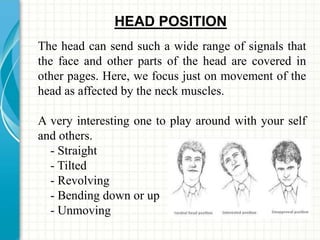
HEAD POSITION 
The head can send such a wide range of signals that 
the face and other parts of the head are covered in 
other pages. Here, we focus just on movement of the 
head as affected by the neck muscles. 
A very interesting one to play around with your self 
and others. 
- Straight 
- Tilted 
- Revolving 
- Bending down or up 
- Unmoving
ARMS 
They give the clues as to how open and receptive we are 
to everyone we meet and interact with. 
So we can keep our arms out to the side of our body or 
behind our back. This shows we are not scared to take on 
whatever comes your way and you meet things in a “full 
frontal” position. 
Arms act as defensive barriers when across the body, and 
conversely indicate feelings of openness and security 
when in open positions, especially combined with open 
palms. 
Arms are quite reliable indicators of mood and feeling, 
especially when interpreted with other body language.
ANGLE OF BODY 
In relation to others it gives an indication of our attitudes and 
feelings towards them. 
To show your lack of interest in pursuing a conversation, all 
you have to do is angle your body away from the other 
person. You may look his way, your tone of voice may be 
pleasant enough, but if you don’t turn your body toward him, 
you’re sending a subtle yet unmistakable signal that you’re 
not interested.
HAND GESTURES 
When you are preparing a speech, what proportion of time 
and effort do you give to the movement and cadence of your 
hands? If you are like most people, the answer is not much. 
Yet appropriate use of your hands can result in a marked 
increase in the understanding and retention of your message. 
Correctly used, hand gestures can help you say more in less 
time, show what you mean without having to resort to 
visuals, signal your conviction and confidence and add texture 
and dimension to your material and ideas.
FACIAL EXPRESSIONS 
When you speak, your face communicates your attitudes, 
feelings, and emotions more clearly than any other part of 
your body. According to behavioral psychologists, people can 
easily recognize – simply by observing a speaker’s facial 
expressions – such distinct feelings as surprise, fear, 
happiness, confusion, disgust, interest, disbelief, anger, and 
sadness. 
Here’s an example. If a friend were to smile warmly at you 
and say, “You’re crazy,” would you feel insulted? Probably not; 
in fact, you might even take it as a sign of endearment. But 
what if this statement were accompanied by a contemptuous 
sneer? The verbal message would be the same, but your 
reaction would no doubt be drastically different.
HOW TO MAKE A 
GOOD FIRST 
IMPRESSION
First impressions are critical. People meeting for the first time form 
immediate judgments of one another that forever color their 
relationships. When you present a speech, you’ll be judged by the people 
in your audience, and the initial impression you make on them will 
directly affect the success of your presentation. 
One of your objectives as a speaker should be to create a visual image 
that complements and enhances your verbal message. You want your 
listeners to like you, trust you, and want to hear what you say. 
Your Appearance 
Like it or not, your physical appearance strongly influences how others 
judge you. When you deliver a speech, your appearance conveys a 
powerful visual message to the audience – a message vital to your success 
as a communicator. 
You can’t change your age, height, or facial features, but you can enhance 
your appearance through proper attire, grooming, and physical 
conditioning. This manual cannot offer detailed information on these 
subjects; styles and preferences vary greatly with time, location, and 
socioeconomic factors.
Before You Speak 
Part of your first impression is made before you are introduced to begin 
your speech. As the audience is arriving, your preparations should be 
concluded – you should not have to study your speech. Instead, mingle 
with the audience, and project the same friendly, confident attitude 
that will make your speech a success. 
The First Minute 
When you speak, especially if you are not well- known to the audience, 
the most crucial part of your presentation is the first minute. During 
those few seconds, the people in the audience will be making critical 
judgments about you. They will decide if you’re confident, sincere, 
friendly, eager to address them, and worthy of their attention. And to a 
large degree, they will base this decision on what they see.
When your actions are wedded to your words, you will 
strengthen the impact of your speech – even if the 
audience doesn’t consciously notice them. But if your 
platform behavior contains mannerisms not related to 
your spoken message, those actions will call attention 
to themselves and away from your speech. 
“You never get a second chance to 
make the first impression”
Group Members : 
Shubhra Bhardwaj 
Utkarsh Poddar 
Vansha Mahajan 
Aditi Garg 
Dhruv Mahana 
Subhransu Sekhar Biswal 
Monika Prasad
THANK YOU

Body Language

  • 1.
    BODY LANGUAGE GroupNo. 1 5th September 2014
  • 3.
    It could becalled a language which conveys affirmative , ambiguous or negative signals depending on individual perception. The point is do we understand them in detail? If Yes then do we act upon them ? If No then we need practice.
  • 4.
    Body Language Classification • Eye Contact • Posture • Head Position • Arms • Angle of the body • Hand Gestures • Facial Expression
  • 5.
    ACTIONS SPEAK LOUDERTHAN WORDS Your goal in public speaking is to communicate. To be an effective speaker, you must project earnestness, enthusiasm, and sincerity by making your manner and actions affirm what you say. If they don’t, the results can be disastrous. Ralph Waldo Emerson once said, “What you are speaks so loudly that I cannot hear what you say.” When you speak, people not only judge your speech – they also judge you. If they are not convinced of your earnestness and sincerity, they are also unlikely to accept your spoken message.
  • 6.
  • 7.
    EYE CONTACT Eyecontact is one of the most important aspects of dealing with others, especially people we've just met. Maintaining good eye contact shows respect and interest in what we have to say. For Example : When you meet the interviewer, look right in the eyes, then think to yourself, "Wow, so great to finally meet you!" This will make you smile, and they'll pick up on your positive mood. During a job interview, keep your eye contact in the upside-down triangle area of your interviewer's face: from the left eyebrow, to the nose, back up to the right eyebrow.
  • 9.
    POSTURE How wehold our bodies can also serve as an important part of body language. The term posture refers to how we hold our bodies as well as overall physical form of an individual. Posture can convey a wealth of information about how a person is feeling as well as hints about personality characteristics, such as whether a person is confident, open, or submissive. Sitting up straight, for example, may indicate that a person is focused and paying attention to what's going on. Sitting with the body hunched forward, on the other hand, can imply that the person is bored or indifferent. When you are trying to read body language, try to notice some of the signals that a person's posture can send. Open posture involves keeping the trunk of the body open and exposed. This type of posture indicates friendliness, openness, and willingness. Closed posture involves keeping the obscured or hidden often by hunching forward and keeping the arms and legs crossed. This type of posture can be an indicator of hostility, unfriendliness, and anxiety.
  • 10.
    HEAD POSITION Thehead can send such a wide range of signals that the face and other parts of the head are covered in other pages. Here, we focus just on movement of the head as affected by the neck muscles. A very interesting one to play around with your self and others. - Straight - Tilted - Revolving - Bending down or up - Unmoving
  • 11.
    ARMS They givethe clues as to how open and receptive we are to everyone we meet and interact with. So we can keep our arms out to the side of our body or behind our back. This shows we are not scared to take on whatever comes your way and you meet things in a “full frontal” position. Arms act as defensive barriers when across the body, and conversely indicate feelings of openness and security when in open positions, especially combined with open palms. Arms are quite reliable indicators of mood and feeling, especially when interpreted with other body language.
  • 12.
    ANGLE OF BODY In relation to others it gives an indication of our attitudes and feelings towards them. To show your lack of interest in pursuing a conversation, all you have to do is angle your body away from the other person. You may look his way, your tone of voice may be pleasant enough, but if you don’t turn your body toward him, you’re sending a subtle yet unmistakable signal that you’re not interested.
  • 13.
    HAND GESTURES Whenyou are preparing a speech, what proportion of time and effort do you give to the movement and cadence of your hands? If you are like most people, the answer is not much. Yet appropriate use of your hands can result in a marked increase in the understanding and retention of your message. Correctly used, hand gestures can help you say more in less time, show what you mean without having to resort to visuals, signal your conviction and confidence and add texture and dimension to your material and ideas.
  • 14.
    FACIAL EXPRESSIONS Whenyou speak, your face communicates your attitudes, feelings, and emotions more clearly than any other part of your body. According to behavioral psychologists, people can easily recognize – simply by observing a speaker’s facial expressions – such distinct feelings as surprise, fear, happiness, confusion, disgust, interest, disbelief, anger, and sadness. Here’s an example. If a friend were to smile warmly at you and say, “You’re crazy,” would you feel insulted? Probably not; in fact, you might even take it as a sign of endearment. But what if this statement were accompanied by a contemptuous sneer? The verbal message would be the same, but your reaction would no doubt be drastically different.
  • 16.
    HOW TO MAKEA GOOD FIRST IMPRESSION
  • 17.
    First impressions arecritical. People meeting for the first time form immediate judgments of one another that forever color their relationships. When you present a speech, you’ll be judged by the people in your audience, and the initial impression you make on them will directly affect the success of your presentation. One of your objectives as a speaker should be to create a visual image that complements and enhances your verbal message. You want your listeners to like you, trust you, and want to hear what you say. Your Appearance Like it or not, your physical appearance strongly influences how others judge you. When you deliver a speech, your appearance conveys a powerful visual message to the audience – a message vital to your success as a communicator. You can’t change your age, height, or facial features, but you can enhance your appearance through proper attire, grooming, and physical conditioning. This manual cannot offer detailed information on these subjects; styles and preferences vary greatly with time, location, and socioeconomic factors.
  • 18.
    Before You Speak Part of your first impression is made before you are introduced to begin your speech. As the audience is arriving, your preparations should be concluded – you should not have to study your speech. Instead, mingle with the audience, and project the same friendly, confident attitude that will make your speech a success. The First Minute When you speak, especially if you are not well- known to the audience, the most crucial part of your presentation is the first minute. During those few seconds, the people in the audience will be making critical judgments about you. They will decide if you’re confident, sincere, friendly, eager to address them, and worthy of their attention. And to a large degree, they will base this decision on what they see.
  • 19.
    When your actionsare wedded to your words, you will strengthen the impact of your speech – even if the audience doesn’t consciously notice them. But if your platform behavior contains mannerisms not related to your spoken message, those actions will call attention to themselves and away from your speech. “You never get a second chance to make the first impression”
  • 20.
    Group Members : Shubhra Bhardwaj Utkarsh Poddar Vansha Mahajan Aditi Garg Dhruv Mahana Subhransu Sekhar Biswal Monika Prasad
  • 21.

Editor's Notes

  • #2 This template can be used as a starter file for presenting training materials in a group setting. Sections Sections can help to organize your slides or facilitate collaboration between multiple authors. On the Home tab under Slides, click Section, and then click Add Section. Notes Use the Notes pane for delivery notes or to provide additional details for the audience. You can see these notes in Presenter View during your presentation. Keep in mind the font size (important for accessibility, visibility, videotaping, and online production) Coordinated colors Pay particular attention to the graphs, charts, and text boxes. Consider that attendees will print in black and white or grayscale. Run a test print to make sure your colors work when printed in pure black and white and grayscale. Graphics, tables, and graphs Keep it simple: If possible, use consistent, non-distracting styles and colors. Label all graphs and tables.
  • #3 This is another option for an overview using transitions to advance through several slides.
  • #7 Use a section header for each of the topics, so there is a clear transition to the audience.
  • #8 Add slides to each topic section as necessary, including slides with tables, graphs, and images. See next section for sample table, graph, image, and video layouts.
  • #9 Add slides to each topic section as necessary, including slides with tables, graphs, and images. See next section for sample table, graph, image, and video layouts.
  • #10 Add slides to each topic section as necessary, including slides with tables, graphs, and images. See next section for sample table, graph, image, and video layouts.
  • #11 Add slides to each topic section as necessary, including slides with tables, graphs, and images. See next section for sample table, graph, image, and video layouts.
  • #12 Add slides to each topic section as necessary, including slides with tables, graphs, and images. See next section for sample table, graph, image, and video layouts.
  • #13 Add slides to each topic section as necessary, including slides with tables, graphs, and images. See next section for sample table, graph, image, and video layouts.
  • #14 Add slides to each topic section as necessary, including slides with tables, graphs, and images. See next section for sample table, graph, image, and video layouts.
  • #15 Add slides to each topic section as necessary, including slides with tables, graphs, and images. See next section for sample table, graph, image, and video layouts.
  • #17 Use a section header for each of the topics, so there is a clear transition to the audience.
  • #20 Summarize presentation content by restating the important points from the lessons. What do you want the audience to remember when they leave your presentation?
  • #22 Microsoft Confidential