SUBMITTED BY: 
E.CHANDAN (A2324612045) 
PRAVEEN SINGH (A2324612047) 
SAKET KUMAR (A2324612069) 
(5EEE)
OUTLINE: 
DEFINITION 
READING SKILLS 
SQ3R 
SQ4R 
PARAPHRASING 
SUMMARISING 
PRECIS WRITING 
LISTENING COMPREHENSION
WHAT IS COMPREHENSION SKILL? 
Comprehension skills includes the different parameters 
for understanding a comprehension. Basic comprehension 
includes: 
1. Reading skill 
SQ3R 
SQ4R 
1. Listening skill 
2. Précis writing 
3. Summarising and paraphrasing.
SQ3R: 
• It is a way to read academic material such as textbooks, 
articles, research studies or manuals that can increase your 
comprehension of what you are reading and improve your 
ability to recall it. 
•With the SQ3R method, your active involvement in the 
reading process is required – in fact, it is demanded!
1.SURVEY 
1.Skim the following 
• The title of the chapter 
• The introduction 
• The table of contents and any illustrations 
• Charts or graphs and the summary paragraph. 
2.Note any unknown vocabulary and find a definition. 
3.Skim the section headings and the first sentences of each paragraph to 
find the main points that will be developed.
2.QUESTION 
Turn the first heading, or the first sentence of the first 
paragraph, into a question. 
• Arouse curiosity. 
• Provides active involvement. 
Turning a heading into a question can be done instantly upon 
reading the heading, but it demands a conscious effort on 
your part to make this a query for which you must read to 
find the answer.
3.READ 
Read to answer that question, i.e., to the end of the first 
headed section. 
• Underline only key words,never whole paragraphs. 
• Use a dictionary if necessary to look up unfamiliar 
vocabulary. 
The reader should definitely have in mind what he wants 
to learn as he reads each section and not just passively 
read it line by line.
4.RECITE 
This part is concerned with learning the answer of our 
question from the comprehension. 
• Having read the first section, look away from the book and 
try briefly to recite in your own words the answer to your 
question. 
• An excellent way to do this reciting from memory is to jot 
down cue phrases in outline form on a sheet of paper. 
• Make these notes very brief!
5.REVIEW 
When the comprehension has thus been completely 
read, look over your notes to get a bird’s-eye view of 
the points and their relationship to one another. 
• Check your memory by reciting the major points under each 
heading and the critical points under each major point. 
• You can do this by covering up the notes and trying to recall 
the information.
sq4r 
• It is one more way of reading comprehensions which includes an extra 
RECORD apart from SQ3R. 
1. SURVEY 
2. QUESTION 
3. READ 
4. RECORD 
5. RECITE 
6. REVIEW 
RECORD involves jotting down the main points from the 
comprehension and keeping a record of it for future references.
PARAPHRASING 
It is a way of writing our own ideas which we derived 
from the comprehension. 
• It includes: 
1.Notemaking from readings and lectures. 
2.Integrating evidence/sources in essays, journals, research 
reports. 
3.Explaining information in tables, charts and diagrams. 
It is mostly used for shorter texts.
SUMMARISING 
Summarising is a spoken or written account of an event, 
text, section of text, or visual, in which the main idea is 
given, but details, examples and formalities are left out. 
It includes: 
1.Notetaking in lectures and while reading. 
2.Writing an abstract/synopsis. 
3.Writing annotated bibliographies. 
It is often used for long comprehensions.
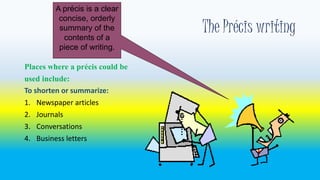
The Précis writing 
A précis is a clear 
concise, orderly 
summary of the 
contents of a 
piece of writing. 
Places where a précis could be 
used include: 
To shorten or summarize: 
1. Newspaper articles 
2. Journals 
3. Conversations 
4. Business letters
LISTENING COMPREHENSION 
• Listening is the most common communicative activity in daily life: 
“we can expect to listen twice as much as we speak, four times more 
than we read, and five times more than we write.” 
It includes: 
* Speech perception 
* Word recognition 
* Sentence processing 
* Constructing the literal meaning 
* Holding the information in short-term memory 
* Recognizing cohesive devices in discourse
THANK YOU!

Comprehension Skills

  • 1.
    SUBMITTED BY: E.CHANDAN(A2324612045) PRAVEEN SINGH (A2324612047) SAKET KUMAR (A2324612069) (5EEE)
  • 2.
    OUTLINE: DEFINITION READINGSKILLS SQ3R SQ4R PARAPHRASING SUMMARISING PRECIS WRITING LISTENING COMPREHENSION
  • 3.
    WHAT IS COMPREHENSIONSKILL? Comprehension skills includes the different parameters for understanding a comprehension. Basic comprehension includes: 1. Reading skill SQ3R SQ4R 1. Listening skill 2. Précis writing 3. Summarising and paraphrasing.
  • 4.
    SQ3R: • Itis a way to read academic material such as textbooks, articles, research studies or manuals that can increase your comprehension of what you are reading and improve your ability to recall it. •With the SQ3R method, your active involvement in the reading process is required – in fact, it is demanded!
  • 5.
    1.SURVEY 1.Skim thefollowing • The title of the chapter • The introduction • The table of contents and any illustrations • Charts or graphs and the summary paragraph. 2.Note any unknown vocabulary and find a definition. 3.Skim the section headings and the first sentences of each paragraph to find the main points that will be developed.
  • 6.
    2.QUESTION Turn thefirst heading, or the first sentence of the first paragraph, into a question. • Arouse curiosity. • Provides active involvement. Turning a heading into a question can be done instantly upon reading the heading, but it demands a conscious effort on your part to make this a query for which you must read to find the answer.
  • 7.
    3.READ Read toanswer that question, i.e., to the end of the first headed section. • Underline only key words,never whole paragraphs. • Use a dictionary if necessary to look up unfamiliar vocabulary. The reader should definitely have in mind what he wants to learn as he reads each section and not just passively read it line by line.
  • 8.
    4.RECITE This partis concerned with learning the answer of our question from the comprehension. • Having read the first section, look away from the book and try briefly to recite in your own words the answer to your question. • An excellent way to do this reciting from memory is to jot down cue phrases in outline form on a sheet of paper. • Make these notes very brief!
  • 9.
    5.REVIEW When thecomprehension has thus been completely read, look over your notes to get a bird’s-eye view of the points and their relationship to one another. • Check your memory by reciting the major points under each heading and the critical points under each major point. • You can do this by covering up the notes and trying to recall the information.
  • 10.
    sq4r • Itis one more way of reading comprehensions which includes an extra RECORD apart from SQ3R. 1. SURVEY 2. QUESTION 3. READ 4. RECORD 5. RECITE 6. REVIEW RECORD involves jotting down the main points from the comprehension and keeping a record of it for future references.
  • 11.
    PARAPHRASING It isa way of writing our own ideas which we derived from the comprehension. • It includes: 1.Notemaking from readings and lectures. 2.Integrating evidence/sources in essays, journals, research reports. 3.Explaining information in tables, charts and diagrams. It is mostly used for shorter texts.
  • 12.
    SUMMARISING Summarising isa spoken or written account of an event, text, section of text, or visual, in which the main idea is given, but details, examples and formalities are left out. It includes: 1.Notetaking in lectures and while reading. 2.Writing an abstract/synopsis. 3.Writing annotated bibliographies. It is often used for long comprehensions.
  • 13.
    The Précis writing A précis is a clear concise, orderly summary of the contents of a piece of writing. Places where a précis could be used include: To shorten or summarize: 1. Newspaper articles 2. Journals 3. Conversations 4. Business letters
  • 14.
    LISTENING COMPREHENSION •Listening is the most common communicative activity in daily life: “we can expect to listen twice as much as we speak, four times more than we read, and five times more than we write.” It includes: * Speech perception * Word recognition * Sentence processing * Constructing the literal meaning * Holding the information in short-term memory * Recognizing cohesive devices in discourse
  • 15.