Silent Way Background Decline of Audio-lingualism (1960s) Theoretical  Attack Rejection of  structural linguistics Emergence of  T-G  linguistics Rejection of  Behaviorism  Emergence of  Cognitive-code learning theory  Practical  Attack Inability to use L2 habits to communicative situations  Boring & unsatisfying teaching procedures  Alternative Teaching proposals (1980s) Silent Way by Caleb  Gattegno TPR by James Asher CLL  by Charles A. Curran
Approach Language theory Structural approach sentence a basic unit of teaching teaching & learning grammar inductively teaching functional vocabulary Learning theory Cognitive-code view of learning L2 learning radically different from L1 learning Meaningful, discovery learning Focus on having  an artificial  teaching approach Primacy of learning to teaching Rejection of repetition Silence  a powerful tool for mental organization  Inner criteria, self-correction
Design Teaching Objectives To attain near-native fluency in L2 Objectives for low-level students To gain oral-aural facility in basic L2 elements To gain a basic practical knowledge of L2 grammar To Perform adequately in reading , and  writing Syllabus Richrds & Rogers:  a Structural  syllabus Larsen Freeman: Based on learners’ needs More lexico-grammatical  units No precise selection & arrangement  of  content Grammatical complexity Ease of visual presentation
Types of  Teaching / Learning Activities Problem-solving activities  Using charts, rods, other aids Helping  Ss develop independence, autonomy, responsibility Developing inner  criteria & correct themselves Cooperating with other Ss to solve language problems  Cooperative  rather than competitive  procedures Learner Roles Rule  discoverers /  Language explorers Working cooperatively not competitively Correcting themselves & being corrected by others Making use of their background Assuming responsibility for their own learning
Teacher Roles Technician / engineer Stimulator / Not a hand holder  Being silent most of the time Getting out of the way for Ss to develop inner criteria Cooperative  rather than competitive  procedures Learner Roles Rule  discoverers /  Language explorers Working cooperatively not competitively Correcting themselves & being corrected by others Making use of their background Assuming responsibility for their own learning
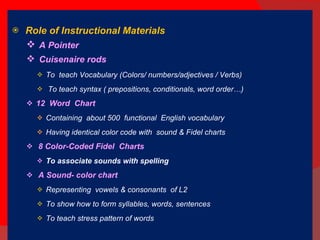
Role of Instructional Materials A Pointer Cuisenaire rods  To  teach Vocabulary (Colors/ numbers/adjectives / Verbs) To teach syntax ( prepositions, conditionals, word order…) 12  Word  Chart Containing  about 500  functional  English vocabulary  Having identical color code with  sound & Fidel charts 8 Color-Coded Fidel  Charts To associate sounds with spelling A Sound- color chart Representing  vowels & consonants  of L2 To show how to form syllables, words, sentences To teach stress pattern of words
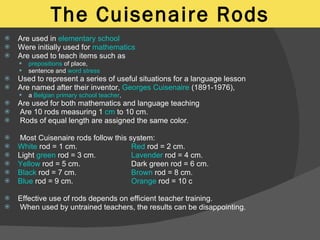
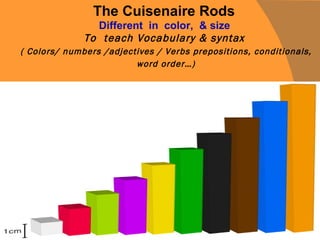
The Cuisenaire Rods Are used in  elementary school   Were initially used for  mathematics Are used to teach items such as  prepositions  of place,  sentence and  word stress   Used to represent a series of useful situations for a language lesson Are named after their inventor,  Georges Cuisenaire  (1891-1976),  a  Belgian   primary school   teacher ,  Are used for both mathematics and language teaching Are 10 rods measuring 1  cm  to 10 cm.  Rods of equal length are assigned the same color. Most Cuisenaire rods follow this system: White  rod = 1 cm. Red  rod = 2 cm. Light  green  rod = 3 cm. Lavender  rod = 4 cm. Yellow  rod = 5 cm. Dark green rod = 6 cm. Black  rod = 7 cm. Brown  rod = 8 cm. Blue  rod = 9 cm. Orange  rod = 10 c Effective use of rods depends on efficient teacher training. When used by untrained teachers, the results can be disappointing.
The Cuisenaire Rods  Different  in  color,  & size   To  teach Vocabulary & syntax  ( Colors/ numbers /adjectives / Verbs prepositions, conditionals, word order…)
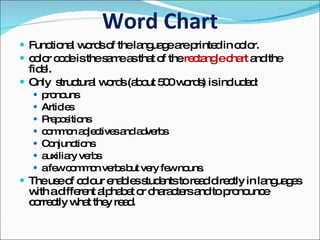
Word Chart Functional words of the language are printed in color. color code is the same as that of the  rectangle chart  and the fidel. Only  structural words (about 500 words) is included:  pronouns  Articles Prepositions common adjectives and adverbs Conjunctions auxiliary verbs a few common verbs but very few nouns. The use of colour enables students to read directly in languages with a different alphabet or characters and to pronounce correctly what they read.
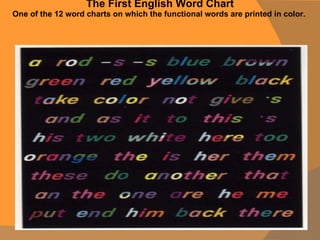
The First English Word Chart One of the 12 word charts on which the functional words are printed in color.
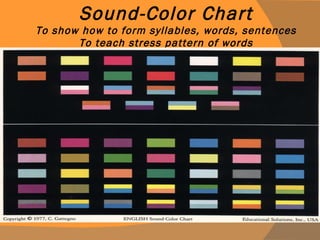
Sound-Color Chart To show how to form syllables, words, sentences To teach stress pattern of words
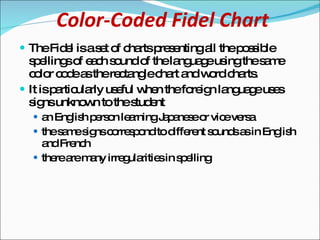
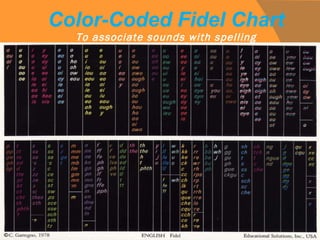
  Color-Coded Fidel Chart The Fidel is a set of charts presenting all the possible spellings of each sound of the language using the same color code as the rectangle chart and word charts. It is particularly useful when the foreign language uses signs unknown to the student an English person learning Japanese or vice versa the same signs correspond to different sounds as in English and French there are many irregularities in spelling
Color-Coded Fidel Chart To associate sounds with spelling
Procedure Teaching L2 sounds first Using sound-color chart Considering  L1 background of Ss Modeling sounds at the beginning Using pointer to indicate stress/phrasing /intonation Teaching sentence-patterns & vocabulary  Using colored rods for visual realization Modeling utterances by the teacher first Having a S  model & produce utterances No encouragement or correction by the teacher Regarding learning as personal responsibility Practice with L2 structure without repetition Self-correction gestures / peer correction Structured feedback

Silent Way

  • 1.
  • 2.
  • 3.
    Silent Way BackgroundDecline of Audio-lingualism (1960s) Theoretical Attack Rejection of structural linguistics Emergence of T-G linguistics Rejection of Behaviorism Emergence of Cognitive-code learning theory Practical Attack Inability to use L2 habits to communicative situations Boring & unsatisfying teaching procedures Alternative Teaching proposals (1980s) Silent Way by Caleb Gattegno TPR by James Asher CLL by Charles A. Curran
  • 4.
    Approach Language theoryStructural approach sentence a basic unit of teaching teaching & learning grammar inductively teaching functional vocabulary Learning theory Cognitive-code view of learning L2 learning radically different from L1 learning Meaningful, discovery learning Focus on having an artificial teaching approach Primacy of learning to teaching Rejection of repetition Silence a powerful tool for mental organization Inner criteria, self-correction
  • 5.
    Design Teaching ObjectivesTo attain near-native fluency in L2 Objectives for low-level students To gain oral-aural facility in basic L2 elements To gain a basic practical knowledge of L2 grammar To Perform adequately in reading , and writing Syllabus Richrds & Rogers: a Structural syllabus Larsen Freeman: Based on learners’ needs More lexico-grammatical units No precise selection & arrangement of content Grammatical complexity Ease of visual presentation
  • 6.
    Types of Teaching / Learning Activities Problem-solving activities Using charts, rods, other aids Helping Ss develop independence, autonomy, responsibility Developing inner criteria & correct themselves Cooperating with other Ss to solve language problems Cooperative rather than competitive procedures Learner Roles Rule discoverers / Language explorers Working cooperatively not competitively Correcting themselves & being corrected by others Making use of their background Assuming responsibility for their own learning
  • 7.
    Teacher Roles Technician/ engineer Stimulator / Not a hand holder Being silent most of the time Getting out of the way for Ss to develop inner criteria Cooperative rather than competitive procedures Learner Roles Rule discoverers / Language explorers Working cooperatively not competitively Correcting themselves & being corrected by others Making use of their background Assuming responsibility for their own learning
  • 8.
    Role of InstructionalMaterials A Pointer Cuisenaire rods To teach Vocabulary (Colors/ numbers/adjectives / Verbs) To teach syntax ( prepositions, conditionals, word order…) 12 Word Chart Containing about 500 functional English vocabulary Having identical color code with sound & Fidel charts 8 Color-Coded Fidel Charts To associate sounds with spelling A Sound- color chart Representing vowels & consonants of L2 To show how to form syllables, words, sentences To teach stress pattern of words
  • 9.
    The Cuisenaire RodsAre used in elementary school Were initially used for mathematics Are used to teach items such as prepositions of place, sentence and word stress Used to represent a series of useful situations for a language lesson Are named after their inventor, Georges Cuisenaire (1891-1976), a Belgian primary school teacher , Are used for both mathematics and language teaching Are 10 rods measuring 1 cm to 10 cm. Rods of equal length are assigned the same color. Most Cuisenaire rods follow this system: White rod = 1 cm. Red rod = 2 cm. Light green rod = 3 cm. Lavender rod = 4 cm. Yellow rod = 5 cm. Dark green rod = 6 cm. Black rod = 7 cm. Brown rod = 8 cm. Blue rod = 9 cm. Orange rod = 10 c Effective use of rods depends on efficient teacher training. When used by untrained teachers, the results can be disappointing.
  • 10.
    The Cuisenaire Rods Different in color, & size To teach Vocabulary & syntax ( Colors/ numbers /adjectives / Verbs prepositions, conditionals, word order…)
  • 11.
    Word Chart Functionalwords of the language are printed in color. color code is the same as that of the rectangle chart and the fidel. Only structural words (about 500 words) is included: pronouns Articles Prepositions common adjectives and adverbs Conjunctions auxiliary verbs a few common verbs but very few nouns. The use of colour enables students to read directly in languages with a different alphabet or characters and to pronounce correctly what they read.
  • 12.
    The First EnglishWord Chart One of the 12 word charts on which the functional words are printed in color.
  • 13.
    Sound-Color Chart Toshow how to form syllables, words, sentences To teach stress pattern of words
  • 14.
    Color-CodedFidel Chart The Fidel is a set of charts presenting all the possible spellings of each sound of the language using the same color code as the rectangle chart and word charts. It is particularly useful when the foreign language uses signs unknown to the student an English person learning Japanese or vice versa the same signs correspond to different sounds as in English and French there are many irregularities in spelling
  • 15.
    Color-Coded Fidel ChartTo associate sounds with spelling
  • 16.
    Procedure Teaching L2sounds first Using sound-color chart Considering L1 background of Ss Modeling sounds at the beginning Using pointer to indicate stress/phrasing /intonation Teaching sentence-patterns & vocabulary Using colored rods for visual realization Modeling utterances by the teacher first Having a S model & produce utterances No encouragement or correction by the teacher Regarding learning as personal responsibility Practice with L2 structure without repetition Self-correction gestures / peer correction Structured feedback