Dr.VMS
Language for communication
 Communication is an essential part of human interaction.
 The benefits of effective communication are many and obvious as they
enhance all aspects of our personal and professional lives.
 Ineffective or misunderstood communications in our personal lives
may give rise to problems or embarrassment but in our professional
lives the results of misunderstandings may have much more serious
results.
 There are several associated lexicographical terms that we meet when
studying languages.
 Those are a vocabulary, dictionary, thesaurus, lexicon, and glossary.
Needless to mention that these terms are often mixed up.
 A person's vocabulary is the set of words they are familiar with in a
language. A vocabulary usually grows and evolves with age, and serves
as a useful and fundamental tool for communication and acquiring
knowledge.
Lexical Enrichment
 Vocabulary is the words that are stored or what we
know. Words are the currency of communication. A
robust vocabulary improves all areas of
communication like listening, speaking, reading and
writing. People may judge you by means of your
vocabulary and how you use them. And an extensive
vocabulary aids expressions and communication.
Reading and Listening Vocabulary
 Ways we learn Vocabulary Reading vocabulary
 A person's reading vocabulary is all the words he or she
can recognize when reading.
 This is the most simple because this is aided by our visual
eyes.
 And as we know, we always encounter thousands of words,
phrases, lines, icons, graphics, etc. with our eyes as we look
around.
 A person's listening vocabulary is all the words he or she
can recognize when listening to speech.
 This vocabulary is aided in size by context and tone of
voice.
Writing and Speaking Vocabulary
 Writing vocabulary :- A person's writing vocabulary is all the
words he or she can employ in writing. Contrary to the previous
two vocabulary types, the writing vocabulary is stimulated by its
user.
 The greatest way to express your vocabulary well is in speech
writing, essays, research, advertisements and letters.
 In this way we can make our written work more colorful and
interesting.
 Speaking vocabulary:- A person's speaking vocabulary is all the
words he or she can use in speech. Due to the spontaneous
nature of the speaking vocabulary, words are often misused. This
misuse – though slight and unintentional – may be compensated
by facial expressions, tone of voice, or hand gestures.
Vocabulary Building
 Vocabulary is way too easy than learning mathematics.
 We use them often than computing numbers.
 But in learning new words, one should be actively receptive
to new words. Words won’t come chasing after you.
 You must train yourself to be on a constant lookout, in
reading and listening for any words that other people know
and you do not.
 And try to absorb the fascinating new words you come
across. Let them percolate in your mind.
 Learn the meanings of the words themselves, so you can
throw them around in your everyday speech. Throw them
about with abandon.
Vocabulary Building
 There are some key points that will help you understand a
word that you aren’t familiar with.
 Learning their Roots.
 Almost least half of the words in the English language are
derived from Greek and Latin roots.
 Knowing these roots helps us to grasp the meaning of
words before we look them up in the dictionary.
 It also helps us to see how words are often arranged in
families with similar characteristics. Like when we hear or
read something that has a “bio”, we think and understand
that the word is about life because “bio” means life.
Prefixes
 Prefixes showing negation without, no, anonymous,
illegal, immoral, not invalid, irreverent, unskilled not,
absence nonbreakable, antacid, antipathy, of,
opposing, contradict against opposite to,
counterclockwise, counterweight complement to do
the dehorn, devitalize, devalue opposite of, remove,
reduce do the disestablish, disarm opposite of, deprive
of wrongly, bad misjudge, misdeed Prefixes showing
time before antecedent, forecast, precede, prologue
after postwar again rewrite, redundant Prefixes
showing direction or position above, over
suffixes
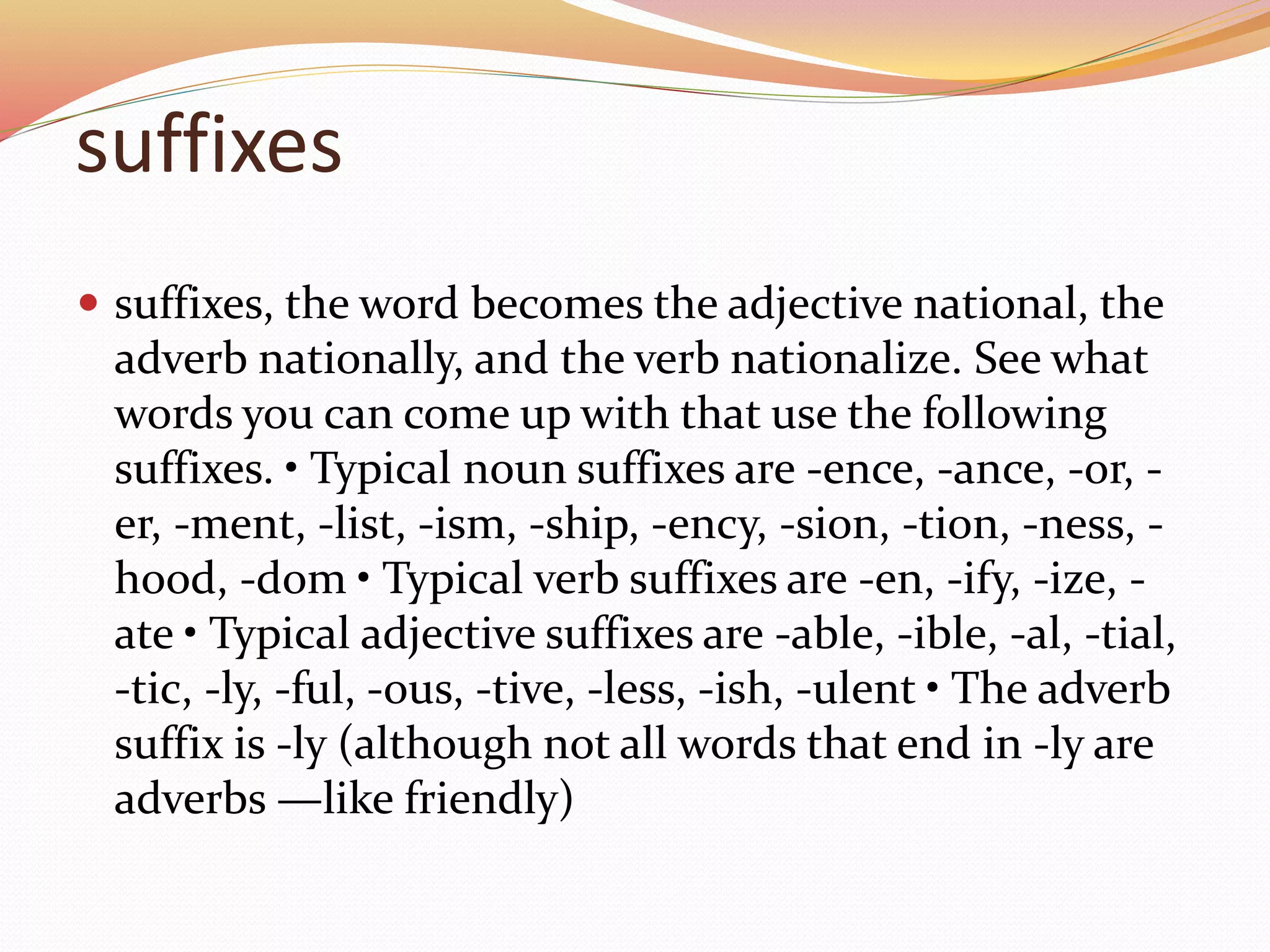
 suffixes, the word becomes the adjective national, the
adverb nationally, and the verb nationalize. See what
words you can come up with that use the following
suffixes. • Typical noun suffixes are -ence, -ance, -or, -
er, -ment, -list, -ism, -ship, -ency, -sion, -tion, -ness, -
hood, -dom • Typical verb suffixes are -en, -ify, -ize, -
ate • Typical adjective suffixes are -able, -ible, -al, -tial,
-tic, -ly, -ful, -ous, -tive, -less, -ish, -ulent • The adverb
suffix is -ly (although not all words that end in -ly are
adverbs —like friendly)
Lexical enrichment and lang development.pptx

Lexical enrichment and lang development.pptx

  • 1.
  • 2.
    Language for communication Communication is an essential part of human interaction.  The benefits of effective communication are many and obvious as they enhance all aspects of our personal and professional lives.  Ineffective or misunderstood communications in our personal lives may give rise to problems or embarrassment but in our professional lives the results of misunderstandings may have much more serious results.  There are several associated lexicographical terms that we meet when studying languages.  Those are a vocabulary, dictionary, thesaurus, lexicon, and glossary. Needless to mention that these terms are often mixed up.  A person's vocabulary is the set of words they are familiar with in a language. A vocabulary usually grows and evolves with age, and serves as a useful and fundamental tool for communication and acquiring knowledge.
  • 3.
    Lexical Enrichment  Vocabularyis the words that are stored or what we know. Words are the currency of communication. A robust vocabulary improves all areas of communication like listening, speaking, reading and writing. People may judge you by means of your vocabulary and how you use them. And an extensive vocabulary aids expressions and communication.
  • 4.
    Reading and ListeningVocabulary  Ways we learn Vocabulary Reading vocabulary  A person's reading vocabulary is all the words he or she can recognize when reading.  This is the most simple because this is aided by our visual eyes.  And as we know, we always encounter thousands of words, phrases, lines, icons, graphics, etc. with our eyes as we look around.  A person's listening vocabulary is all the words he or she can recognize when listening to speech.  This vocabulary is aided in size by context and tone of voice.
  • 5.
    Writing and SpeakingVocabulary  Writing vocabulary :- A person's writing vocabulary is all the words he or she can employ in writing. Contrary to the previous two vocabulary types, the writing vocabulary is stimulated by its user.  The greatest way to express your vocabulary well is in speech writing, essays, research, advertisements and letters.  In this way we can make our written work more colorful and interesting.  Speaking vocabulary:- A person's speaking vocabulary is all the words he or she can use in speech. Due to the spontaneous nature of the speaking vocabulary, words are often misused. This misuse – though slight and unintentional – may be compensated by facial expressions, tone of voice, or hand gestures.
  • 6.
    Vocabulary Building  Vocabularyis way too easy than learning mathematics.  We use them often than computing numbers.  But in learning new words, one should be actively receptive to new words. Words won’t come chasing after you.  You must train yourself to be on a constant lookout, in reading and listening for any words that other people know and you do not.  And try to absorb the fascinating new words you come across. Let them percolate in your mind.  Learn the meanings of the words themselves, so you can throw them around in your everyday speech. Throw them about with abandon.
  • 7.
    Vocabulary Building  Thereare some key points that will help you understand a word that you aren’t familiar with.  Learning their Roots.  Almost least half of the words in the English language are derived from Greek and Latin roots.  Knowing these roots helps us to grasp the meaning of words before we look them up in the dictionary.  It also helps us to see how words are often arranged in families with similar characteristics. Like when we hear or read something that has a “bio”, we think and understand that the word is about life because “bio” means life.
  • 8.
    Prefixes  Prefixes showingnegation without, no, anonymous, illegal, immoral, not invalid, irreverent, unskilled not, absence nonbreakable, antacid, antipathy, of, opposing, contradict against opposite to, counterclockwise, counterweight complement to do the dehorn, devitalize, devalue opposite of, remove, reduce do the disestablish, disarm opposite of, deprive of wrongly, bad misjudge, misdeed Prefixes showing time before antecedent, forecast, precede, prologue after postwar again rewrite, redundant Prefixes showing direction or position above, over
  • 9.
    suffixes  suffixes, theword becomes the adjective national, the adverb nationally, and the verb nationalize. See what words you can come up with that use the following suffixes. • Typical noun suffixes are -ence, -ance, -or, - er, -ment, -list, -ism, -ship, -ency, -sion, -tion, -ness, - hood, -dom • Typical verb suffixes are -en, -ify, -ize, - ate • Typical adjective suffixes are -able, -ible, -al, -tial, -tic, -ly, -ful, -ous, -tive, -less, -ish, -ulent • The adverb suffix is -ly (although not all words that end in -ly are adverbs —like friendly)