Prepared by: Ruby Angela d. O. Pena
What do the languages of the
world have in common?
And how do they differ from each
other?
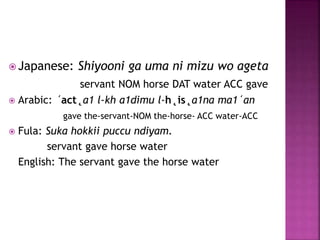
 Japanese: Shiyooni ga uma ni mizu wo ageta
servant NOM horse DAT water ACC gave
 Arabic: ´act˛a1 l-kh a1dimu l-h˛is˛a1na ma1´an
gave the-servant-NOM the-horse- ACC water-ACC
 Fula: Suka hokkii puccu ndiyam.
servant gave horse water
English: The servant gave the horse water
 The pronunciation of words differ from one
language to another.
 The word order also differ.
 All three languages have sentences that
consist of words with a pronunciation and a
meaning.
 In all three languages, the pronunciation may
be analyzed into vowels and consonants that
combine into syllables.
 In all three languages, the action of giving is
referred to with a verb, while the servant,
the horse and the water are referred to with
nouns.
 It is a pattern that occurs systematically
across natural languages, potentially true for
all of them.
 Properties shared by all languages
1. Absolute
2. Statistical
 refer to properties found in all languages.
 All languages have vowels and consonants.
 reflect important trends that are found in a
predominant part of the languages of the
world, but not necessarily in all.
 Subjects tend strongly to precede objects.
1. Monogenesis Hypothesis
2. Language Contact Hypothesis
3. Innateness Hypothesis
 The idea that all languages stem from the
same protolanguage and have inherited the
same universal traits from this
protolanguage.
 According to this hypothesis, language
have many thiings in common because
they are constantly influenced by each
other.
 This fits well with the fact that
exceptional features are often found in
peripheral languages that have developed
in relative isolation.
 Example: few languages in which the object
usually precedes the subject are mostly located
in the geographical periphery and have
traditionally had little contact with other
languages.
 This includes Austronesian island languages Fijian
and Malagasy (VOS); a number of very small
languages along the tributaries of the Amazon
River in Brazil (OVS).
 Languages learn from each other and the strong
tendency for subjects to recede objects may at
least partly be a result of language contact.
 The idea that our ability to use language is a
part of our genetic endowment, and that
genetics also determines many details in the
form and structure of languages.
 We may be genetically predisposed to
distinguish between vowels and consonants,
and to let subjects precede objects.
 This also explains our ability to learn and use
language as an effect of an innate grammar—
a genetic program specifically designed to
determine the development of our language
ability.
 Example: our speech organs are shaped in a
unique way that enable us to speak the way
we do (as opposed to apes, who would not be
able to pronounce the sounds of human
language even if they wanted to.)
 Some language features are universal
because they make linguistic utterances
easier both to produce and to interpret.
 All languages, obviously, have both
consonants and vowels.
 A language with only consonants would be
very difficult to hear, since consonants are
generally less sonorant than vowels.
 A language with only vowels, on the other
hand, would be unsatisfactory because we
are only able to distinguish a very limited
number of vowel qualities.
 Most lexical universals are approximate
rather than precis.
 For instance, it has often been said that all
languages have the concept of “black” and
“white” but this is only true in an
approximate sense.
 Another, an English speaker learning Chinese
will have to learn eight new concepts for
cousin while a Chinese speaker learning
English will have to learn the general
concept represented by the English word
cousin.
 Most lexical universals are also statistical and
absolite.
 The concept of water, for instance, is
probably found in most languages, but not in
all.
 Japanese: mizu – cold water; o-yu – hot
water
 Yimas language of New Guinea: arm - liquid
 The Norwegian word for carrot is gulrot
which translates as yellow root while in
Chinese it is called as hong luobo or red
turnip. Since the color of carrot is in
between red or yellow, the more appropriate
color term would be orange.
 Interjection
 Nouns
 Verbs
 All languages appear to have a separate class
of words resembling English words like wow,
psst, mhm, and wham.
 All or at least nearly all languages of the
world also make a distinction between nouns
and verbs.
 The prototypical noun refers to an entity (a
substance or an object), while the
prototypical verb refers to a process
(dynamic or stative).
 In Chinese, the class of verbs also includes
words resembling English prepositions.
 Example: cut with a knife is rendered as
using a knife [to] cut.
 Also the same with Samoan, the class of
verbs also includes words resembling English
numerals, so that two men is rendered as
man being-two.
 Some segmental phonemes are universal,
while others are found in some languages and
not in others.
 No language is known for sure to have less
than three vowel phonemes.
 No language is known for sure to have more
than 46 vowel phonemes.
The distinctive features involved in the
3-vowel system are universal:
1. All languages make a distinction between
close and open vowels.
2. All languages make a distinction between
front and back vowels
 The number of consonant phonemes in a
language varies from 6 to 95, the average
number being 23.
 All languages make a distinction between
labial (lip) and lingual (tongue) articulation,
and all but a very few divide lingual
articulation further into coronal (front part
of the tongue) and dorsal (tongue ridge)
articulation.
 Many languages distinguish between laminal
(tongue blade) and apical (tongue tip)
articulations
 All languages have syllables ending in a
vowel (open syllables), but not necessarily
syllables ending in a consonant (closed
syllables).
 All languages have syllables with an initial
consonant, but not necessarily syllables
without an initial consonant.
 All languages that allo VC, also allow CVC
and V, as well as the universal CV.
 Talking about linguistic universal is
distinguishing the differences and features
(structure, meaning, word order,
pronunciation) of the world languages in
order to know what these languages have in
common.
Thank you very much for
listening and I hope you
learned something from my
report. 

Linguistic Universal

  • 1.
    Prepared by: RubyAngela d. O. Pena
  • 2.
    What do thelanguages of the world have in common? And how do they differ from each other?
  • 3.
     Japanese: Shiyooniga uma ni mizu wo ageta servant NOM horse DAT water ACC gave  Arabic: ´act˛a1 l-kh a1dimu l-h˛is˛a1na ma1´an gave the-servant-NOM the-horse- ACC water-ACC  Fula: Suka hokkii puccu ndiyam. servant gave horse water English: The servant gave the horse water
  • 4.
     The pronunciationof words differ from one language to another.  The word order also differ.
  • 5.
     All threelanguages have sentences that consist of words with a pronunciation and a meaning.  In all three languages, the pronunciation may be analyzed into vowels and consonants that combine into syllables.  In all three languages, the action of giving is referred to with a verb, while the servant, the horse and the water are referred to with nouns.
  • 6.
     It isa pattern that occurs systematically across natural languages, potentially true for all of them.  Properties shared by all languages
  • 7.
  • 8.
     refer toproperties found in all languages.  All languages have vowels and consonants.
  • 9.
     reflect importanttrends that are found in a predominant part of the languages of the world, but not necessarily in all.  Subjects tend strongly to precede objects.
  • 10.
    1. Monogenesis Hypothesis 2.Language Contact Hypothesis 3. Innateness Hypothesis
  • 11.
     The ideathat all languages stem from the same protolanguage and have inherited the same universal traits from this protolanguage.
  • 12.
     According tothis hypothesis, language have many thiings in common because they are constantly influenced by each other.  This fits well with the fact that exceptional features are often found in peripheral languages that have developed in relative isolation.
  • 13.
     Example: fewlanguages in which the object usually precedes the subject are mostly located in the geographical periphery and have traditionally had little contact with other languages.  This includes Austronesian island languages Fijian and Malagasy (VOS); a number of very small languages along the tributaries of the Amazon River in Brazil (OVS).  Languages learn from each other and the strong tendency for subjects to recede objects may at least partly be a result of language contact.
  • 14.
     The ideathat our ability to use language is a part of our genetic endowment, and that genetics also determines many details in the form and structure of languages.  We may be genetically predisposed to distinguish between vowels and consonants, and to let subjects precede objects.  This also explains our ability to learn and use language as an effect of an innate grammar— a genetic program specifically designed to determine the development of our language ability.
  • 15.
     Example: ourspeech organs are shaped in a unique way that enable us to speak the way we do (as opposed to apes, who would not be able to pronounce the sounds of human language even if they wanted to.)
  • 16.
     Some languagefeatures are universal because they make linguistic utterances easier both to produce and to interpret.  All languages, obviously, have both consonants and vowels.  A language with only consonants would be very difficult to hear, since consonants are generally less sonorant than vowels.  A language with only vowels, on the other hand, would be unsatisfactory because we are only able to distinguish a very limited number of vowel qualities.
  • 17.
     Most lexicaluniversals are approximate rather than precis.  For instance, it has often been said that all languages have the concept of “black” and “white” but this is only true in an approximate sense.  Another, an English speaker learning Chinese will have to learn eight new concepts for cousin while a Chinese speaker learning English will have to learn the general concept represented by the English word cousin.
  • 18.
     Most lexicaluniversals are also statistical and absolite.  The concept of water, for instance, is probably found in most languages, but not in all.  Japanese: mizu – cold water; o-yu – hot water  Yimas language of New Guinea: arm - liquid
  • 19.
     The Norwegianword for carrot is gulrot which translates as yellow root while in Chinese it is called as hong luobo or red turnip. Since the color of carrot is in between red or yellow, the more appropriate color term would be orange.
  • 20.
  • 21.
     All languagesappear to have a separate class of words resembling English words like wow, psst, mhm, and wham.
  • 22.
     All orat least nearly all languages of the world also make a distinction between nouns and verbs.  The prototypical noun refers to an entity (a substance or an object), while the prototypical verb refers to a process (dynamic or stative).  In Chinese, the class of verbs also includes words resembling English prepositions.  Example: cut with a knife is rendered as using a knife [to] cut.
  • 23.
     Also thesame with Samoan, the class of verbs also includes words resembling English numerals, so that two men is rendered as man being-two.
  • 24.
     Some segmentalphonemes are universal, while others are found in some languages and not in others.
  • 25.
     No languageis known for sure to have less than three vowel phonemes.  No language is known for sure to have more than 46 vowel phonemes. The distinctive features involved in the 3-vowel system are universal: 1. All languages make a distinction between close and open vowels. 2. All languages make a distinction between front and back vowels
  • 26.
     The numberof consonant phonemes in a language varies from 6 to 95, the average number being 23.  All languages make a distinction between labial (lip) and lingual (tongue) articulation, and all but a very few divide lingual articulation further into coronal (front part of the tongue) and dorsal (tongue ridge) articulation.  Many languages distinguish between laminal (tongue blade) and apical (tongue tip) articulations
  • 27.
     All languageshave syllables ending in a vowel (open syllables), but not necessarily syllables ending in a consonant (closed syllables).  All languages have syllables with an initial consonant, but not necessarily syllables without an initial consonant.  All languages that allo VC, also allow CVC and V, as well as the universal CV.
  • 28.
     Talking aboutlinguistic universal is distinguishing the differences and features (structure, meaning, word order, pronunciation) of the world languages in order to know what these languages have in common.
  • 29.
    Thank you verymuch for listening and I hope you learned something from my report. 