


http://www.free-powerpoint-templates-design.com
LANGUAGE PLANNING
STATUS PLANNING
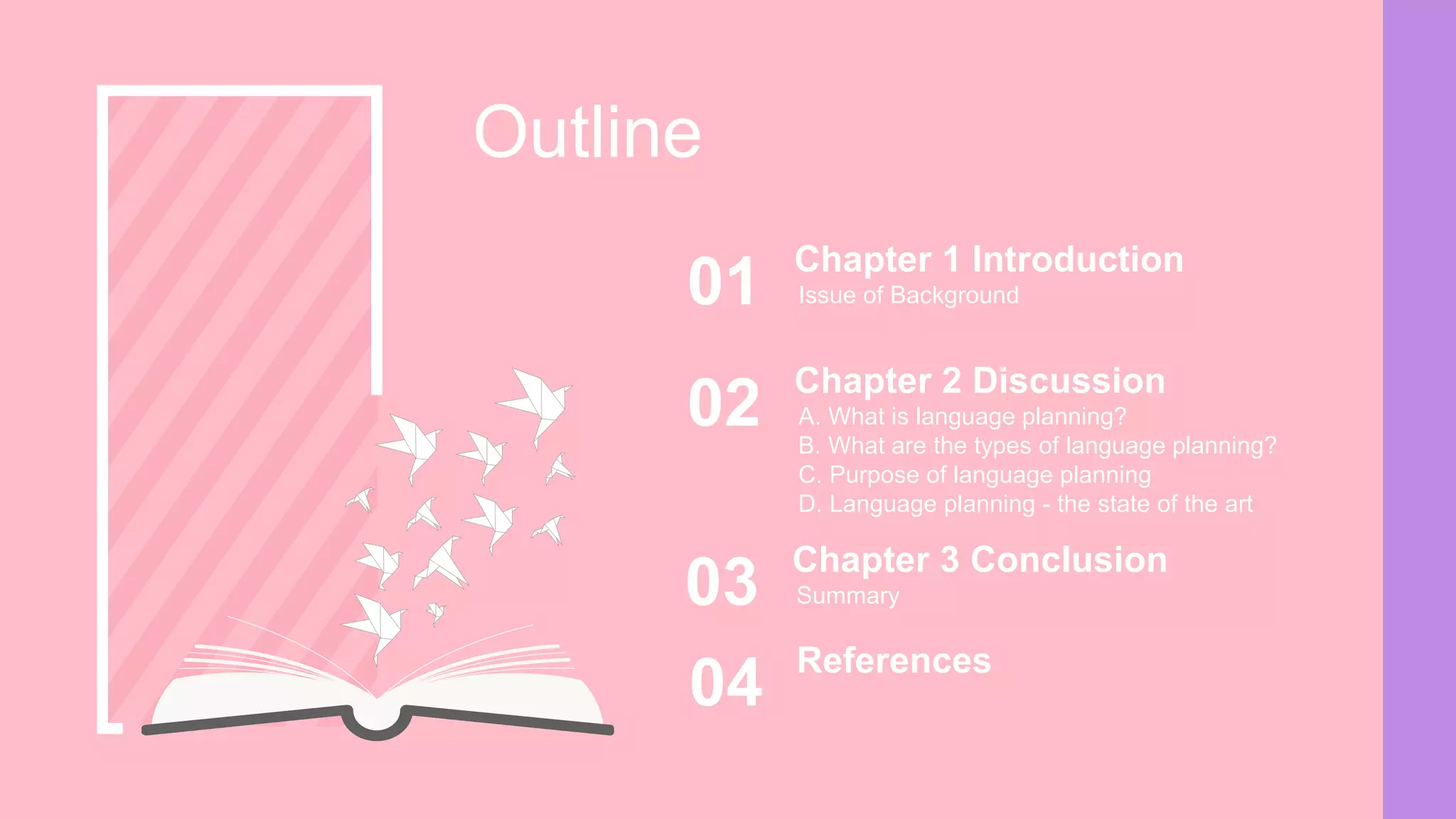
Issue of Background
Chapter 1 Introduction
01
Outline
A. What is language planning?
B. What are the types of language planning?
C. Purpose of language planning
D. Language planning - the state of the art
Chapter 2 Discussion
02
Summary
Chapter 3 Conclusion
03
References
04
Meet
Our
Team
“The limits of my language are
the limits of my world”
Ludwig Wittgenstein
Aprilianty Widyastuti
NIM. 1705086025
Didien Novianty
NIM. 1705086026
Dian Eka Rachmawati
NIM. 1705086028
Kartika Natalia
NIM. 1705086019
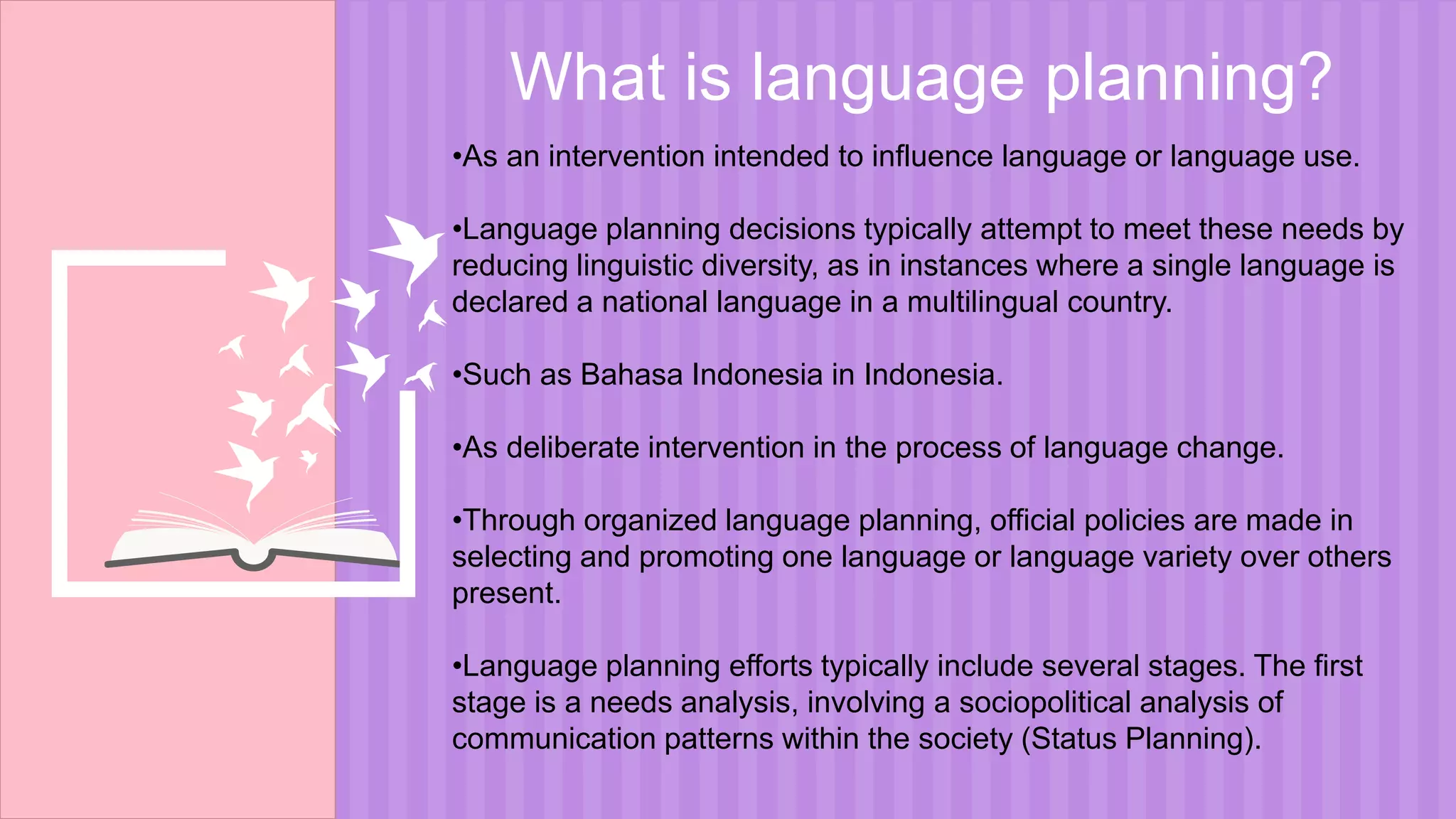
What is language planning?
•As an intervention intended to influence language or language use.
•Language planning decisions typically attempt to meet these needs by
reducing linguistic diversity, as in instances where a single language is
declared a national language in a multilingual country.
•Such as Bahasa Indonesia in Indonesia.
•As deliberate intervention in the process of language change.
•Through organized language planning, official policies are made in
selecting and promoting one language or language variety over others
present.
•Language planning efforts typically include several stages. The first
stage is a needs analysis, involving a sociopolitical analysis of
communication patterns within the society (Status Planning).
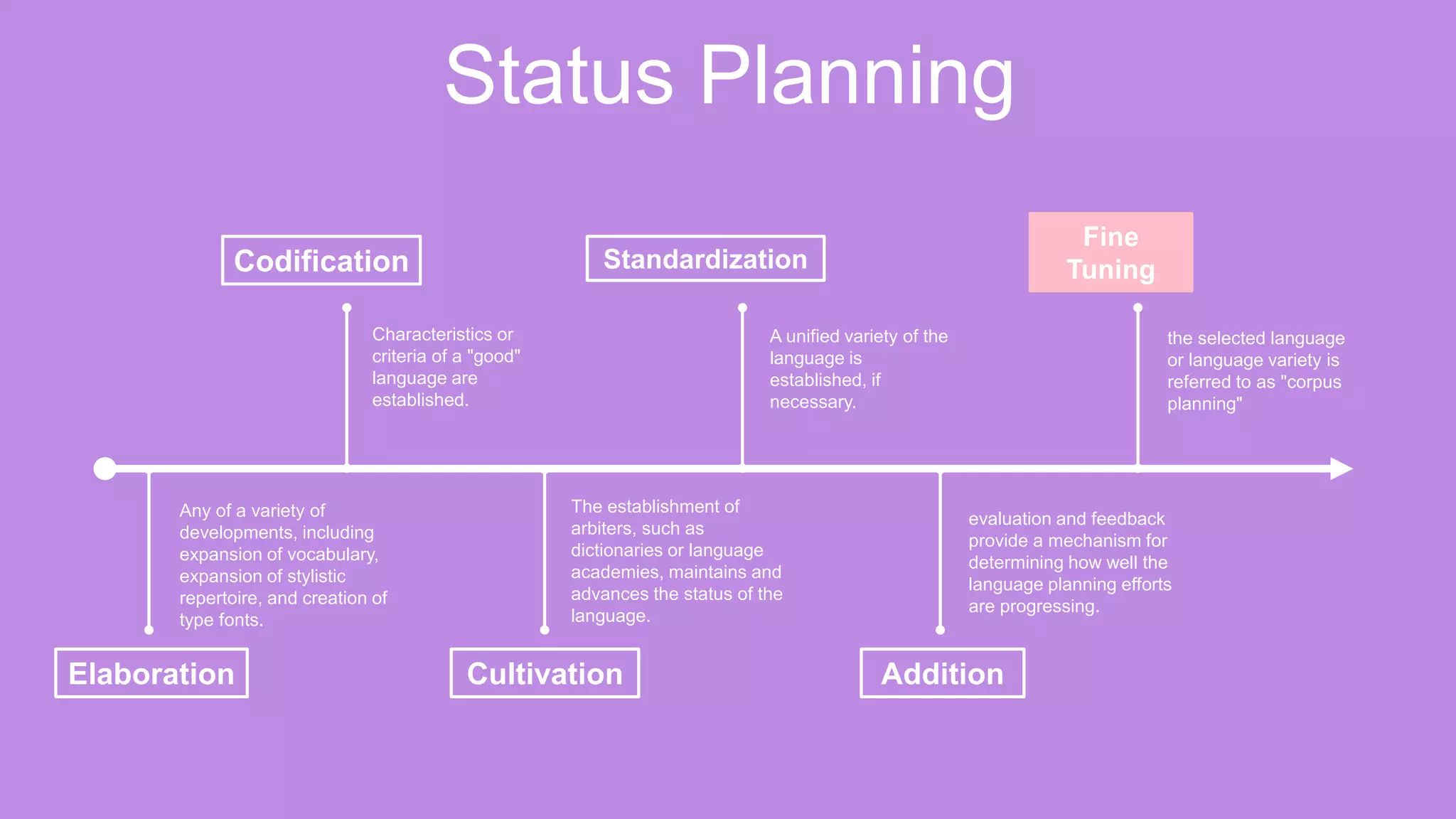
Status Planning
Codification
Characteristics or
criteria of a "good"
language are
established.
Standardization
A unified variety of the
language is
established, if
necessary.
Fine
Tuning
the selected language
or language variety is
referred to as "corpus
planning"
Elaboration
Any of a variety of
developments, including
expansion of vocabulary,
expansion of stylistic
repertoire, and creation of
type fonts.
Cultivation
The establishment of
arbiters, such as
dictionaries or language
academies, maintains and
advances the status of the
language.
Addition
evaluation and feedback
provide a mechanism for
determining how well the
language planning efforts
are progressing.
Stewart’s functions as targets
of status planning (1968)
Haugen and Classic
Language Planning (1959)
According to Cooper (1989): Status
Planning refers to deliberate efforts
to allocate the functions of languages
and literacies within a speech
community.
Definition
Chapter 2
Discussion
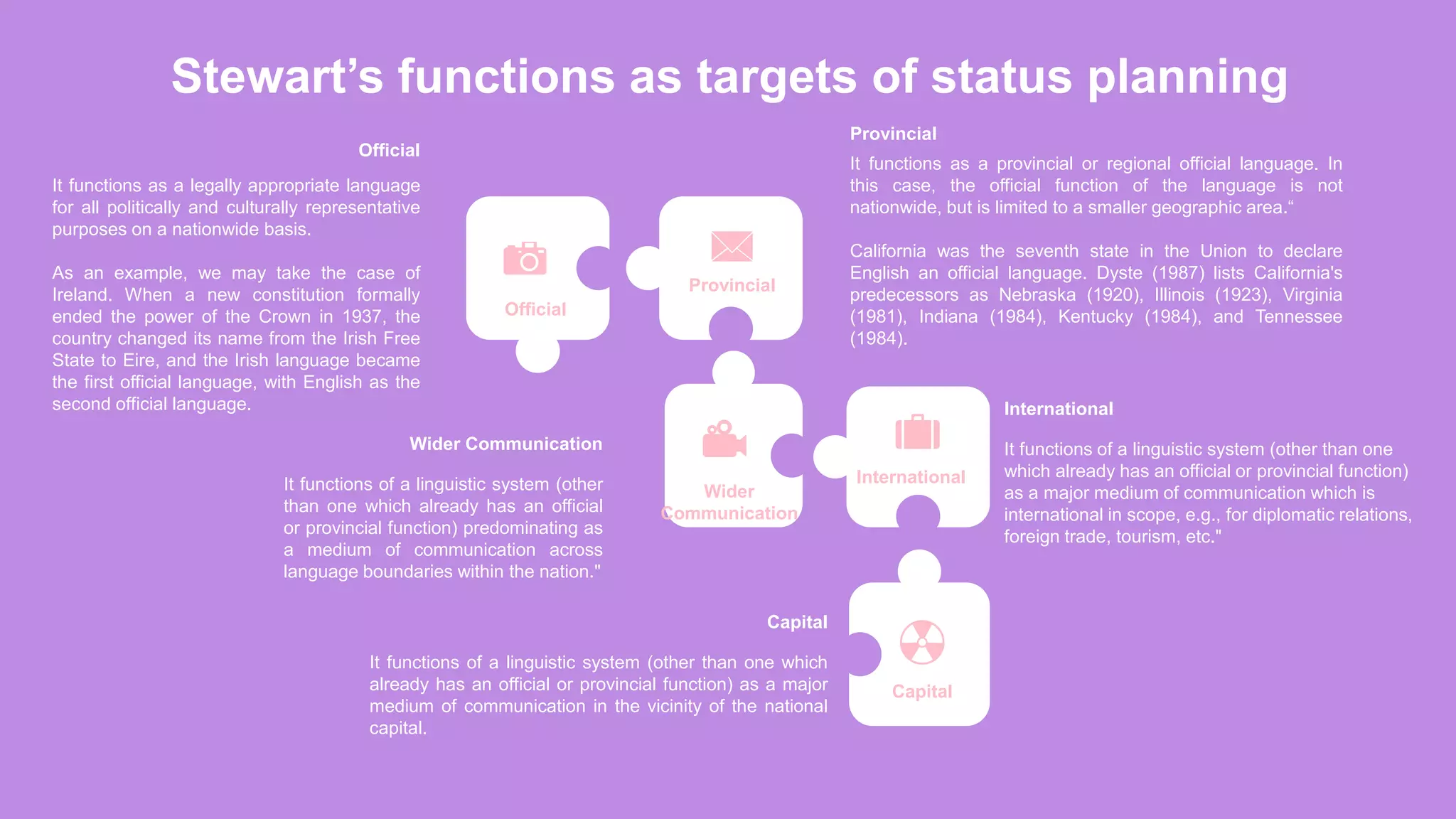
Stewart’s functions as targets of status planning
Provincial
It functions as a provincial or regional official language. In
this case, the official function of the language is not
nationwide, but is limited to a smaller geographic area.“
California was the seventh state in the Union to declare
English an official language. Dyste (1987) lists California's
predecessors as Nebraska (1920), Illinois (1923), Virginia
(1981), Indiana (1984), Kentucky (1984), and Tennessee
(1984).
Capital
It functions of a linguistic system (other than one which
already has an official or provincial function) as a major
medium of communication in the vicinity of the national
capital.
International
It functions of a linguistic system (other than one
which already has an official or provincial function)
as a major medium of communication which is
international in scope, e.g., for diplomatic relations,
foreign trade, tourism, etc."
Official
It functions as a legally appropriate language
for all politically and culturally representative
purposes on a nationwide basis.
As an example, we may take the case of
Ireland. When a new constitution formally
ended the power of the Crown in 1937, the
country changed its name from the Irish Free
State to Eire, and the Irish language became
the first official language, with English as the
second official language.
Wider Communication
It functions of a linguistic system (other
than one which already has an official
or provincial function) predominating as
a medium of communication across
language boundaries within the nation."
Official
Provincial
Wider
Communication
International
Capital
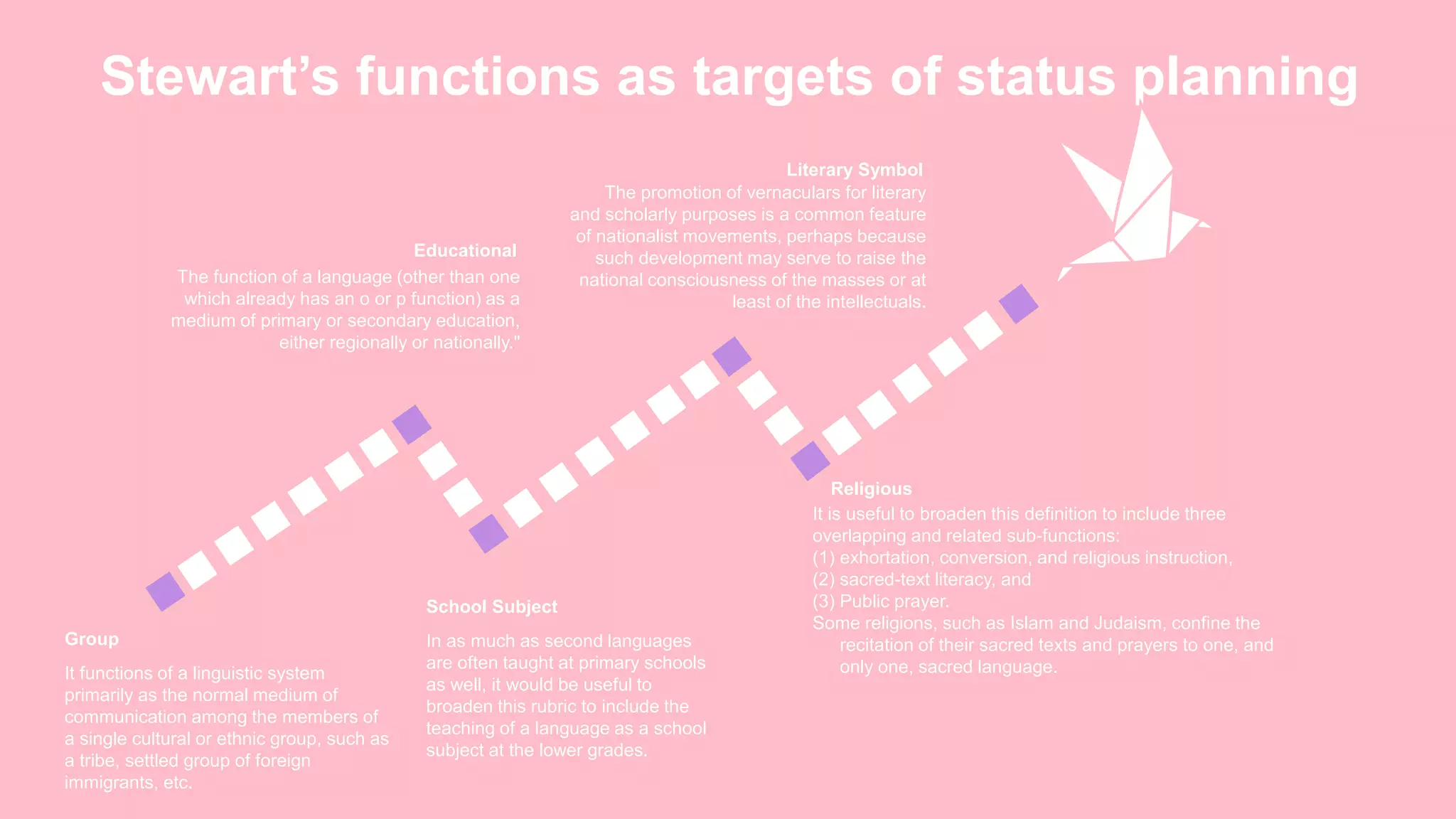
Stewart’s functions as targets of status planning
It functions of a linguistic system
primarily as the normal medium of
communication among the members of
a single cultural or ethnic group, such as
a tribe, settled group of foreign
immigrants, etc.
Group
The function of a language (other than one
which already has an o or p function) as a
medium of primary or secondary education,
either regionally or nationally."
Educational
The promotion of vernaculars for literary
and scholarly purposes is a common feature
of nationalist movements, perhaps because
such development may serve to raise the
national consciousness of the masses or at
least of the intellectuals.
Literary Symbol
In as much as second languages
are often taught at primary schools
as well, it would be useful to
broaden this rubric to include the
teaching of a language as a school
subject at the lower grades.
School Subject
It is useful to broaden this definition to include three
overlapping and related sub-functions:
(1) exhortation, conversion, and religious instruction,
(2) sacred-text literacy, and
(3) Public prayer.
Some religions, such as Islam and Judaism, confine the
recitation of their sacred texts and prayers to one, and
only one, sacred language.
Religious
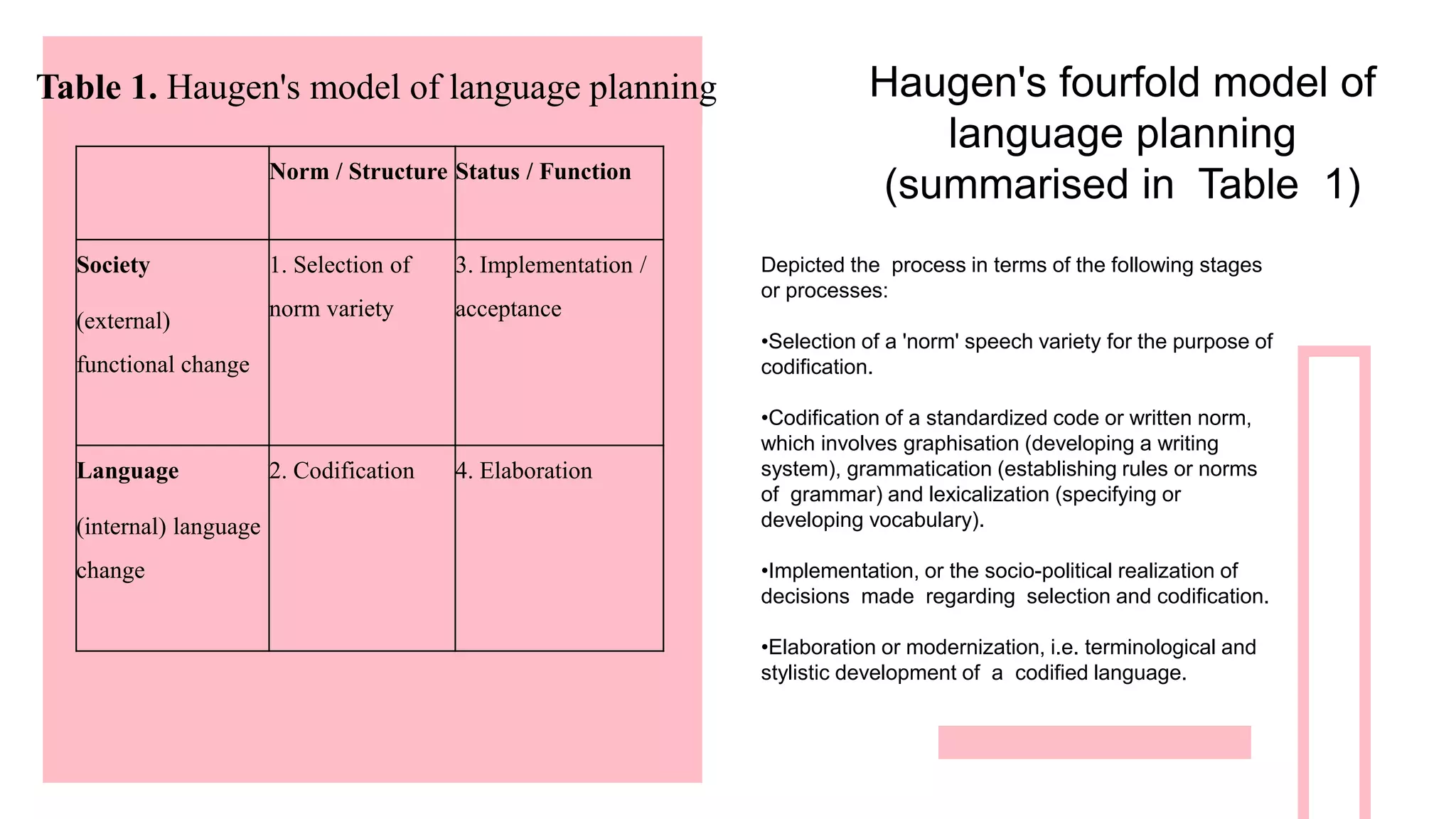
Haugen's fourfold model of
language planning
(summarised in Table 1)
Depicted the process in terms of the following stages
or processes:
•Selection of a 'norm' speech variety for the purpose of
codification.
•Codification of a standardized code or written norm,
which involves graphisation (developing a writing
system), grammatication (establishing rules or norms
of grammar) and lexicalization (specifying or
developing vocabulary).
•Implementation, or the socio-political realization of
decisions made regarding selection and codification.
•Elaboration or modernization, i.e. terminological and
stylistic development of a codified language.
Norm / Structure Status / Function
Society
(external)
functional change
1. Selection of
norm variety
3. Implementation /
acceptance
Language
(internal) language
change
2. Codification 4. Elaboration
Table 1. Haugen's model of language planning
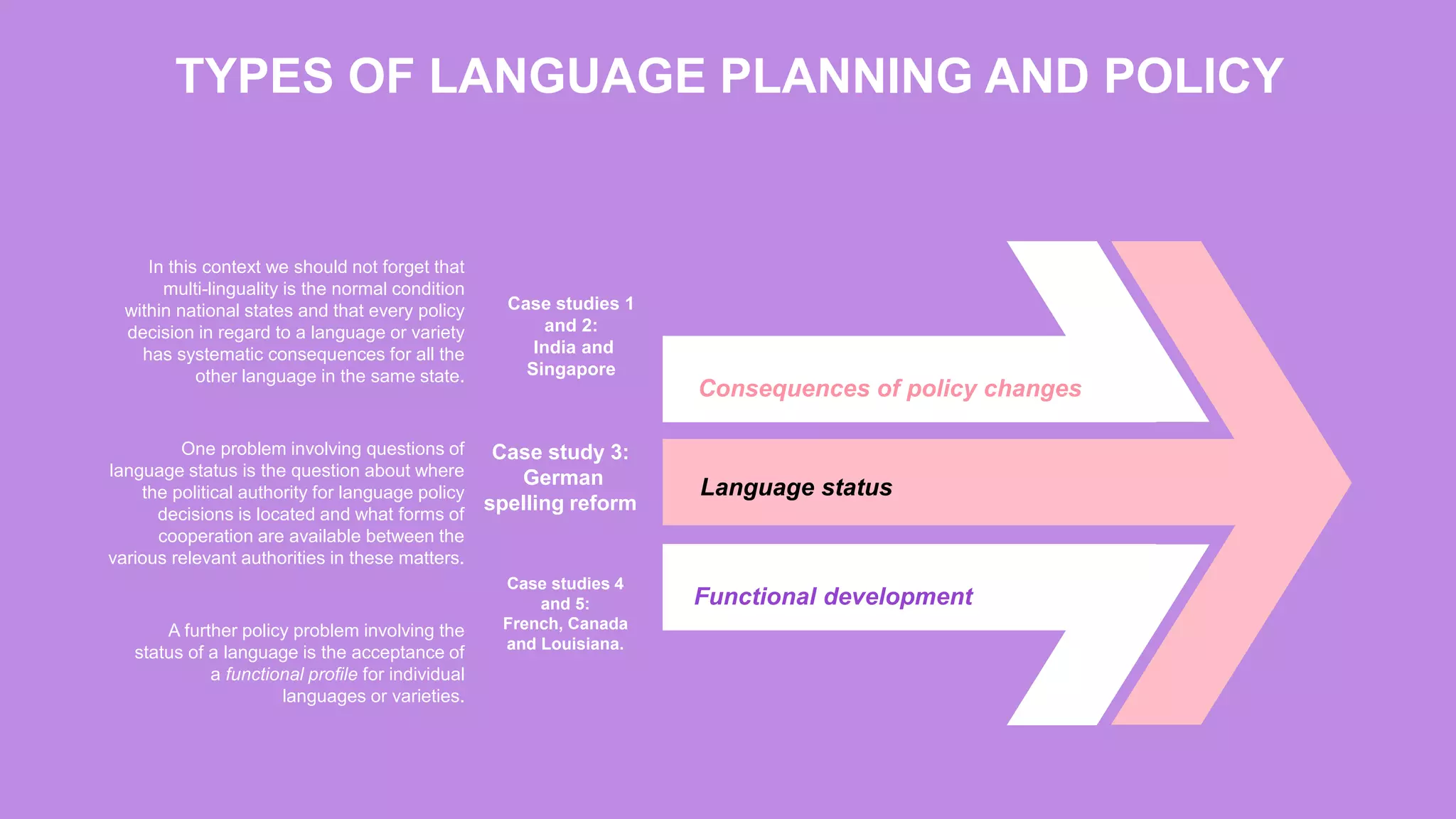
TYPES OF LANGUAGE PLANNING AND POLICY
Consequences of policy changes
Language status
Functional development
Case study 3:
German
spelling reform
Case studies 1
and 2:
India and
Singapore
Case studies 4
and 5:
French, Canada
and Louisiana.
In this context we should not forget that
multi-linguality is the normal condition
within national states and that every policy
decision in regard to a language or variety
has systematic consequences for all the
other language in the same state.
One problem involving questions of
language status is the question about where
the political authority for language policy
decisions is located and what forms of
cooperation are available between the
various relevant authorities in these matters.
A further policy problem involving the
status of a language is the acceptance of
a functional profile for individual
languages or varieties.
TYPES OF LANGUAGE PLANNING AND POLICY
Examples from History
Neustupný (1993, 2006) attempted to describe the
history of language planning as social practice using
the concept of developmental types, which are
determined by the specific order of a number of
sociocultural phenomena
The French Academy
The first example, which can be categorized
as a (late) Premodern type, is the initial
activity of the Académie française, the
language academy founded in 1634.Standardization
Processes of standardization come about
whenever a number of variants are available,
one of which has to be selected, leaving the
others in a subordinate position.
Other functions as targets of status planning
Status planning decisions are made with
respect to at least two uses in addition to
those identified by Stewart: the mass media
and work.
Structural development
Language policy measures which have an
effect on the structure of the language
(corpus planning) comprise processes of
selection and standardization of variants on
the linguistic levels of grammar and lexicon
European National Movements
A second example illustrating the Early
Modern type is the language planning that
was a part of the European national
movements of the nineteenth century.
These movements led to the forma- tion of a
number of modern nations in the Herderian
sense (Slovak, Czech, Norwegian, Finnish
and other nations).
TYPES OF LANGUAGE PLANNING AND POLICY
The third case is the language
planning in the Soviet Union that
took place in the 1920s and
1930s.
Soviet Union of the 1920s and 1930s
The work done was noteworthy: Alpatov
(2000,p. 222), for example, claims that more
than seventy alphabets were created for the
languages of the Soviet Union during this
period.
Soviet Union of the 1920s and 1930s
The fourth example is the language planning
that occurred in Czechoslovakia in the 1920s
and 1930s, the participants of which were the
linguists of the Prague Linguistic School (above
all B. Havránek and V. Mathesius, also in part R.
O. Jakobson).
Czechoslovakia and the Prague Linguistic School
PURPOSE OF LANGUAGE PLANNING
Your Text Here
Language Revival:
To attempt to turn a language with few or
no surviving native speakers back into a
spoken means of communication.
Example:
Hebrew
Language Purification:
To prescribe the usage in order to
preserve the “linguistic purity” of a
language and protect it from foreign
influences.
Example:
Classical Arabic grammar books.
PURPOSE OF LANGUAGE PLANNING
Language Reform :
To deliberately change specific aspects of a
language such as orthography or grammar in
order to facilitate its use.
Example:
Chinese [reduced the number of characters]
Turkish [Changed characters from Arabic to Latin
Language Spread:
To attempt to increase the number of speakers
of one language at the expense of another.
Example: The spread of Spanish in Paraguay at
the expense of the native language, Guarani.
Language Maintenance:
To preserve the use of a group’s native language
as a first or second language where pressure
cause a decline in the status of the language.
Example: Welsh.
Terminology Unification:
To develop unified terminologies, primarily in
technical domains.
Example: The Arab Language Academy
LANGUAGE PLANNING - THE STATE OF THE ART
Add Text
Simple
PowerPoint
Presentation
Add Text
Simple
PowerPoint
Presentation
) Language planning, at the present point in time is seen as an important
core component within the general framework of Language Policy. The other
two components are ‘language ideology’ and ‘language practices’ of the
people. (Spolsky 5).
“Language Planning cannot be 66 understood apart from its social context or
the history that produced the context.” (Cooper, 183)
Language Planning is seen as managemental and interventionist strategy
mainly dealing with the status issue of the choice of language or language
variety made available to people. In some societies like Britain, this choice is
“implicit and the public discussion ofthe subject is muted,” and in some
others, like France or India, “language choice is explicit, legislated for and
much discussed” (Wright, 148).
It is today well accepted that Language Planning is not just the domain of
government-authorized agencies: intellectual and power elites also have an
enormous influence.
LANGUAGE PLANNING - THE STATE OF THE ART
Conclusion
D
DD
01 02 0402 03
It argues that language
planning has been
conducted in various
countries for centuries
and from the perspective
of developmental types
The theories, models and
frameworks of language
planning will undoubtedly
continue to develop based
on the demand for language
planning itself in
contemporary society
. It appears that
this demand is
growing rather than
decreasing.
ReferencesPresentat
ion
Cooper, Robert l.1989. Language Planning And Social Change.Cambridge University
Press
Haugen, Einar. (1966). Linguistics and language planning. In: W. Bright (ed.)
Sociolinguistics: Proceedings of the UCLA Sociolinguistics Conference, 1964. The
Hague: Mouton. 50–71.
Haugen, Einar. (1987). Language planning. In: U. Ammon, N. Dittmer & J. K. Mattheier
(eds.) Sociolinguistics: An international handbook of the science of language and
society, vol. 1. Berlin / New York: de Gruyter. 626–637.
Jiří Nekvapil. 2011. The history and theory of language planning.Charles University,
Prague; Faculty of Arts
Lloyd Hill . 2010. Language and status: On the limits of language planning. Stellenbosch
Papers in Linguistics, Vol. 39, 2010, 41-58 doi: 10.5774/39-0-3
Thank YouInsert the Sub Title of Your Presentation

Language policy Status Planning

  • 1.
  • 2.
    Issue of Background Chapter1 Introduction 01 Outline A. What is language planning? B. What are the types of language planning? C. Purpose of language planning D. Language planning - the state of the art Chapter 2 Discussion 02 Summary Chapter 3 Conclusion 03 References 04
  • 3.
    Meet Our Team “The limits ofmy language are the limits of my world” Ludwig Wittgenstein Aprilianty Widyastuti NIM. 1705086025 Didien Novianty NIM. 1705086026 Dian Eka Rachmawati NIM. 1705086028 Kartika Natalia NIM. 1705086019
  • 4.
    What is languageplanning? •As an intervention intended to influence language or language use. •Language planning decisions typically attempt to meet these needs by reducing linguistic diversity, as in instances where a single language is declared a national language in a multilingual country. •Such as Bahasa Indonesia in Indonesia. •As deliberate intervention in the process of language change. •Through organized language planning, official policies are made in selecting and promoting one language or language variety over others present. •Language planning efforts typically include several stages. The first stage is a needs analysis, involving a sociopolitical analysis of communication patterns within the society (Status Planning).
  • 5.
    Status Planning Codification Characteristics or criteriaof a "good" language are established. Standardization A unified variety of the language is established, if necessary. Fine Tuning the selected language or language variety is referred to as "corpus planning" Elaboration Any of a variety of developments, including expansion of vocabulary, expansion of stylistic repertoire, and creation of type fonts. Cultivation The establishment of arbiters, such as dictionaries or language academies, maintains and advances the status of the language. Addition evaluation and feedback provide a mechanism for determining how well the language planning efforts are progressing.
  • 6.
    Stewart’s functions astargets of status planning (1968) Haugen and Classic Language Planning (1959) According to Cooper (1989): Status Planning refers to deliberate efforts to allocate the functions of languages and literacies within a speech community. Definition Chapter 2 Discussion
  • 7.
    Stewart’s functions astargets of status planning Provincial It functions as a provincial or regional official language. In this case, the official function of the language is not nationwide, but is limited to a smaller geographic area.“ California was the seventh state in the Union to declare English an official language. Dyste (1987) lists California's predecessors as Nebraska (1920), Illinois (1923), Virginia (1981), Indiana (1984), Kentucky (1984), and Tennessee (1984). Capital It functions of a linguistic system (other than one which already has an official or provincial function) as a major medium of communication in the vicinity of the national capital. International It functions of a linguistic system (other than one which already has an official or provincial function) as a major medium of communication which is international in scope, e.g., for diplomatic relations, foreign trade, tourism, etc." Official It functions as a legally appropriate language for all politically and culturally representative purposes on a nationwide basis. As an example, we may take the case of Ireland. When a new constitution formally ended the power of the Crown in 1937, the country changed its name from the Irish Free State to Eire, and the Irish language became the first official language, with English as the second official language. Wider Communication It functions of a linguistic system (other than one which already has an official or provincial function) predominating as a medium of communication across language boundaries within the nation." Official Provincial Wider Communication International Capital
  • 9.
    Stewart’s functions astargets of status planning It functions of a linguistic system primarily as the normal medium of communication among the members of a single cultural or ethnic group, such as a tribe, settled group of foreign immigrants, etc. Group The function of a language (other than one which already has an o or p function) as a medium of primary or secondary education, either regionally or nationally." Educational The promotion of vernaculars for literary and scholarly purposes is a common feature of nationalist movements, perhaps because such development may serve to raise the national consciousness of the masses or at least of the intellectuals. Literary Symbol In as much as second languages are often taught at primary schools as well, it would be useful to broaden this rubric to include the teaching of a language as a school subject at the lower grades. School Subject It is useful to broaden this definition to include three overlapping and related sub-functions: (1) exhortation, conversion, and religious instruction, (2) sacred-text literacy, and (3) Public prayer. Some religions, such as Islam and Judaism, confine the recitation of their sacred texts and prayers to one, and only one, sacred language. Religious
  • 10.
    Haugen's fourfold modelof language planning (summarised in Table 1) Depicted the process in terms of the following stages or processes: •Selection of a 'norm' speech variety for the purpose of codification. •Codification of a standardized code or written norm, which involves graphisation (developing a writing system), grammatication (establishing rules or norms of grammar) and lexicalization (specifying or developing vocabulary). •Implementation, or the socio-political realization of decisions made regarding selection and codification. •Elaboration or modernization, i.e. terminological and stylistic development of a codified language. Norm / Structure Status / Function Society (external) functional change 1. Selection of norm variety 3. Implementation / acceptance Language (internal) language change 2. Codification 4. Elaboration Table 1. Haugen's model of language planning
  • 11.
    TYPES OF LANGUAGEPLANNING AND POLICY Consequences of policy changes Language status Functional development Case study 3: German spelling reform Case studies 1 and 2: India and Singapore Case studies 4 and 5: French, Canada and Louisiana. In this context we should not forget that multi-linguality is the normal condition within national states and that every policy decision in regard to a language or variety has systematic consequences for all the other language in the same state. One problem involving questions of language status is the question about where the political authority for language policy decisions is located and what forms of cooperation are available between the various relevant authorities in these matters. A further policy problem involving the status of a language is the acceptance of a functional profile for individual languages or varieties.
  • 12.
    TYPES OF LANGUAGEPLANNING AND POLICY Examples from History Neustupný (1993, 2006) attempted to describe the history of language planning as social practice using the concept of developmental types, which are determined by the specific order of a number of sociocultural phenomena The French Academy The first example, which can be categorized as a (late) Premodern type, is the initial activity of the Académie française, the language academy founded in 1634.Standardization Processes of standardization come about whenever a number of variants are available, one of which has to be selected, leaving the others in a subordinate position. Other functions as targets of status planning Status planning decisions are made with respect to at least two uses in addition to those identified by Stewart: the mass media and work. Structural development Language policy measures which have an effect on the structure of the language (corpus planning) comprise processes of selection and standardization of variants on the linguistic levels of grammar and lexicon European National Movements A second example illustrating the Early Modern type is the language planning that was a part of the European national movements of the nineteenth century. These movements led to the forma- tion of a number of modern nations in the Herderian sense (Slovak, Czech, Norwegian, Finnish and other nations).
  • 13.
    TYPES OF LANGUAGEPLANNING AND POLICY The third case is the language planning in the Soviet Union that took place in the 1920s and 1930s. Soviet Union of the 1920s and 1930s The work done was noteworthy: Alpatov (2000,p. 222), for example, claims that more than seventy alphabets were created for the languages of the Soviet Union during this period. Soviet Union of the 1920s and 1930s The fourth example is the language planning that occurred in Czechoslovakia in the 1920s and 1930s, the participants of which were the linguists of the Prague Linguistic School (above all B. Havránek and V. Mathesius, also in part R. O. Jakobson). Czechoslovakia and the Prague Linguistic School
  • 14.
    PURPOSE OF LANGUAGEPLANNING Your Text Here Language Revival: To attempt to turn a language with few or no surviving native speakers back into a spoken means of communication. Example: Hebrew Language Purification: To prescribe the usage in order to preserve the “linguistic purity” of a language and protect it from foreign influences. Example: Classical Arabic grammar books.
  • 15.
    PURPOSE OF LANGUAGEPLANNING Language Reform : To deliberately change specific aspects of a language such as orthography or grammar in order to facilitate its use. Example: Chinese [reduced the number of characters] Turkish [Changed characters from Arabic to Latin Language Spread: To attempt to increase the number of speakers of one language at the expense of another. Example: The spread of Spanish in Paraguay at the expense of the native language, Guarani. Language Maintenance: To preserve the use of a group’s native language as a first or second language where pressure cause a decline in the status of the language. Example: Welsh. Terminology Unification: To develop unified terminologies, primarily in technical domains. Example: The Arab Language Academy
  • 16.
    LANGUAGE PLANNING -THE STATE OF THE ART Add Text Simple PowerPoint Presentation Add Text Simple PowerPoint Presentation ) Language planning, at the present point in time is seen as an important core component within the general framework of Language Policy. The other two components are ‘language ideology’ and ‘language practices’ of the people. (Spolsky 5). “Language Planning cannot be 66 understood apart from its social context or the history that produced the context.” (Cooper, 183) Language Planning is seen as managemental and interventionist strategy mainly dealing with the status issue of the choice of language or language variety made available to people. In some societies like Britain, this choice is “implicit and the public discussion ofthe subject is muted,” and in some others, like France or India, “language choice is explicit, legislated for and much discussed” (Wright, 148). It is today well accepted that Language Planning is not just the domain of government-authorized agencies: intellectual and power elites also have an enormous influence.
  • 17.
    LANGUAGE PLANNING -THE STATE OF THE ART
  • 18.
    Conclusion D DD 01 02 040203 It argues that language planning has been conducted in various countries for centuries and from the perspective of developmental types The theories, models and frameworks of language planning will undoubtedly continue to develop based on the demand for language planning itself in contemporary society . It appears that this demand is growing rather than decreasing.
  • 19.
    ReferencesPresentat ion Cooper, Robert l.1989.Language Planning And Social Change.Cambridge University Press Haugen, Einar. (1966). Linguistics and language planning. In: W. Bright (ed.) Sociolinguistics: Proceedings of the UCLA Sociolinguistics Conference, 1964. The Hague: Mouton. 50–71. Haugen, Einar. (1987). Language planning. In: U. Ammon, N. Dittmer & J. K. Mattheier (eds.) Sociolinguistics: An international handbook of the science of language and society, vol. 1. Berlin / New York: de Gruyter. 626–637. Jiří Nekvapil. 2011. The history and theory of language planning.Charles University, Prague; Faculty of Arts Lloyd Hill . 2010. Language and status: On the limits of language planning. Stellenbosch Papers in Linguistics, Vol. 39, 2010, 41-58 doi: 10.5774/39-0-3
  • 20.
    Thank YouInsert theSub Title of Your Presentation