LANGUAGE LOSS CDE (2007).  Preschool English learners: Principles and practices to promote language, literacy and learning .  Sacramento, CA: CDE Press
LANGUAGE LOSS Language loss occurs When a minority group member cannot do the things with the minority language that he or she used to be able to do When some of the proficiency is no longer accessible. Language loss may also refer to incomplete or imperfect learning of a language spoken in childhood.
LANGUAGE LOSS Children rarely have both languages in balance. One language is usually stronger than the other in regards to exposure, use, and proficiency.  When this type of language dominance happens, the elements of the other language can quickly be lost.
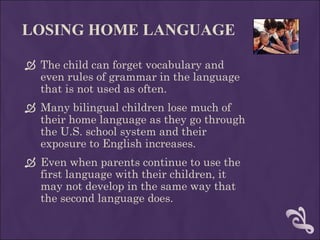
LOSING HOME LANGUAGE The child can forget vocabulary and even rules of grammar in the language that is not used as often.  Many bilingual children lose much of their home language as they go through the U.S. school system and their exposure to English increases.  Even when parents continue to use the first language with their children, it may not develop in the same way that the second language does.
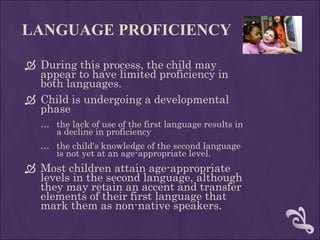
LANGUAGE PROFICIENCY During this process, the child may appear to have limited proficiency in both languages.  Child is undergoing a developmental phase  the lack of use of the first language results in a decline in proficiency the child's knowledge of the second language is not yet at an age-appropriate level.  Most children attain age-appropriate levels in the second language, although they may retain an accent and transfer elements of their first language that mark them as non-native speakers.
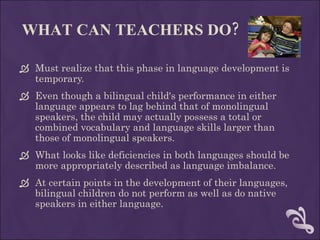
WHAT CAN TEACHERS DO? Must realize that this phase in language development is temporary.  Even though a bilingual child's performance in either language appears to lag behind that of monolingual speakers, the child may actually possess a total or combined vocabulary and language skills larger than those of monolingual speakers.  What looks like deficiencies in both languages should be more appropriately described as language imbalance.  At certain points in the development of their languages, bilingual children do not perform as well as do native speakers in either language.
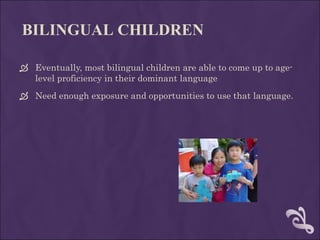
BILINGUAL CHILDREN   Eventually, most bilingual children are able to come up to age-level proficiency in their dominant language Need enough exposure and opportunities to use that language.
BALANCED BILINGUALISM   The age at which a child reaches this more balanced level of bilingualism is dependent on a variety of factors  the age at which the child begin acquisition of each language  the quality and quantity of exposure to each language the social climate surrounding the use of each language
MAINTAIN PRIMARY LANGUAGE A language will be maintained only through exposure to speakers of that language and opportunities to use it.  For many children, a significant reduction in use of the home language leads to home language loss.  When children are older, many regret having lost proficiency in their first language.
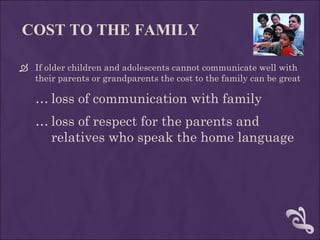
COST TO THE FAMILY If older children and adolescents cannot communicate well with their parents or grandparents the cost to the family can be great  loss of communication with family loss of respect for the parents and relatives who speak the home language
HOME LANGUAGE OPPORTUNITIES Families should provide sufficient opportunities for children to speak their home language so that it can be maintained.  Some families enroll their child in after-school or weekend "foreign" language classes.  Support the development of the home language and connect the child to the culture associated with that language community.  Such options are not available in all communities or they may be too expensive for many immigrant families.
PARENT QUOTE I spoke only Spanish until I started school.  I can’t remember exactly when it happened, but eventually I lost most of it.  I can communicate with my parents, I understand what they’re saying, but I often have trouble finding the right words to answer them.  Sometimes they even laugh at my attempts.  That’s why I don’t want Breanna to lose the Spanish she learned and used when she was staying with my parents.  I want her to keep her home language.  I’m glad you use both English and Spanish in the classroom.
ASK YOURSELF How can I make sure that the children have plenty of opportunities to engage in conversation with both peers and adults so that their language development will flourish? How can I balance the amount of talking I do in order to allow the children to participate more through their own use of language?

Language Loss

  • 1.
    LANGUAGE LOSS CDE(2007). Preschool English learners: Principles and practices to promote language, literacy and learning . Sacramento, CA: CDE Press
  • 2.
    LANGUAGE LOSS Languageloss occurs When a minority group member cannot do the things with the minority language that he or she used to be able to do When some of the proficiency is no longer accessible. Language loss may also refer to incomplete or imperfect learning of a language spoken in childhood.
  • 3.
    LANGUAGE LOSS Childrenrarely have both languages in balance. One language is usually stronger than the other in regards to exposure, use, and proficiency. When this type of language dominance happens, the elements of the other language can quickly be lost.
  • 4.
    LOSING HOME LANGUAGEThe child can forget vocabulary and even rules of grammar in the language that is not used as often. Many bilingual children lose much of their home language as they go through the U.S. school system and their exposure to English increases. Even when parents continue to use the first language with their children, it may not develop in the same way that the second language does.
  • 5.
    LANGUAGE PROFICIENCY Duringthis process, the child may appear to have limited proficiency in both languages. Child is undergoing a developmental phase the lack of use of the first language results in a decline in proficiency the child's knowledge of the second language is not yet at an age-appropriate level. Most children attain age-appropriate levels in the second language, although they may retain an accent and transfer elements of their first language that mark them as non-native speakers.
  • 6.
    WHAT CAN TEACHERSDO? Must realize that this phase in language development is temporary. Even though a bilingual child's performance in either language appears to lag behind that of monolingual speakers, the child may actually possess a total or combined vocabulary and language skills larger than those of monolingual speakers. What looks like deficiencies in both languages should be more appropriately described as language imbalance. At certain points in the development of their languages, bilingual children do not perform as well as do native speakers in either language.
  • 7.
    BILINGUAL CHILDREN Eventually, most bilingual children are able to come up to age-level proficiency in their dominant language Need enough exposure and opportunities to use that language.
  • 8.
    BALANCED BILINGUALISM The age at which a child reaches this more balanced level of bilingualism is dependent on a variety of factors the age at which the child begin acquisition of each language the quality and quantity of exposure to each language the social climate surrounding the use of each language
  • 9.
    MAINTAIN PRIMARY LANGUAGEA language will be maintained only through exposure to speakers of that language and opportunities to use it. For many children, a significant reduction in use of the home language leads to home language loss. When children are older, many regret having lost proficiency in their first language.
  • 10.
    COST TO THEFAMILY If older children and adolescents cannot communicate well with their parents or grandparents the cost to the family can be great loss of communication with family loss of respect for the parents and relatives who speak the home language
  • 11.
    HOME LANGUAGE OPPORTUNITIESFamilies should provide sufficient opportunities for children to speak their home language so that it can be maintained. Some families enroll their child in after-school or weekend "foreign" language classes. Support the development of the home language and connect the child to the culture associated with that language community. Such options are not available in all communities or they may be too expensive for many immigrant families.
  • 12.
    PARENT QUOTE Ispoke only Spanish until I started school. I can’t remember exactly when it happened, but eventually I lost most of it. I can communicate with my parents, I understand what they’re saying, but I often have trouble finding the right words to answer them. Sometimes they even laugh at my attempts. That’s why I don’t want Breanna to lose the Spanish she learned and used when she was staying with my parents. I want her to keep her home language. I’m glad you use both English and Spanish in the classroom.
  • 13.
    ASK YOURSELF Howcan I make sure that the children have plenty of opportunities to engage in conversation with both peers and adults so that their language development will flourish? How can I balance the amount of talking I do in order to allow the children to participate more through their own use of language?