Language Policy Language and Culture WTUC
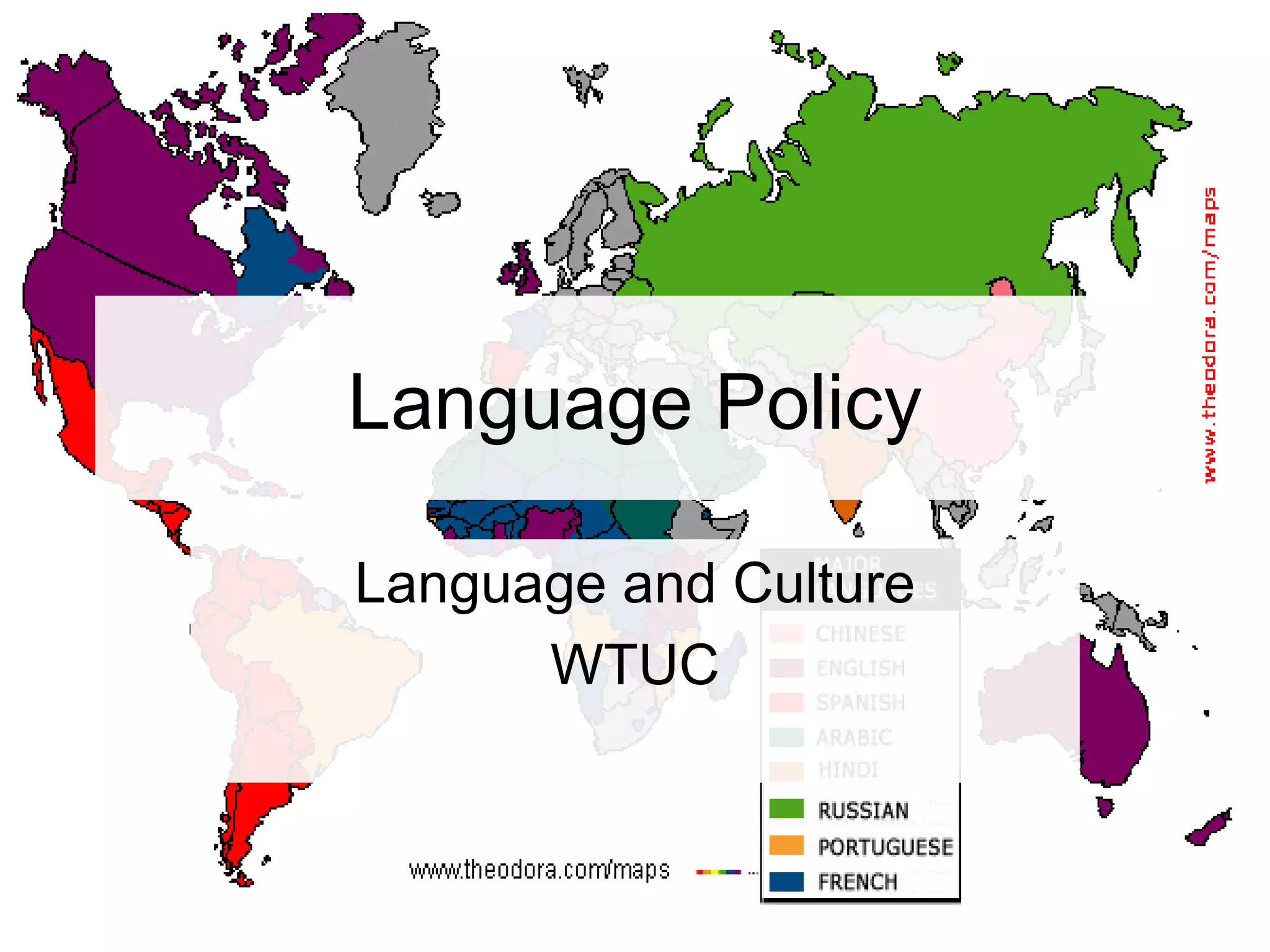
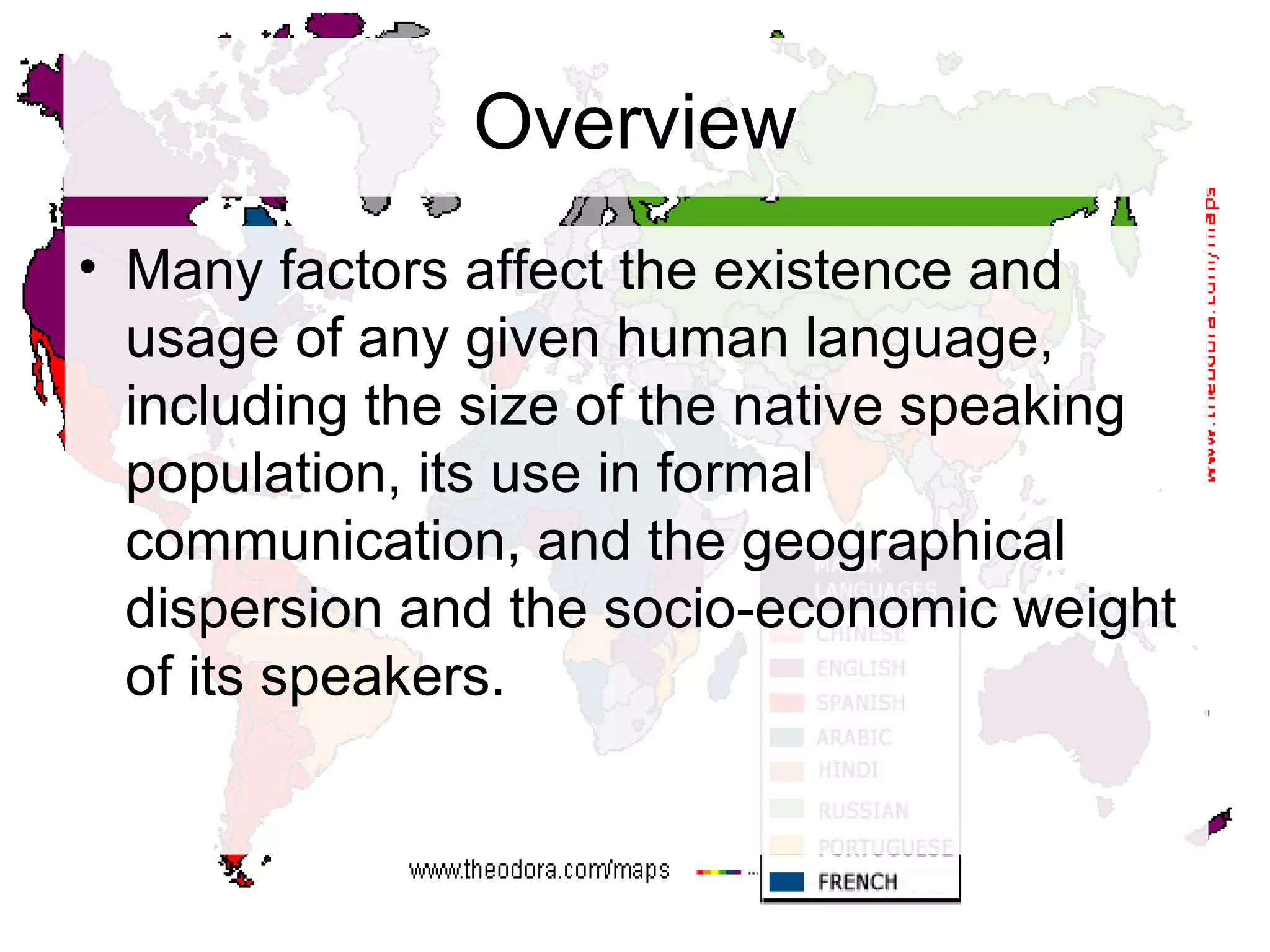
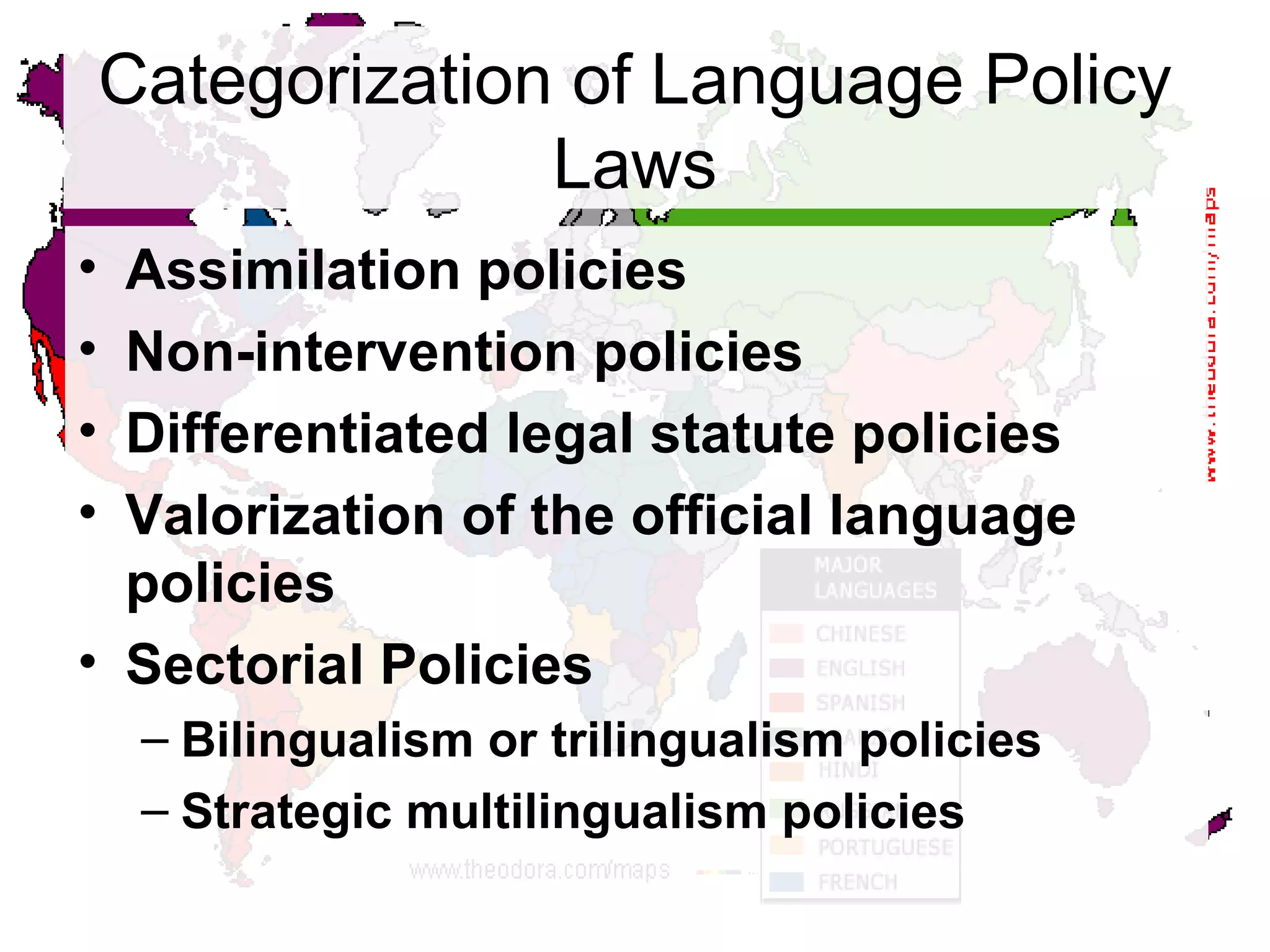
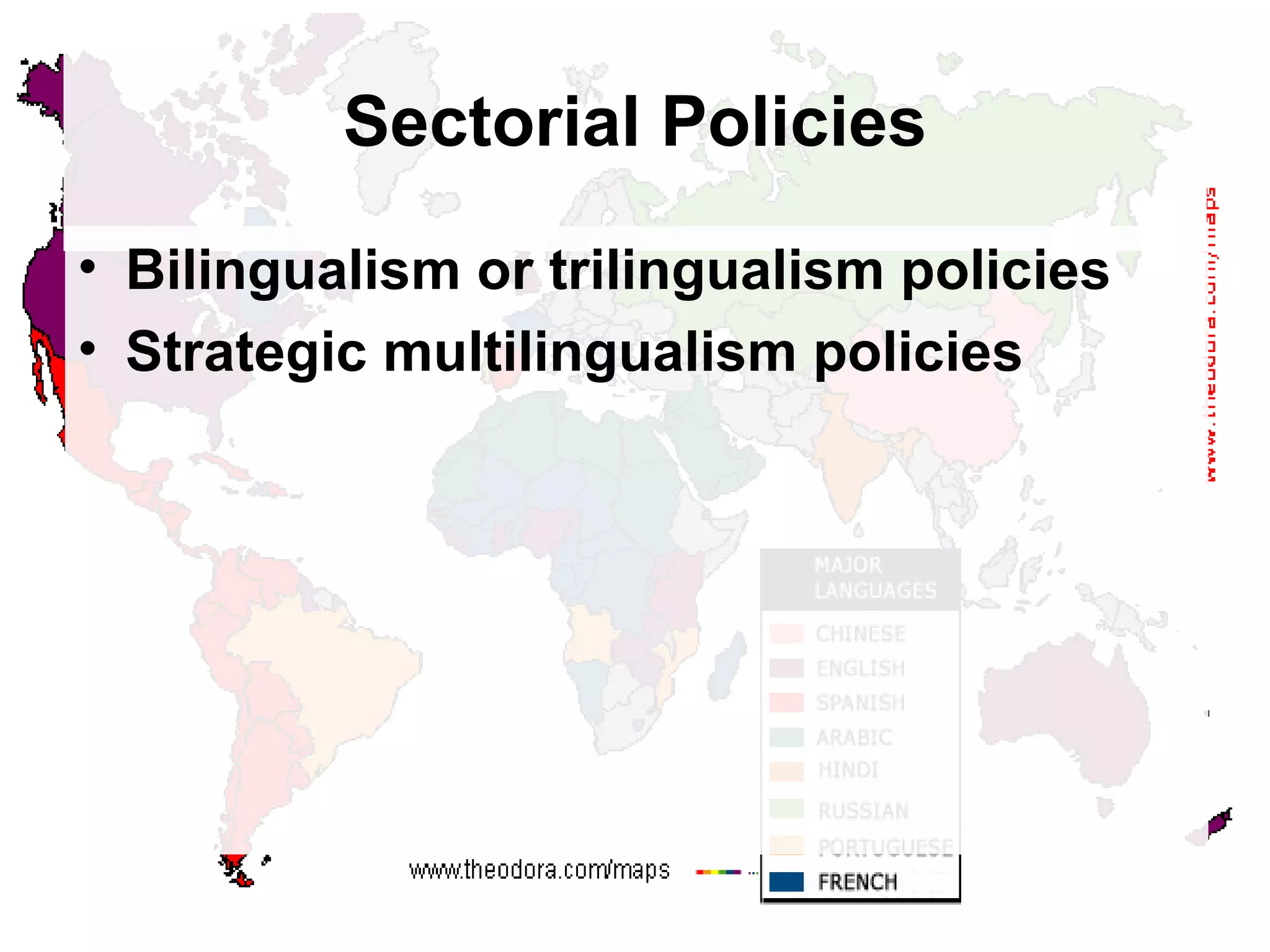
Major Languages of the World
Language Policy Many countries have a  language policy  designed to favour or discourage the use of a particular  language  or set of languages.  http://en.wikipedia.org/wiki/Language_policy
Language Policy Although nations historically have used language policies most often to promote one  official language  at the expense of others, many countries now have policies designed to protect and promote regional and ethnic languages whose viability is threatened.
Overview The preservation of cultural and linguistic  diversity  in today's world is a major concern to many scientists, artists, writers, politicians, and leaders of linguistic communities. Up to one half of the 6000 languages currently spoken in the world are estimated to be in danger of disappearing during the  21st century .
Overview Many factors affect the existence and usage of any given human language, including the size of the native speaking population, its use in formal communication, and the geographical dispersion and the socio-economic weight of its speakers.
Overview National language policies can either mitigate or exacerbate the effects of some of these factors.  http://en.wikipedia.org/wiki/Language_policy
Categorization of Language Policy Laws Assimilation policies Non-intervention policies Differentiated legal statute policies Valorization of the official language policies Sectorial Policies Bilingualism or trilingualism policies Strategic multilingualism policies
Assimilation Policies A policy of assimilation is one that uses measures to accelerate the downsizing of one or more linguistic minority group(s). The ultimate goal of such policies is to foster national unity inside a state (based on the idea that a single language in the country will favor that end).
Jurisdictions having such a policy:  Afghanistan   Burma   Indonesia   Iran   Iraq   Kosovo  ( Not a state; under  United Nations   protectorate  and officially under sovereignty of  Serbia )  Pakistan   Syria   Thailand   Vietnam
Non-intervention policies A policy of non-intervention consists in choosing to allow the normal rapport between the main linguistic group and the minorities evolve on its own. This almost invariably favours the dominant group. Sometimes, such policies are accompanied by administrative measures protecting certain minorities.
Jurisdictions having such a policy:  Angola  -  Argentina  -  Australia  -  Austria  -  Bangladesh  -  Benin  -  Burkina Faso  -  Chile  -  Congo-Kinshasa  -  Côte d'Ivoire  -  Cuba  -  Czech Republic  -  Dominica  -  Dominican Republic  -  Ecuador  -  Gabon  -  Ghana  -  Germany  -  Gibraltar  -  Guinea  -  Guyana  -  Northern Ireland  -  Jamaica  -  Japan  -  Liechtenstein  -  Mali  -  Nebraska  -  Nicaragua  -  Saint Kitts and Nevis  -  Saint Lucia  -  Saint Vincent and the Grenadines  -  El Salvador  -  San Marino  -  Saudi Arabia  -  Senegal  -  Turkey  -  United Kingdom  -  Uruguay  -  Venezuela  -  Vermont
Differentiated legal statute policies A policy that recognizes a different legal statute for a given language usually aims at allowing the coexistence of multiple linguistic groups inside a state. Typically, the majority has all its linguistic rights secured and sometimes promoted while the minority or minorities are given special protection for their language.
Jurisdictions having such a policy:  Albania  -  Bosnia and Herzegovina  -  Bulgaria  -  California  -  China  -  Croatia  -  Estonia  -  European Council  - Republic of Macedonia  -  Guatemala  -  Latvia  -  Lithuania  -  Manitoba  -  Ontario  -  Netherlands  -  New Mexico  -  Paraguay  -  Quebec  -  Portugal  -  Romania  -  Slovakia  -  Spain  -  Sweden  -  Wales  -  Yukon
Valorization of the official language policies A policy favouring the  official language  is a policy of unilingualism. Sometimes, it favours the (or a)  national language , sometime it favours a colonial language with a strong influence internationally. In some cases, such policies are accompanied by measures recognizing and protecting  minority languages  or  indigenous languages . This approach may be considered in two broadly different types of situations: where the official language is also the  first language  of the majority of the population, and where it is not.
Jurisdictions having such a policy:  Åland  -  Albania  -  Algeria  -  Andorra  -  Azerbaijan  -  Brazil  -  California  -  Cambodia  -  Colombia  -  Cyprus  -  Croatia  -  East Timor  -  Egypt  -  Estonia  -  France  -  India  -  Iran  -  Iceland  -  Israel  -  Italy  -  Japan  -  Kuwait  -  Latvia  -  Lebanon  -  Lithuania  -  Republic of Macedonia  -  Madagascar  -  Morocco  -  Mexico  -  Moldova  -  Montenegro  -  North Korea  -  Nepal  -  Peru  -  Poland  -  Quebec  -  Romania  -  Saint-Pierre and  Miquelon  -  Slovakia  -  Slovenia  -  Somalia  -  South Korea  -  Tunisia  -  Ukraine  -  Uzbekistan  -  Vietnam  -  Voivodina
Sectorial Policies Bilingualism or trilingualism policies Strategic multilingualism policies
Bilingualism or trilingualism policies A policy favouring the two official languages is a policy of  bilingualism . There are many different ways in which these policies can be applied.
Bilingualism or trilingualism policies Based on non-territorialized individual rights Based on territorialized individual rights Based on territorial rights
Based on non-territorialized individual rights A policy of bilingualism based on non-territorialized individual rights recognizes the same rights to all members of a community whatever their location on the national territory.  Belarus  -  Burundi  -  Canada  -  Central African Republic  -  Chad  -  Djibouti  -  Guam  -  Hong Kong  -  Ireland  -  Kenya  -  Kiribati  -  Malta  -  Nauru  -  New Zealand  -  Northwest Territories  -  Norway  -  Nunavut  -  Rwanda  -  Samoa  -  South Africa  -  Tanzania  -  Tonga  -  Tuvalu
Based on territorialized individual rights A language policy based on territorialized individual rights recognizes the same rights to all members of a community within a specific region.  Aosta  Valley  -  Balearic Islands  -  Basque Country  -  Brandenburg  -  Brittany  -  Catalonia  -  Channel Islands  -  Corsica  -  Faroe  -  Finland  -  Friuli   Venezia   Giulia  -  Galicia  -  Hawaii  -  Isle of Man  -  Micronesia  -  Navarre  -  Northern Ireland  -  Nicaragua  -  Sardinia  -  Scotland  -  Sicily  -  Sind  -  Slovenia  ( Istria  and  Prekmurje )-  Trentino -Alto  Adige/Südtirol  -  Wales
Based on territorial rights A language policy based on territorial rights recognizes the same rights to all members of a community within a specific territory. Belgium  -  Cameroon  -  Fribourg  -  Grisons  -  Switzerland  -  Ticino  -  Valais
Strategic multilingualism policies Based on non-territorialized individual rights A policy of multilingualism based on non-territorialized individual rights recognizes the same rights to all members of a community whatever their location on the national territory. Singapore
Language of politics   is a term used to describe political (and sometimes social) consequences of linguistic differences between people, or on occasion the political consequences of the way a language is spoken and what words are used.  http://en.wikipedia.org/wiki/Language_politics
Examples include:  Recognition (or not) of a language as an  official language . Generally this means that all official documents effecting a country or region are published in languages that are 'official', but not in those that are not. Evidence in a court of law may also be expected to be in an official language only.  In countries where there are more than one main language, there are often political implications in decisions that are seen to promote one group of speakers over another, and this is often referred to as language politics. An example of a country with this type of language politics is  Belgium .
Examples include: In countries where there is one main language, immigrants seeking full  citizenship  may be expected to have a degree of fluency in that language ('language politics' then being a reference to the debate over the appropriateness of this). This has been a feature of  Australian politics .
Example At various times  minority languages  have either been promoted or banned in schools, as politicians have either sought to promote a minority language with a view to srengthening the cultural identity of its speakers, or banning its use (either for teaching, or on occasion an entire ban on its use), with a view to promoting a national identity based on the majority language. An example of recent promotion of a minority language is  Welsh , an example of official discouragement of a minority language is  Breton .
Language politics also sometimes relates to  dialect , where speakers of a particular dialect are perceived as speaking a more culturally 'advanced' or 'correct' form of the language. Politicians may therefore try to use that dialect rather than their own when in the public eye. Alternatively, at times those speaking the dialect perceived as more 'correct' may try to use another dialect when in the public eye to be seen as a 'man/woman of the people'.
To promote national identity, what are strictly dialects of the same language may be promoted as separate languages to promote a sense of national identity (examples include  Danish  and  Norwegian , and  Serbian  and  Croatian  - the latter two also use different scripts for what is linguistically the same language -  cyrillic  for Serbian and  roman script  for Croatian). Whether or not something is a language can also invlove language politics, for instance,  Macedonian .
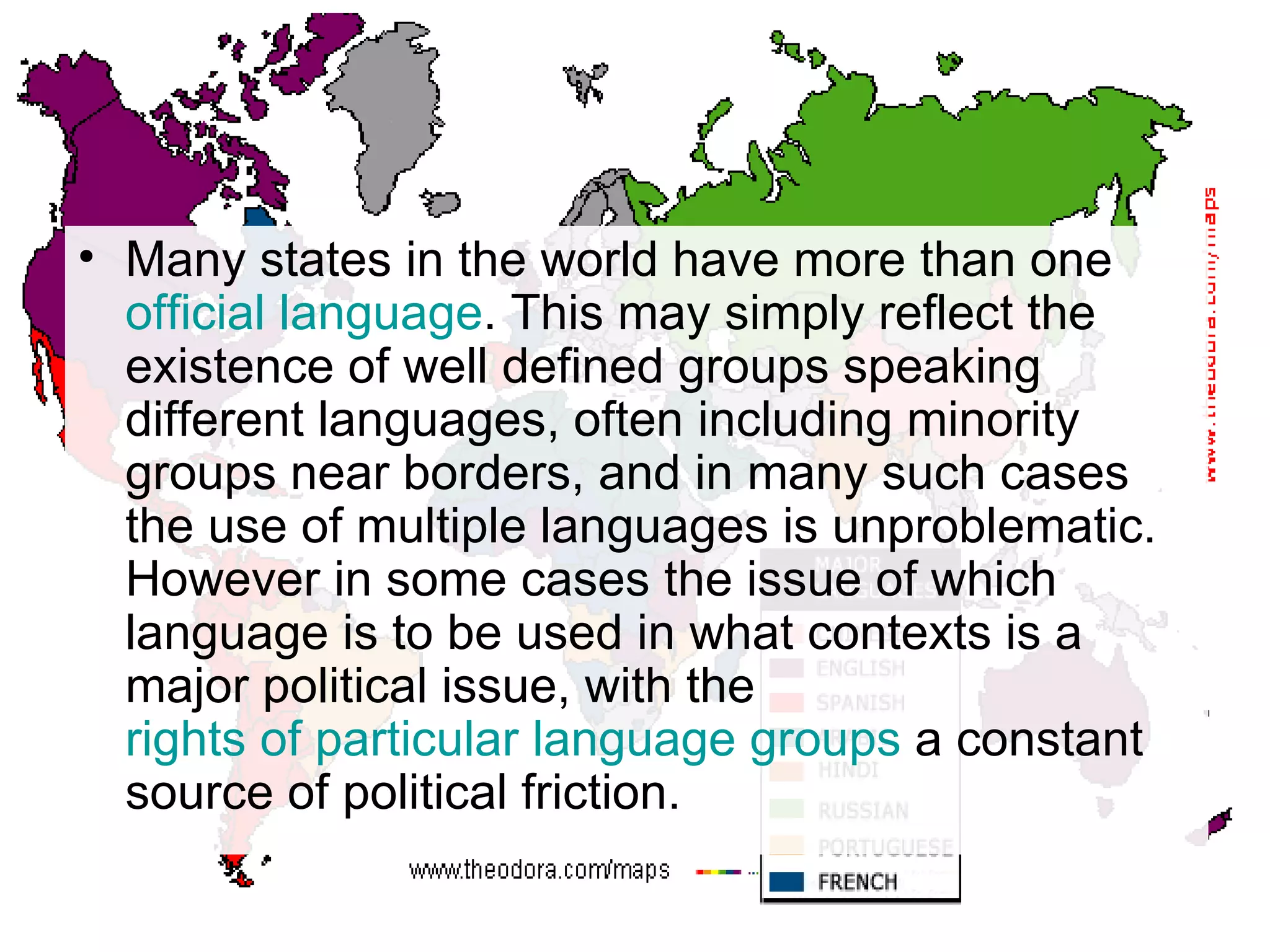
Many states in the world have more than one  official language . This may simply reflect the existence of well defined groups speaking different languages, often including minority groups near borders, and in many such cases the use of multiple languages is unproblematic. However in some cases the issue of which language is to be used in what contexts is a major political issue, with the  rights of particular language groups  a constant source of political friction.
More than a question about language per se, such frictions generally illustrate the uneasy cohabitation of different cultural communities, sometimes with different ethnic origins. This is especially the case if one community dominates, or used to dominate, the other (better economical situation, control of government, etc.).
Assessments of gravity The list attempts to give an idea of the gravity of the problem, but this is inevitably a subjective judgement and liable to change. The ratings are: Serious - language is a major organizing principle of the state's politics, and language disputes persistently threaten the unity of the state and/or involve violent protest or terrorist action  Moderate - language disputes regularly arise, but are currently contained  Minor - language issues are the concern of a small minority of the population (though those people may take them very seriously.)
Canada , particularly in  Quebec   English  and  French ; also, to varying degrees, English and  Aboriginal  languages [assessment] moderate to serious China, People's Republic  of Mandarin  Chinese  et  various local dialects and languages  [assessment: minor]
Hong  Kong Chinese  and  English  [minor] China, Republic  of Mandarin  Chinese ,  Taiwanese Chinese , and to some extent  Hakka  Chinese  and  Formosan languages  [minor] India English  and  Hindi , Hindi and  Tamil , Hindi and other regional languages in some states [minor to serious]
Indonesia   Indonesian  and various native languages [serious] Iraq   Arabic  and  Kurdish  [serious] Kazakhstan   Kazakh  and  Russian  [serious] Philippines Filipino   de facto  based on  Tagalog  and English [moderate] Philippines  English and Spanish [serious in past, now very minor,  Cebuano  native speakers resist Tagalog.]
Northern  Ireland English ,  Ulster Scots ,  Irish  [minor to moderate.] Irish and Scots were officially recognized as  regional or minority languages  in 2001, when the  UK  ratified the  European Charter for Regional or Minority Languages . Under the  Good Friday Agreement , and subsequent legislation, both Irish Gaelic and Scots have cross-border, state-funded language boards.
Scotland English ,  Scottish Gaelic ,  Scots  [minor] Some Gaelic language service provision was guaranteed by statute in  2005 . Scots and Scottish Gaelic were officially recognized as  regional or minority languages  in 2001, when the  UK  ratified the  European Charter for Regional or Minority Languages .
Wales   English  and  Welsh  in  Wales minor to moderate. Welsh is a national language and can be a medium of instruction within Wales.
United States   English  and  Spanish ; also English alongside  Hawaiian  (in  Hawaii ),  French  (in  Louisiana ), and various  Native American languages  (on  Indian reservations ) minor to moderate (see also  Spanish in the United States
Uzbekistan Uzbek ,  Persian , and  Russian  serious
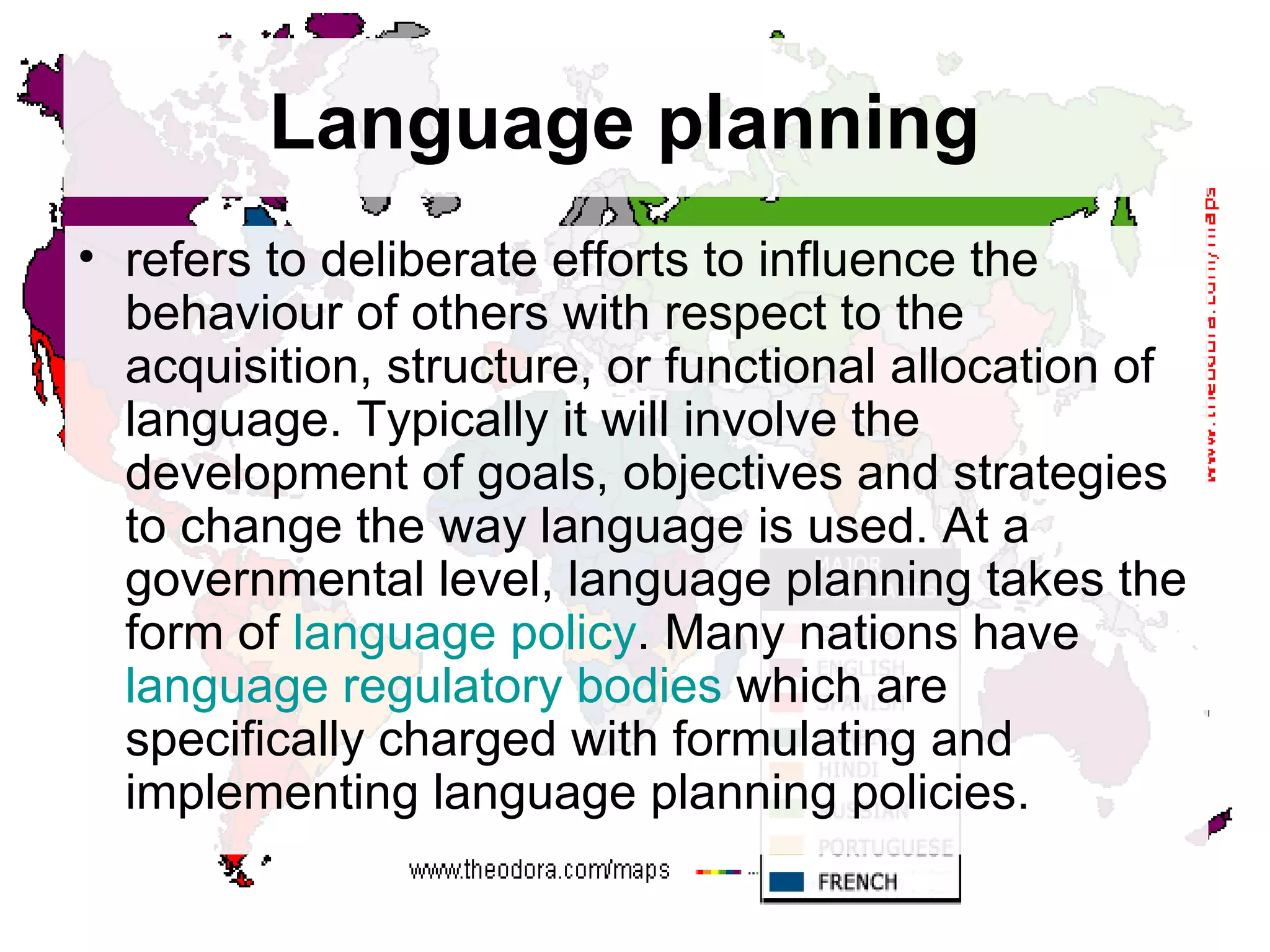
Language planning   refers to deliberate efforts to influence the behaviour of others with respect to the acquisition, structure, or functional allocation of language. Typically it will involve the development of goals, objectives and strategies to change the way language is used. At a governmental level, language planning takes the form of  language policy . Many nations have  language regulatory bodies  which are specifically charged with formulating and implementing language planning policies.
Language planning can be divided into three sub-dimensions:  Corpus planning Status planning Acquisition planning
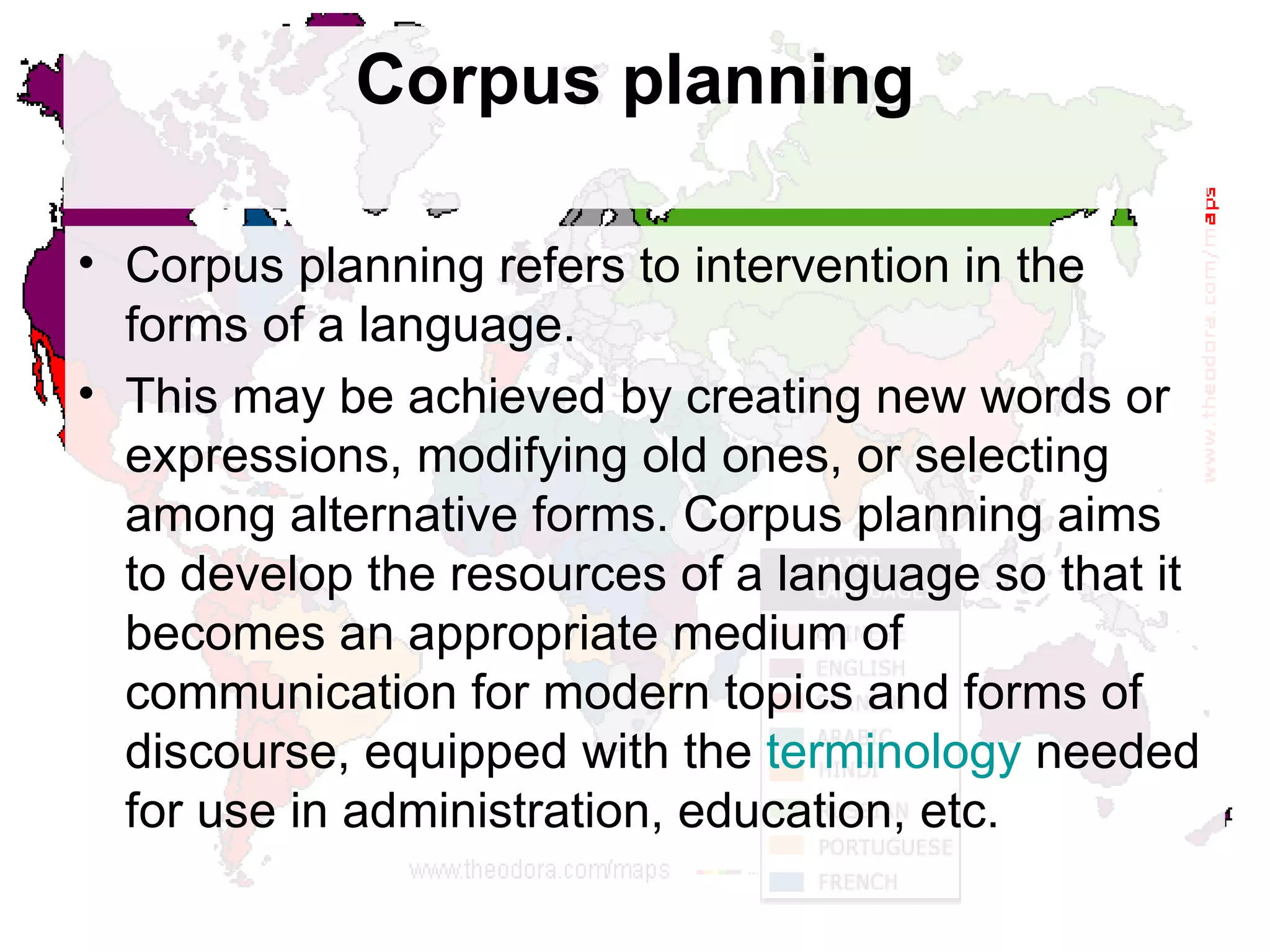
Corpus planning Corpus planning refers to intervention in the forms of a language.  This may be achieved by creating new words or expressions, modifying old ones, or selecting among alternative forms. Corpus planning aims to develop the resources of a language so that it becomes an appropriate medium of communication for modern topics and forms of discourse, equipped with the  terminology  needed for use in administration, education, etc.
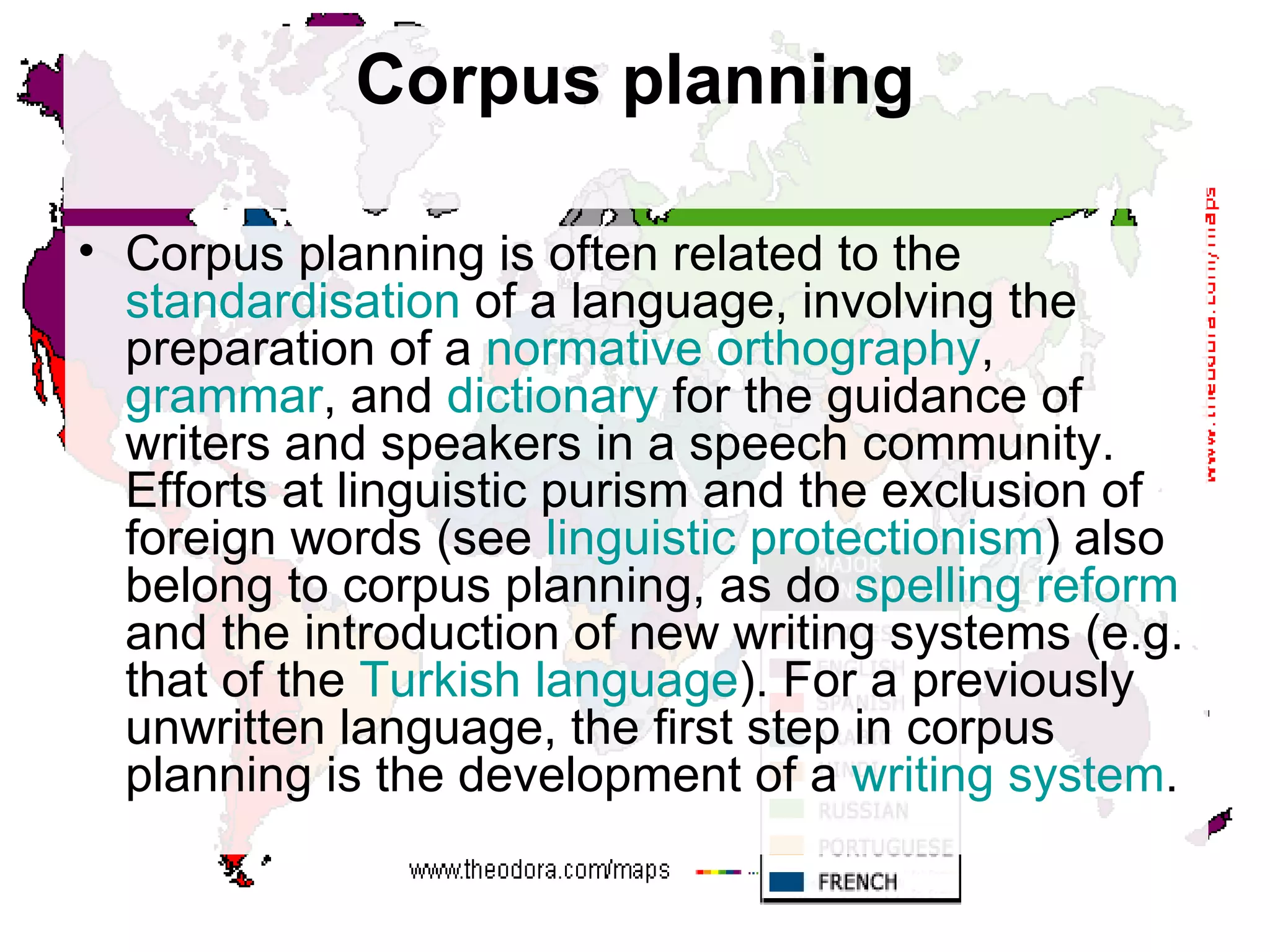
Corpus planning Corpus planning is often related to the  standardisation  of a language, involving the preparation of a  normative   orthography ,  grammar , and  dictionary  for the guidance of writers and speakers in a speech community. Efforts at linguistic purism and the exclusion of foreign words (see  linguistic protectionism ) also belong to corpus planning, as do  spelling reform  and the introduction of new writing systems (e.g. that of the  Turkish language ). For a previously unwritten language, the first step in corpus planning is the development of a  writing system .
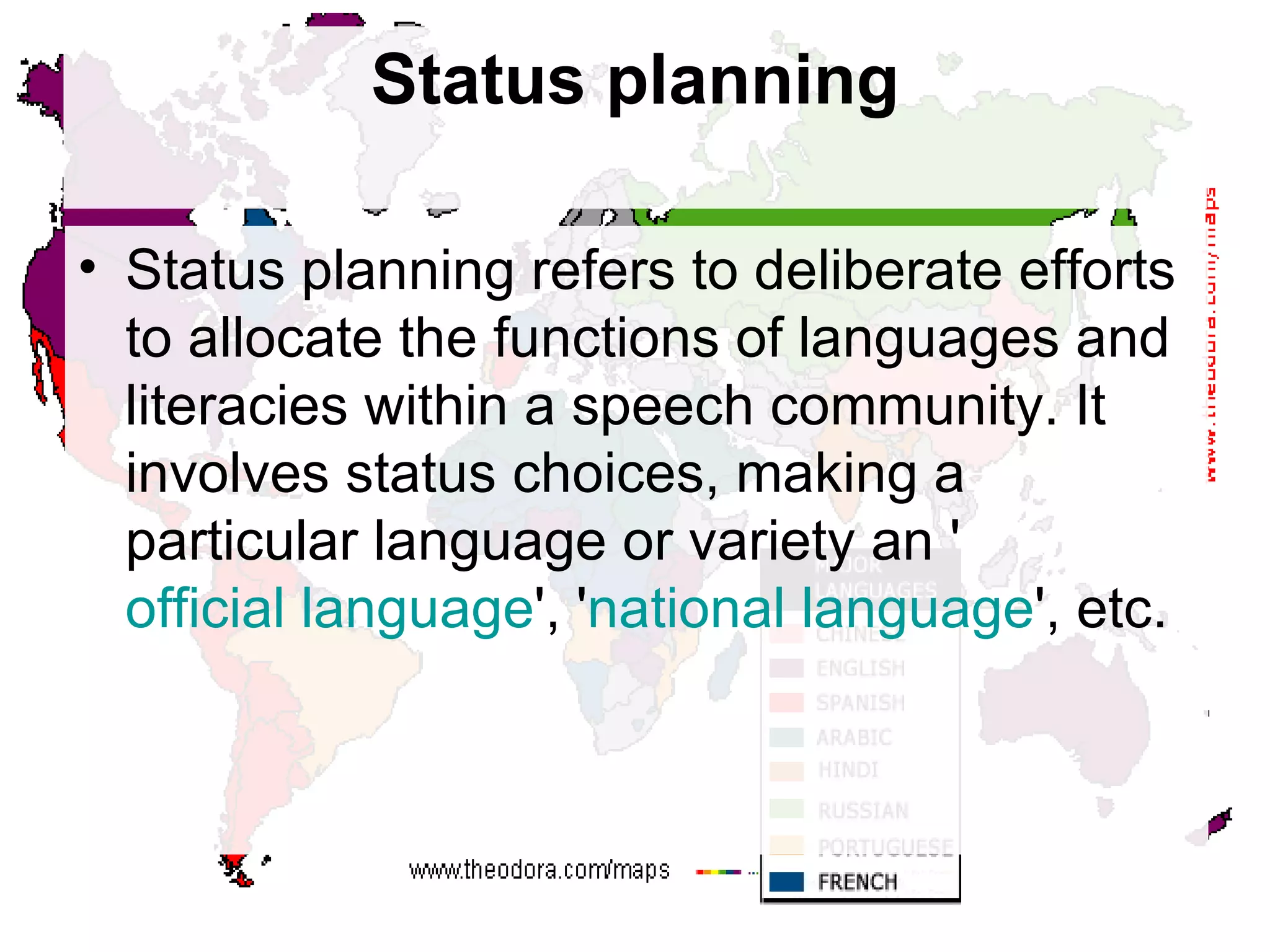
Status planning Status planning refers to deliberate efforts to allocate the functions of languages and literacies within a speech community. It involves status choices, making a particular language or variety an ' official language ', ' national language ', etc.
Status Planning Often it will involve elevating a  language  or  dialect  into a  prestige variety , which may be at the expense of competing dialects. Status planning is often part and parcel of creating a new writing system. Status planning tends to be the most controversial aspect of language planning
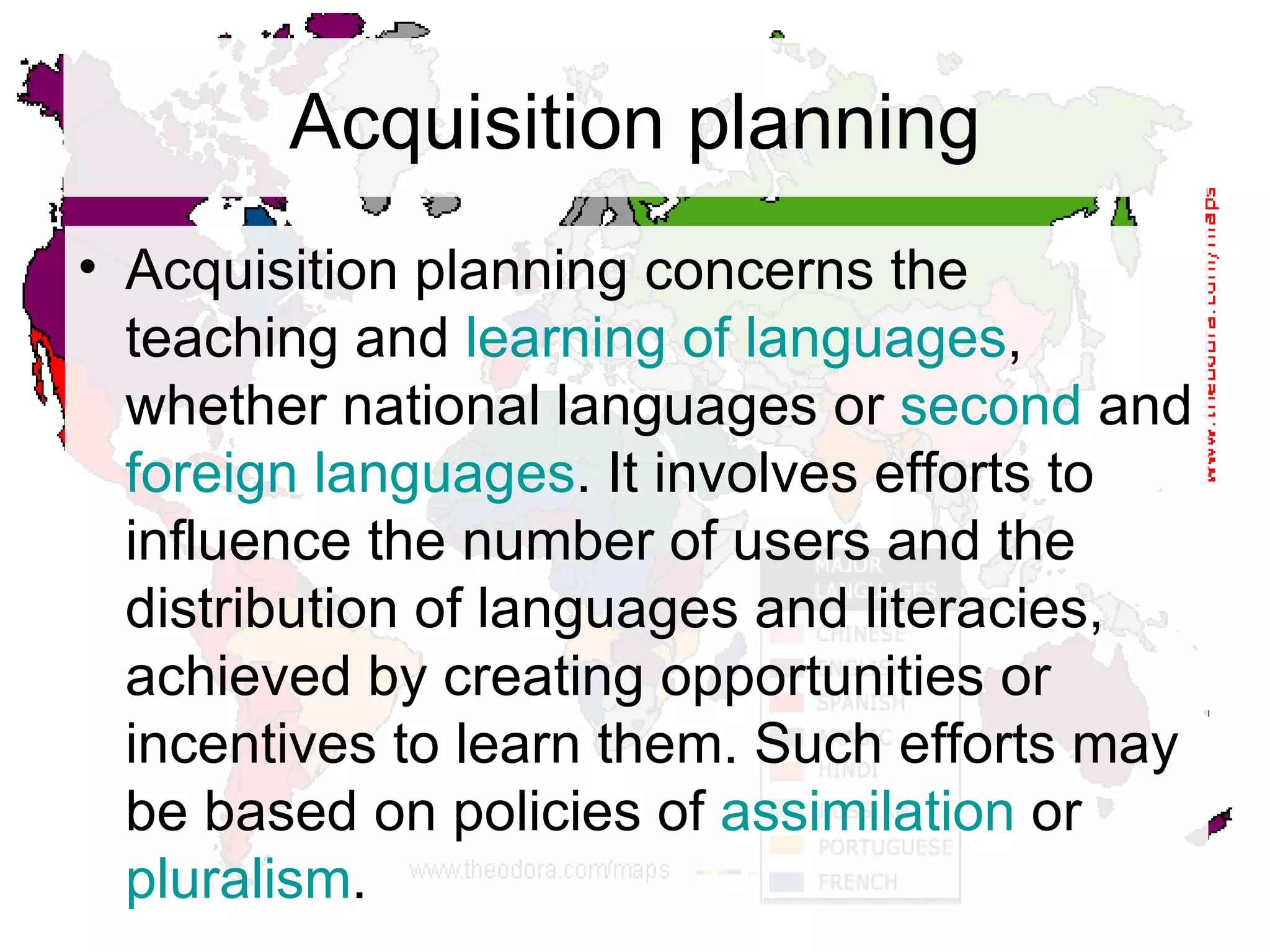
Acquisition planning Acquisition planning concerns the teaching and  learning of languages , whether national languages or  second  and  foreign languages . It involves efforts to influence the number of users and the distribution of languages and literacies, achieved by creating opportunities or incentives to learn them. Such efforts may be based on policies of  assimilation  or  pluralism .
Acquisition planning Acquisition planning is directly related to language spread. While acquisition planning is normally the province of national, regional, or local governments, bodies such as the  British Council ,  Alliance  française ,  Instituto  Cervantes  and  Goethe- Institut  are also very active internationally promoting education in their respective languages.

Language Policy

  • 1.
    Language Policy Languageand Culture WTUC
  • 2.
  • 3.
    Language Policy Manycountries have a language policy designed to favour or discourage the use of a particular language or set of languages. http://en.wikipedia.org/wiki/Language_policy
  • 4.
    Language Policy Althoughnations historically have used language policies most often to promote one official language at the expense of others, many countries now have policies designed to protect and promote regional and ethnic languages whose viability is threatened.
  • 5.
    Overview The preservationof cultural and linguistic diversity in today's world is a major concern to many scientists, artists, writers, politicians, and leaders of linguistic communities. Up to one half of the 6000 languages currently spoken in the world are estimated to be in danger of disappearing during the 21st century .
  • 6.
    Overview Many factorsaffect the existence and usage of any given human language, including the size of the native speaking population, its use in formal communication, and the geographical dispersion and the socio-economic weight of its speakers.
  • 7.
    Overview National languagepolicies can either mitigate or exacerbate the effects of some of these factors. http://en.wikipedia.org/wiki/Language_policy
  • 8.
    Categorization of LanguagePolicy Laws Assimilation policies Non-intervention policies Differentiated legal statute policies Valorization of the official language policies Sectorial Policies Bilingualism or trilingualism policies Strategic multilingualism policies
  • 9.
    Assimilation Policies Apolicy of assimilation is one that uses measures to accelerate the downsizing of one or more linguistic minority group(s). The ultimate goal of such policies is to foster national unity inside a state (based on the idea that a single language in the country will favor that end).
  • 10.
    Jurisdictions having sucha policy: Afghanistan Burma Indonesia Iran Iraq Kosovo ( Not a state; under United Nations protectorate and officially under sovereignty of Serbia ) Pakistan Syria Thailand Vietnam
  • 11.
    Non-intervention policies Apolicy of non-intervention consists in choosing to allow the normal rapport between the main linguistic group and the minorities evolve on its own. This almost invariably favours the dominant group. Sometimes, such policies are accompanied by administrative measures protecting certain minorities.
  • 12.
    Jurisdictions having sucha policy: Angola - Argentina - Australia - Austria - Bangladesh - Benin - Burkina Faso - Chile - Congo-Kinshasa - Côte d'Ivoire - Cuba - Czech Republic - Dominica - Dominican Republic - Ecuador - Gabon - Ghana - Germany - Gibraltar - Guinea - Guyana - Northern Ireland - Jamaica - Japan - Liechtenstein - Mali - Nebraska - Nicaragua - Saint Kitts and Nevis - Saint Lucia - Saint Vincent and the Grenadines - El Salvador - San Marino - Saudi Arabia - Senegal - Turkey - United Kingdom - Uruguay - Venezuela - Vermont
  • 13.
    Differentiated legal statutepolicies A policy that recognizes a different legal statute for a given language usually aims at allowing the coexistence of multiple linguistic groups inside a state. Typically, the majority has all its linguistic rights secured and sometimes promoted while the minority or minorities are given special protection for their language.
  • 14.
    Jurisdictions having sucha policy: Albania - Bosnia and Herzegovina - Bulgaria - California - China - Croatia - Estonia - European Council - Republic of Macedonia - Guatemala - Latvia - Lithuania - Manitoba - Ontario - Netherlands - New Mexico - Paraguay - Quebec - Portugal - Romania - Slovakia - Spain - Sweden - Wales - Yukon
  • 15.
    Valorization of theofficial language policies A policy favouring the official language is a policy of unilingualism. Sometimes, it favours the (or a) national language , sometime it favours a colonial language with a strong influence internationally. In some cases, such policies are accompanied by measures recognizing and protecting minority languages or indigenous languages . This approach may be considered in two broadly different types of situations: where the official language is also the first language of the majority of the population, and where it is not.
  • 16.
    Jurisdictions having sucha policy: Åland - Albania - Algeria - Andorra - Azerbaijan - Brazil - California - Cambodia - Colombia - Cyprus - Croatia - East Timor - Egypt - Estonia - France - India - Iran - Iceland - Israel - Italy - Japan - Kuwait - Latvia - Lebanon - Lithuania - Republic of Macedonia - Madagascar - Morocco - Mexico - Moldova - Montenegro - North Korea - Nepal - Peru - Poland - Quebec - Romania - Saint-Pierre and Miquelon - Slovakia - Slovenia - Somalia - South Korea - Tunisia - Ukraine - Uzbekistan - Vietnam - Voivodina
  • 17.
    Sectorial Policies Bilingualismor trilingualism policies Strategic multilingualism policies
  • 18.
    Bilingualism or trilingualismpolicies A policy favouring the two official languages is a policy of bilingualism . There are many different ways in which these policies can be applied.
  • 19.
    Bilingualism or trilingualismpolicies Based on non-territorialized individual rights Based on territorialized individual rights Based on territorial rights
  • 20.
    Based on non-territorializedindividual rights A policy of bilingualism based on non-territorialized individual rights recognizes the same rights to all members of a community whatever their location on the national territory. Belarus - Burundi - Canada - Central African Republic - Chad - Djibouti - Guam - Hong Kong - Ireland - Kenya - Kiribati - Malta - Nauru - New Zealand - Northwest Territories - Norway - Nunavut - Rwanda - Samoa - South Africa - Tanzania - Tonga - Tuvalu
  • 21.
    Based on territorializedindividual rights A language policy based on territorialized individual rights recognizes the same rights to all members of a community within a specific region. Aosta Valley - Balearic Islands - Basque Country - Brandenburg - Brittany - Catalonia - Channel Islands - Corsica - Faroe - Finland - Friuli Venezia Giulia - Galicia - Hawaii - Isle of Man - Micronesia - Navarre - Northern Ireland - Nicaragua - Sardinia - Scotland - Sicily - Sind - Slovenia ( Istria and Prekmurje )- Trentino -Alto Adige/Südtirol - Wales
  • 22.
    Based on territorialrights A language policy based on territorial rights recognizes the same rights to all members of a community within a specific territory. Belgium - Cameroon - Fribourg - Grisons - Switzerland - Ticino - Valais
  • 23.
    Strategic multilingualism policiesBased on non-territorialized individual rights A policy of multilingualism based on non-territorialized individual rights recognizes the same rights to all members of a community whatever their location on the national territory. Singapore
  • 24.
    Language of politics is a term used to describe political (and sometimes social) consequences of linguistic differences between people, or on occasion the political consequences of the way a language is spoken and what words are used. http://en.wikipedia.org/wiki/Language_politics
  • 25.
    Examples include: Recognition (or not) of a language as an official language . Generally this means that all official documents effecting a country or region are published in languages that are 'official', but not in those that are not. Evidence in a court of law may also be expected to be in an official language only. In countries where there are more than one main language, there are often political implications in decisions that are seen to promote one group of speakers over another, and this is often referred to as language politics. An example of a country with this type of language politics is Belgium .
  • 26.
    Examples include: Incountries where there is one main language, immigrants seeking full citizenship may be expected to have a degree of fluency in that language ('language politics' then being a reference to the debate over the appropriateness of this). This has been a feature of Australian politics .
  • 27.
    Example At varioustimes minority languages have either been promoted or banned in schools, as politicians have either sought to promote a minority language with a view to srengthening the cultural identity of its speakers, or banning its use (either for teaching, or on occasion an entire ban on its use), with a view to promoting a national identity based on the majority language. An example of recent promotion of a minority language is Welsh , an example of official discouragement of a minority language is Breton .
  • 28.
    Language politics alsosometimes relates to dialect , where speakers of a particular dialect are perceived as speaking a more culturally 'advanced' or 'correct' form of the language. Politicians may therefore try to use that dialect rather than their own when in the public eye. Alternatively, at times those speaking the dialect perceived as more 'correct' may try to use another dialect when in the public eye to be seen as a 'man/woman of the people'.
  • 29.
    To promote nationalidentity, what are strictly dialects of the same language may be promoted as separate languages to promote a sense of national identity (examples include Danish and Norwegian , and Serbian and Croatian - the latter two also use different scripts for what is linguistically the same language - cyrillic for Serbian and roman script for Croatian). Whether or not something is a language can also invlove language politics, for instance, Macedonian .
  • 30.
    Many states inthe world have more than one official language . This may simply reflect the existence of well defined groups speaking different languages, often including minority groups near borders, and in many such cases the use of multiple languages is unproblematic. However in some cases the issue of which language is to be used in what contexts is a major political issue, with the rights of particular language groups a constant source of political friction.
  • 31.
    More than aquestion about language per se, such frictions generally illustrate the uneasy cohabitation of different cultural communities, sometimes with different ethnic origins. This is especially the case if one community dominates, or used to dominate, the other (better economical situation, control of government, etc.).
  • 32.
    Assessments of gravityThe list attempts to give an idea of the gravity of the problem, but this is inevitably a subjective judgement and liable to change. The ratings are: Serious - language is a major organizing principle of the state's politics, and language disputes persistently threaten the unity of the state and/or involve violent protest or terrorist action Moderate - language disputes regularly arise, but are currently contained Minor - language issues are the concern of a small minority of the population (though those people may take them very seriously.)
  • 33.
    Canada , particularlyin Quebec English and French ; also, to varying degrees, English and Aboriginal languages [assessment] moderate to serious China, People's Republic of Mandarin Chinese et various local dialects and languages [assessment: minor]
  • 34.
    Hong KongChinese and English [minor] China, Republic of Mandarin Chinese , Taiwanese Chinese , and to some extent Hakka Chinese and Formosan languages [minor] India English and Hindi , Hindi and Tamil , Hindi and other regional languages in some states [minor to serious]
  • 35.
    Indonesia Indonesian and various native languages [serious] Iraq Arabic and Kurdish [serious] Kazakhstan Kazakh and Russian [serious] Philippines Filipino de facto based on Tagalog and English [moderate] Philippines English and Spanish [serious in past, now very minor, Cebuano native speakers resist Tagalog.]
  • 36.
    Northern IrelandEnglish , Ulster Scots , Irish [minor to moderate.] Irish and Scots were officially recognized as regional or minority languages in 2001, when the UK ratified the European Charter for Regional or Minority Languages . Under the Good Friday Agreement , and subsequent legislation, both Irish Gaelic and Scots have cross-border, state-funded language boards.
  • 37.
    Scotland English , Scottish Gaelic , Scots [minor] Some Gaelic language service provision was guaranteed by statute in 2005 . Scots and Scottish Gaelic were officially recognized as regional or minority languages in 2001, when the UK ratified the European Charter for Regional or Minority Languages .
  • 38.
    Wales English and Welsh in Wales minor to moderate. Welsh is a national language and can be a medium of instruction within Wales.
  • 39.
    United States English and Spanish ; also English alongside Hawaiian (in Hawaii ), French (in Louisiana ), and various Native American languages (on Indian reservations ) minor to moderate (see also Spanish in the United States
  • 40.
    Uzbekistan Uzbek , Persian , and Russian serious
  • 41.
    Language planning refers to deliberate efforts to influence the behaviour of others with respect to the acquisition, structure, or functional allocation of language. Typically it will involve the development of goals, objectives and strategies to change the way language is used. At a governmental level, language planning takes the form of language policy . Many nations have language regulatory bodies which are specifically charged with formulating and implementing language planning policies.
  • 42.
    Language planning canbe divided into three sub-dimensions: Corpus planning Status planning Acquisition planning
  • 43.
    Corpus planning Corpusplanning refers to intervention in the forms of a language. This may be achieved by creating new words or expressions, modifying old ones, or selecting among alternative forms. Corpus planning aims to develop the resources of a language so that it becomes an appropriate medium of communication for modern topics and forms of discourse, equipped with the terminology needed for use in administration, education, etc.
  • 44.
    Corpus planning Corpusplanning is often related to the standardisation of a language, involving the preparation of a normative orthography , grammar , and dictionary for the guidance of writers and speakers in a speech community. Efforts at linguistic purism and the exclusion of foreign words (see linguistic protectionism ) also belong to corpus planning, as do spelling reform and the introduction of new writing systems (e.g. that of the Turkish language ). For a previously unwritten language, the first step in corpus planning is the development of a writing system .
  • 45.
    Status planning Statusplanning refers to deliberate efforts to allocate the functions of languages and literacies within a speech community. It involves status choices, making a particular language or variety an ' official language ', ' national language ', etc.
  • 46.
    Status Planning Oftenit will involve elevating a language or dialect into a prestige variety , which may be at the expense of competing dialects. Status planning is often part and parcel of creating a new writing system. Status planning tends to be the most controversial aspect of language planning
  • 47.
    Acquisition planning Acquisitionplanning concerns the teaching and learning of languages , whether national languages or second and foreign languages . It involves efforts to influence the number of users and the distribution of languages and literacies, achieved by creating opportunities or incentives to learn them. Such efforts may be based on policies of assimilation or pluralism .
  • 48.
    Acquisition planning Acquisitionplanning is directly related to language spread. While acquisition planning is normally the province of national, regional, or local governments, bodies such as the British Council , Alliance française , Instituto Cervantes and Goethe- Institut are also very active internationally promoting education in their respective languages.