
NATIVIST
THEORY
(NOAM CHOMSKY)
BY :
MAIZATUL MALIK
CONCEPTS OF NATIVIST THEORY
• Acquisition is innately determined, that we are born with a
built-in-device of some kind that predisposes us to language
acquisition.
• Children are biologically programmed for language
acquisition.
• Human abilities and development are innate and haired-wired
at birth.
• By Noam Chomsky, stating that children's brains contain a
Language Acquisition Device which holds the grammatical
universals.
NOAM CHOMSKY
•He said that every child is born with a biological
predisposition to learn language- any language
•He came up with the idea of a language organ, which is
known as the Language Acquisition Device (LAD).
•children have been observed to pick up grammar and
syntax without any formal teaching (in spoken
language).
•They seem to learn these fundamentals of their native
language(s) purely from the input around them.
LINGUISTICS PROPERTIES OF LAD
1. Ability to distinguish speech sounds from other
sounds in the environment.
2. Ability to organize linguistic events into various
classes which can later be refined.
3. Knowledge that only a certain kind of linguistic
system is possible and that other kinds are not
4. Ability to engage in constant evaluation of the
developing linguistic system
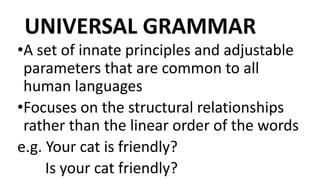
UNIVERSAL GRAMMAR
•A set of innate principles and adjustable
parameters that are common to all
human languages
•Focuses on the structural relationships
rather than the linear order of the words
e.g. Your cat is friendly?
Is your cat friendly?
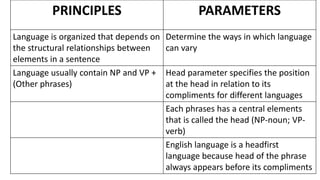
PRINCIPLES PARAMETERS
Language is organized that depends on
the structural relationships between
elements in a sentence
Determine the ways in which language
can vary
Language usually contain NP and VP +
(Other phrases)
Head parameter specifies the position
at the head in relation to its
compliments for different languages
Each phrases has a central elements
that is called the head (NP-noun; VP-
verb)
English language is a headfirst
language because head of the phrase
always appears before its compliments
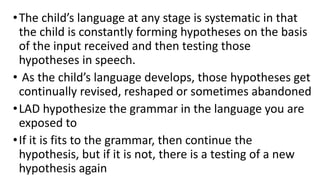
•The child’s language at any stage is systematic in that
the child is constantly forming hypotheses on the basis
of the input received and then testing those
hypotheses in speech.
• As the child’s language develops, those hypotheses get
continually revised, reshaped or sometimes abandoned
•LAD hypothesize the grammar in the language you are
exposed to
•If it is fits to the grammar, then continue the
hypothesis, but if it is not, there is a testing of a new
hypothesis again
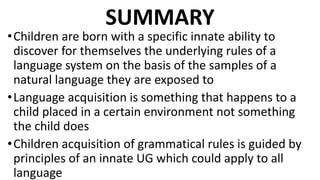
SUMMARY
•Children are born with a specific innate ability to
discover for themselves the underlying rules of a
language system on the basis of the samples of a
natural language they are exposed to
•Language acquisition is something that happens to a
child placed in a certain environment not something
the child does
•Children acquisition of grammatical rules is guided by
principles of an innate UG which could apply to all
language

Nativist theory

  • 1.
  • 2.
    CONCEPTS OF NATIVISTTHEORY • Acquisition is innately determined, that we are born with a built-in-device of some kind that predisposes us to language acquisition. • Children are biologically programmed for language acquisition. • Human abilities and development are innate and haired-wired at birth. • By Noam Chomsky, stating that children's brains contain a Language Acquisition Device which holds the grammatical universals.
  • 3.
    NOAM CHOMSKY •He saidthat every child is born with a biological predisposition to learn language- any language •He came up with the idea of a language organ, which is known as the Language Acquisition Device (LAD). •children have been observed to pick up grammar and syntax without any formal teaching (in spoken language). •They seem to learn these fundamentals of their native language(s) purely from the input around them.
  • 4.
    LINGUISTICS PROPERTIES OFLAD 1. Ability to distinguish speech sounds from other sounds in the environment. 2. Ability to organize linguistic events into various classes which can later be refined. 3. Knowledge that only a certain kind of linguistic system is possible and that other kinds are not 4. Ability to engage in constant evaluation of the developing linguistic system
  • 5.
    UNIVERSAL GRAMMAR •A setof innate principles and adjustable parameters that are common to all human languages •Focuses on the structural relationships rather than the linear order of the words e.g. Your cat is friendly? Is your cat friendly?
  • 6.
    PRINCIPLES PARAMETERS Language isorganized that depends on the structural relationships between elements in a sentence Determine the ways in which language can vary Language usually contain NP and VP + (Other phrases) Head parameter specifies the position at the head in relation to its compliments for different languages Each phrases has a central elements that is called the head (NP-noun; VP- verb) English language is a headfirst language because head of the phrase always appears before its compliments
  • 7.
    •The child’s languageat any stage is systematic in that the child is constantly forming hypotheses on the basis of the input received and then testing those hypotheses in speech. • As the child’s language develops, those hypotheses get continually revised, reshaped or sometimes abandoned •LAD hypothesize the grammar in the language you are exposed to •If it is fits to the grammar, then continue the hypothesis, but if it is not, there is a testing of a new hypothesis again
  • 8.
    SUMMARY •Children are bornwith a specific innate ability to discover for themselves the underlying rules of a language system on the basis of the samples of a natural language they are exposed to •Language acquisition is something that happens to a child placed in a certain environment not something the child does •Children acquisition of grammatical rules is guided by principles of an innate UG which could apply to all language