Vocabulary is commonly defined 
as "all the words known and 
used by a particular 
person". Knowing a word, 
however, is not as simple as 
simply being able to recognize or 
use it. There are several aspects 
of word knowledge which are 
used to measure word 
knowledge.
An extensive vocabulary aids expression and 
communication. 
Vocabulary size has been directly linked to reading 
comprehension. 
Linguistic vocabulary is synonymous with thinking 
vocabulary. 
A person may be judged by others based on his or 
her vocabulary. 
Wilkins (1972) once said," Without grammar, very 
little can be conveyed, without vocabulary, nothing 
can be conveyed.”
Within the receptive–productive distinction lies a 
range of abilities which are often referred to 
as degree of knowledge. This simply indicates that a 
word gradually enters a person's vocabulary over a 
period of time as more aspects of word knowledge 
are learnt. Roughly, these stages could be described 
as: 
Never encountered the word. 
Heard the word, but cannot define it. 
Recognize the word due to context or tone of voice. 
Able to use the word and understand the general 
and/or intended meaning, but cannot clearly explain 
it.
Being unable to Pay One's debt - Insolvent( दिवालिया 
) 
The study of the functions of the body - 
Physiology( शरीर क्रिया ववज्ञान ) 
A person with a long experience of any occupation - 
Veteran(अनुभवी ) 
Words written on a Tomb - Epitaph (समाधििेख) 
Stealthy Done - Surreptitious (िुक छिप कर) 
Something No Longer in Use - Obsolete ( अप्रचलित ) 
One not concerned with Right or Wrong - Amoral 
(अनैछतक )
SYNONYMS AND ANTONYMS 
SYNONYMS : A synonym is a word with the same or 
similar meaning of another word. 
Synonym words are said to be synonymous. 
The state of being a synonym is called synonymy. 
Synonyms can be any part of speech(noun, verb, 
adjective, preposition, adverb), as long as both words 
belong to the same part of speech. 
Here are more examples of English synonyms: 
Verb : buy and purchase 
Adjective : big and large 
Adverb : quickly and speedily 
Preposition : on and upon
Examples of adjectives and their synonyms that are 
commonly used to describe people. 
Beautiful: Attractive, Pretty, Lovely, Stunning 
Fair: Just, Objective, Impartial, Unbiased 
Funny: Humorous, Comical, Hilarious, Hysterical 
Happy: Content, Joyful, Mirthful, Upbeat 
Hardworking: Diligent, Determined, Industrious 
Here are some miscellaneous words and their 
synonyms: 
Baffle: confuse, deceive 
Hypocrisy: duplicity, falseness 
Old: antiquated, ancient, obsolete, extinct
ANTONYM: An antonym is a word that has 
the opposite meaning as the another word. 
 It refers to a word that is completely different from another 
one. 
 The opposite of a antonym is a synonym. 
Categories of Antonyms- 
There are three categories of antonyms: 
Graded antonyms deal with levels of the meaning of the 
words, like if something is not “good”, is may still not be 
“bad.” 
Examples include: 
Fat and skinny 
Young and old 
Happy and sad 
Hard and soft
• Complementary antonyms :There are only two 
possibilities, either one or the other. 
Examples are: 
Man and woman 
Push and pull 
Dead and alive 
Off and on 
Day and night 
• Relational antonyms: Sometimes considered as a 
subcategory of complementary antonyms. 
Examples are: 
Husband and wife 
Doctor and patient 
Buy and sell 
Predator and prey
• An idiom is a combination of words that have a 
figurative meaning following to its common usage. 
•An idiom is a phrase where the words together have 
a meaning that is different from the dictionary 
definitions of the individual words. 
• It’s figurative meaning is separate from 
the literal meaning. 
•There are estimated to be twenty-five thousand 
idiomatic expressions in the English Language.
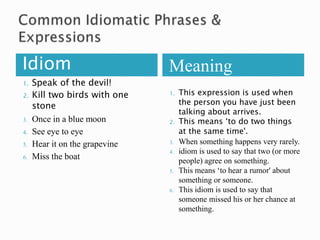
Idiom Meaning 
1. Speak of the devil! 
2. Kill two birds with one 
stone 
3. Once in a blue moon 
4. See eye to eye 
5. Hear it on the grapevine 
6. Miss the boat 
1. This expression is used when 
the person you have just been 
talking about arrives. 
2. This means ‘to do two things 
at the same time'. 
3. When something happens very rarely. 
4. idiom is used to say that two (or more 
people) agree on something. 
5. This means ‘to hear a rumor' about 
something or someone. 
6. This idiom is used to say that 
someone missed his or her chance at 
something.
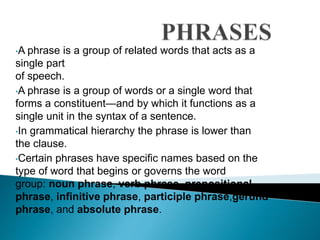
•A phrase is a group of related words that acts as a 
single part 
of speech. 
•A phrase is a group of words or a single word that 
forms a constituent—and by which it functions as a 
single unit in the syntax of a sentence. 
•In grammatical hierarchy the phrase is lower than 
the clause. 
•Certain phrases have specific names based on the 
type of word that begins or governs the word 
group: noun phrase, verb phrase, prepositional 
phrase, infinitive phrase, participle phrase,gerund 
phrase, and absolute phrase.
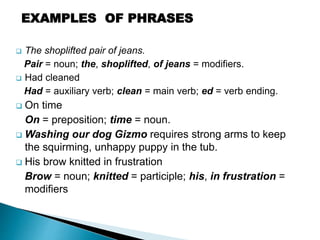
EXAMPLES OF PHRASES 
 The shoplifted pair of jeans. 
Pair = noun; the, shoplifted, of jeans = modifiers. 
 Had cleaned 
Had = auxiliary verb; clean = main verb; ed = verb ending. 
 On time 
On = preposition; time = noun. 
Washing our dog Gizmo requires strong arms to keep 
the squirming, unhappy puppy in the tub. 
 His brow knitted in frustration 
Brow = noun; knitted = participle; his, in frustration = 
modifiers
Homonyms, Homophones & Homographs 
What do all of these words have in 
common? 
How are they the same? 
Homonym 
Homophone 
Homograph 
Each begins with the root word homo. 
Homo means same . 
All of these words have to do with 
sameness.
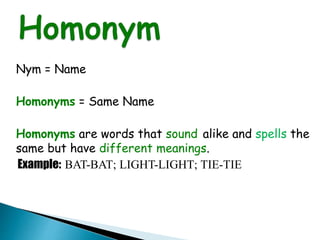
Nym = Name 
Homonyms = Same Name 
Homonyms are words that sound alike and spells the 
same but have different meanings. 
Example: BAT-BAT; LIGHT-LIGHT; TIE-TIE
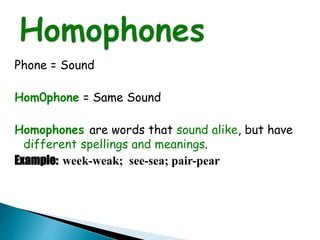
Phone = Sound 
Hom0phone = Same Sound 
Homophones are words that sound alike, but have 
different spellings and meanings. 
Example: week-weak; see-sea; pair-pear
Graph = Writing 
Homograph = Same Writing 
Homographs are words that are spelled the 
same, but have different sounds and meanings. 
Example: saw-saw; Bass- Bass;
Vocabulary Drills 
helps students learn how to approach new 
words and to become more comfortable 
with the language 
Latin and Greek roots expand students’ 
vocabularies exponentially 
Personal words help students build a 
useful bank of interesting words. 
Making connections helps students build 
personal word power.
THANK YOU 
Submitted By: 
Lekhansh A2324612008 
Praroop Joshi A2324612033 
Rudraksha Rana A2324612034 
Prashu Prakash A2324612039

Vocabulary

  • 2.
    Vocabulary is commonlydefined as "all the words known and used by a particular person". Knowing a word, however, is not as simple as simply being able to recognize or use it. There are several aspects of word knowledge which are used to measure word knowledge.
  • 3.
    An extensive vocabularyaids expression and communication. Vocabulary size has been directly linked to reading comprehension. Linguistic vocabulary is synonymous with thinking vocabulary. A person may be judged by others based on his or her vocabulary. Wilkins (1972) once said," Without grammar, very little can be conveyed, without vocabulary, nothing can be conveyed.”
  • 4.
    Within the receptive–productivedistinction lies a range of abilities which are often referred to as degree of knowledge. This simply indicates that a word gradually enters a person's vocabulary over a period of time as more aspects of word knowledge are learnt. Roughly, these stages could be described as: Never encountered the word. Heard the word, but cannot define it. Recognize the word due to context or tone of voice. Able to use the word and understand the general and/or intended meaning, but cannot clearly explain it.
  • 5.
    Being unable toPay One's debt - Insolvent( दिवालिया ) The study of the functions of the body - Physiology( शरीर क्रिया ववज्ञान ) A person with a long experience of any occupation - Veteran(अनुभवी ) Words written on a Tomb - Epitaph (समाधििेख) Stealthy Done - Surreptitious (िुक छिप कर) Something No Longer in Use - Obsolete ( अप्रचलित ) One not concerned with Right or Wrong - Amoral (अनैछतक )
  • 6.
    SYNONYMS AND ANTONYMS SYNONYMS : A synonym is a word with the same or similar meaning of another word. Synonym words are said to be synonymous. The state of being a synonym is called synonymy. Synonyms can be any part of speech(noun, verb, adjective, preposition, adverb), as long as both words belong to the same part of speech. Here are more examples of English synonyms: Verb : buy and purchase Adjective : big and large Adverb : quickly and speedily Preposition : on and upon
  • 7.
    Examples of adjectivesand their synonyms that are commonly used to describe people. Beautiful: Attractive, Pretty, Lovely, Stunning Fair: Just, Objective, Impartial, Unbiased Funny: Humorous, Comical, Hilarious, Hysterical Happy: Content, Joyful, Mirthful, Upbeat Hardworking: Diligent, Determined, Industrious Here are some miscellaneous words and their synonyms: Baffle: confuse, deceive Hypocrisy: duplicity, falseness Old: antiquated, ancient, obsolete, extinct
  • 8.
    ANTONYM: An antonymis a word that has the opposite meaning as the another word.  It refers to a word that is completely different from another one.  The opposite of a antonym is a synonym. Categories of Antonyms- There are three categories of antonyms: Graded antonyms deal with levels of the meaning of the words, like if something is not “good”, is may still not be “bad.” Examples include: Fat and skinny Young and old Happy and sad Hard and soft
  • 9.
    • Complementary antonyms:There are only two possibilities, either one or the other. Examples are: Man and woman Push and pull Dead and alive Off and on Day and night • Relational antonyms: Sometimes considered as a subcategory of complementary antonyms. Examples are: Husband and wife Doctor and patient Buy and sell Predator and prey
  • 10.
    • An idiomis a combination of words that have a figurative meaning following to its common usage. •An idiom is a phrase where the words together have a meaning that is different from the dictionary definitions of the individual words. • It’s figurative meaning is separate from the literal meaning. •There are estimated to be twenty-five thousand idiomatic expressions in the English Language.
  • 11.
    Idiom Meaning 1.Speak of the devil! 2. Kill two birds with one stone 3. Once in a blue moon 4. See eye to eye 5. Hear it on the grapevine 6. Miss the boat 1. This expression is used when the person you have just been talking about arrives. 2. This means ‘to do two things at the same time'. 3. When something happens very rarely. 4. idiom is used to say that two (or more people) agree on something. 5. This means ‘to hear a rumor' about something or someone. 6. This idiom is used to say that someone missed his or her chance at something.
  • 12.
    •A phrase isa group of related words that acts as a single part of speech. •A phrase is a group of words or a single word that forms a constituent—and by which it functions as a single unit in the syntax of a sentence. •In grammatical hierarchy the phrase is lower than the clause. •Certain phrases have specific names based on the type of word that begins or governs the word group: noun phrase, verb phrase, prepositional phrase, infinitive phrase, participle phrase,gerund phrase, and absolute phrase.
  • 13.
    EXAMPLES OF PHRASES  The shoplifted pair of jeans. Pair = noun; the, shoplifted, of jeans = modifiers.  Had cleaned Had = auxiliary verb; clean = main verb; ed = verb ending.  On time On = preposition; time = noun. Washing our dog Gizmo requires strong arms to keep the squirming, unhappy puppy in the tub.  His brow knitted in frustration Brow = noun; knitted = participle; his, in frustration = modifiers
  • 14.
    Homonyms, Homophones &Homographs What do all of these words have in common? How are they the same? Homonym Homophone Homograph Each begins with the root word homo. Homo means same . All of these words have to do with sameness.
  • 15.
    Nym = Name Homonyms = Same Name Homonyms are words that sound alike and spells the same but have different meanings. Example: BAT-BAT; LIGHT-LIGHT; TIE-TIE
  • 16.
    Phone = Sound Hom0phone = Same Sound Homophones are words that sound alike, but have different spellings and meanings. Example: week-weak; see-sea; pair-pear
  • 17.
    Graph = Writing Homograph = Same Writing Homographs are words that are spelled the same, but have different sounds and meanings. Example: saw-saw; Bass- Bass;
  • 18.
    Vocabulary Drills helpsstudents learn how to approach new words and to become more comfortable with the language Latin and Greek roots expand students’ vocabularies exponentially Personal words help students build a useful bank of interesting words. Making connections helps students build personal word power.
  • 19.
    THANK YOU SubmittedBy: Lekhansh A2324612008 Praroop Joshi A2324612033 Rudraksha Rana A2324612034 Prashu Prakash A2324612039