Upakar Paudel (B.Sc MIT)
UCMSTH BHAIRAHAWA
NEPAL
1.Advancement in Magnets.
 It is the biggest, most expensive, and most demanding and
controlling aspect of an MRI system.
 To produce homogeneous magnetic field high field magnet
required.
 Cylindrical systems have been designed with ever
increasing aperture size.
 3Tesla system is now routinely used, Some are using up to
7T for clinical use. About 17T are using in research.
 “mission specific” magnets designed to fill specialized
needs.(interventional suite) Some magnet ability image in
sitting position.
2
Disadvantage of High field (3T)imaging
 Increase in excitation frequency (ω) .
 Decrease wavelength which are near to natural body
temp and cause shielding effect and interferences and
effect on RF homogeneity.(body imaging) which can
be solved by RF shimming and improved coil design.
 More chemical shift, corrected with increasing
bandwidth.
 Decreased T1 tissue contrast, and increased
susceptibility effects.
3
2.Advancement in Gradients.
 With greater max amplitude and faster rise time.
 Reduced duration of RF result reduced minimum TR and TE
which increases spatial resolution by increasing matrices.
 To reduce eddy currents, it is now commonplace to have self-
shielded gradient.
 gradient tube is placed in a vacuum tube in effort to lower
acoustic noise
 Rotating gradient tube where the gradients remained on and
provided spatial encoding while it rotated.
 “Dual”gradients .(reduce dB/dt) –enable max amplitude and
rise time.
 High performance gradient enable EPI.
 Incresed cardiac imaging by faster acquisition 4
3.RF Transmit and receive.
 Coils at specific parts of body.
 Using multiple receiving coil elements, the phased
array coil.(this technology is applied to other region in
addition to spine and body)
 Quadrature circular polarized coil with resulting
increased SNR.
 Tim coils are designed for Parallel Imaging from head
to toe in all 3 spatial directions.
5
4.Image processing computer.
 Increased in computing power.
 Rapid imaging strategies can easily produce hundred
of image per exam.
 Dedicated array processor can perform thousands of
Fourier transformation per second.
 Innovative technique for manipulating k-space
acquisition(half Fourier and partial echo acquisition)
6
Dedicated peripheral “phased-array” RF surface coil for the
acquisition of multistation MR angiography
7
5.Sequence advances.
 1.Single shot acquisition of breath hold T2 sequence
with half Fourier K-space filling (HASTE) –MRCP.
 2.Echoplanar imaging sequence-
8
Echo planar imaging.
 Echo-planar imaging is a very fast magnetic
resonance (MR) imaging technique capable of
acquiring an entire MR image in only a fraction of a
second. In single-shot echo-planar imaging, all the
spatial-encoding data of an image can be obtained
after a single radio-frequency excitation.
 echo-planar imaging offers major advantages over
conventional MR imaging, including reduced
imaging time, decreased motion artifact, and the
ability to image rapid physiologic processes of the
human body.
9
 Echo-planar imaging can be performed by using single
or multiple excitation pulses (“shots”). The number of
shots represents the number of TR periods required to
complete the image acquisition.
 Clinical applications of EPI:
 Diffusion weighted MR
 Perfusion weighted MR
 Functional MR.
 Heart imaging.
 GI motility imaging.
10
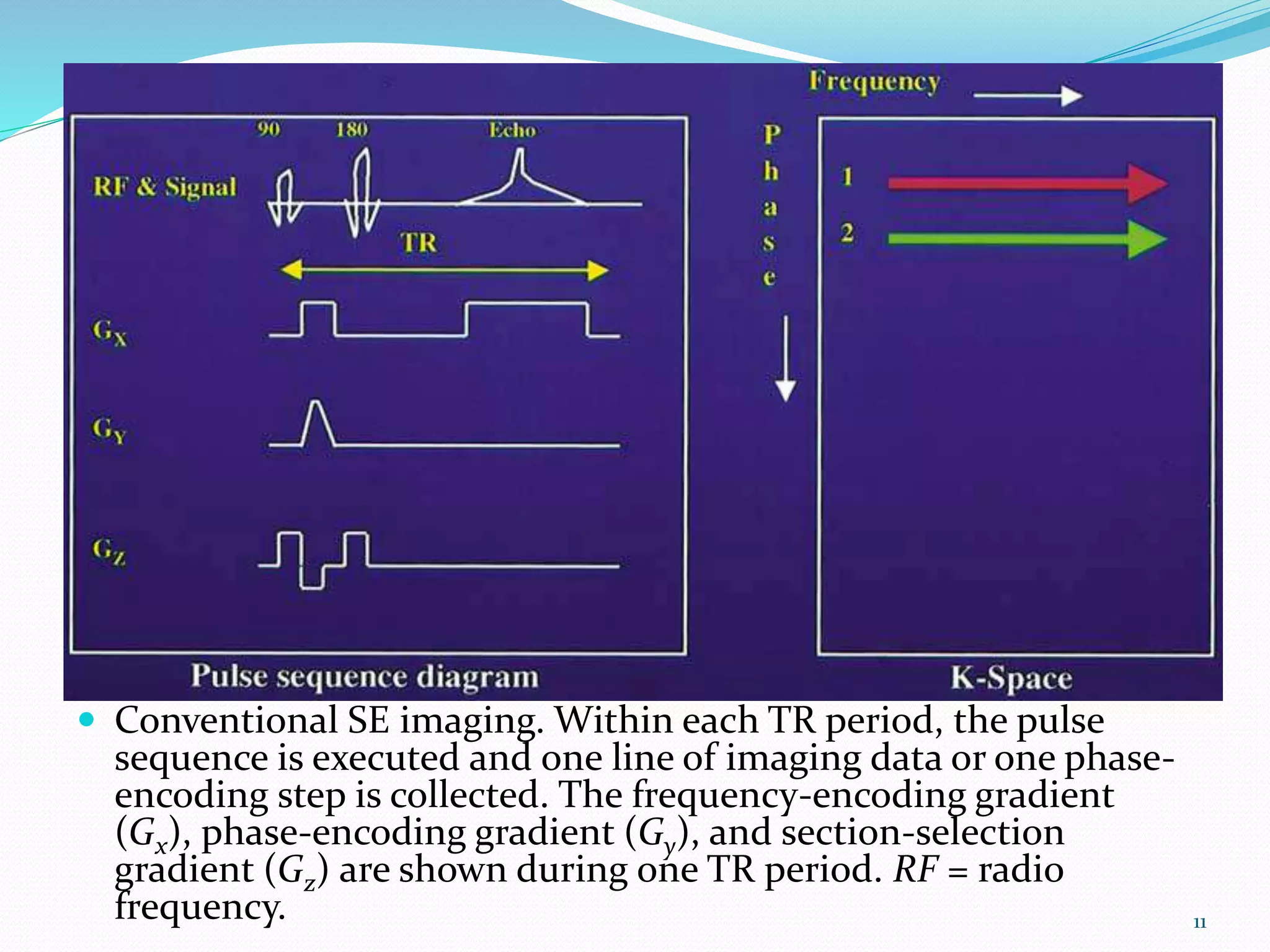
 Conventional SE imaging. Within each TR period, the pulse
sequence is executed and one line of imaging data or one phase-
encoding step is collected. The frequency-encoding gradient
(Gx), phase-encoding gradient (Gy), and section-selection
gradient (Gz) are shown during one TR period. RF = radio
frequency. 11
 Echo-planar imaging. Within each TR period, multiple
lines of imaging data are collected.Gx = frequency-
encoding gradient, Gy = phase-encoding gradient, Gz =
section-selection gradient.
12
A. Diffusion weighted MRI.
 Term to describe random thermal motion of molecule.
 Restricted by boundaries.
 Sometime restriction in diffusion is directional depending
on structure of tissue.
 DWI sequences are acquired with ultrafast sequence ,EPI
with two large gradient pulses applied after excitation.
 Gradient pulse cancel each other if spins do not move,
while moving spins experienced phase shift.
 So in DWI sequences signal attenuation occur in normal
tissue with random diffusion and bright signal appear
in tissue with restricted diffusion (e.g ischemia)
13
14
15
 A gradient pulse unrelated to the imaging gradients and at a
certain duration ( ) is applied to the spins. This gradient
causes net dephasing of the spins. Now, after a certain time
(∆), the spins are rephased by applying either an equal and
opposite gradient or, if a 180 degree pulse has been applied in
the interim, an equal and same polarity gradient.
 All spins that were stationary will be rephased, however,
spins that moved during the time(∆) will feel a different
rephasing gradient than that encountered during the
dephasing pulse and thus will not be rephased.
 Extremely prone to motion.
16
17
18
 If multi-shot sequences are used for DWI phase
change will be different for different lines of k-space
and strong artifact will appear along phase direction.
 Additional echoes called navigator echo is generated
and used to correct artifact during post processing.
 Stroke imaging by DWI –can show irreversible
and reversible ischemic lesion.
19
 The amount of attenuation depends on amplitude and
direction of diffusion gradient.
 Diffusion gradient in X,Y,Z direction are combined to
produce diffusion image.
 When diffusion gradient are applied only in X, and Y
direction slight signal change may reflect direction of axon.
 Diffusion gradient most be long and strong for enough
DWI weighting.
 Diffusion sensitivity “b” –It determines diffusion
attenuation by modification of duration and amplitude of
diffusion gradient. (b-S/mm2 )
20
Contains contribution from spin density and relaxation times T1 and
T2; therefore, the hyperintense lesion on a diffusion-weighted image
may reflect a strong T2 effect (T2 "shine-through" effect) instead of
reduced diffusion.
21
22
 Because the ADC values of gray and white matter
are similar, typically there is no contrast between
gray and white matter on the exponential image
or ADC map. The contrast between gray and white
matter seen on the DW image is due to T2-
weighted contrast.
 This residual T2 component on the DW image makes
it important to view either the exponential image or
ADC map in conjunction with the DW image.
 In lesions such as acute stroke, the T2-weighted and
DW effects both cause increased signal intensity on
the DW image. Therefore, we have found that we
identify regions of decreased diffusion best on ADC
images.
23
 An ADC map shows parametric images containing the apparent
diffusion cofficient of diffusion weighted image
 Term apparent refers to the dependence of these coefficients on
factors other than prior molecular mobility. Also called diffusion
map.
 The ADC is actually a tensor quantity or a matrix:
 The diagonal elements of this matrix can be combined to give
information about the magnitude of the apparent diffusion:
(ADCxx + ADCyy + ADCzz)/3.
24
Anisotropic nature of diffusion in the brain.
Schaefer P W et al. Radiology 2000;217:331-345
©2000 by Radiological Society of North America 25
26
 To remove T2 contrast transverse DWI image is
divided with images having same parameter except
different b value.
27
 Creation of ADC map mathematically manipulating
exponential image.
28
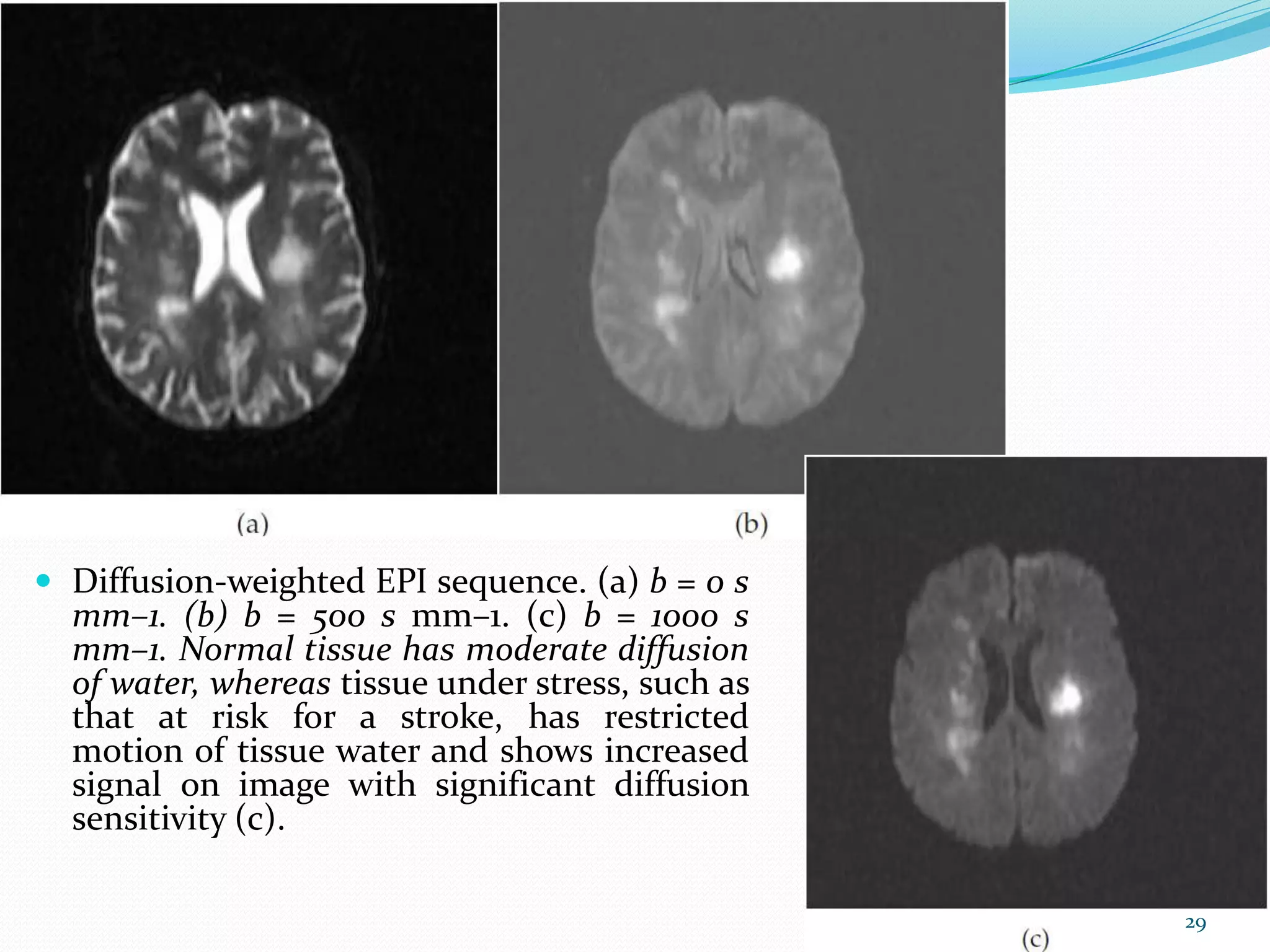
 Diffusion-weighted EPI sequence. (a) b = 0 s
mm–1. (b) b = 500 s mm–1. (c) b = 1000 s
mm–1. Normal tissue has moderate diffusion
of water, whereas tissue under stress, such as
that at risk for a stroke, has restricted
motion of tissue water and shows increased
signal on image with significant diffusion
sensitivity (c).
29
Diffusion tensor imaging (DTI)
 Is rapidly evolving noninvasive MRI technique for
delineating the anatomy and pathology of white
matter tracts.
 Useful for presurgical planning in patients with intra-
axial, focal mass lesions.
 Delineation of the various tracts around a focal lesion
and knowledge of the status of infiltration vs
displacement , that help neurosurgeons decide on the
appropriate surgical approach.
30
DTI
 For DTI, several directions are required, as white
matter in the brain is anatomically present in different
directions.
 Diffusion in the brain is not uniform but anisotropic,
along the direction of the various fiber tracts.
 diffusion tensor (D)- measurement of water diffusion
in different directions
 At least six noncollinear directions and an image
without diffusion weighting are needed in order to
calculate D.
 From this, the tensor ‘eigen values and eigenvectors’
can be derived.The eigenvalues represent the
magnitude of diffusion, whereas eigenvectors
represent the corresponding direction.
31
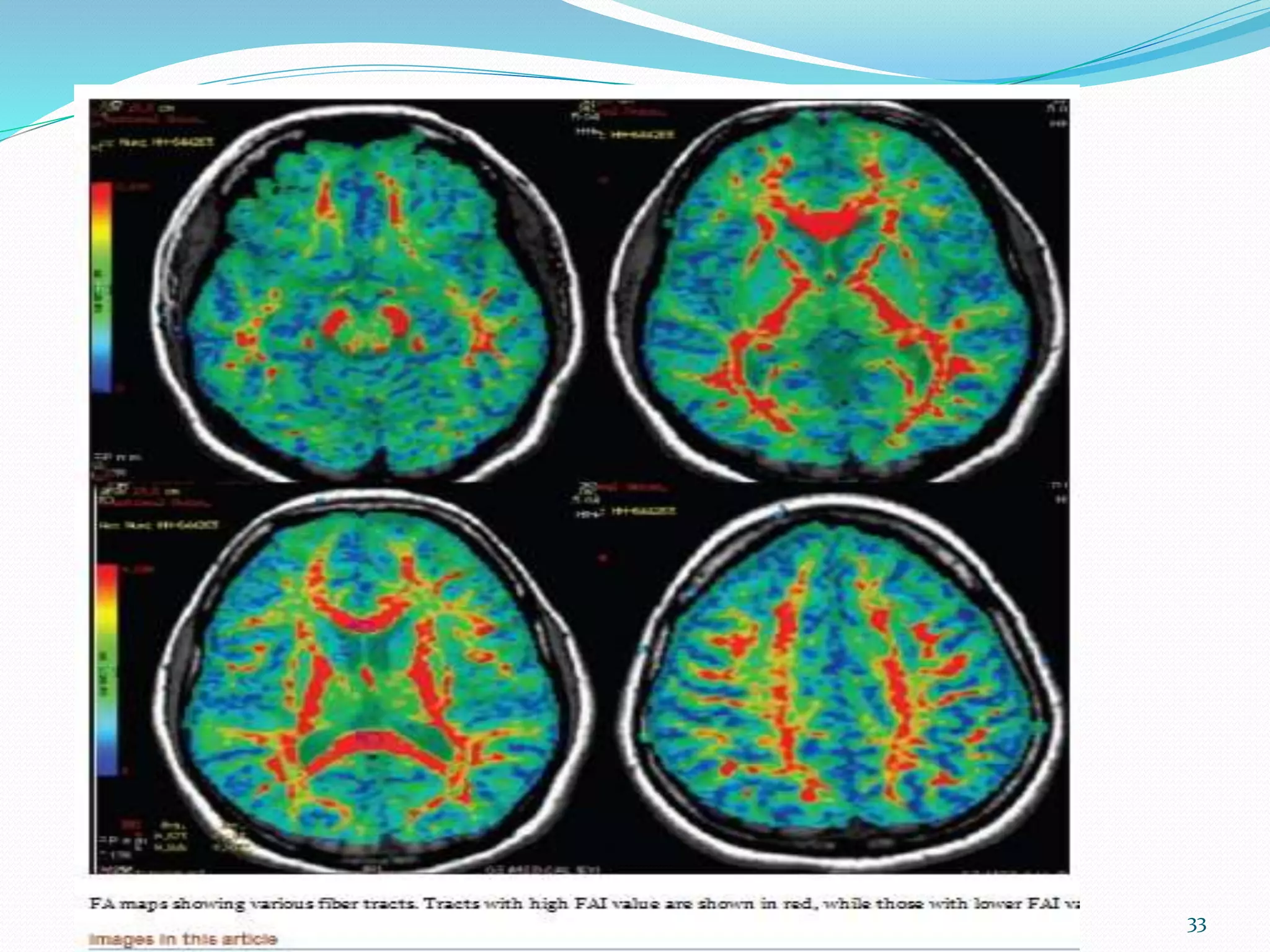
 The anisotropic part of diffusion in a tissue is measured by
fractional anisotropy (FA).
 FA values will alter in any area where there is a focal brain
lesion, causing alteration in the white matter tract.
 Color intensity was scaled in proportion to the magnitude
of FA
 From these FA maps, DTI-based color-coded maps can be
generated.
 In these maps, colors are chosen according to the high
eigenvector associated with the largest eigenvalue. In most
MRI machines, red is assigned to the x-direction (left to
right), green to the y-direction (anterior-posterior), and
blue to the z-direction (superior-inferior).
32
33
Fiber tractography.
 By combining the anisotropy data with the
directionality it is possible to estimate fiber
orientation.
 Fiber tractography in which three-dimensional
pathways of white matter tracts can be reconstructed.
In this algorithm, called ‘fiber assignment by
continuous tracking’ (FACT), reconstruction of the
tract is performed by sequentially piecing together
discrete and shortly spaced estimates of fiber
orientation to form continuous trajectories.
34
Whole brain tractography of the human in vivo data using the corpus callosum as a ROI,
with directions: left – right (red), superior –
inferior (blue), anterior – posterior (green).
35
 Cingulum, sagittal view. A, Illustration shows the cingulum arching over the
corpus callosum. B, Gross dissection, median view. C, Directional map. Because
DTI reflects tract orientation voxel by voxel, the color changes from green to
blue as the cingulum (arrows) arches around the genu and splenium
(arrowheads). Green indicates anteroposterior; red, left-right; blue, superior-
inferior. D, Tractogram. 36
DTI pattern 1: normal anisotropy, abnormal
location or orientation. A–E, T2-weighted MR
image (A), contrast- enhanced T1-weighted
image (B), directional maps in axial (C) and
coronal (D) planes, and coronal tractogram of
bilateral corticospinal tracts (E). WM tracts
are deviated anteriorly, inferiorly, and
posterolaterally by this ganglioglioma but
retain their normal anisotropy. Therefore,
they remain readily identified on DTI (C and
D) and readily traced with tractography (E).
The AC (red, arrowhead), IOFF (green, open
arrow), and CST (blue, solid arrows) are
deviated. Note the blue hue of the CST change
to red as it deviates toward the axial plane by
the tumor (arrow on coronal view [D]).37
 Potential patterns of WM fiber tract alteration by cerebral
neoplasms. The extent to which these patterns can be
discriminated on the basis of DTI is under investigation.
38
 DTI pattern : tract
unidentifiable. A–
D, T2-weighted MR
image (A),
contrast-
enhanced T1-
weighted image
(B), FA map (C),
and directional
map (D). This
high-grade
astrocytoma has
destroyed the body
of the corpus
callosum,
rendering the
diffusion
essentially
isotropic and
precluding
identification on
the directional
map (arrow).
39
Whole body diffusion.
 diffusion-weighted whole-body imaging with
background body signal suppression” (DWIBS) now
allows acquisition of volumetric diffusion-weighted
images of the entire body
 Thin DWI images can be
combined to form reformatted.
(coronal image with rectal
Ca and LN inversed image)
Application-Onco imaging.
40
B.PERFUSION WEIGHTED MR
 Although angiographic techniques visualize the vascular
network within a patient, they do not have sufficient
spatial resolution to visualize blood flow through a tissue
in bulk. However, it is possible in many instances to
observe changes in tissue signal due to the blood flow
through it, a process known as perfusion.
 Proper tissue perfusion is critical to ensure an adequate
supply of nutrients to the constituent cells as well as
removal of metabolic byproducts. It also aids in
maintenance of a stable tissue temperature.
 Abnormalities in perfusion can lead to an increased
temperature sensitivity and a loss of tissue viability
through hypoxia.
41
.
 It is measure of quality of vascular supply to tissue
vascular supply and metabolism are related perfusion
can be used to measure tissue activity.
 Measured by tagging the water in arterial blood during
image acquisition.
 Tagging can be done by IV GD or by saturating the
proton in arterial blood by RF inversion.
 Difference between tagged and un tagged image is
small- ultrafast imaging method are required to reduce
artifact.
 Fast scanning –before, during and after contrast
injection.
42
Three approach for perfusion
imaging.
 First one approach acquires a series of rapid (less
than 20 seconds per image) T1-weighted imaging
studies following the bolus administration of a
gadolinium-chelated contrast agent. These images
are typically acquired using spoiled gradient echo, T1-
weighted magnetization prepared or echo planar
techniques. An increase in tissue signal occurs as the
contrast agent infuses the extravascular spaces of the
tissue. Perfusion defects are visualized as a lack of
signal increase for the affected region of tissue.
43
2.Second approach is useful if the contrast
agent remains in the blood vessels, such as in
cerebral tissue with an intact blood–brain
barrier. In this case, the paramagnetic nature
of the contrast agent increases the local tissue
susceptibility, causing increased T2*
dephasing of nearby tissues. Serial T2*-
weighted gradient echo or echo planar
sequences are acquired, and the well-perfused
tissue exhibits a reduction of signal relative to
the precontrast images or the poorly perfused
tissues.
44
3.The third approach does not use contrast media
to highlight the flowing spins. Instead, two sets of
images are acquired using an EPI pulse sequence.
One set is acquired following a region-selective
inversion pulse that inverts or “tags” the spins
outside the slice of interest, whereas the other set of
images serves as a reference. A variable delay time
between the tagging pulse and the data collection
allows control of the tag position based on the flow
velocity.
45
Application.
 Two areas in which perfusion studies have shown
promise are the examination of abnormalities of
blood flow within tissue and the detection of
tumors.(cerebral ischemia early detection)
46
 43-year-old man with acute onset of left-sided weakness
and visual changes who was found to have left
homonmous hemianopsia on examination. A,
Unenhanced CT scan reveals negative finding for
cortical infarction. B, T2-weighted MR image shows
increased signal (arrow ) in right calcarine cortex. C,
Diffusion-weighted scan demonstrates larger area of
signal abnormality (arrow) involving right occipital
lobe, consistent with infarction. D, Color-coded
cerebral blood volume map obtained using dynamic
T2-weighted technique shows even larger perfusion
deficit than that seen in B and C in right occipital
lobe, including infarction core, and surrounding tissue at
risk. Red denotes high cerebral blood volume; blue, low
cerebral blood volume. E, Color-coded mean transit
time map obtained using dynamic T2-weighted
technique shows prolonged transit time in right
occipital lobe, also corresponding to infarct core, and
surrounding tissue at risk. Red denotes prolonged mean
transit time; yellow, normal mean transit time.
47
 24-year-old woman with previously treated high-grade cerebral neoplasm (anaplastic ependymoma)
with an enhancing lesion on follow-up examination. Biopsy revealed radiation necrosis. A, Contrast-
enhanced axial T1-weighted image shows area of abnormal enhancement in right
frontoparietal deep white matter. B, Color-coded cerebral blood volume map obtained using
dynamic T2-weighted technique illustrates low cerebral blood volume in area of abnormal contrast
enhancement seen in A. Red denotes high cerebral blood volume; blue, low cerebral blood
volume. C, Overlay of color-coded cerebral blood volume map on T1-weighted image with
cerebral blood volume map thresholded so only voxels with cerebral blood volume values equal to or
higher than that of gray matter are depicted. Note that area of enhancement in right frontoparietal
deep white matter has low cerebral blood volume relative to gray matter, consistent with radiation
necrosis.
48
C.MRS
 MR spectroscopy provides a measure of brain chemistry.
The most common nuclei that are used are 1H (proton),
23Na (sodium), 31P (phosphorus).
 Proton spectroscopy is easier to perform and provides
much higher signal-to-noise than either sodium or
phosphorus.
 Proton MRS can be performed within 10-15 minutes and
can be added on to conventional MR imaging protocols.
 It can be used to serially monitor biochemical changes
in tumors, stroke, epilepsy, metabolic disorders,
infections, and neurodegenerative diseases.
 The MR spectra do not come labeled with diagnoses. They
require interpretation and should always be correlated with
the MR images before making a final diagnosis.
49
 The resonant frequencies of nuclei are at the lower end
of the electromagnetic spectrum between FM radio
and radar.
 10 MHz at 0.3 T to about 300 MHz on a 7 T.
 higher field strength are higher signal-to-noise and
better separation of the metabolite peaks.
 In a proton spectrum at 1.5 T, the metabolites are
spread out between 63,000,000 and 64,000,000 Hertz.
 The resonant frequencies expressed in in parts per
million (ppm)
 NAA at 2.0 ppm and let the other metabolites fall into
their proper positions on the spectral line.
50
 In MR imaging, the total signal from all the protons in
each voxel is used to make the image.
 If all the signal were used for MRS, the fat and water
peaks would be huge and scaling would make the other
metabolite peaks invisible.
 Fat and water are eliminated-
1.Fat is avoided by placing the voxel for MRS within the
brain, away from the fat in bone marrow and scalp.
2. Water suppression is accomplished with either a CHESS
(Chemical-Shift Selective ) or IR (Inversion Recovery)
technique. These suppression techniques are used with a
STEAM or PRESS pulse sequence acquisition
51
 STEAM (Stimulated Echo Acquisition Mode) pulse
sequence uses a 90o refocusing pulse to collect the signal
like a gradient echo.
 STEAM can achieve shorter echo times but at the expense
of less signal-to-noise.
 The PRESS (Point Resolved SpectroScopy) sequence
refocuses the spins with a 180o RF pulse like a spin echo.
 Two other acronyms are. CSI (Chemical Shift Imaging)
refers to multi-voxel MRS. SI (Spectroscopic Imaging)
displays the data as an image with the signal intensity
representing the concentration of a particular metabolite.
52
 Fourier transform is then applied to the data to
separate the signal into individual frequencies.
 Protons in different molecules resonate at slightly
different frequencies because the local electron cloud
affects the magnetic field experienced by the proton.
53
TE affect information obtained in MRS.
 With a short TE of 30 msec, metabolites with both short
and long T2 relaxation times are observed.
 With a long TE of 270 msec, only metabolites with a long
T2 are seen, producing a spectrum with primarily NAA,
creatine, and choline.
 Single voxel, short TE technique is used to make the
initial diagnosis, because the signal-to-noise is high and
all metabolites are represented.
 Multi-voxel, long TE techniques are used to further
characterize different regions of a mass and to assess
brain parenchyma around or adjacent to the mass,
assess response to therapy and to search for tumor
recurrence
54
Each metabolite appears at a specific ppm, and each one reflects specific
cellular and biochemical processes.
55
 NAA is a neuronal marker and decreases with any
disease that adversely affects neuronal integrity.
 Creatine provides a measure of energy stores.
 Choline is a measure of increased cellular turnover and
is elevated in tumors and inflammatory processes.
 The observable MR metabolites provide powerful
information.
56
gray matter has more creatine
57
Hunter's angle is the line formed by the
metabolites on the white matter
spectrum
58
 Normal MR spectra
obtained from gray
matter and white matter
are shown on the right.
The predominant
metabolites, displayed
from right to left, are
NAA, creatine, choline,
and myo-inositol.
 The primary difference
between the two spectra
is that gray matter has
more creatine.
 Hunter's angle is the
line formed by the
metabolites on the
white matter spectrum.
 The common way to
analyze clinical spectra is
to look at metabolite
ratios, namely NAA/Cr,
NAA/Cho, and Cho/Cr.
59
Application.
 MRS can be used to determine the degree of malignancy.
 As malignancy increases, NAA and creatine decrease, and
choline, lactate, and lipids increase.
 To get an accurate assessment of the tumor chemistry, the
spectroscopic voxel should be placed over an enhancing region
of the tumor, avoiding areas of necrosis, hemorrhage,
calcification, or cysts.
 Multi-voxel spectroscopy is best to detect infiltration of
malignant cells beyond the enhancing margins of tumors.
 Cerebral glioma, elevated choline levels are frequently
detected in edematous regions of the brain outside the
enhancing mass.
 MRS can direct the surgeon to the most metabolically active
part of the tumor for biopsy to obtain accurate grading of the
malignancy.
60
 To distinguish-radiation necrosis and tumor
recurrence-(Recurrence-elevated choline and
radiation necrosis low NAA choline and creatine with
elevated lipid and lactate).
 cerebral hypoxia and ischemia- elevated lactate.
 brain abscesses destroy or displace brain tissue, so
NAA is not present.
61
D.fMRI
 Functional MRI (fMRI) is a magnetic resonance
imaging (MRI)-based neuroimaging technique which allows us
to detect the brain areas which are involved in a task, a
process or an emotion.
 CBF change induced by stimulation has been used for
mapping brain functions.
 In 1990, Ogawa and colleagues at AT&T Bell Laboratories
reported that functional brain mapping is possible by using the
venous blood oxygenation level-dependent (BOLD)
magnetic resonance imaging (MRI) contrast. The BOLD
contrast relies on changes in deoxyhemoglobin (dHb), which
acts as an endogenous paramagnetic contrast agent. Therefore,
changes in the local dHb concentration in the brain lead to
alterations in the signal intensity of magnetic resonance images
(MRI).
62
 Oxygenated hemoglobin is diamagnetic, with a
very small magnetic moment.
 deoxygenated hemoglobin has a significant
paramagnetic moment.
 Concentrations of deoxygenated hemoglobin shorten
the T2* relaxation time of the tissue and result in a
decrease in signal compared to tissue with oxygenated
hemoglobin.
 High magnetic field strengths (1.5 T or greater) are
necessary to increase the change in T2* between
activated and nonactivated tissue.
63
 Activation-Stimulated tissue undergoes an increase in
blood flow ( oxygenated hemoglobin).
 As deoxygenated hemoglobin decreases within the
tissue. reducing the concentration of paramagnetic
molecules. This condition reduces the amount of
susceptibility dephasing induced and thereby increases
the T2* time for the stimulated tissue relative to
unstimulated.
 As a result, the stimulated tissue appears higher in
signal on T2*-weighted images. This phenomenon is
known as the blood oxygenation-level-dependent
effect or BOLD effect..
64
 In fMRI –use to perform a large series of
measurements in the presence and absence of the
stimulus and subtract the images, leaving pixels
presumably from the activated region of tissue.
 Correction for patient movement between
measurements must be performed.
 The correlation coefficient of the voxel intensity and
the time variation of the stimulus is also calculated to
ensure that the observed variation is in response to the
stimulus
65
Ac | Functional
MRI (fMRI) during finger tapping identifies the brain
regions associated with hand movement.. d | fMRI
with sensory stimulation of the left foot identifies
regions that, if injured during tumour resection, could
be expected to lead to greater functional impairments 66
Application of fMRI
 Presurgical mapping of eloquent brain areas (motor,
language,...)
 Assessment of plasticity after a brain injury.
 Assessment of patients with disorders of consciousness
(coma, vegetative state, minimally conscious state, locked-in
syndrome)
 Mapping of complex functions (emotions, motor control,
specialized language functions,...) in normal and pathological
conditions
 Monitoring of treatment response
 Neuromarketing
 Lie detector
 Mind reading.
67
Parallel Imaging Technique.
 Parallel acquisition techniques combine the signals of
several coil elements in a phased array to reconstruct
the image.
 combining the signal of several coil arrays. The spatial
information related to the phased array coil elements is
utilized for reducing the amount of conventional Fourier
encoding.
 To improve the SNR or to accelerate acquisition and reduce
scan time.
 A shorter scan time enables breath-hold sequences or
improves the temporal resolution of dynamic scans.
 Improve image quality(better spatial resolution, reduced
artifacts).
68
Two type recon algorithm.
 Algorithms that reconstruct the global image from the
images produced by each coil (reconstruction in the
image domain, after Fourier transform): SENSE
(SENSitivity Encoding), PILS (Partially Parallel
Imaging with Localized Sensitivity), ASSET (Array
Spatial Sensitivity Encoding Technique)
 Algorithms that reconstruct the Fourier plane of the
image from the frequency signals of each coil
(reconstruction in the frequency domain, before
Fourier transform): GRAPPA (GeneRalized Auto-
calibrating Partially Parallel Acquisition)
69
Application.
 Echo-planar (Diffusion imaging, diffusion tensor and
perfusion imaging): enhanced spatial resolution,
reduced artifacts (related to the sensitivity of the echo-
planar to magnetic susceptibility artifacts)
 Cardiac, abdominal imaging
 Magnetic resonance angiography
 Ultra high field MRI
70
Whole body MRI screening.
 High performance gradient linked to automated table
movements enable rapid imaging covering whole
body.
 Fast T1W and T2W sequence can be planned with
automated sequential movement of patient through
MR scanner.
 Images taken whole body sag/cor plane.
 Whole body STIR for nodal assessment in tumor.
71
72
Whole bod MR
angiography
(A) combined
from five 3D
data sets,
which were
acquired over a
total period of
72
seconds
73
Future.
 Higher strength and RF power system with RF safety
mechanism.
 Drug delivery monitoring and therapeutic application
of MR.
 MR linking with digital fluoroscopy single
exam/operating room allowing easy patient movement
between modalities.
74
Refrences.
 Article Pamela W. Schaefer, MD, P. Ellen Grant, MD
and R. Gilberto Gonzalez, MD, PhD.
 MRI principle and application-Mark K.Brown.
 MRI in practice Catherine westbrook.
75
Thank you.
76

Recent Advances In MRI

  • 1.
    Upakar Paudel (B.ScMIT) UCMSTH BHAIRAHAWA NEPAL
  • 2.
    1.Advancement in Magnets. It is the biggest, most expensive, and most demanding and controlling aspect of an MRI system.  To produce homogeneous magnetic field high field magnet required.  Cylindrical systems have been designed with ever increasing aperture size.  3Tesla system is now routinely used, Some are using up to 7T for clinical use. About 17T are using in research.  “mission specific” magnets designed to fill specialized needs.(interventional suite) Some magnet ability image in sitting position. 2
  • 3.
    Disadvantage of Highfield (3T)imaging  Increase in excitation frequency (ω) .  Decrease wavelength which are near to natural body temp and cause shielding effect and interferences and effect on RF homogeneity.(body imaging) which can be solved by RF shimming and improved coil design.  More chemical shift, corrected with increasing bandwidth.  Decreased T1 tissue contrast, and increased susceptibility effects. 3
  • 4.
    2.Advancement in Gradients. With greater max amplitude and faster rise time.  Reduced duration of RF result reduced minimum TR and TE which increases spatial resolution by increasing matrices.  To reduce eddy currents, it is now commonplace to have self- shielded gradient.  gradient tube is placed in a vacuum tube in effort to lower acoustic noise  Rotating gradient tube where the gradients remained on and provided spatial encoding while it rotated.  “Dual”gradients .(reduce dB/dt) –enable max amplitude and rise time.  High performance gradient enable EPI.  Incresed cardiac imaging by faster acquisition 4
  • 5.
    3.RF Transmit andreceive.  Coils at specific parts of body.  Using multiple receiving coil elements, the phased array coil.(this technology is applied to other region in addition to spine and body)  Quadrature circular polarized coil with resulting increased SNR.  Tim coils are designed for Parallel Imaging from head to toe in all 3 spatial directions. 5
  • 6.
    4.Image processing computer. Increased in computing power.  Rapid imaging strategies can easily produce hundred of image per exam.  Dedicated array processor can perform thousands of Fourier transformation per second.  Innovative technique for manipulating k-space acquisition(half Fourier and partial echo acquisition) 6
  • 7.
    Dedicated peripheral “phased-array”RF surface coil for the acquisition of multistation MR angiography 7
  • 8.
    5.Sequence advances.  1.Singleshot acquisition of breath hold T2 sequence with half Fourier K-space filling (HASTE) –MRCP.  2.Echoplanar imaging sequence- 8
  • 9.
    Echo planar imaging. Echo-planar imaging is a very fast magnetic resonance (MR) imaging technique capable of acquiring an entire MR image in only a fraction of a second. In single-shot echo-planar imaging, all the spatial-encoding data of an image can be obtained after a single radio-frequency excitation.  echo-planar imaging offers major advantages over conventional MR imaging, including reduced imaging time, decreased motion artifact, and the ability to image rapid physiologic processes of the human body. 9
  • 10.
     Echo-planar imagingcan be performed by using single or multiple excitation pulses (“shots”). The number of shots represents the number of TR periods required to complete the image acquisition.  Clinical applications of EPI:  Diffusion weighted MR  Perfusion weighted MR  Functional MR.  Heart imaging.  GI motility imaging. 10
  • 11.
     Conventional SEimaging. Within each TR period, the pulse sequence is executed and one line of imaging data or one phase- encoding step is collected. The frequency-encoding gradient (Gx), phase-encoding gradient (Gy), and section-selection gradient (Gz) are shown during one TR period. RF = radio frequency. 11
  • 12.
     Echo-planar imaging.Within each TR period, multiple lines of imaging data are collected.Gx = frequency- encoding gradient, Gy = phase-encoding gradient, Gz = section-selection gradient. 12
  • 13.
    A. Diffusion weightedMRI.  Term to describe random thermal motion of molecule.  Restricted by boundaries.  Sometime restriction in diffusion is directional depending on structure of tissue.  DWI sequences are acquired with ultrafast sequence ,EPI with two large gradient pulses applied after excitation.  Gradient pulse cancel each other if spins do not move, while moving spins experienced phase shift.  So in DWI sequences signal attenuation occur in normal tissue with random diffusion and bright signal appear in tissue with restricted diffusion (e.g ischemia) 13
  • 14.
  • 15.
  • 16.
     A gradientpulse unrelated to the imaging gradients and at a certain duration ( ) is applied to the spins. This gradient causes net dephasing of the spins. Now, after a certain time (∆), the spins are rephased by applying either an equal and opposite gradient or, if a 180 degree pulse has been applied in the interim, an equal and same polarity gradient.  All spins that were stationary will be rephased, however, spins that moved during the time(∆) will feel a different rephasing gradient than that encountered during the dephasing pulse and thus will not be rephased.  Extremely prone to motion. 16
  • 17.
  • 18.
  • 19.
     If multi-shotsequences are used for DWI phase change will be different for different lines of k-space and strong artifact will appear along phase direction.  Additional echoes called navigator echo is generated and used to correct artifact during post processing.  Stroke imaging by DWI –can show irreversible and reversible ischemic lesion. 19
  • 20.
     The amountof attenuation depends on amplitude and direction of diffusion gradient.  Diffusion gradient in X,Y,Z direction are combined to produce diffusion image.  When diffusion gradient are applied only in X, and Y direction slight signal change may reflect direction of axon.  Diffusion gradient most be long and strong for enough DWI weighting.  Diffusion sensitivity “b” –It determines diffusion attenuation by modification of duration and amplitude of diffusion gradient. (b-S/mm2 ) 20
  • 21.
    Contains contribution fromspin density and relaxation times T1 and T2; therefore, the hyperintense lesion on a diffusion-weighted image may reflect a strong T2 effect (T2 "shine-through" effect) instead of reduced diffusion. 21
  • 22.
  • 23.
     Because theADC values of gray and white matter are similar, typically there is no contrast between gray and white matter on the exponential image or ADC map. The contrast between gray and white matter seen on the DW image is due to T2- weighted contrast.  This residual T2 component on the DW image makes it important to view either the exponential image or ADC map in conjunction with the DW image.  In lesions such as acute stroke, the T2-weighted and DW effects both cause increased signal intensity on the DW image. Therefore, we have found that we identify regions of decreased diffusion best on ADC images. 23
  • 24.
     An ADCmap shows parametric images containing the apparent diffusion cofficient of diffusion weighted image  Term apparent refers to the dependence of these coefficients on factors other than prior molecular mobility. Also called diffusion map.  The ADC is actually a tensor quantity or a matrix:  The diagonal elements of this matrix can be combined to give information about the magnitude of the apparent diffusion: (ADCxx + ADCyy + ADCzz)/3. 24
  • 25.
    Anisotropic nature ofdiffusion in the brain. Schaefer P W et al. Radiology 2000;217:331-345 ©2000 by Radiological Society of North America 25
  • 26.
  • 27.
     To removeT2 contrast transverse DWI image is divided with images having same parameter except different b value. 27
  • 28.
     Creation ofADC map mathematically manipulating exponential image. 28
  • 29.
     Diffusion-weighted EPIsequence. (a) b = 0 s mm–1. (b) b = 500 s mm–1. (c) b = 1000 s mm–1. Normal tissue has moderate diffusion of water, whereas tissue under stress, such as that at risk for a stroke, has restricted motion of tissue water and shows increased signal on image with significant diffusion sensitivity (c). 29
  • 30.
    Diffusion tensor imaging(DTI)  Is rapidly evolving noninvasive MRI technique for delineating the anatomy and pathology of white matter tracts.  Useful for presurgical planning in patients with intra- axial, focal mass lesions.  Delineation of the various tracts around a focal lesion and knowledge of the status of infiltration vs displacement , that help neurosurgeons decide on the appropriate surgical approach. 30
  • 31.
    DTI  For DTI,several directions are required, as white matter in the brain is anatomically present in different directions.  Diffusion in the brain is not uniform but anisotropic, along the direction of the various fiber tracts.  diffusion tensor (D)- measurement of water diffusion in different directions  At least six noncollinear directions and an image without diffusion weighting are needed in order to calculate D.  From this, the tensor ‘eigen values and eigenvectors’ can be derived.The eigenvalues represent the magnitude of diffusion, whereas eigenvectors represent the corresponding direction. 31
  • 32.
     The anisotropicpart of diffusion in a tissue is measured by fractional anisotropy (FA).  FA values will alter in any area where there is a focal brain lesion, causing alteration in the white matter tract.  Color intensity was scaled in proportion to the magnitude of FA  From these FA maps, DTI-based color-coded maps can be generated.  In these maps, colors are chosen according to the high eigenvector associated with the largest eigenvalue. In most MRI machines, red is assigned to the x-direction (left to right), green to the y-direction (anterior-posterior), and blue to the z-direction (superior-inferior). 32
  • 33.
  • 34.
    Fiber tractography.  Bycombining the anisotropy data with the directionality it is possible to estimate fiber orientation.  Fiber tractography in which three-dimensional pathways of white matter tracts can be reconstructed. In this algorithm, called ‘fiber assignment by continuous tracking’ (FACT), reconstruction of the tract is performed by sequentially piecing together discrete and shortly spaced estimates of fiber orientation to form continuous trajectories. 34
  • 35.
    Whole brain tractographyof the human in vivo data using the corpus callosum as a ROI, with directions: left – right (red), superior – inferior (blue), anterior – posterior (green). 35
  • 36.
     Cingulum, sagittalview. A, Illustration shows the cingulum arching over the corpus callosum. B, Gross dissection, median view. C, Directional map. Because DTI reflects tract orientation voxel by voxel, the color changes from green to blue as the cingulum (arrows) arches around the genu and splenium (arrowheads). Green indicates anteroposterior; red, left-right; blue, superior- inferior. D, Tractogram. 36
  • 37.
    DTI pattern 1:normal anisotropy, abnormal location or orientation. A–E, T2-weighted MR image (A), contrast- enhanced T1-weighted image (B), directional maps in axial (C) and coronal (D) planes, and coronal tractogram of bilateral corticospinal tracts (E). WM tracts are deviated anteriorly, inferiorly, and posterolaterally by this ganglioglioma but retain their normal anisotropy. Therefore, they remain readily identified on DTI (C and D) and readily traced with tractography (E). The AC (red, arrowhead), IOFF (green, open arrow), and CST (blue, solid arrows) are deviated. Note the blue hue of the CST change to red as it deviates toward the axial plane by the tumor (arrow on coronal view [D]).37
  • 38.
     Potential patternsof WM fiber tract alteration by cerebral neoplasms. The extent to which these patterns can be discriminated on the basis of DTI is under investigation. 38
  • 39.
     DTI pattern: tract unidentifiable. A– D, T2-weighted MR image (A), contrast- enhanced T1- weighted image (B), FA map (C), and directional map (D). This high-grade astrocytoma has destroyed the body of the corpus callosum, rendering the diffusion essentially isotropic and precluding identification on the directional map (arrow). 39
  • 40.
    Whole body diffusion. diffusion-weighted whole-body imaging with background body signal suppression” (DWIBS) now allows acquisition of volumetric diffusion-weighted images of the entire body  Thin DWI images can be combined to form reformatted. (coronal image with rectal Ca and LN inversed image) Application-Onco imaging. 40
  • 41.
    B.PERFUSION WEIGHTED MR Although angiographic techniques visualize the vascular network within a patient, they do not have sufficient spatial resolution to visualize blood flow through a tissue in bulk. However, it is possible in many instances to observe changes in tissue signal due to the blood flow through it, a process known as perfusion.  Proper tissue perfusion is critical to ensure an adequate supply of nutrients to the constituent cells as well as removal of metabolic byproducts. It also aids in maintenance of a stable tissue temperature.  Abnormalities in perfusion can lead to an increased temperature sensitivity and a loss of tissue viability through hypoxia. 41
  • 42.
    .  It ismeasure of quality of vascular supply to tissue vascular supply and metabolism are related perfusion can be used to measure tissue activity.  Measured by tagging the water in arterial blood during image acquisition.  Tagging can be done by IV GD or by saturating the proton in arterial blood by RF inversion.  Difference between tagged and un tagged image is small- ultrafast imaging method are required to reduce artifact.  Fast scanning –before, during and after contrast injection. 42
  • 43.
    Three approach forperfusion imaging.  First one approach acquires a series of rapid (less than 20 seconds per image) T1-weighted imaging studies following the bolus administration of a gadolinium-chelated contrast agent. These images are typically acquired using spoiled gradient echo, T1- weighted magnetization prepared or echo planar techniques. An increase in tissue signal occurs as the contrast agent infuses the extravascular spaces of the tissue. Perfusion defects are visualized as a lack of signal increase for the affected region of tissue. 43
  • 44.
    2.Second approach isuseful if the contrast agent remains in the blood vessels, such as in cerebral tissue with an intact blood–brain barrier. In this case, the paramagnetic nature of the contrast agent increases the local tissue susceptibility, causing increased T2* dephasing of nearby tissues. Serial T2*- weighted gradient echo or echo planar sequences are acquired, and the well-perfused tissue exhibits a reduction of signal relative to the precontrast images or the poorly perfused tissues. 44
  • 45.
    3.The third approachdoes not use contrast media to highlight the flowing spins. Instead, two sets of images are acquired using an EPI pulse sequence. One set is acquired following a region-selective inversion pulse that inverts or “tags” the spins outside the slice of interest, whereas the other set of images serves as a reference. A variable delay time between the tagging pulse and the data collection allows control of the tag position based on the flow velocity. 45
  • 46.
    Application.  Two areasin which perfusion studies have shown promise are the examination of abnormalities of blood flow within tissue and the detection of tumors.(cerebral ischemia early detection) 46
  • 47.
     43-year-old manwith acute onset of left-sided weakness and visual changes who was found to have left homonmous hemianopsia on examination. A, Unenhanced CT scan reveals negative finding for cortical infarction. B, T2-weighted MR image shows increased signal (arrow ) in right calcarine cortex. C, Diffusion-weighted scan demonstrates larger area of signal abnormality (arrow) involving right occipital lobe, consistent with infarction. D, Color-coded cerebral blood volume map obtained using dynamic T2-weighted technique shows even larger perfusion deficit than that seen in B and C in right occipital lobe, including infarction core, and surrounding tissue at risk. Red denotes high cerebral blood volume; blue, low cerebral blood volume. E, Color-coded mean transit time map obtained using dynamic T2-weighted technique shows prolonged transit time in right occipital lobe, also corresponding to infarct core, and surrounding tissue at risk. Red denotes prolonged mean transit time; yellow, normal mean transit time. 47
  • 48.
     24-year-old womanwith previously treated high-grade cerebral neoplasm (anaplastic ependymoma) with an enhancing lesion on follow-up examination. Biopsy revealed radiation necrosis. A, Contrast- enhanced axial T1-weighted image shows area of abnormal enhancement in right frontoparietal deep white matter. B, Color-coded cerebral blood volume map obtained using dynamic T2-weighted technique illustrates low cerebral blood volume in area of abnormal contrast enhancement seen in A. Red denotes high cerebral blood volume; blue, low cerebral blood volume. C, Overlay of color-coded cerebral blood volume map on T1-weighted image with cerebral blood volume map thresholded so only voxels with cerebral blood volume values equal to or higher than that of gray matter are depicted. Note that area of enhancement in right frontoparietal deep white matter has low cerebral blood volume relative to gray matter, consistent with radiation necrosis. 48
  • 49.
    C.MRS  MR spectroscopyprovides a measure of brain chemistry. The most common nuclei that are used are 1H (proton), 23Na (sodium), 31P (phosphorus).  Proton spectroscopy is easier to perform and provides much higher signal-to-noise than either sodium or phosphorus.  Proton MRS can be performed within 10-15 minutes and can be added on to conventional MR imaging protocols.  It can be used to serially monitor biochemical changes in tumors, stroke, epilepsy, metabolic disorders, infections, and neurodegenerative diseases.  The MR spectra do not come labeled with diagnoses. They require interpretation and should always be correlated with the MR images before making a final diagnosis. 49
  • 50.
     The resonantfrequencies of nuclei are at the lower end of the electromagnetic spectrum between FM radio and radar.  10 MHz at 0.3 T to about 300 MHz on a 7 T.  higher field strength are higher signal-to-noise and better separation of the metabolite peaks.  In a proton spectrum at 1.5 T, the metabolites are spread out between 63,000,000 and 64,000,000 Hertz.  The resonant frequencies expressed in in parts per million (ppm)  NAA at 2.0 ppm and let the other metabolites fall into their proper positions on the spectral line. 50
  • 51.
     In MRimaging, the total signal from all the protons in each voxel is used to make the image.  If all the signal were used for MRS, the fat and water peaks would be huge and scaling would make the other metabolite peaks invisible.  Fat and water are eliminated- 1.Fat is avoided by placing the voxel for MRS within the brain, away from the fat in bone marrow and scalp. 2. Water suppression is accomplished with either a CHESS (Chemical-Shift Selective ) or IR (Inversion Recovery) technique. These suppression techniques are used with a STEAM or PRESS pulse sequence acquisition 51
  • 52.
     STEAM (StimulatedEcho Acquisition Mode) pulse sequence uses a 90o refocusing pulse to collect the signal like a gradient echo.  STEAM can achieve shorter echo times but at the expense of less signal-to-noise.  The PRESS (Point Resolved SpectroScopy) sequence refocuses the spins with a 180o RF pulse like a spin echo.  Two other acronyms are. CSI (Chemical Shift Imaging) refers to multi-voxel MRS. SI (Spectroscopic Imaging) displays the data as an image with the signal intensity representing the concentration of a particular metabolite. 52
  • 53.
     Fourier transformis then applied to the data to separate the signal into individual frequencies.  Protons in different molecules resonate at slightly different frequencies because the local electron cloud affects the magnetic field experienced by the proton. 53
  • 54.
    TE affect informationobtained in MRS.  With a short TE of 30 msec, metabolites with both short and long T2 relaxation times are observed.  With a long TE of 270 msec, only metabolites with a long T2 are seen, producing a spectrum with primarily NAA, creatine, and choline.  Single voxel, short TE technique is used to make the initial diagnosis, because the signal-to-noise is high and all metabolites are represented.  Multi-voxel, long TE techniques are used to further characterize different regions of a mass and to assess brain parenchyma around or adjacent to the mass, assess response to therapy and to search for tumor recurrence 54
  • 55.
    Each metabolite appearsat a specific ppm, and each one reflects specific cellular and biochemical processes. 55
  • 56.
     NAA isa neuronal marker and decreases with any disease that adversely affects neuronal integrity.  Creatine provides a measure of energy stores.  Choline is a measure of increased cellular turnover and is elevated in tumors and inflammatory processes.  The observable MR metabolites provide powerful information. 56
  • 57.
    gray matter hasmore creatine 57
  • 58.
    Hunter's angle isthe line formed by the metabolites on the white matter spectrum 58
  • 59.
     Normal MRspectra obtained from gray matter and white matter are shown on the right. The predominant metabolites, displayed from right to left, are NAA, creatine, choline, and myo-inositol.  The primary difference between the two spectra is that gray matter has more creatine.  Hunter's angle is the line formed by the metabolites on the white matter spectrum.  The common way to analyze clinical spectra is to look at metabolite ratios, namely NAA/Cr, NAA/Cho, and Cho/Cr. 59
  • 60.
    Application.  MRS canbe used to determine the degree of malignancy.  As malignancy increases, NAA and creatine decrease, and choline, lactate, and lipids increase.  To get an accurate assessment of the tumor chemistry, the spectroscopic voxel should be placed over an enhancing region of the tumor, avoiding areas of necrosis, hemorrhage, calcification, or cysts.  Multi-voxel spectroscopy is best to detect infiltration of malignant cells beyond the enhancing margins of tumors.  Cerebral glioma, elevated choline levels are frequently detected in edematous regions of the brain outside the enhancing mass.  MRS can direct the surgeon to the most metabolically active part of the tumor for biopsy to obtain accurate grading of the malignancy. 60
  • 61.
     To distinguish-radiationnecrosis and tumor recurrence-(Recurrence-elevated choline and radiation necrosis low NAA choline and creatine with elevated lipid and lactate).  cerebral hypoxia and ischemia- elevated lactate.  brain abscesses destroy or displace brain tissue, so NAA is not present. 61
  • 62.
    D.fMRI  Functional MRI(fMRI) is a magnetic resonance imaging (MRI)-based neuroimaging technique which allows us to detect the brain areas which are involved in a task, a process or an emotion.  CBF change induced by stimulation has been used for mapping brain functions.  In 1990, Ogawa and colleagues at AT&T Bell Laboratories reported that functional brain mapping is possible by using the venous blood oxygenation level-dependent (BOLD) magnetic resonance imaging (MRI) contrast. The BOLD contrast relies on changes in deoxyhemoglobin (dHb), which acts as an endogenous paramagnetic contrast agent. Therefore, changes in the local dHb concentration in the brain lead to alterations in the signal intensity of magnetic resonance images (MRI). 62
  • 63.
     Oxygenated hemoglobinis diamagnetic, with a very small magnetic moment.  deoxygenated hemoglobin has a significant paramagnetic moment.  Concentrations of deoxygenated hemoglobin shorten the T2* relaxation time of the tissue and result in a decrease in signal compared to tissue with oxygenated hemoglobin.  High magnetic field strengths (1.5 T or greater) are necessary to increase the change in T2* between activated and nonactivated tissue. 63
  • 64.
     Activation-Stimulated tissueundergoes an increase in blood flow ( oxygenated hemoglobin).  As deoxygenated hemoglobin decreases within the tissue. reducing the concentration of paramagnetic molecules. This condition reduces the amount of susceptibility dephasing induced and thereby increases the T2* time for the stimulated tissue relative to unstimulated.  As a result, the stimulated tissue appears higher in signal on T2*-weighted images. This phenomenon is known as the blood oxygenation-level-dependent effect or BOLD effect.. 64
  • 65.
     In fMRI–use to perform a large series of measurements in the presence and absence of the stimulus and subtract the images, leaving pixels presumably from the activated region of tissue.  Correction for patient movement between measurements must be performed.  The correlation coefficient of the voxel intensity and the time variation of the stimulus is also calculated to ensure that the observed variation is in response to the stimulus 65
  • 66.
    Ac | Functional MRI(fMRI) during finger tapping identifies the brain regions associated with hand movement.. d | fMRI with sensory stimulation of the left foot identifies regions that, if injured during tumour resection, could be expected to lead to greater functional impairments 66
  • 67.
    Application of fMRI Presurgical mapping of eloquent brain areas (motor, language,...)  Assessment of plasticity after a brain injury.  Assessment of patients with disorders of consciousness (coma, vegetative state, minimally conscious state, locked-in syndrome)  Mapping of complex functions (emotions, motor control, specialized language functions,...) in normal and pathological conditions  Monitoring of treatment response  Neuromarketing  Lie detector  Mind reading. 67
  • 68.
    Parallel Imaging Technique. Parallel acquisition techniques combine the signals of several coil elements in a phased array to reconstruct the image.  combining the signal of several coil arrays. The spatial information related to the phased array coil elements is utilized for reducing the amount of conventional Fourier encoding.  To improve the SNR or to accelerate acquisition and reduce scan time.  A shorter scan time enables breath-hold sequences or improves the temporal resolution of dynamic scans.  Improve image quality(better spatial resolution, reduced artifacts). 68
  • 69.
    Two type reconalgorithm.  Algorithms that reconstruct the global image from the images produced by each coil (reconstruction in the image domain, after Fourier transform): SENSE (SENSitivity Encoding), PILS (Partially Parallel Imaging with Localized Sensitivity), ASSET (Array Spatial Sensitivity Encoding Technique)  Algorithms that reconstruct the Fourier plane of the image from the frequency signals of each coil (reconstruction in the frequency domain, before Fourier transform): GRAPPA (GeneRalized Auto- calibrating Partially Parallel Acquisition) 69
  • 70.
    Application.  Echo-planar (Diffusionimaging, diffusion tensor and perfusion imaging): enhanced spatial resolution, reduced artifacts (related to the sensitivity of the echo- planar to magnetic susceptibility artifacts)  Cardiac, abdominal imaging  Magnetic resonance angiography  Ultra high field MRI 70
  • 71.
    Whole body MRIscreening.  High performance gradient linked to automated table movements enable rapid imaging covering whole body.  Fast T1W and T2W sequence can be planned with automated sequential movement of patient through MR scanner.  Images taken whole body sag/cor plane.  Whole body STIR for nodal assessment in tumor. 71
  • 72.
  • 73.
    Whole bod MR angiography (A)combined from five 3D data sets, which were acquired over a total period of 72 seconds 73
  • 74.
    Future.  Higher strengthand RF power system with RF safety mechanism.  Drug delivery monitoring and therapeutic application of MR.  MR linking with digital fluoroscopy single exam/operating room allowing easy patient movement between modalities. 74
  • 75.
    Refrences.  Article PamelaW. Schaefer, MD, P. Ellen Grant, MD and R. Gilberto Gonzalez, MD, PhD.  MRI principle and application-Mark K.Brown.  MRI in practice Catherine westbrook. 75
  • 76.

Editor's Notes

  • #24 Instead of obtaining images with b 50 sec/mm2 and with b = 1,000 sec/mm2 and solving for ADC, one usually determines the ADC graphically. This is accomplished by obtaining two image sets, one with a very low but nonzero b value and one with b = 1,000 sec/mm2. By plotting the natural logarithm of the signal intensity versus b for these two b values, the ADC can be determined from the slope of this line.
  • #26 Anisotropic nature of diffusion in the brain. Transverse DW MR images (b = 1,000 sec/mm2; effective gradient, 14 mT/m; repetition time, 7,500 msec; minimum echo time; matrix, 128 × 128; field of view, 200 × 200 mm; section thickness, 6 mm with 1-mm gap) with the diffusion gradients applied along the x (Gx, left), y (Gy, middle), and z (Gz, right) axes demonstrate anisotropy. The signal intensity decreases when the white matter tracts run in the same direction as the DW gradient because water protons move preferentially in this direction. Note that the corpus callosum (arrow on left image) is hypointense when the gradient is applied in the x (right-to-left) direction, the frontal and posterior white matter (arrowheads) are hypointense when the gradient is applied in the y (anterior-to-posterior) direction, and the corticospinal tracts (arrow on right image) are hypointense when the gradient is applied in the z (superior-to-inferior) direction.
  • #32 In general, a tensor is a rather abstract mathematic entity having specific properties that enable complex physical phenomena to be quantified. In the present context, the tensor is simply a matrix of numbers derived from diffusion measurements in several different directions, from which one can estimate the diffusivity in any arbitrary direction or determine the direction of maximum diffusivity.
  • #51 The STEAM (STimulated Echo Acquisition Mode) pulse sequence uses a 90o refocusing pulse to collect the signal like a gradient echo. STEAM can achieve shorter echo times but at the expense of less signal-to-noise. The PRESS (Point REsolved SpectroScopy) sequence refocuses the spins with a 180o rf pulse like a spin echo. Two other acronyms require definition. CSI (Chemical Shift Imaging) refers to multi-voxel MRS. SI (Spectroscopic Imaging) displays the data as an image with the signal intensity representing the concentration of a particular metabolite. NAA = N-acetyl aspartate
  • #63 Oxygenated hemoglobin is diamagnetic, with a very small magnetic moment, whereas deoxygenated hemoglobin has a significant paramagnetic moment. Significant concentrations of deoxygenated hemoglobin shorten the T2* relaxation time of the tissue and result in a decrease in signal compared to tissue with oxygenated hemoglobin. Brain activation studies are based on the assumption that stimulated tissue undergoes an increase in blood flow with an increased delivery of oxygenated hemoglobin. The amount of deoxygenated hemoglobin decreases within the tissue, reducing the concentration of paramagnetic molecules. This condition reduces the amount of susceptibility dephasing induced and thereby increases the T2* for the stimulated tissue relative to the unstimulated tissue. As a result, the stimulated tissue appears higher in signal on T2*-weighted images. This phenomenon is known as the bloodoxygenation- level-dependent effect or BOLD effect (DeYoe et al., 1994). The typical approach is to perform a large series of measurements in the presence and absence of the stimulus and subtract the images, leaving pixels presumably from the activated region of tissue. BOLD-type functional MRI studies have been used for studying many areas of the brain, including the visual, auditory, motor, and frontal cortexes. Their results have compared favorably with those obtained using positron emission tomography (PET).