MR pulse sequences.
Dr/ ABD ALLAH NAZEER. MD.
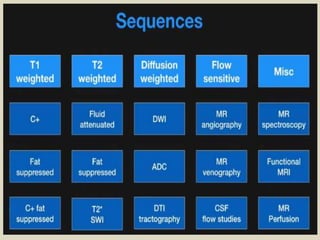
MRI pulse sequences:
An MRI pulse sequence is a programmed set of
changing magnetic gradients. Each sequence will have
a number of parameters, and multiple sequences are
grouped together into an MRI protocol.
Pulse sequences can be broadly grouped as follows:
Spin echo sequences
Inversion recovery sequences
Gradient echo sequences
Diffusion weighted sequences
Saturation recovery sequences
Echo-planar pulse sequences
Spiral pulse sequences
Functional techniques.
Diffusion-Weighted imaging.
Perfusion weighted imaging.
Spectroscopy.
fMRI.
Diffusion tensor imaging (DTI).
High angular resolution diffusion
imaging (HARDI),
Parameters
A pulse sequence is generally defined by multiple parameters, including:
Time to echo (TE)
Time to repetition (TR)
Flip angle
Field of view and matrix size
Inversion pulse(s)
Spoiler gradient(s) (crusher gradients)
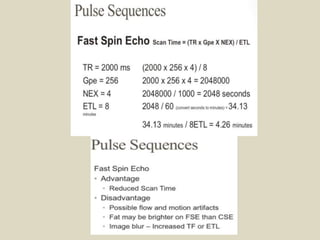
Echo train length (ETL)
The spatial acquisition of k-space
3D acquisition vs. 2D acquisition vs. multiple overlapping slab
acquisition
post contrast imaging with gadolinium contrast agents
Diffusion weighting (b values)
Different combinations of these parameters affect tissue contrast
and spatial resolution.
Pulse Sequences.
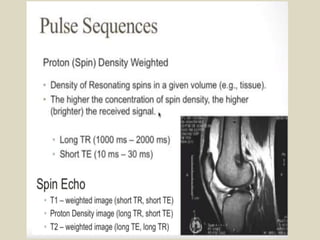
Spin Echo Pulse Sequences
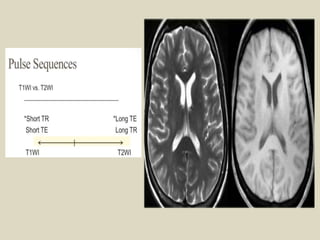
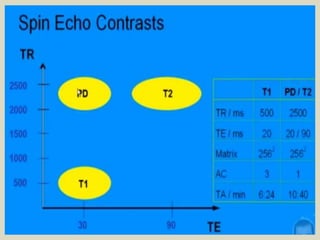
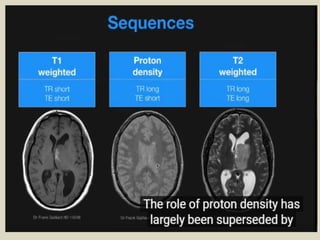
T1 weighted images
Short TR(300ms-700ms).
Short TE (10ms-30ms).
T2 weighted Images
Long TE(>80ms).
Long TR(>2000ms).
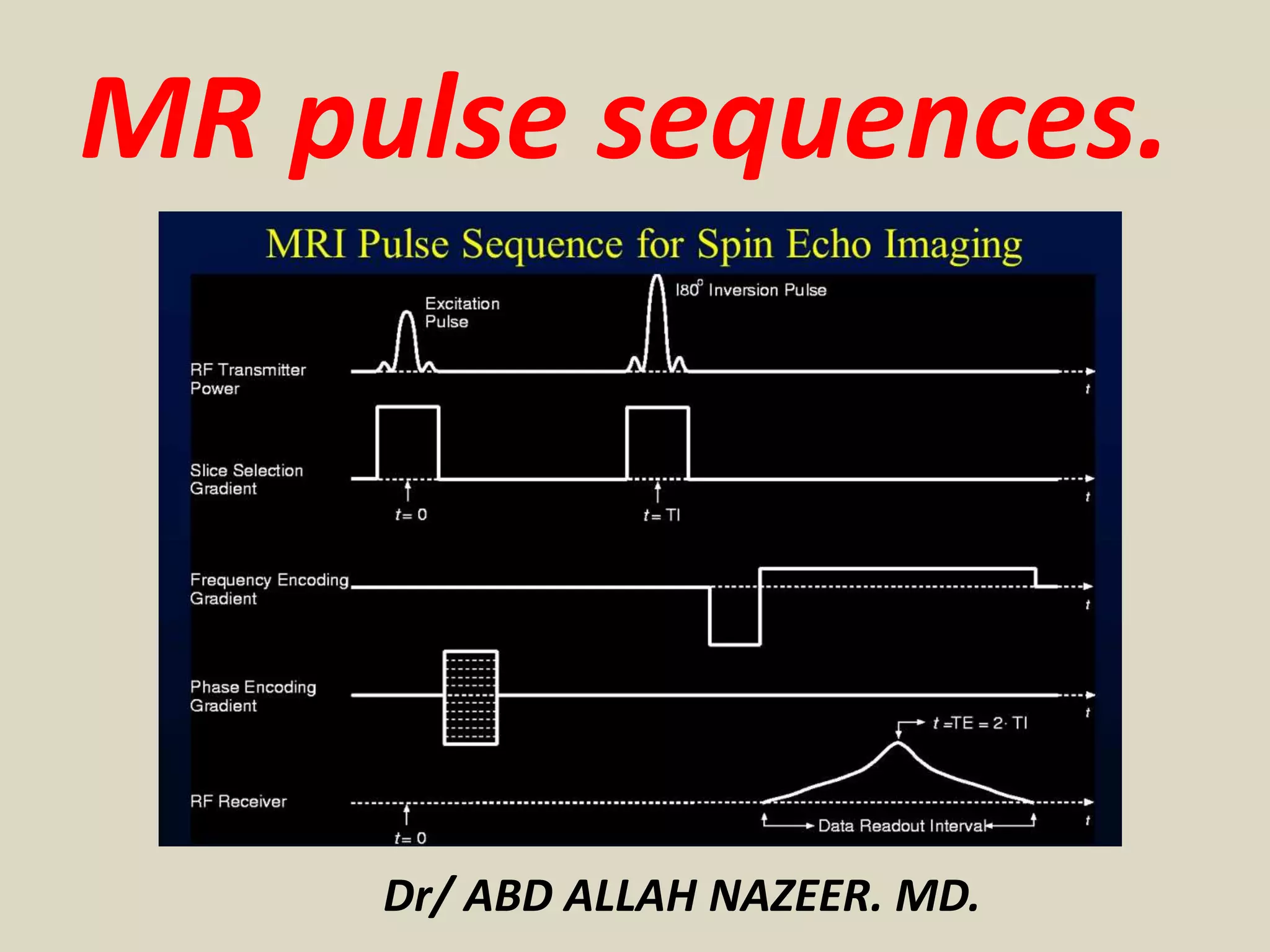
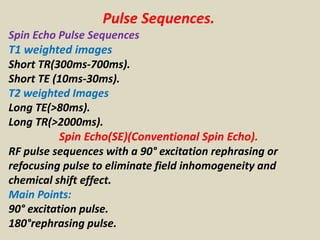
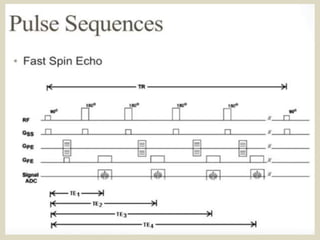
Spin Echo(SE)(Conventional Spin Echo).
RF pulse sequences with a 90° excitation rephrasing or
refocusing pulse to eliminate field inhomogeneity and
chemical shift effect.
Main Points:
90° excitation pulse.
180°rephrasing pulse.
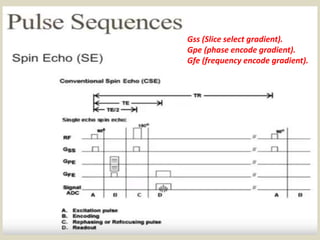
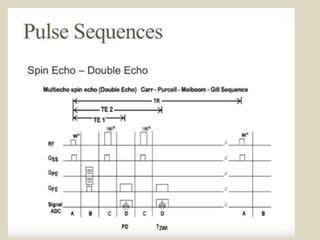
Gss (Slice select gradient).
Gpe (phase encode gradient).
Gfe (frequency encode gradient).
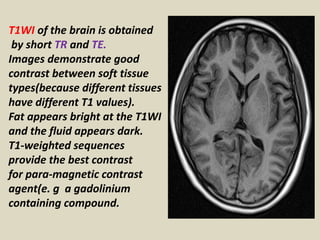
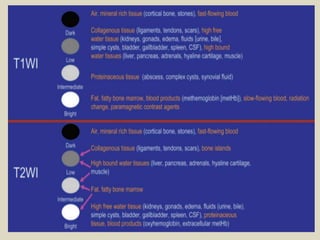
T1WI of the brain is obtained
by short TR and TE.
Images demonstrate good
contrast between soft tissue
types(because different tissues
have different T1 values).
Fat appears bright at the T1WI
and the fluid appears dark.
T1-weighted sequences
provide the best contrast
for para-magnetic contrast
agent(e. g a gadolinium
containing compound.
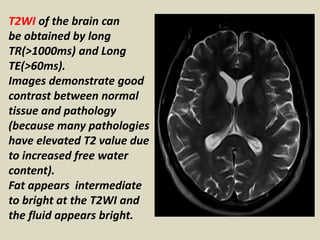
T2WI of the brain can
be obtained by long
TR(>1000ms) and Long
TE(>60ms).
Images demonstrate good
contrast between normal
tissue and pathology
(because many pathologies
have elevated T2 value due
to increased free water
content).
Fat appears intermediate
to bright at the T2WI and
the fluid appears bright.
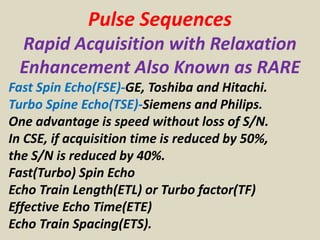
Pulse Sequences
Rapid Acquisition with Relaxation
Enhancement Also Known as RARE
Fast Spin Echo(FSE)-GE, Toshiba and Hitachi.
Turbo Spine Echo(TSE)-Siemens and Philips.
One advantage is speed without loss of S/N.
In CSE, if acquisition time is reduced by 50%,
the S/N is reduced by 40%.
Fast(Turbo) Spin Echo
Echo Train Length(ETL) or Turbo factor(TF)
Effective Echo Time(ETE)
Echo Train Spacing(ETS).
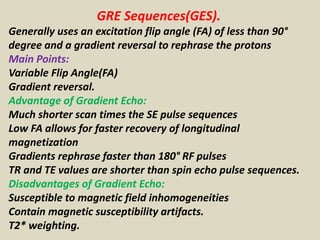
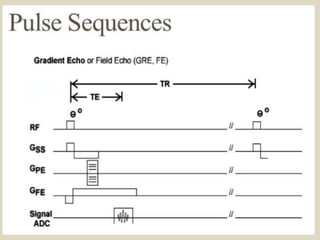
GRE Sequences(GES).
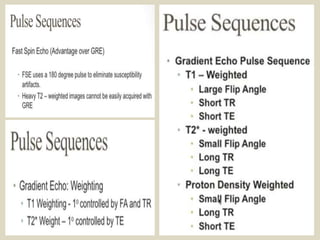
Generally uses an excitation flip angle (FA) of less than 90°
degree and a gradient reversal to rephrase the protons
Main Points:
Variable Flip Angle(FA)
Gradient reversal.
Advantage of Gradient Echo:
Much shorter scan times the SE pulse sequences
Low FA allows for faster recovery of longitudinal
magnetization
Gradients rephrase faster than 180° RF pulses
TR and TE values are shorter than spin echo pulse sequences.
Disadvantages of Gradient Echo:
Susceptible to magnetic field inhomogeneities
Contain magnetic susceptibility artifacts.
T2* weighting.
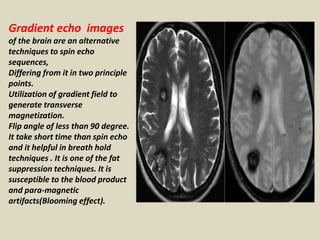
Gradient echo images
of the brain are an alternative
techniques to spin echo
sequences,
Differing from it in two principle
points.
Utilization of gradient field to
generate transverse
magnetization.
Flip angle of less than 90 degree.
It take short time than spin echo
and it helpful in breath hold
techniques . It is one of the fat
suppression techniques. It is
susceptible to the blood product
and para-magnetic
artifacts(Blooming effect).
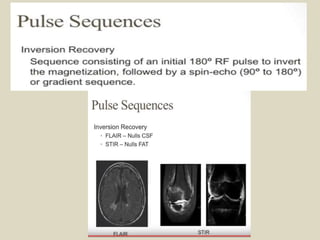
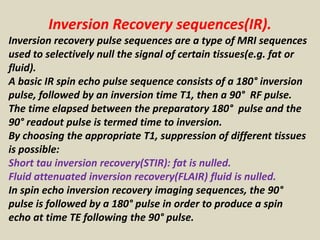
Inversion Recovery sequences(IR).
Inversion recovery pulse sequences are a type of MRI sequences
used to selectively null the signal of certain tissues(e.g. fat or
fluid).
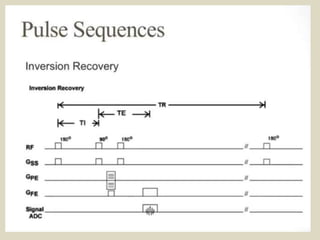
A basic IR spin echo pulse sequence consists of a 180° inversion
pulse, followed by an inversion time T1, then a 90° RF pulse.
The time elapsed between the preparatory 180° pulse and the
90° readout pulse is termed time to inversion.
By choosing the appropriate T1, suppression of different tissues
is possible:
Short tau inversion recovery(STIR): fat is nulled.
Fluid attenuated inversion recovery(FLAIR) fluid is nulled.
In spin echo inversion recovery imaging sequences, the 90°
pulse is followed by a 180° pulse in order to produce a spin
echo at time TE following the 90° pulse.
Pulse Sequences
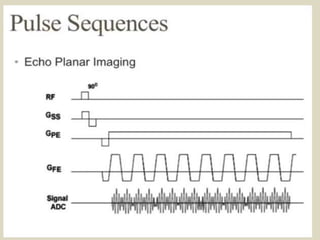
Echo Planar Imaging(EPI)(single shot techniques).
Allows data to be collected and reconstructed in
less than a second.
Stronger and faster gradients (slew rate) requires
Data collected along GFE (readout) direction
Echo-planar imaging is more vulnerable to
magnetic susceptibility effects and provides greater
tissue contrast than does imaging with standard
GRE sequences; therefore, echo-planar imaging
sequences are widely used to assess cerebral
perfusion.
Functional techniques.
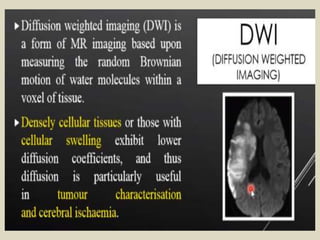
Diffusion-Weighted imaging(DWI)
• Technique used to measure the motion of water molecules.
• Areas with increased diffusion within a tissue show greater
signal loss
• Terms such as-b-value, Apparent diffusion coefficient(ADC).
• Clinical application-acute cerebral infarcts(ischemic areas)
appear bright.
• Perfusion-weighted image(PWI).
• Technique used to measure the flow of blood through the capillary
region of an organ or tissue.
• Dynamic susceptibility contrast(DSC) uses gadolinium as a tracer.
• Arterial Spin labeling(ASL) noninvasive .
• Terms-cerebral Blood Flow(CBF),Mean transit Time(MTT) and
cerebral Blood Volume (CBV).
Functional techniques
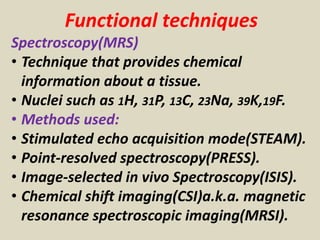
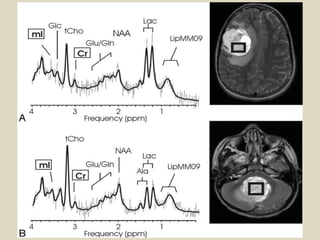
Spectroscopy(MRS)
• Technique that provides chemical
information about a tissue.
• Nuclei such as 1H, 31P, 13C, 23Na, 39K,19F.
• Methods used:
• Stimulated echo acquisition mode(STEAM).
• Point-resolved spectroscopy(PRESS).
• Image-selected in vivo Spectroscopy(ISIS).
• Chemical shift imaging(CSI)a.k.a. magnetic
resonance spectroscopic imaging(MRSI).
Functional techniques
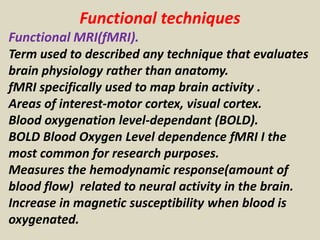
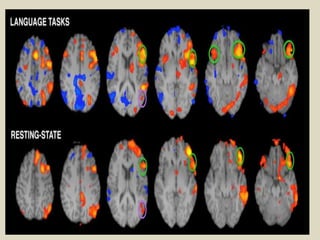
Functional MRI(fMRI).
Term used to described any technique that evaluates
brain physiology rather than anatomy.
fMRI specifically used to map brain activity .
Areas of interest-motor cortex, visual cortex.
Blood oxygenation level-dependant (BOLD).
BOLD Blood Oxygen Level dependence fMRI I the
most common for research purposes.
Measures the hemodynamic response(amount of
blood flow) related to neural activity in the brain.
Increase in magnetic susceptibility when blood is
oxygenated.
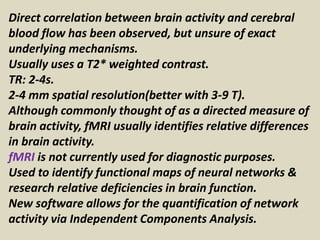
Direct correlation between brain activity and cerebral
blood flow has been observed, but unsure of exact
underlying mechanisms.
Usually uses a T2* weighted contrast.
TR: 2-4s.
2-4 mm spatial resolution(better with 3-9 T).
Although commonly thought of as a directed measure of
brain activity, fMRI usually identifies relative differences
in brain activity.
fMRI is not currently used for diagnostic purposes.
Used to identify functional maps of neural networks &
research relative deficiencies in brain function.
New software allows for the quantification of network
activity via Independent Components Analysis.
Thank You.

Presentation1, mr pulse sequences.

  • 1.
    MR pulse sequences. Dr/ABD ALLAH NAZEER. MD.
  • 2.
    MRI pulse sequences: AnMRI pulse sequence is a programmed set of changing magnetic gradients. Each sequence will have a number of parameters, and multiple sequences are grouped together into an MRI protocol. Pulse sequences can be broadly grouped as follows: Spin echo sequences Inversion recovery sequences Gradient echo sequences Diffusion weighted sequences Saturation recovery sequences Echo-planar pulse sequences Spiral pulse sequences
  • 3.
    Functional techniques. Diffusion-Weighted imaging. Perfusionweighted imaging. Spectroscopy. fMRI. Diffusion tensor imaging (DTI). High angular resolution diffusion imaging (HARDI),
  • 4.
    Parameters A pulse sequenceis generally defined by multiple parameters, including: Time to echo (TE) Time to repetition (TR) Flip angle Field of view and matrix size Inversion pulse(s) Spoiler gradient(s) (crusher gradients) Echo train length (ETL) The spatial acquisition of k-space 3D acquisition vs. 2D acquisition vs. multiple overlapping slab acquisition post contrast imaging with gadolinium contrast agents Diffusion weighting (b values) Different combinations of these parameters affect tissue contrast and spatial resolution.
  • 5.
    Pulse Sequences. Spin EchoPulse Sequences T1 weighted images Short TR(300ms-700ms). Short TE (10ms-30ms). T2 weighted Images Long TE(>80ms). Long TR(>2000ms). Spin Echo(SE)(Conventional Spin Echo). RF pulse sequences with a 90° excitation rephrasing or refocusing pulse to eliminate field inhomogeneity and chemical shift effect. Main Points: 90° excitation pulse. 180°rephrasing pulse.
  • 6.
    Gss (Slice selectgradient). Gpe (phase encode gradient). Gfe (frequency encode gradient).
  • 8.
    T1WI of thebrain is obtained by short TR and TE. Images demonstrate good contrast between soft tissue types(because different tissues have different T1 values). Fat appears bright at the T1WI and the fluid appears dark. T1-weighted sequences provide the best contrast for para-magnetic contrast agent(e. g a gadolinium containing compound.
  • 9.
    T2WI of thebrain can be obtained by long TR(>1000ms) and Long TE(>60ms). Images demonstrate good contrast between normal tissue and pathology (because many pathologies have elevated T2 value due to increased free water content). Fat appears intermediate to bright at the T2WI and the fluid appears bright.
  • 15.
    Pulse Sequences Rapid Acquisitionwith Relaxation Enhancement Also Known as RARE Fast Spin Echo(FSE)-GE, Toshiba and Hitachi. Turbo Spine Echo(TSE)-Siemens and Philips. One advantage is speed without loss of S/N. In CSE, if acquisition time is reduced by 50%, the S/N is reduced by 40%. Fast(Turbo) Spin Echo Echo Train Length(ETL) or Turbo factor(TF) Effective Echo Time(ETE) Echo Train Spacing(ETS).
  • 18.
    GRE Sequences(GES). Generally usesan excitation flip angle (FA) of less than 90° degree and a gradient reversal to rephrase the protons Main Points: Variable Flip Angle(FA) Gradient reversal. Advantage of Gradient Echo: Much shorter scan times the SE pulse sequences Low FA allows for faster recovery of longitudinal magnetization Gradients rephrase faster than 180° RF pulses TR and TE values are shorter than spin echo pulse sequences. Disadvantages of Gradient Echo: Susceptible to magnetic field inhomogeneities Contain magnetic susceptibility artifacts. T2* weighting.
  • 20.
    Gradient echo images ofthe brain are an alternative techniques to spin echo sequences, Differing from it in two principle points. Utilization of gradient field to generate transverse magnetization. Flip angle of less than 90 degree. It take short time than spin echo and it helpful in breath hold techniques . It is one of the fat suppression techniques. It is susceptible to the blood product and para-magnetic artifacts(Blooming effect).
  • 23.
    Inversion Recovery sequences(IR). Inversionrecovery pulse sequences are a type of MRI sequences used to selectively null the signal of certain tissues(e.g. fat or fluid). A basic IR spin echo pulse sequence consists of a 180° inversion pulse, followed by an inversion time T1, then a 90° RF pulse. The time elapsed between the preparatory 180° pulse and the 90° readout pulse is termed time to inversion. By choosing the appropriate T1, suppression of different tissues is possible: Short tau inversion recovery(STIR): fat is nulled. Fluid attenuated inversion recovery(FLAIR) fluid is nulled. In spin echo inversion recovery imaging sequences, the 90° pulse is followed by a 180° pulse in order to produce a spin echo at time TE following the 90° pulse.
  • 25.
    Pulse Sequences Echo PlanarImaging(EPI)(single shot techniques). Allows data to be collected and reconstructed in less than a second. Stronger and faster gradients (slew rate) requires Data collected along GFE (readout) direction Echo-planar imaging is more vulnerable to magnetic susceptibility effects and provides greater tissue contrast than does imaging with standard GRE sequences; therefore, echo-planar imaging sequences are widely used to assess cerebral perfusion.
  • 27.
    Functional techniques. Diffusion-Weighted imaging(DWI) •Technique used to measure the motion of water molecules. • Areas with increased diffusion within a tissue show greater signal loss • Terms such as-b-value, Apparent diffusion coefficient(ADC). • Clinical application-acute cerebral infarcts(ischemic areas) appear bright. • Perfusion-weighted image(PWI). • Technique used to measure the flow of blood through the capillary region of an organ or tissue. • Dynamic susceptibility contrast(DSC) uses gadolinium as a tracer. • Arterial Spin labeling(ASL) noninvasive . • Terms-cerebral Blood Flow(CBF),Mean transit Time(MTT) and cerebral Blood Volume (CBV).
  • 29.
    Functional techniques Spectroscopy(MRS) • Techniquethat provides chemical information about a tissue. • Nuclei such as 1H, 31P, 13C, 23Na, 39K,19F. • Methods used: • Stimulated echo acquisition mode(STEAM). • Point-resolved spectroscopy(PRESS). • Image-selected in vivo Spectroscopy(ISIS). • Chemical shift imaging(CSI)a.k.a. magnetic resonance spectroscopic imaging(MRSI).
  • 31.
    Functional techniques Functional MRI(fMRI). Termused to described any technique that evaluates brain physiology rather than anatomy. fMRI specifically used to map brain activity . Areas of interest-motor cortex, visual cortex. Blood oxygenation level-dependant (BOLD). BOLD Blood Oxygen Level dependence fMRI I the most common for research purposes. Measures the hemodynamic response(amount of blood flow) related to neural activity in the brain. Increase in magnetic susceptibility when blood is oxygenated.
  • 32.
    Direct correlation betweenbrain activity and cerebral blood flow has been observed, but unsure of exact underlying mechanisms. Usually uses a T2* weighted contrast. TR: 2-4s. 2-4 mm spatial resolution(better with 3-9 T). Although commonly thought of as a directed measure of brain activity, fMRI usually identifies relative differences in brain activity. fMRI is not currently used for diagnostic purposes. Used to identify functional maps of neural networks & research relative deficiencies in brain function. New software allows for the quantification of network activity via Independent Components Analysis.
  • 35.