RETAIL STORE LOCATION
BY - VIJYATA
LIKE SHARE SUBSCRIBE
“LOCATION, LOCATION,
LOCATION” IS THE
MAJOR FACTOR
LEADING TO A RETAIL’S
SUCCESS OR FAILURE
Add a Footer 2
LEARNING OBJECTIVES:
1 .IMPORTANCE OF STORE LOCATIONS
2.TYPES OF STORE LOCATIONS
3
WHY SO IMPORTANT?
Consumer choice: the location is often the most important consumer behaviour consideration in a customer’s
decision of where to shop;
Competitive advantage: the decision over where to develop a retail outlet will be of strategic importance
because retailers can gain long-term competitive advantage if they develop in the best location;
Consideration of trends: any decision on location has to consider the recent social and structural
changes – greater use of the motor car, the importance of out-of-town shopping centers, regional shopping areas,
the growth of multiple retailers, the power of retailer brands, and so on;
High investment: development of a retail site is accompanied by high investment and rental costs and long
lead times, which require decisions regarding long-term financial implications;
Property asset: it is important to select carefully as the final property assets of a company can be valued as
high as their annual turnover;
4
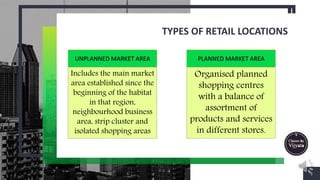
TYPES OF RETAIL LOCATIONS
5
UNPLANNED MARKET AREA
Includes the main market
area established since the
beginning of the habitat
in that region,
neighbourhood business
area, strip cluster and
isolated shopping areas
PLANNED MARKET AREA
Organised planned
shopping centres
with a balance of
assortment of
products and services
in different stores.
MAIN MARKET AREA CHARACTERISTICS
6
High competition, price ranges ,
high quality of product and
services
Large shopping stores with
selected assortment of
merchandise
Major market of the city
where most of the business
transactions take place
Variety of store types in the
centralized location
Convenience of
transport and mobility
Variety of customer services
and commercial and social
facilities
High rentals, high maintenance
cost and incidences of
shoplifting too.
Variety of shops from consumer to shopping goods. Higher competition and comparison of goods and
services.•Unorganized parking and traffic congestion. for the retailers.Variety of shopping opportunities
Prices are comparable to central market area.Lower assortment of breadth and depth of merchandise.•
Rental are usually lower than the central market area.
NEIGHBORHOOD AREA CHARACTERISTICS
7
Variety of shops from consumer
to shopping goods.
Higher competition and
comparison of goods and
services.
Unorganized parking and
traffic congestion.
Variety of shopping opportunities
for the retailers.
Prices are comparable to central
market area.
Lower assortment of breadth
and depth of merchandise.
Rental are usually lower than
the central market area.
Secondary business area or a neighbourhood business area is located in the catchment area within 2 -3
kms in adject neighbourhood residential area and serve as major markets of suburb. Their
characteristics include
ISOLATED SHOPPING AREA CHARACTERISTICS
8
“Free standing stores” away from any nearby stores established to meet specific requirement of
the customers with a very narrow customer base.
• Difficulty in attracting
customers
• High advertising Cost
• Operating cost not
shared
• Building ownership
• Customers like variety
in shopping
DISADVANTAGES
ADVANTAGES
• No Competition
• Low Rental Costs
• Flexibility
• Visibility
• Facility Adaptation
• Parking
• Cost Reduction
STRIP CLUSTERS CHARACTERISTICS
9
Small
convenience
shops located
near residential
areas
PLANNED MARKET AREA CHARACTERISTICS
10
Planned to promote organised
retailing .
Essentially planned as a unit with
an objective of having a balanced
assortment of the product and
services in different stores
Complements overall
merchandising efforts
Have the potential for integrated
promotional efforts
Seeks to have one or more
ANCHOR or GENERATOR store that
will draw customer traffic.
Provides ample parking facilities
THANK YOU
Do comment in the comment box or
write to me at Vijyata.rwc@gmail.com
11

Retail Store Location

  • 1.
    RETAIL STORE LOCATION BY- VIJYATA LIKE SHARE SUBSCRIBE
  • 2.
    “LOCATION, LOCATION, LOCATION” ISTHE MAJOR FACTOR LEADING TO A RETAIL’S SUCCESS OR FAILURE Add a Footer 2
  • 3.
    LEARNING OBJECTIVES: 1 .IMPORTANCEOF STORE LOCATIONS 2.TYPES OF STORE LOCATIONS 3
  • 4.
    WHY SO IMPORTANT? Consumerchoice: the location is often the most important consumer behaviour consideration in a customer’s decision of where to shop; Competitive advantage: the decision over where to develop a retail outlet will be of strategic importance because retailers can gain long-term competitive advantage if they develop in the best location; Consideration of trends: any decision on location has to consider the recent social and structural changes – greater use of the motor car, the importance of out-of-town shopping centers, regional shopping areas, the growth of multiple retailers, the power of retailer brands, and so on; High investment: development of a retail site is accompanied by high investment and rental costs and long lead times, which require decisions regarding long-term financial implications; Property asset: it is important to select carefully as the final property assets of a company can be valued as high as their annual turnover; 4
  • 5.
    TYPES OF RETAILLOCATIONS 5 UNPLANNED MARKET AREA Includes the main market area established since the beginning of the habitat in that region, neighbourhood business area, strip cluster and isolated shopping areas PLANNED MARKET AREA Organised planned shopping centres with a balance of assortment of products and services in different stores.
  • 6.
    MAIN MARKET AREACHARACTERISTICS 6 High competition, price ranges , high quality of product and services Large shopping stores with selected assortment of merchandise Major market of the city where most of the business transactions take place Variety of store types in the centralized location Convenience of transport and mobility Variety of customer services and commercial and social facilities High rentals, high maintenance cost and incidences of shoplifting too.
  • 7.
    Variety of shopsfrom consumer to shopping goods. Higher competition and comparison of goods and services.•Unorganized parking and traffic congestion. for the retailers.Variety of shopping opportunities Prices are comparable to central market area.Lower assortment of breadth and depth of merchandise.• Rental are usually lower than the central market area. NEIGHBORHOOD AREA CHARACTERISTICS 7 Variety of shops from consumer to shopping goods. Higher competition and comparison of goods and services. Unorganized parking and traffic congestion. Variety of shopping opportunities for the retailers. Prices are comparable to central market area. Lower assortment of breadth and depth of merchandise. Rental are usually lower than the central market area. Secondary business area or a neighbourhood business area is located in the catchment area within 2 -3 kms in adject neighbourhood residential area and serve as major markets of suburb. Their characteristics include
  • 8.
    ISOLATED SHOPPING AREACHARACTERISTICS 8 “Free standing stores” away from any nearby stores established to meet specific requirement of the customers with a very narrow customer base. • Difficulty in attracting customers • High advertising Cost • Operating cost not shared • Building ownership • Customers like variety in shopping DISADVANTAGES ADVANTAGES • No Competition • Low Rental Costs • Flexibility • Visibility • Facility Adaptation • Parking • Cost Reduction
  • 9.
  • 10.
    PLANNED MARKET AREACHARACTERISTICS 10 Planned to promote organised retailing . Essentially planned as a unit with an objective of having a balanced assortment of the product and services in different stores Complements overall merchandising efforts Have the potential for integrated promotional efforts Seeks to have one or more ANCHOR or GENERATOR store that will draw customer traffic. Provides ample parking facilities
  • 11.
    THANK YOU Do commentin the comment box or write to me at Vijyata.rwc@gmail.com 11