1
By :
Ravikeerthi Rao
MERCHANDISE PLANNING
Merchandising
2
What is merchandising?
• In retail, merchandising is the link between sales and
marketing on the front end and supply chain at the back end.
Merchandising
3
• All activities of merchandising are integral to retailer’s success
since :
• holding inventory, and
• selling it to end customers - are primary functions of retailers.
Merchandising
4
• Key measure of the retailer’s success is :
- selling as much merchandise as possible at the highest profit margin.
Merchandising
5
• Retailers can no longer depend on random sourcing / buying in
the hope that they will sell them all.
• Earlier the focus was :
• the right product,
• in the right place,
• at the right time.
Merchandising
6
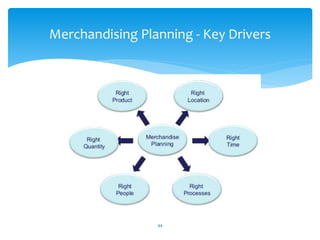
• In today’s hypercompetitive Omni channel world, it’s :
• the right product,
• in the right place,
• at the right time,
• at the right price,
• in the right quantity,
putting greater pressure on retailers to have the right processes
in place to satisfy today’s demanding customers.
Common Problems
7
• The common problems faced by a Retailer are :
• Late to market
• High Stock Holdings
• Wrong Product on Racks
• Timing of Markdowns
• Inadequate Stock Allocation Methodology
• Range Planning not identifying Key Trends
• Inadequate Margin Management
• Lack of detailed Management Reporting
• No Life cycle Management Strategy
• No Pre-Season Strategic Plan
Common Problems
8
There are two major areas of profit leakage in retail.
• Firstly - lost sales resulting from lack of stock, and
• Secondly - forced margin reductions (markdown) due to excessive
stock.
Merchandise Planning
9
• A typical retail clothing business will lose about 15% of its turnover in
markdown and perhaps 10% due to lost sales.
• If we assume a turnover of INR 100Lakhs (1 Cr), then we are looking at a
loss of INR 25 Lakhs here.
• Reducing each of these figures by 1%, adds INR 2Lakh to the profit.
• What is equally important it that this profit increase can be delivered in a
sustained way.
Merchandise Planning
10
• There are processes and solutions in order to reduce and
eliminate excess inventory and maximise profit. That is
"Merchandise Planning".
• Merchandise Planning is "A systematic approach by the retailer,
aimed at:
• maximising return on investment, through sales & inventory
planning, in order to increase profitability”.
Why a Merchandise Plan is Important?
11
Merchandise plans help stores avoid the two pitfalls retailers fear
most:
• greeting customers with sparsely stocked shelves, and
• greeting them with gluts of unpopular, out-of-style, marked-down
merchandise.
Merchandise Planning
12
• A merchandise plan can refer to something as large as the
entire inventory of a chain of stores for a season, or
• as small as how many articles of clothing should be placed
on a single display fixture.
Merchandise Planning And Buying
13
Important tasks with the merchandise planning and buying process
are :
• Selection of merchandise to sell (carry),
• establishment of retail prices,
• ongoing ordering processes,
• management of supplier relationships, and
• in-store promotion
Merchandise Planning and Buying
14
• Typically, retailers have a centralized buyer or team of buyers
who manages this process for the group.
• There is a difference between Merchandise Planning and
Buying.
• Hence, within a business these two functions should be
separated as much as possible and should report to different
managers.
BUYING
15
• Buyers are the magic in retail.
• They know that trend changes and to be truly successful - a
business needs to be ahead of the trend.
• Buyers know what is happening in other markets and can
translate that to their own markets.
Merchandise Planning
16
• On the other hand, Merchandise Planning is about the science
in retail.
• It is a data-driven approach to selecting, buying, presenting &
selling merchandise to maximise the return on investment and
satisfy consumer demand.
• It is highly analytical and relies heavily on data.
• It is about facts.
Merchandise Planning
17
• Merchandise planners implement structure for the buying process.
• By using past data they plan future demand.
• They control the OTB (Open to Buy) and will manage how much to buy within
specified, agreed, hierarchies.
• They will match the OTB back to budgets and forecasts and adjust for
overselling or underselling (something that many retailers overlook).
• Merchandise Planners also control markdowns and liquidation of obsolete
inventory.
Planning Process Overview
18
Merchandise Planning
19
• The first element in the merchandise plan is the Strategic Plan.
• This is normally done at top management level, with perhaps a
five year timescale.
• It is used to set financial targets, review target achievement and
create open-to-buy budgets.
• It is also used to set the critical success factors (or KPIs) for
merchandising in terms of sales, margins & stocks.
Merchandise Planning
20
• The Merchandise Planner will present key business figures
including :
• the budget,
• target, and
• pricing information, together with
• the features of the Range that will drive it through the season
to senior management.
Sales Forecast & Merchandise Plan
21
• The sales forecast is the foundation for building the
merchandise plan.
• This encompasses specific trending, turnover and seasonal
factors for each category of Retailer’s merchandise mix.
Merchandise Mix
22
• The merchandise mix is the width and depth of the variety of
products a retailer carries for a particular category.
• There are various types of merchandise (products) which
retailers can choose to display in-store as part of their
merchandise mix.
• To maximise sales and profits retailers need to choose an
efficient merchandise mix.
Range Planning
23
• Having generated a category level plan the Retailer then need
to translate it into something that can be bought.
• We may know that we plan to take £100,000 in Ladies v-neck
sweaters and generate a 40% margin on the sales, but we have
to decide how many styles and options we should have to
achieve this result, and within these how many should we buy to
achieve the margin mix.
• This is called Range Planning.
Range Planning
24
• Some of the styles are probably for window dressing only - they
might need to be there, but you do not need to buy a container
full.
Range Planning
25
• It is essential that the range plan can be analysed in terms of :
• Fabrics,
• Colours,
• Supplier,
• Fashionableness, etc.
• The key here is flexibility.
Merchandise Planning
26
• Typically the Buyer will help set the direction of the range, and
• the Planner will fine-tune the range by looking at current sales
and establish what is selling and what is not.
Merchandise Planning
27
• The merchandise system generally begins with a buying plan.
• While planning, Buyers have to consider how much space is
available in stores for each department and product category.
• They also have to plan for volatility in sales and other effects on
inventory demands / stock requirement.
Sales Forecast & Merchandise Plan
28
• Using sales forecast we can generate a stock intake plan that
closely matches with the stock requirement.
• This will probably be done at a category level.
• With a sales plan in place, we can then set required inventory
levels, pace of issuing the merchandise purchase orders and
deliveries.
Merchandise Planning
29
• Buyers negotiate with suppliers :
• to make the best deals,
• to plan for efficient inventory replenishment, and
• managing ordering processes, etc.
ultimately satisfying the needs of end customers.
Open-to-Buy
30
• The key output from Merchandise Planning is a figure called the
Open to Buy for each planned figure.
Open-to-buy :
• Merchandise budgeted for purchase during a certain time period
that has not yet been ordered.
Open-to-Buy
31
• Unlike conventional inventory control reports, which look back in
time, “open-to-buy” looks ahead.
• An “Open to Buy” control system uses planned sales forecasts
and stock turn requirements for each merchandise category, like
how much to order, and when to place the order, etc. to
determine the optimum level of stock required.
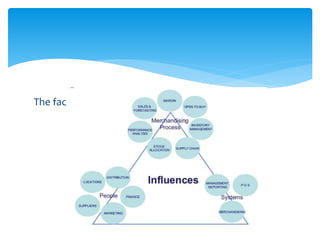
The factors influencing the merchandising process
32
33
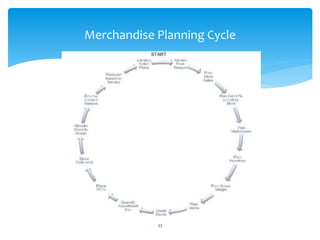
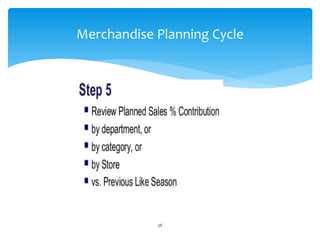
Merchandise Planning Cycle
34
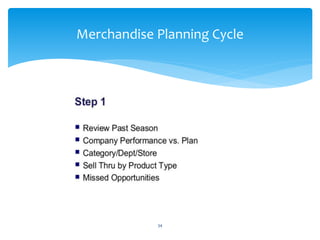
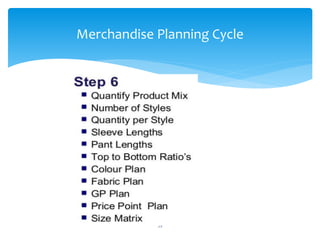
Merchandise Planning Cycle
35
Merchandise Planning Cycle
36
Merchandise Planning Cycle
37
Merchandise Planning Cycle
38
Merchandise Planning Cycle
39
Merchandise Planning Cycle
40
Merchandise Planning Cycle
41
Merchandise Planning Cycle
42
Merchandise Planning Cycle
43
Merchandise Planning Cycle
44
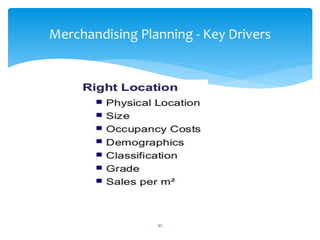
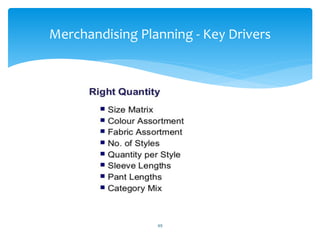
Merchandising Planning - Key Drivers
45
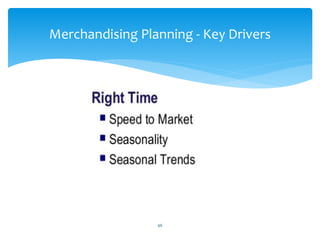
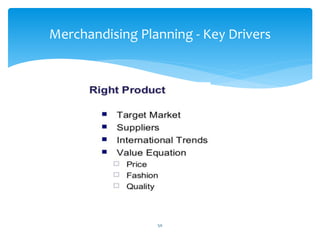
Merchandising Planning - Key Drivers
46
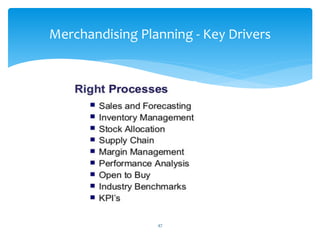
Merchandising Planning - Key Drivers
47
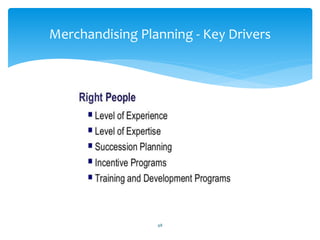
Merchandising Planning - Key Drivers
48
Merchandising Planning - Key Drivers
49
Merchandising Planning - Key Drivers
50
Merchandising Planning - Key Drivers
Why is Merchandise Planning so important for Retailers?
51
• Keeping stock and buying stock is the biggest cost to the
retailer.
• Effective planning has a crucial impact on a retail business as it
determines their profits.
• If the right stock is not allocated to the right places at the right
time a retailer will not be maximising their potential as this will
ultimately damage sales.
How can Merchandise Planning help Overall
Business Strategy?
52
• Company strategic plans can be developed, executed, managed and
measured more effectively
• Goals for future sales, markdowns, and profits can be set and managed
• Inventory levels and inventory productivity can be optimized
• Cash flow can be forecasted, measured and managed
• Micromarketing needs, assortment planning and allocation can be targeted
more specifically.
Merchandise Planning
53
• Implementing a merchandise plan is an evolutionary process,
not an immediately revolutionary break through.
• In the long run, effective merchandise planning can save you
time, help streamline your business processes and objectives,
and optimize and mobilize your inventory to get it off your
shelves and into the hands of your consumers for the right price.
54

Merchandise planning 26.05.18

  • 1.
  • 2.
    Merchandising 2 What is merchandising? •In retail, merchandising is the link between sales and marketing on the front end and supply chain at the back end.
  • 3.
    Merchandising 3 • All activitiesof merchandising are integral to retailer’s success since : • holding inventory, and • selling it to end customers - are primary functions of retailers.
  • 4.
    Merchandising 4 • Key measureof the retailer’s success is : - selling as much merchandise as possible at the highest profit margin.
  • 5.
    Merchandising 5 • Retailers canno longer depend on random sourcing / buying in the hope that they will sell them all. • Earlier the focus was : • the right product, • in the right place, • at the right time.
  • 6.
    Merchandising 6 • In today’shypercompetitive Omni channel world, it’s : • the right product, • in the right place, • at the right time, • at the right price, • in the right quantity, putting greater pressure on retailers to have the right processes in place to satisfy today’s demanding customers.
  • 7.
    Common Problems 7 • Thecommon problems faced by a Retailer are : • Late to market • High Stock Holdings • Wrong Product on Racks • Timing of Markdowns • Inadequate Stock Allocation Methodology • Range Planning not identifying Key Trends • Inadequate Margin Management • Lack of detailed Management Reporting • No Life cycle Management Strategy • No Pre-Season Strategic Plan
  • 8.
    Common Problems 8 There aretwo major areas of profit leakage in retail. • Firstly - lost sales resulting from lack of stock, and • Secondly - forced margin reductions (markdown) due to excessive stock.
  • 9.
    Merchandise Planning 9 • Atypical retail clothing business will lose about 15% of its turnover in markdown and perhaps 10% due to lost sales. • If we assume a turnover of INR 100Lakhs (1 Cr), then we are looking at a loss of INR 25 Lakhs here. • Reducing each of these figures by 1%, adds INR 2Lakh to the profit. • What is equally important it that this profit increase can be delivered in a sustained way.
  • 10.
    Merchandise Planning 10 • Thereare processes and solutions in order to reduce and eliminate excess inventory and maximise profit. That is "Merchandise Planning". • Merchandise Planning is "A systematic approach by the retailer, aimed at: • maximising return on investment, through sales & inventory planning, in order to increase profitability”.
  • 11.
    Why a MerchandisePlan is Important? 11 Merchandise plans help stores avoid the two pitfalls retailers fear most: • greeting customers with sparsely stocked shelves, and • greeting them with gluts of unpopular, out-of-style, marked-down merchandise.
  • 12.
    Merchandise Planning 12 • Amerchandise plan can refer to something as large as the entire inventory of a chain of stores for a season, or • as small as how many articles of clothing should be placed on a single display fixture.
  • 13.
    Merchandise Planning AndBuying 13 Important tasks with the merchandise planning and buying process are : • Selection of merchandise to sell (carry), • establishment of retail prices, • ongoing ordering processes, • management of supplier relationships, and • in-store promotion
  • 14.
    Merchandise Planning andBuying 14 • Typically, retailers have a centralized buyer or team of buyers who manages this process for the group. • There is a difference between Merchandise Planning and Buying. • Hence, within a business these two functions should be separated as much as possible and should report to different managers.
  • 15.
    BUYING 15 • Buyers arethe magic in retail. • They know that trend changes and to be truly successful - a business needs to be ahead of the trend. • Buyers know what is happening in other markets and can translate that to their own markets.
  • 16.
    Merchandise Planning 16 • Onthe other hand, Merchandise Planning is about the science in retail. • It is a data-driven approach to selecting, buying, presenting & selling merchandise to maximise the return on investment and satisfy consumer demand. • It is highly analytical and relies heavily on data. • It is about facts.
  • 17.
    Merchandise Planning 17 • Merchandiseplanners implement structure for the buying process. • By using past data they plan future demand. • They control the OTB (Open to Buy) and will manage how much to buy within specified, agreed, hierarchies. • They will match the OTB back to budgets and forecasts and adjust for overselling or underselling (something that many retailers overlook). • Merchandise Planners also control markdowns and liquidation of obsolete inventory.
  • 18.
  • 19.
    Merchandise Planning 19 • Thefirst element in the merchandise plan is the Strategic Plan. • This is normally done at top management level, with perhaps a five year timescale. • It is used to set financial targets, review target achievement and create open-to-buy budgets. • It is also used to set the critical success factors (or KPIs) for merchandising in terms of sales, margins & stocks.
  • 20.
    Merchandise Planning 20 • TheMerchandise Planner will present key business figures including : • the budget, • target, and • pricing information, together with • the features of the Range that will drive it through the season to senior management.
  • 21.
    Sales Forecast &Merchandise Plan 21 • The sales forecast is the foundation for building the merchandise plan. • This encompasses specific trending, turnover and seasonal factors for each category of Retailer’s merchandise mix.
  • 22.
    Merchandise Mix 22 • Themerchandise mix is the width and depth of the variety of products a retailer carries for a particular category. • There are various types of merchandise (products) which retailers can choose to display in-store as part of their merchandise mix. • To maximise sales and profits retailers need to choose an efficient merchandise mix.
  • 23.
    Range Planning 23 • Havinggenerated a category level plan the Retailer then need to translate it into something that can be bought. • We may know that we plan to take £100,000 in Ladies v-neck sweaters and generate a 40% margin on the sales, but we have to decide how many styles and options we should have to achieve this result, and within these how many should we buy to achieve the margin mix. • This is called Range Planning.
  • 24.
    Range Planning 24 • Someof the styles are probably for window dressing only - they might need to be there, but you do not need to buy a container full.
  • 25.
    Range Planning 25 • Itis essential that the range plan can be analysed in terms of : • Fabrics, • Colours, • Supplier, • Fashionableness, etc. • The key here is flexibility.
  • 26.
    Merchandise Planning 26 • Typicallythe Buyer will help set the direction of the range, and • the Planner will fine-tune the range by looking at current sales and establish what is selling and what is not.
  • 27.
    Merchandise Planning 27 • Themerchandise system generally begins with a buying plan. • While planning, Buyers have to consider how much space is available in stores for each department and product category. • They also have to plan for volatility in sales and other effects on inventory demands / stock requirement.
  • 28.
    Sales Forecast &Merchandise Plan 28 • Using sales forecast we can generate a stock intake plan that closely matches with the stock requirement. • This will probably be done at a category level. • With a sales plan in place, we can then set required inventory levels, pace of issuing the merchandise purchase orders and deliveries.
  • 29.
    Merchandise Planning 29 • Buyersnegotiate with suppliers : • to make the best deals, • to plan for efficient inventory replenishment, and • managing ordering processes, etc. ultimately satisfying the needs of end customers.
  • 30.
    Open-to-Buy 30 • The keyoutput from Merchandise Planning is a figure called the Open to Buy for each planned figure. Open-to-buy : • Merchandise budgeted for purchase during a certain time period that has not yet been ordered.
  • 31.
    Open-to-Buy 31 • Unlike conventionalinventory control reports, which look back in time, “open-to-buy” looks ahead. • An “Open to Buy” control system uses planned sales forecasts and stock turn requirements for each merchandise category, like how much to order, and when to place the order, etc. to determine the optimum level of stock required.
  • 32.
    The factors influencingthe merchandising process 32
  • 33.
  • 34.
  • 35.
  • 36.
  • 37.
  • 38.
  • 39.
  • 40.
  • 41.
  • 42.
  • 43.
  • 44.
  • 45.
  • 46.
  • 47.
  • 48.
  • 49.
  • 50.
  • 51.
    Why is MerchandisePlanning so important for Retailers? 51 • Keeping stock and buying stock is the biggest cost to the retailer. • Effective planning has a crucial impact on a retail business as it determines their profits. • If the right stock is not allocated to the right places at the right time a retailer will not be maximising their potential as this will ultimately damage sales.
  • 52.
    How can MerchandisePlanning help Overall Business Strategy? 52 • Company strategic plans can be developed, executed, managed and measured more effectively • Goals for future sales, markdowns, and profits can be set and managed • Inventory levels and inventory productivity can be optimized • Cash flow can be forecasted, measured and managed • Micromarketing needs, assortment planning and allocation can be targeted more specifically.
  • 53.
    Merchandise Planning 53 • Implementinga merchandise plan is an evolutionary process, not an immediately revolutionary break through. • In the long run, effective merchandise planning can save you time, help streamline your business processes and objectives, and optimize and mobilize your inventory to get it off your shelves and into the hands of your consumers for the right price.
  • 54.