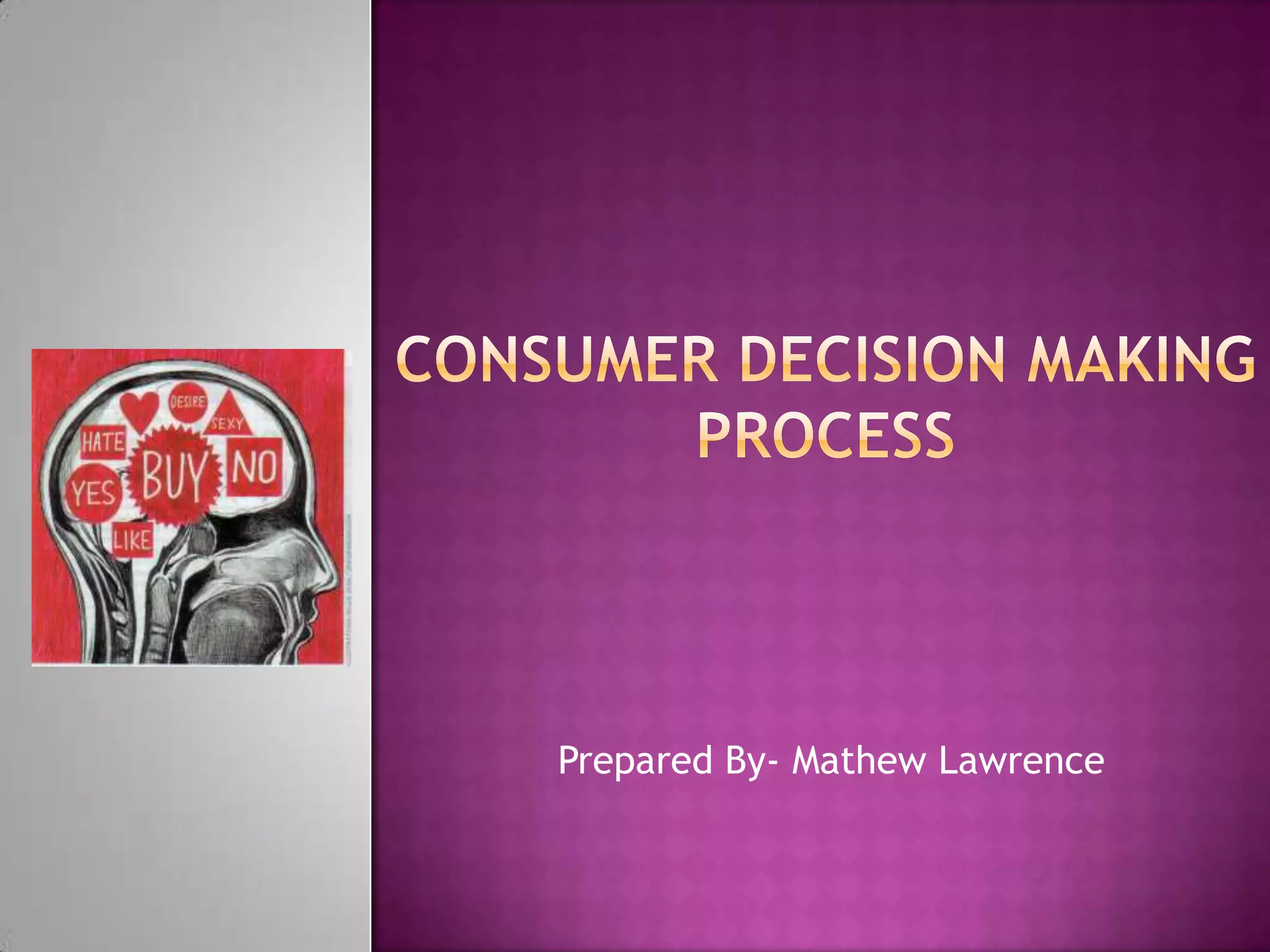
Prepared By- Mathew Lawrence
   Why study Consumer Decision Making
   What is consumer mind (Black Box)
   Concepts - consumer decision, purchase involvement and
    product involvemt
   Types of consumer decisions
   Roles of Consumer in C.D.M
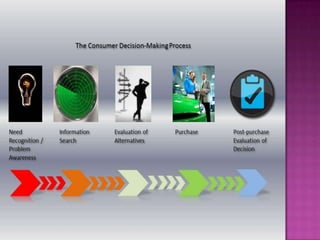
   Consumer Decision Making process
   Need Recognition process
   Information search process
   Evaluation process
   Purchase
   Post-purchase
   Factors influencing C.D.M
   Opening Case on Aarey Milk Diary.

   So firms that choose not to understand their consumers
    purchasing behaviour often lose out of the market.

   An excellent engineered product may fail just because the
    customer does not identify himself or herself with it.
    (share examples)

   The firm must understand the buyers purchasing
    behaviour. Specially how the buyer decides, what
    motivates him and who influences him.

   The marketer needs to focus on “how and “why” of the
    total experience consumers have with products and
    service. (share examples)
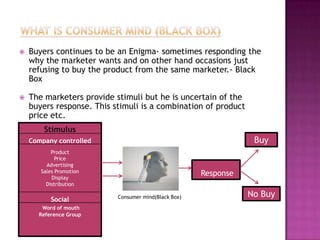
   Buyers continues to be an Enigma- sometimes responding the
    why the marketer wants and on other hand occasions just
    refusing to buy the product from the same marketer.- Black
    Box

   The marketers provide stimuli but he is uncertain of the
    buyers response. This stimuli is a combination of product
    price etc.
        Stimulus
    Company controlled                                            Buy
           Product
             Price
         Advertising
       Sales Promotion                                Response
           Display
         Distribution

                           Consumer mind(Black Box)              No Buy
          Social
       Word of mouth
      Reference Group
   A decision is a set of an options from two or more alternatives
    choices.

   So consumer decision produces an image of an individual
    carefully evaluating the alternatives of a set of
    products, brand or services and rationally selecting the one
    that solves a clearly recognized need for the least cost.

   Purchase involvement is the level of concern for, or interest
    in the purchase process triggered by the need to consider a
    particular purchase.

    Product involvement is the level of concern for a particular
    brand or a product category.

   Examples: Juice (purchase involvement ) Slice,
    Mirinda, Thums up etc. (product involvement)
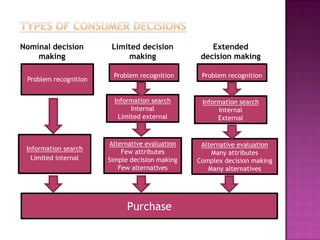
Nominal decision        Limited decision            Extended
    making                  making               decision making

                        Problem recognition      Problem recognition
 Problem recognition


                         Information search      Information search
                              Internal                Internal
                          Limited external            External


                       Alternative evaluation    Alternative evaluation
 Information search        Few attributes           Many attributes
   Limited internal    Simple decision making   Complex decision making
                          Few alternatives         Many alternatives


                             Purchase
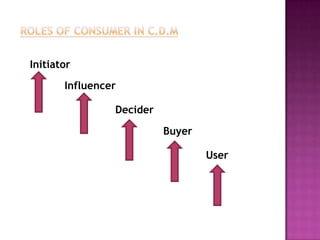
Initiator
       Influencer

                Decider

                          Buyer

                                  User
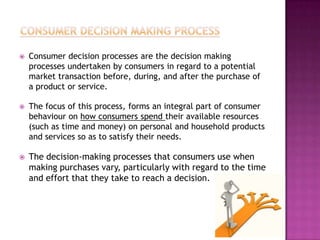
   Consumer decision processes are the decision making
    processes undertaken by consumers in regard to a potential
    market transaction before, during, and after the purchase of
    a product or service.

   The focus of this process, forms an integral part of consumer
    behaviour on how consumers spend their available resources
    (such as time and money) on personal and household products
    and services so as to satisfy their needs.

   The decision-making processes that consumers use when
    making purchases vary, particularly with regard to the time
    and effort that they take to reach a decision.
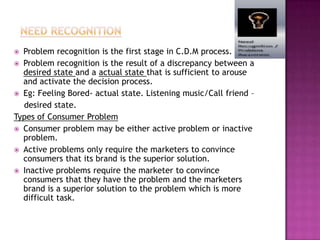
 Problem recognition is the first stage in C.D.M process.
 Problem recognition is the result of a discrepancy between a
  desired state and a actual state that is sufficient to arouse
  and activate the decision process.
 Eg: Feeling Bored- actual state. Listening music/Call friend –
  desired state.
Types of Consumer Problem
 Consumer problem may be either active problem or inactive
  problem.
 Active problems only require the marketers to convince
  consumers that its brand is the superior solution.
 Inactive problems require the marketer to convince
  consumers that they have the problem and the marketers
  brand is a superior solution to the problem which is more
  difficult task.
Marketing Strategy used problem recognition
 Discover Consumers problem
       Activity analysis
       Product analysis
       Problem analysis
   Responding to Consumer problem
   Helping Consumer recognize problem
   Suppressing problem recognition
   Once problem is recognized relevant information from
    long-term memory is used to determine if a satisfactory
    solution is known, what are the characteristics of potential
    solution are, what are appropriate ways to compare
    solutions and so forth- This is called Internal search.
   If a resolution is not reached through internal search, then
    external search is focused.
   It is important to note that even in extended decision
    making with extensive external search, the initial internal
    search generally produces a set of guides or decision
    constraints that limit and guide external search.
   Examples of External search: web, books, articles
    newspaper, friends etc.
 Types of Information
Evaluative Criteria: The desired characteristics are the
consumers evaluative criteria. Ex: Laptop or Computer

Appropriate Alternative: Here the consumer seeks for
different companies or brand Ex: Dell, HP Asus, Toshiba,
                                         ,
Apple, Fuji.

    Evoked Set              Inert Set             Inept Set
                               Asus
        Dell                                        Fuji
                             Toshiba
        HP                    Apple


    These are the           Which are          Which are not
    brands which          known but not           known
    are know very              the
         well              performance
Alternative Characteristics: Here the consumer compares
the different features of the selected evoked set
Ex: price, memory, processor etc.
   When potential consumers have all the necessary internal
    and external information on alternatives, they have to
    evaluate the alternatives in order to make a purchase.
   Information will lead to an evoked set(familiar brands) of
    alternative products from which a choice will then have to
    be made.
   Theory of Evoked Set- By Howard and Sheth’s

 Total Set        Awareness      Consideration
                                                   Decision Set
(all brands)         Set              Set
                                                      (brands
                   (brands          (brands
                                                     decided)
                  aware off)      considered)


                                                       Purchase
                                                          Set
   Consumers use several attributes when they are evaluating
    alternative products and they are more interested in a
    specific attribute that brings the sought benefits.
    Example: Price, Quality, availability, service, performance
    etc
   The number of criteria used in decision making are
    relatively limited, usually less than six.
   Also, not all criteria are equally important.
   The criteria used to make a decision change depends on
    the consumer, the product, and the situation.
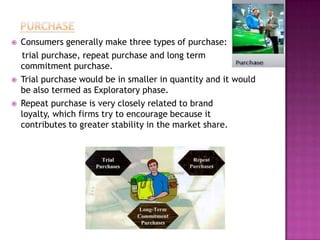
   Consumers generally make three types of purchase:
    trial purchase, repeat purchase and long term
    commitment purchase.
   Trial purchase would be in smaller in quantity and it would
    be also termed as Exploratory phase.
   Repeat purchase is very closely related to brand
    loyalty, which firms try to encourage because it
    contributes to greater stability in the market share.
   The purchasing process does not end when a consumer buys
    a product . After the purchase consumers tend to evaluate
    their experience to decide if they are satisfied or
    dissatisfied.
   The information will be used in future decision-making.
   The performance of the product or service will be compared
    with consumers expectations. There are three possible
    outcomes of these evaluations:
       Perceived performance meeting expectations
       Perceived performance exceeding expectations
       Perceived performance being lower than expectations
   When a consumer thinks of the unique, positive qualities of
    the brand not selected, it is known as cognitive dissonance.
   When cognitive dissonance occurs Marketing can minimize through:
     after a purchase, it is called      Effective Communication
                                                 Follow-up
     post purchase dissonance.                  Guarantees
                                                  Warranties
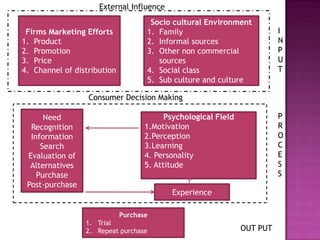
External Influence
                                     Socio cultural Environment
 Firms Marketing Efforts            1. Family                             I
1. Product                          2. Informal sources                   N
2. Promotion                        3. Other non commercial               P
3. Price                               sources                            U
4. Channel of distribution          4. Social class                       T
                                    5. Sub culture and culture

                  Consumer Decision Making

      Need                                Psychological Field             P
  Recognition                       1.Motivation                          R
  Information                       2.Perception                          O
     Search                         3.Learning                            C
 Evaluation of                      4. Personality                        E
  Alternatives                      5. Attitude                           S
    Purchase                                                              S
 Post-purchase
                                           Experience

                             Purchase
                 1. Trial
                 2. Repeat purchase                             OUT PUT
Consumer decesion making process

Consumer decesion making process

  • 1.
  • 2.
    Why study Consumer Decision Making  What is consumer mind (Black Box)  Concepts - consumer decision, purchase involvement and product involvemt  Types of consumer decisions  Roles of Consumer in C.D.M  Consumer Decision Making process  Need Recognition process  Information search process  Evaluation process  Purchase  Post-purchase  Factors influencing C.D.M
  • 3.
    Opening Case on Aarey Milk Diary.  So firms that choose not to understand their consumers purchasing behaviour often lose out of the market.  An excellent engineered product may fail just because the customer does not identify himself or herself with it. (share examples)  The firm must understand the buyers purchasing behaviour. Specially how the buyer decides, what motivates him and who influences him.  The marketer needs to focus on “how and “why” of the total experience consumers have with products and service. (share examples)
  • 4.
    Buyers continues to be an Enigma- sometimes responding the why the marketer wants and on other hand occasions just refusing to buy the product from the same marketer.- Black Box  The marketers provide stimuli but he is uncertain of the buyers response. This stimuli is a combination of product price etc. Stimulus Company controlled Buy Product Price Advertising Sales Promotion Response Display Distribution Consumer mind(Black Box) No Buy Social Word of mouth Reference Group
  • 5.
    A decision is a set of an options from two or more alternatives choices.  So consumer decision produces an image of an individual carefully evaluating the alternatives of a set of products, brand or services and rationally selecting the one that solves a clearly recognized need for the least cost.  Purchase involvement is the level of concern for, or interest in the purchase process triggered by the need to consider a particular purchase.  Product involvement is the level of concern for a particular brand or a product category.  Examples: Juice (purchase involvement ) Slice, Mirinda, Thums up etc. (product involvement)
  • 6.
    Nominal decision Limited decision Extended making making decision making Problem recognition Problem recognition Problem recognition Information search Information search Internal Internal Limited external External Alternative evaluation Alternative evaluation Information search Few attributes Many attributes Limited internal Simple decision making Complex decision making Few alternatives Many alternatives Purchase
  • 7.
    Initiator Influencer Decider Buyer User
  • 8.
    Consumer decision processes are the decision making processes undertaken by consumers in regard to a potential market transaction before, during, and after the purchase of a product or service.  The focus of this process, forms an integral part of consumer behaviour on how consumers spend their available resources (such as time and money) on personal and household products and services so as to satisfy their needs.  The decision-making processes that consumers use when making purchases vary, particularly with regard to the time and effort that they take to reach a decision.
  • 10.
     Problem recognitionis the first stage in C.D.M process.  Problem recognition is the result of a discrepancy between a desired state and a actual state that is sufficient to arouse and activate the decision process.  Eg: Feeling Bored- actual state. Listening music/Call friend – desired state. Types of Consumer Problem  Consumer problem may be either active problem or inactive problem.  Active problems only require the marketers to convince consumers that its brand is the superior solution.  Inactive problems require the marketer to convince consumers that they have the problem and the marketers brand is a superior solution to the problem which is more difficult task.
  • 11.
    Marketing Strategy usedproblem recognition  Discover Consumers problem  Activity analysis  Product analysis  Problem analysis  Responding to Consumer problem  Helping Consumer recognize problem  Suppressing problem recognition
  • 12.
    Once problem is recognized relevant information from long-term memory is used to determine if a satisfactory solution is known, what are the characteristics of potential solution are, what are appropriate ways to compare solutions and so forth- This is called Internal search.  If a resolution is not reached through internal search, then external search is focused.  It is important to note that even in extended decision making with extensive external search, the initial internal search generally produces a set of guides or decision constraints that limit and guide external search.  Examples of External search: web, books, articles newspaper, friends etc.
  • 13.
     Types ofInformation Evaluative Criteria: The desired characteristics are the consumers evaluative criteria. Ex: Laptop or Computer Appropriate Alternative: Here the consumer seeks for different companies or brand Ex: Dell, HP Asus, Toshiba, , Apple, Fuji. Evoked Set Inert Set Inept Set Asus Dell Fuji Toshiba HP Apple These are the Which are Which are not brands which known but not known are know very the well performance
  • 14.
    Alternative Characteristics: Herethe consumer compares the different features of the selected evoked set Ex: price, memory, processor etc.
  • 15.
    When potential consumers have all the necessary internal and external information on alternatives, they have to evaluate the alternatives in order to make a purchase.  Information will lead to an evoked set(familiar brands) of alternative products from which a choice will then have to be made.  Theory of Evoked Set- By Howard and Sheth’s Total Set Awareness Consideration Decision Set (all brands) Set Set (brands (brands (brands decided) aware off) considered) Purchase Set
  • 16.
    Consumers use several attributes when they are evaluating alternative products and they are more interested in a specific attribute that brings the sought benefits. Example: Price, Quality, availability, service, performance etc  The number of criteria used in decision making are relatively limited, usually less than six.  Also, not all criteria are equally important.  The criteria used to make a decision change depends on the consumer, the product, and the situation.
  • 17.
    Consumers generally make three types of purchase: trial purchase, repeat purchase and long term commitment purchase.  Trial purchase would be in smaller in quantity and it would be also termed as Exploratory phase.  Repeat purchase is very closely related to brand loyalty, which firms try to encourage because it contributes to greater stability in the market share.
  • 18.
    The purchasing process does not end when a consumer buys a product . After the purchase consumers tend to evaluate their experience to decide if they are satisfied or dissatisfied.  The information will be used in future decision-making.  The performance of the product or service will be compared with consumers expectations. There are three possible outcomes of these evaluations:  Perceived performance meeting expectations  Perceived performance exceeding expectations  Perceived performance being lower than expectations  When a consumer thinks of the unique, positive qualities of the brand not selected, it is known as cognitive dissonance.  When cognitive dissonance occurs Marketing can minimize through: after a purchase, it is called Effective Communication Follow-up post purchase dissonance. Guarantees Warranties
  • 19.
    External Influence Socio cultural Environment Firms Marketing Efforts 1. Family I 1. Product 2. Informal sources N 2. Promotion 3. Other non commercial P 3. Price sources U 4. Channel of distribution 4. Social class T 5. Sub culture and culture Consumer Decision Making Need Psychological Field P Recognition 1.Motivation R Information 2.Perception O Search 3.Learning C Evaluation of 4. Personality E Alternatives 5. Attitude S Purchase S Post-purchase Experience Purchase 1. Trial 2. Repeat purchase OUT PUT