Retail Locations
What are the three most important
things in retailing?
Location
Location
Location
Importance
• Location- prime consideration in customers
store choice decision Eg car garage,
supermarket
• location- strategic decision- competitive
advantage
• risky decision- retailer needs to put
substantial investment to buy and develop the
real estate
• India- less space and costly
TYPES OF LOCATIONS
Three basic types
• Free standing
• City/town business district
• Shopping centre
• non traditional forms: airport/within another
store
Evaluation criteria for a location
• Size of trade area
• occupancy cost of location
• pedestrian and vehicular traffic
• restrictions placed on store by property
managers
• convenience for customers
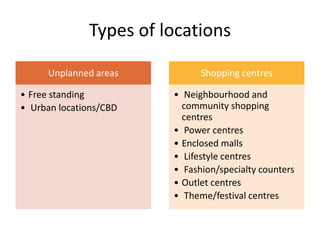
Types of locations
Unplanned areas
• Free standing
• Urban locations/CBD
Shopping centres
• Neighbourhood and
community shopping
centres
• Power centres
• Enclosed malls
• Lifestyle centres
• Fashion/specialty counters
• Outlet centres
• Theme/festival centres
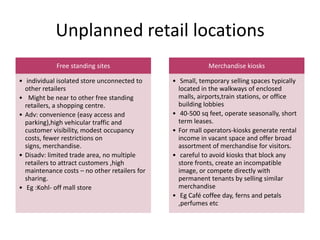
Unplanned retail locations
Free standing sites
• individual isolated store unconnected to
other retailers
• Might be near to other free standing
retailers, a shopping centre.
• Adv: convenience (easy access and
parking),high vehicular traffic and
customer visibility, modest occupancy
costs, fewer restrictions on
signs, merchandise.
• Disadv: limited trade area, no multiple
retailers to attract customers ,high
maintenance costs – no other retailers for
sharing.
• Eg :Kohl- off mall store
Merchandise kiosks
• Small, temporary selling spaces typically
located in the walkways of enclosed
malls, airports,train stations, or office
building lobbies
• 40-500 sq feet, operate seasonally, short
term leases.
• For mall operators-kiosks generate rental
income in vacant space and offer broad
assortment of merchandise for visitors.
• careful to avoid kiosks that block any
store fronts, create an incompatible
image, or compete directly with
permanent tenants by selling similar
merchandise
• Eg Café coffee day, ferns and petals
,perfumes etc
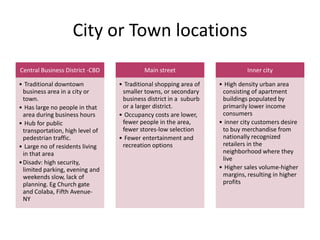
City or Town locations
Central Business District -CBD
• Traditional downtown
business area in a city or
town.
• Has large no people in that
area during business hours
• Hub for public
transportation, high level of
pedestrian traffic.
• Large no of residents living
in that area
•Disadv: high security,
limited parking, evening and
weekends slow, lack of
planning. Eg Church gate
and Colaba, Fifth Avenue-
NY
Main street
• Traditional shopping area of
smaller towns, or secondary
business district in a suburb
or a larger district.
• Occupancy costs are lower,
fewer people in the area,
fewer stores-low selection
• Fewer entertainment and
recreation options
Inner city
• High density urban area
consisting of apartment
buildings populated by
primarily lower income
consumers
• inner city customers desire
to buy merchandise from
nationally recognized
retailers in the
neighborhood where they
live
• Higher sales volume-higher
margins, resulting in higher
profits
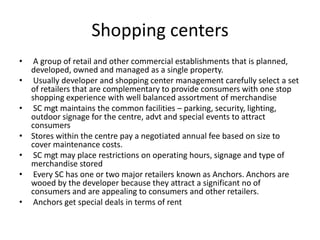
Shopping centers
• A group of retail and other commercial establishments that is planned,
developed, owned and managed as a single property.
• Usually developer and shopping center management carefully select a set
of retailers that are complementary to provide consumers with one stop
shopping experience with well balanced assortment of merchandise
• SC mgt maintains the common facilities – parking, security, lighting,
outdoor signage for the centre, advt and special events to attract
consumers
• Stores within the centre pay a negotiated annual fee based on size to
cover maintenance costs.
• SC mgt may place restrictions on operating hours, signage and type of
merchandise stored
• Every SC has one or two major retailers known as Anchors. Anchors are
wooed by the developer because they attract a significant no of
consumers and are appealing to consumers and other retailers.
• Anchors get special deals in terms of rent
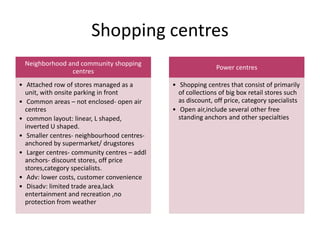
Shopping centres
Neighborhood and community shopping
centres
• Attached row of stores managed as a
unit, with onsite parking in front
• Common areas – not enclosed- open air
centres
• common layout: linear, L shaped,
inverted U shaped.
• Smaller centres- neighbourhood centres-
anchored by supermarket/ drugstores
• Larger centres- community centres – addl
anchors- discount stores, off price
stores,category specialists.
• Adv: lower costs, customer convenience
• Disadv: limited trade area,lack
entertainment and recreation ,no
protection from weather
Power centres
• Shopping centres that consist of primarily
of collections of big box retail stores such
as discount, off price, category specialists
• Open air,include several other free
standing anchors and other specialties
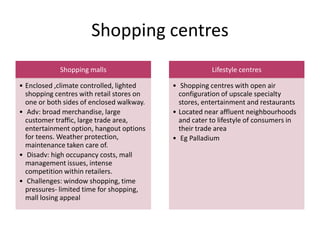
Shopping centres
Shopping malls
• Enclosed ,climate controlled, lighted
shopping centres with retail stores on
one or both sides of enclosed walkway.
• Adv: broad merchandise, large
customer traffic, large trade area,
entertainment option, hangout options
for teens. Weather protection,
maintenance taken care of.
• Disadv: high occupancy costs, mall
management issues, intense
competition within retailers.
• Challenges: window shopping, time
pressures- limited time for shopping,
mall losing appeal
Lifestyle centres
• Shopping centres with open air
configuration of upscale specialty
stores, entertainment and restaurants
• Located near affluent neighbourhoods
and cater to lifestyle of consumers in
their trade area
• Eg Palladium
Shopping centres
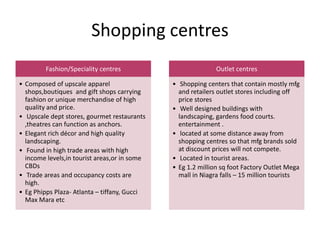
Fashion/Speciality centres
• Composed of upscale apparel
shops,boutiques and gift shops carrying
fashion or unique merchandise of high
quality and price.
• Upscale dept stores, gourmet restaurants
,theatres can function as anchors.
• Elegant rich décor and high quality
landscaping.
• Found in high trade areas with high
income levels,in tourist areas,or in some
CBDs
• Trade areas and occupancy costs are
high.
• Eg Phipps Plaza- Atlanta – tiffany, Gucci
Max Mara etc
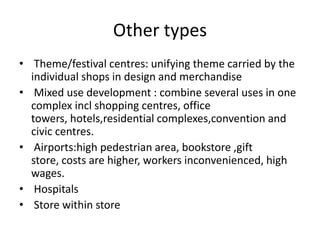
Outlet centres
• Shopping centers that contain mostly mfg
and retailers outlet stores including off
price stores
• Well designed buildings with
landscaping, gardens food courts.
entertainment .
• located at some distance away from
shopping centres so that mfg brands sold
at discount prices will not compete.
• Located in tourist areas.
• Eg 1.2 million sq foot Factory Outlet Mega
mall in Niagra falls – 15 million tourists
Other types
• Theme/festival centres: unifying theme carried by the
individual shops in design and merchandise
• Mixed use development : combine several uses in one
complex incl shopping centres, office
towers, hotels,residential complexes,convention and
civic centres.
• Airports:high pedestrian area, bookstore ,gift
store, costs are higher, workers inconvenienced, high
wages.
• Hospitals
• Store within store
LOCATION AND RETAIL STRATEGY
Location and Retail Strategy
• Type of location must reinforce the retail
strategy
• Location type decision- consistent with size of
target market, shopping behavior, and
retailers positioning in the target market.
Shopping behavior – target market
• A critical factor- how consumers select a
particular shopping location depends upon
the shopping situation
• Convenience shopping
• Comparison shopping
• Specialty shopping
Convenience shopping
• Concern – to minimize the effort required to
get the product/service they want
• Indifferent towards: Retailer, brand and price
• Eg:Coffee during work break
• Don’t spend time in brand evaluation
• Retailers – locate stores close to customers,
offer easy parking, access and location
• Located in the neighborhood
Comparison shopping
• Have a general idea about the
product/service they want, but no strong
preference for a brand,retailer or a model.
• Not brand/store loyal
• Seek info, spend effort ,take time in making a
purchase decision.
• Competing shops present close to each other
to increase consumer traffic
• Eg Furniture,appliances,apparel
Specialty shopping
• Consumers know what they want and don’t
accept a substitute
• Brand, retailer loyal and pay a premium
/spend extra effort
• Eg designer perfumes, clothing.
• will travel extra to obtain that item
• thus location- not important for retailers
selling unique merchandise
Density of target market
• Good location- close to target market
• For eg convenience store- close to target
customers- living /working
• Not applicable for a premium retailer
Uniqueness of retail offering
• Unique differentiated offering .
• Customers will travel wherever the store is
located and the location - destination
Legal considerations
• Environmental issues: storage of hazardous
material: Eg car garage – disposal of used
motor oil and battery fluid
• Signs: restrictions on use of signs can also
affect location.
• Licensing requirements: for alcohol

Retail locations

  • 1.
  • 2.
    What are thethree most important things in retailing? Location Location Location
  • 3.
    Importance • Location- primeconsideration in customers store choice decision Eg car garage, supermarket • location- strategic decision- competitive advantage • risky decision- retailer needs to put substantial investment to buy and develop the real estate • India- less space and costly
  • 4.
  • 5.
    Three basic types •Free standing • City/town business district • Shopping centre • non traditional forms: airport/within another store
  • 6.
    Evaluation criteria fora location • Size of trade area • occupancy cost of location • pedestrian and vehicular traffic • restrictions placed on store by property managers • convenience for customers
  • 7.
    Types of locations Unplannedareas • Free standing • Urban locations/CBD Shopping centres • Neighbourhood and community shopping centres • Power centres • Enclosed malls • Lifestyle centres • Fashion/specialty counters • Outlet centres • Theme/festival centres
  • 8.
    Unplanned retail locations Freestanding sites • individual isolated store unconnected to other retailers • Might be near to other free standing retailers, a shopping centre. • Adv: convenience (easy access and parking),high vehicular traffic and customer visibility, modest occupancy costs, fewer restrictions on signs, merchandise. • Disadv: limited trade area, no multiple retailers to attract customers ,high maintenance costs – no other retailers for sharing. • Eg :Kohl- off mall store Merchandise kiosks • Small, temporary selling spaces typically located in the walkways of enclosed malls, airports,train stations, or office building lobbies • 40-500 sq feet, operate seasonally, short term leases. • For mall operators-kiosks generate rental income in vacant space and offer broad assortment of merchandise for visitors. • careful to avoid kiosks that block any store fronts, create an incompatible image, or compete directly with permanent tenants by selling similar merchandise • Eg Café coffee day, ferns and petals ,perfumes etc
  • 9.
    City or Townlocations Central Business District -CBD • Traditional downtown business area in a city or town. • Has large no people in that area during business hours • Hub for public transportation, high level of pedestrian traffic. • Large no of residents living in that area •Disadv: high security, limited parking, evening and weekends slow, lack of planning. Eg Church gate and Colaba, Fifth Avenue- NY Main street • Traditional shopping area of smaller towns, or secondary business district in a suburb or a larger district. • Occupancy costs are lower, fewer people in the area, fewer stores-low selection • Fewer entertainment and recreation options Inner city • High density urban area consisting of apartment buildings populated by primarily lower income consumers • inner city customers desire to buy merchandise from nationally recognized retailers in the neighborhood where they live • Higher sales volume-higher margins, resulting in higher profits
  • 10.
    Shopping centers • Agroup of retail and other commercial establishments that is planned, developed, owned and managed as a single property. • Usually developer and shopping center management carefully select a set of retailers that are complementary to provide consumers with one stop shopping experience with well balanced assortment of merchandise • SC mgt maintains the common facilities – parking, security, lighting, outdoor signage for the centre, advt and special events to attract consumers • Stores within the centre pay a negotiated annual fee based on size to cover maintenance costs. • SC mgt may place restrictions on operating hours, signage and type of merchandise stored • Every SC has one or two major retailers known as Anchors. Anchors are wooed by the developer because they attract a significant no of consumers and are appealing to consumers and other retailers. • Anchors get special deals in terms of rent
  • 11.
    Shopping centres Neighborhood andcommunity shopping centres • Attached row of stores managed as a unit, with onsite parking in front • Common areas – not enclosed- open air centres • common layout: linear, L shaped, inverted U shaped. • Smaller centres- neighbourhood centres- anchored by supermarket/ drugstores • Larger centres- community centres – addl anchors- discount stores, off price stores,category specialists. • Adv: lower costs, customer convenience • Disadv: limited trade area,lack entertainment and recreation ,no protection from weather Power centres • Shopping centres that consist of primarily of collections of big box retail stores such as discount, off price, category specialists • Open air,include several other free standing anchors and other specialties
  • 12.
    Shopping centres Shopping malls •Enclosed ,climate controlled, lighted shopping centres with retail stores on one or both sides of enclosed walkway. • Adv: broad merchandise, large customer traffic, large trade area, entertainment option, hangout options for teens. Weather protection, maintenance taken care of. • Disadv: high occupancy costs, mall management issues, intense competition within retailers. • Challenges: window shopping, time pressures- limited time for shopping, mall losing appeal Lifestyle centres • Shopping centres with open air configuration of upscale specialty stores, entertainment and restaurants • Located near affluent neighbourhoods and cater to lifestyle of consumers in their trade area • Eg Palladium
  • 13.
    Shopping centres Fashion/Speciality centres •Composed of upscale apparel shops,boutiques and gift shops carrying fashion or unique merchandise of high quality and price. • Upscale dept stores, gourmet restaurants ,theatres can function as anchors. • Elegant rich décor and high quality landscaping. • Found in high trade areas with high income levels,in tourist areas,or in some CBDs • Trade areas and occupancy costs are high. • Eg Phipps Plaza- Atlanta – tiffany, Gucci Max Mara etc Outlet centres • Shopping centers that contain mostly mfg and retailers outlet stores including off price stores • Well designed buildings with landscaping, gardens food courts. entertainment . • located at some distance away from shopping centres so that mfg brands sold at discount prices will not compete. • Located in tourist areas. • Eg 1.2 million sq foot Factory Outlet Mega mall in Niagra falls – 15 million tourists
  • 14.
    Other types • Theme/festivalcentres: unifying theme carried by the individual shops in design and merchandise • Mixed use development : combine several uses in one complex incl shopping centres, office towers, hotels,residential complexes,convention and civic centres. • Airports:high pedestrian area, bookstore ,gift store, costs are higher, workers inconvenienced, high wages. • Hospitals • Store within store
  • 15.
  • 16.
    Location and RetailStrategy • Type of location must reinforce the retail strategy • Location type decision- consistent with size of target market, shopping behavior, and retailers positioning in the target market.
  • 17.
    Shopping behavior –target market • A critical factor- how consumers select a particular shopping location depends upon the shopping situation • Convenience shopping • Comparison shopping • Specialty shopping
  • 18.
    Convenience shopping • Concern– to minimize the effort required to get the product/service they want • Indifferent towards: Retailer, brand and price • Eg:Coffee during work break • Don’t spend time in brand evaluation • Retailers – locate stores close to customers, offer easy parking, access and location • Located in the neighborhood
  • 19.
    Comparison shopping • Havea general idea about the product/service they want, but no strong preference for a brand,retailer or a model. • Not brand/store loyal • Seek info, spend effort ,take time in making a purchase decision. • Competing shops present close to each other to increase consumer traffic • Eg Furniture,appliances,apparel
  • 20.
    Specialty shopping • Consumersknow what they want and don’t accept a substitute • Brand, retailer loyal and pay a premium /spend extra effort • Eg designer perfumes, clothing. • will travel extra to obtain that item • thus location- not important for retailers selling unique merchandise
  • 21.
    Density of targetmarket • Good location- close to target market • For eg convenience store- close to target customers- living /working • Not applicable for a premium retailer
  • 22.
    Uniqueness of retailoffering • Unique differentiated offering . • Customers will travel wherever the store is located and the location - destination
  • 23.
    Legal considerations • Environmentalissues: storage of hazardous material: Eg car garage – disposal of used motor oil and battery fluid • Signs: restrictions on use of signs can also affect location. • Licensing requirements: for alcohol