By: -
Ramendra Mani Tripathi
MBA (2nd Year)
By:- Ramendra Mani Tripathi MBA 1
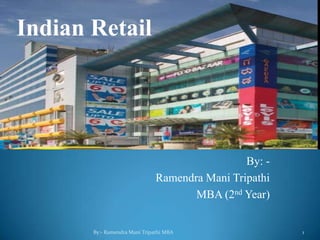
Indian Retail
Retailing Definition
 According to Philip Kotler “retailing includes all the
activities involved in selling goods or Services directly to
final consumers for personal , Non business use”.
 “Every sale of Goods and Services to final consumer” –
Food products, apparel, movie tickets.
By:- Ramendra Mani Tripathi MBA 2
Evolution of Indian Retail
By:- Ramendra Mani Tripathi MBA 3
Retailing
 Retail comes from the Old French word tailer, which
means "to cut off, clip, pare, divide" in terms of tailoring
(1365). It was first recorded as a noun with the meaning of
a "sale in small quantities" in 1433.
 Retailing may be understood as the final step in the
distribution of merchandise, for consumption by the end
consumers.
 Retailers attempt to satisfy consumer needs by having the
right merchandise, at the right price, at the right place,
when the consumer wants it.
By:- Ramendra Mani Tripathi MBA 4
Retailing
 Retailers are the final business in a distribution channel
that links manufacturers to consumers
 Indian retail industry is the second largest employer in the
country with almost 12million retail stores in India.
 A retailer or retail store is any business enterprise whose
sale volume comes primarily from retailing”.
By:- Ramendra Mani Tripathi MBA 5
Timeline of Retailing in India
By:- Ramendra Mani Tripathi MBA 6
Characteristics of Retailing
 It offers direct interaction
 Sale volume is comparatively large in quantities
 Customer service
 Sales promotions are offered at this point only
 Different forms
 Location and layout are critical factors
 More employment opportunities
By:- Ramendra Mani Tripathi MBA 7
Functions of Retailing
• Sorting
• Breaking Bulk
• Holding stock
• Communications
• Assist small suppliers
• Customer service
By:- Ramendra Mani Tripathi MBA 8
INDIAN RETAIL-BRIEF
OVERVIEW
 The Indian retail sector is highly fragmented with more
than 90 per cent of its business being carried out by
traditional family run small stores.
 In Indian context total 7% of population engaged in the
retailing trade and in those 7% only 10% population are
engaged in organized retailing and rest other 90%
population are engaged into the Unorganized Retailing.
By:- Ramendra Mani Tripathi MBA 9
Organized Retailing
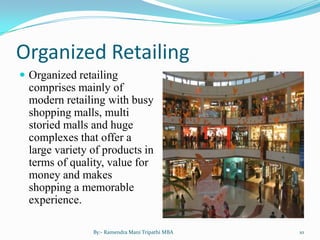
 Organized retailing
comprises mainly of
modern retailing with busy
shopping malls, multi
storied malls and huge
complexes that offer a
large variety of products in
terms of quality, value for
money and makes
shopping a memorable
experience.
By:- Ramendra Mani Tripathi MBA 10
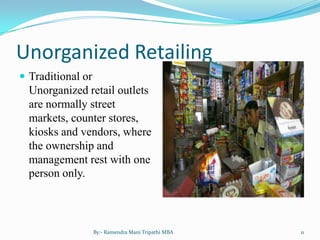
Unorganized Retailing
 Traditional or
Unorganized retail outlets
are normally street
markets, counter stores,
kiosks and vendors, where
the ownership and
management rest with one
person only.
By:- Ramendra Mani Tripathi MBA 11
INDIAN RETAIL-BRIEF
OVERVIEW
 This provides immense opportunity for large scale
retailers to set-up their operations – a slew of organized
retail formats like departmental
stores, hypermarkets, supermarkets and specialty stores
are swiftly replacing the traditional formats dramatically
altering the retailing landscape in India.
By:- Ramendra Mani Tripathi MBA 12
INDIAN RETAIL-BRIEF
OVERVIEW
 India is the third-most attractive retail market for global
retailers among the 30 largest emerging
markets, according to US consulting group AT Kearney’s
report published in June 2010
By:- Ramendra Mani Tripathi MBA 13
RETAIL-MARKET SIZE
 The total retail sales in India will grow from US$ 395.96
billion in 2011 to US$ 785.12 billion by 2015
 Indian retail sector accounts for 22 per cent of the
country's gross domestic product (GDP) and contributes to
8 per cent of the total employment.
By:- Ramendra Mani Tripathi MBA 14
Driving forces of Retailing
 Ecommerce
 The Store
 Marketing
 Information technology
 Mobile & Social
 Generation of shoppers
 The economy
 Coupons
By:- Ramendra Mani Tripathi MBA 15
Concept of Retailing
 It uses a customer-centered, chain wide approach to
strategy development and implementation, it is value
driven, and it has clear goals. Together these four
principles form the retailing Concept
By:- Ramendra Mani Tripathi MBA 16
Concept of Retailing
 Customer Orientation-The retailer determines the
attributes and needs of its customers and endeavors to
satisfy these needs to fullest
 Coordinated Effort-The retailer integrates all plans
and activities to maximize efficiency
By:- Ramendra Mani Tripathi MBA 17
Concept of Retailing
 Value-driven-The retailer offers good value to
customers, whether it be upscale or discount. This
means having prices appropriate for the level of
products and customer service
 Goal orientation-The retailer sets goals and then uses
its strategy to attain them
By:- Ramendra Mani Tripathi MBA 18
By:- Ramendra Mani Tripathi MBA 19

Indian retail ppt

  • 1.
    By: - Ramendra ManiTripathi MBA (2nd Year) By:- Ramendra Mani Tripathi MBA 1 Indian Retail
  • 2.
    Retailing Definition  Accordingto Philip Kotler “retailing includes all the activities involved in selling goods or Services directly to final consumers for personal , Non business use”.  “Every sale of Goods and Services to final consumer” – Food products, apparel, movie tickets. By:- Ramendra Mani Tripathi MBA 2
  • 3.
    Evolution of IndianRetail By:- Ramendra Mani Tripathi MBA 3
  • 4.
    Retailing  Retail comesfrom the Old French word tailer, which means "to cut off, clip, pare, divide" in terms of tailoring (1365). It was first recorded as a noun with the meaning of a "sale in small quantities" in 1433.  Retailing may be understood as the final step in the distribution of merchandise, for consumption by the end consumers.  Retailers attempt to satisfy consumer needs by having the right merchandise, at the right price, at the right place, when the consumer wants it. By:- Ramendra Mani Tripathi MBA 4
  • 5.
    Retailing  Retailers arethe final business in a distribution channel that links manufacturers to consumers  Indian retail industry is the second largest employer in the country with almost 12million retail stores in India.  A retailer or retail store is any business enterprise whose sale volume comes primarily from retailing”. By:- Ramendra Mani Tripathi MBA 5
  • 6.
    Timeline of Retailingin India By:- Ramendra Mani Tripathi MBA 6
  • 7.
    Characteristics of Retailing It offers direct interaction  Sale volume is comparatively large in quantities  Customer service  Sales promotions are offered at this point only  Different forms  Location and layout are critical factors  More employment opportunities By:- Ramendra Mani Tripathi MBA 7
  • 8.
    Functions of Retailing •Sorting • Breaking Bulk • Holding stock • Communications • Assist small suppliers • Customer service By:- Ramendra Mani Tripathi MBA 8
  • 9.
    INDIAN RETAIL-BRIEF OVERVIEW  TheIndian retail sector is highly fragmented with more than 90 per cent of its business being carried out by traditional family run small stores.  In Indian context total 7% of population engaged in the retailing trade and in those 7% only 10% population are engaged in organized retailing and rest other 90% population are engaged into the Unorganized Retailing. By:- Ramendra Mani Tripathi MBA 9
  • 10.
    Organized Retailing  Organizedretailing comprises mainly of modern retailing with busy shopping malls, multi storied malls and huge complexes that offer a large variety of products in terms of quality, value for money and makes shopping a memorable experience. By:- Ramendra Mani Tripathi MBA 10
  • 11.
    Unorganized Retailing  Traditionalor Unorganized retail outlets are normally street markets, counter stores, kiosks and vendors, where the ownership and management rest with one person only. By:- Ramendra Mani Tripathi MBA 11
  • 12.
    INDIAN RETAIL-BRIEF OVERVIEW  Thisprovides immense opportunity for large scale retailers to set-up their operations – a slew of organized retail formats like departmental stores, hypermarkets, supermarkets and specialty stores are swiftly replacing the traditional formats dramatically altering the retailing landscape in India. By:- Ramendra Mani Tripathi MBA 12
  • 13.
    INDIAN RETAIL-BRIEF OVERVIEW  Indiais the third-most attractive retail market for global retailers among the 30 largest emerging markets, according to US consulting group AT Kearney’s report published in June 2010 By:- Ramendra Mani Tripathi MBA 13
  • 14.
    RETAIL-MARKET SIZE  Thetotal retail sales in India will grow from US$ 395.96 billion in 2011 to US$ 785.12 billion by 2015  Indian retail sector accounts for 22 per cent of the country's gross domestic product (GDP) and contributes to 8 per cent of the total employment. By:- Ramendra Mani Tripathi MBA 14
  • 15.
    Driving forces ofRetailing  Ecommerce  The Store  Marketing  Information technology  Mobile & Social  Generation of shoppers  The economy  Coupons By:- Ramendra Mani Tripathi MBA 15
  • 16.
    Concept of Retailing It uses a customer-centered, chain wide approach to strategy development and implementation, it is value driven, and it has clear goals. Together these four principles form the retailing Concept By:- Ramendra Mani Tripathi MBA 16
  • 17.
    Concept of Retailing Customer Orientation-The retailer determines the attributes and needs of its customers and endeavors to satisfy these needs to fullest  Coordinated Effort-The retailer integrates all plans and activities to maximize efficiency By:- Ramendra Mani Tripathi MBA 17
  • 18.
    Concept of Retailing Value-driven-The retailer offers good value to customers, whether it be upscale or discount. This means having prices appropriate for the level of products and customer service  Goal orientation-The retailer sets goals and then uses its strategy to attain them By:- Ramendra Mani Tripathi MBA 18
  • 19.
    By:- Ramendra ManiTripathi MBA 19