Module 2
Strategic planning in retailing
1. Deciding the store’s philosophy, mission and
objectives
2 Situation analysis

3. Formulation of retail strategy

4. Strategy implementation and control.
Strategic planning in retailing
Retail Environment
1. Micro environment and
2.macro environment.
Retail Environment
Micro Environment 

1- Suppliers – are business firms and individuals who
provide resources needed by the retailer. For example a
retail store must obtain various products from different
suppliers so that as and when customers come and ask the
product, he will be in a position to sell them on tome. 

2-  Intermediaries – are firms that aid the retail shop in
promoting selling and distribution goods to final buyers. 

.
Micro Environment 

3-  Customers – are the end users of the product or
services and they are the last link in the business 

process. 

4-  Competitors – the retailers marketing system is
surrounded and affected by a host of competitors. 

These competitors have to be identified, monitored and out
manoeuvred to captured and maintain customer loyalty. 

Macro

1.Demographic:The first environmental fact of interest to
retailers is population because people make up markets. 

2.Political and legal: Retail marketing decisions are
substantially impacted by development in political / legal
environment. 

3.Social and cultural environment
4.Economic environment: Retail markets consist of
purchasing power as well as people. Total purchasing power
is a function of current income, prices, savings and credit
availability.
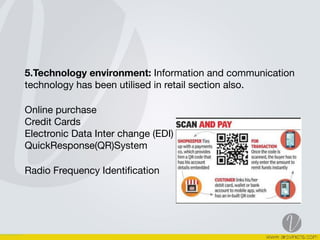
5.Technology environment: Information and communication
technology has been utilised in retail section also.

Online purchase 

Credit Cards 

Electronic Data Inter change (EDI) 

QuickResponse(QR)System 

Radio Frequency Identification 


Consumer Behaviour In Retail
In retail marketing sector, marketers are keen to know
the consumers shopping behaviour, which involves an
understanding of decision variables like when where,
and what to shop.
Consumer Behaviour In Retail
1- Demographic factors
A designer store of garments is usually located in an up
market shopping centre or Mall. If this is in a low-income
group residential area the store will not be viable.
Consumer Behaviour In Retail
2.Psychological Factors 

Consumers respond differently towards the same retail
marketing due to their respective motives, personality, level
of involvement and attitude. 

Consumer Behaviour In Retail
3.Motives

The need to have the latest fashion in clothes, 

mobile phones etc. is also a motivation. 

Consumer Behaviour In Retail
4. Learning 

Free sampling/trials etc. are also ways of making the
consumer learn about a product and its attributes 

Consumer Behaviour In Retail
5.Attitude
Workaholic, Impulsive, Self confident, Friendliness,
Adaptability, Ambitious, Introversion, Extroversion Can be
used as measure to represent consumer buying behaviour. 

Consumer Behaviour In Retail
9.Lifestyle
DINKS 

SINKS

Full Nest 

Empty Nest
Retail Information System
The Retail Information System (RIS) is a flexible tool that
enables you to collect aggregate and analyze data from
retailing activities. 

The Retail Information System is a component of the
logistics Information system.
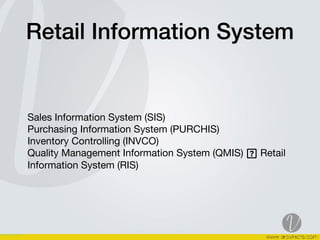
Retail Information System
Sales Information System (SIS)

Purchasing Information System (PURCHIS)

Inventory Controlling (INVCO)

Quality Management Information System (QMIS) Retail 

Information System (RIS)
Retail research
—Undertake market situation analysis

—Work at developing strategy to build competitive
advantage 

—Work out specific market development programs

— Implement strategy with measureable objectives
Parameters of retail research

Demographics
Competitive analysis
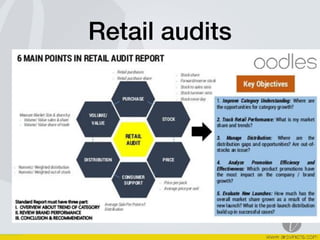
Retail audits
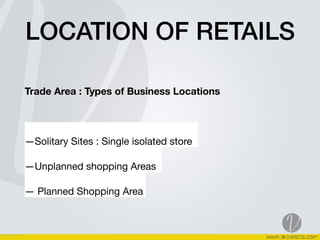
LOCATION OF RETAILS
Trade Area : Types of Business Locations
—Solitary Sites : Single isolated store 

—Unplanned shopping Areas 

— Planned Shopping Area
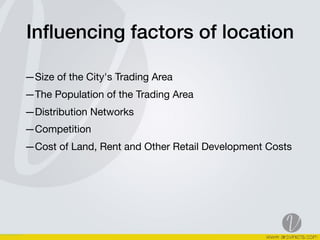
Influencing factors of location
—Size of the City's Trading Area 

—The Population of the Trading Area

—Distribution Networks 

—Competition 

—Cost of Land, Rent and Other Retail Development Costs 


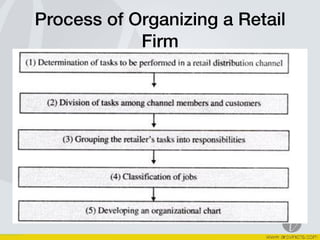
Process of Organizing a Retail
Firm

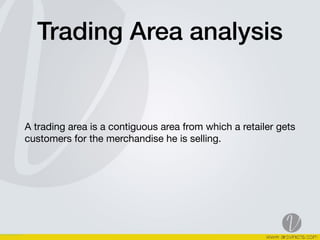
Trading Area analysis
A trading area is a contiguous area from which a retailer gets
customers for the merchandise he is selling.
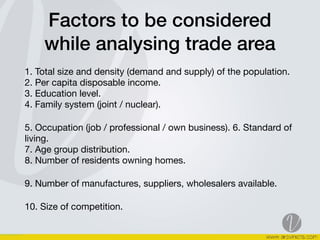
Factors to be considered
while analysing trade area
1. Total size and density (demand and supply) of the population.
2. Per capita disposable income.

3. Education level.

4. Family system (joint / nuclear). 

5. Occupation (job / professional / own business). 6. Standard of
living.

7. Age group distribution.

8. Number of residents owning homes. 

9. Number of manufactures, suppliers, wholesalers available. 

10. Size of competition.
THANK YOU
www.aravindts.com

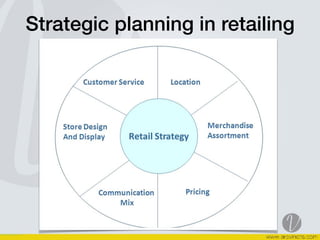
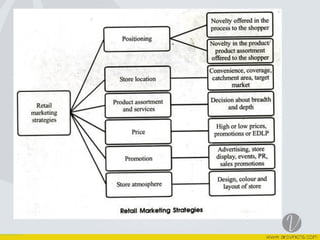
Retail Strategy

  • 1.
  • 2.
    Strategic planning inretailing 1. Deciding the store’s philosophy, mission and objectives 2 Situation analysis
 3. Formulation of retail strategy
 4. Strategy implementation and control.
  • 3.
  • 4.
  • 7.
    Retail Environment 1. Microenvironment and 2.macro environment.
  • 8.
    Retail Environment Micro Environment
 1- Suppliers – are business firms and individuals who provide resources needed by the retailer. For example a retail store must obtain various products from different suppliers so that as and when customers come and ask the product, he will be in a position to sell them on tome. 2-  Intermediaries – are firms that aid the retail shop in promoting selling and distribution goods to final buyers. 
 .
  • 9.
    Micro Environment 3- Customers – are the end users of the product or services and they are the last link in the business 
 process. 
 4-  Competitors – the retailers marketing system is surrounded and affected by a host of competitors. 
 These competitors have to be identified, monitored and out manoeuvred to captured and maintain customer loyalty. 

  • 10.
    Macro
 1.Demographic:The first environmentalfact of interest to retailers is population because people make up markets. 2.Political and legal: Retail marketing decisions are substantially impacted by development in political / legal environment. 

  • 11.
    3.Social and culturalenvironment 4.Economic environment: Retail markets consist of purchasing power as well as people. Total purchasing power is a function of current income, prices, savings and credit availability.
  • 12.
    5.Technology environment: Informationand communication technology has been utilised in retail section also. Online purchase 
 Credit Cards 
 Electronic Data Inter change (EDI) 
 QuickResponse(QR)System Radio Frequency Identification 
 

  • 13.
    Consumer Behaviour InRetail In retail marketing sector, marketers are keen to know the consumers shopping behaviour, which involves an understanding of decision variables like when where, and what to shop.
  • 14.
    Consumer Behaviour InRetail 1- Demographic factors A designer store of garments is usually located in an up market shopping centre or Mall. If this is in a low-income group residential area the store will not be viable.
  • 15.
    Consumer Behaviour InRetail 2.Psychological Factors 
 Consumers respond differently towards the same retail marketing due to their respective motives, personality, level of involvement and attitude. 

  • 16.
    Consumer Behaviour InRetail 3.Motives
 The need to have the latest fashion in clothes, 
 mobile phones etc. is also a motivation. 

  • 17.
    Consumer Behaviour InRetail 4. Learning 
 Free sampling/trials etc. are also ways of making the consumer learn about a product and its attributes 

  • 18.
    Consumer Behaviour InRetail 5.Attitude Workaholic, Impulsive, Self confident, Friendliness, Adaptability, Ambitious, Introversion, Extroversion Can be used as measure to represent consumer buying behaviour. 

  • 19.
    Consumer Behaviour InRetail 9.Lifestyle DINKS SINKS Full Nest Empty Nest
  • 20.
    Retail Information System TheRetail Information System (RIS) is a flexible tool that enables you to collect aggregate and analyze data from retailing activities. The Retail Information System is a component of the logistics Information system.
  • 21.
    Retail Information System SalesInformation System (SIS)
 Purchasing Information System (PURCHIS)
 Inventory Controlling (INVCO)
 Quality Management Information System (QMIS) Retail 
 Information System (RIS)
  • 22.
    Retail research —Undertake marketsituation analysis
 —Work at developing strategy to build competitive advantage —Work out specific market development programs
 — Implement strategy with measureable objectives
  • 23.
    Parameters of retailresearch
 Demographics Competitive analysis
  • 24.
  • 25.
    LOCATION OF RETAILS TradeArea : Types of Business Locations —Solitary Sites : Single isolated store —Unplanned shopping Areas — Planned Shopping Area
  • 26.
    Influencing factors oflocation —Size of the City's Trading Area —The Population of the Trading Area —Distribution Networks —Competition —Cost of Land, Rent and Other Retail Development Costs 


  • 27.
    Process of Organizinga Retail Firm

  • 28.
    Trading Area analysis Atrading area is a contiguous area from which a retailer gets customers for the merchandise he is selling.
  • 29.
    Factors to beconsidered while analysing trade area 1. Total size and density (demand and supply) of the population. 2. Per capita disposable income.
 3. Education level.
 4. Family system (joint / nuclear). 5. Occupation (job / professional / own business). 6. Standard of living.
 7. Age group distribution.
 8. Number of residents owning homes. 9. Number of manufactures, suppliers, wholesalers available. 10. Size of competition.
  • 30.