PRICING
BY – VIJYATA
PRICE
Price is the amount of money charged for
a product or a service.
Price is the sum of all the values that
customers give up to gain the benefits of
having or using a product or service.
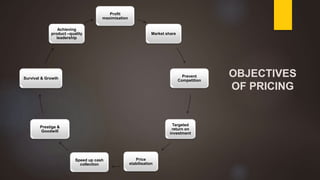
OBJECTIVES
OF PRICING
Profit
maximisation
Market share
Prevent
Competition
Targeted
return on
investment
Price
stabilisation
Speed up cash
collection
Prestige &
Goodwill
Survival & Growth
Achieving
product –quality
leadership
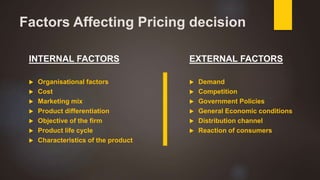
Factors Affecting Pricing decision
INTERNAL FACTORS
 Organisational factors
 Cost
 Marketing mix
 Product differentiation
 Objective of the firm
 Product life cycle
 Characteristics of the product
EXTERNAL FACTORS
 Demand
 Competition
 Government Policies
 General Economic conditions
 Distribution channel
 Reaction of consumers
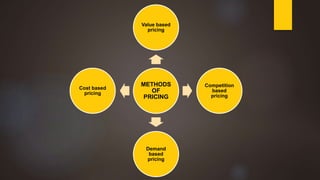
METHODS
OF
PRICING
Value based
pricing
Competition
based
pricing
Demand
based
pricing
Cost based
pricing
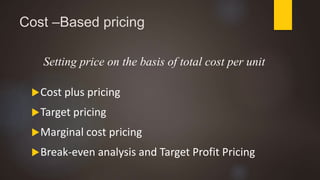
Cost –Based pricing
Setting price on the basis of total cost per unit
Cost plus pricing
Target pricing
Marginal cost pricing
Break-even analysis and Target Profit Pricing
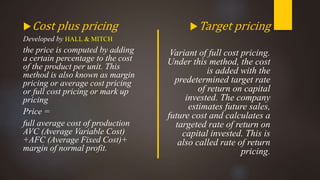
Cost plus pricing
Developed by HALL & MITCH
the price is computed by adding
a certain percentage to the cost
of the product per unit. This
method is also known as margin
pricing or average cost pricing
or full cost pricing or mark up
pricing
Price =
full average cost of production
AVC (Average Variable Cost)
+AFC (Average Fixed Cost)+
margin of normal profit.
Target pricing
Variant of full cost pricing.
Under this method, the cost
is added with the
predetermined target rate
of return on capital
invested. The company
estimates future sales,
future cost and calculates a
targeted rate of return on
capital invested. This is
also called rate of return
pricing.
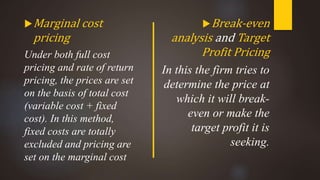
Marginal cost
pricing
Under both full cost
pricing and rate of return
pricing, the prices are set
on the basis of total cost
(variable cost + fixed
cost). In this method,
fixed costs are totally
excluded and pricing are
set on the marginal cost
Break-even
analysis and Target
Profit Pricing
In this the firm tries to
determine the price at
which it will break-
even or make the
target profit it is
seeking.
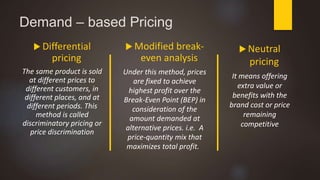
Demand – based Pricing
 Differential
pricing
The same product is sold
at different prices to
different customers, in
different places, and at
different periods. This
method is called
discriminatory pricing or
price discrimination
 Modified break-
even analysis
Under this method, prices
are fixed to achieve
highest profit over the
Break-Even Point (BEP) in
consideration of the
amount demanded at
alternative prices. i.e. A
price-quantity mix that
maximizes total profit.
 Neutral
pricing
It means offering
extra value or
benefits with the
brand cost or price
remaining
competitive
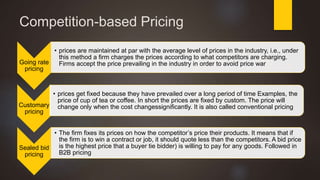
Competition-based Pricing
Going rate
pricing
• prices are maintained at par with the average level of prices in the industry, i.e., under
this method a firm charges the prices according to what competitors are charging.
Firms accept the price prevailing in the industry in order to avoid price war
Customary
pricing
• prices get fixed because they have prevailed over a long period of time Examples, the
price of cup of tea or coffee. In short the prices are fixed by custom. The price will
change only when the cost changessignificantly. It is also called conventional pricing
Sealed bid
pricing
• The firm fixes its prices on how the competitor’s price their products. It means that if
the firm is to win a contract or job, it should quote less than the competitors. A bid price
is the highest price that a buyer tie bidder) is willing to pay for any goods. Followed in
B2B pricing
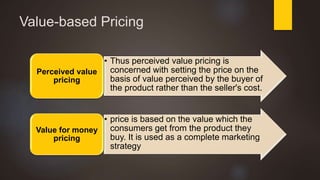
Value-based Pricing
• Thus perceived value pricing is
concerned with setting the price on the
basis of value perceived by the buyer of
the product rather than the seller's cost.
Perceived value
pricing
• price is based on the value which the
consumers get from the product they
buy. It is used as a complete marketing
strategy
Value for money
pricing
THANK YOU !!!

Pricing decision

  • 1.
  • 2.
    PRICE Price is theamount of money charged for a product or a service. Price is the sum of all the values that customers give up to gain the benefits of having or using a product or service.
  • 3.
    OBJECTIVES OF PRICING Profit maximisation Market share Prevent Competition Targeted returnon investment Price stabilisation Speed up cash collection Prestige & Goodwill Survival & Growth Achieving product –quality leadership
  • 4.
    Factors Affecting Pricingdecision INTERNAL FACTORS  Organisational factors  Cost  Marketing mix  Product differentiation  Objective of the firm  Product life cycle  Characteristics of the product EXTERNAL FACTORS  Demand  Competition  Government Policies  General Economic conditions  Distribution channel  Reaction of consumers
  • 5.
  • 6.
    Cost –Based pricing Settingprice on the basis of total cost per unit Cost plus pricing Target pricing Marginal cost pricing Break-even analysis and Target Profit Pricing
  • 7.
    Cost plus pricing Developedby HALL & MITCH the price is computed by adding a certain percentage to the cost of the product per unit. This method is also known as margin pricing or average cost pricing or full cost pricing or mark up pricing Price = full average cost of production AVC (Average Variable Cost) +AFC (Average Fixed Cost)+ margin of normal profit. Target pricing Variant of full cost pricing. Under this method, the cost is added with the predetermined target rate of return on capital invested. The company estimates future sales, future cost and calculates a targeted rate of return on capital invested. This is also called rate of return pricing.
  • 8.
    Marginal cost pricing Under bothfull cost pricing and rate of return pricing, the prices are set on the basis of total cost (variable cost + fixed cost). In this method, fixed costs are totally excluded and pricing are set on the marginal cost Break-even analysis and Target Profit Pricing In this the firm tries to determine the price at which it will break- even or make the target profit it is seeking.
  • 9.
    Demand – basedPricing  Differential pricing The same product is sold at different prices to different customers, in different places, and at different periods. This method is called discriminatory pricing or price discrimination  Modified break- even analysis Under this method, prices are fixed to achieve highest profit over the Break-Even Point (BEP) in consideration of the amount demanded at alternative prices. i.e. A price-quantity mix that maximizes total profit.  Neutral pricing It means offering extra value or benefits with the brand cost or price remaining competitive
  • 10.
    Competition-based Pricing Going rate pricing •prices are maintained at par with the average level of prices in the industry, i.e., under this method a firm charges the prices according to what competitors are charging. Firms accept the price prevailing in the industry in order to avoid price war Customary pricing • prices get fixed because they have prevailed over a long period of time Examples, the price of cup of tea or coffee. In short the prices are fixed by custom. The price will change only when the cost changessignificantly. It is also called conventional pricing Sealed bid pricing • The firm fixes its prices on how the competitor’s price their products. It means that if the firm is to win a contract or job, it should quote less than the competitors. A bid price is the highest price that a buyer tie bidder) is willing to pay for any goods. Followed in B2B pricing
  • 11.
    Value-based Pricing • Thusperceived value pricing is concerned with setting the price on the basis of value perceived by the buyer of the product rather than the seller's cost. Perceived value pricing • price is based on the value which the consumers get from the product they buy. It is used as a complete marketing strategy Value for money pricing
  • 12.