REAL TIME IMAGE
PROCESSING


             Guided by
             Prof. K.S. Ingle
             Student name
             Ashwini Jagdhane.
             M.E. (EC)
Contents
   Introduction
   Literature survey
   Requirements
   Difference between real and non real time processing
   General detection system
   System design
   Advantages
   Disadvantages
   Applications
   Future scope
   Definitions in RTIP in different sense
   References
Introduction

•What is Real-time Image Processing?

•How it differs from ordinary Image
Processing?

•What is the need for Real time image
processing?
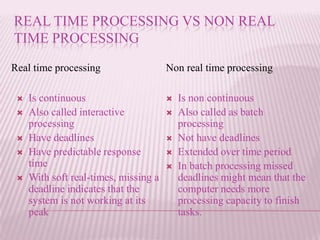
REAL TIME PROCESSING VS NON REAL
TIME PROCESSING

Real time processing                   Non real time processing

    Is continuous                        Is non continuous
    Also called interactive              Also called as batch
     processing                            processing
    Have deadlines                       Not have deadlines
    Have predictable response            Extended over time period
     time                                 In batch processing missed
    With soft real-times, missing a       deadlines might mean that the
     deadline indicates that the           computer needs more
     system is not working at its          processing capacity to finish
     peak                                  tasks.
Literature survey

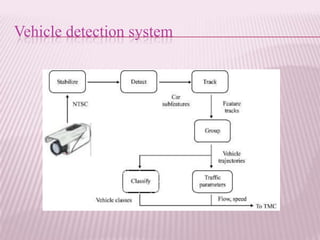
 Vehicle detection system
 Speed controller

 Image recognition with hardware neural
 networks
 Real time yahoo! store order processing
Vehicle detection system
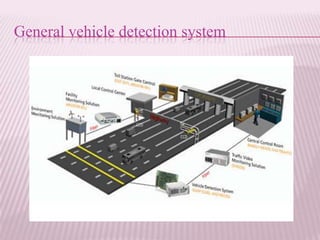
General vehicle detection system
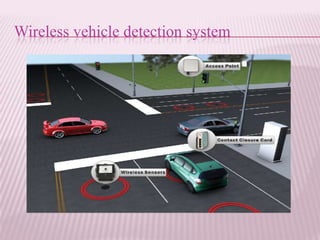
Wireless vehicle detection system
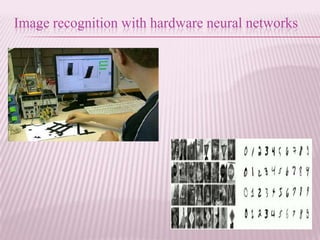
Image recognition with hardware neural networks
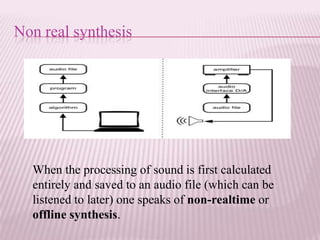
Non real synthesis


  When the processing of sound is first calculated
  entirely and saved to an audio file (which can be
  listened to later) one speaks of non-realtime or
  offline synthesis.
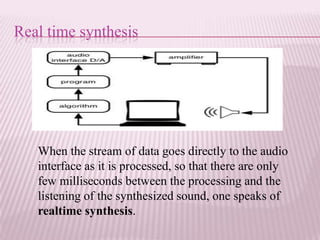
Real time synthesis


   When the stream of data goes directly to the audio
   interface as it is processed, so that there are only
   few milliseconds between the processing and the
   listening of the synthesized sound, one speaks of
   realtime synthesis.
Real time yahoo! Store order processing
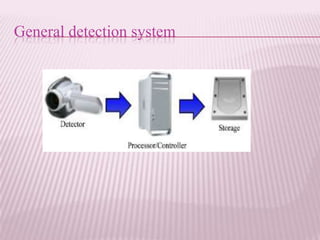
General detection system
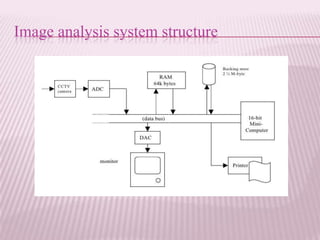
Image analysis system structure
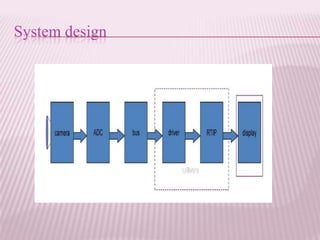
System design
Real-Time Image Processing Platform
Requirements:

• High resolution, high frame rate video
input
• Low latency video input
• Low latency operating system scheduling
• High processing performance
Sampling resolution

 Image processing attempts to extract
  information from the outside world through its
  visual appearance. Therefore adequate
  information must be provided to the processing
  algorithm by the video input hardware.
 Broadcast video provides a practical reference
  point as most cameras provide images in
  formats derived from broadcast standards
  regardless of their computer interface
  (analog, USB etc).
Advantages

  1. Customer can see the results immediately.
  2. Allows you to automate your business. This
  is especially important if your time is very
  limited.
  3. Real-time image processing also helps
  eliminate customer errors.
  4. Real-time image processing is fast .
  5. Real-time image processing is continuous.
Disadvantages

Causes many errors when many people code
 together on the same document. There are
 chances that they use the same variables for
 different tasks.
 In some cases infrared cameras used to detect the
 object having low pixel capability. Therefore
 object identification fails.
Applications
 Deriving a compact representation.
 Includes spatial or temporal down-sampling.
 Spatial block partitioning.
 Region of interest or selective processing.
 Formulating the algorithm in a multi resolution or
 processing framework.
 Mobile robots.
 Video-based interfaces for human computer
 interaction.
Definitions of RTIP in different sense

    Real-time in the perceptual sense
      It is used mainly to describe the interaction
    between a human and a computer device for a
    near instantaneous response of the device to an
    input by a human user. For instance, Bovik
    defines the concept of “real-time” in the context
    of video processing, describing that “the result of
    processing appears effectively „instantaneously‟
    (usually in a perceptual sense) once the input
    becomes available”.
Definitions of RTIP in different sense
    Real-time in the signal processing sense
       It is based on the idea of completing processing in
    the time available between successive input samples.
    An important item of note here is that one way to
    gauge the “real-time” status of an algorithm is to
    determine some measure of the amount of time it
    takes for the algorithm to complete all requisite
    transferring and processing of image data, and then
    making sure that it is less than the allotted time for
    processing.
Future scope
   The performance requirements of image processing
    applications have continuously increased the computing
    power of implementation platforms, especially when
    they are executed under real time constraints.
   The real time applications may consist of different image
    standards, or different algorithms used at different stages
    of the processing chain.
   The computing paradigm using reconfigurable
    architectures promises an intermediatetrade-off between
    flexibility and performance.
REFERENCES
   http://www.scribd.com/doc/6738837/Real-Time-Image-and-Video-Processing-
    From-Research-to-Reality (First Edition 10 9 8 7 6 5 4 3 2 1 Printed in the
    United States of America)
   http://www.authorstream.com/Presentation/pl_arun-360868-image-processing-
    ip-arunpl-science -technology-ppt-power point
    Rourke , A., and Bell, M.G.H.: „Queue detection and congestion monitoring
    using mage processing‟, Traffic Engg. and Control
    A. Bovik, Introduction to Digital Image and Video Processing, in Handbook of
    Image &VideoProcessing, A. C. Bovik, Ed., Elsevier AcademicPress, 2005
    http://www.ncbi.nlm.nih.gov/pmc/articles/PMC2678783/ Real-time processing
    for Fourier domain optical coherence tomography using a field programmable
    gate array
    Grueger, H., R. Gottfried-Gottfried, M. Schwarzenberg, M. Scholles and R.
    Zachmann, 2001. Magnetic trac detection using fluxgate sensors. Proc. Int.
    Conf. Sensor, 2: 351-356
QUERY?????
THANK YOU
!!!

Real time image processing ppt

  • 1.
    REAL TIME IMAGE PROCESSING Guided by Prof. K.S. Ingle Student name Ashwini Jagdhane. M.E. (EC)
  • 2.
    Contents  Introduction  Literature survey  Requirements  Difference between real and non real time processing  General detection system  System design  Advantages  Disadvantages  Applications  Future scope  Definitions in RTIP in different sense  References
  • 3.
    Introduction •What is Real-timeImage Processing? •How it differs from ordinary Image Processing? •What is the need for Real time image processing?
  • 4.
    REAL TIME PROCESSINGVS NON REAL TIME PROCESSING Real time processing Non real time processing  Is continuous  Is non continuous  Also called interactive  Also called as batch processing processing  Have deadlines  Not have deadlines  Have predictable response  Extended over time period time  In batch processing missed  With soft real-times, missing a deadlines might mean that the deadline indicates that the computer needs more system is not working at its processing capacity to finish peak tasks.
  • 5.
    Literature survey  Vehicledetection system  Speed controller  Image recognition with hardware neural networks  Real time yahoo! store order processing
  • 6.
  • 7.
  • 8.
  • 9.
    Image recognition withhardware neural networks
  • 10.
    Non real synthesis When the processing of sound is first calculated entirely and saved to an audio file (which can be listened to later) one speaks of non-realtime or offline synthesis.
  • 11.
    Real time synthesis When the stream of data goes directly to the audio interface as it is processed, so that there are only few milliseconds between the processing and the listening of the synthesized sound, one speaks of realtime synthesis.
  • 12.
    Real time yahoo!Store order processing
  • 13.
  • 14.
  • 15.
  • 16.
    Real-Time Image ProcessingPlatform Requirements: • High resolution, high frame rate video input • Low latency video input • Low latency operating system scheduling • High processing performance
  • 17.
    Sampling resolution  Imageprocessing attempts to extract information from the outside world through its visual appearance. Therefore adequate information must be provided to the processing algorithm by the video input hardware.  Broadcast video provides a practical reference point as most cameras provide images in formats derived from broadcast standards regardless of their computer interface (analog, USB etc).
  • 18.
    Advantages 1.Customer can see the results immediately. 2. Allows you to automate your business. This is especially important if your time is very limited. 3. Real-time image processing also helps eliminate customer errors. 4. Real-time image processing is fast . 5. Real-time image processing is continuous.
  • 19.
    Disadvantages Causes many errorswhen many people code together on the same document. There are chances that they use the same variables for different tasks.  In some cases infrared cameras used to detect the object having low pixel capability. Therefore object identification fails.
  • 20.
    Applications  Deriving acompact representation.  Includes spatial or temporal down-sampling.  Spatial block partitioning.  Region of interest or selective processing.  Formulating the algorithm in a multi resolution or processing framework.  Mobile robots.  Video-based interfaces for human computer interaction.
  • 21.
    Definitions of RTIPin different sense  Real-time in the perceptual sense It is used mainly to describe the interaction between a human and a computer device for a near instantaneous response of the device to an input by a human user. For instance, Bovik defines the concept of “real-time” in the context of video processing, describing that “the result of processing appears effectively „instantaneously‟ (usually in a perceptual sense) once the input becomes available”.
  • 22.
    Definitions of RTIPin different sense  Real-time in the signal processing sense It is based on the idea of completing processing in the time available between successive input samples. An important item of note here is that one way to gauge the “real-time” status of an algorithm is to determine some measure of the amount of time it takes for the algorithm to complete all requisite transferring and processing of image data, and then making sure that it is less than the allotted time for processing.
  • 23.
    Future scope  The performance requirements of image processing applications have continuously increased the computing power of implementation platforms, especially when they are executed under real time constraints.  The real time applications may consist of different image standards, or different algorithms used at different stages of the processing chain.  The computing paradigm using reconfigurable architectures promises an intermediatetrade-off between flexibility and performance.
  • 24.
    REFERENCES  http://www.scribd.com/doc/6738837/Real-Time-Image-and-Video-Processing- From-Research-to-Reality (First Edition 10 9 8 7 6 5 4 3 2 1 Printed in the United States of America)  http://www.authorstream.com/Presentation/pl_arun-360868-image-processing- ip-arunpl-science -technology-ppt-power point  Rourke , A., and Bell, M.G.H.: „Queue detection and congestion monitoring using mage processing‟, Traffic Engg. and Control  A. Bovik, Introduction to Digital Image and Video Processing, in Handbook of Image &VideoProcessing, A. C. Bovik, Ed., Elsevier AcademicPress, 2005  http://www.ncbi.nlm.nih.gov/pmc/articles/PMC2678783/ Real-time processing for Fourier domain optical coherence tomography using a field programmable gate array  Grueger, H., R. Gottfried-Gottfried, M. Schwarzenberg, M. Scholles and R. Zachmann, 2001. Magnetic trac detection using fluxgate sensors. Proc. Int. Conf. Sensor, 2: 351-356
  • 25.
  • 26.