TUMKUR UNVIVERSITY
Ph.D COURSEWORK SEMINAR
Presented by
Divyarani .K
Research scholar in chemistry
Tumkur university , Tumakuru
Under the guidance
Dr.S.Sreenivasa
Associate professor in chemistry,
UCS Tumkur university
Deputy adviser
NAAC , Bengaluru
CONTENTS
 Prelude
 Electronic states of nitrenes
 Stability of nitrenes
 Generation of nitrenes
 Reaction of nitrenes
 Conclusions
 References
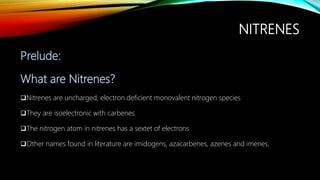
NITRENES
Prelude:
What are Nitrenes?
Nitrenes are uncharged, electron deficient monovalent nitrogen species
They are isoelectronic with carbenes
The nitrogen atom in nitrenes has a sextet of electrons
Other names found in literature are imidogens, azacarbenes, azenes and imenes.
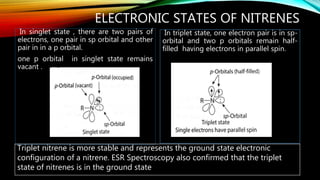
ELECTRONIC STATES OF NITRENES
In singlet state , there are two pairs of
electrons, one pair in sp orbital and other
pair in in a p orbital.
one p orbital in singlet state remains
vacant .
In triplet state, one electron pair is in sp-
orbital and two p orbitals remain half-
filled having electrons in parallel spin.
Triplet nitrene is more stable and represents the ground state electronic
configuration of a nitrene. ESR Spectroscopy also confirmed that the triplet
state of nitrenes is in the ground state
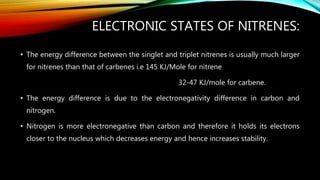
ELECTRONIC STATES OF NITRENES:
• The energy difference between the singlet and triplet nitrenes is usually much larger
for nitrenes than that of carbenes i.e 145 KJ/Mole for nitrene
32-47 KJ/mole for carbene.
• The energy difference is due to the electronegativity difference in carbon and
nitrogen.
• Nitrogen is more electronegative than carbon and therefore it holds its electrons
closer to the nucleus which decreases energy and hence increases stability.
STABILITY OF NITRENES:
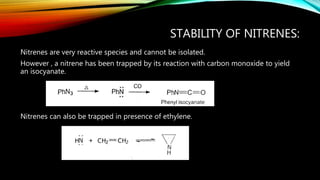
Nitrenes are very reactive species and cannot be isolated.
However , a nitrene has been trapped by its reaction with carbon monoxide to yield
an isocyanate.
Nitrenes can also be trapped in presence of ethylene.
GENERATION OF NITRENES
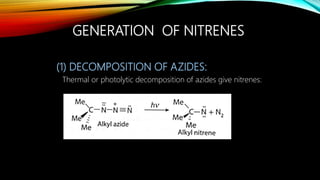
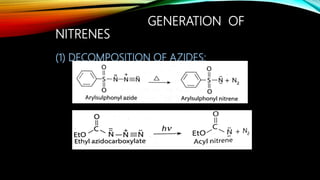
(1) DECOMPOSITION OF AZIDES:
Thermal or photolytic decomposition of azides give nitrenes:
GENERATION OF
NITRENES
(1) DECOMPOSITION OF AZIDES:
GENERATION OF NITRENES
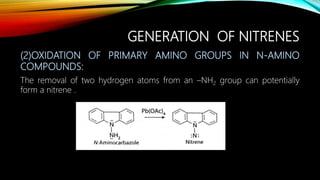
(2)OXIDATION OF PRIMARY AMINO GROUPS IN N-AMINO
COMPOUNDS:
The removal of two hydrogen atoms from an –NH2 group can potentially
form a nitrene .
GENERATION OF NITRENES
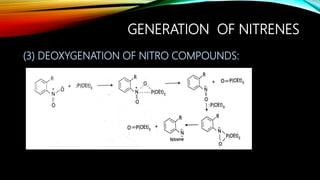
(3) DEOXYGENATION OF NITRO COMPOUNDS:
REACTIONS OF NITRENES
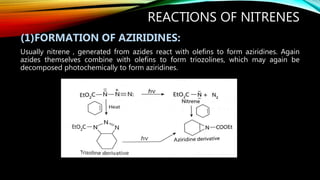
(1)FORMATION OF AZIRIDINES:
Usually nitrene , generated from azides react with olefins to form aziridines. Again
azides themselves combine with olefins to form triozolines, which may again be
decomposed photochemically to form aziridines.
REACTIONS OF NITRENES
(1)FORMATION OF AZIRIDINES:
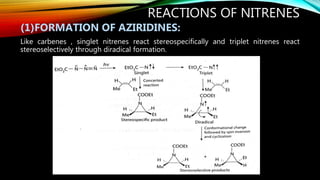
Like carbenes , singlet nitrenes react stereospecifically and triplet nitrenes react
stereoselectively through diradical formation.
REACTIONS OF NITRENES
(1)FORMATION OF AZIRIDINES:
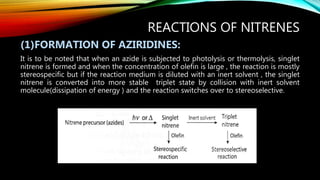
It is to be noted that when an azide is subjected to photolysis or thermolysis, singlet
nitrene is formed and when the concentration of olefin is large , the reaction is mostly
stereospecific but if the reaction medium is diluted with an inert solvent , the singlet
nitrene is converted into more stable triplet state by collision with inert solvent
molecule(dissipation of energy ) and the reaction switches over to stereoselective.
REACTIONS OF NITRENES
FORMATION OF AZIRIDINES:
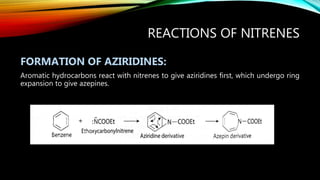
Aromatic hydrocarbons react with nitrenes to give aziridines first, which undergo ring
expansion to give azepines.
REACTIONS OF NITRENES
INSERTION REACTION:
Like carbenes , nitrenes also undergo insertion reactions. Singlet nitrenes insert in a
concerted manner and the stereochemistry of the substrate should be retained in the
product.
Triplet nitrenes could give the same, but by a two step process. Two radicals are
formed which combine to give the product.
REACTIONS OF NITRENES
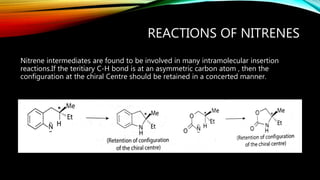
Nitrene intermediates are found to be involved in many intramolecular insertion
reactions.If the teritiary C-H bond is at an asymmetric carbon atom , then the
configuration at the chiral Centre should be retained in a concerted manner.
REACTIONS OF NITRENES
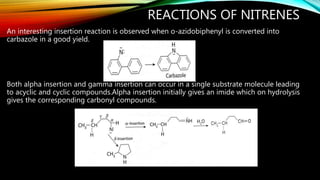
An interesting insertion reaction is observed when o-azidobiphenyl is converted into
carbazole in a good yield.
Both alpha insertion and gamma insertion can occur in a single substrate molecule leading
to acyclic and cyclic compounds.Alpha insertion initially gives an imide which on hydrolysis
gives the corresponding carbonyl compounds.
REACTIONS OF NITRENES
Metal catalyzed C-H insertion
Ph
CH3
F3C
[(cod)Ir(OMe)]2
2 mol%
Benzene
rt, 15h
Ph
NH
F3C
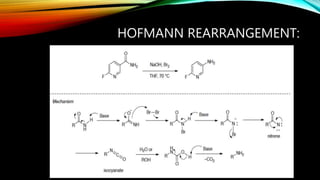
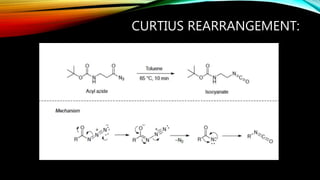
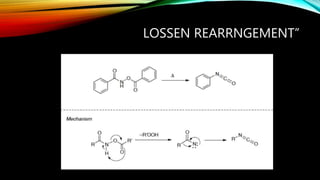
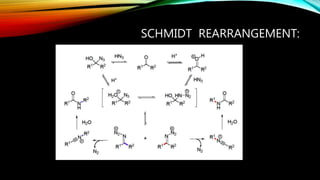
REARRANGEMENT REACTIONS OF NITRENES:
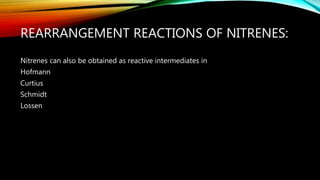
Nitrenes can also be obtained as reactive intermediates in
Hofmann
Curtius
Schmidt
Lossen
HOFMANN REARRANGEMENT:
CURTIUS REARRANGEMENT:
LOSSEN REARRNGEMENT”
SCHMIDT REARRANGEMENT:
REFERENCES:
Reaction mechanisms in organic chemistry – Subrata Sen Gupta
Organic chemistry- Jonathan Clayden, Nick Greeves and Stuart Warren
Nitrenes slideshare  Reactive intermediates

Nitrenes slideshare Reactive intermediates

  • 1.
    TUMKUR UNVIVERSITY Ph.D COURSEWORKSEMINAR Presented by Divyarani .K Research scholar in chemistry Tumkur university , Tumakuru Under the guidance Dr.S.Sreenivasa Associate professor in chemistry, UCS Tumkur university Deputy adviser NAAC , Bengaluru
  • 2.
    CONTENTS  Prelude  Electronicstates of nitrenes  Stability of nitrenes  Generation of nitrenes  Reaction of nitrenes  Conclusions  References
  • 3.
    NITRENES Prelude: What are Nitrenes? Nitrenesare uncharged, electron deficient monovalent nitrogen species They are isoelectronic with carbenes The nitrogen atom in nitrenes has a sextet of electrons Other names found in literature are imidogens, azacarbenes, azenes and imenes.
  • 4.
    ELECTRONIC STATES OFNITRENES In singlet state , there are two pairs of electrons, one pair in sp orbital and other pair in in a p orbital. one p orbital in singlet state remains vacant . In triplet state, one electron pair is in sp- orbital and two p orbitals remain half- filled having electrons in parallel spin. Triplet nitrene is more stable and represents the ground state electronic configuration of a nitrene. ESR Spectroscopy also confirmed that the triplet state of nitrenes is in the ground state
  • 5.
    ELECTRONIC STATES OFNITRENES: • The energy difference between the singlet and triplet nitrenes is usually much larger for nitrenes than that of carbenes i.e 145 KJ/Mole for nitrene 32-47 KJ/mole for carbene. • The energy difference is due to the electronegativity difference in carbon and nitrogen. • Nitrogen is more electronegative than carbon and therefore it holds its electrons closer to the nucleus which decreases energy and hence increases stability.
  • 6.
    STABILITY OF NITRENES: Nitrenesare very reactive species and cannot be isolated. However , a nitrene has been trapped by its reaction with carbon monoxide to yield an isocyanate. Nitrenes can also be trapped in presence of ethylene.
  • 7.
    GENERATION OF NITRENES (1)DECOMPOSITION OF AZIDES: Thermal or photolytic decomposition of azides give nitrenes:
  • 8.
  • 9.
    GENERATION OF NITRENES (2)OXIDATIONOF PRIMARY AMINO GROUPS IN N-AMINO COMPOUNDS: The removal of two hydrogen atoms from an –NH2 group can potentially form a nitrene .
  • 10.
    GENERATION OF NITRENES (3)DEOXYGENATION OF NITRO COMPOUNDS:
  • 11.
    REACTIONS OF NITRENES (1)FORMATIONOF AZIRIDINES: Usually nitrene , generated from azides react with olefins to form aziridines. Again azides themselves combine with olefins to form triozolines, which may again be decomposed photochemically to form aziridines.
  • 12.
    REACTIONS OF NITRENES (1)FORMATIONOF AZIRIDINES: Like carbenes , singlet nitrenes react stereospecifically and triplet nitrenes react stereoselectively through diradical formation.
  • 13.
    REACTIONS OF NITRENES (1)FORMATIONOF AZIRIDINES: It is to be noted that when an azide is subjected to photolysis or thermolysis, singlet nitrene is formed and when the concentration of olefin is large , the reaction is mostly stereospecific but if the reaction medium is diluted with an inert solvent , the singlet nitrene is converted into more stable triplet state by collision with inert solvent molecule(dissipation of energy ) and the reaction switches over to stereoselective.
  • 14.
    REACTIONS OF NITRENES FORMATIONOF AZIRIDINES: Aromatic hydrocarbons react with nitrenes to give aziridines first, which undergo ring expansion to give azepines.
  • 15.
    REACTIONS OF NITRENES INSERTIONREACTION: Like carbenes , nitrenes also undergo insertion reactions. Singlet nitrenes insert in a concerted manner and the stereochemistry of the substrate should be retained in the product. Triplet nitrenes could give the same, but by a two step process. Two radicals are formed which combine to give the product.
  • 16.
    REACTIONS OF NITRENES Nitreneintermediates are found to be involved in many intramolecular insertion reactions.If the teritiary C-H bond is at an asymmetric carbon atom , then the configuration at the chiral Centre should be retained in a concerted manner.
  • 17.
    REACTIONS OF NITRENES Aninteresting insertion reaction is observed when o-azidobiphenyl is converted into carbazole in a good yield. Both alpha insertion and gamma insertion can occur in a single substrate molecule leading to acyclic and cyclic compounds.Alpha insertion initially gives an imide which on hydrolysis gives the corresponding carbonyl compounds.
  • 18.
    REACTIONS OF NITRENES Metalcatalyzed C-H insertion Ph CH3 F3C [(cod)Ir(OMe)]2 2 mol% Benzene rt, 15h Ph NH F3C
  • 19.
    REARRANGEMENT REACTIONS OFNITRENES: Nitrenes can also be obtained as reactive intermediates in Hofmann Curtius Schmidt Lossen
  • 20.
  • 21.
  • 22.
  • 23.
  • 24.
    REFERENCES: Reaction mechanisms inorganic chemistry – Subrata Sen Gupta Organic chemistry- Jonathan Clayden, Nick Greeves and Stuart Warren