Animal Nutrition and
Feeds
What is Nutrition!
Nutrition is the science of dealing
with the utilization of food by the
body processes which transforms
food into body tissues and energy.
UtilizationsUtilizations
Nutrients are utilized by the animals for:
 Maintenance
 Growth
 Production
 Reproduction
 Health control
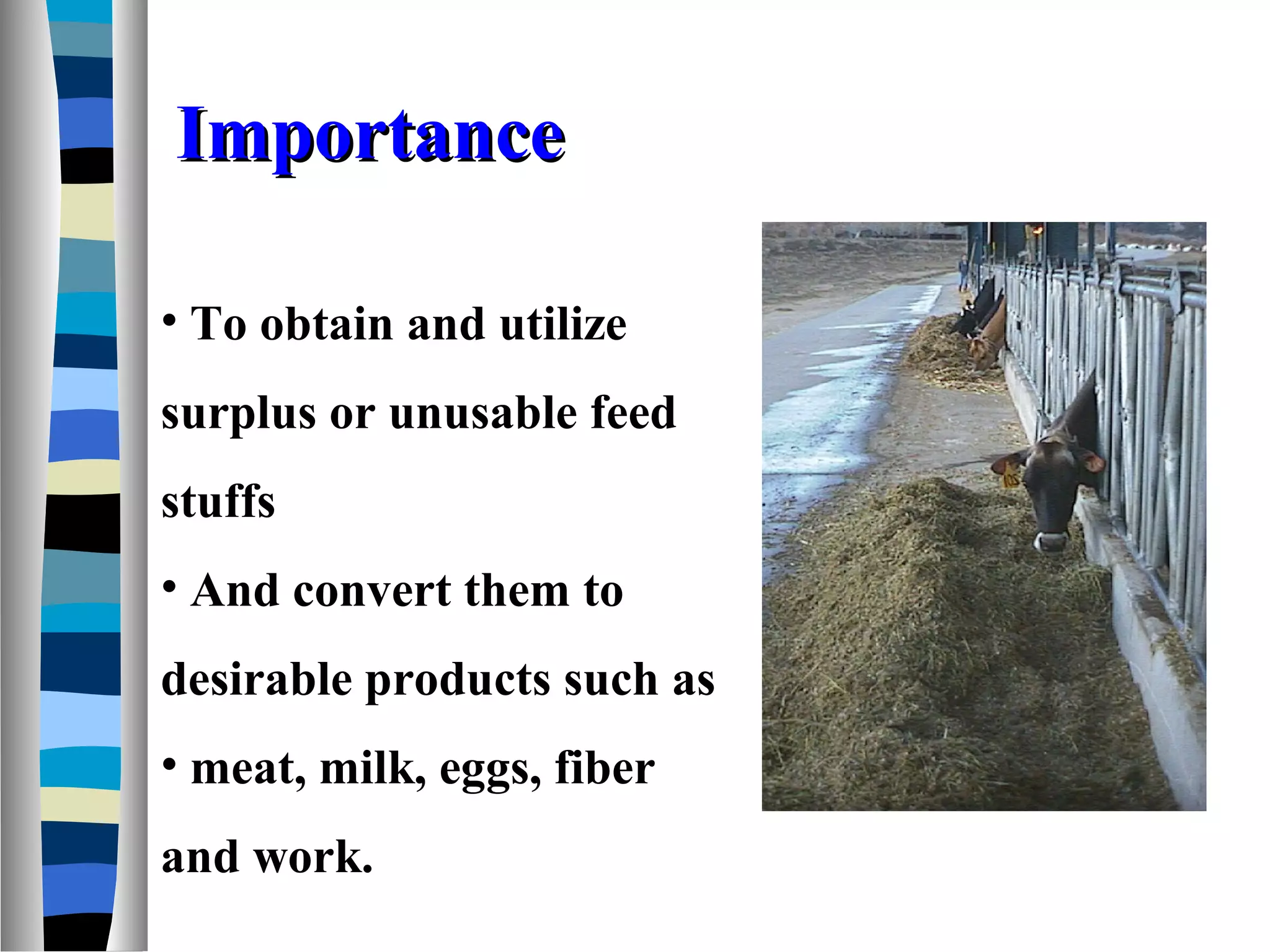
• To obtain and utilize
surplus or unusable feed
stuffs
• And convert them to
desirable products such as
• meat, milk, eggs, fiber
and work.
ImportanceImportance
What is a Nutrient?What is a Nutrient?
A single class of food or group of
like foods that aids in the support
of life and makes it possible for
animals to grow or provide energy
for physiological processes.
Digestible NutrientDigestible Nutrient
The portion of the nutrient which
may be broken down (digested) and
absorbed and used by the body.
The Six Nutrients NeededThe Six Nutrients Needed
• Protein
• Carbohydrates
• Fats
• Minerals
• Vitamins
• Water
ProteinsProteins
 Needed for growth and repair
 Helps form muscles, internal organs, skin,
hair,wool, feathers, hoofs and horns
 Contain carbon, hydrogen, oxygen and
nitrogen
Examples of ProteinsExamples of Proteins
1. Meat and Bone
Meal
2. Fish Meal
3. Soybean Meal
4. Cottonseed Meal
5. Dried Skim Milk
6. Amino Acids
CarbohydrateCarbohydrate
ss
• Furnish energy for body functions, growth
and reproduction
• The largest part of the animals food supply
and usually the fibrous part of the diet
• Include sugars, starch and cellulose
•Are made of carbon, oxygen and hydrogen
FatsFats
• Furnish a concentrated source of energy, up to
2.25 times as much energy as carbohydrates do
• Form cholesterol, steroids and other body
compounds
• Found in every cell in the body
• Affect the condition of skin and hair
• Are made of carbon, oxygen and hydrogen, but
contain much larger proportions of carbon and
hydrogen than carbohydrates do
• They also provide energy reserves, protection for
vital organs, and they insulate the body
MineralsMinerals
 Primarily found in bones and teeth
 Important in blood for the carrying of
oxygen
 Regulates heartbeat with potassium,
sodium and calcium
Major MineralsMajor Minerals
 The major minerals are
 calcium, phosphorus, sodium, chlorine,
magnesium, and potassium.
 They are required at comparatively high
levels described as per cent of diet or
grams per day.
Minor MineralsMinor Minerals
 They are required only in very small
amounts.
 Some minerals fed in excess amounts
may cause a deficiency in others
 Iron, Zinc, Copper, Manganese, Cobalt,
Iodine, Molybdenum, Selenium, Fluorine
• Are only needed in small amounts
• Are essential for life and health
• Provide a defense against disease,
promote growth and reproduction
• Contribute to the general health of
the animal
•Vit. A, B, C, D, K, E etc
VitaminsVitamins
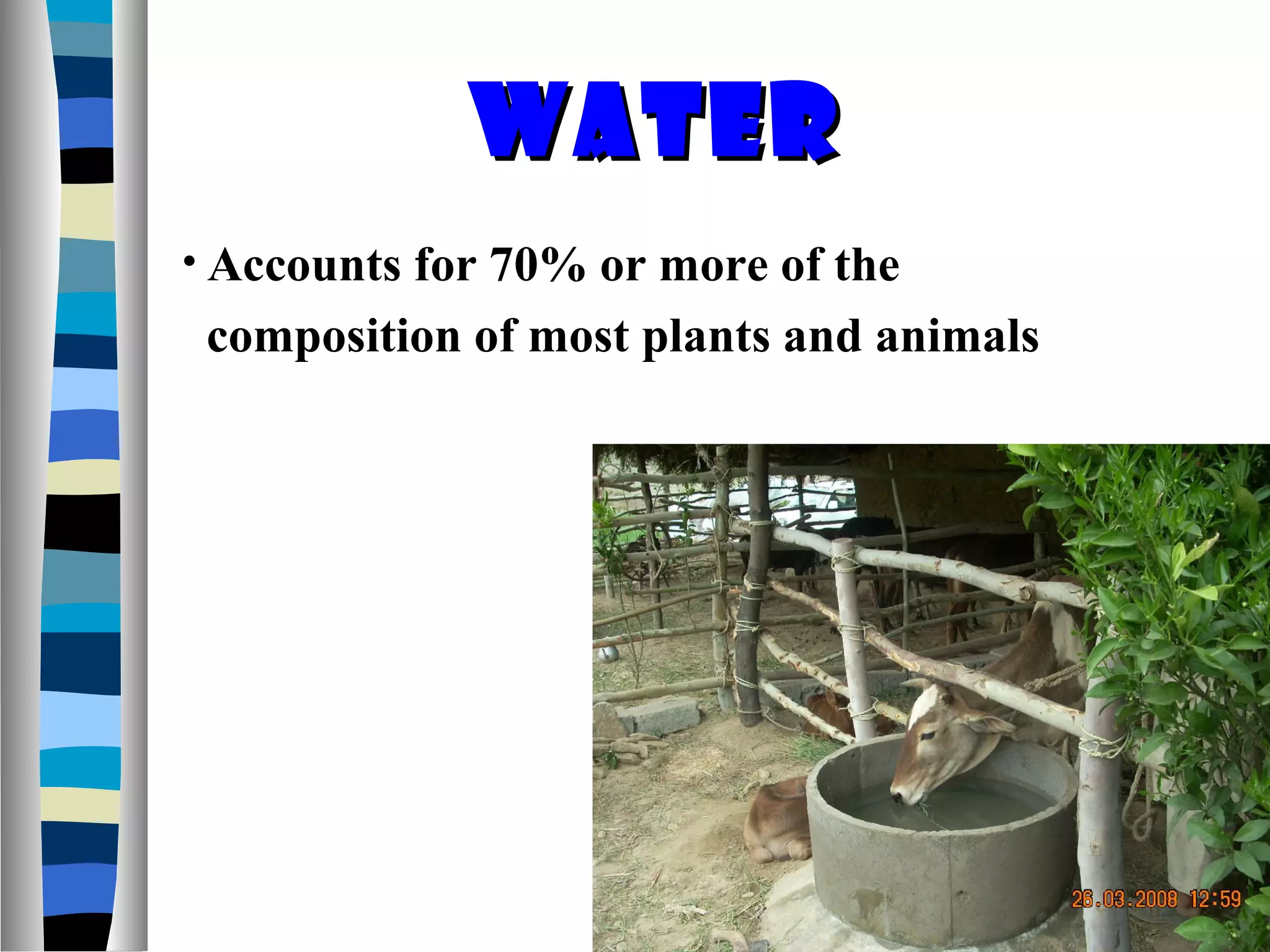
• Accounts for 70% or more of the
composition of most plants and animals
WATERWATER
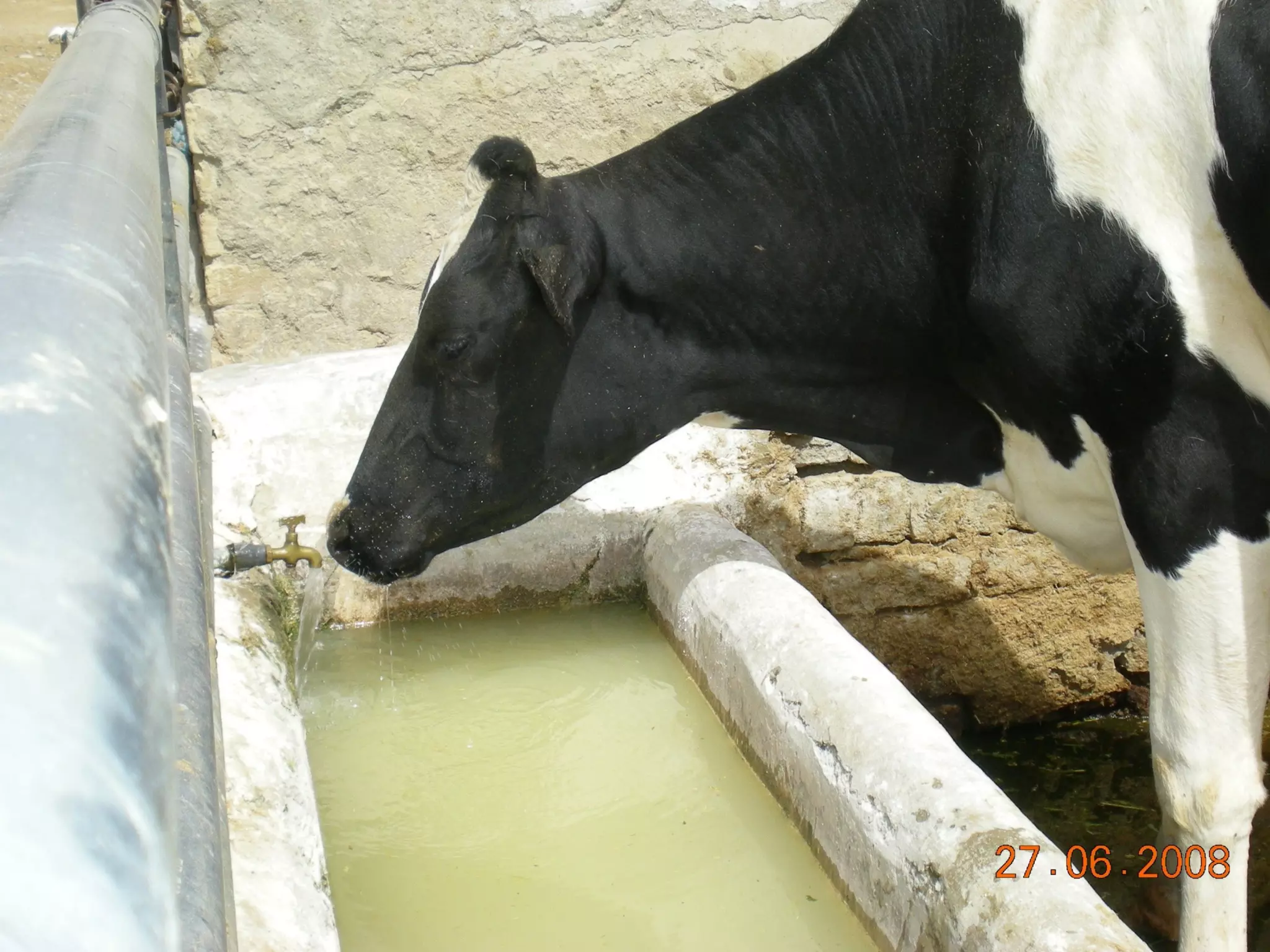
How much do animals drink per day?How much do animals drink per day?
 Beef cattle: 7-12 gallons per head
 Dairy cattle: 10-16 gallons per head
 Horses: 8-12 gallons
 Swine: 3-5 gallons
 Sheep and goats: 1-4 gallons
 Chickens: 8-10 gallons per 100 birds
 Turkeys: 10-15 gallons per 100 birds
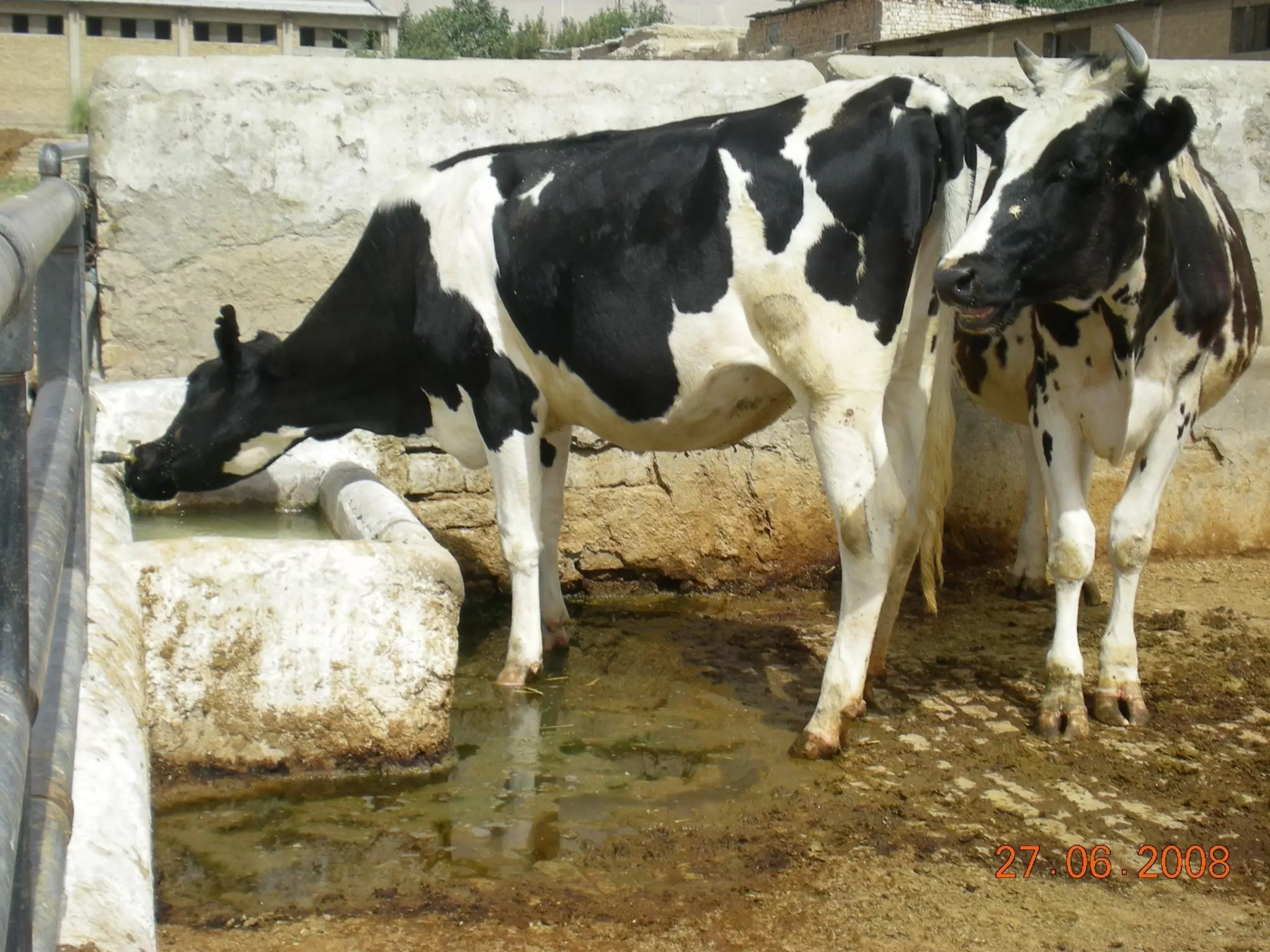
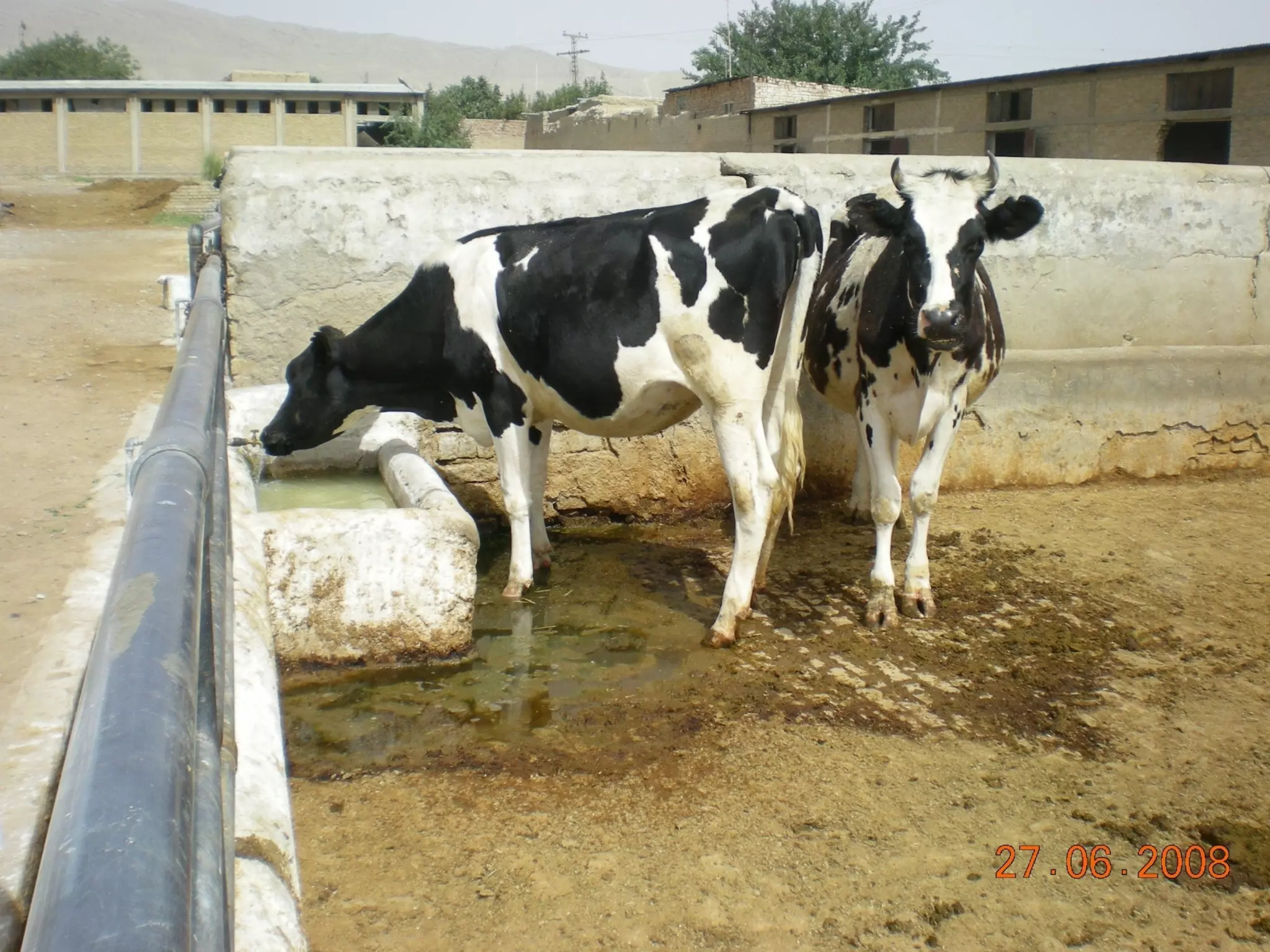
Factors for ControlFactors for Control
 Water Quality
– Salinity, acidity, pollution, and algae growth
 Environmental Factors
– Air temperature and feed quality
 Animal Factors
– Breed differences, age, and condition of stock
Feed Resources
Crop
Residues
Fodders
Feed
Additives
Grazing
Areas
Grains/
Oilseeds
By-
Products
LIVESTOCK
FEED
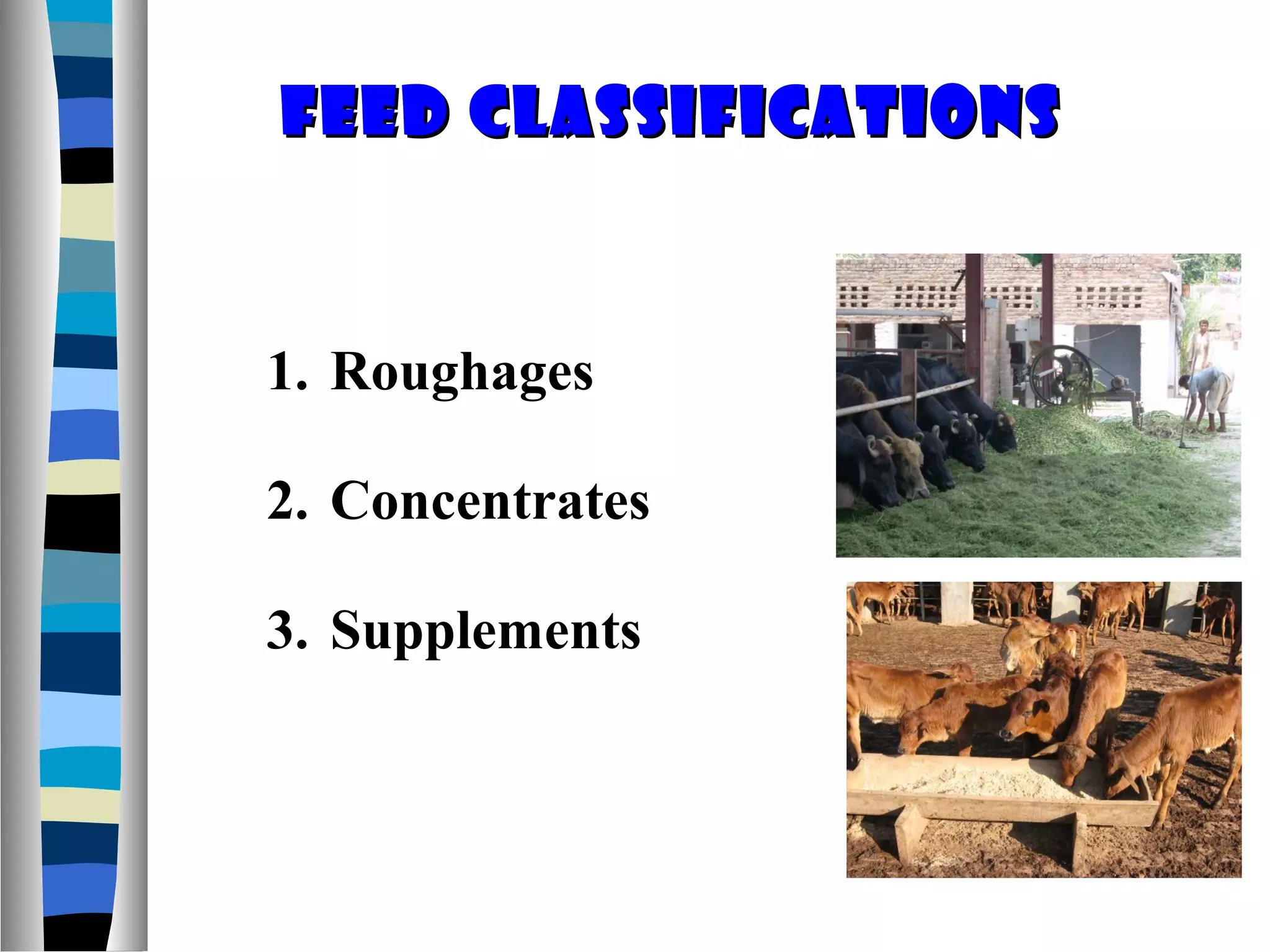
FEED CLASSIFICATIONSFEED CLASSIFICATIONS
1. Roughages
2. Concentrates
3. Supplements
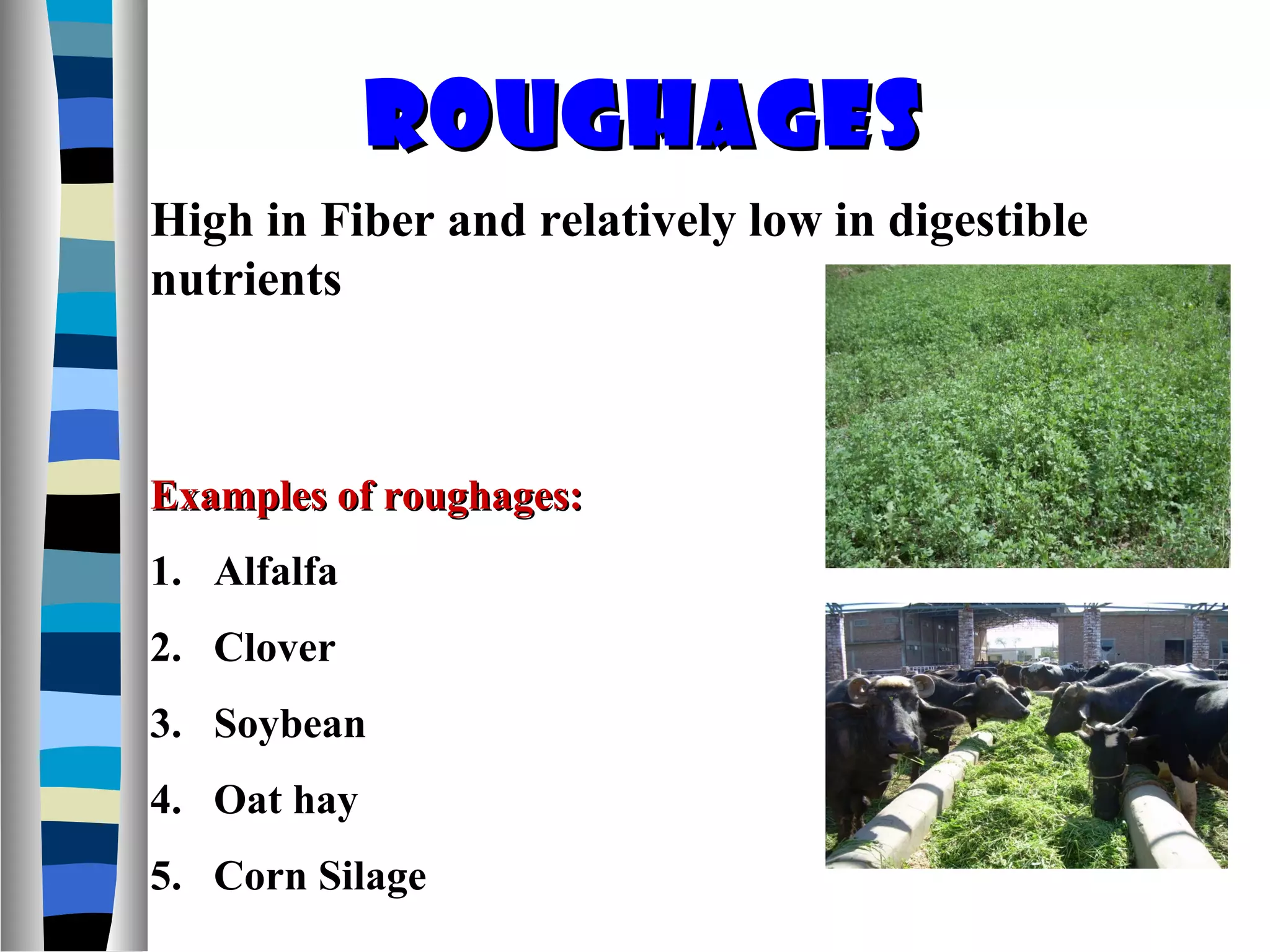
ROUGHAGESROUGHAGES
High in Fiber and relatively low in digestible
nutrients
Examples of roughages:Examples of roughages:
1. Alfalfa
2. Clover
3. Soybean
4. Oat hay
5. Corn Silage
ConcentratesConcentrates
Are low in fiber and high in
digestible nutrients
Examples of concentrates:
1. Corn
2. Cottonseed
3. Barley
4. Oats
5. Sorghum
SupplementsSupplements
• Supplements are extras that supply the body with
additional nutrients.
• Some of the supplements are minerals salt, copper,
iodine and iron
• Vitamin A and D are also very important to
ruminant animals
Salt Copper Iron
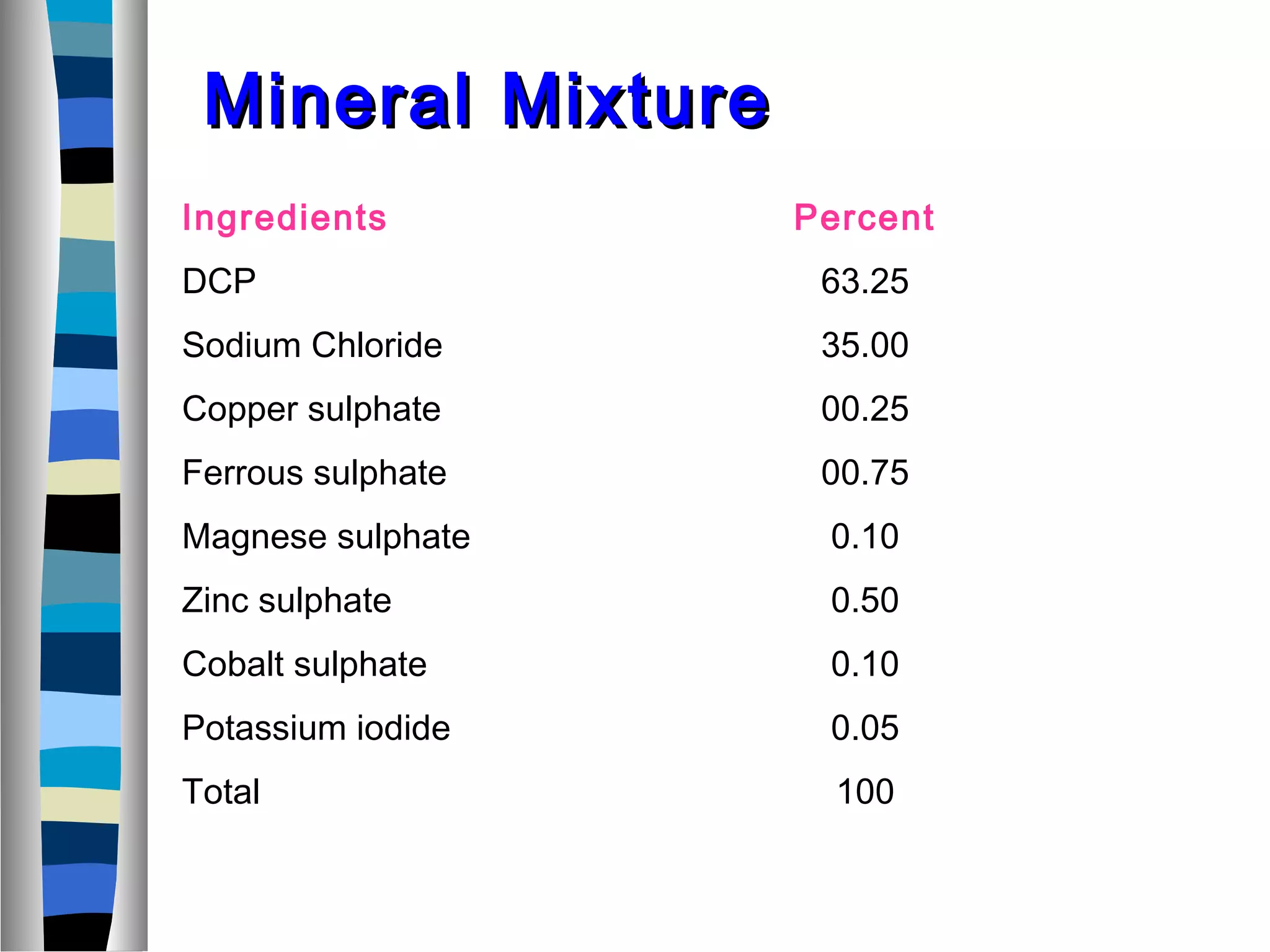
Mineral MixtureMineral Mixture
Ingredients Percent
DCP 63.25
Sodium Chloride 35.00
Copper sulphate 00.25
Ferrous sulphate 00.75
Magnese sulphate 0.10
Zinc sulphate 0.50
Cobalt sulphate 0.10
Potassium iodide 0.05
Total 100
Feed Resources
Crop
Residue
44%
Conc.
3%
Fodder
15%
Grazing
38%
0
2
4
6
8
10
12
14
16
milliontons
DM C.Protein TDN
Feed Balance
Available Demand
Feed Availability & Demand in PakistanFeed Availability & Demand in Pakistan
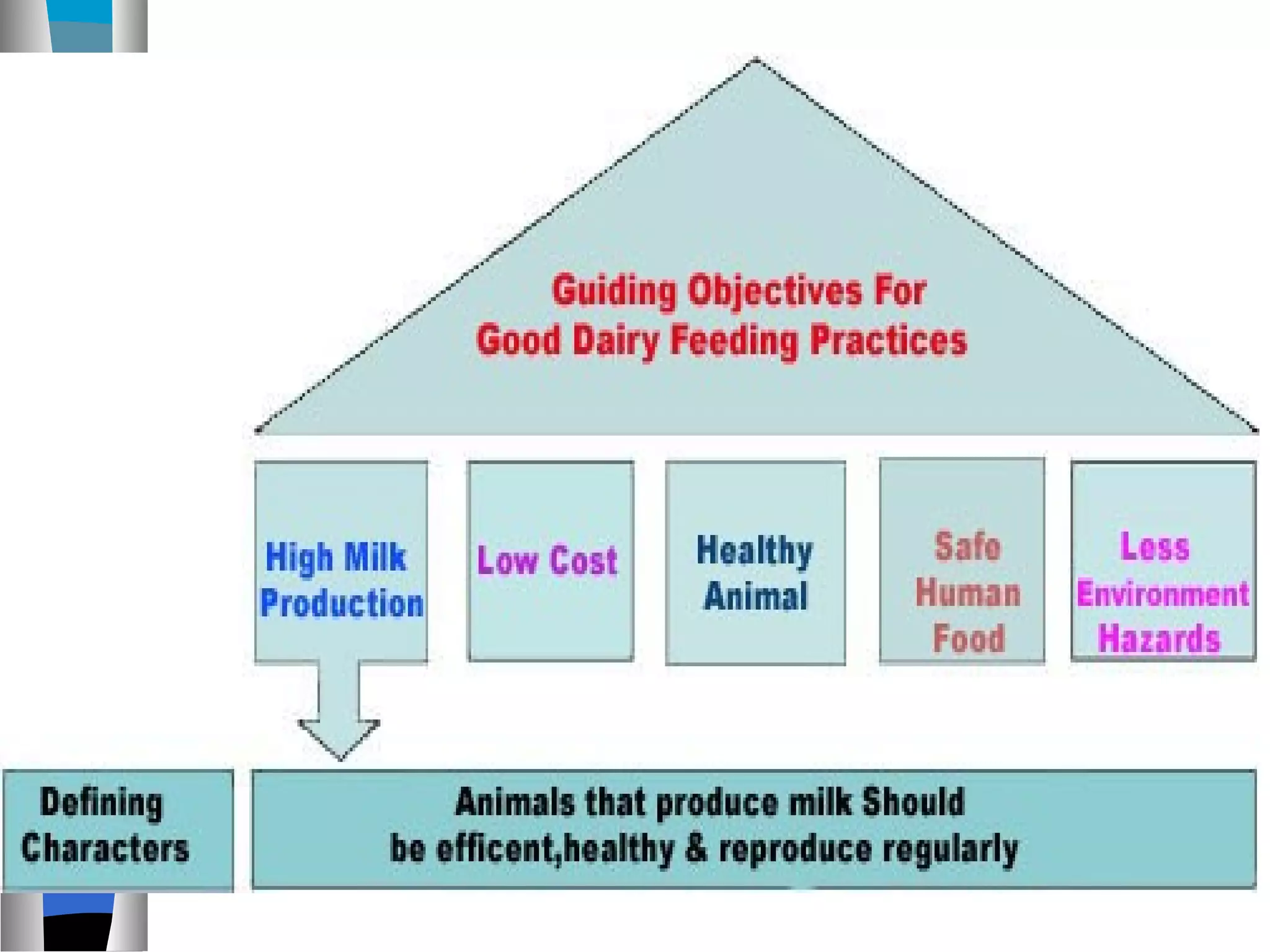
Feeding ManagementFeeding Management
An Art that need to know;
 Requirements of the animal according to milk yield
& lactation stages
 Nutrient composition of available feeds
&
 How to combine different feeds to match the
animal requirements
Should be
 Balanced approach
 Cost effective
 Sustainable
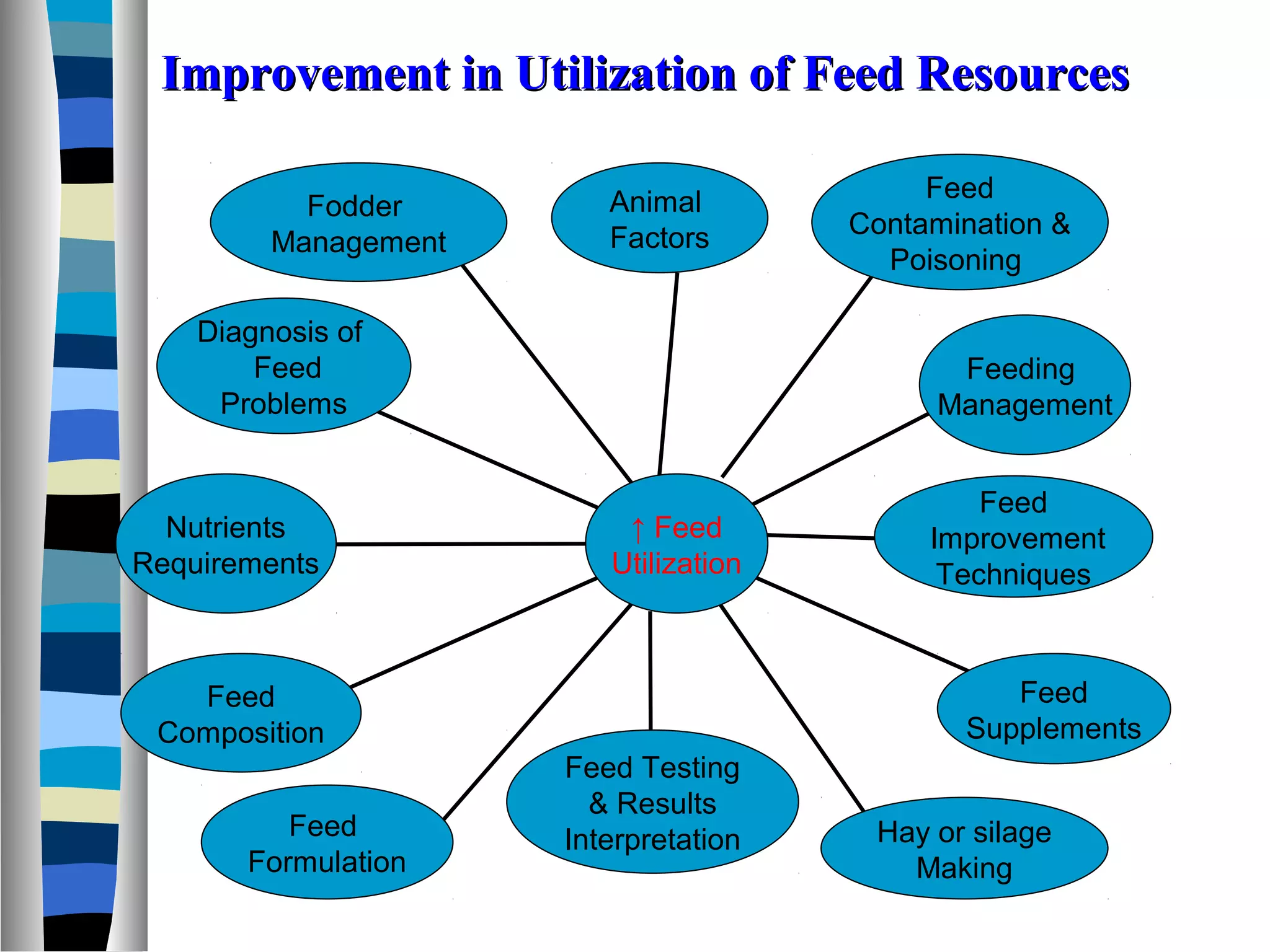
Improvement in Utilization of Feed ResourcesImprovement in Utilization of Feed Resources
Fodder
Management
Diagnosis of
Feed
Problems
Nutrients
Requirements
Feed
Composition
Feed
Formulation
Feed Testing
& Results
Interpretation Hay or silage
Making
Feed
Supplements
Feed
Improvement
Techniques
Feeding
Management
Feed
Contamination &
Poisoning
Animal
Factors
↑ Feed
Utilization
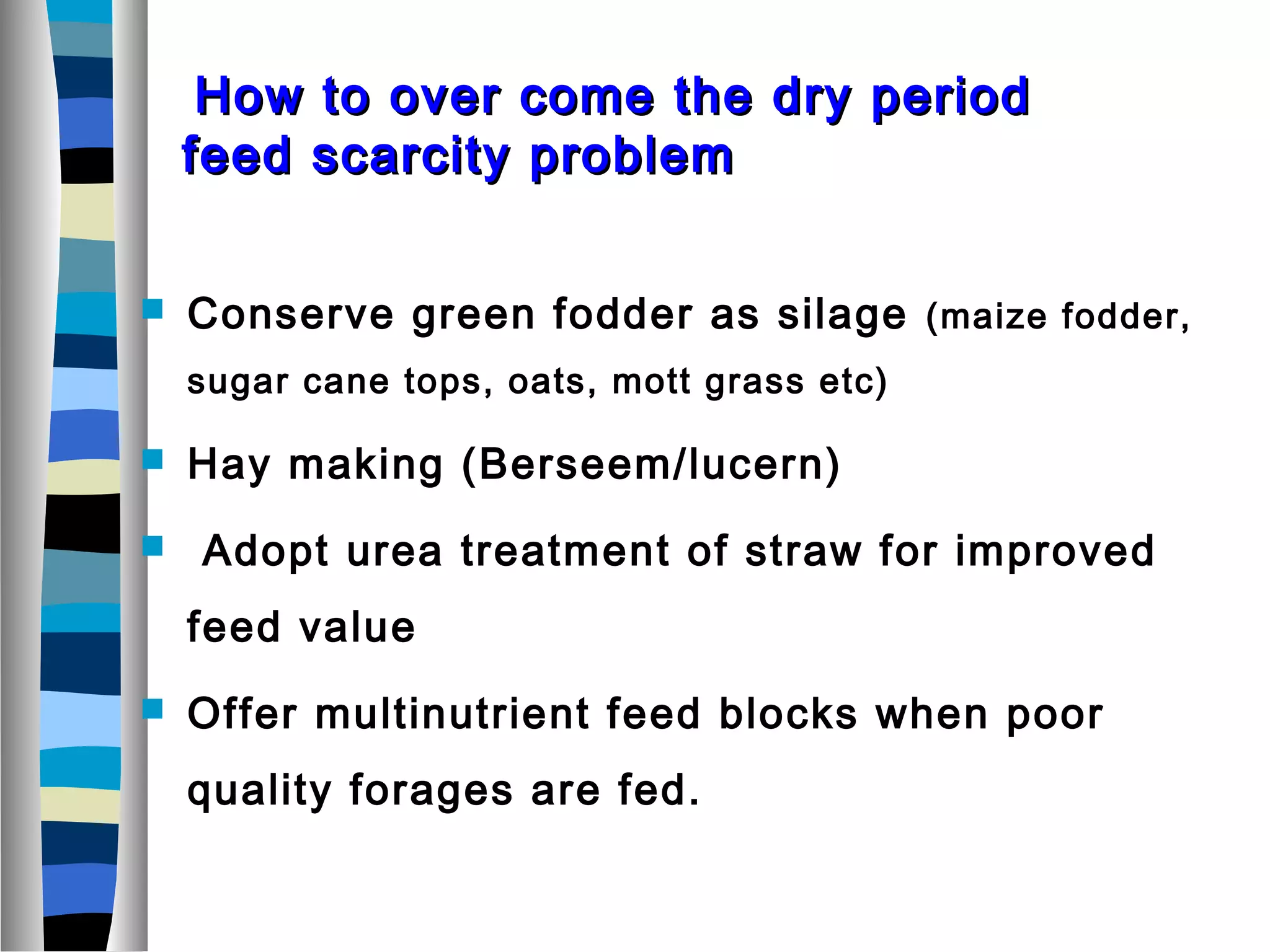
How to over come the dry periodHow to over come the dry period
feed scarcity problemfeed scarcity problem
 Conserve green fodder as silage (maize fodder,
sugar cane tops, oats, mott grass etc)
 Hay making (Berseem/lucern)
 Adopt urea treatment of straw for improved
feed value
 Offer multinutrient feed blocks when poor
quality forages are fed.
Silage Making
Molasses-urea Blocks are suitable with
poor quality forages during dry period
Molasses-Urea Blocks can be prepared onMolasses-Urea Blocks can be prepared on
farmfarm
Feeding ruminant animals atFeeding ruminant animals at
different life stagesdifferent life stages
Start from Pregnancy to End of Lactation Period
(Peak, mid, late lactation)
Dairy NutritionDairy Nutrition
 Nutrition is important
in order to be
profitable in the dairy
industry from growth
of the calves through
milk production in
lactating cows.
Stages of A Dairy CowStages of A Dairy Cow
 Calf
 Heifer
 Dry Cow
 Close-up Cow
 Lactating Cow
Digestive systemDigestive system
Calf NutritionCalf Nutrition
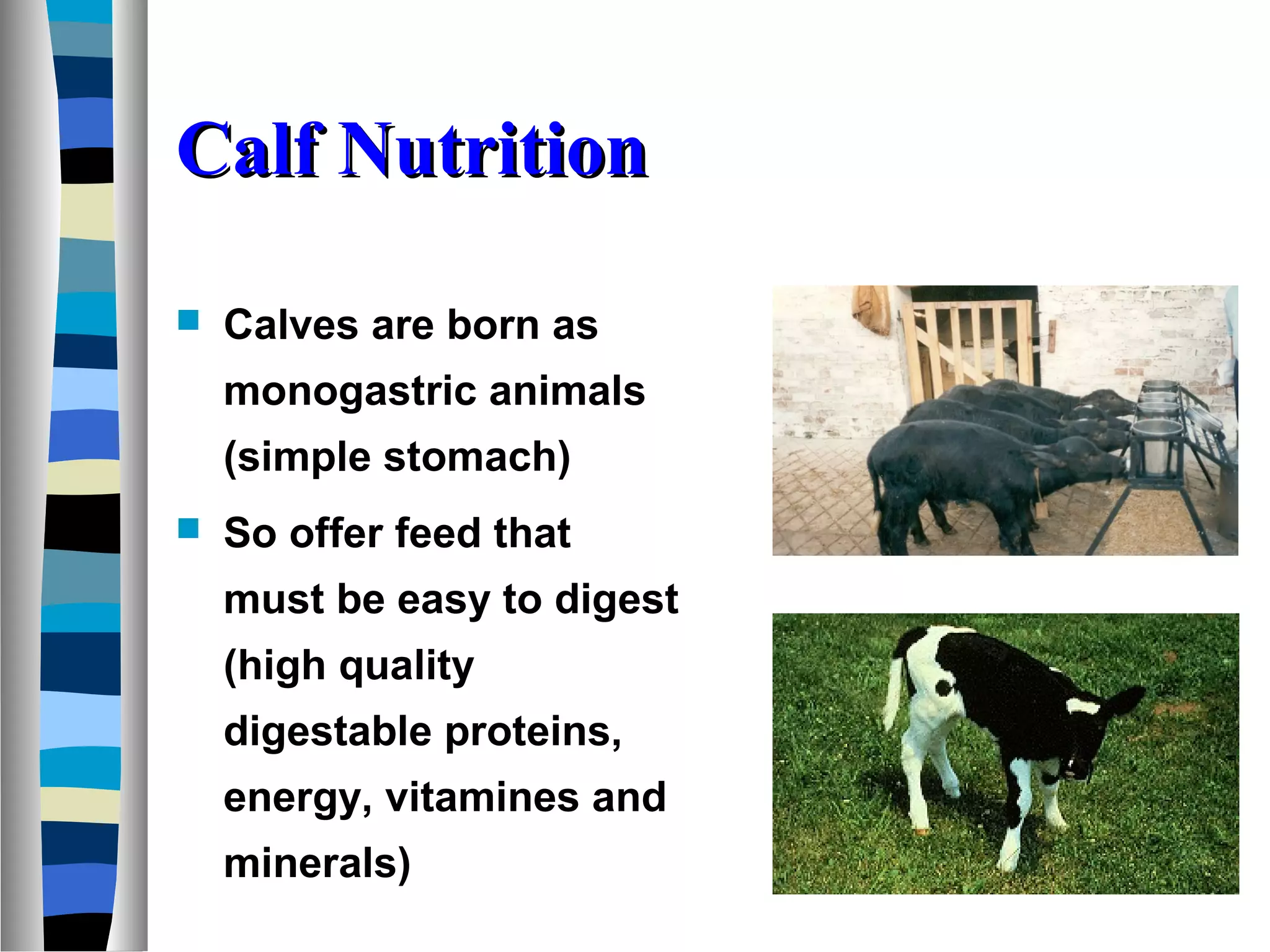
 Calves are born as
monogastric animals
(simple stomach)
 So offer feed that
must be easy to digest
(high quality
digestable proteins,
energy, vitamines and
minerals)
Calf NutritionCalf Nutrition
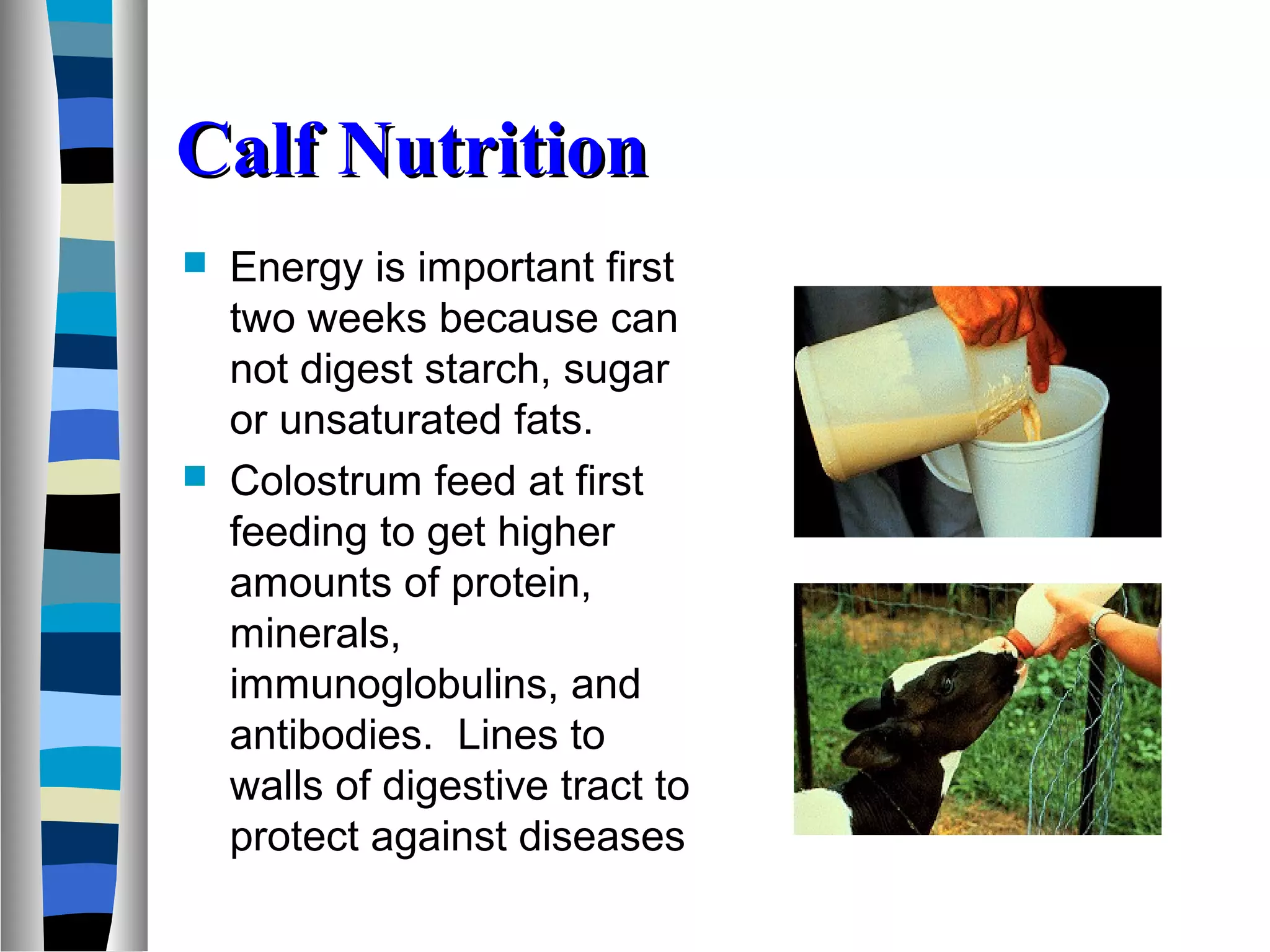
 Energy is important first
two weeks because can
not digest starch, sugar
or unsaturated fats.
 Colostrum feed at first
feeding to get higher
amounts of protein,
minerals,
immunoglobulins, and
antibodies. Lines to
walls of digestive tract to
protect against diseases
Calf NutritionCalf Nutrition
 Grains (Dry Matter)
stimulate production
of VFAs in rumen
(acetic, propionic,
butyric)
 Digestive system
develops from 2
weeks until 4-6
months and calf
evolves into
ruminant
Heifer NutritionHeifer Nutrition
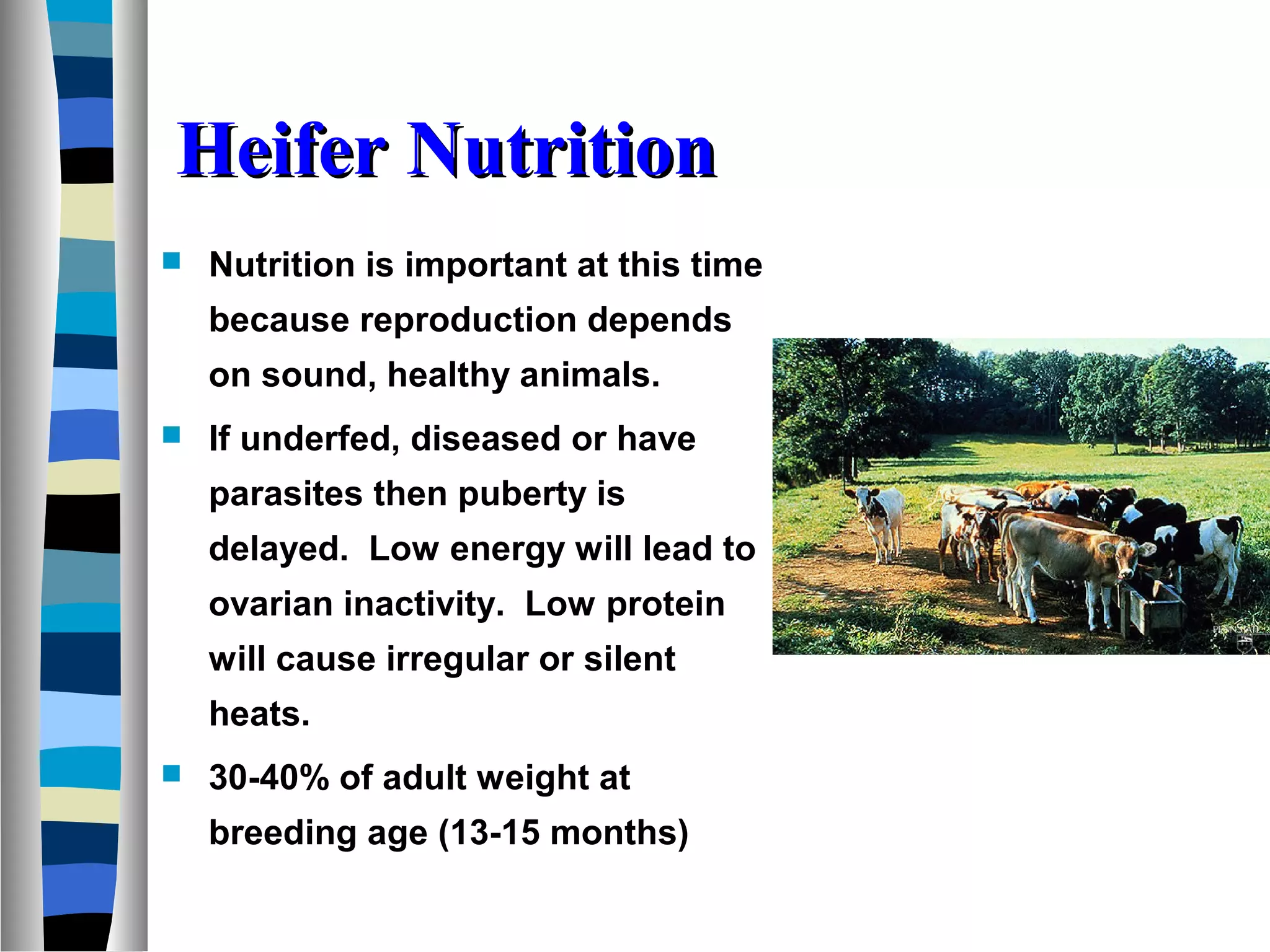
 Nutrition is important at this time
because reproduction depends
on sound, healthy animals.
 If underfed, diseased or have
parasites then puberty is
delayed. Low energy will lead to
ovarian inactivity. Low protein
will cause irregular or silent
heats.
 30-40% of adult weight at
breeding age (13-15 months)
Heifer NutritionHeifer Nutrition
 Pasture is a good choice of
forage (high energy and less
expensive)
 3 lbs concentrate/ day
 12% crude protein, 15% crude
fiber and .41% Calcium at 6
months, .29% Calcium at 12
months
 Final 3 months of pregnancy
heifer will need extra nutrients for
developing calf
Dry Cow NutritionDry Cow Nutrition
 Low energy diet (less expensive)
 Pasture often used
 Important for successful lactation to follow
 Restore body energy and nutrient reserves
 Want to maintain 3+ to 4- body condition score
Feeding in PregnancyFeeding in Pregnancy
(Last 2 months)(Last 2 months)
For;
 Rapid growing foetus
 Develop body reserves for use in
subsequent lactation
How;
 Give rest if in milk (forced drying)
 Feed concentrate 2 kg/day + good quality
fodder, restrict straw
Close-up cowsClose-up cows
 Move cows and heifers to
close-up pen at 2 weeks
before calving
 High dry matter intake to
gain nutrients for cow and
calf to reduce metabolic
problems
Close-up CowsClose-up Cows
 Start grain feeding
 Increase CP to 15%
 Limit added fat 100 gm/d
 Low energy with adequate levels of
minerals vitamines and protein and
watch forage levels (<50% DM)
 Decrease metabolic problems and
maintain condition while not
lactating
Decrease Calcium to begin to use
stored Ca to prepare for lactation
changes
 Most critical period
 Period of peak milk yield
 Higher the peak yield more will be the milk
yield throughout lactation until drying off.
 Good quality forage
 Maintain healthy level of fiber
 Avoid high starch level
 Undegradeable protein & digestible fiber
Early lactation (First 60 days)Early lactation (First 60 days)
Lactating CowsLactating Cows
 Highest energy diet
(most expensive)
 Supports not only
growth, reproduction
and maintenance but
also production
 Free feed at all times
to increase and
support production
Consequences of Feed Restriction in earlyConsequences of Feed Restriction in early
lactation as a traditional practicelactation as a traditional practice
 Low peak milk production & total lactation yield
 Drastic body weight losses in high potential cows
leading to;
 Metabolic diseases ( milk fever, acetonaemia, red
water disease etc)
 Delayed estrus resumption
 Long dry period
SuggestionsSuggestions
 Select & mix different ingredients on basis of nutritional
profile for making concentrate mixture (change from
cakes to meals, e.g. SBM)
 Always add minerals especially take care of Calcium &
Phosphorus ratio in the rations
 Plan your feeding program to raise the peak milk yield
 Never restrict feed & water soon after parturition
Suggestions
 Avoid large fluctuation in green fodder
supply through hay and silage making
 Make best use of local feed resources
with relevant supplementation &
conservation
 Improve feeding value of straw
through urea treatment for fodder
scarcity period
 Use feed additives to boost milk
production.
21 animal nutrition and feeds

21 animal nutrition and feeds

  • 1.
  • 2.
    What is Nutrition! Nutritionis the science of dealing with the utilization of food by the body processes which transforms food into body tissues and energy.
  • 3.
    UtilizationsUtilizations Nutrients are utilizedby the animals for:  Maintenance  Growth  Production  Reproduction  Health control
  • 4.
    • To obtainand utilize surplus or unusable feed stuffs • And convert them to desirable products such as • meat, milk, eggs, fiber and work. ImportanceImportance
  • 5.
    What is aNutrient?What is a Nutrient? A single class of food or group of like foods that aids in the support of life and makes it possible for animals to grow or provide energy for physiological processes.
  • 6.
    Digestible NutrientDigestible Nutrient Theportion of the nutrient which may be broken down (digested) and absorbed and used by the body.
  • 7.
    The Six NutrientsNeededThe Six Nutrients Needed • Protein • Carbohydrates • Fats • Minerals • Vitamins • Water
  • 8.
    ProteinsProteins  Needed forgrowth and repair  Helps form muscles, internal organs, skin, hair,wool, feathers, hoofs and horns  Contain carbon, hydrogen, oxygen and nitrogen
  • 9.
    Examples of ProteinsExamplesof Proteins 1. Meat and Bone Meal 2. Fish Meal 3. Soybean Meal 4. Cottonseed Meal 5. Dried Skim Milk 6. Amino Acids
  • 10.
    CarbohydrateCarbohydrate ss • Furnish energyfor body functions, growth and reproduction • The largest part of the animals food supply and usually the fibrous part of the diet • Include sugars, starch and cellulose •Are made of carbon, oxygen and hydrogen
  • 11.
    FatsFats • Furnish aconcentrated source of energy, up to 2.25 times as much energy as carbohydrates do • Form cholesterol, steroids and other body compounds • Found in every cell in the body • Affect the condition of skin and hair • Are made of carbon, oxygen and hydrogen, but contain much larger proportions of carbon and hydrogen than carbohydrates do • They also provide energy reserves, protection for vital organs, and they insulate the body
  • 12.
    MineralsMinerals  Primarily foundin bones and teeth  Important in blood for the carrying of oxygen  Regulates heartbeat with potassium, sodium and calcium
  • 13.
    Major MineralsMajor Minerals The major minerals are  calcium, phosphorus, sodium, chlorine, magnesium, and potassium.  They are required at comparatively high levels described as per cent of diet or grams per day.
  • 14.
    Minor MineralsMinor Minerals They are required only in very small amounts.  Some minerals fed in excess amounts may cause a deficiency in others  Iron, Zinc, Copper, Manganese, Cobalt, Iodine, Molybdenum, Selenium, Fluorine
  • 15.
    • Are onlyneeded in small amounts • Are essential for life and health • Provide a defense against disease, promote growth and reproduction • Contribute to the general health of the animal •Vit. A, B, C, D, K, E etc VitaminsVitamins
  • 16.
    • Accounts for70% or more of the composition of most plants and animals WATERWATER
  • 23.
    How much doanimals drink per day?How much do animals drink per day?  Beef cattle: 7-12 gallons per head  Dairy cattle: 10-16 gallons per head  Horses: 8-12 gallons  Swine: 3-5 gallons  Sheep and goats: 1-4 gallons  Chickens: 8-10 gallons per 100 birds  Turkeys: 10-15 gallons per 100 birds
  • 24.
    Factors for ControlFactorsfor Control  Water Quality – Salinity, acidity, pollution, and algae growth  Environmental Factors – Air temperature and feed quality  Animal Factors – Breed differences, age, and condition of stock
  • 25.
  • 26.
    FEED CLASSIFICATIONSFEED CLASSIFICATIONS 1.Roughages 2. Concentrates 3. Supplements
  • 27.
    ROUGHAGESROUGHAGES High in Fiberand relatively low in digestible nutrients Examples of roughages:Examples of roughages: 1. Alfalfa 2. Clover 3. Soybean 4. Oat hay 5. Corn Silage
  • 28.
    ConcentratesConcentrates Are low infiber and high in digestible nutrients Examples of concentrates: 1. Corn 2. Cottonseed 3. Barley 4. Oats 5. Sorghum
  • 29.
    SupplementsSupplements • Supplements areextras that supply the body with additional nutrients. • Some of the supplements are minerals salt, copper, iodine and iron • Vitamin A and D are also very important to ruminant animals Salt Copper Iron
  • 30.
    Mineral MixtureMineral Mixture IngredientsPercent DCP 63.25 Sodium Chloride 35.00 Copper sulphate 00.25 Ferrous sulphate 00.75 Magnese sulphate 0.10 Zinc sulphate 0.50 Cobalt sulphate 0.10 Potassium iodide 0.05 Total 100
  • 31.
    Feed Resources Crop Residue 44% Conc. 3% Fodder 15% Grazing 38% 0 2 4 6 8 10 12 14 16 milliontons DM C.ProteinTDN Feed Balance Available Demand Feed Availability & Demand in PakistanFeed Availability & Demand in Pakistan
  • 32.
    Feeding ManagementFeeding Management AnArt that need to know;  Requirements of the animal according to milk yield & lactation stages  Nutrient composition of available feeds &  How to combine different feeds to match the animal requirements Should be  Balanced approach  Cost effective  Sustainable
  • 33.
    Improvement in Utilizationof Feed ResourcesImprovement in Utilization of Feed Resources Fodder Management Diagnosis of Feed Problems Nutrients Requirements Feed Composition Feed Formulation Feed Testing & Results Interpretation Hay or silage Making Feed Supplements Feed Improvement Techniques Feeding Management Feed Contamination & Poisoning Animal Factors ↑ Feed Utilization
  • 34.
    How to overcome the dry periodHow to over come the dry period feed scarcity problemfeed scarcity problem  Conserve green fodder as silage (maize fodder, sugar cane tops, oats, mott grass etc)  Hay making (Berseem/lucern)  Adopt urea treatment of straw for improved feed value  Offer multinutrient feed blocks when poor quality forages are fed.
  • 35.
  • 38.
    Molasses-urea Blocks aresuitable with poor quality forages during dry period
  • 39.
    Molasses-Urea Blocks canbe prepared onMolasses-Urea Blocks can be prepared on farmfarm
  • 41.
    Feeding ruminant animalsatFeeding ruminant animals at different life stagesdifferent life stages Start from Pregnancy to End of Lactation Period (Peak, mid, late lactation)
  • 42.
    Dairy NutritionDairy Nutrition Nutrition is important in order to be profitable in the dairy industry from growth of the calves through milk production in lactating cows.
  • 43.
    Stages of ADairy CowStages of A Dairy Cow  Calf  Heifer  Dry Cow  Close-up Cow  Lactating Cow
  • 44.
  • 45.
    Calf NutritionCalf Nutrition Calves are born as monogastric animals (simple stomach)  So offer feed that must be easy to digest (high quality digestable proteins, energy, vitamines and minerals)
  • 46.
    Calf NutritionCalf Nutrition Energy is important first two weeks because can not digest starch, sugar or unsaturated fats.  Colostrum feed at first feeding to get higher amounts of protein, minerals, immunoglobulins, and antibodies. Lines to walls of digestive tract to protect against diseases
  • 47.
    Calf NutritionCalf Nutrition Grains (Dry Matter) stimulate production of VFAs in rumen (acetic, propionic, butyric)  Digestive system develops from 2 weeks until 4-6 months and calf evolves into ruminant
  • 48.
    Heifer NutritionHeifer Nutrition Nutrition is important at this time because reproduction depends on sound, healthy animals.  If underfed, diseased or have parasites then puberty is delayed. Low energy will lead to ovarian inactivity. Low protein will cause irregular or silent heats.  30-40% of adult weight at breeding age (13-15 months)
  • 49.
    Heifer NutritionHeifer Nutrition Pasture is a good choice of forage (high energy and less expensive)  3 lbs concentrate/ day  12% crude protein, 15% crude fiber and .41% Calcium at 6 months, .29% Calcium at 12 months  Final 3 months of pregnancy heifer will need extra nutrients for developing calf
  • 50.
    Dry Cow NutritionDryCow Nutrition  Low energy diet (less expensive)  Pasture often used  Important for successful lactation to follow  Restore body energy and nutrient reserves  Want to maintain 3+ to 4- body condition score
  • 51.
    Feeding in PregnancyFeedingin Pregnancy (Last 2 months)(Last 2 months) For;  Rapid growing foetus  Develop body reserves for use in subsequent lactation How;  Give rest if in milk (forced drying)  Feed concentrate 2 kg/day + good quality fodder, restrict straw
  • 52.
    Close-up cowsClose-up cows Move cows and heifers to close-up pen at 2 weeks before calving  High dry matter intake to gain nutrients for cow and calf to reduce metabolic problems
  • 53.
    Close-up CowsClose-up Cows Start grain feeding  Increase CP to 15%  Limit added fat 100 gm/d  Low energy with adequate levels of minerals vitamines and protein and watch forage levels (<50% DM)  Decrease metabolic problems and maintain condition while not lactating Decrease Calcium to begin to use stored Ca to prepare for lactation changes
  • 54.
     Most criticalperiod  Period of peak milk yield  Higher the peak yield more will be the milk yield throughout lactation until drying off.  Good quality forage  Maintain healthy level of fiber  Avoid high starch level  Undegradeable protein & digestible fiber Early lactation (First 60 days)Early lactation (First 60 days)
  • 55.
    Lactating CowsLactating Cows Highest energy diet (most expensive)  Supports not only growth, reproduction and maintenance but also production  Free feed at all times to increase and support production
  • 56.
    Consequences of FeedRestriction in earlyConsequences of Feed Restriction in early lactation as a traditional practicelactation as a traditional practice  Low peak milk production & total lactation yield  Drastic body weight losses in high potential cows leading to;  Metabolic diseases ( milk fever, acetonaemia, red water disease etc)  Delayed estrus resumption  Long dry period
  • 57.
    SuggestionsSuggestions  Select &mix different ingredients on basis of nutritional profile for making concentrate mixture (change from cakes to meals, e.g. SBM)  Always add minerals especially take care of Calcium & Phosphorus ratio in the rations  Plan your feeding program to raise the peak milk yield  Never restrict feed & water soon after parturition
  • 58.
    Suggestions  Avoid largefluctuation in green fodder supply through hay and silage making  Make best use of local feed resources with relevant supplementation & conservation  Improve feeding value of straw through urea treatment for fodder scarcity period  Use feed additives to boost milk production.