Feeding Standard
Dr. Pramod Kumar
Assistant Professor-cum-Jr. Scientist
Bihar Animal Sciences University
Patna,Bihar,India.
What is feeding standard
• Feedings standards are the tables showing the quantities of nutrients
to be fed to the various classes of livestock for different physiological
functions like growth, maintenance, lactation, egg production and
wool growth.
OR
• Feeding standards may be expressed in quantities of nutrients or in
dietary proportions. The nutrient requirements are generally
expressed separately for each function or an overall figure for the
combined functions. In case of dairy animal, nutrient requirements
are generally expressed for the separate body functions but in case of
poultry and pigs combined requirements of maintenance and other
body functions are given.
Objectives of Feeding Standards
• To Guide Farmers to selecting properly balanced
rations for their livestock.
• To classify different physiological functions like
growth , maintenance , lactation , egg production
and wool growth.
• Considering individual animal for preparation of
FS due to their ability to digest and utilize feed.
Nutrient requirement: A nutrient requirement is the average amount required for a
particular function,
Nutrient allowance: A nutrient allowance is greater than this by a safety margin
designed primarily to allow for variations in the requirement between individual
animals.
Albuminoid ratio: Albuminoid ratio is the ratio of digestible protein to digestible
carbohydrate used. The term was used in Wolff’s Feeding Standard.
Nutritive ratio : Nutritive ratio is the sum of the digestible carbohydrate, digestible
protein, and 2.25 × digestible fat, divided by digestible protein.
Nutritive ratio: (Digestible carbohydrate + Digestible ether extract X 2.4)
Digestible protein
Physiological Fuel Value (PFV) : Physiological Fuel Value is "available fuel values" of
the feeds, which is obtained by multiplying gross energy of the nutrients by
digestibility coefficient. Physiological Fuel Values are 4.0 kcal/g for carbohydrates, 9.0
kcal/g for fat and 4.0 kcal/g for protein.
Glossary of terms
Various units are used for feeding standards
• The energy requirements of ruminants may be stated in terms of
• Net energy (NE),
• Metabolisable energy (ME),
• Digestible energy (DE) or feed units
• Protein requirements in terms of crude protein (CP),
• Digestible crude protein (DCP)
• Metabolisable protein (MP) etc.
Classification of Feeding Standard
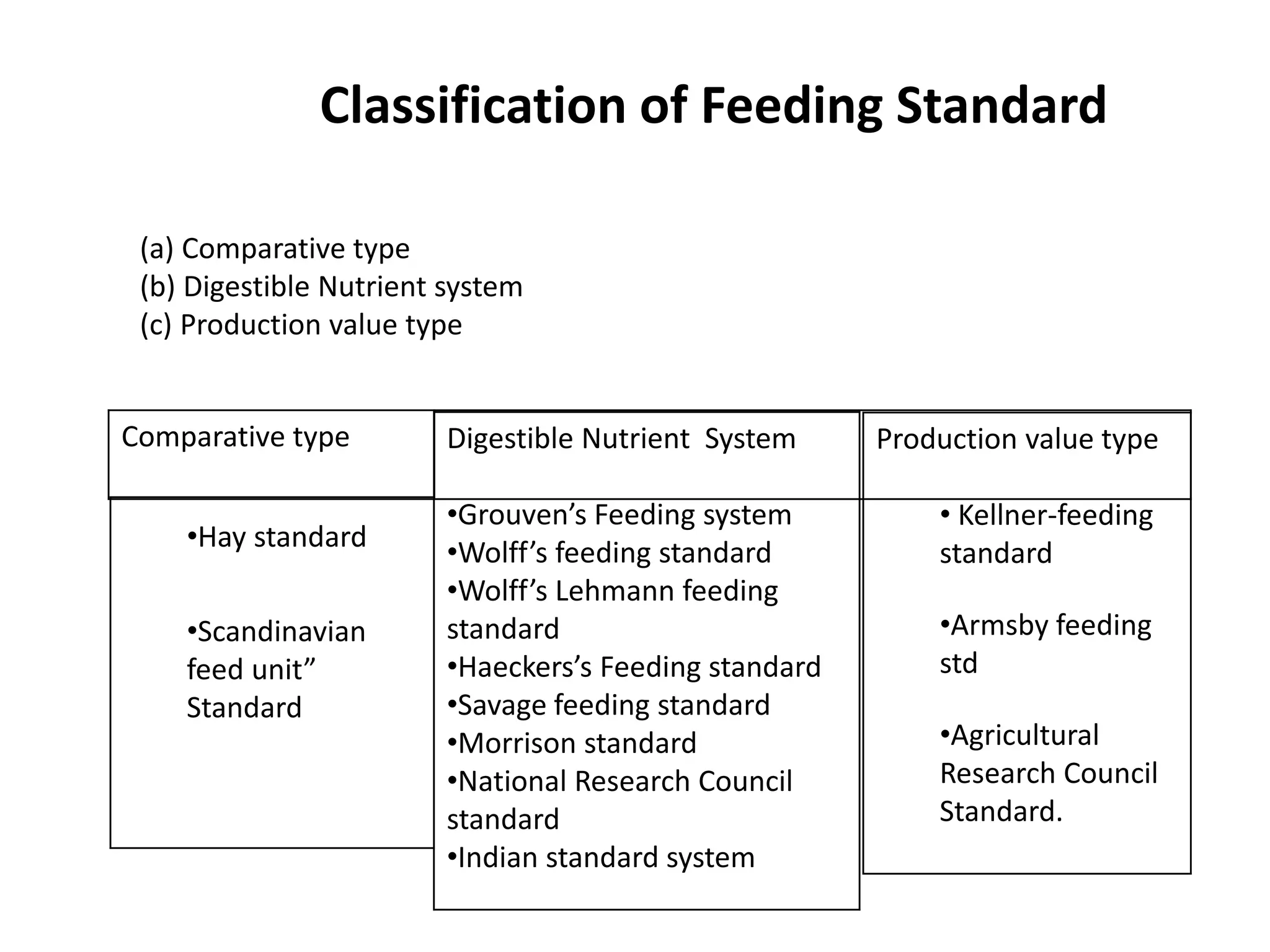
(a) Comparative type
(b) Digestible Nutrient system
(c) Production value type
Comparative type
•Hay standard
•Scandinavian
feed unit”
Standard
Digestible Nutrient System
•Grouven’s Feeding system
•Wolff’s feeding standard
•Wolff’s Lehmann feeding
standard
•Haeckers’s Feeding standard
•Savage feeding standard
•Morrison standard
•National Research Council
standard
•Indian standard system
Production value type
• Kellner-feeding
standard
•Armsby feeding
std
•Agricultural
Research Council
Standard.
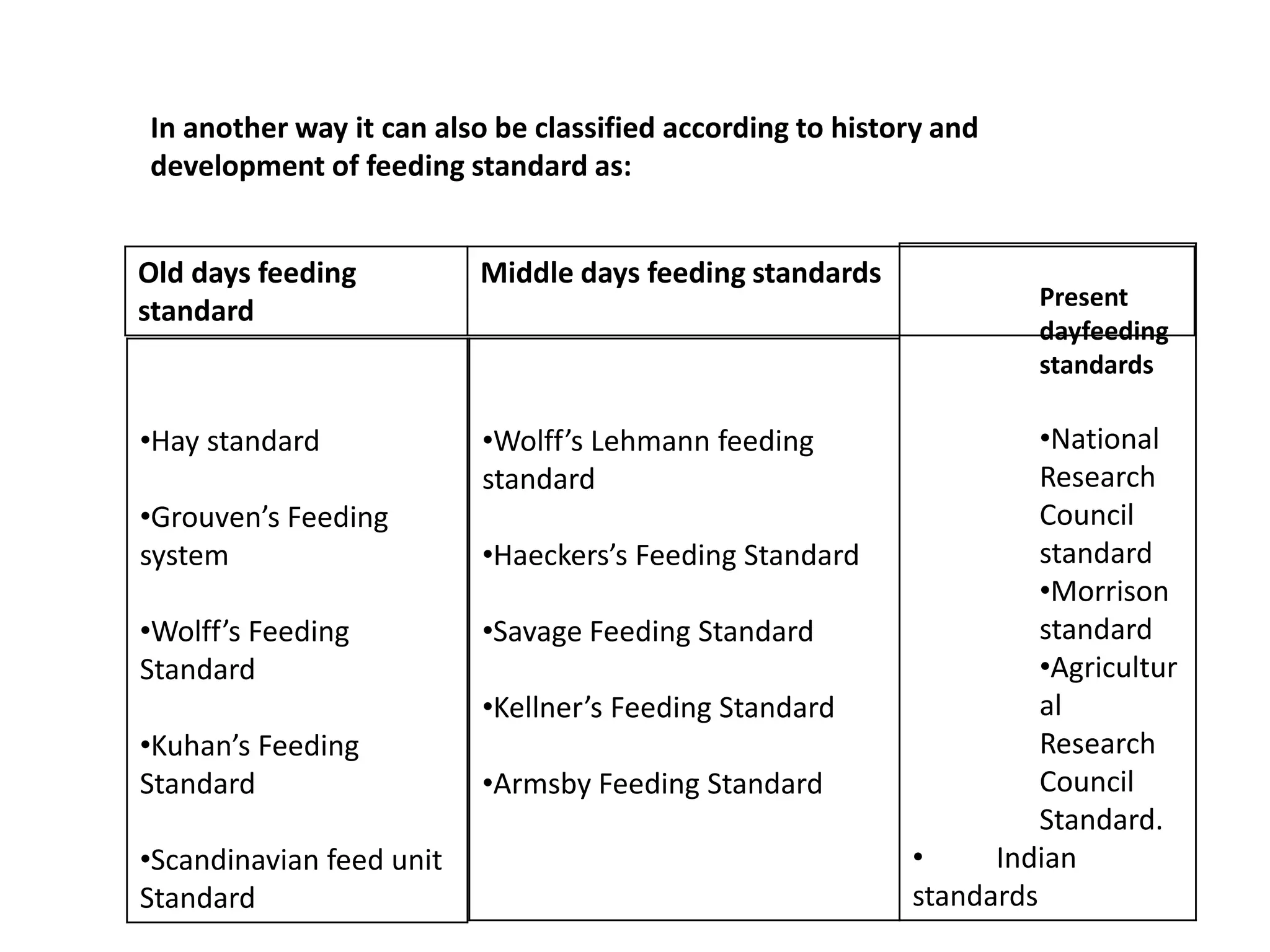
In another way it can also be classified according to history and
development of feeding standard as:
Old days feeding
standard
Middle days feeding standards
•Hay standard
•Grouven’s Feeding
system
•Wolff’s Feeding
Standard
•Kuhan’s Feeding
Standard
•Scandinavian feed unit
Standard
•Wolff’s Lehmann feeding
standard
•Haeckers’s Feeding Standard
•Savage Feeding Standard
•Kellner’s Feeding Standard
•Armsby Feeding Standard
Present
dayfeeding
standards
•National
Research
Council
standard
•Morrison
standard
•Agricultur
al
Research
Council
Standard.
• Indian
standards
COMPARATIVE TYPE FEEDING STANDARD
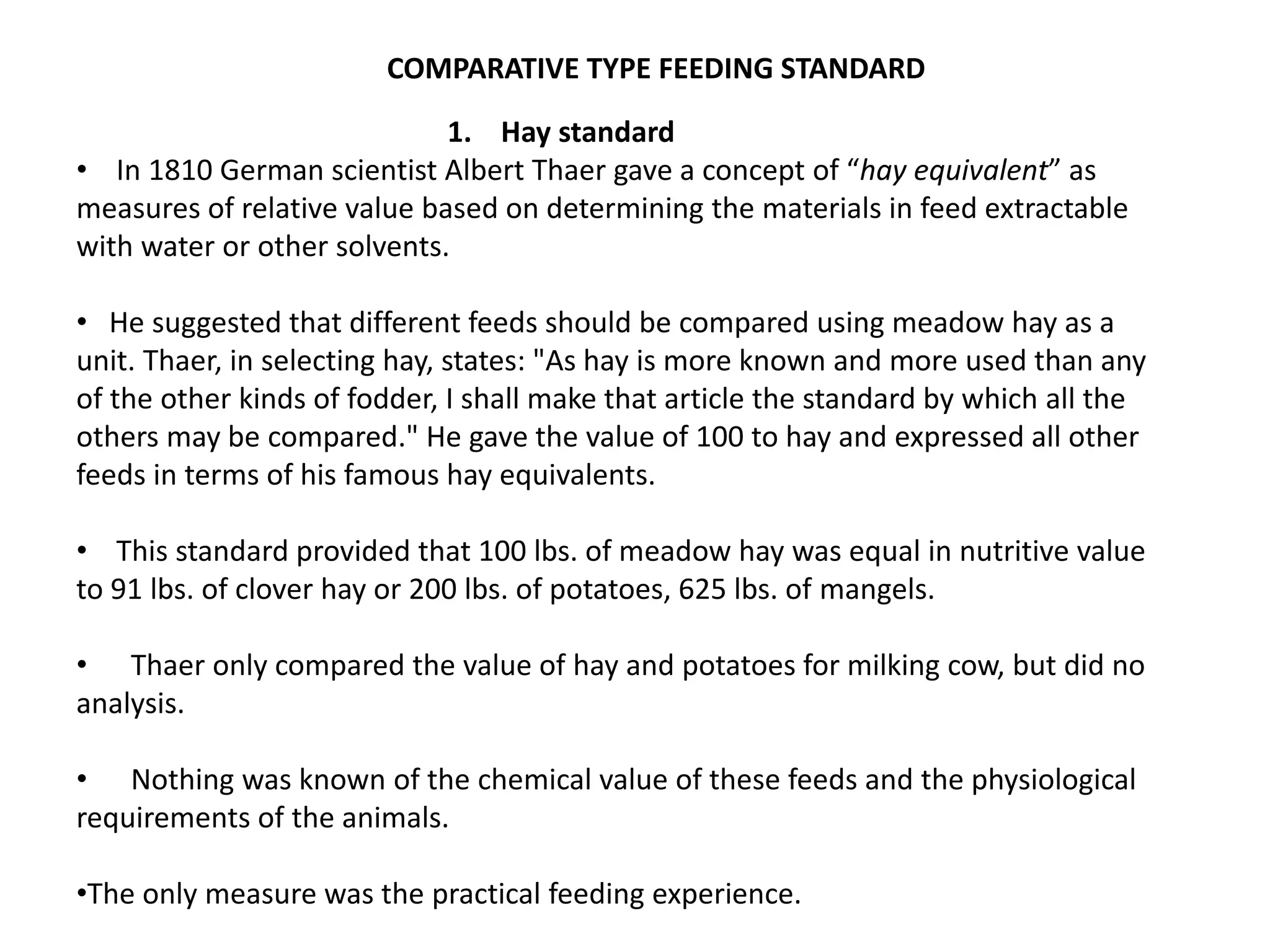
1. Hay standard
• In 1810 German scientist Albert Thaer gave a concept of “hay equivalent” as
measures of relative value based on determining the materials in feed extractable
with water or other solvents.
• He suggested that different feeds should be compared using meadow hay as a
unit. Thaer, in selecting hay, states: "As hay is more known and more used than any
of the other kinds of fodder, I shall make that article the standard by which all the
others may be compared." He gave the value of 100 to hay and expressed all other
feeds in terms of his famous hay equivalents.
• This standard provided that 100 lbs. of meadow hay was equal in nutritive value
to 91 lbs. of clover hay or 200 lbs. of potatoes, 625 lbs. of mangels.
• Thaer only compared the value of hay and potatoes for milking cow, but did no
analysis.
• Nothing was known of the chemical value of these feeds and the physiological
requirements of the animals.
•The only measure was the practical feeding experience.
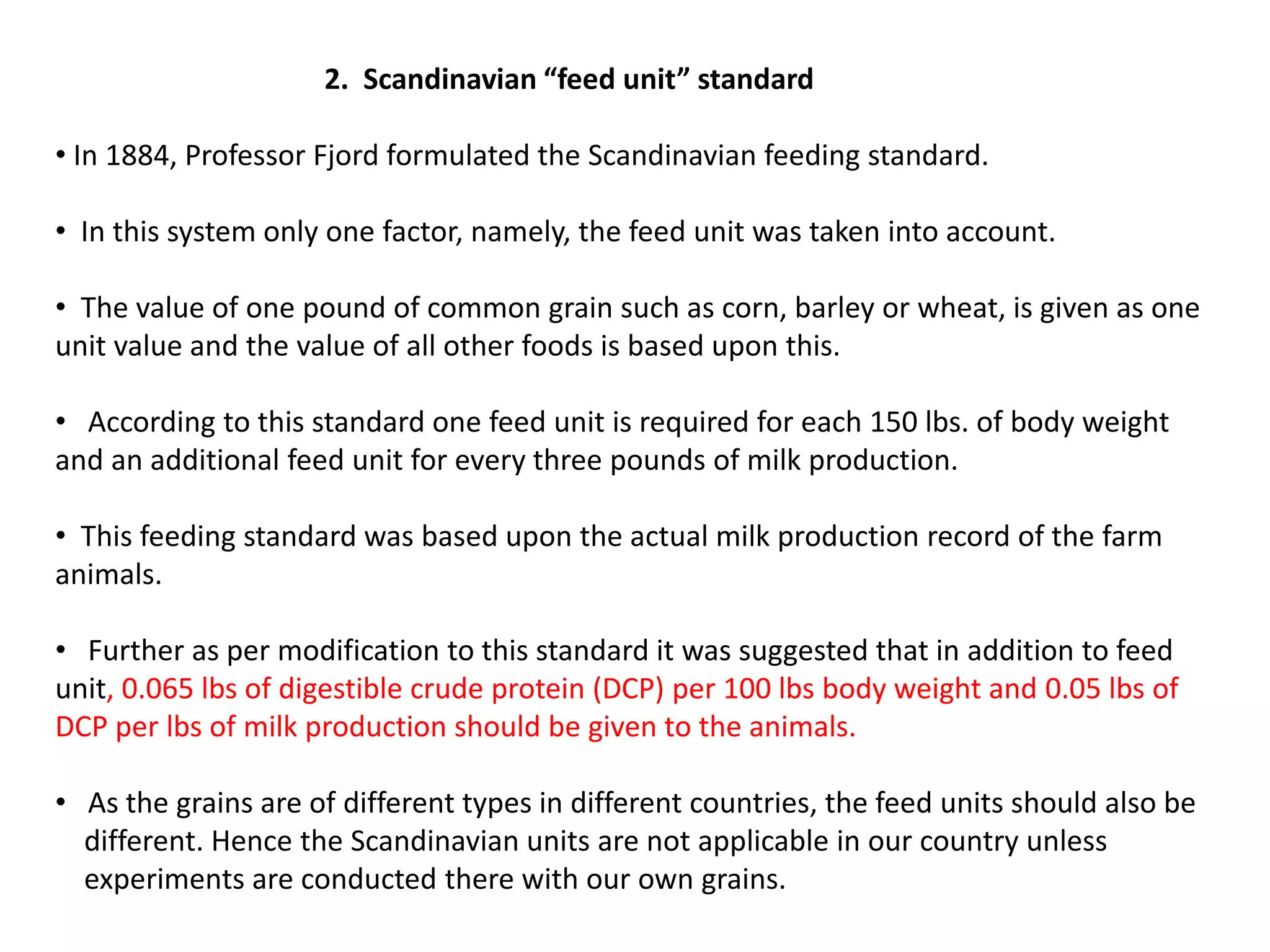
2. Scandinavian “feed unit” standard
• In 1884, Professor Fjord formulated the Scandinavian feeding standard.
• In this system only one factor, namely, the feed unit was taken into account.
• The value of one pound of common grain such as corn, barley or wheat, is given as one
unit value and the value of all other foods is based upon this.
• According to this standard one feed unit is required for each 150 lbs. of body weight
and an additional feed unit for every three pounds of milk production.
• This feeding standard was based upon the actual milk production record of the farm
animals.
• Further as per modification to this standard it was suggested that in addition to feed
unit, 0.065 lbs of digestible crude protein (DCP) per 100 lbs body weight and 0.05 lbs of
DCP per lbs of milk production should be given to the animals.
• As the grains are of different types in different countries, the feed units should also be
different. Hence the Scandinavian units are not applicable in our country unless
experiments are conducted there with our own grains.
FEEDING STANDARD-II (DIGESTIBLE NUTRIENT TYPE)
1. Grouven’s Feeding Standard
• In 1859 Grouven, a German chemist published “First Feeding Standard” for farm
animals with crude protein, carbohydrates and fat contained in the feed as the basis of the
standard.
• According to this standard a cow weighing 1,000 lbs. should be fed 28.7 lbs. of dry
matter containing 2.67 lbs. of crude protein 0.6 lb. of crude fat and 14.55 lbs. of crude
carbohydrates.
• Very soon after standard of Grouven, Henneberg and Stohann found that the total
nutrient contained in a feed did not form an accurate guide to its value.
• The proportion of digestible parts varied with different feeds and hence the digestible
nutrient would be more valuable. So due to this defect Grouven’s feeding standard is now
abandoned.
2. Wolff’s Feeding Standard
• In 1864 Dr. Emil Von Wolff proposed a standard based on digestible protein,
digestible carbohydrates and digestible fats contained in a feeding stuff.
• He calculated the ratio of digestible protein to digestible carbohydrate, called the
Albuminoid ratio, because he recognized that the proportion of protein in the ration
affected its digestibility.
• Later on albuminoid ratio developed as nutritive ratio. Nutritive ratio is the sum
of the digestible carbohydrate, digestible protein, and 2.25 × digestible fat, divided by
digestible protein.
• This standard through an improvement over the standard of Grouven, yet it does
not consider the quantity and quality of milk produced. Keeping these shortcomings in
mind Professor Kuhn published feeding standards in 1867 based upon the
maintenance and production requirements along with quantity of milk production.
• Atwater brought the Wolff's standard to the attention of American workers in
1874 in the annual report of the Connecticut Board of Agriculture. In 1880 these
standards were also published by Armsby in his book "Manual of Cattle Feeding". As a
result, the Wolff standards commenced to be used in the United .
Atwater`s Available Fuel Value
•In 1890 Atwater proposed a feeding standard based on the "available fuel values" of the
feeds.
•The system is based on the heats of combustion of protein, fat and carbohydrate, which are
corrected for losses in digestion, absorption and urinary excretion of urea.
• In this system, digestibility coefficient of carbohydrate (0.98), fats (0.95) and protein (0.92)
of a mixed diet was taken into account and these figures were multiplied by gross energy of
the nutrients.
•In this case of protein, a subtraction of 1.25 kcal per gram was made for the energy lost in
the urine.
Wolff’s Lehmann feeding standard
• Dr. G. Lehmann of Berlin modified Wolff’s standard in 1896. Till then Wolff’s standard
was in use.
• He took into account the quantity of milk produced, but he failed to take into account
the quality of milk.
• The requirements of a cow with a body weight of 1000 lbs. as fixed by this standard for
maintenance and maintenance cum milk production are as follows:
• In 1898, Henry published the first edition of his book ‘Feeds and Feeding’, which
contained tables showing the average composition of American feeds, digestion
coefficients for protein, crude fiber, nitrogen free extract, and ether extract.
• This feeding standards for various classes of livestock included intakes of dry matter,
digestible protein, digestible carbohydrates, and digestible ether extract.
• The table also included nutritive ratios calculated as follows·
Nutritive ratios= (Digestible carbohydrate + Digestible ether extract X 2.4 )
Digestible protein
Haecker’s feeding standard
• Haecker an American worker who for the first time considered quality as well
as the quality of milk produced in formulating a feeding standard.
• Haecker recognized that the food requirements must vary in accordance with
the composition of the product.
• He was also the first to separate requirements for maintenance form the
requirements of production.
• He took into account the allowance for the percentage of fat in the milk in
addition to the requirement for maintenance, production and total milk yield.
• His standard included digestible crude protein, carbohydrates and fats. Later
it was expressed in digestible crude protein and total digestible nutrients
Savage feeding standard
• Another American scientist Savage came to the conclusion that the Haecker standard
was too low especially in protein.
• Harrison and Savage compared concentrate mixtures containing 12, 16, 20 and 24
percent protein fed with corn silage and trimothy-clover mixed hay during complete
lactations.
• The 16 percent feed gave as good results as higher levels, but the 12 percent was
inadequate.
• Based on Haecker's maintenance figure the 16 percent supplied 128 percent of the
protein in the milk.
• Savage published his feeding standard by increasing 20 % protein requirement in 1912.
• He expressed his standard in terms of DCP and TDN and further showed that about 2/3
requirement of the dry matter should be met by feeding roughages and the remaining 1/3
from concentrates.
• He suggested that in case of milking cows at least 24 lbs. of dry matter should be
provided for an average cow. The nutritive ratio should not be wider than 1:6 or narrow
than 1:4.5.
Morrison feeding standard
• F.B. Morrison observed that stockmen are spending large sums of money for entirely
unnecessary amounts on protein supplement, thus considerably reducing their profits.
• He therefore, combined nutrients requirement in one set of standards as the best
guide available in computation of rations for the various classes of stock.
• These standards were first presented in the 15th edition of “Feeds and Feedings”
published in 1915 and where then called “Modified Wolff and Lehmann standard”.
They soon came to be known as the “Morrison Feeding Standard”.
• These standards have expressed in terms of Dry Matter (DM), Digestible Protein
(DP) and Total Digestible Nutrients (TDN).
• Morrison indicated the nutrient requirement of animals in a range rather than in
one figure. The average of Morrison standards has been accepted for Indian livestock.
National Research Council (N.R.C.) standard
• In 1942 the Committee on Animal Nutrition of the National Research Council (NRC)
of the National Academy of Sciences published the Recommended Nutrient Allowances
for Farm Animals, comprising separate reports for poultry, swine, dairy cattle, beef cattle,
sheep; and horses.
• The NRC reports representing in each case the pooled judgment of a group of experts
in the field or the species in question, and it should be considered the most authoritative
statements of the nutritional needs of farm animals for feeding practice in the United
states.
• The standard includes digestible protein and total digestible nutrients and also
includes the recommended requirements for calcium, phosphorus, carotene and vitamin
D for dairy cattle, beef cattle, pigs, poultry, sheep dogs, horses, laboratory animals etc.
• Today in a number of countries NRC standards are followed where they use ME for
poultry, DE for swine and horses, DE, ME and TDN for sheep, ME, TDN and NEm and NEg
for beef cattle and for dairy cattle, values are given for DE, ME, TDN, NEm and NEg for
growing animals with additional values as NEl for lactating cows.
Indian standards
Sen and Ray standard
• Dr. K. C. Sen, the first Director, National Dairy Research Institute, Bangalore and Karnal
and Ray have compiled the feeding standards for Zebu cattle and buffaloes, based on
Morrison’s recommendations.
• where they adopted the average of maximum and minimum values recommended by
Morrison.
• Later on, Sen, Ray and Ranjhan (1978) revised the Sen and Ray (1964) standard on the
basis of experimental trials conducted in Indian animals. These modified values are still
functioning in many of our established dairy farms.
Indian council of agricultural research feeding standard
• Considering the fact that nutrient needs of livestock and poultry breeds under tropical
environments are different from those developed in temperate climate.
• The scientific panel set up sub-committees for each species by inviting experts from
various institutes of the country. On the basis of the scientific information arising from the
experimental work carried out in India over the past two decades, nutrient requirement of
Indian livestock and poultry ultimately has been published by ICAR in January 1985 under the
Chairmanship of the panel Dr. K. Pradhan, which formed a strong basis for feeding our
livestock and poultry.
• These standards were updated and were revised in 1998. Latest feeding standard was
published by ICAR, New Delhi in 2013. In India, Bureau of India Standards (BIS) also publishes
feeding standard for different categories of poultry. Latest BIS publication for poultry feeding
is 2007.
• The feeding standards are based on the experimental results and have been organized
to contain information on daily DM, DCP, TDN, Calcium and Phosphorus intake in cattle. For
poultry protein is expressed in terms of crude protein (%) whereas energy is expressed in
metabolisable energy (kcal/kg diet).
. Feeding Standard (Production Value Type)
1. Kellner feeding standard
• In 1907 Kellner, a German scientist investigated a feeding standard based upon “Starch” as
the unit of measurement.
• He took into account not only the digestibility of the feeds as calculated from the amount
lost in faeces and urine but also the entire loss from the body including energy expended in
digestion and passing the food inside the body (chewing, etc.).
• For measuring the amount of energy lost from the body as heat, Kellner devised a
respiration apparatus. Here heat in determined indirectly by finding the amount of carbon
dioxide gas liberated or by measuring the amount of oxygen gas used up in oxidation which
take place in the body.
• According to this system, a 1,000 lbs. animal needs 0.6 lb. of digestible protein and 6.35 lbs.
of starch equivalent.
• This starch equivalent in turn can be converted into energy by a method worked out by
Armsby and Kellner. Any of the feeds the composition of which known be converted to starch
equivalent by using the following factors:
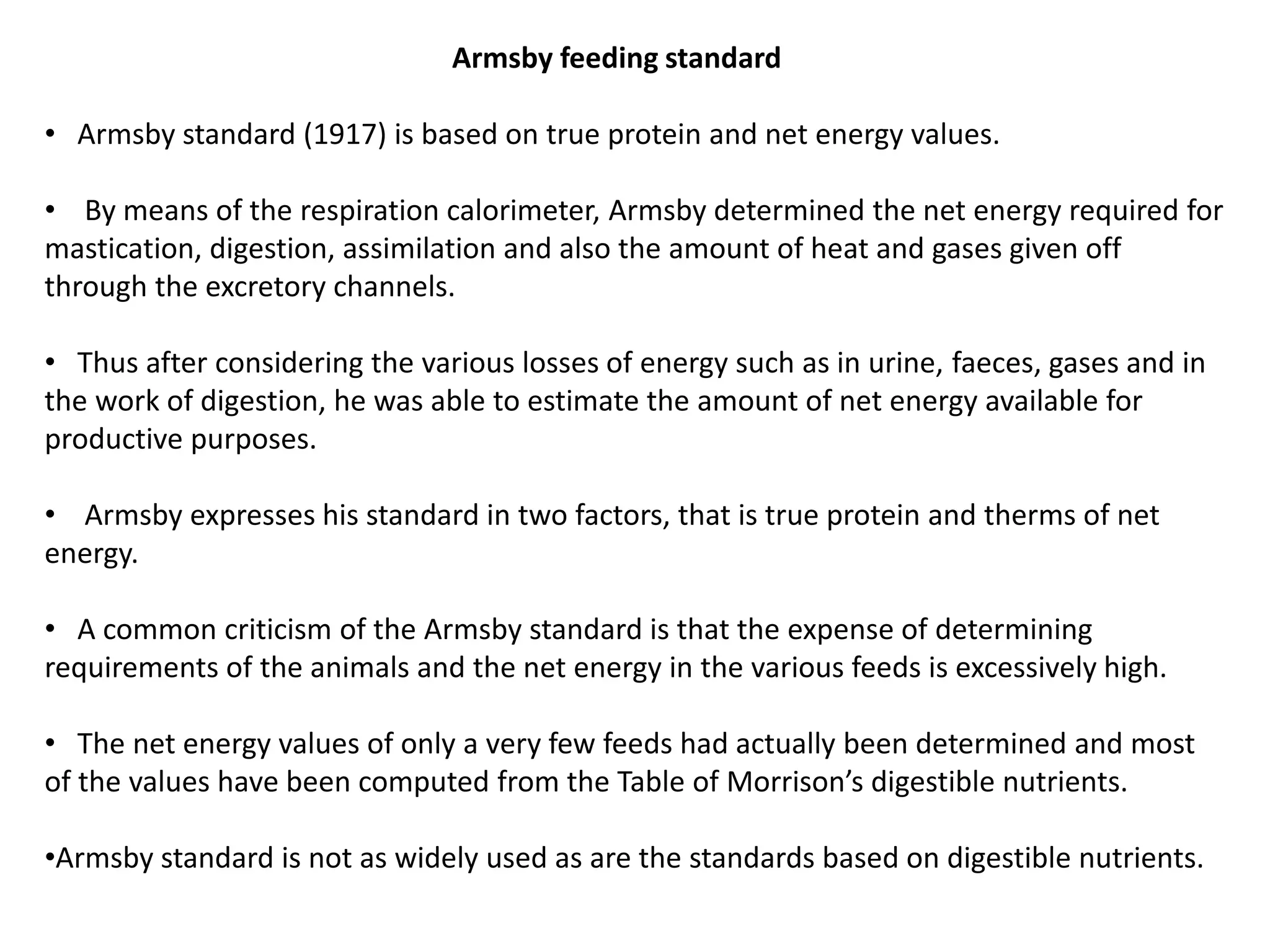
Armsby feeding standard
• Armsby standard (1917) is based on true protein and net energy values.
• By means of the respiration calorimeter, Armsby determined the net energy required for
mastication, digestion, assimilation and also the amount of heat and gases given off
through the excretory channels.
• Thus after considering the various losses of energy such as in urine, faeces, gases and in
the work of digestion, he was able to estimate the amount of net energy available for
productive purposes.
• Armsby expresses his standard in two factors, that is true protein and therms of net
energy.
• A common criticism of the Armsby standard is that the expense of determining
requirements of the animals and the net energy in the various feeds is excessively high.
• The net energy values of only a very few feeds had actually been determined and most
of the values have been computed from the Table of Morrison’s digestible nutrients.
•Armsby standard is not as widely used as are the standards based on digestible nutrients.
Agricultural Research Council (A.R.C.) standard
• In United Kingdom a technical committee was set up to develop the standards in 1959,
by the Agricultural Research Council (ARC), which later came to be known as Agricultural
and Food Research Council (AFRC).
• Requirements are set forth in three separate reports dealing with poultry, ruminants
and pigs, each of these reports are extensive summaries of the literatures upon which
the requirements are based.
• For ruminants, protein requirements are expressed in terms of metabolisable protein
(g) and energy in term of metabolisable energy (MJ).
• For horse, protein requirements are expressed in terms of crude protein (g) and
energy in term of digestible energy (MJ).
• For pigs, protein requirements are expressed in terms of standarised illeal digestible
amino acid (g) and energy in term of net energy (MJ).
• For poultry, protein requirements are expressed in terms of crude protein (g) and
energy in term of metabolisable energy (MJ).
Usefulness of feeding
• The feeding standard consist of
the quantity of nutrients required by an animal to remain healthy and highly productive.
•Feeding standards are set in accordance with productivity (milk, meat, wool, eggs), comp
osition of the product (fat content of milk), and physiological condition (growth, fetal dev
elopment).
•Consideration is also given to varying regional conditions in feeding standard.
•Feeding standards serves as guides in feeding animals and in estimating the adequacy of
feed intake and of feed supplies for groups of animal.
•Feeding standards are bases for feeding systems which should allow effective and
profitable nutritional management of animals appropriate to the prevailing nutritional,
economic and sociological environment.
Limitation of feeding standards
• Feeding standard is not a complete guide to feeding because other factors such as
palatability and the physical nature of the ration are not taken into account.
• Feeding standards are only approximately correct.
• The amounts of nutrients recommended in the table of feeding standards are
intended to be sufficient to meet the food requirements of maximum production.
• Environment may change nutrient requirements.
• Feeding standard does not consider economics of livestock production.
• Feeding standards based on assigned nutritive values (e.g., net energy) are misleading
when unconventional feed resources are used.
• Feeding standards are not permanent, but are reexamined with changes in technology
and production targets.
Merits and demerits of various feeding standards
TDN and DE systems
The TDN and DE system of feed evaluation have been and continue to be used because these
measures are useful as first approximation of feed’s value as a source of energy.
Merits
• TDN is a measure of apparent DE but is expressed in units of weight or % rather than
energy per SE.
• TDN value provides a relative measure of the DE content of feed;
1 kg TDN = 4.409 Mcal DE.
• It is easy to determine the TDN content of feedstuffs; proximate composition of feeds and
faeces and digestion trial are to be done.
• Digestible energy can readily be determined by using a bomb calorimeter to measure the
GE of feed and faeces. No chemical analyses are required.
Demerits
• TDN system takes into account only the losses of nutrients in the faeces but not the
other losses from the body.
• TDN system over evaluates the energy value of poor quality roughages in relation to
concentrates specially so in hot environment because TDN does not consider large
amounts of energy wasted in the digestion of fibrous feeds in the form of gases and heat
increment and Ether extract of forages largely comprise other than true fat.
• So a kg of TDN in roughage has less value for productive purpose than a kg of TDN in
concentrate.
• Certain species of forage were found to have high gross energy and high TDN values
due to essential oils but low ME values.
• The measurement of DE takes into account the losses only through faeces.
SE and ME systems
The total digestible nutrients system in the United States, Canada and India
and starch equivalent (SE) system in Europe have been widely used since early 1900s.
The SE system was replaced by the ME system devised by Blaxter in UK.
Merits of ME system
ME represents a more accurate measure since losses in urinary and gaseous products of
digestion are also accounted for.
ME provides a more satisfactory measure of nutritive value than do TDN or DE.
ME is cheaper and easier to obtain than NE values.
The efficiency of utilization of ME takes into consideration the purpose for which it is fed,
level of feeding and caloric density of the diet.
References
Agricultural and Food Research Council (AFRC) 1992 Technical Committee on Responses to
Nutrients, report no. 5. Nutrient Requirements of Ruminant Animals: Energy, Farnham
Royal, Commonwealth Agricultural Bureaux.
BIS (2007). IndianStandard: Poultry Feeds- Specification, IS-1374. Bureau of Indian
Standards, 9, Bahadur Sah Zafar Marg, Manak Bhawan, New Delhi, India.
Bondi A (1987). Animal Nutrition. Wiley Inter Science.
Cramptan EW and Harris LE. (1969). Applied Animal Nutrition. WH Freeman.
French, M. H. (2015). The Development of Feeding Standards for Cattle. The East African
Agricultural Journal 179-187.
Garnsworthy P C and Wiseman J (1990). Recent Advances in Animal Nutrition, Nottingham,
Nottingham University Press, pp. 255–75.
ICAR. (2013). Nutrient Requirements of Poultry. Nutrient Requirements of Animals. Indian
Council of Agricultural Research, New Delhi, India
Maynard, L. A., Loosli, J.K., Hintz, H. F. and Warner, R. G. (1979). Animal Nutrition. 7th
Edition, McGraw-Hill, New York.
Mc Donald P., Edwards R.A., Greenhalgh, J.F.D., Morgan, C.A., Sinclair, L.A and Wikinson,
R.G (2010). Animal nutrition. 7th edn. Prentice Hall, Harlow, Essex, UK
Morrison, FB. (1917). The Modified Wolff-Lehmann Feeding Standards. Journal of
Animal Science, 1: 64–69.
National Research Council 2001 Nutrient Requirements of Dairy Cattle, 7th rev.
edn,Washington, DC, National Research Council. National Academy of Sciences/
National Research Council 2007 Nutrient Requirements of Horses, 6th rev.
edn,Washington, DC, National Academic Press.
National Research Council 2007 Nutrient Requirements of Small Ruminants: Sheep,
Goats, Cervids and New World Camelids, DC,Washington, National Academic Press.
Ponds WG, Church DC, Pond KR and Schoknecht PA. (2005). Basic Animal Nutrition and
Feeding. Wiley Dreamtech India.
Thomas C 2004 Feed into Milk: A New Applied Feeding System for Dairy Cows,
Nottingham, Nottingham University Press.
Wu, G. (2018). Principles of Animal Nutrition. CRC Press. Taylor & Francis Group, NW
T H A N K S

Feeding standard

  • 1.
    Feeding Standard Dr. PramodKumar Assistant Professor-cum-Jr. Scientist Bihar Animal Sciences University Patna,Bihar,India.
  • 2.
    What is feedingstandard • Feedings standards are the tables showing the quantities of nutrients to be fed to the various classes of livestock for different physiological functions like growth, maintenance, lactation, egg production and wool growth. OR • Feeding standards may be expressed in quantities of nutrients or in dietary proportions. The nutrient requirements are generally expressed separately for each function or an overall figure for the combined functions. In case of dairy animal, nutrient requirements are generally expressed for the separate body functions but in case of poultry and pigs combined requirements of maintenance and other body functions are given.
  • 3.
    Objectives of FeedingStandards • To Guide Farmers to selecting properly balanced rations for their livestock. • To classify different physiological functions like growth , maintenance , lactation , egg production and wool growth. • Considering individual animal for preparation of FS due to their ability to digest and utilize feed.
  • 4.
    Nutrient requirement: Anutrient requirement is the average amount required for a particular function, Nutrient allowance: A nutrient allowance is greater than this by a safety margin designed primarily to allow for variations in the requirement between individual animals. Albuminoid ratio: Albuminoid ratio is the ratio of digestible protein to digestible carbohydrate used. The term was used in Wolff’s Feeding Standard. Nutritive ratio : Nutritive ratio is the sum of the digestible carbohydrate, digestible protein, and 2.25 × digestible fat, divided by digestible protein. Nutritive ratio: (Digestible carbohydrate + Digestible ether extract X 2.4) Digestible protein Physiological Fuel Value (PFV) : Physiological Fuel Value is "available fuel values" of the feeds, which is obtained by multiplying gross energy of the nutrients by digestibility coefficient. Physiological Fuel Values are 4.0 kcal/g for carbohydrates, 9.0 kcal/g for fat and 4.0 kcal/g for protein. Glossary of terms
  • 5.
    Various units areused for feeding standards • The energy requirements of ruminants may be stated in terms of • Net energy (NE), • Metabolisable energy (ME), • Digestible energy (DE) or feed units • Protein requirements in terms of crude protein (CP), • Digestible crude protein (DCP) • Metabolisable protein (MP) etc.
  • 6.
    Classification of FeedingStandard (a) Comparative type (b) Digestible Nutrient system (c) Production value type Comparative type •Hay standard •Scandinavian feed unit” Standard Digestible Nutrient System •Grouven’s Feeding system •Wolff’s feeding standard •Wolff’s Lehmann feeding standard •Haeckers’s Feeding standard •Savage feeding standard •Morrison standard •National Research Council standard •Indian standard system Production value type • Kellner-feeding standard •Armsby feeding std •Agricultural Research Council Standard.
  • 7.
    In another wayit can also be classified according to history and development of feeding standard as: Old days feeding standard Middle days feeding standards •Hay standard •Grouven’s Feeding system •Wolff’s Feeding Standard •Kuhan’s Feeding Standard •Scandinavian feed unit Standard •Wolff’s Lehmann feeding standard •Haeckers’s Feeding Standard •Savage Feeding Standard •Kellner’s Feeding Standard •Armsby Feeding Standard Present dayfeeding standards •National Research Council standard •Morrison standard •Agricultur al Research Council Standard. • Indian standards
  • 8.
    COMPARATIVE TYPE FEEDINGSTANDARD 1. Hay standard • In 1810 German scientist Albert Thaer gave a concept of “hay equivalent” as measures of relative value based on determining the materials in feed extractable with water or other solvents. • He suggested that different feeds should be compared using meadow hay as a unit. Thaer, in selecting hay, states: "As hay is more known and more used than any of the other kinds of fodder, I shall make that article the standard by which all the others may be compared." He gave the value of 100 to hay and expressed all other feeds in terms of his famous hay equivalents. • This standard provided that 100 lbs. of meadow hay was equal in nutritive value to 91 lbs. of clover hay or 200 lbs. of potatoes, 625 lbs. of mangels. • Thaer only compared the value of hay and potatoes for milking cow, but did no analysis. • Nothing was known of the chemical value of these feeds and the physiological requirements of the animals. •The only measure was the practical feeding experience.
  • 9.
    2. Scandinavian “feedunit” standard • In 1884, Professor Fjord formulated the Scandinavian feeding standard. • In this system only one factor, namely, the feed unit was taken into account. • The value of one pound of common grain such as corn, barley or wheat, is given as one unit value and the value of all other foods is based upon this. • According to this standard one feed unit is required for each 150 lbs. of body weight and an additional feed unit for every three pounds of milk production. • This feeding standard was based upon the actual milk production record of the farm animals. • Further as per modification to this standard it was suggested that in addition to feed unit, 0.065 lbs of digestible crude protein (DCP) per 100 lbs body weight and 0.05 lbs of DCP per lbs of milk production should be given to the animals. • As the grains are of different types in different countries, the feed units should also be different. Hence the Scandinavian units are not applicable in our country unless experiments are conducted there with our own grains.
  • 10.
    FEEDING STANDARD-II (DIGESTIBLENUTRIENT TYPE) 1. Grouven’s Feeding Standard • In 1859 Grouven, a German chemist published “First Feeding Standard” for farm animals with crude protein, carbohydrates and fat contained in the feed as the basis of the standard. • According to this standard a cow weighing 1,000 lbs. should be fed 28.7 lbs. of dry matter containing 2.67 lbs. of crude protein 0.6 lb. of crude fat and 14.55 lbs. of crude carbohydrates. • Very soon after standard of Grouven, Henneberg and Stohann found that the total nutrient contained in a feed did not form an accurate guide to its value. • The proportion of digestible parts varied with different feeds and hence the digestible nutrient would be more valuable. So due to this defect Grouven’s feeding standard is now abandoned.
  • 11.
    2. Wolff’s FeedingStandard • In 1864 Dr. Emil Von Wolff proposed a standard based on digestible protein, digestible carbohydrates and digestible fats contained in a feeding stuff. • He calculated the ratio of digestible protein to digestible carbohydrate, called the Albuminoid ratio, because he recognized that the proportion of protein in the ration affected its digestibility. • Later on albuminoid ratio developed as nutritive ratio. Nutritive ratio is the sum of the digestible carbohydrate, digestible protein, and 2.25 × digestible fat, divided by digestible protein. • This standard through an improvement over the standard of Grouven, yet it does not consider the quantity and quality of milk produced. Keeping these shortcomings in mind Professor Kuhn published feeding standards in 1867 based upon the maintenance and production requirements along with quantity of milk production. • Atwater brought the Wolff's standard to the attention of American workers in 1874 in the annual report of the Connecticut Board of Agriculture. In 1880 these standards were also published by Armsby in his book "Manual of Cattle Feeding". As a result, the Wolff standards commenced to be used in the United .
  • 12.
    Atwater`s Available FuelValue •In 1890 Atwater proposed a feeding standard based on the "available fuel values" of the feeds. •The system is based on the heats of combustion of protein, fat and carbohydrate, which are corrected for losses in digestion, absorption and urinary excretion of urea. • In this system, digestibility coefficient of carbohydrate (0.98), fats (0.95) and protein (0.92) of a mixed diet was taken into account and these figures were multiplied by gross energy of the nutrients. •In this case of protein, a subtraction of 1.25 kcal per gram was made for the energy lost in the urine.
  • 13.
    Wolff’s Lehmann feedingstandard • Dr. G. Lehmann of Berlin modified Wolff’s standard in 1896. Till then Wolff’s standard was in use. • He took into account the quantity of milk produced, but he failed to take into account the quality of milk. • The requirements of a cow with a body weight of 1000 lbs. as fixed by this standard for maintenance and maintenance cum milk production are as follows: • In 1898, Henry published the first edition of his book ‘Feeds and Feeding’, which contained tables showing the average composition of American feeds, digestion coefficients for protein, crude fiber, nitrogen free extract, and ether extract. • This feeding standards for various classes of livestock included intakes of dry matter, digestible protein, digestible carbohydrates, and digestible ether extract. • The table also included nutritive ratios calculated as follows· Nutritive ratios= (Digestible carbohydrate + Digestible ether extract X 2.4 ) Digestible protein
  • 14.
    Haecker’s feeding standard •Haecker an American worker who for the first time considered quality as well as the quality of milk produced in formulating a feeding standard. • Haecker recognized that the food requirements must vary in accordance with the composition of the product. • He was also the first to separate requirements for maintenance form the requirements of production. • He took into account the allowance for the percentage of fat in the milk in addition to the requirement for maintenance, production and total milk yield. • His standard included digestible crude protein, carbohydrates and fats. Later it was expressed in digestible crude protein and total digestible nutrients
  • 15.
    Savage feeding standard •Another American scientist Savage came to the conclusion that the Haecker standard was too low especially in protein. • Harrison and Savage compared concentrate mixtures containing 12, 16, 20 and 24 percent protein fed with corn silage and trimothy-clover mixed hay during complete lactations. • The 16 percent feed gave as good results as higher levels, but the 12 percent was inadequate. • Based on Haecker's maintenance figure the 16 percent supplied 128 percent of the protein in the milk. • Savage published his feeding standard by increasing 20 % protein requirement in 1912. • He expressed his standard in terms of DCP and TDN and further showed that about 2/3 requirement of the dry matter should be met by feeding roughages and the remaining 1/3 from concentrates. • He suggested that in case of milking cows at least 24 lbs. of dry matter should be provided for an average cow. The nutritive ratio should not be wider than 1:6 or narrow than 1:4.5.
  • 16.
    Morrison feeding standard •F.B. Morrison observed that stockmen are spending large sums of money for entirely unnecessary amounts on protein supplement, thus considerably reducing their profits. • He therefore, combined nutrients requirement in one set of standards as the best guide available in computation of rations for the various classes of stock. • These standards were first presented in the 15th edition of “Feeds and Feedings” published in 1915 and where then called “Modified Wolff and Lehmann standard”. They soon came to be known as the “Morrison Feeding Standard”. • These standards have expressed in terms of Dry Matter (DM), Digestible Protein (DP) and Total Digestible Nutrients (TDN). • Morrison indicated the nutrient requirement of animals in a range rather than in one figure. The average of Morrison standards has been accepted for Indian livestock.
  • 17.
    National Research Council(N.R.C.) standard • In 1942 the Committee on Animal Nutrition of the National Research Council (NRC) of the National Academy of Sciences published the Recommended Nutrient Allowances for Farm Animals, comprising separate reports for poultry, swine, dairy cattle, beef cattle, sheep; and horses. • The NRC reports representing in each case the pooled judgment of a group of experts in the field or the species in question, and it should be considered the most authoritative statements of the nutritional needs of farm animals for feeding practice in the United states. • The standard includes digestible protein and total digestible nutrients and also includes the recommended requirements for calcium, phosphorus, carotene and vitamin D for dairy cattle, beef cattle, pigs, poultry, sheep dogs, horses, laboratory animals etc. • Today in a number of countries NRC standards are followed where they use ME for poultry, DE for swine and horses, DE, ME and TDN for sheep, ME, TDN and NEm and NEg for beef cattle and for dairy cattle, values are given for DE, ME, TDN, NEm and NEg for growing animals with additional values as NEl for lactating cows.
  • 18.
    Indian standards Sen andRay standard • Dr. K. C. Sen, the first Director, National Dairy Research Institute, Bangalore and Karnal and Ray have compiled the feeding standards for Zebu cattle and buffaloes, based on Morrison’s recommendations. • where they adopted the average of maximum and minimum values recommended by Morrison. • Later on, Sen, Ray and Ranjhan (1978) revised the Sen and Ray (1964) standard on the basis of experimental trials conducted in Indian animals. These modified values are still functioning in many of our established dairy farms.
  • 19.
    Indian council ofagricultural research feeding standard • Considering the fact that nutrient needs of livestock and poultry breeds under tropical environments are different from those developed in temperate climate. • The scientific panel set up sub-committees for each species by inviting experts from various institutes of the country. On the basis of the scientific information arising from the experimental work carried out in India over the past two decades, nutrient requirement of Indian livestock and poultry ultimately has been published by ICAR in January 1985 under the Chairmanship of the panel Dr. K. Pradhan, which formed a strong basis for feeding our livestock and poultry. • These standards were updated and were revised in 1998. Latest feeding standard was published by ICAR, New Delhi in 2013. In India, Bureau of India Standards (BIS) also publishes feeding standard for different categories of poultry. Latest BIS publication for poultry feeding is 2007. • The feeding standards are based on the experimental results and have been organized to contain information on daily DM, DCP, TDN, Calcium and Phosphorus intake in cattle. For poultry protein is expressed in terms of crude protein (%) whereas energy is expressed in metabolisable energy (kcal/kg diet).
  • 20.
    . Feeding Standard(Production Value Type) 1. Kellner feeding standard • In 1907 Kellner, a German scientist investigated a feeding standard based upon “Starch” as the unit of measurement. • He took into account not only the digestibility of the feeds as calculated from the amount lost in faeces and urine but also the entire loss from the body including energy expended in digestion and passing the food inside the body (chewing, etc.). • For measuring the amount of energy lost from the body as heat, Kellner devised a respiration apparatus. Here heat in determined indirectly by finding the amount of carbon dioxide gas liberated or by measuring the amount of oxygen gas used up in oxidation which take place in the body. • According to this system, a 1,000 lbs. animal needs 0.6 lb. of digestible protein and 6.35 lbs. of starch equivalent. • This starch equivalent in turn can be converted into energy by a method worked out by Armsby and Kellner. Any of the feeds the composition of which known be converted to starch equivalent by using the following factors:
  • 21.
    Armsby feeding standard •Armsby standard (1917) is based on true protein and net energy values. • By means of the respiration calorimeter, Armsby determined the net energy required for mastication, digestion, assimilation and also the amount of heat and gases given off through the excretory channels. • Thus after considering the various losses of energy such as in urine, faeces, gases and in the work of digestion, he was able to estimate the amount of net energy available for productive purposes. • Armsby expresses his standard in two factors, that is true protein and therms of net energy. • A common criticism of the Armsby standard is that the expense of determining requirements of the animals and the net energy in the various feeds is excessively high. • The net energy values of only a very few feeds had actually been determined and most of the values have been computed from the Table of Morrison’s digestible nutrients. •Armsby standard is not as widely used as are the standards based on digestible nutrients.
  • 22.
    Agricultural Research Council(A.R.C.) standard • In United Kingdom a technical committee was set up to develop the standards in 1959, by the Agricultural Research Council (ARC), which later came to be known as Agricultural and Food Research Council (AFRC). • Requirements are set forth in three separate reports dealing with poultry, ruminants and pigs, each of these reports are extensive summaries of the literatures upon which the requirements are based. • For ruminants, protein requirements are expressed in terms of metabolisable protein (g) and energy in term of metabolisable energy (MJ). • For horse, protein requirements are expressed in terms of crude protein (g) and energy in term of digestible energy (MJ). • For pigs, protein requirements are expressed in terms of standarised illeal digestible amino acid (g) and energy in term of net energy (MJ). • For poultry, protein requirements are expressed in terms of crude protein (g) and energy in term of metabolisable energy (MJ).
  • 23.
    Usefulness of feeding •The feeding standard consist of the quantity of nutrients required by an animal to remain healthy and highly productive. •Feeding standards are set in accordance with productivity (milk, meat, wool, eggs), comp osition of the product (fat content of milk), and physiological condition (growth, fetal dev elopment). •Consideration is also given to varying regional conditions in feeding standard. •Feeding standards serves as guides in feeding animals and in estimating the adequacy of feed intake and of feed supplies for groups of animal. •Feeding standards are bases for feeding systems which should allow effective and profitable nutritional management of animals appropriate to the prevailing nutritional, economic and sociological environment.
  • 24.
    Limitation of feedingstandards • Feeding standard is not a complete guide to feeding because other factors such as palatability and the physical nature of the ration are not taken into account. • Feeding standards are only approximately correct. • The amounts of nutrients recommended in the table of feeding standards are intended to be sufficient to meet the food requirements of maximum production. • Environment may change nutrient requirements. • Feeding standard does not consider economics of livestock production. • Feeding standards based on assigned nutritive values (e.g., net energy) are misleading when unconventional feed resources are used. • Feeding standards are not permanent, but are reexamined with changes in technology and production targets.
  • 25.
    Merits and demeritsof various feeding standards TDN and DE systems The TDN and DE system of feed evaluation have been and continue to be used because these measures are useful as first approximation of feed’s value as a source of energy. Merits • TDN is a measure of apparent DE but is expressed in units of weight or % rather than energy per SE. • TDN value provides a relative measure of the DE content of feed; 1 kg TDN = 4.409 Mcal DE. • It is easy to determine the TDN content of feedstuffs; proximate composition of feeds and faeces and digestion trial are to be done. • Digestible energy can readily be determined by using a bomb calorimeter to measure the GE of feed and faeces. No chemical analyses are required.
  • 26.
    Demerits • TDN systemtakes into account only the losses of nutrients in the faeces but not the other losses from the body. • TDN system over evaluates the energy value of poor quality roughages in relation to concentrates specially so in hot environment because TDN does not consider large amounts of energy wasted in the digestion of fibrous feeds in the form of gases and heat increment and Ether extract of forages largely comprise other than true fat. • So a kg of TDN in roughage has less value for productive purpose than a kg of TDN in concentrate. • Certain species of forage were found to have high gross energy and high TDN values due to essential oils but low ME values. • The measurement of DE takes into account the losses only through faeces.
  • 27.
    SE and MEsystems The total digestible nutrients system in the United States, Canada and India and starch equivalent (SE) system in Europe have been widely used since early 1900s. The SE system was replaced by the ME system devised by Blaxter in UK. Merits of ME system ME represents a more accurate measure since losses in urinary and gaseous products of digestion are also accounted for. ME provides a more satisfactory measure of nutritive value than do TDN or DE. ME is cheaper and easier to obtain than NE values. The efficiency of utilization of ME takes into consideration the purpose for which it is fed, level of feeding and caloric density of the diet.
  • 28.
    References Agricultural and FoodResearch Council (AFRC) 1992 Technical Committee on Responses to Nutrients, report no. 5. Nutrient Requirements of Ruminant Animals: Energy, Farnham Royal, Commonwealth Agricultural Bureaux. BIS (2007). IndianStandard: Poultry Feeds- Specification, IS-1374. Bureau of Indian Standards, 9, Bahadur Sah Zafar Marg, Manak Bhawan, New Delhi, India. Bondi A (1987). Animal Nutrition. Wiley Inter Science. Cramptan EW and Harris LE. (1969). Applied Animal Nutrition. WH Freeman. French, M. H. (2015). The Development of Feeding Standards for Cattle. The East African Agricultural Journal 179-187. Garnsworthy P C and Wiseman J (1990). Recent Advances in Animal Nutrition, Nottingham, Nottingham University Press, pp. 255–75. ICAR. (2013). Nutrient Requirements of Poultry. Nutrient Requirements of Animals. Indian Council of Agricultural Research, New Delhi, India
  • 29.
    Maynard, L. A.,Loosli, J.K., Hintz, H. F. and Warner, R. G. (1979). Animal Nutrition. 7th Edition, McGraw-Hill, New York. Mc Donald P., Edwards R.A., Greenhalgh, J.F.D., Morgan, C.A., Sinclair, L.A and Wikinson, R.G (2010). Animal nutrition. 7th edn. Prentice Hall, Harlow, Essex, UK Morrison, FB. (1917). The Modified Wolff-Lehmann Feeding Standards. Journal of Animal Science, 1: 64–69. National Research Council 2001 Nutrient Requirements of Dairy Cattle, 7th rev. edn,Washington, DC, National Research Council. National Academy of Sciences/ National Research Council 2007 Nutrient Requirements of Horses, 6th rev. edn,Washington, DC, National Academic Press. National Research Council 2007 Nutrient Requirements of Small Ruminants: Sheep, Goats, Cervids and New World Camelids, DC,Washington, National Academic Press. Ponds WG, Church DC, Pond KR and Schoknecht PA. (2005). Basic Animal Nutrition and Feeding. Wiley Dreamtech India. Thomas C 2004 Feed into Milk: A New Applied Feeding System for Dairy Cows, Nottingham, Nottingham University Press. Wu, G. (2018). Principles of Animal Nutrition. CRC Press. Taylor & Francis Group, NW

  • 30.
    T H AN K S