The Probability of a given event is an expression of
likelihood of occurrence of an event. A probability is a
number which ranges from 0 (zero) to 1 (0ne) -- zero for
an event which cannot occur and 1 for an event which
is certain to occur.
DEFINITION
 THE CLASSICAL APPROACH
 RELATIVE FREQUENCY THEORY
 SUBJECTIVE APPROACH
 AXIOMATIC APPROACH
The definition of probability given by disciples of the classical
school runs as follows : “ Probability” it is said, is the ratio of the
number of “favourable’ cases to the total number of equally likely
cases.

The term “equally likely”, though undefined, conveys the notion
that each outcome of an experiment has the same chance of
appearing as any other.
If probability of occurrence of A is denoted by P(A), then
by the definition , we have :
P(A)= Number of favourable cases
Total number of qually likely cases
For example, If a coin is tossed, there are two equally
likely cases, a head or a tail, hence the probability of a
head is ½ and the probability of toss is ½.
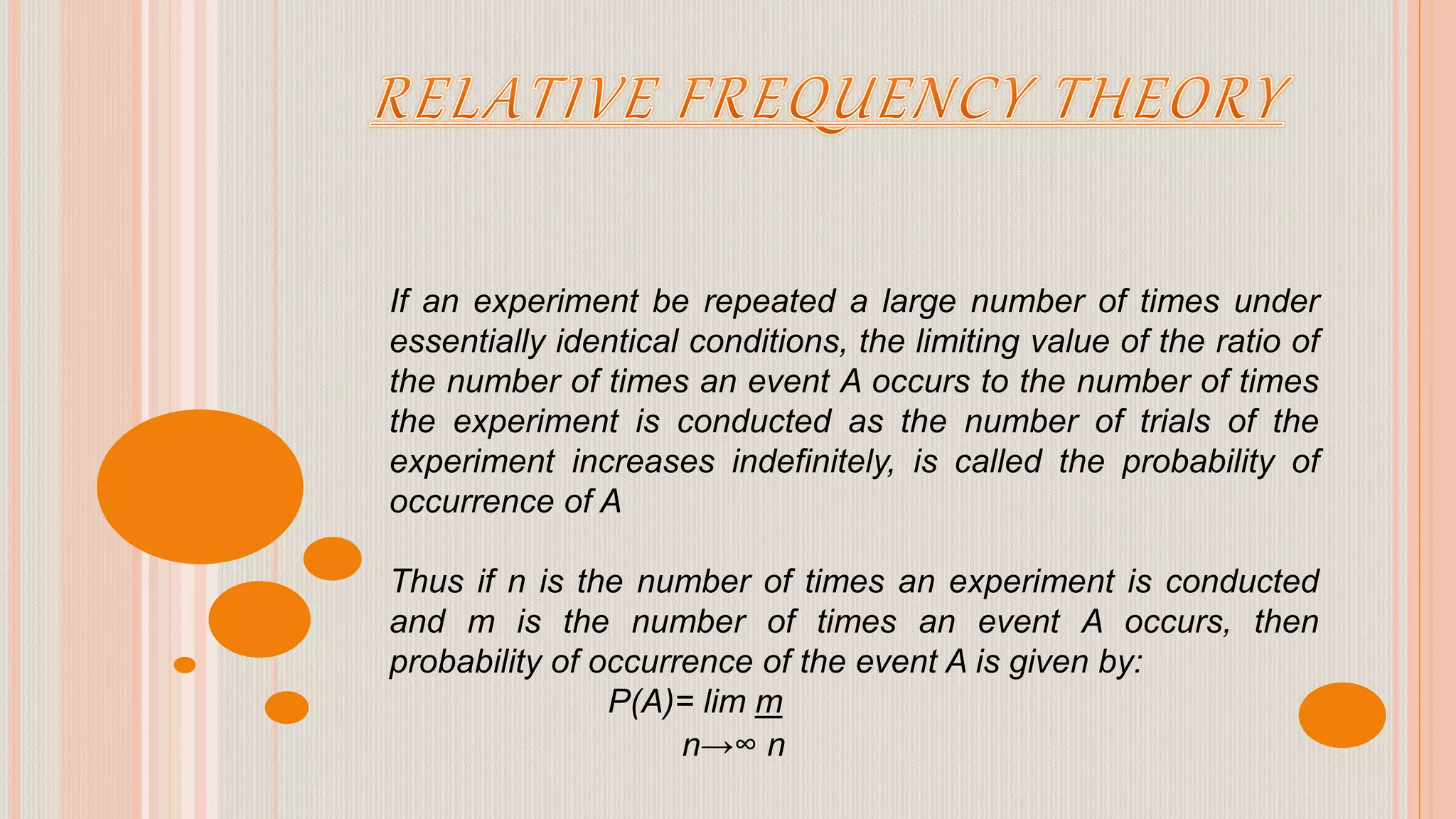
If an experiment be repeated a large number of times under
essentially identical conditions, the limiting value of the ratio of
the number of times an event A occurs to the number of times
the experiment is conducted as the number of trials of the
experiment increases indefinitely, is called the probability of
occurrence of A
Thus if n is the number of times an experiment is conducted
and m is the number of times an event A occurs, then
probability of occurrence of the event A is given by:
P(A)= lim m
n→∞ n
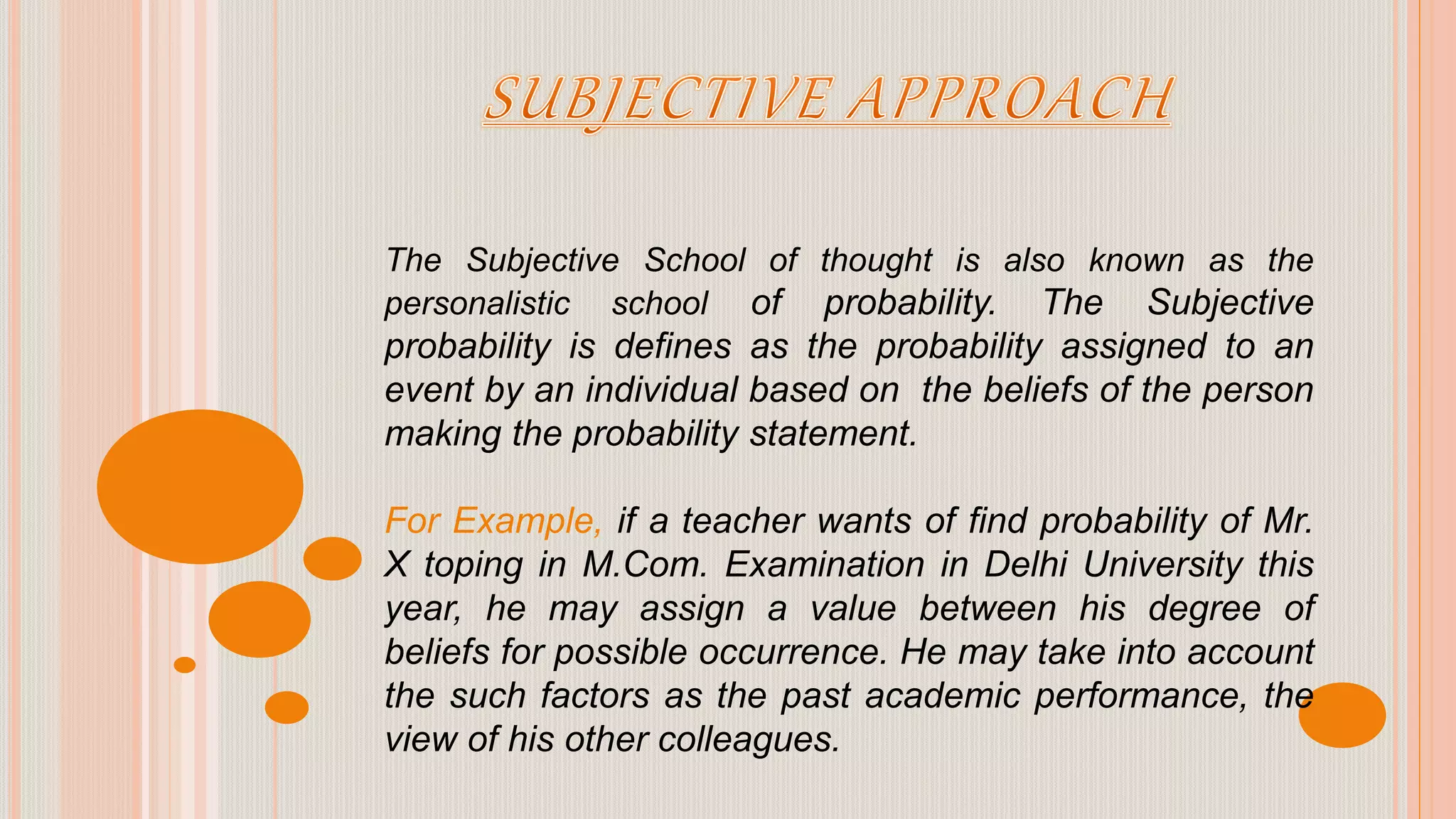
The Subjective School of thought is also known as the
personalistic school of probability. The Subjective
probability is defines as the probability assigned to an
event by an individual based on the beliefs of the person
making the probability statement.
For Example, if a teacher wants of find probability of Mr.
X toping in M.Com. Examination in Delhi University this
year, he may assign a value between his degree of
beliefs for possible occurrence. He may take into account
the such factors as the past academic performance, the
view of his other colleagues.
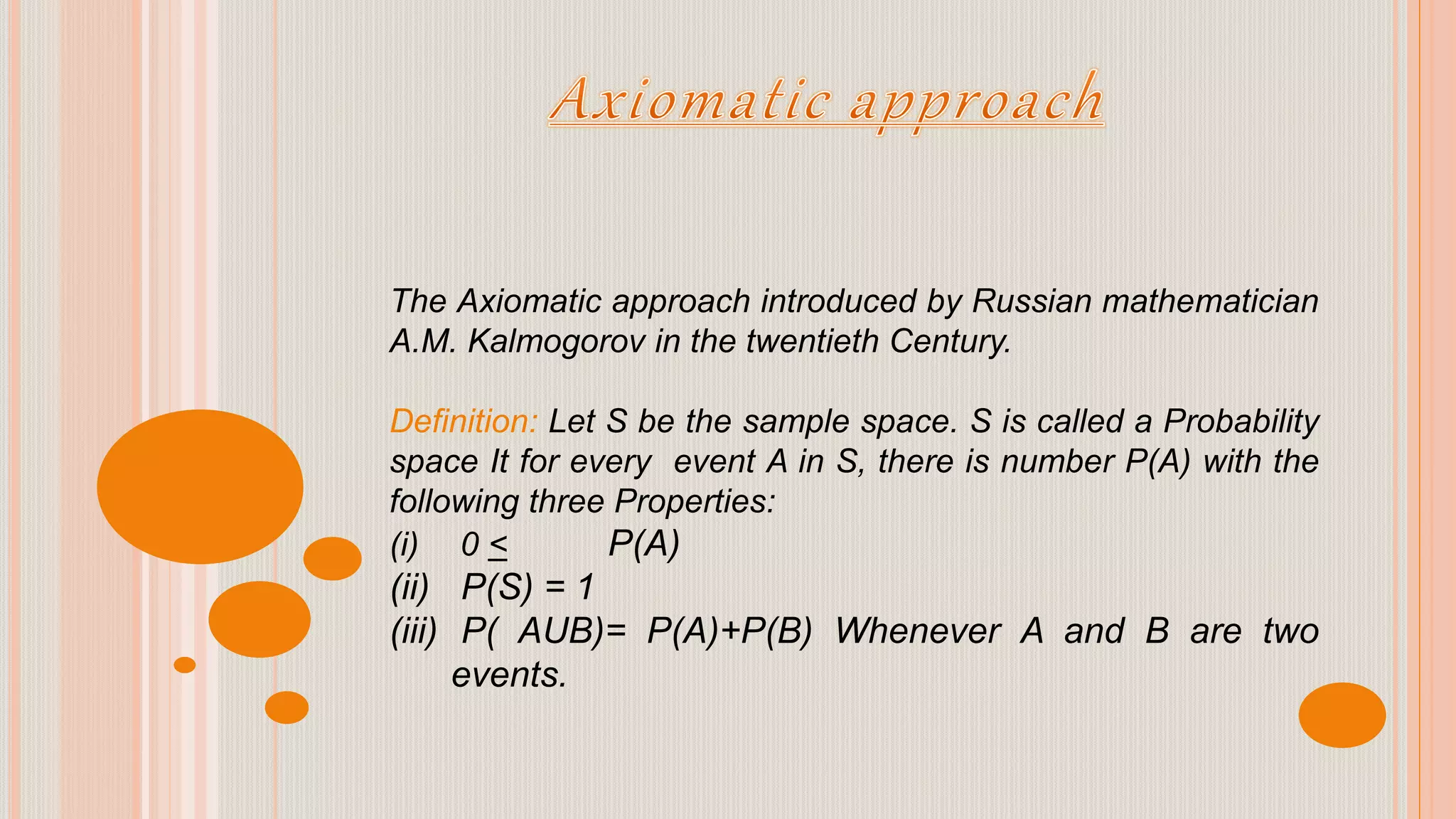
The Axiomatic approach introduced by Russian mathematician
A.M. Kalmogorov in the twentieth Century.
Definition: Let S be the sample space. S is called a Probability
space It for every event A in S, there is number P(A) with the
following three Properties:
(i) 0 < P(A)
(ii) P(S) = 1
(iii) P( AUB)= P(A)+P(B) Whenever A and B are two
events.
IMPORTANCE OF PROBABILITY
PROBABILITY THEORY HAS BEEN DEVELOPED AND
EMPLOYED TO TREAT AND SOLVE MY WEIGHTED
PROBLEMS.
PROBABILITY IS THE FOUNDATION OF THE CLASSICAL
DECISION PROCEDURES OF ESTIMATION AND TESTING.
PROBABILITY MODELS CAN BE VERY USEFUL FOR
MAKING ANY PREDICTIONS.
MUTUALLY EXCLUSIVE EVENTS
TWO EVENTS ARE SAID TO BE MUTUALLY EXCLUSIVE
EVENTS OR DISJOINT EVENTS WHEN EVENTS CANNOT
HAPPENS SIMULTANEOUSLY IN A SINGLE TRAIL.
EXAMPLE :-IF A SINGLE COIN IS TOSSED EITHER HEAD
CAN BE UP OR TAIL CAN BE UP, BOTH CANNOT BE UP AT
THE SAME TIME.
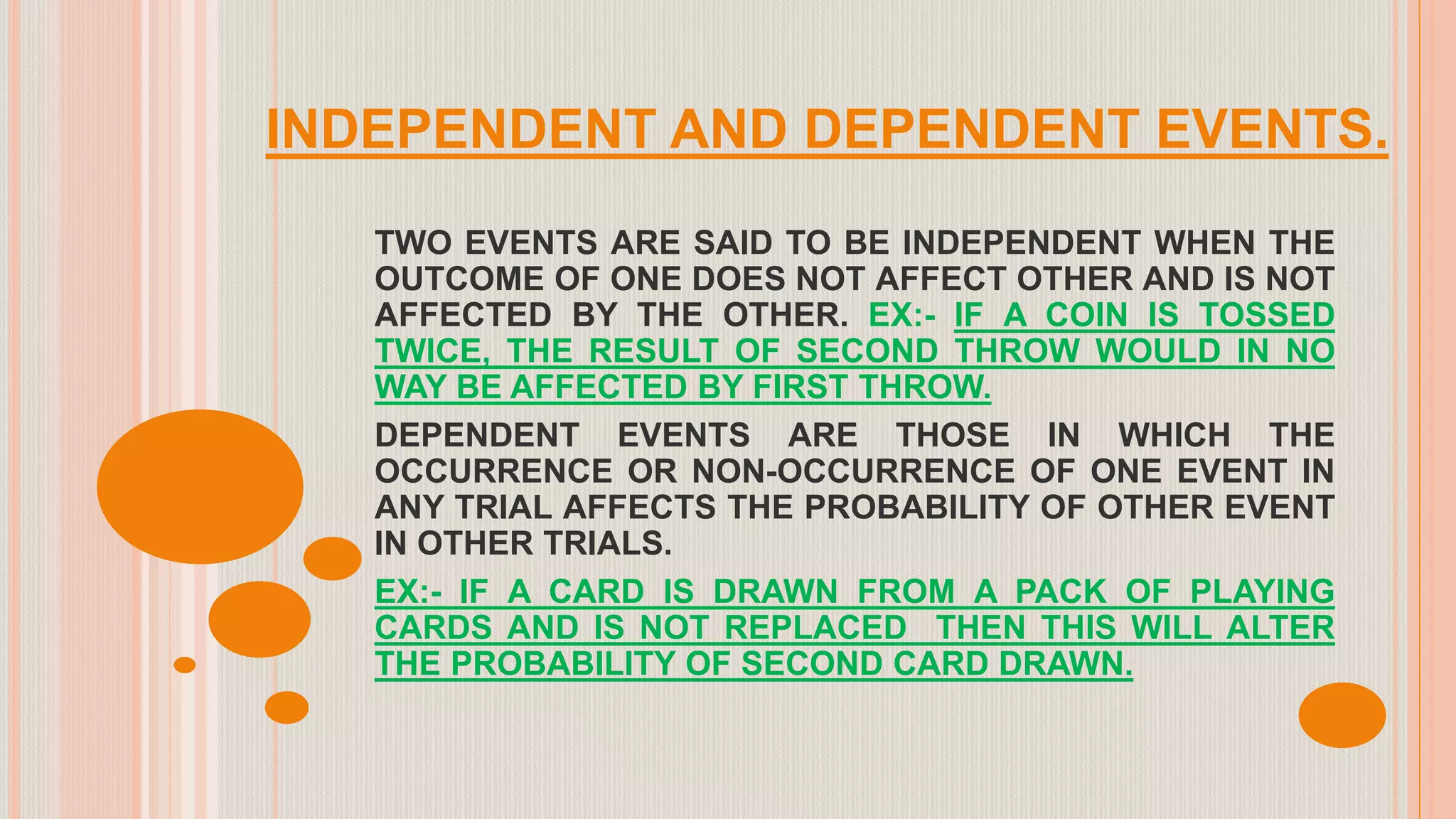
INDEPENDENT AND DEPENDENT EVENTS.
TWO EVENTS ARE SAID TO BE INDEPENDENT WHEN THE
OUTCOME OF ONE DOES NOT AFFECT OTHER AND IS NOT
AFFECTED BY THE OTHER. EX:- IF A COIN IS TOSSED
TWICE, THE RESULT OF SECOND THROW WOULD IN NO
WAY BE AFFECTED BY FIRST THROW.
DEPENDENT EVENTS ARE THOSE IN WHICH THE
OCCURRENCE OR NON-OCCURRENCE OF ONE EVENT IN
ANY TRIAL AFFECTS THE PROBABILITY OF OTHER EVENT
IN OTHER TRIALS.
EX:- IF A CARD IS DRAWN FROM A PACK OF PLAYING
CARDS AND IS NOT REPLACED THEN THIS WILL ALTER
THE PROBABILITY OF SECOND CARD DRAWN.
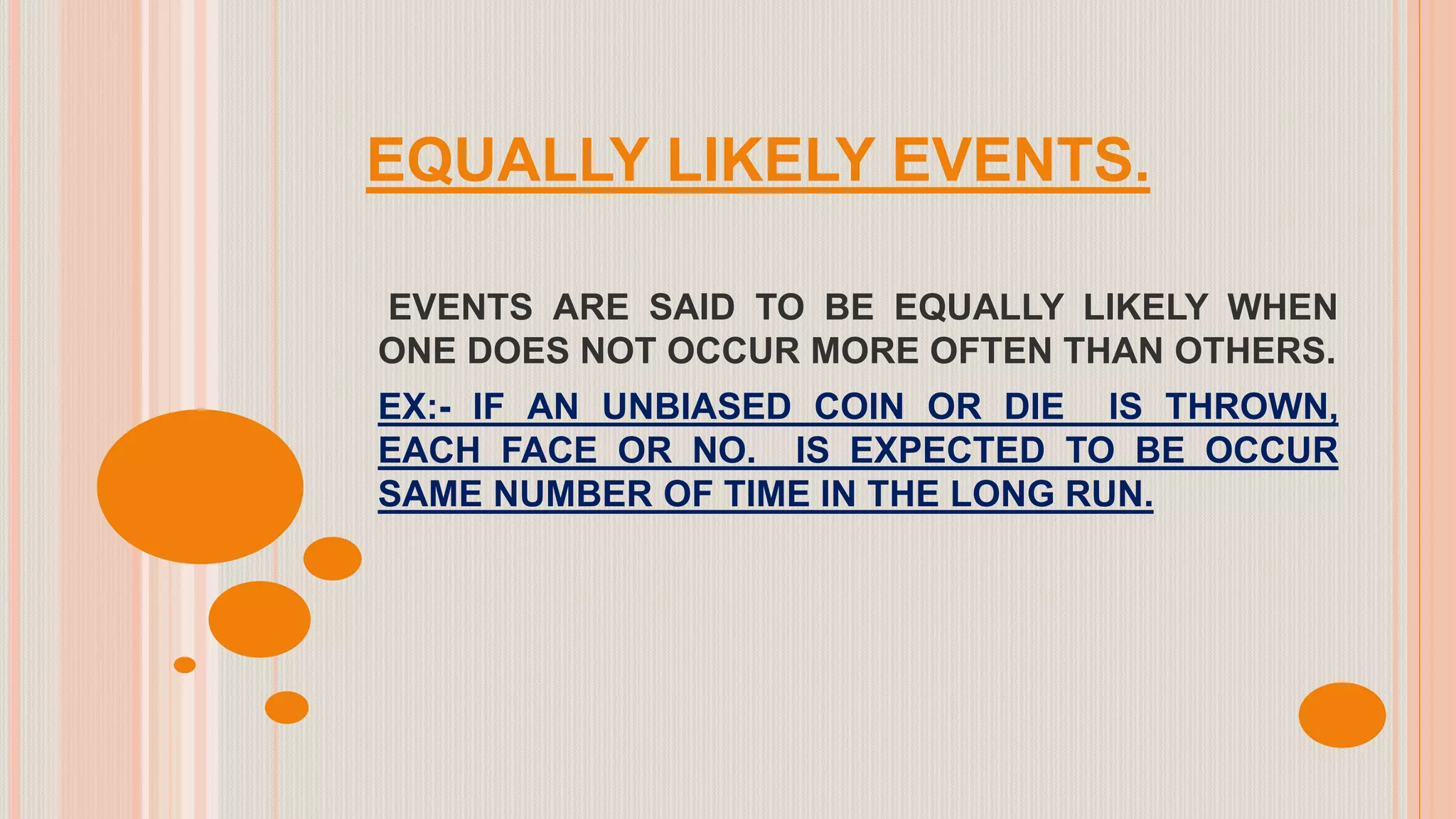
EQUALLY LIKELY EVENTS.
EVENTS ARE SAID TO BE EQUALLY LIKELY WHEN
ONE DOES NOT OCCUR MORE OFTEN THAN OTHERS.
EX:- IF AN UNBIASED COIN OR DIE IS THROWN,
EACH FACE OR NO. IS EXPECTED TO BE OCCUR
SAME NUMBER OF TIME IN THE LONG RUN.
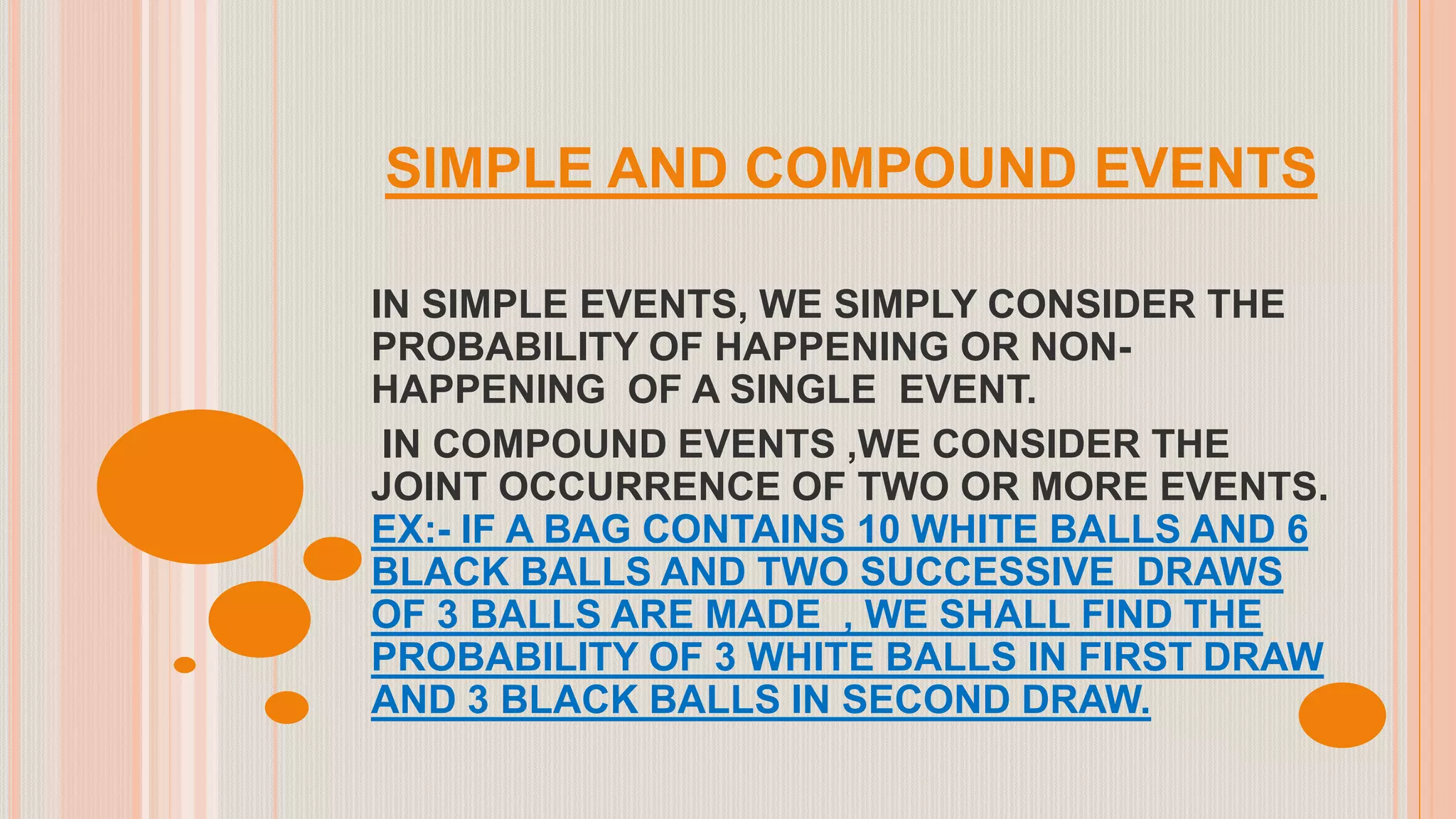
SIMPLE AND COMPOUND EVENTS
IN SIMPLE EVENTS, WE SIMPLY CONSIDER THE
PROBABILITY OF HAPPENING OR NON-
HAPPENING OF A SINGLE EVENT.
IN COMPOUND EVENTS ,WE CONSIDER THE
JOINT OCCURRENCE OF TWO OR MORE EVENTS.
EX:- IF A BAG CONTAINS 10 WHITE BALLS AND 6
BLACK BALLS AND TWO SUCCESSIVE DRAWS
OF 3 BALLS ARE MADE , WE SHALL FIND THE
PROBABILITY OF 3 WHITE BALLS IN FIRST DRAW
AND 3 BLACK BALLS IN SECOND DRAW.
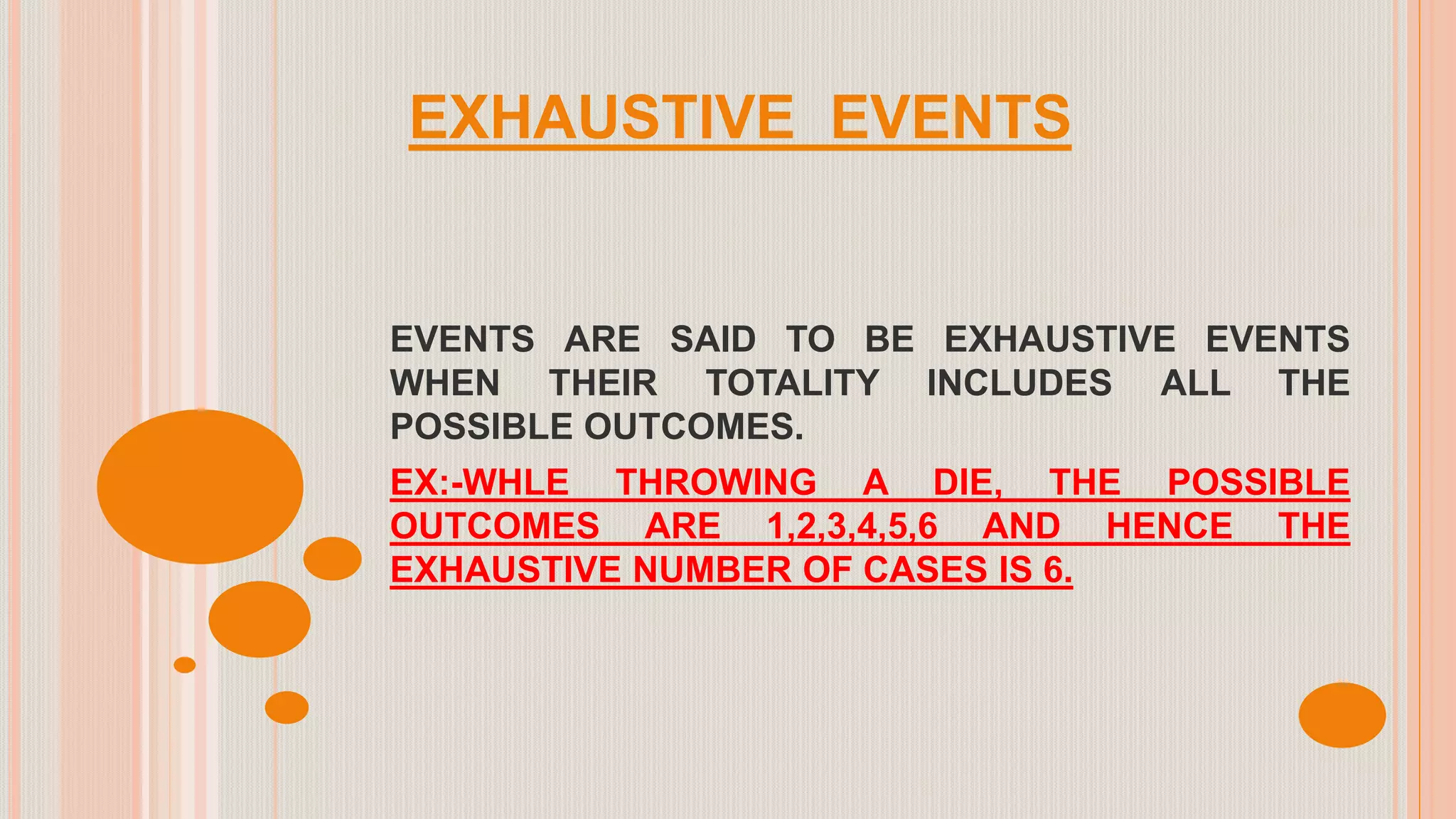
EXHAUSTIVE EVENTS
EVENTS ARE SAID TO BE EXHAUSTIVE EVENTS
WHEN THEIR TOTALITY INCLUDES ALL THE
POSSIBLE OUTCOMES.
EX:-WHLE THROWING A DIE, THE POSSIBLE
OUTCOMES ARE 1,2,3,4,5,6 AND HENCE THE
EXHAUSTIVE NUMBER OF CASES IS 6.
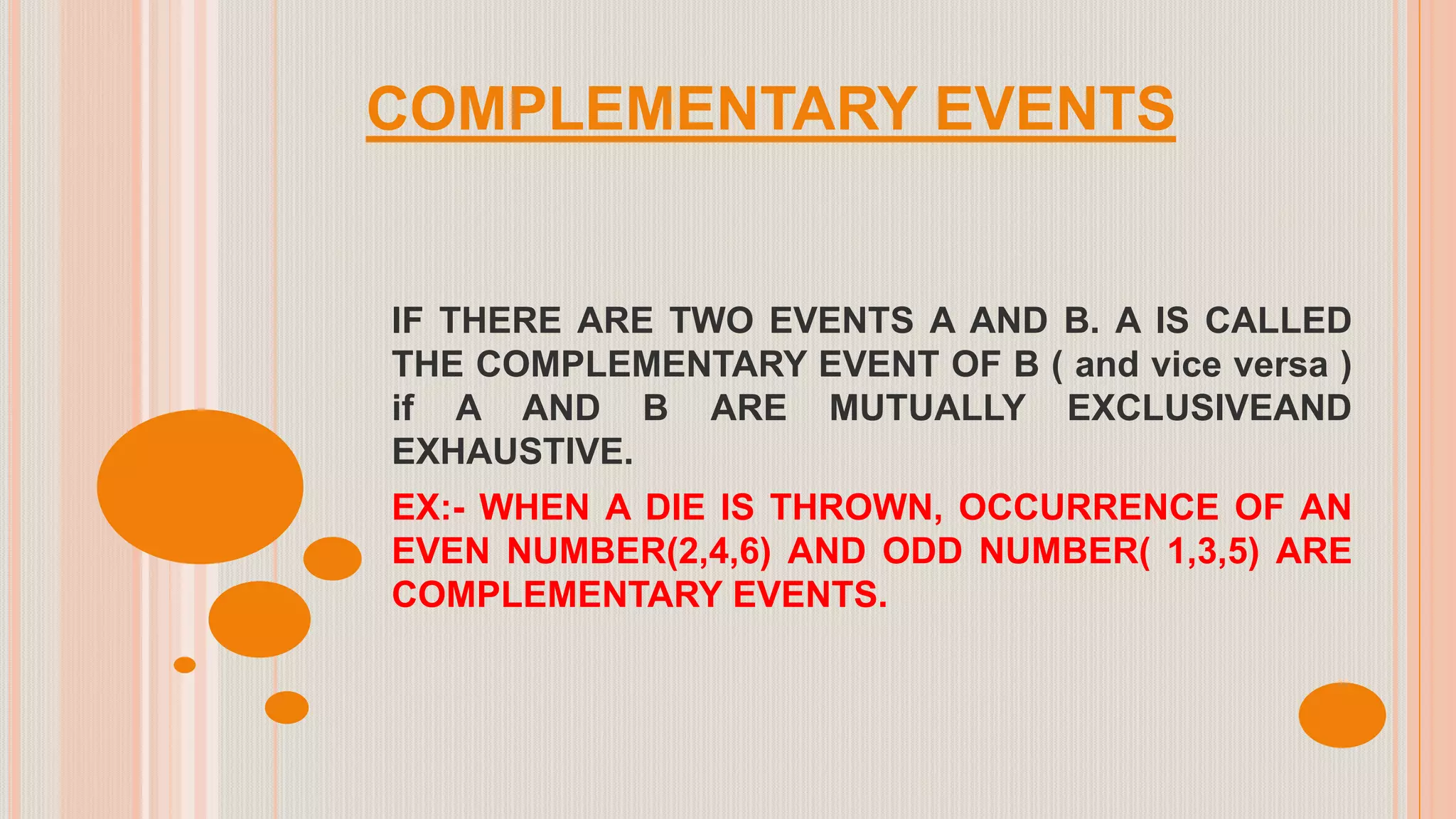
COMPLEMENTARY EVENTS
IF THERE ARE TWO EVENTS A AND B. A IS CALLED
THE COMPLEMENTARY EVENT OF B ( and vice versa )
if A AND B ARE MUTUALLY EXCLUSIVEAND
EXHAUSTIVE.
EX:- WHEN A DIE IS THROWN, OCCURRENCE OF AN
EVEN NUMBER(2,4,6) AND ODD NUMBER( 1,3,5) ARE
COMPLEMENTARY EVENTS.
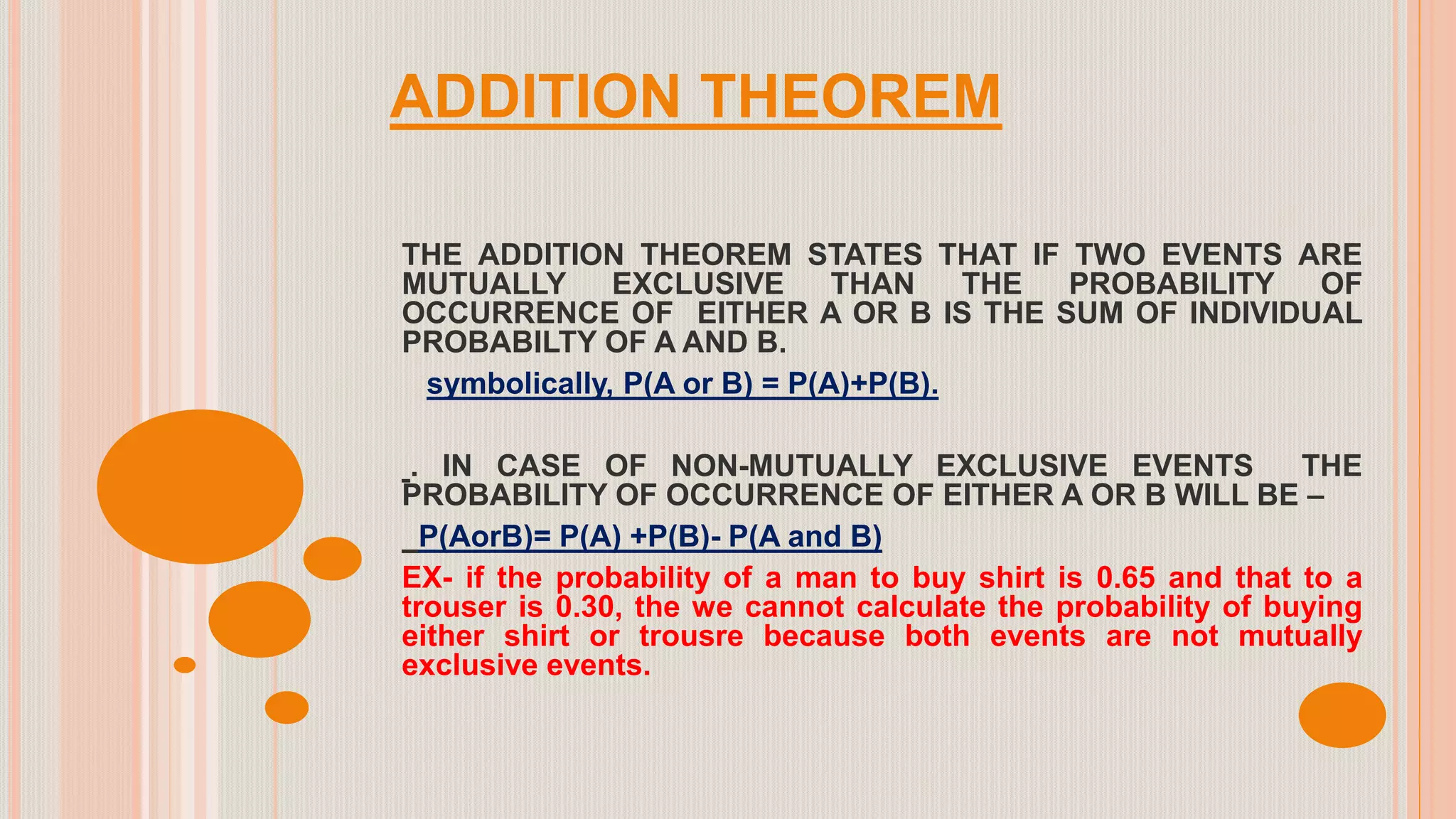
ADDITION THEOREM
THE ADDITION THEOREM STATES THAT IF TWO EVENTS ARE
MUTUALLY EXCLUSIVE THAN THE PROBABILITY OF
OCCURRENCE OF EITHER A OR B IS THE SUM OF INDIVIDUAL
PROBABILTY OF A AND B.
symbolically, P(A or B) = P(A)+P(B).
. IN CASE OF NON-MUTUALLY EXCLUSIVE EVENTS THE
PROBABILITY OF OCCURRENCE OF EITHER A OR B WILL BE –
P(AorB)= P(A) +P(B)- P(A and B)
EX- if the probability of a man to buy shirt is 0.65 and that to a
trouser is 0.30, the we cannot calculate the probability of buying
either shirt or trousre because both events are not mutually
exclusive events.
CONDITIONAL PROBABILITY
Is the probability of an event occurring
given that another event has already
occurred. The conditional probability of
event B occurring, given that event A has
occurred, is denoted by P(B|A) and is read
as “probability of B, given A.”
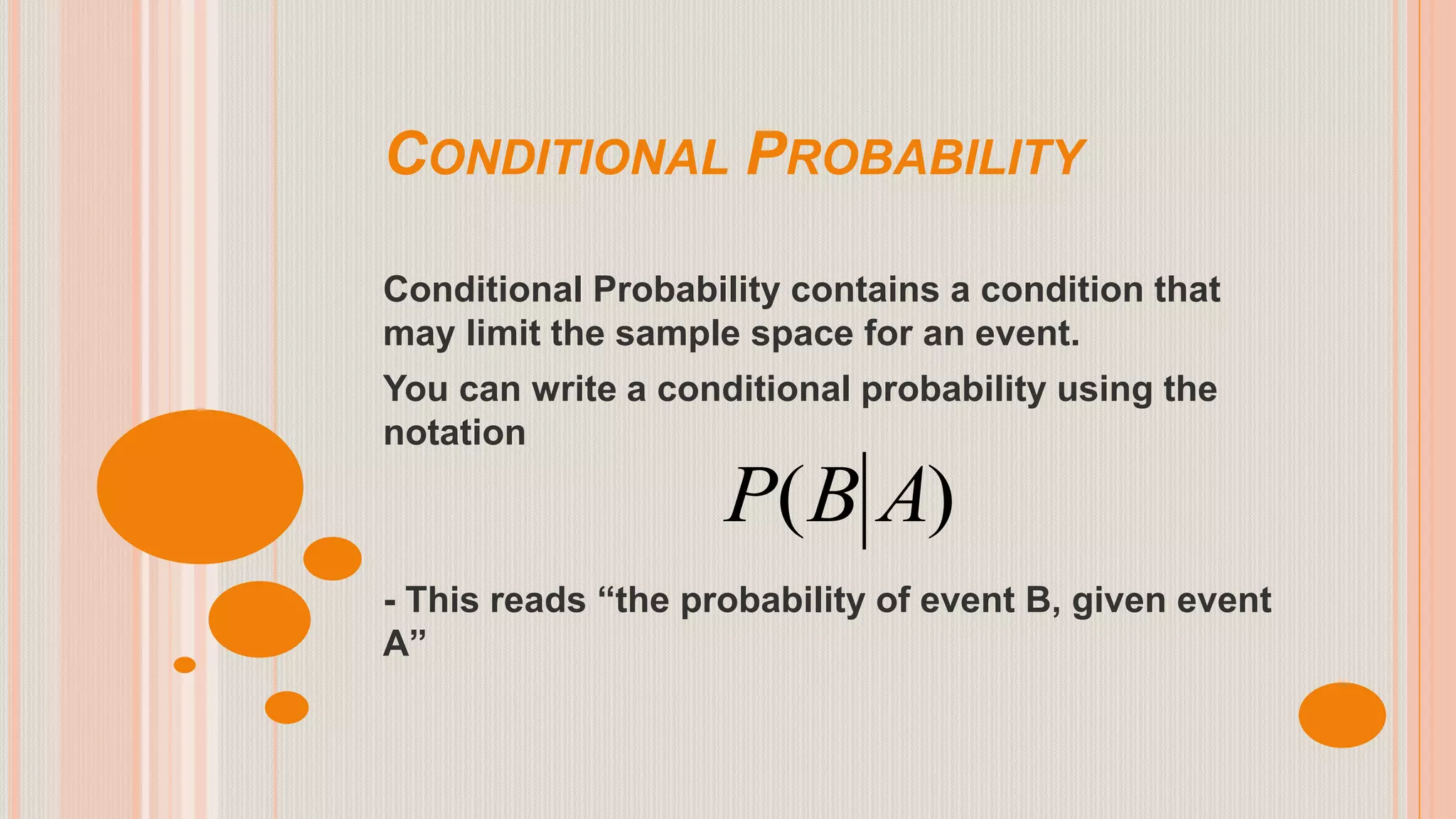
CONDITIONAL PROBABILITY
Conditional Probability contains a condition that
may limit the sample space for an event.
You can write a conditional probability using the
notation
- This reads “the probability of event B, given event
A”
)( ABP
INDEPENDENT AND DEPENDENT
EVENTS
The question of the interdependence of two or more
events is important to researchers in fields such as
marketing, medicine, and psychology. You can use
conditional probabilities to determine whether
events are independent or dependent.
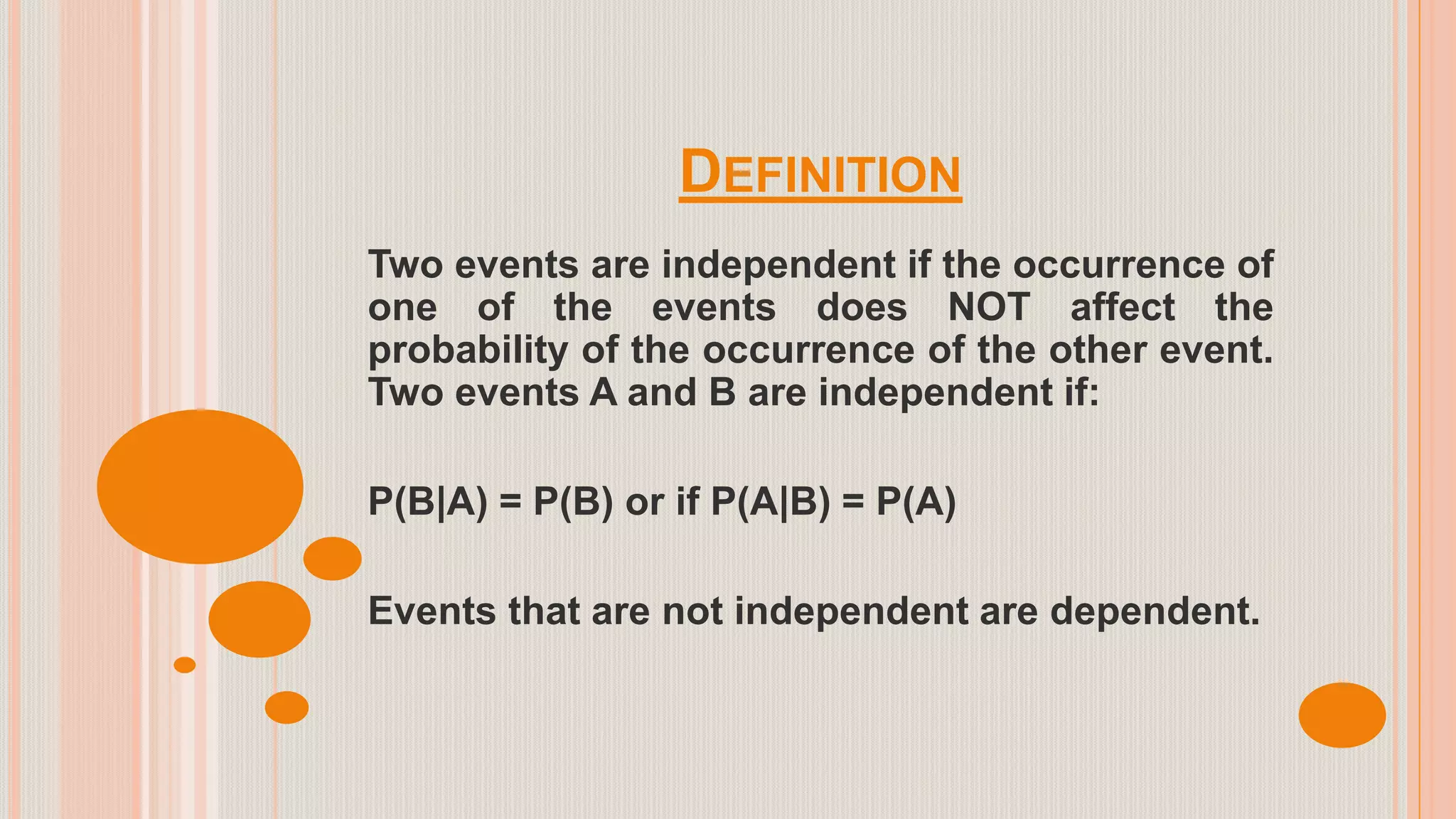
DEFINITION
Two events are independent if the occurrence of
one of the events does NOT affect the
probability of the occurrence of the other event.
Two events A and B are independent if:
P(B|A) = P(B) or if P(A|B) = P(A)
Events that are not independent are dependent.
CLASSIFYING EVENTS AS
INDEPENDENT OR DEPENDENT
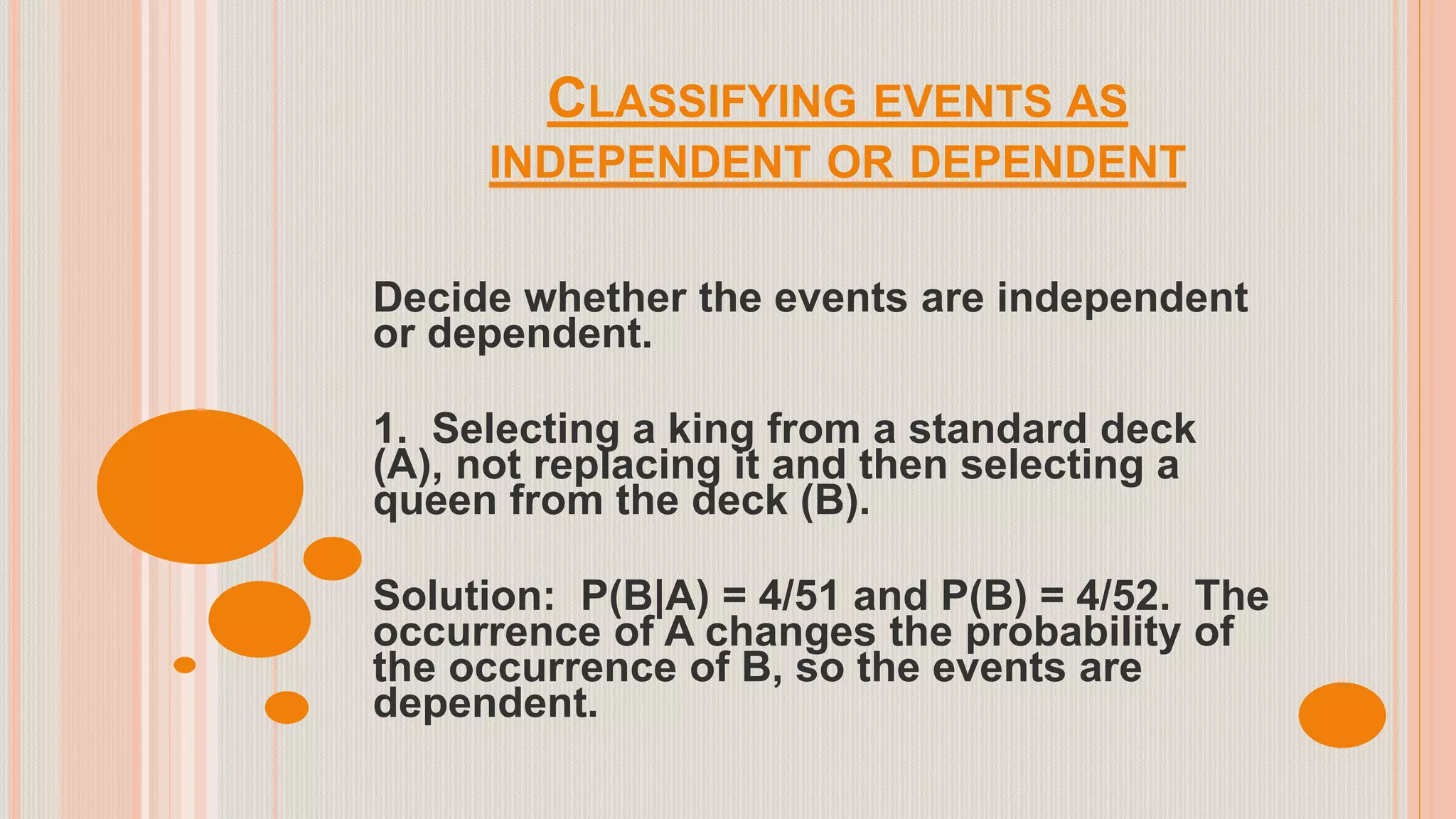
Decide whether the events are independent
or dependent.
1. Selecting a king from a standard deck
(A), not replacing it and then selecting a
queen from the deck (B).
Solution: P(B|A) = 4/51 and P(B) = 4/52. The
occurrence of A changes the probability of
the occurrence of B, so the events are
dependent.
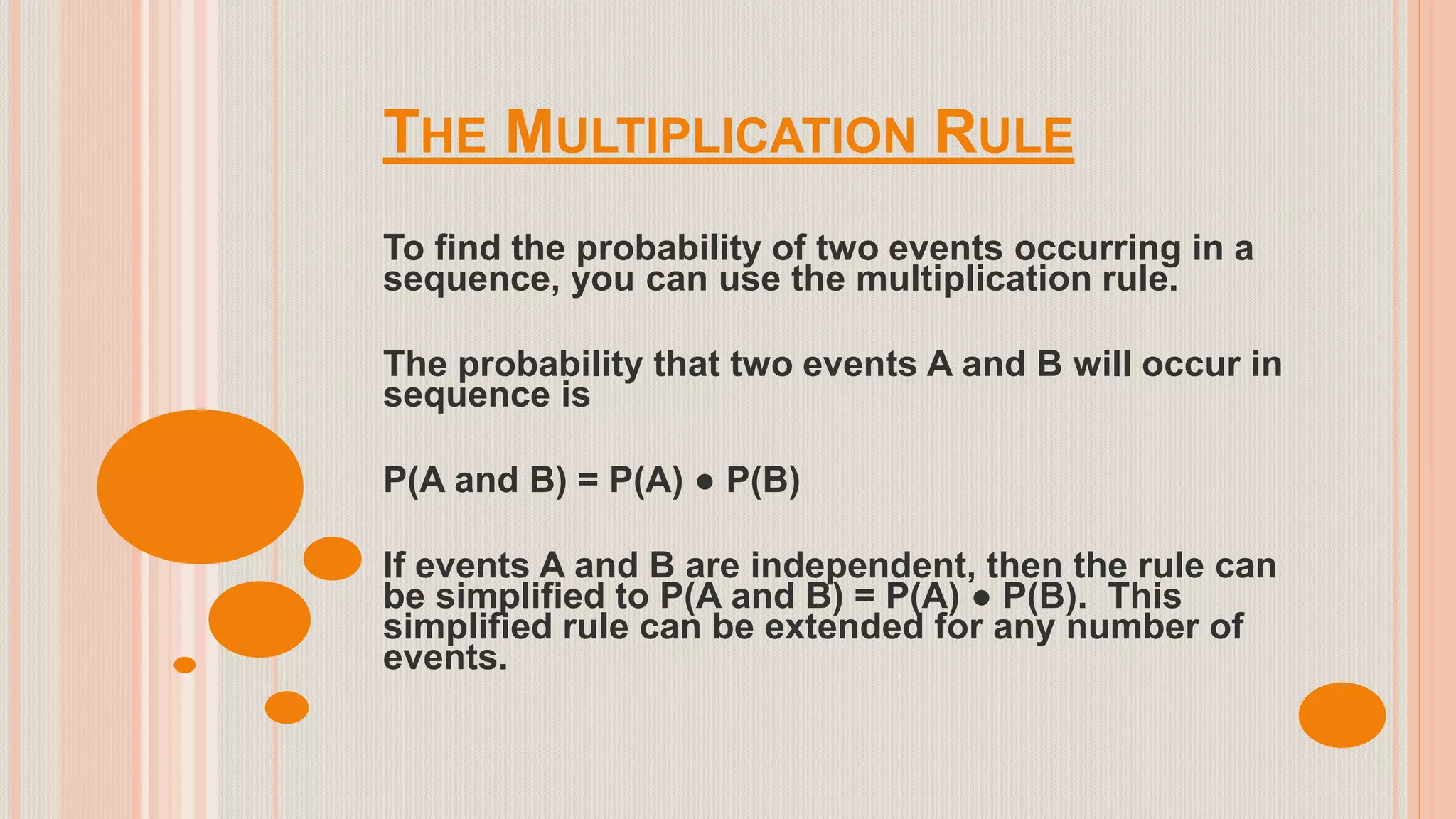
THE MULTIPLICATION RULE
To find the probability of two events occurring in a
sequence, you can use the multiplication rule.
The probability that two events A and B will occur in
sequence is
P(A and B) = P(A) ● P(B)
If events A and B are independent, then the rule can
be simplified to P(A and B) = P(A) ● P(B). This
simplified rule can be extended for any number of
events.
USING THE MULTIPLICATION RULE TO
FIND PROBABILITIES
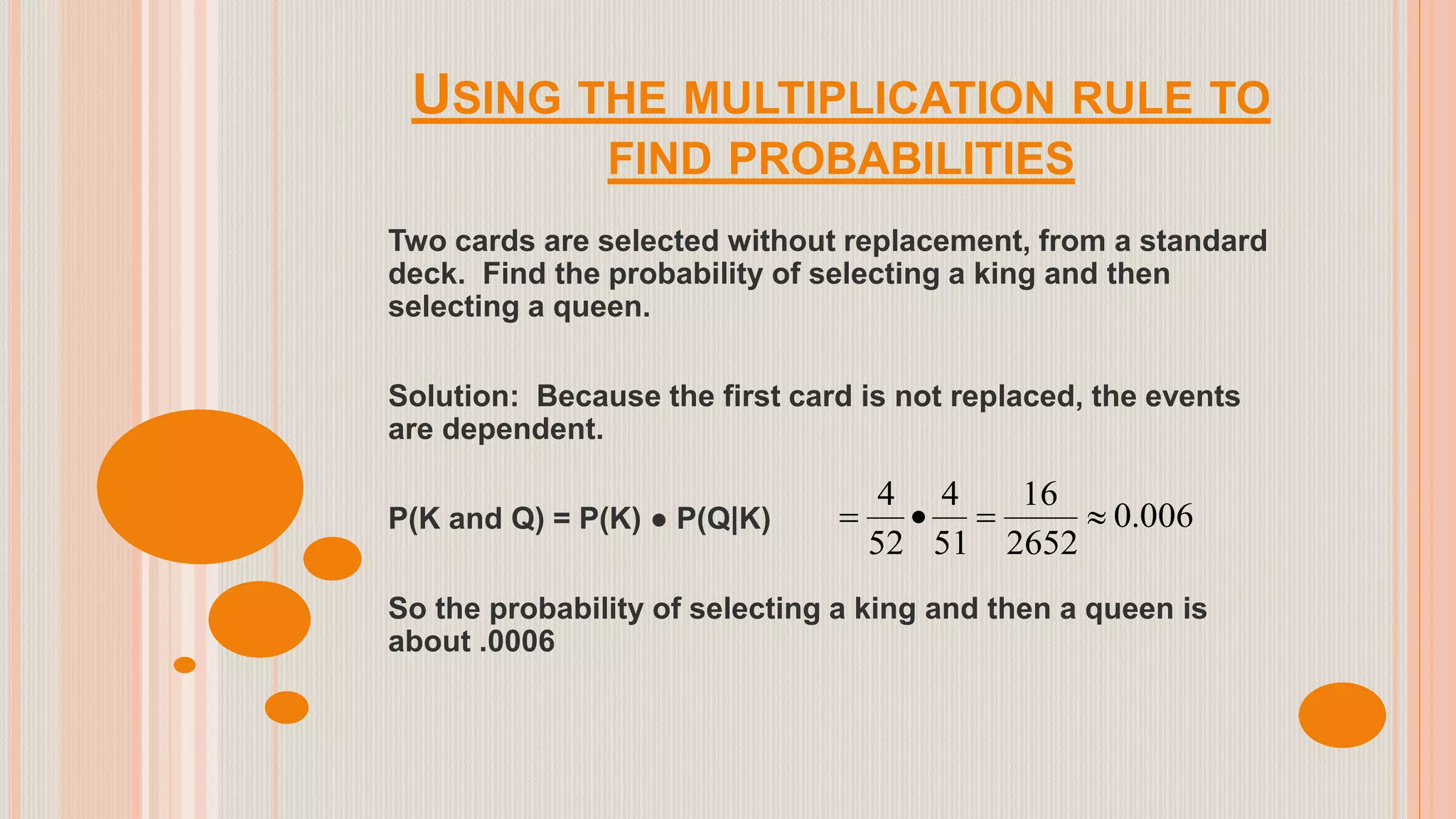
Two cards are selected without replacement, from a standard
deck. Find the probability of selecting a king and then
selecting a queen.
Solution: Because the first card is not replaced, the events
are dependent.
P(K and Q) = P(K) ● P(Q|K)
So the probability of selecting a king and then a queen is
about .0006
006.0
2652
16
51
4
52
4

USING THE MULTIPLICATION RULE TO
FIND PROBABILITIES
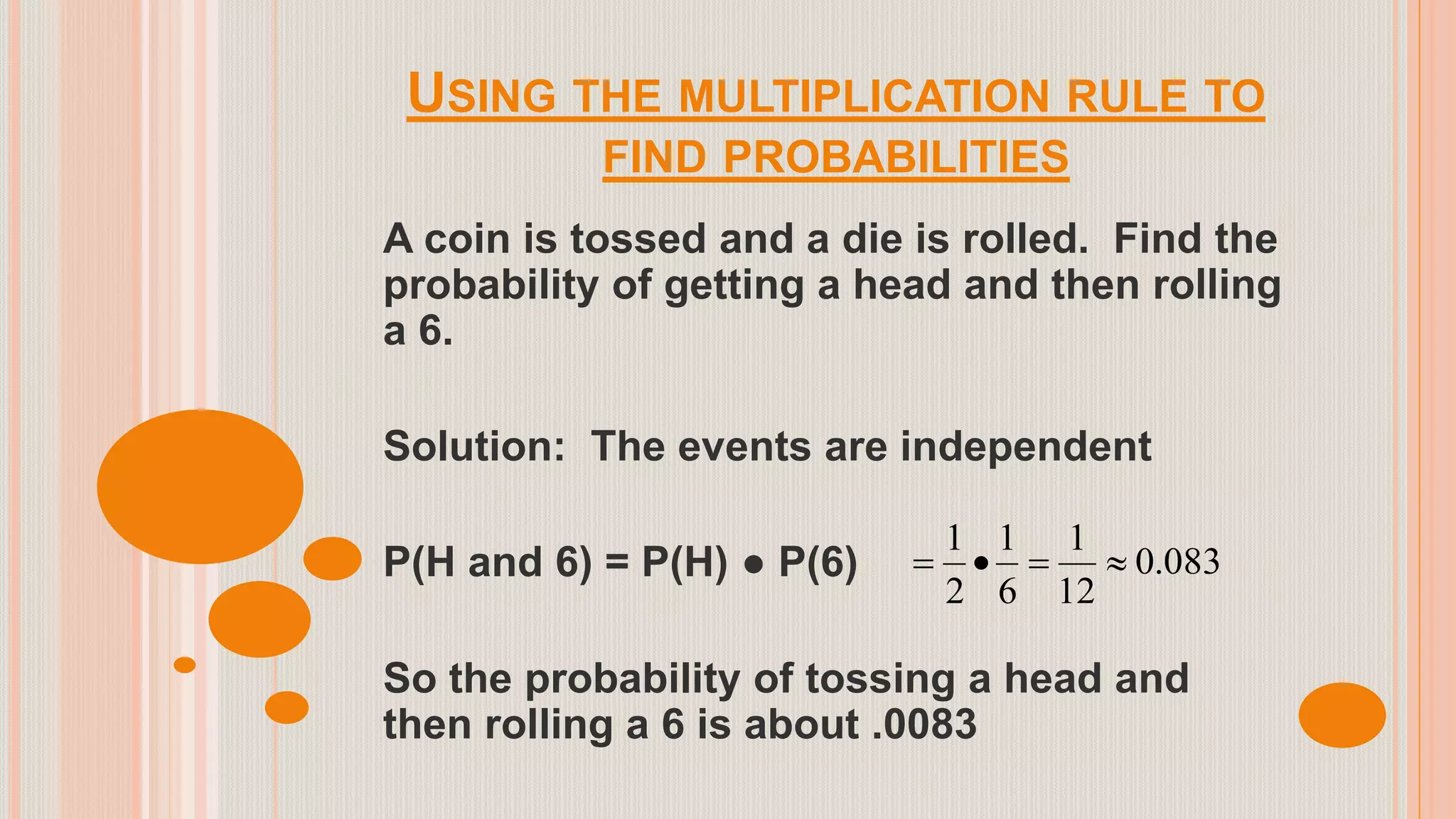
A coin is tossed and a die is rolled. Find the
probability of getting a head and then rolling
a 6.
Solution: The events are independent
P(H and 6) = P(H) ● P(6)
So the probability of tossing a head and
then rolling a 6 is about .0083
083.0
12
1
6
1
2
1

USING THE MULTIPLICATION RULE TO
FIND PROBABILITIES
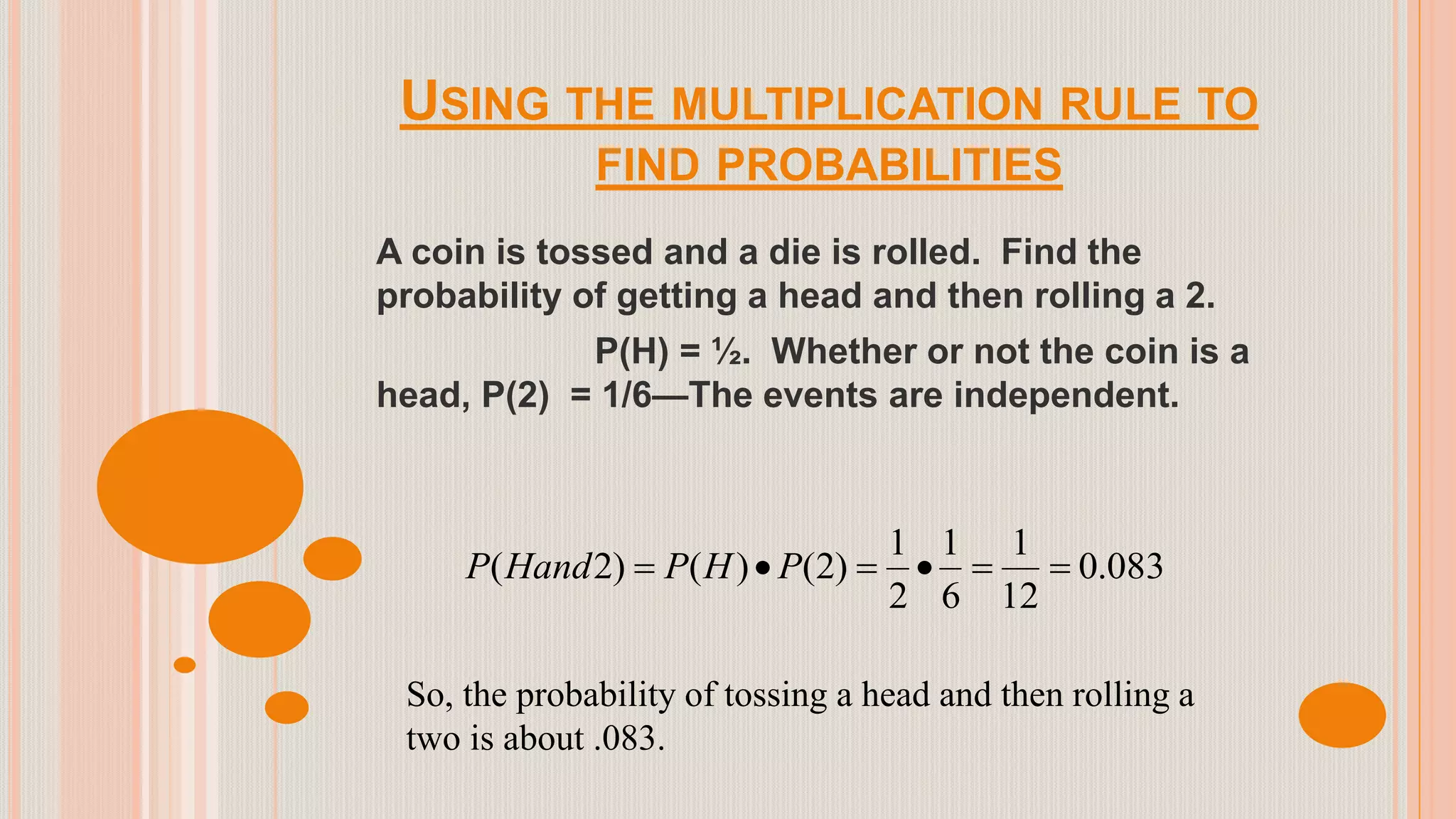
A coin is tossed and a die is rolled. Find the
probability of getting a head and then rolling a 2.
P(H) = ½. Whether or not the coin is a
head, P(2) = 1/6—The events are independent.
083.0
12
1
6
1
2
1
)2()()2(  PHPHandP
So, the probability of tossing a head and then rolling a
two is about .083.
Bayes’ Theorem
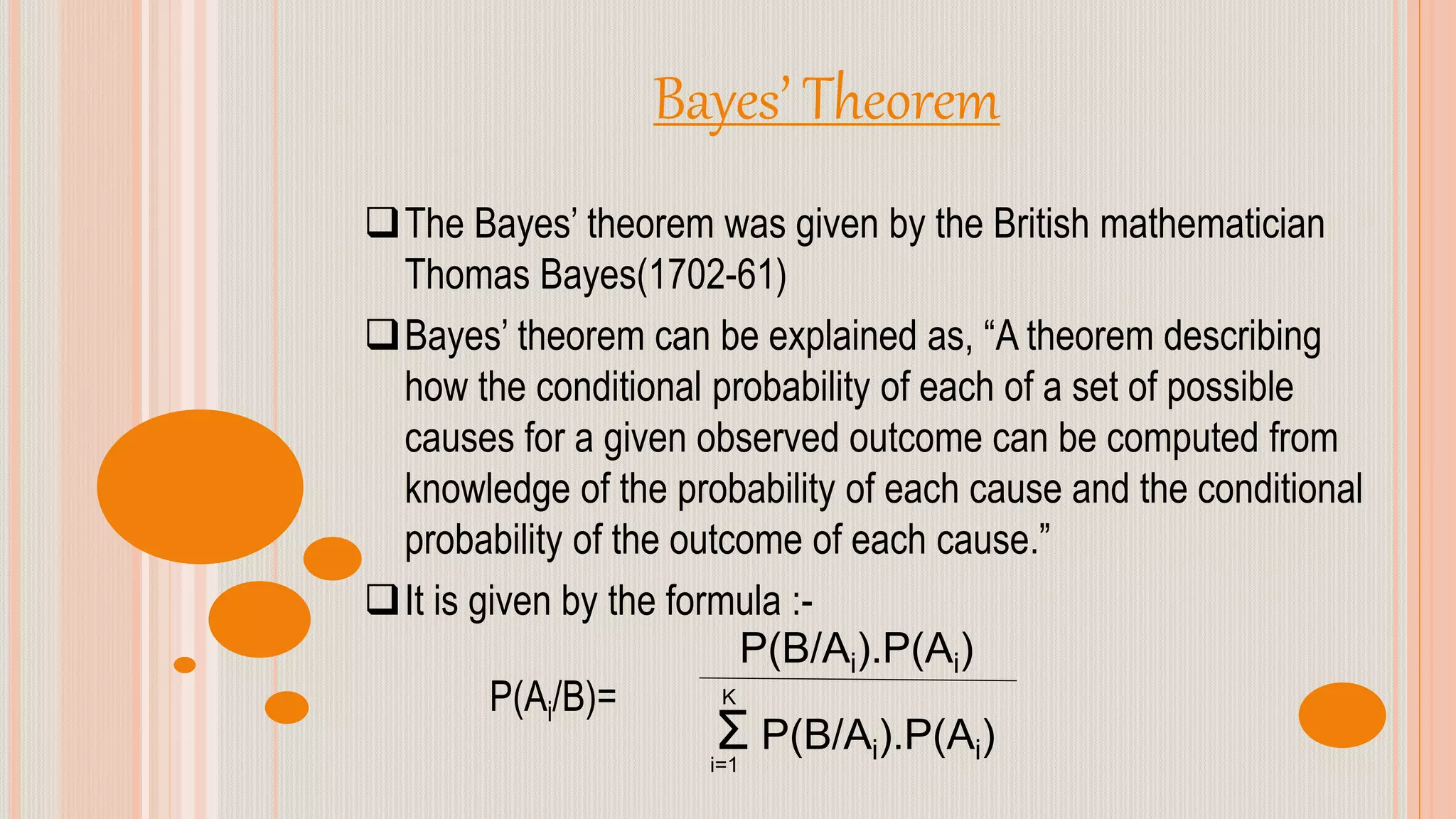
The Bayes’ theorem was given by the British mathematician
Thomas Bayes(1702-61)
Bayes’ theorem can be explained as, “A theorem describing
how the conditional probability of each of a set of possible
causes for a given observed outcome can be computed from
knowledge of the probability of each cause and the conditional
probability of the outcome of each cause.”
It is given by the formula :-
P(Ai/B)=
P(B/Ai).P(Ai)
Σ P(B/Ai).P(Ai)
K
i=1
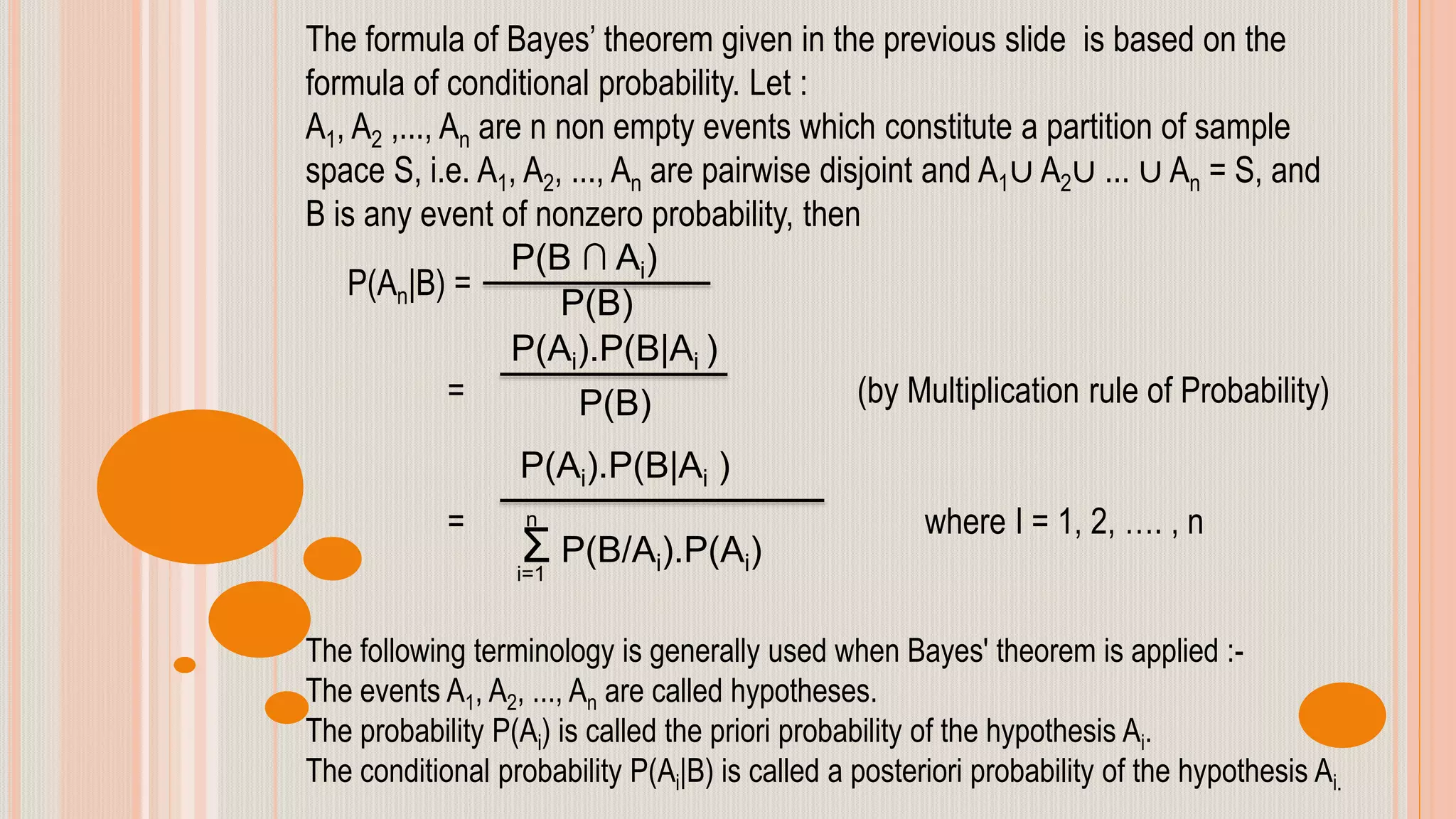
The formula of Bayes’ theorem given in the previous slide is based on the
formula of conditional probability. Let :
A1, A2 ,..., An are n non empty events which constitute a partition of sample
space S, i.e. A1, A2, ..., An are pairwise disjoint and A1∪ A2∪ ... ∪ An = S, and
B is any event of nonzero probability, then
P(An|B) =
= (by Multiplication rule of Probability)
= where I = 1, 2, …. , n
The following terminology is generally used when Bayes' theorem is applied :-
The events A1, A2, ..., An are called hypotheses.
The probability P(Ai) is called the priori probability of the hypothesis Ai.
The conditional probability P(Ai|B) is called a posteriori probability of the hypothesis Ai.
P(B ∩ Ai)
P(B)
P(Ai).P(B|Ai )
P(B)
P(Ai).P(B|Ai )
Σ P(B/Ai).P(Ai)
n
i=1
Problem
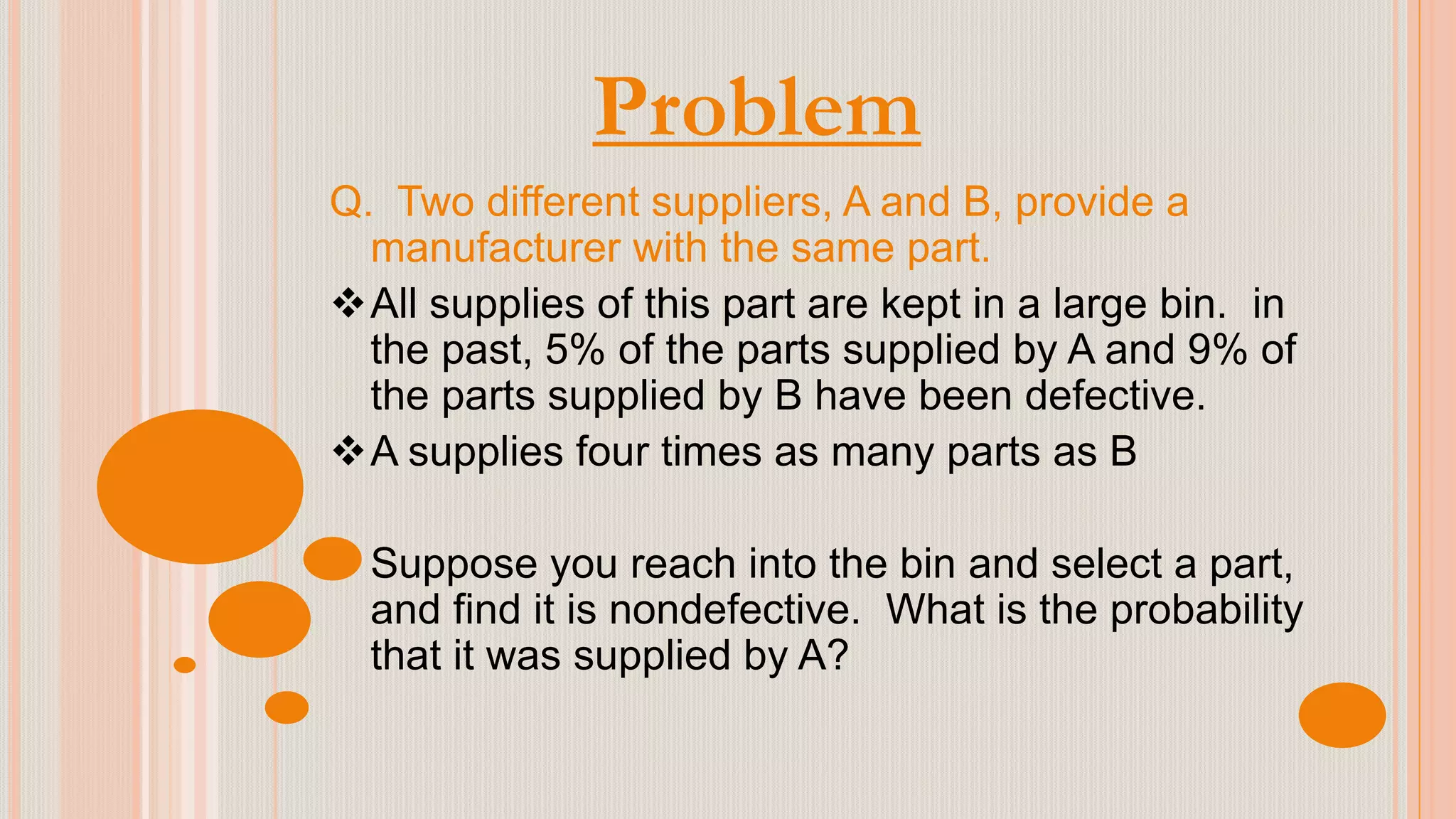
Q. Two different suppliers, A and B, provide a
manufacturer with the same part.
All supplies of this part are kept in a large bin. in
the past, 5% of the parts supplied by A and 9% of
the parts supplied by B have been defective.
A supplies four times as many parts as B
Suppose you reach into the bin and select a part,
and find it is nondefective. What is the probability
that it was supplied by A?
Solution
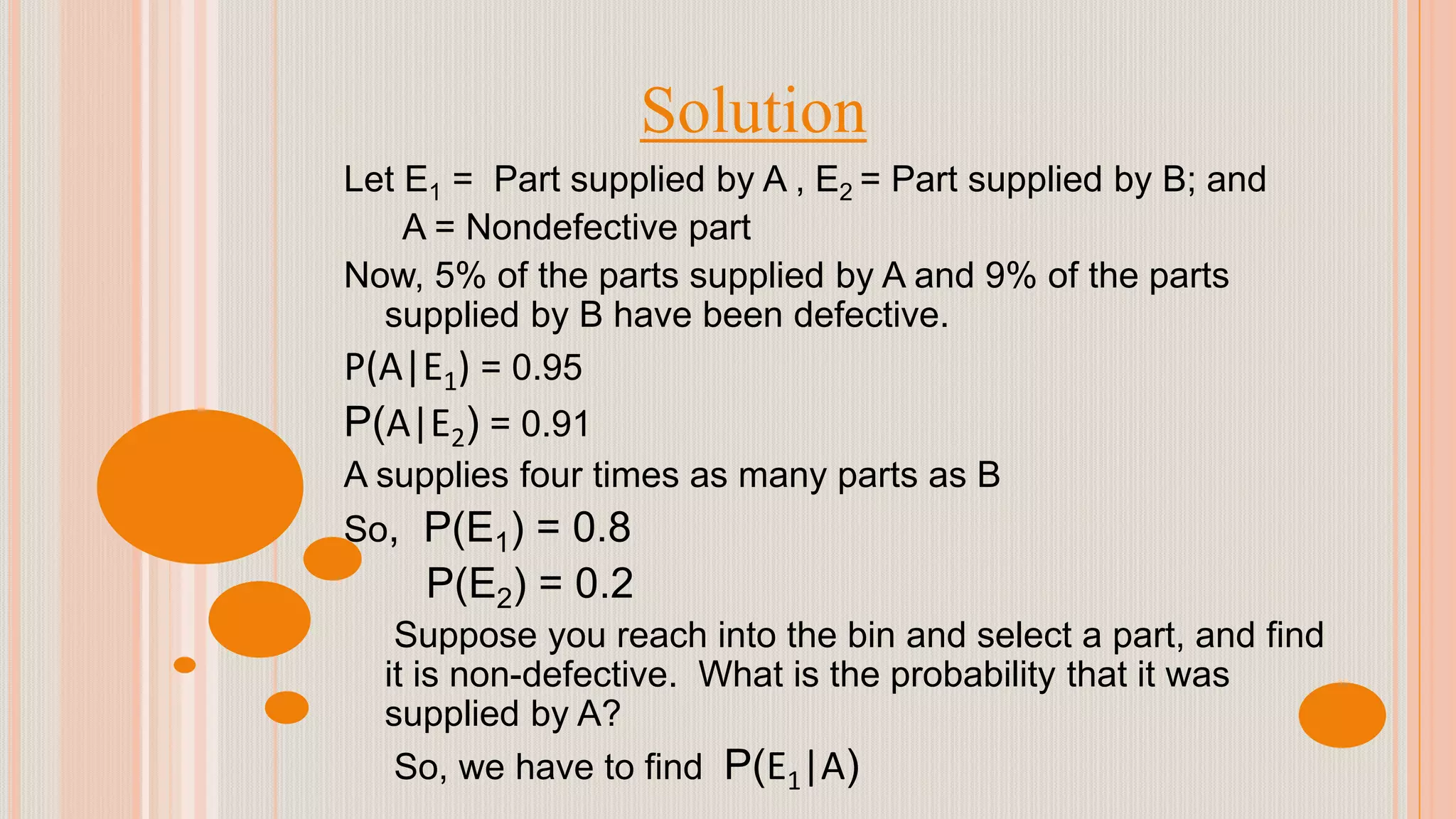
Let E1 = Part supplied by A , E2 = Part supplied by B; and
A = Nondefective part
Now, 5% of the parts supplied by A and 9% of the parts
supplied by B have been defective.
P(A|E1) = 0.95
P(A|E2) = 0.91
A supplies four times as many parts as B
So, P(E1) = 0.8
P(E2) = 0.2
Suppose you reach into the bin and select a part, and find
it is non-defective. What is the probability that it was
supplied by A?
So, we have to find P(E1|A)
Solution (cont.)
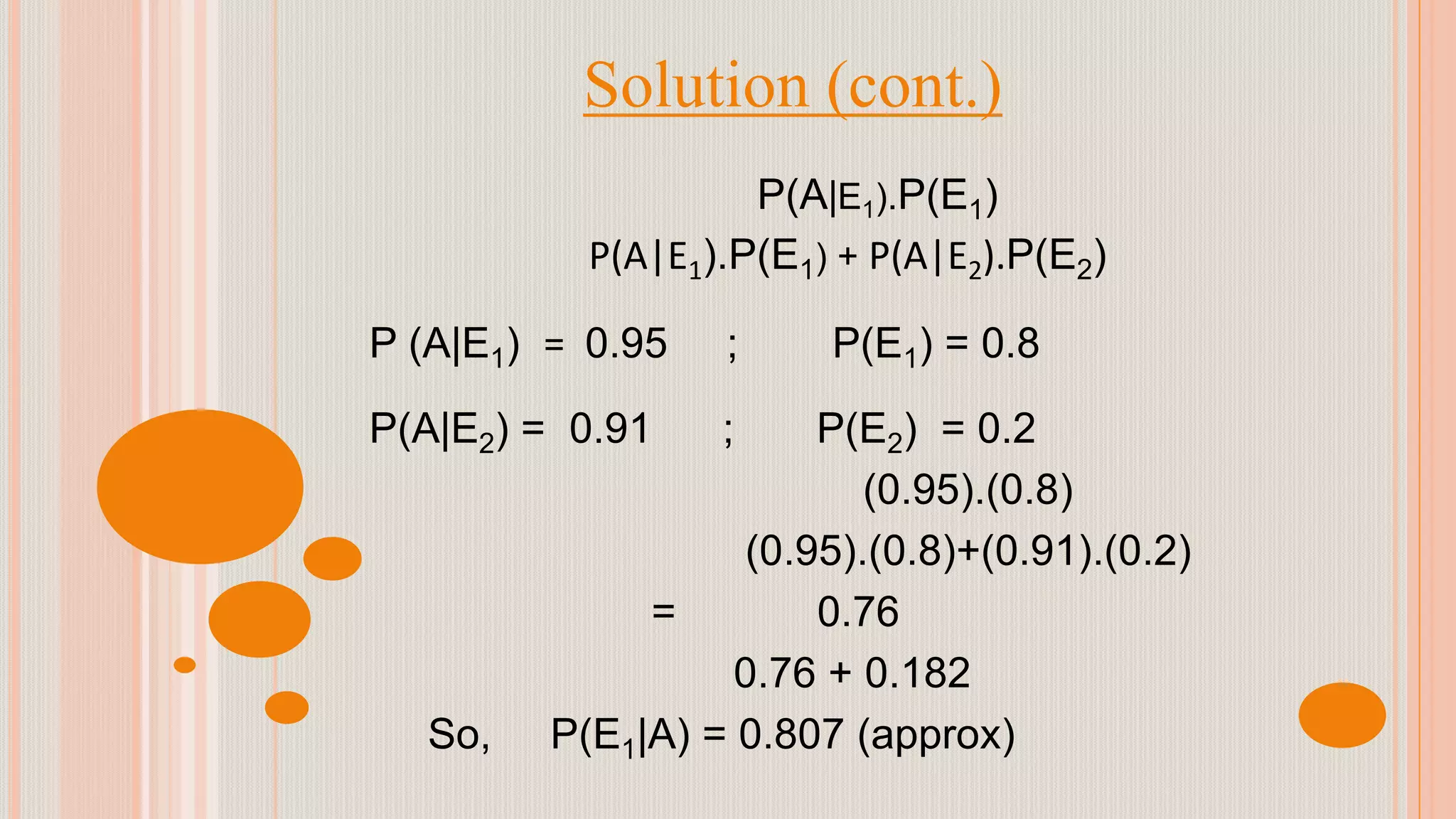
P(A|E1).P(E1)
P(A|E1).P(E1) + P(A|E2).P(E2)
P (A|E1) = 0.95 ; P(E1) = 0.8
P(A|E2) = 0.91 ; P(E2) = 0.2
(0.95).(0.8)
(0.95).(0.8)+(0.91).(0.2)
= 0.76
0.76 + 0.182
So, P(E1|A) = 0.807 (approx)
Random Variable and
Probability Distribution
 A variable whose value is determined by the outcome of a
random experiment is called a random variable. It is also
known as a chance variable or Stochastic variable.
 In terms of symbols if a variable X can assume discrete
set of values X1, X2, …., Xn with respective probabilities
p1, p2, …., pn where p1 + p2 + …. + pn =1, we say that
discrete probability distribution for X has been defined.
The function P(X) which has the respective values p1, p2,
…., pn for X = X1, X2, …., Xn is called the probability
function or frequency function of X.
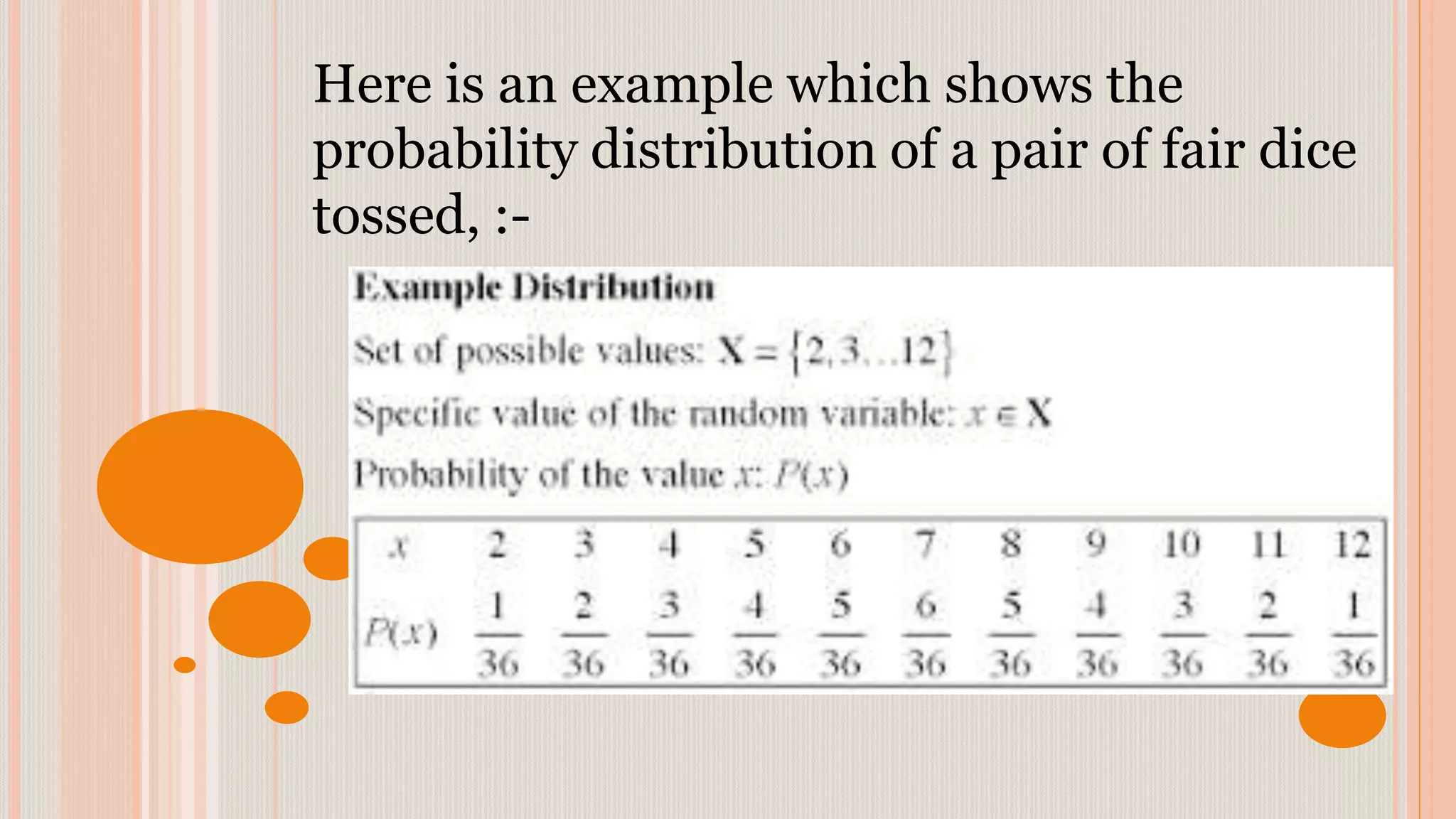
Here is an example which shows the
probability distribution of a pair of fair dice
tossed, :-
Mathematical Expectation
The mathematical expectation, also called
the expected value, of a random variable is
the weighted arithmetic mean of the variable,
where, the weights used to find the
mathematical expectation are all the
respective probabilities of the values that the
variable can possibly assume.
If X denotes a discrete random variable which
can assume the values X1, X2,….., Xn, with
respective probabilities p1, p2,….., pn, where
p1+p2+…..+pn=1, the mathematical expectation
of X denoted by E(X) is defined as :
E(X) = p1X1 +p2X2 + ….. + pnXn.
Thus, the expected value equals the sum of each
particular value within the set (X) multiplied by
the probability that X equals that particular
value.
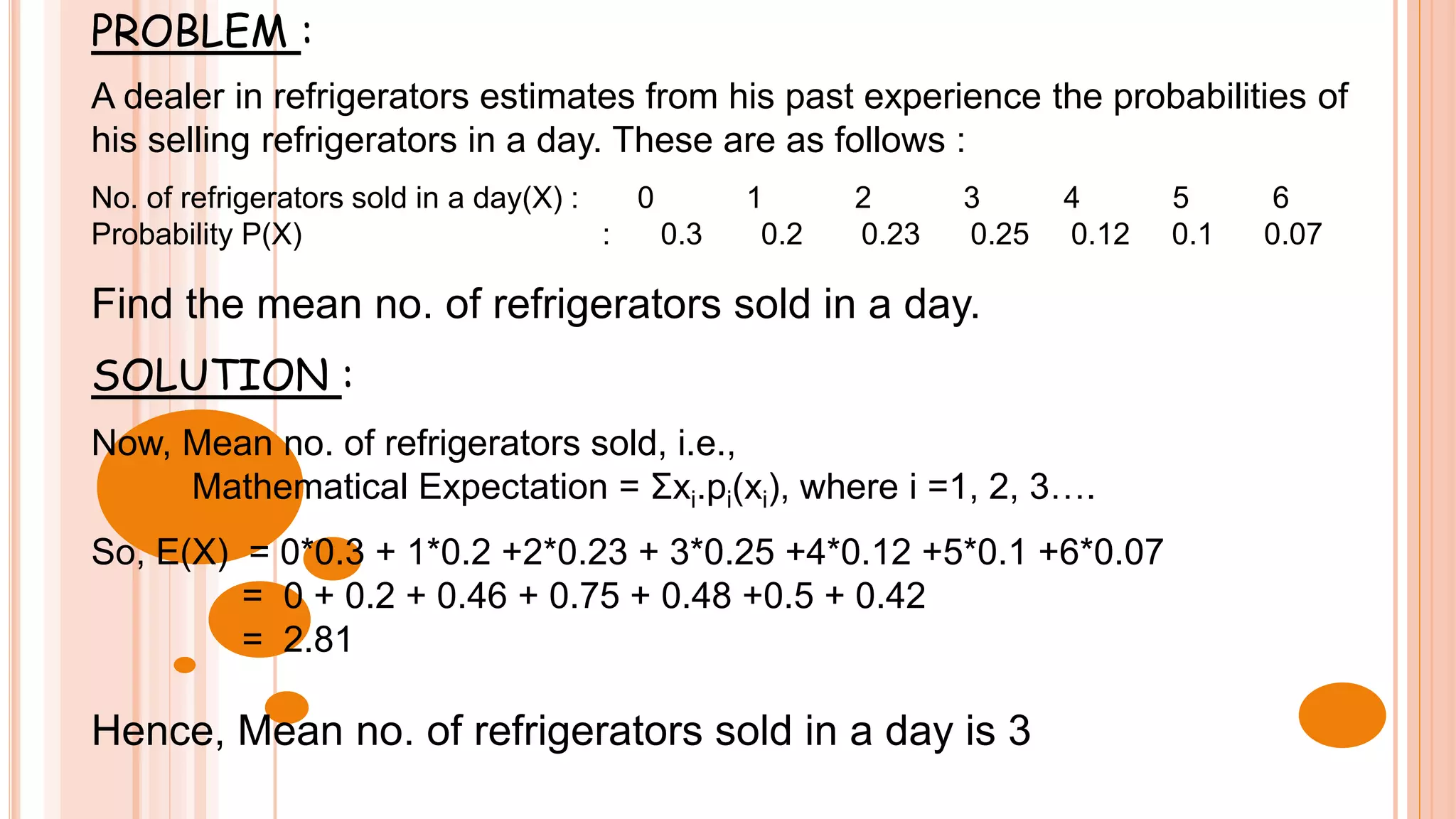
PROBLEM :
A dealer in refrigerators estimates from his past experience the probabilities of
his selling refrigerators in a day. These are as follows :
No. of refrigerators sold in a day(X) : 0 1 2 3 4 5 6
Probability P(X) : 0.3 0.2 0.23 0.25 0.12 0.1 0.07
Find the mean no. of refrigerators sold in a day.
SOLUTION :
Now, Mean no. of refrigerators sold, i.e.,
Mathematical Expectation = Σxi.pi(xi), where i =1, 2, 3….
So, E(X) = 0*0.3 + 1*0.2 +2*0.23 + 3*0.25 +4*0.12 +5*0.1 +6*0.07
= 0 + 0.2 + 0.46 + 0.75 + 0.48 +0.5 + 0.42
= 2.81
Hence, Mean no. of refrigerators sold in a day is 3
Made by:
Sachin Kumar
Krishan Sharma
Mohit Ostwal
Yugal Gupta (2003)

Introduction to Probability and Bayes' Theorom

  • 2.
    The Probability ofa given event is an expression of likelihood of occurrence of an event. A probability is a number which ranges from 0 (zero) to 1 (0ne) -- zero for an event which cannot occur and 1 for an event which is certain to occur. DEFINITION
  • 3.
     THE CLASSICALAPPROACH  RELATIVE FREQUENCY THEORY  SUBJECTIVE APPROACH  AXIOMATIC APPROACH
  • 4.
    The definition ofprobability given by disciples of the classical school runs as follows : “ Probability” it is said, is the ratio of the number of “favourable’ cases to the total number of equally likely cases. The term “equally likely”, though undefined, conveys the notion that each outcome of an experiment has the same chance of appearing as any other.
  • 5.
    If probability ofoccurrence of A is denoted by P(A), then by the definition , we have : P(A)= Number of favourable cases Total number of qually likely cases For example, If a coin is tossed, there are two equally likely cases, a head or a tail, hence the probability of a head is ½ and the probability of toss is ½.
  • 6.
    If an experimentbe repeated a large number of times under essentially identical conditions, the limiting value of the ratio of the number of times an event A occurs to the number of times the experiment is conducted as the number of trials of the experiment increases indefinitely, is called the probability of occurrence of A Thus if n is the number of times an experiment is conducted and m is the number of times an event A occurs, then probability of occurrence of the event A is given by: P(A)= lim m n→∞ n
  • 7.
    The Subjective Schoolof thought is also known as the personalistic school of probability. The Subjective probability is defines as the probability assigned to an event by an individual based on the beliefs of the person making the probability statement. For Example, if a teacher wants of find probability of Mr. X toping in M.Com. Examination in Delhi University this year, he may assign a value between his degree of beliefs for possible occurrence. He may take into account the such factors as the past academic performance, the view of his other colleagues.
  • 8.
    The Axiomatic approachintroduced by Russian mathematician A.M. Kalmogorov in the twentieth Century. Definition: Let S be the sample space. S is called a Probability space It for every event A in S, there is number P(A) with the following three Properties: (i) 0 < P(A) (ii) P(S) = 1 (iii) P( AUB)= P(A)+P(B) Whenever A and B are two events.
  • 9.
    IMPORTANCE OF PROBABILITY PROBABILITYTHEORY HAS BEEN DEVELOPED AND EMPLOYED TO TREAT AND SOLVE MY WEIGHTED PROBLEMS. PROBABILITY IS THE FOUNDATION OF THE CLASSICAL DECISION PROCEDURES OF ESTIMATION AND TESTING. PROBABILITY MODELS CAN BE VERY USEFUL FOR MAKING ANY PREDICTIONS.
  • 10.
    MUTUALLY EXCLUSIVE EVENTS TWOEVENTS ARE SAID TO BE MUTUALLY EXCLUSIVE EVENTS OR DISJOINT EVENTS WHEN EVENTS CANNOT HAPPENS SIMULTANEOUSLY IN A SINGLE TRAIL. EXAMPLE :-IF A SINGLE COIN IS TOSSED EITHER HEAD CAN BE UP OR TAIL CAN BE UP, BOTH CANNOT BE UP AT THE SAME TIME.
  • 11.
    INDEPENDENT AND DEPENDENTEVENTS. TWO EVENTS ARE SAID TO BE INDEPENDENT WHEN THE OUTCOME OF ONE DOES NOT AFFECT OTHER AND IS NOT AFFECTED BY THE OTHER. EX:- IF A COIN IS TOSSED TWICE, THE RESULT OF SECOND THROW WOULD IN NO WAY BE AFFECTED BY FIRST THROW. DEPENDENT EVENTS ARE THOSE IN WHICH THE OCCURRENCE OR NON-OCCURRENCE OF ONE EVENT IN ANY TRIAL AFFECTS THE PROBABILITY OF OTHER EVENT IN OTHER TRIALS. EX:- IF A CARD IS DRAWN FROM A PACK OF PLAYING CARDS AND IS NOT REPLACED THEN THIS WILL ALTER THE PROBABILITY OF SECOND CARD DRAWN.
  • 12.
    EQUALLY LIKELY EVENTS. EVENTSARE SAID TO BE EQUALLY LIKELY WHEN ONE DOES NOT OCCUR MORE OFTEN THAN OTHERS. EX:- IF AN UNBIASED COIN OR DIE IS THROWN, EACH FACE OR NO. IS EXPECTED TO BE OCCUR SAME NUMBER OF TIME IN THE LONG RUN.
  • 13.
    SIMPLE AND COMPOUNDEVENTS IN SIMPLE EVENTS, WE SIMPLY CONSIDER THE PROBABILITY OF HAPPENING OR NON- HAPPENING OF A SINGLE EVENT. IN COMPOUND EVENTS ,WE CONSIDER THE JOINT OCCURRENCE OF TWO OR MORE EVENTS. EX:- IF A BAG CONTAINS 10 WHITE BALLS AND 6 BLACK BALLS AND TWO SUCCESSIVE DRAWS OF 3 BALLS ARE MADE , WE SHALL FIND THE PROBABILITY OF 3 WHITE BALLS IN FIRST DRAW AND 3 BLACK BALLS IN SECOND DRAW.
  • 14.
    EXHAUSTIVE EVENTS EVENTS ARESAID TO BE EXHAUSTIVE EVENTS WHEN THEIR TOTALITY INCLUDES ALL THE POSSIBLE OUTCOMES. EX:-WHLE THROWING A DIE, THE POSSIBLE OUTCOMES ARE 1,2,3,4,5,6 AND HENCE THE EXHAUSTIVE NUMBER OF CASES IS 6.
  • 15.
    COMPLEMENTARY EVENTS IF THEREARE TWO EVENTS A AND B. A IS CALLED THE COMPLEMENTARY EVENT OF B ( and vice versa ) if A AND B ARE MUTUALLY EXCLUSIVEAND EXHAUSTIVE. EX:- WHEN A DIE IS THROWN, OCCURRENCE OF AN EVEN NUMBER(2,4,6) AND ODD NUMBER( 1,3,5) ARE COMPLEMENTARY EVENTS.
  • 16.
    ADDITION THEOREM THE ADDITIONTHEOREM STATES THAT IF TWO EVENTS ARE MUTUALLY EXCLUSIVE THAN THE PROBABILITY OF OCCURRENCE OF EITHER A OR B IS THE SUM OF INDIVIDUAL PROBABILTY OF A AND B. symbolically, P(A or B) = P(A)+P(B). . IN CASE OF NON-MUTUALLY EXCLUSIVE EVENTS THE PROBABILITY OF OCCURRENCE OF EITHER A OR B WILL BE – P(AorB)= P(A) +P(B)- P(A and B) EX- if the probability of a man to buy shirt is 0.65 and that to a trouser is 0.30, the we cannot calculate the probability of buying either shirt or trousre because both events are not mutually exclusive events.
  • 17.
    CONDITIONAL PROBABILITY Is theprobability of an event occurring given that another event has already occurred. The conditional probability of event B occurring, given that event A has occurred, is denoted by P(B|A) and is read as “probability of B, given A.”
  • 18.
    CONDITIONAL PROBABILITY Conditional Probabilitycontains a condition that may limit the sample space for an event. You can write a conditional probability using the notation - This reads “the probability of event B, given event A” )( ABP
  • 19.
    INDEPENDENT AND DEPENDENT EVENTS Thequestion of the interdependence of two or more events is important to researchers in fields such as marketing, medicine, and psychology. You can use conditional probabilities to determine whether events are independent or dependent.
  • 20.
    DEFINITION Two events areindependent if the occurrence of one of the events does NOT affect the probability of the occurrence of the other event. Two events A and B are independent if: P(B|A) = P(B) or if P(A|B) = P(A) Events that are not independent are dependent.
  • 21.
    CLASSIFYING EVENTS AS INDEPENDENTOR DEPENDENT Decide whether the events are independent or dependent. 1. Selecting a king from a standard deck (A), not replacing it and then selecting a queen from the deck (B). Solution: P(B|A) = 4/51 and P(B) = 4/52. The occurrence of A changes the probability of the occurrence of B, so the events are dependent.
  • 22.
    THE MULTIPLICATION RULE Tofind the probability of two events occurring in a sequence, you can use the multiplication rule. The probability that two events A and B will occur in sequence is P(A and B) = P(A) ● P(B) If events A and B are independent, then the rule can be simplified to P(A and B) = P(A) ● P(B). This simplified rule can be extended for any number of events.
  • 23.
    USING THE MULTIPLICATIONRULE TO FIND PROBABILITIES Two cards are selected without replacement, from a standard deck. Find the probability of selecting a king and then selecting a queen. Solution: Because the first card is not replaced, the events are dependent. P(K and Q) = P(K) ● P(Q|K) So the probability of selecting a king and then a queen is about .0006 006.0 2652 16 51 4 52 4 
  • 24.
    USING THE MULTIPLICATIONRULE TO FIND PROBABILITIES A coin is tossed and a die is rolled. Find the probability of getting a head and then rolling a 6. Solution: The events are independent P(H and 6) = P(H) ● P(6) So the probability of tossing a head and then rolling a 6 is about .0083 083.0 12 1 6 1 2 1 
  • 25.
    USING THE MULTIPLICATIONRULE TO FIND PROBABILITIES A coin is tossed and a die is rolled. Find the probability of getting a head and then rolling a 2. P(H) = ½. Whether or not the coin is a head, P(2) = 1/6—The events are independent. 083.0 12 1 6 1 2 1 )2()()2(  PHPHandP So, the probability of tossing a head and then rolling a two is about .083.
  • 26.
    Bayes’ Theorem The Bayes’theorem was given by the British mathematician Thomas Bayes(1702-61) Bayes’ theorem can be explained as, “A theorem describing how the conditional probability of each of a set of possible causes for a given observed outcome can be computed from knowledge of the probability of each cause and the conditional probability of the outcome of each cause.” It is given by the formula :- P(Ai/B)= P(B/Ai).P(Ai) Σ P(B/Ai).P(Ai) K i=1
  • 27.
    The formula ofBayes’ theorem given in the previous slide is based on the formula of conditional probability. Let : A1, A2 ,..., An are n non empty events which constitute a partition of sample space S, i.e. A1, A2, ..., An are pairwise disjoint and A1∪ A2∪ ... ∪ An = S, and B is any event of nonzero probability, then P(An|B) = = (by Multiplication rule of Probability) = where I = 1, 2, …. , n The following terminology is generally used when Bayes' theorem is applied :- The events A1, A2, ..., An are called hypotheses. The probability P(Ai) is called the priori probability of the hypothesis Ai. The conditional probability P(Ai|B) is called a posteriori probability of the hypothesis Ai. P(B ∩ Ai) P(B) P(Ai).P(B|Ai ) P(B) P(Ai).P(B|Ai ) Σ P(B/Ai).P(Ai) n i=1
  • 28.
    Problem Q. Two differentsuppliers, A and B, provide a manufacturer with the same part. All supplies of this part are kept in a large bin. in the past, 5% of the parts supplied by A and 9% of the parts supplied by B have been defective. A supplies four times as many parts as B Suppose you reach into the bin and select a part, and find it is nondefective. What is the probability that it was supplied by A?
  • 29.
    Solution Let E1 =Part supplied by A , E2 = Part supplied by B; and A = Nondefective part Now, 5% of the parts supplied by A and 9% of the parts supplied by B have been defective. P(A|E1) = 0.95 P(A|E2) = 0.91 A supplies four times as many parts as B So, P(E1) = 0.8 P(E2) = 0.2 Suppose you reach into the bin and select a part, and find it is non-defective. What is the probability that it was supplied by A? So, we have to find P(E1|A)
  • 30.
    Solution (cont.) P(A|E1).P(E1) P(A|E1).P(E1) +P(A|E2).P(E2) P (A|E1) = 0.95 ; P(E1) = 0.8 P(A|E2) = 0.91 ; P(E2) = 0.2 (0.95).(0.8) (0.95).(0.8)+(0.91).(0.2) = 0.76 0.76 + 0.182 So, P(E1|A) = 0.807 (approx)
  • 31.
    Random Variable and ProbabilityDistribution  A variable whose value is determined by the outcome of a random experiment is called a random variable. It is also known as a chance variable or Stochastic variable.  In terms of symbols if a variable X can assume discrete set of values X1, X2, …., Xn with respective probabilities p1, p2, …., pn where p1 + p2 + …. + pn =1, we say that discrete probability distribution for X has been defined. The function P(X) which has the respective values p1, p2, …., pn for X = X1, X2, …., Xn is called the probability function or frequency function of X.
  • 32.
    Here is anexample which shows the probability distribution of a pair of fair dice tossed, :-
  • 33.
    Mathematical Expectation The mathematicalexpectation, also called the expected value, of a random variable is the weighted arithmetic mean of the variable, where, the weights used to find the mathematical expectation are all the respective probabilities of the values that the variable can possibly assume.
  • 34.
    If X denotesa discrete random variable which can assume the values X1, X2,….., Xn, with respective probabilities p1, p2,….., pn, where p1+p2+…..+pn=1, the mathematical expectation of X denoted by E(X) is defined as : E(X) = p1X1 +p2X2 + ….. + pnXn. Thus, the expected value equals the sum of each particular value within the set (X) multiplied by the probability that X equals that particular value.
  • 35.
    PROBLEM : A dealerin refrigerators estimates from his past experience the probabilities of his selling refrigerators in a day. These are as follows : No. of refrigerators sold in a day(X) : 0 1 2 3 4 5 6 Probability P(X) : 0.3 0.2 0.23 0.25 0.12 0.1 0.07 Find the mean no. of refrigerators sold in a day. SOLUTION : Now, Mean no. of refrigerators sold, i.e., Mathematical Expectation = Σxi.pi(xi), where i =1, 2, 3…. So, E(X) = 0*0.3 + 1*0.2 +2*0.23 + 3*0.25 +4*0.12 +5*0.1 +6*0.07 = 0 + 0.2 + 0.46 + 0.75 + 0.48 +0.5 + 0.42 = 2.81 Hence, Mean no. of refrigerators sold in a day is 3
  • 37.
    Made by: Sachin Kumar KrishanSharma Mohit Ostwal Yugal Gupta (2003)

Editor's Notes

  • #3 Probability is the measure of the likeliness that an event will occur. Probability is quantified as a number between 0 and 1 ( where 0 indicates impossibility and 1 indicates certainty). The higher the probability of an event, the more certain we are that the event will occur. A simple example is the toss of a fair coin. Since the two outcomes are equally probable, the probability lof “heads” equals the probability of “tails”, So the probability is ½ (or 50%) chance of “heads” or “tails”.
  • #5 Classical Approach to probability is the oldest and simplest method. It orginated in eighteenth century. The basic assumption of the classical theory is that the outcome of random experiment are “ Equally Likely”.
  • #7 THE Classical definition is difficult or impossible to apply as soon as we deviate from the fields of coins, dice, cards anf other simple games of chance, Secondly, the classical approach may not explain actual results in certain cases. For example, if a coin is tossed 10 times we may get 6 heads and 4 tails. The probability of head if thus 0.6 and that of tail 0.4.